Is the Aston Martin share price a bargain?

With an iconic brand and well-heeled customer base, Aston Martin (LSE: AML) might seem like it has a license to print money. If only! The company has been losing money hand over fist – and the Aston Martin share price is now 88% lower than it was five years ago.

So, is the share price a bargain (or even a potential bargain) for an investor to consider?

I’m giving this a wide berth

In my opinion, it is not a bargain and I myself have no plans to invest.

I could be wrong and it may yet turn out that the current price is a bargain when seen from a few years down the road. So, let me explain my reasoning.

A lot of people confuse a good business with a good investment. Right now though, I think Aston Martin does not even require that level of analysis. I do not even see it as a good business, let alone a good investment.

Consistent losses at the operational level

Understanding why can be useful when it comes to making stock market decisions.

Looking at company accounts may sound boring but it is essential if an investor wants to understand how a business is performing.

With thousands of car sales a year and high pricing power, Aston Martin may seem like it has the makings of a lucrative business. In fact, last year it made an operating loss of £100m. That was 11% better than the prior year — but is still substantial.

Wholesale sales volumes were just over 6,000 vehicles. So the operating loss equates to around £16K per vehicle. To me, that does not sound like a good business to be in.

Non-operating losses make things worse

But the bad news does not stop there.

On top of an operating loss (or profit), a company’s financial performance is influenced by non-operating costs (or gains) from investing and financing.

In the case of Aston Martin, those are substantial.

After all, it has £1.1bn of net debt, much of it at high interest rates, meaning there is a large interest cost. Indeed, its net financing expense last year jumped to £190m. It spent over £2m a week on average in net interest costs but the debt remains stubbornly high.

So, not only is the business losing money at the operating level, but it is doing even worse when taking other costs into account. On that basis, I do not think it is a good business let alone investment.

Looking for bargains, but also considering risks

What if things turn around though? Might the Aston Martin share price be a potential bargain if future performance improves?

In theory it could and I do think the business has strong assets especially its unique brand and pricing power.

Management has consistently struggled to get the economics right so far, however, and I see that large net debt as a big risk. Not only does it need to be serviced but ultimately it will need to be paid off. One way to do that could be by issuing new shares and diluting existing shareholders.

2 UK shares I’m buying in April

UK shares have fared better than their US counterparts during the first quarter of 2025. Yet I’m still looking at the FTSE 100 and the FTSE 250 for growth-with-value when it comes to stocks to buy in April. 

I have a few ideas in mind, but there are a couple that I’m set on in the absence of any major issue that might crop up. And both are firmly in the category of growth stocks.

Bunzl

When shares in Bunzl (LSE:BNZL) fell 14% in the first half of March, I started buying the stock for my portfolio. But – as is always the way – I didn’t manage to get as much as I’d have liked.

On the face of it, 2024 wasn’t a great year for the FTSE 100 distribution company. Revenues fell 0.4%, which isn’t what investors look for in a growth stock. This however, was largely due to the firm passing on lower prices from suppliers. As a result, operating profits grew 2.2% on an adjusted basis.

Looking ahead, I’m impressed by Bunzl’s plans for growth. It’s aiming to invest £700m a year into a combination of acquisitions and shareholder returns.

Attempting to grow in this way brings the risk of destroying shareholder value by overpaying to acquire a business. But the company operates in a fragmented market, which should help. 

This doesn’t entirely eliminate the risk and investors will want to see returns on equity staying strong over time. At today’s prices though, I’m looking to add to my existing Bunzl investment.

AG Barr

The soft drinks market doesn’t stand out as a particularly growth-focused industry – and it isn’t. But I think AG Barr (LSE:BAG) has a number of growth opportunities in front of it.

The most obvious is its revenues, which are forecast to increase by 4.2% a year on average between now and 2028. That doesn’t sound like much, but it isn’t the only source of growth.

Another key opportunity is operating margins. These have reached 12.5%, but are expected to keep expanding as the company completes its integration of Boost Drinks Holdings.

On top of that, there’s a rising dividend. That means investors have three clear sources of growth and I don’t think this is adequately reflected in a price-to-earnings (P/E) ratio of 17.5.

Arguably, what is reflected in the share price is rising costs. With UK inflation set to rise, expanding margins won’t be entirely straightforward and that’s a risk for investors to consider.

I think AG Barr’s core brand – Irn Bru – should give it some protection against this, but we’ll see. In any event, I see the stock as a bargain and I’m looking to add it to my ISA in April.

Growth stocks

When it comes to growth stocks, the UK isn’t the first place most investors look. And there’s clearly some justification for this. Nonetheless, I think there are some very attractive opportunities in places that are going unnoticed. That’s where I’m looking to concentrate my investing in April.

Down 72%! This FTSE 250 firm could now be a stock market takeover target

To assess how well the UK stock market is doing, analysts typically measure the performance of its key index, the FTSE 100.

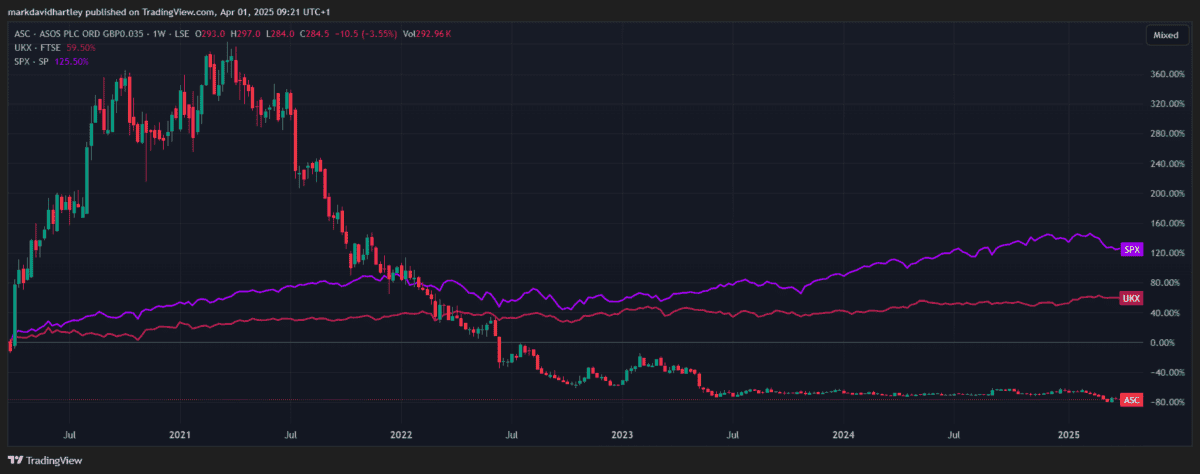
Sure, it lags slightly behind the famous S&P 500, but at 58.5%, it’s not bad.

Created on TradingView.com

Unfortunately, not every listing on the index has been doing so well. Some have fallen off it completely, as happened to online fashion retailer ASOS (LSE: ASC) in June 2023.

Now listed on the mid-cap FTSE 250 index, the stock is down 72% in the past five years. Despite an initial surge in popularity bolstered by a promising business model, the company has failed to stay relevant.

Now, it’s becoming increasingly likely that it may become a takeover target in the near future.

What does this mean for investors?

Fast fashion

Founded in 2000 as ‘AsSeenOnScreen,’ the company initially sold clothing and accessories inspired by Hollywood celebrities. It later rebranded to ASOS and doubled down on the fast fashion model as it worked to compete with then-mainly-store-based businesses like Zara-owner Inditex and H&M. It now sells to over 200 countries worldwide, with key markets being the UK, US and Australia. 

Using an online-only business model, the theory was that fast fashion retailers could rapidly produce and sell clothes at lower cost. But e-tail has high delivery costs and the huge volume of returns also weighs on profits.

And more recently, the model has been adopted by low-cost Chinese labels like Shein, presenting significant competition to ASOS. The model has also been heavily criticised for its environmental impact, leading to a rise in the popularity of resale sites.

What will happen to ASOS?

As takeover rumours swell, ASOS’s large single shareholder Anders Povlsen and his family have increased their shares in the company and Frasers Group has also increased its position.

Share prices typically surge following a successful takeover bid, so do they know something we don’t?

There’s also rumours the company could merge with German peer Zalando. And I’d be surprised if Primark owner Associated British Foods didn’t show interest in the coming months.

But ASOS isn’t alone. 

Debenhams owner Boohoo Group has also been tipped as a potential takeover target. Recently, it received pushback from its largest shareholder Frasers after changing its name to Debenhams. The fashion firm has also struggled to compete with low-cost rivals, with the shares down 85% in five years.

On the right track

Despite declining sales, ASOS seems to be turning things around. The price surged almost 30% in March after it posted positive first half results. Cost-cutting exercises combined with reduced discount activity led to a “significant improvement” in profitability.

The successful implementation of a ‘Test & React’ approach may be helping. This involves producing small batches of new designs and scaling up production based on customer response.

The boost helped it briefly bounce back above 300p — a price level it hasn’t traded under since 2009. Sadly, it didn’t last, with the stock currently trading around 285p.

After three years of being unprofitable, I’m not convinced this small win will be enough to save the company. 

If a takeover bid is successful, it might make some impressive short-term gains. But as an investor with a long-term mindset, I wouldn’t consider the stock right now.

Is it worth me buying more shares in this FTSE heavyweight after its big Capital Markets Day target updates?

FTSE 100 heavyweight Imperial Brands (LSE: IMB) is up 72% from its 11 April 12-month traded low of £16.77.

That said, this sort of price gain is no reason to avoid buying the stock, in my experience. It may be that the firm is simply worth more than it was before. Or it could be that the market is just playing catch-up with its true value.

In fact, there might be a lot more value in the stock than is reflected even in its higher price.

What could the stock’s fair value be?

The first part of my assessment of any stock price is looking at its key valuations compared to its peers.  

On the price-to-earnings ratio, Imperial Brands currently trades at just 8.6 — bottom of its competitor group, which averages 20.4.

These firms include Altria at 8.7, Japan Tobacco at 15.9, British American Tobacco at 22.9, and Philip Morris at 34.1.

So, Imperial Brands’ share price looks very undervalued on this measure.

It also looks a bargain on the price-to-sales ratio too, presently trading at only 1.2 compared to a peer average of 4.

To work out what all this means in share price terms, I ran a discounted cash flow analysis. This highlights that the stock is 59% undervalued at its current £28.79 price.

Therefore, the fair value of the shares is £70.22. A variety of market forces could move it lower or higher than that, of course. But the DCF underlines to me the scale of the stock’s under-pricing highlighted in its key valuations.

How do its growth prospects look?

Imperial Brands’ earnings increased by an average 10.4% annually over the past five years. This outpaced the tobacco and nicotine sector’s 7.5% average yearly growth over the period.

And it is earnings growth that drives a company’s price and dividend over the long term.

For the next five years, at its 26 March Capital Markets Day, it forecast yearly low-single-digit tobacco net revenue growth. Over the same period, it projected double-digit net revenue growth for its Next Generation Products, centred on nicotine substitutes.

A risk here is that the intense competition in this business reduces Imperial Brands’ earnings. However, the firm expects annual operating profit growth of 3%-5% and earnings per share growth in the high single digits.

It also forecast free cash flow of £2.2bn-£3bn per annum over the five-year period. Free cash flow can also act as a major driver of growth.

Ongoing boost to shareholder rewards

I think the firm’s earnings and free cash flow should enable its share price to gradually close the gap to its fair value.

This process should be further helped by Imperial Brands’ pledge to conduct big share buybacks every year to 2030. These are also broadly supportive of stock price gains.

The firm additionally promised to continue its progressive dividend policy. These will grow annually at a rate that accounts for underlying business performance.

Currently, the stock yields 5.6%. However, analysts forecast this will rise to 6% in 2025, 6.2% in 2026 and 6.4% in 2027.

Given this and the share price implications of the new performance benchmarks, I think it is worth my while buying more of the stock, which I will do shortly.

I asked ChatGPT for the best FTSE 100 stock to buy in April. It picked a dividend gem!

The £20,000 Stocks and Shares ISA contribution limit will reset on 6 April, and I’m eyeing up FTSE 100 shares to buy for my portfolio. While brainstorming ideas, I was curious to know what artificial intelligence (AI) thinks is the crème de la crème from the Footsie right now.

ChatGPT is the world’s most popular AI chatbot, but it’s prone to making mistakes. I’d never accept its stock market recommendations at face value. Nonetheless, there’s always some merit in a different investing perspective — even a robotic one!

Encouragingly, the FTSE 100 stock ChatGPT named looks like a solid choice for investors to consider buying from my perspective.

A passive income heavyweight

The dividend stock my AI buddy championed is the asset management, life insurance, and pensions giant Legal & General (LSE:LGEN). With a strong history of dividend growth, it’s a popular pick for many UK income-focused investors.

Legal & General shares currently offer the third-highest yield in the FTSE 100 index, at a mammoth 8.74%. Disappointingly, ChatGPT wrongly informed me that today’s yield was lower at just 6.7%. This figure’s actually the stock’s average yield over the past decade. As I said, it’s wise to exercise caution when consulting unreliable AI-generated information for investment ideas.

The company’s forward-looking guidance is promising. The board hopes to reward shareholders with over £5bn in the coming three years. This will be sourced from a £500m share buyback, £3.6bn in dividend payouts, and the sale of the firm’s US insurance business for £1.8bn.

Macroeconomic changes could aid Legal & General’s ambitions. The UK’s CPI inflation rate fell to 2.8% in February, fuelling hopes for further Bank of England interest rate cuts.

Looser monetary policy would make cash and bonds less attractive than high-yield FTSE 100 shares like Legal & General. It could also boost the group’s assets under management (AUM). That’s good news for the dividend as well as potential growth in the Legal & General share price.

Risk and reward

My AI companion showed awareness of the risks involved with investing in Legal & General shares. One potential challenge it cited was “pension reform“.

Following a spring statement concentrated on welfare cuts, the Institute for Fiscal Studies (IFS) believes there’s a good chance wealthy pensioners could be Chancellor Rachel Reeves’ next target in the autumn budget. Changing pension tax relief rules might be a tempting source of fiscal savings.

This could be damaging for the Legal & General share price since it may hurt demand for the company’s retirement products. It’s worth monitoring Treasury rumours on this topic. Even mere speculation can have real-world consequences regarding how individuals plan for their financial futures.

Nevertheless, I think the potential rewards offered by the stock are sufficiently attractive despite these risks. A forward price-to-earnings (P/E) ratio slightly above 10 means the shares offer good value today, in my view. Furthermore, a 6% rise in FY24 operating profit to £1.62bn indicates the group’s maintaining a strong growth trajectory.

Overall, I think ChatGPT’s FTSE 100 selection is a solid one. But, I’m reminded of a phrase my maths teachers often told me at school: “show your working!

Given the AI chatbot’s habit of producing false data, it has a long way to go in providing credible stock market analysis.

Down 33%! Is this S&P 500 growth stock worth considering?

Palantir (NASDAQ:PLTR) continues to be a standout performer in the S&P 500 in 2025. So far, its shares are up 12% this year. That’s on the back of a 340% rise in 2024.

Great enthusiasm for artificial intelligence (AI), in which the firm has been one of the leaders, has led this charge.

Its shares peaked in the middle of February at $124.62. However, because of valuation fears, combined with broader uncertainty due to Trump’s tariffs, Palantir has seen its stock drop by 33%.

For a company that’s been on a blast over the last couple of years and seen its shares move steadily upward, a dip this large is notable.

Therefore, it may be a chance for investors to consider buying some of its shares. On the flip side, it could also be a sign that the bubble has started to burst.

Why has Palantir stock fallen?

The primary issue investors have with Palantir is its valuation. To add perspective, even after its shares declined, the company still has a market cap of $201bn. Its revenue and net income in 2024 were only $2.9bn and $462m, respectively.

This gives it a price-to-sales (P/S) ratio of 73. Pricey for sure. I own shares in the company, and even I’ll admit its price-to-earnings (P/E) ratio of 452 is simply ridiculous.

For context, the AI firm is more valuable than American Express, which has a market cap of $186bn on the back of sales and net income of $61bn and $10bn, respectively.

Yes, Palantir’s growth and business are far more exciting than those of American Express, but it’s still unjustified.

With caution surrounding the valuation of US stocks and the emergence of a global trade war, this could be the start of the AI firm seeing a more sustained decline in its share price over the near term.

Huge potential

On the other hand, investors weren’t driving up the company’s stock earlier for no reason.

In its most recent quarter, Palantir saw its revenue jump by 36%. Moreover, while its revenue was only $2.9bn last year, Wall Street anticipates further growth of 32% in 2025 and 27% in 2026. This is pretty impressive.

So why has this happened? Well, its Artificial Intelligence Platform (AIP) has been a big hit among its commercial clients. This product allows the integration of AI models directly into the user’s platform. As a result, US commercial revenue skyrocketed 64% year on year (yoy) to $214m in its fourth-quarter results for 2024.

Furthermore, the big data analytics specialist is becoming increasingly important for the US military ecosystem. Revenue in this segment climbed by 45% to $343m yoy in the last quarter.

Final thoughts

I started buying Palantir shares at the start of 2022. I did so because I liked the company’s fundamentals and saw great potential for it. However, back then it was only a $27bn company.

Today, I’m even more enthusiastic about the company’s potential. Its AI products are superior to the competition’s and it’s providing game-changing applications for businesses. This might only be the start for the AI powerhouse.

But it has an astronomical valuation even when taking into account the recent pullback.

However, I also think the company has the potential to achieve astronomical success in the long term. Therefore, investors should consider its shares.

The Diageo share price has fallen so far the stock now offers a 4% dividend yield

The Diageo (LSE: DGE) share price has plummeted over the last three years and as a result the stock now sports a dividend yield of around 4%. That’s about twice the yield it was offering three years ago (and the highest I can remember from the stock).

I’ve owned Diageo shares for many years now and always viewed it as a core long-term holding. Should I snap up a few more shares in the alcoholic beverages company to pick up this yield?

Facing multiple challenges

When I look at Diageo today, I see a company facing quite a few challenges. Issues include:

  • Lower demand for the company’s beverages – right now there are multiple factors leading to lower demand for the company’s products including a global consumer slowdown, GLP-1 weight-loss drugs, and the consumption habits of Gen Z (who are drinking less).
  • Donald Trump’s tariffs – these could lead to a $200m hit to operating profits in H2 according to analysts.
  • A large debt pile – as of 31 December, net debt-to-earnings before interest, tax, depreciation, and amortisation (EBITDA) was 3.1 times.
  • A management team in which investors have lost confidence.

Plenty to like

The thing is, I also see a lot to like here including:

  • World class brands such as Johnnie Walker, Tanqueray, and Guinness, many of which are poised to benefit from the ‘premiumisation’ trend (drinking less but focusing on better quality).
  • Plenty of exposure to tequila – the fastest-growing spirit worldwide.
  • Emerging markets exposure – this could be a major driver of growth over the long run.
  • A high return on capital (ROCE) – Diageo remains a very profitable company.

So, it’s not like the company is a complete basket case. In the long run, it still has plenty of potential.

The valuation

As for the valuation, it looks pretty attractive, in my view.

Currently, the consensus earnings per share forecast for the year ending 30 June 2025 is $1.62. That puts the forward-looking price-to-earnings (P/E) ratio at just 16.

That’s a low valuation for a company of Diageo’s quality. That said, there is some uncertainty over near-term earnings due to tariffs, so this P/E ratio may not be accurate.

The dividend

Zooming in on the dividend payout, it looks quite secure to me.

This financial year, dividend coverage (the ratio of earnings per share to dividends per share) is expected to be about 1.6. That’s a solid number.

Meanwhile, this is a company that delivered more than 20 consecutive annual dividend increases. Management isn’t going to want to end that brilliant track record.

My move now

With the stock trading near 2,000p – roughly 50% below its all-time highs – I think it’s worth considering and I’m seriously tempted to buy a few more shares for my portfolio. I’m not 100% decided yet (there are some other stocks I’m looking at) but I may press The Buy button on it in the next few weeks.

I’m not expecting the stock to rebound in the months ahead. But taking a five-year view, I think there’s potential for solid gains, especially when the 4% dividend yield is taken into account.

GSK’s share price looks a steal to me anywhere below £43.29, and here’s why

GSK’s (LSE: GSK) share price is down 19% from its 15 May one-year traded high of £18.19.

This could flag that a business is fundamentally worth less than it was before. Or it could highlight a bargain-basement buying opportunity to be had.

I think it is the latter in this case for three key reasons.

Strong earnings growth

It is ultimately earnings growth that determines the trajectory of a firm’s stock price (and dividend) in the future.

In GSK’s case, analysts forecast that its earnings will increase an extremely robust 18.3% a year to end-2027.

Its 2024 results certainly showed a strong foundation for such growth, in my view. Sales jumped 7% year on year to £31.376bn, while operating profit leapt 11% to £9.148bn. Earnings per share increased 10% to 159.3p.

The pharmaceutical giant also lifted its 2031 sales target to £40bn+ from £38bn+.

Extreme share price undervaluation

GSK’s 1.9 price-to-sales ratio looks extremely cheap against the 4.9 average of its competitors. These comprise Merck KGaA at 2.6, AstraZeneca at 4.2, CSL at 5.1, and Zoetis at 7.9.

The same is true of its 23.4 price-to-earnings compared to its peer group’s 27.3 average.

And it also looks a steal on the price-to-book ratio. Here it trades at 4.4 against the 6.7 average of its competitors.

I ran a discounted cash flow analysis to ascertain where it should be priced based on future cash flow forecasts. This shows GSK shares are a stunning 66% undervalued at their present £14.72.

So the fair value for the stock is technically £43.29, although share prices are unpredictable and it may never reach that level.

New product approvals

A risk to GSK is legal action arising from the alleged ill effects of one of its products.

Lawsuits against its Zantac drug have hung over the firm’s share price for some time now. However, it was agreed last October to pay $2.2bn to resolve 93% of the relevant cases in the US.

That said, 2024 saw a 98% year-on-year rise in sales of its oncology products. Specialty medicines sales jumped 19% and those of respiratory/immunology products increased 98%.

Positive as well were new approvals for several GSK drugs. In March alone, the US Food and Drug Administration approved Blujepa for the treatment of uncomplicated urinary tract infections.

And the European Medicines Agency approved the Nucala asthma drug for use in the treatment of chronic obstructive pulmonary disease.

Will I buy more of the stock?

I already have a sizeable holding in GSK based around its strong earnings growth potential. This will drive its share price – and dividend yield (currently 4.1%) – much higher over time, I think.

I also believe it is positioned in a sector that will only grow as the world’s population lives longer.

Some 1.4bn people will be aged 60+ by 2030 compared to 1bn now, according to figures from the World Health Organization. That will increase to 2.1bn by 2050, and by then the number of people aged 80+ will have trebled to 426m.

As older age brings declining health, the demand for medical assistance, including drugs, increases.

I, for one, fully intend to use every possible (legal) drug I can to keep going. So I might as well benefit financially along the way as well.

Consequently, I will buy more GSK shares very soon.

6.5% yield! Is this FTSE 100 stock my ticket to a growing second income?

Most of the time, when a stock has a 6.5% yield, there’s something I don’t like about it. But I think income investors should give LondonMetric Property (LSE:LMP) a second look.

It’s a FTSE 100 real estate investment trust (REIT) that owns a mixture of warehouses and long income retail properties. And unlike most REITs, it has some interesting growth prospects.

Please note that tax treatment depends on the individual circumstances of each client and may be subject to change in future. The content in this article is provided for information purposes only. It is not intended to be, neither does it constitute, any form of tax advice.

Industrial distribution

Right now, just under half of LondonMetric Property’s portfolio is in industrial distribution. And over the last few years, that has been the place to be when it comes to real estate.

The growth of e-commerce has increased demand for warehouses. But it has also given rise to a surge in building, with the amount of available space in the UK increasing significantly.

In this situation two things are important. One is having long-lasting contracts and with its average lease having 17 years left until its first break, LondonMetric fares well on this front.

The other is having a portfolio that consists of quality properties in desirable locations. And some of the company’s recent deals have been focused on this. 

Acquisitions

LondonMetric has been making moves to shift its portfolio towards warehouses. And the most recent is its deal to acquire Highcroft Properties – another UK REIT.  I think this deal looks interesting. The plan is to retain the parts of the portfolio that consist of industrial warehouses (52%) and retail warehouses (27%) and divest the remainder.

The implied price for the company is £44m and Highcroft has around £23m in net debt. And its rental income is around £5.79m a year, which suggests a yield of around 8.5%.

LondonMetric is using stock to finance the deal, which will cause the share count to rise. But its own stock has a 6.5% dividend yield, so the transaction should add value for shareholders. 

Risks

REITs have to distribute 90% of their rental income as dividends. Given this, I’m impressed at how LondonMetric has managed to grow its portfolio in ways that add value for shareholders.

There are however, some important risks. A large amount of the firm’s rental income comes from two companies – Ramsay Health Care and Merlin Attractions. Continued expansion through acquisitions should help reduce this to some extent, but I don’t see it going away entirely. And this is something shareholders should take note of.

I think the best way to manage a risk like this though, is to try and buy the stock when there’s a margin of safety in the share price. And with a 6.5% yield, this might be the case right now.

Income opportunities

LondonMetric’s been looking to increase its exposure to a promising part of the real estate sector. Importantly, it’s done this in a way that adds value for shareholders. 

As I see it, growth is likely to be steady, rather than spectacular. But a 6.5% dividend yield might mean that the company doesn’t have to do much to be a very good investment. 

Several UK REITs – specifically Assura, Care REIT, and Warehouse REIT – have been takeover targets recently. So I’m considering buying shares in this one while there’s still an opportunity.

At a P/E ratio of 7, are shares in this UK retailer unbelievable value?

A bit like the stuff it sells, shares in Card Factory (LSE:CARD) look cheap. But when it comes to stocks, there’s a difference between being cheap and being good value. 

The share price is down 14% since the start of the year, but there are reasons to be positive about the underlying business. And a 6.7% dividend yield’s also pretty attractive.

The bull case

I think there are a lot of reasons to like Card Factory as an investment. The first is its vertical integration, which gives it a cost advantage over retailers who buy in cards from external suppliers. This allows the firm to charge lower prices than its rivals. And that’s important in an industry where people generally care more about how much they pay than where they get them from.

Another strength is an improving balance sheet. Since 2020, the company’s long-term debt has fallen from £140m to £38m, putting it in a much stronger financial position. The advantage of this isn’t just that it makes the business more resilient. Over time, less debt should mean lower interest payments and higher profits. 

The third reason for optimism is Card Factory’s partnership with Aldi. I think a position in a leading supermarket looks like a much better distribution strategy than running its own shops.

Despite the falling share price, there are plenty of reasons to be positive about the business. But it’s unusual for a stock to drop for no reason and there are also causes for concern.

The bear case

I think the biggest issue with Card Factory is inflation. The company’s focus on customer value makes it tough to pass through the effects of higher costs to customers.

The government’s recent Spring Statement reported expectations of rising inflation in the near future. And there are also increased staff costs to try and factor in. 

Margins have already been going the wrong way over the last 10 years, so it will be interesting to see how Card Factory copes. But this isn’t the only issue the company’s facing at the moment. 

Like-for-like (LFL) sales growth has also been slowing. The firm’s January update reported LFL growth of 3.9%, which is a significant drop from the 8.2% reported in the previous year

To some extent, this is in line with a broader trend among UK retailers. The likes of Associated British Foods (Primark), Greggs and JD Sports have also reported lower LFL sales growth recently.

This goes some way towards confirming my sense that running its own stores is a tough way for Card Factory to go. And that makes me very hesitant when it comes to the stock.

An investment thesis

Another high street retailer – WH Smith – has announced plans to divest its high street stores to focus on its more profitable travel outlets. I’d like to see Card Factory do something similar.

The company’s position as a supplier to Aldi looks very interesting to me. My view is that the stock could be attractive if the firm focused on this, rather than operating from its own venues.

From what I can see though, Card Factory has absolutely no intention of doing this. And since I don’t have the power to make it happen, I’m staying away from the stock.

Financial News

Daily News on Investing, Personal Finance, Markets, and more!

Financial News

Policy(Required)