Activist Irenic takes a stake in Atkore, urges company to consider a sale

Thomas Fuller | SOPA Images | Lightrocket | Getty Images

Company: Atkore (ATKR)

Business: Atkore is a manufacturer of electrical products for construction and renovation markets, and safety and infrastructure products for the construction and industrial markets. The company’s segments include electrical and safety & infrastructure. The electrical segment manufactures products used in the construction of electrical power systems including conduit, cable and installation accessories. This segment serves contractors in partnership with the electrical wholesale channel. The safety & infrastructure segment designs and manufactures solutions including metal framing, mechanical pipe, perimeter security and cable management for the protection and reliability of critical infrastructure. These solutions are marketed to contractors, OEMs, and end-users. It manufactures products in 42 facilities and operates a total footprint of over 8.5 million square feet of manufacturing and distribution space in eight countries.

Stock Market Value: $2.09 billion ($61.97 per share)

Activist: Irenic Capital Management

Ownership: 2.5%

Average Cost: n/a

Activist Commentary: Irenic Capital was founded in October 2021 by Adam Katz, a former portfolio manager at Elliott Investment Management, and Andy Dodge, a former investment partner at Indaba Capital Management. Irenic invests in public companies and works collaboratively with firm leadership. Their activism has thus far focused on strategic activism, recommending spinoffs and sales of businesses.

What’s happening

On Sept. 30, Irenic announced that they have taken a 2.5% position in Atkore and are urging the company to pursue a potential sales process.

Behind the scenes

Atkore is a manufacturer of electrical products for construction and renovation markets, and safety and infrastructure products for the construction and industrial markets. Its electrical segment produces conduit, cable, and installation accessories for electrical power systems. The safety & infrastructure segment manufactures solutions including metal framing, mechanical pipe, perimeter security, and cable management systems. For years Atkore operated as part of a stable oligopoly — Hubbell, Eaton and nVent being among the other major domestic players.

The pandemic catalyzed a surge in construction and, in turn, the demand for Atkore’s electrical products that are essential in the wiring processes. As a result, the company got aggressive in pricing and, from fiscal year 2019 to 2022, revenue grew from $1.9 billion to $3.9 billion, and EBITDA grew alongside from $300 million to $1.3 billion. However, as we have seen with many companies, demand ultimately normalized after Covid and revenue stopped growing. To make matters worse, Atkore’s aggressive pricing strategy backfired, as it invited import competition into a market that had long been protected by high freight costs and distributor preference for local supply. By raising prices too sharply, they effectively undermined their own market position. As a result, revenue has declined to $2.9 billion and EBITDA to $462 million.

Moreover, despite a $1 billion decrease in revenue, SG&A has increased, and the company’s headcount has risen over 40%. On top of this is a misallocation of capital. Instead of using Covid-era windfalls to invest into the core electric business, management has pursued non-core ventures such as water infrastructure and fiber conduit for rural broadband, many of which projects never materialized. Now, a company that once traded at the top of the market around $190 per share in early 2024, has fallen all the way down to around $60 per share; and amid this underperformance, in late August, CEO Bill Waltz unexpectedly announced his retirement without a successor in place.

This has all prompted Irenic Capital Management to announce a 2.5% position in Atkore. With no CEO, operational and capital challenges, and a poor market perception, Atkore is now at a critical inflection point where the board will have the biggest decision it will ever make that will determine the outcome for shareholders.

The most important thing a board does is identify and retain a CEO and Atkore is now at that point. However, when a company faces similar issues to Atkore and is on the precipice of a serious restructuring, the board needs to make one more decision before hiring a new CEO – whether the company should remain independent or not. We would expect that Irenic would want one or two new directors identified by them on the board to take part in this analysis and decision, likely independent directors with relevant experience.

Atkore currently trades at approximately 6.5x EBITDA but offers clear cost cutting and divesture opportunities that private equity may be able to more effectively execute. Thus, it is fair to assume a takeout at multiple turns above the company’s current valuation, potentially 8 to 10 times EBITDA. If a review of strategic alternatives concludes that an acquisition would happen in that range, then the board would need to use that as the benchmark against a standalone plan.

The first step in a standalone plan would be identifying the right CEO who would be tasked with realigning the company’s operational and capital focus with its core electrical business, divesting non-core assets, cutting costs, and implementing pricing discipline. As Rocco says to Michael Corleone, this would be difficult, but not impossible. There is definitely at least $100 million of costs that could be cut from SG&A and the headwinds that caused the decline in revenue have now reversed, with pricing low enough to once again discourage importers even before the issuance of tariffs, which is a tailwind for Atkore.

But it is worth repeating that none of this is possible without the right CEO and it is important to have the best possible board to make that decision, and this board has given shareholders the right to be worried. Currently, both the company’s chairman and former CEO come from water industry backgrounds, likely contributing to the strategic shift away from the company’s core.

Moreover, Atkore recently announced a strategic review focused on non-core asset sales, including its water conduit business. While this might be the right decision, launching a strategic review without a permanent CEO seems rushed and poorly timed, and conducting such a review at this time without weighing the possibility of a full sale is even more perplexing. A refreshed board with directors who bring in relevant electrical industry expertise that can guide the CEO succession process, and the sale analysis would be an essential first step.

Irenic has significant experience in strategic activism, identifying companies that are struggling in the public markets and helping implement spinoffs and sales of businesses. The nomination window for directors opened on Oct. 2 and we do not think it is a coincidence that Irenic went public with their campaign the day prior to the nomination window opening. We expect that they will be talking to the company about board composition. Ideally, shareholders would benefit most with the addition of a couple of new independent directors with relevant experience and having Irenic as an active shareholder to support the board in its analysis.

Ken Squire is the founder and president of 13D Monitor, an institutional research service on shareholder activism, and the founder and portfolio manager of the 13D Activist Fund, a mutual fund that invests in a portfolio of activist investments.

Mike Novogratz’s Galaxy Digital jumps after launching retail trading app to rival Robinhood

Sopa Images | Lightrocket | Getty Images

Galaxy Digital shares jumped 7% Monday after the digital assets investment firm led by CEO Mike Novogratz unveiled a Robinhood-like trading platform, called GalaxyOne.

The platform, which launched Monday, hosts commission-free buying and selling of more than 2,000 stocks and exchange-traded funds, in addition to trading of cryptocurrencies such as bitcoin and ether, Galaxy Digital said in a statement.

GalaxyOne also offers several yield-bearing accounts, including a 4% annual percentage yield on cash deposits and an 8% yield investment note for accredited investors who put up a minimum of $25,000, the company said.

Galaxy shares have more than doubled this year as federal regulators have softened their oversight of digital assets.

The trading platform’s launch comes as cryptocurrencies and their underlying blockchains appear poised to disrupt the traditional financial system, Novogratz said Monday on CNBC’s “Squawk Box.”

“You’re going to see stablecoins take money out of bank deposits … then, you’re going to see credit be replaced,” Novogratz said. “In time, that will happen.”

In that ever-changing environment, GalaxyOne aims to serve as a one-stop shop for retail investors looking to trade a wider range of traditional and digital assets than those available through existing brokerages, he added.

“You got a bank account, and you gotta shift that money somewhere else to buy stocks. You got a brokerage account, [but] to buy crypto, you gotta go somewhere else,” Novogratz said. “We think all of that’s gonna aggregate in one place.”

Cantor Fitzgerald said Monday in a note to clients that Galaxy’s foray into retail-focused services reflects its desire to compete against one-stop financial services applications, including Robinhood and eToro.

“GLXY, which has historically only served institutional clients, is expanding its reach for the first time,” Cantor analyst Brett Knoblauch said in the note. “This product, in our mind, will look to compete with HOOD (OW) and ETOR (OW).”

The firm has a buy rating on Galaxy’s stock, and it has set a $45 price target on shares. That implies upside of 24% from Friday’s close.

Asked whether Galaxy’s trading platform plans to target Robinhood and its rivals’ users, GalaxyOne managing director Zac Prince said Monday in an interview with CNBC: “We’re not thinking of the app as something that is trying to take Robin Hood head on today. We are actually aiming to target a very specific type of customer profile currently, which is the affluent accredited investor … in the U.S.”

Nevertheless, Prince acknowledged that GalaxyOne is entering a crowded market. “In a sense, we are competing with everyone who has a consumer-facing financial app, whether it’s [decentralized or centralized] finance or traditional FinTech, and we’re competing for mindshare and attention.”

A growing number of traders have flocked to crypto in recent months, largely due to a broader bull run that has propelled several digital assets’ prices to record highs this year.

Bitcoin rallied to a new all-time-high price of roughly $125,800 on Monday, shortly after surpassing the $125,000 mark for the first time last weekend.

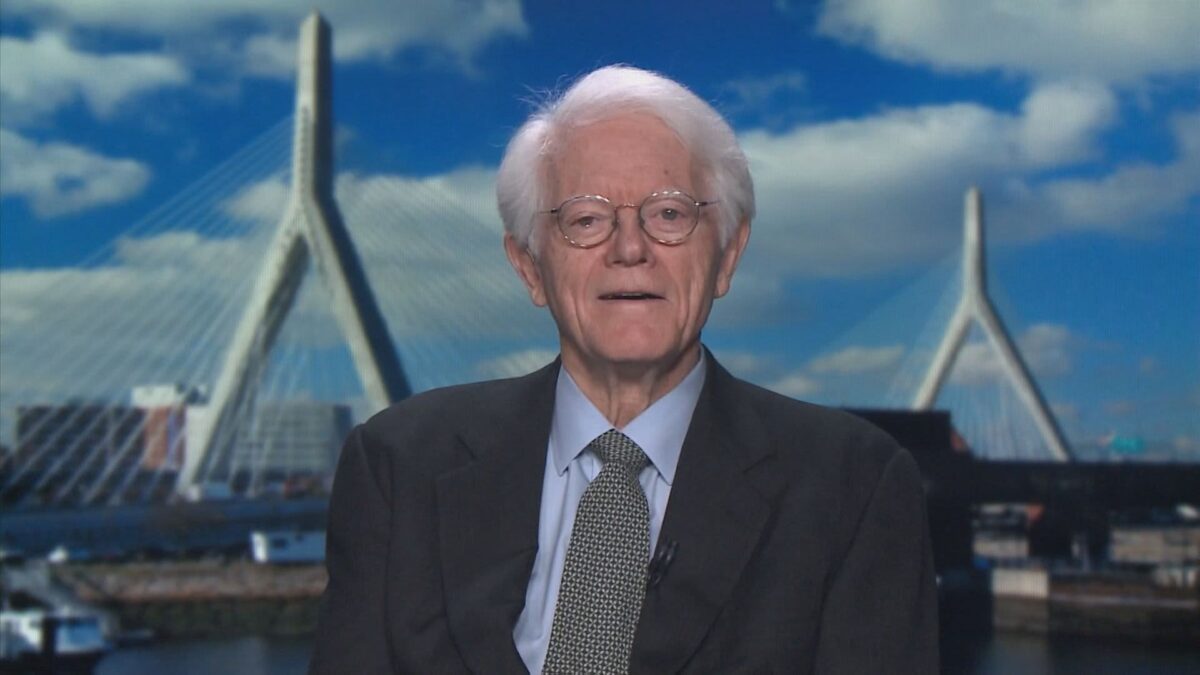
Peter Lynch on why he isn’t in the AI trade: ‘I literally couldn’t pronounce Nvidia until about 8 months ago’

  • Legendary investor Peter Lynch joined “The Compound and Friends” podcast to discuss artificial intelligence, his biggest investing lessons and the benefits of investing today.
  • Lynch averaged a 29.2% return in his 13 years managing the Magellan Fund at Fidelity from 1977 until 1990
Peter Lynch, Fidelity Funds Advisory Board Member.

Legendary investor Peter Lynch built a reputation for routinely beating the market while overseeing Fidelity Magellan Fund in the 1980s. Decades later, he has some advice for the next generation of investors.

The artificial intelligence boom has dominated the market for the past three years, but Lynch, who averaged a 29.2% annual return in his 13 years at the helm of Magellan until 1990, has been happy to watch from the sidelines.

“I have zero AI stocks,” Lynch said on “The Compound and Friends” podcast with investor Josh Brown . “I literally couldn’t pronounce Nvidia until about eight months ago.”

Lynch, who famously claimed that at one time 1 out of every 100 Americans had a stake in Fidelity Magellan, on the podcast addressed his career, the lessons he’s learned along the way and, yes, today’s craze for everything tied to artificial intelligence. Here are five of the biggest takeaways:

Sitting out AI

Megacap tech stocks have skyrocketed since the introduction of ChatGPT in late 2022, leading many on Wall Street to question if the AI trade is reminiscent of the dot-com bubble in the late 1990s. Asked if investors have chased the AI trade too far, Lynch said he had “no idea.”

Lynch said he doesn’t understand technology enough to have an informed opinion on the market’s optimism toward AI.

“I’m the lowest tech guy ever,” he said. “I can’t do anything with computers. I just have yellow pads.”

Lynch declined to discuss his current portfolio or the stocks he likes at the moment, citing rules from Fidelity.

Why you don’t ‘play the market’

Lynch has long advocated that investors have a deep understanding of the companies they invest in. It’s a core tenet of his book “One Up on Wall Street.”

“I have this expression: ‘Know what you own,”’ Lynch said. “If you don’t understand what you own, you’re toast.”

Lynch said people will spend hours researching flights to ensure they get the best price. But when it comes to investing, he said “they’ll put $10,000 in some crazy stock they heard on the bus.”

He described the phrase “play the market” as “awful” and “dangerous.” Instead, Lynch said people should buy good companies and have an awareness of what they do.

Lynch said that the average variation in a typical New York Stock Exchange security in any given year is 100%, so investors need to know what to do when big moves happen.

Entering after the first inning

While the conventional wisdom is to buy stocks before they take off, Lynch cautioned against scorning all investment ideas just because a security has already rallied.

“Sometimes, you don’t have to be in the first inning,” Lynch said.

As an example, Lynch pointed to McDonald’s, which he was told long ago had already seen rapid domestic growth. The hamburger chain went on to see strong growth when it expanded internationally.

“People said ‘McDonald’s is done,'” Lynch said. “They just simply didn’t think it through.”

Investment advantages today

Today’s investors have “cushions” that didn’t exist before the Great Depression and the New Deal, according to Lynch.

Lynch named unemployment insurance, Social Security benefits and the creation of the Securities and Exchange Commission helping everyday people over time. He also highlighted the active role of the Federal Reserve in recent decades.

Investors today benefit from “so many things that are better,” Lynch said, noting more market and economic “buffers” than existed in the past.

Lynch said investors have frequently braced for an economic collapse on the order of the 1930s. But none of the market tests since then, even the Global Financial Crisis in 2008-2009, have had the same downward intensity.

“We had many opportunities to have a ‘big one,'” Lynch said. “We’ve had some probably bad presidents, some bad congresses, we’ve had bad economists, and we’ve made it through.”

Future of work

Lynch reassured workers who wonder if they will lose their jobs to AI.

In the early 1980s,about one million people worked for AT&T alone at a time when the entire labor force stood at about 100 million. Even as the telecom sector has grown, Lynch said the leading companies today employ about 400,000 workers.

Today, the U.S. workforce itself has swelled past 160 million jobs. Americans can probably count on expansion in some sectors to help offset elimination tied to technological advances or automation in others.

Lynch’s comments come as executives at companies ranging from Walmart to Accenture have warned that artificial intelligence will drastically reshape their workforces.

“It’s a great country. We’re creative,” Lynch said. “America creates, China duplicates, and Europe legislates.”

(Follow Josh Brown’s take on the best stocks in the market right now, including his investment outlook and where he sees opportunities next.)

(Learn the best 2026 strategies from inside the NYSE with Josh Brown and others at CNBC PRO Live. Tickets and info here.)

Top Wall Street analysts recommend these 3 dividend stocks for stable returns

In this photo illustration, the Brookfield Infrastructure Partners company logo is seen displayed on a smartphone screen.
Piotr Swat | Lightrocket | Getty Images

Fears about the impact of a government shutdown, a slowing labor market, and elevated stock valuations are weighing on investor sentiment. Given the ongoing uncertainty, investors looking for stable returns can consider adding dividend stocks to their portfolios.

Top Wall Street analysts’ recommendations can help investors pick stocks of dividend-paying companies that have strong fundamentals to support consistent dividend payments.  

Here are three dividend-paying stocks, highlighted by Wall Street’s top pros as tracked by TipRanks, a platform that ranks analysts based on their past performance.

Brookfield Infrastructure Partners

First on this week’s dividend list is Brookfield Infrastructure Partners (BIP), a global infrastructure company that owns and operates diversified, long-life assets in the utilities, transport, midstream, and data sectors. BIP paid a dividend of 43 cents per unit on Sept. 29, reflecting a 6% year-over-year increase. At an annualized dividend of $1.72 per unit, BIP stock offers a dividend yield of 5.2%.

Following the recently held Investor Day event, BMO Capital analyst Devin Dodge reiterated a buy rating on Brookfield Infrastructure stock with a price forecast of $42. The 5-star analyst stated that the presentations by management at the event reflected the robust underlying organic growth trends across BIP’s portfolio, which he expects to become more evident in the upcoming quarters.

Dodge highlighted that the number of high-growth platforms in BIP’s portfolio continues to increase, and there are significant investment opportunities across most of its sectors. In particular, he mentioned the robust digital infrastructure investment opportunity. With hyperscalers’ capital spending estimated to increase by 50% this year, there is a strong growth potential for BIP’s data center platforms over the intermediate term.

The analyst pointed out that BIP’s funds from operations per unit (FFO/unit) growth is nearing an inflection point. He noted that over the past five years, BIP’s FFO/unit has increased at a compound annual growth rate of about 10% despite foreign exchange headwinds and high interest rates. However, Dodge expects these challenges to ease in the near term, which could drive visible FFO growth.  

“As FFO/unit growth shifts higher, we believe there are positive implications for distribution growth and valuation,” said Dodge. Interestingly, TipRanks’ AI Analyst has a “neutral” rating on BIP stock with a price target of $33.

Dodge ranks No. 377 among more than 10,000 analysts tracked by TipRanks. His ratings have been successful 73% of the time, delivering an average return of 13.2%. See Brookfield Infrastructure Statistics on TipRanks.

Ares Capital

We move to Ares Capital (ARCC), a specialty finance company that provides direct loans and other investments to private middle-market companies. Ares pays a quarterly dividend of 48 cents per share. At an annualized dividend of $1.92 per share, ARCC stock offers a yield of 9.4%.

In an update on business development companies, RBC Capital analyst Kenneth Lee reiterated a buy rating on Ares Capital stock with a price target of $24. Interestingly, TipRanks’ AI Analyst has an “outperform” rating on ARCC stock with a price target of $25.

In the current scenario, Lee prefers ARCC, Blackstone Secured Lending Fund (BXSL), and Sixth Street Specialty Lending (TSLX) stocks. “ARCC has a long track record of successfully managing risks through cycles,” noted Lee.

The 5-star analyst specified that ARCC is a market-leading BDC with scale. He believes that the company’s access to the Ares global credit platform is one of its major competitive advantages. Lee is confident about Ares Capital’s potential to generate above peer-average return on equity.

Lee views Ares Capital’s experienced senior management team as one of its key strengths. He also pointed out that ARCC’s dividends are backed by the company’s core earnings per share generation and potential net realized gains.

Lee ranks No. 59 among more than 10,000 analysts tracked by TipRanks. His ratings have been profitable 72% of the time, delivering an average return of 16.7%. See Ares Capital Ownership Structure on TipRanks.

ONE Gas

Finally, let’s look at ONE Gas (OGS), a 100% regulated natural gas utility that provides affordable energy to over 2.3 million customers in Kansas, Oklahoma, and Texas. At a quarterly dividend of 67 cents per share (annualized dividend of $2.68 per share), OGS stock offers a dividend yield of 3.3%.

Recently, Mizuho analyst Gabe Moreen upgraded OGS stock to buy from hold and increased his price forecast to $86 from $77, citing several reasons, such as the benefits from the Texas HB 4384 legislation (enables recovery of certain costs associated with a gas utility’s plant, facilities, or equipment placed in service) and lower interest rates. Meanwhile, TipRanks’ AI Analyst has a “neutral” rating on OGS stock with a price target of $81.

Moreen sees the possibility of HB 4384 generating a full-year benefit of about 18 cents in incremental EPS in fiscal 2026. He added that this benefit is not one-time in nature, and will grow with ONE Gas’ yearly Texas capital spending. It is worth noting that Texas constitutes about 32% of OGS’ rate base. “We believe this will place a floor under OGS’ growth outlook at the higher-end of its 4-6%,” said Moreen.

The top-rated analyst noted that elevated short-term interest rates were one of the reasons that forced OGS to revise its guidance in 2023 and 2024. He expects the Federal Reserve’s interest rate cuts to benefit the company, as they will ease relative interest expense from prior periods.

Additionally, Moreen highlighted notable growth opportunities for OGS, thanks to the growing natural gas demand from data centers and advanced manufacturers. He believes that all these catalysts, along with a growing customer base and a solid balance sheet, make OGS stock an attractive pick at the current valuation. In fact, Moreen expects OGS to rebound to its historical premium valuation levels, at which the stock traded before the company restated its guidance in 2023 and 2024.

Moreen ranks No. 142 among more than 10,000 analysts tracked by TipRanks. His ratings have been successful 75% of the time, delivering an average return of 13.3%. See ONE Gas Technical Analysis on TipRanks.

Activist Irenic builds a stake in Workiva, hoping to gain a voice on the software company’s board

Thomas Fuller | SOPA Images | Lightrocket | Getty Images

Company: Workiva (WK)

Business: Workiva is a provider of cloud-based reporting solutions that are designed to solve financial and non-financial business challenges at the intersection of data, process and people. The company offers its unified software-as-a-service, or SaaS, platform that brings customers’ financial reporting; environmental, social and governance (ESG); and governance, risk and compliance (GRC) together in a controlled, secure, audit-ready platform. The Workiva platform is multi-tenant cloud software deployed in multiple regions worldwide for assured integrated reporting. The company’s platform is built primarily on Amazon Web Services and is composed of both proprietary and open-source technologies. Its Workiva platform helps customers by connecting and transforming data from hundreds of enterprise resource planning, human capital management, and customer relationship management systems, as well as other third-party cloud and on-premises applications.

Stock Market Value: $4.92 billion ($87.46 per share)

Activist: Irenic Capital Management

Ownership: ~2.0%

Average Cost: n/a

Activist Commentary: Irenic Capital was founded in October 2021 by Adam Katz, a former portfolio manager at Elliott Investment Management, and Andy Dodge, a former investment partner at Indaba Capital Management. Irenic invests in public companies and works collaboratively with firm leadership. Their activism has thus far focused on strategic activism, recommending spinoffs and sales of businesses.

What’s happening

On Sept. 29, Irenic announced that they have taken a roughly 2% position in Workiva and are calling on the company to improve its operating efficiency, review strategic alternatives with fresh board oversight, including a potential sale of the company, and improve corporate governance practices, including collapsing its dual-class share structure. Irenic also called on the company to add two new board members, including Irenic executive Krishna Korupolu, to the board, and noted that they have not ruled out nominating directors if the two sides can’t reach an agreement.

Behind the scenes

Workiva is the leading provider of cloud-based reporting solutions, integrating financial reporting, sustainability management, and governance, risk, and compliance, into a sharable, data-integrated, and audit-ready environment. Over 40% of the company’s revenue is derived from its SEC filing service, which simplifies regulatory filings and other disclosures for public companies. This is a great business that serves some of the world’s largest enterprises, with 95% of the Fortune 100, 89% of the Fortune 500 and 85% of the Fortune 1000 using its platform, supported by an approximately 97% customer retention rate that has enabled consistent mid-teens revenue growth.

But the problem for Workiva lies not in the quality of its business, but rather its lack of profitability. Despite scaling toward more than $1 billion in revenue by 2026 and over 10 years operating in the public markets, Workiva is yet to generate a profit. As a result, Workiva shares currently trade at a roughly 25% discount to application software rivals like Workday and ServiceNow.

This discount and operational challenges have drawn the attention of Irenic Capital, who has disclosed an approximately 2% position in the company and issued a presentation to the Workiva board calling for governance enhancements, operational changes and a review of strategic alternatives.

Governance is a real issue at Workiva and an obvious reason for the discounted stock price. Workiva is still run like a private company with its three founders controlling the company through the dual share class structure. This has led to a staggered board with little relevant experience and five of seven directors serving since the 2014 IPO.

Irenic would like to see the dual class share structure collapsed and the board de-staggered and reconstituted with qualified directors including Irenic executive Krishna Korupolu. In the world of shareholder activism, this is generally tantamount to asking a country like North Korea to convert to a democracy, but Irenic’s prospects are not hopeless here (more on that later).

Operationally, you get what you would expect from a founder-controlled company — an extremely bloated SG&A. Much of the margin pressure can be attributed to inefficiencies in the company’s operating model, particularly within its sales force, as sales and marketing currently occupy 43% of revenue compared to 31% on average for peers. This has produced an estimated operating margin for calendar year 2025 of 7%, despite having 80% gross profit margins. SaaS companies of this caliber should be able to meet “Rule of 40” targets (operating margins plus revenue growth equal or exceeding 40), a level of efficiency that would be extremely accretive to shareholders, which Irenic believes is achievable by FY 2027.

Workiva currently has an 18% revenue growth rate but spends an inordinate amount of money to get the last couple of percentage points. It should be able to sustain double-digit revenue growth with far less sales force spending, which could in itself meaningfully change the company’s margin profile. Combining this with the company’s extremely strong pricing power suggests room for significant profitability improvements.

Irenic states that if Workiva is unable to execute as a refocused public company with improved corporate governance, the board (preferably revamped) should run a strategic review, pursuing a sale of the company to determine the best risk-adjusted path for shareholders.

Workiva is a market leader in a secularly growing business with a vast blue-chip clientele and no real number two when it comes to its SEC filing service. The quality of Workiva’s business should mean no shortage of private and strategic interest. In fact, in 2022, reports surfaced that PE firms Thoma Bravo and TPG had interest in a potential acquisition. Logical strategic acquirers include similar financial management platforms like Intuit, stock exchange operators (Nasdaq, LSEG, Deutsche Börse), as well as software behemoths such as Salesforce, Oracle and IBM, all of whom could realize meaningful synergies.

Comparable transactions — Smartsheet/Vista Equity (7x revenue), Coupa/Thoma Bravo (8x), AspenTech/Emerson Electric (14x), and AltairEngineering/Siemens (14x) — suggest a 7 to 8 times forward revenue multiple for financial acquirers, which at $1 billion projected revenue for 2026, would imply 40% to 60% upside, with the potential for even higher premiums in a strategic transaction given the potential for significant synergies.

While Irenic’s public presence at Workiva has likely piqued the interest of potential acquirers, the bottom line here is, as an effectively controlled company, nothing can happen without the consent of the controlling parties – the three founders, who through a dual class structure control roughly 44% of the voting power.

While such factors can often stifle an activist campaign, there are a few reasons why this situation may be different. First, this is not a founding family but three different founders that are not necessarily aligned and may have grown apart.

Matthew Rizai resigned as chairman and CEO in June 2018 with a nice severance package. This and the fact that he was replaced by co-founder Martin Vanderploeg as CEO and did not even stay on the board indicates that this might have not been as mutual as the company’s press release stated. Jeffrey Trom reduced his duties at the company in 2022, resigned in 2023 and ended a consulting relationship in 2024. Additionally, all three founders are over 65 years of age and have been slowly selling shares. Of the three founders, only Vanderploeg remains actively involved in the company as the non-executive chairman and he has 10.6% of total voting power versus 24.6% for Rizai and 9.2% for Trom. At the price that Irenic thinks this company could fetch in a sale, it is hard to believe that they would not be able to get the support of Rizai and/or Trom.

Additionally, Irenic has stated that they have not ruled out nominating directors if the two sides can’t reach an agreement and if it does come to that, we would not necessarily assume the three founders are aligned.

Ken Squire is the founder and president of 13D Monitor, an institutional research service on shareholder activism, and the founder and portfolio manager of the 13D Activist Fund, a mutual fund that invests in a portfolio of activist 13D investments.

Inside the uranium plant at the center of U.S. plans to expand nuclear power

  • Urenco USA operates the only commercial uranium enrichment facility in the U.S.
  • The enrichment plant in New Mexico will play a crucial role in fueling U.S. efforts to expand nuclear power in the coming decades.
  • The U.S. faces a looming nuclear fuel supply gap as its bans Russian uranium from the marketplace in response to the war in Ukraine.
  • Urenco is expanding production to meet the nuclear fleet’s growing fuel needs.

EUNICE, NEW MEXICO — Paul Lorskulsint was a shift manager at a brand new uranium enrichment facility deep in the American Southwest when catastrophe struck Japan in 2011.

A massive tsunami and earthquake had caused a severe accident at the Fukushima Daiichi Nuclear Power Plant. Thousands of miles away in Eunice, New Mexico, Lorskulsint turned on the television to make sure his team could witness what was happening across the Pacific Ocean.

Lorskulsint knew the disaster in Japan was a watershed moment for the nuclear industry. The plant where he was leading an operations shift had just opened in 2010, after the European uranium enricher Urenco had spent years building the facility in anticipation of growing demand.

Over the ensuing decade, public support for nuclear power diminshed and a dozen reactors closed in the U.S. as the industry struggled to compete against a flood of cheap natural gas and renewable energy. Demand for the low enriched uranium that fuels nuclear plants dwindled.

“The price of what we sold basically went through the floor,” Lorskulsint, who is now the chief nuclear officer at Urenco USA, told CNBC. Urenco’s long-term contracts with utilities insulated the facility during the downturn, he said, but the price drop put further expansion plans on hold.

Paul Lorskulsint, Chief Nuclear Officer, Urenco USA talks about the uranium enrichment process.
Adam Jeffery | CNBC

Headquartered outside London, Urenco is joinly owned by the British and Dutch goverments and two German utilities. Its New Mexico facility is the only commercial enrichment facility left in the U.S. The last U.S.-owned commercial facility in Paducah, Kentucky, closed in 2013 and its owner the United States Enrichment Corporation went bankrupt during the downturn after Fukushima.

Fourteen years later, the situation has reversed once again. Urenco USA is racing to expand its enrichment capacity. The nuclear industry is gaining momentum as electricity demand in the U.S. is projected to surge from artificial intelligence and the push to expand domestic manufacturing. Doubts persist about whether U.S. power supplies will ramp up quick enough to meet the needs. Increasing uranium enrichment will be a key part of the process, despite the history of past disappointments. 

Also, U.S. enriched uranium supplies are at risk. The U.S. still imported 20% of its enriched uranium from Russia in 2024, a legacy of the now shattered hope for friendship between the two countries after the collapse of the Soviet Union and end of the Cold War.

The U.S. will completely ban the import Russian uranium by 2028 in repsonse to Moscow’s full-scale invasion of Ukraine, leaving a gapping supply deficit just when Washington, the utilities and the tech sector are developing the most ambitious plans in decades to build new reactors.

Nuclear plants like Palisades in Michigan, Crane Clean Energy Center in Pennsylvania and Duane Arnold in Iowa are planning to restart operations this decade after closing years ago. The tech sector is investing hundreds of millions of dollars to bring advanced reactors online in the 2030s to help power their computer warehouses that train and run AI applications.

“It is a pivotal moment, the next five to 10 years for the nuclear industry,” Lorskulsint said. “We’re going to have to have to deliver on time, on schedule and continue to maintain that momentum, which is a significant challenge.”

Employees at Urenco USA receive a cylinder of feed material for enrichment process.
Adam Jeffery | CNBC

Expansion plans

In deeply divided Washington, support for nuclear power is one of the few issues that can still muster some bipartisan support. President Donald Trump wants to quadruple nuclear power by 2050, a significant increase over President Joe Biden’s previous goal to triple it by that date.

The U.S. has only built one new nuclear plant from scratch in the past 30 years, raising doubts about whether such ambitious plans can be realized. But any effort big or small to expand nuclear power in the U.S. will run through Urenco’s facility in New Mexico.

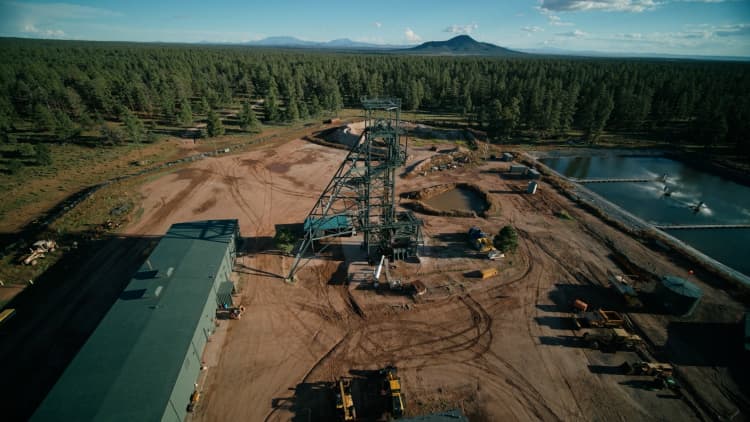
The plant currently has capacity to supply about a third of U.S. demand with $5 billion invested in the facility to date. Urenco is expanding its capacity in New Mexico by 15% through 2027 as utilties replace Russian fuel. It has installed two new centrifuge cascades for enrichment this year. But Urenco’s expansion alone won’t fill the Russian supply gap, Lorskulsint said.

“Our competitors will have to expand in order to make sure that as a whole the industry is still supplied,” he said. “We’re building quickly as we can to make sure that the the industry is not short handed.”

As Russian fuel is banned from the U.S., the Trump administration is pushing for 10 new large reactors to start construction this decade. Alphabet is investing in about 2 gigawatts of new nuclear, Amazon has committed to more than 5 gigawatts, and Meta wants to bring up to 4 gigawatts online.

Urenco USA Facilities in Eunice, New Mexico.
Adam Jeffery | CNBC

The industry is worried about the supply gap, Lorskulsint said, but filling it “is not an insurmountable task.”

Urenco USA is a candidate to receive a contract from the Department of Energy to produce more low-enriched uranium, part of U.S. efforts to standup a domestic nuclear supply chain. The contract would allow the New Mexico facility to expand further with the construction of a fourth production building.

Urenco’s competitors are also seeking support from the Energy Department to build out U.S. enrichment capacity. France’s Orano is planning to build a facility in Oak Ridge, Tennesse, with operations potentially starting in the 2030s.

Publicly traded Centrus has a facility in Piketon, Ohio, where it plans to produce low-enriched uranium, but it hasn’t yet started commercial operations. Centrus is the successor company to the United States Enrichment Corporation that went bankrupt in 2013.

Centrus stock has gained more than 400% this year as investors bet on a growing demand for enriched uranium due to U.S. plans to expand nuclear power.

Paul Lorskulsint, Chief Nuclear Officer, Urenco USA talks about the uranium enrichment process next to centrifuge cascade.
Adam Jeffery | CNBC

Supply chain bottlenecks

But enrichment is just one stage in a long supply chain that will be stretched by growing demand. Uranium delivered to the U.S is often mined in Canada and it is then converted into intermediate state called uranium hexafluoride that is the feedstock for enrichment.

The feedstock is spun in Urenco’s centrifuges to increase the presence of the isotope Uranium-235 to 5%, the level needed for most nuclear plants. The enriched uranium is then shipped to fuel fabricators that manufacture the pellets that go into reactors in power plants.

U.S. nuclear plants are facing cumulative supply gap of 184 million pounds of uranium through 2034, according to the Energy Information Administration.The biggest bottleneck right now for Urenco is the conversion of uranium into the feedstock for enrichment, Lorskulsint said. There are only three facilities in the Western world located in Canada, France and Illinois that convert uranium into feedstock.

“Every portion of the supply chain is going to have to expand, it’s not just about enrichment,” Lorskulsint said. “We need more of everything but conversion right now is the bottleneck.”

The nuclear supply chain may not be the biggest challenge in the end, the executive said. The ageing U.S. electric grid could prove to be the real constraint on building new nuclear due how long it takes to complete upgrades, he said. While this could slow Urenco down, it won’t stop the expansion, he said.

“We came here when the market demanded it,” Lorskulsint said of Urenco’s investment in the U.S. “We were here when the market didn’t demand it. And we are now expanding to make sure that we can still support as much as the market needs from us.”

Dan Ives says AI-related M&A ‘floodgates’ are about to open. Here are his takeover picks

A Nvidia HGX H100 server at the Yotta Data Services Pvt. data center in Navi Mumbai, India, on Thursday, Mar. 14, 2024.
Bloomberg | Bloomberg | Getty Images

Notable technology industry analyst Dan Ives says Big Tech companies and private equity firms are gearing up to make a flurry of acquisitions to stay ahead in the AI arms race. The analyst shared his picks for stocks that are prime acquisition targets as the dealmaking boom gets underway.

“With the regulatory landscape becoming more lenient to acquisitions with the new administrations stepping in and no longer representing steep hurdles, we believe that the tech M&A floodgates are ready to be opened as more opportunities arise to add accretive assets with an easier path forward,” Ives said late Wednesday note to Wedbush Securities clients.

Over the past few months, several technology firms have entered into deals to sell their businesses to AI and AI-adjacent firms. Core Scientific agreed in July to sell its data center business to CoreWeave in a $9 billion all-stock deal. Around the same time, Palo Alto Networks announced it would acquire CyberArk, an Israeli security firm valued at $25 billion, while NiCE unveiled plans to purchase consumer-focused generative AI company Cognigy for nearly $1 billion.

Ives pointed to C3.ai and Sandisk as being among the prime M&A targets, while Apple and IBM are most likely to be highly acquisitive during this AI merger wave because the two Big Tech companies are looking to play catch up in the AI race.

“While plenty of funding is expected to build AI use cases, we anticipate significant consolidation within the space over the next 5-10 years as more niche use cases for AI will be picked up and added to growing AI product portfolios from large-scale tech players and other financial buyers to capitalize on the exploding demand for AI across both enterprise and federal landscapes,” Ives wrote.

Here are the analyst’s top publicly traded takeover candidates.

Ives stock picks for AI-related M&A

Tickers Companies Stock Performance (YTD)
TENB Tenable Holdings -25.66%
QLYS Qualys -6.33%
AI C3.AI -48.85%
LYFT Lyft 68.33%
TRIP TripAdvisor 4.47%
SNDK Sandisk
Source: Wedbush Securities

Sandisk shares have surged more than 200% since the stock began trading under the ticker SNDK in February. Lyft and Tripadvisor are up 68% and 5% since the beginning of this year, respectively.

However, Tenable Holdings stock fell 26% this year, while C3.ai shares plunged 49% over the same period. Qualys shares slid roughly 6% in the year to date.

Disney’s image tanks among Republicans, Democrats after Jimmy Kimmel controversy

  • A Jefferies analysis of Morning Consult data showed sentiment and brand awareness for Disney and its streaming platform have fallen to lowest in at least two years in the last two weeks.
  • The drop follows the company’s decision to temporarily halt Jimmy Kimmel’s show and price increases for Disney+.
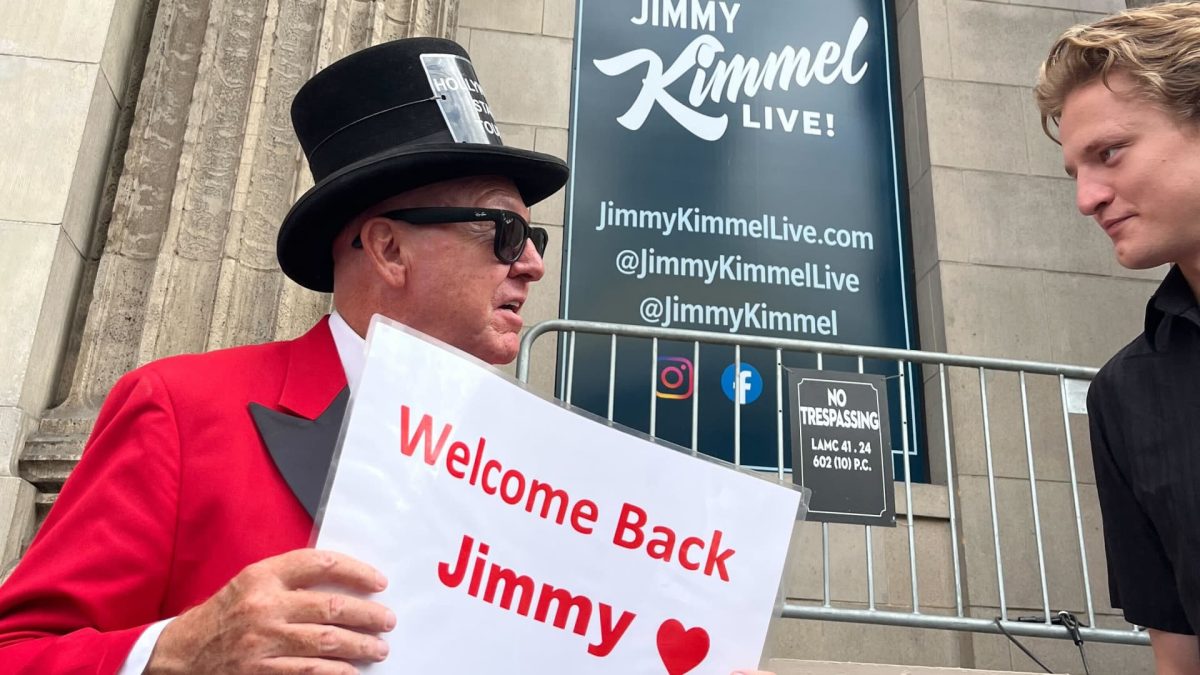
Gregg Donovan displays a sign at the El Capitan Entertainment Centre, where “Jimmy Kimmel Live!” is recorded to celebrate the show’s return on Hollywood Boulevard in Los Angeles, California, U.S. on Sept 23, 2025.
Gabriel Cortes | CNBC

The image for Disney and its streaming service plunged to multiyear lows after pulling comedian Jimmy Kimmel temporarily off air, a move that managed to alienate members of both political parties, according to analysis by investment bank Jefferies.

The firm, using Morning Consult data, shows sentiment for the company and its Disney+ platform have fallen to levels not seen in at least two years. Sentiment from Democrats, who had typically had better views of Disney before the past two weeks, soured more strongly than Republicans. Though both groups showed significant declines.

“The last two weeks for Disney have been as eventful to say the least, and have been equally controversial,” analyst James Heaney wrote in a Thursday note to clients. The analyst noted a recent price hike for Disney+ added to the plunging mood around the brand.

Disney became a cultural flashpoint after taking Kimmel’s late-night comedy show briefly off the air in the wake of his comments about slain conservative activist Charlie Kirk last month. ABC made the move after Federal Communications Commission Chair Brendan Carr hinted the network’s broadcast license could be yanked. Local ABC-affiliated stations owned by Nexstar Media Group and Sinclair preempted the show in their areas before Disney’s decision.

Heaney noted that the entertainment giant faced backlash for both Kimmel’s original comments and the subsequent move to halt his show’s production. And then bring him back.

Critics of Disney’s decision — including Democratic-leaning Hollywood power players — argued that the company was acquiescing to appease President Donald Trump’s administration rather than stand up for the First Amendment right of free speech. Kimmel’s show returned to much higher viewership than is typical.

A chart Heaney shared with clients of the bank’s research showed the readings of positive Disney sentiment divided by negative sentient among Democrats, Republicans and all consumers plunging to near zero, the lowest readings going back to before 2024.

Disney also announced late last month it was upping prices for many of its subscriptions by $2 to $3. The new cost tiers take effect Oct. 21.

Heaney noted that Disney as a whole saw its highest brand awareness in the past two years. For Disney+ specifically, the jump was much smaller, which the analyst said bodes well from a business perspective for CEO Bob Iger.

“This is clearly a PR hit for Disney,” Heaney said. “But the data implies a smaller impact on Disney+ than the brand as a whole, which may limit the amount of streaming churn.”

Disney shares have dropped 6% over the last month, pulling the stock into the red for 2025. But Heaney reaffirmed his buy rating and $144 price target, which implies nearly 30% upside over Wednesday’s close.

Leon Cooperman says we’ve reached the stage of the bull market that Warren Buffett warned about

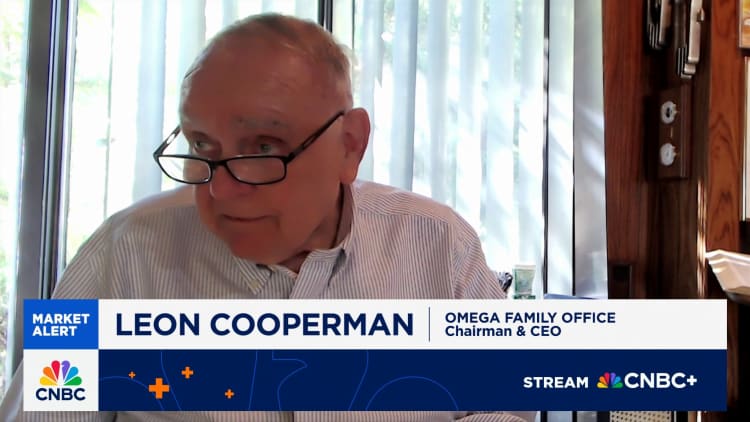
Longtime investor Leon Cooperman believes we are in the late innings of a bull market where bubbles can form and risks rise, a stage of the cycle that Warren Buffett had warned about.

The chair and CEO of the Omega Family Office read a quote from the “Oracle of Omaha” on CNBC’s “Money Movers” Wednesday, which he said fits neatly with what he’s seeing right now.

“Once a bull market gets under way, and once you reach the point where everybody has made money no matter what system he or she followed, a crowd is attracted into the game that is responding not to interest rates and profits but simply to the fact that it seems a mistake to be out of stocks,” Buffett said in 1999, according to a Fortune Magazine article.

Buffett believes bull markets often end not only when valuations are stretched, but also when there is irrational exuberance and when the rally is fueled by momentum.

“It’s what’s going on now,” Cooperman said, adding that investors’ mood is very similar and valuation on artificial intelligence companies is “ridiculously high.”

The S&P 500 has surged almost 40% since its April lows, returning to all-time highs. The rally has been led by mega-cap tech giants, which have invested billions in artificial intelligence and are being valued richly on the potential of this emerging era.

The famous Buffett Indicator — the ratio of total U.S. stock market value to GDP — is also flashing one of the clearest signs of market exuberance. The gauge is sitting at record highs well above the peaks reached during the Dotcom Bubble as well as the pandemic-era rally in 2021, suggesting equity prices are running far ahead of the underlying economy. At 217%, it’s also beyond the level Buffett once said is “playing with fire.”

While Cooperman thinks stocks could be risky with the late-cycle crowd behavior, he dislikes government bonds even more due to elevated inflation. Bonds pay fixed nominal interest, so higher inflation erodes their real returns.

“Stocks are less risky than bonds at these levels,” he said.

Warren Buffett is reportedly eyeing Berkshire Hathaway’s biggest deal in three years

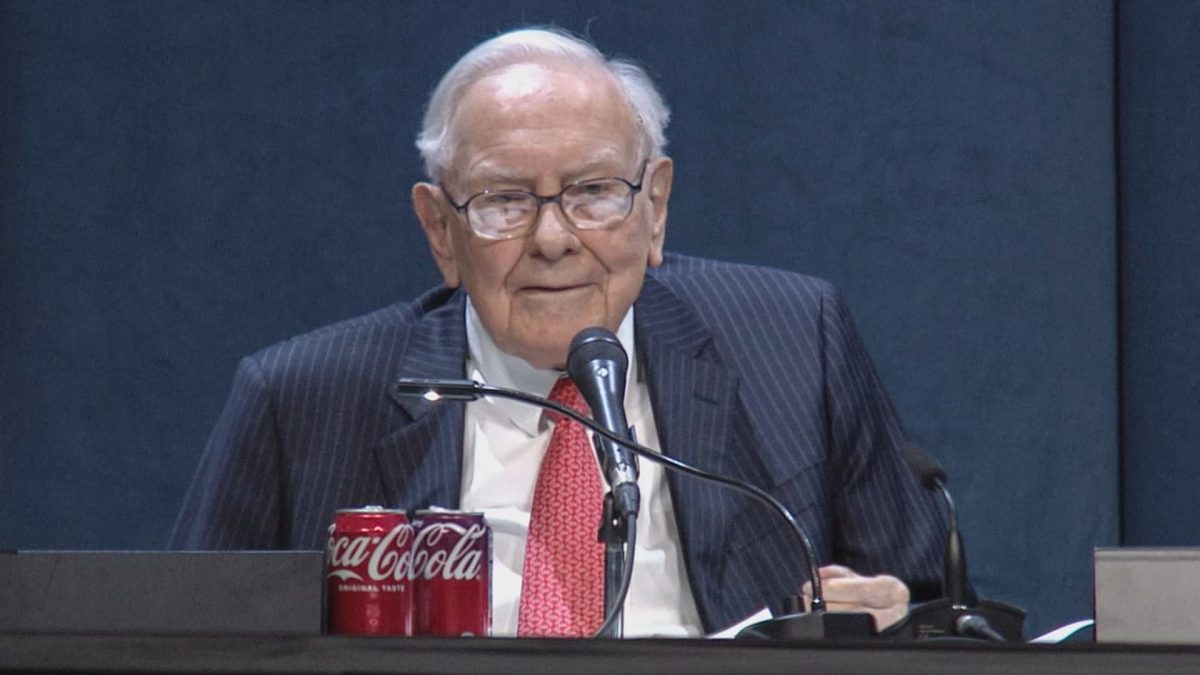
Warren Buffett speaks during the Berkshire Hathaway Annual Shareholders Meeting in Omaha, Nebraska, on May 3, 2025.

Warren Buffett’s Berkshire Hathaway is closing in on a deal to buy Occidental Petroleum’s petrochemical unit OxyChem for roughly $10 billion, the Wall Street Journal reported Tuesday.

The potential deal, which could finalize within days per the Journal, could be Berkshire’s largest since 2022 when it bought insurer Alleghany for $11.6 billion. That deal was announced in March of that year and completed in October 2022. Berkshire is sitting on a record cash hoard of $344 billion.

Buffett, 95, is stepping down as Berkshire CEO at the end of 2025, but he will remain as chairman. Buffett’s successor Greg Abel, who was CEO of Berkshire Hathaway Energy, is known for his strong expertise in the energy industry.

Shares of Houston-based energy company fell 1.8% Tuesday despite WSJ’s report.

The Omaha-based conglomerate owned more than $11 billion worth of Occidental stock, or a 28.2% stake. The 95-year-old Buffett previously said he wouldn’t take full control of the oil company, founded by legendary oilman Armand Hammer.

In 2019, Buffett helped bankroll Occidental’s purchase of Anadarko Petroleum with a $10 billion commitment, receiving preferred shares and warrants to buy common stock in return. 

The billionaire investor started buying Occidental common stock in the open market in early 2022 after reading a transcript of the oil company’s earnings conference call. He took advantage of the heightened volatility in the Covid pandemic to scoop up the shares at a discount.

Occidental also pays a 2% dividend yield and has been investing in a carbon capture business.

— Click here to reach the original WSJ story.

Financial News

Daily News on Investing, Personal Finance, Markets, and more!

Financial News

Policy(Required)