How much would a 40-year-old need to invest in an ISA to earn a £2k monthly passive income in retirement?

The Stocks and Shares ISA can significantly boost an investor’s chances of building wealth for retirement. Being shielded from capital gains tax and dividend tax — which over time can total tens of thousands of pounds — can eventually yield an impressive passive income.

Exactly how much an individual needs to invest for a decent second income depends on what they invest in. But with a balanced portfolio of FTSE 100 and S&P 500 shares, I’m optimistic that investors could enjoy a £2k passive income by the time they retire.

Let me show you why.

Please note that tax treatment depends on the individual circumstances of each client and may be subject to change in future. The content in this article is provided for information purposes only. It is not intended to be, neither does it constitute, any form of tax advice. Readers are responsible for carrying out their own due diligence and for obtaining professional advice before making any investment decisions.

Buying UK and US shares

Diversification is an essential part of long-term investing, allowing individuals to spread risk and realise a spectrum of growth and income opportunities. By providing around 600 companies to choose from, a strategy focused on FTSE 100 and S&P 500 shares can help individuals effectively achieve this.

The S&P 500’s large weighting of growth shares can facilitate strong capital gains over time as share prices respond to rising earnings. And the UK blue-chip index is packed with dividend shares that provide a reliable and healthy passive income (the forward dividend yield is currently around 3.5%). So it’s a powerful combination, in my view.

Strong returns

The earlier the investment journey begins — thus allowing more time to grow wealth — the better. But previous long-term returns of UK and US shares (shown below) suggests even those late to the party can build a big nest egg:

Index Average annual return (Feb 2015 – Feb 2025)
FTSE 100 6.3%
S&P 500 12.4%

Let’s say a 40-year old’s looking to make a £2,000 monthly passive income in retirement at the State Pension age of 68. If they invested just under £250 equally across the Footsie and the S&P each month in that time (£246 to be exact), they could have an ISA worth roughly £400,000 to retire on. That’s based on a long-term average return of 9.4% across both indices.

There’s then multiple ways they can use this to generate income, like purchasing an annuity or drawing down a percentage of the fund each year. Another popular option is to buy dividend shares, which throw off cash while offering the potential for further growth.

If our middle-aged investor selected 6%-yielding dividend stocks, they would hit that magic £2k monthly income target.

A FTSE 100 hero

To build that £400k portfolio needed for such a passive income, they could invest in individual shares, tracker funds, investment trusts, or a mix of all three.

One share I think would be worth serious consideration is Legal & General (LSE:LGEN), which has the potential to deliver significant capital gains and dividends over time. As a major life insurance, wealth services and retirement product provider, it has multiple ways to capitalise on the world’s growing elderly population. It also stands to gain as rising uncertainty about the future of state benefits boosts the importance of financial planning.

While it may struggle to grow profits during economic downturns, its exceptional cash generation means Legal & General shares (which currently yield a huge 9%) should at the very least continue providing a solid dividend income. Payouts here have risen during 12 of the last 13 years.


Up 95% this year, why has the Eurasia Mining (EUA) share price now crashed?

Over the past three weeks or so, the Eurasia Mining (LSE: EUA) share price has crashed 42%. Despite that, the EUA share price is still 95% higher than it was at the start of the year.

What is going on – and could the latest tumble be an opportunity to add the share to my portfolio?

Lots of hope but limited news

In fact, nothing has been going on. Rather, it is the main focus of recent years that is the issue, namely trying to offload its Russian mining assets.

The strong movement in the share price might seem to suggest there has been some action on that front. In reality however, the company has not made any substantive announcements this year when it comes to progress in its attempts to sell the assets.

That does not mean it has all been quiet in other areas though. Eurasia did announce last week that it plans a new share placing in an effort to boost its working capital, allowing it to fund the costs of maintaining its listing on the London stock market as well as acquiring a listing on the Kazakhstan stock market.

While that news is interesting – without any income from its mines, Eurasia needs cash to keep running – it does not cast light one way or the other on the big question of whether Eurasia will be able to find a buyer for its Russian assets and if so at what price.

High degree of uncertainty

So why has the price crashed? Partly, it reflects the ongoing wait for substantive news. After all, if Eurasia cannot sell its assets then it will likely keep struggling to monetise them effectively. That reflects the various sanctions currently in place let alone the fact that the mining assets it owns are not currently productive on a commercial scale.

The proposed Kazakh listing may also have scared some investors as they ponder what it could ultimately mean for the London listing.

For now Eurasia has not suggested any plan to delist in London, but the Kazakh listing adds a new layer of complexity for a business that is already dealing with a challenging geopolitical landscape for its business.

I see this as uninvestable for me

Still, the fact that Eurasia has managed to sell millions of pounds worth of new shares underlines that some investors continue to see potential value here. The same holds true of the fact that the EUA share price has almost doubled in just three months.

I can see what buyers are excited about: if Eurasia is able to sell its Russian assets at an attractive price, its current valuation could soar. That would likely boost the share price.

But we have no idea what will happen. Eurasia has been trying to sell the assets for a while already, in a buyer’s market. To date it has not been successful in that effort — and there is a risk that it will not be in future, either.

I continue to see this as speculation more than investment, so will not be buying any Eurasia shares for my portfolio.

Up another 53% in a month! Can the Greatland Gold (GGP) share price keep rocketing?

The Greatland Gold (LSE: GGP) share price just won’t stop. When I last wrote about the AIM-listed mining company on 10 March, the shares were flying to the stars. Since then, they’ve only climbed higher.

Greatland Gold shares are now up 53% over one month and 108% over the last year. Those are stunning returns. And it’s not hard to see what’s driving them. Gold fever!

The gold price recently smashed through $3,000 an ounce for the first time ever, as nervous investors pile into the world’s ultimate safe haven. It’s up 35% in a year.

Can this stock go higher?

This time, the trigger is Donald Trump’s threatened trade tariffs. Stock indexes have shrugged off crisis after crisis in recent years, but this one is really getting to them.

The greater the uncertainty, the higher Greatland Gold shares climb. But it’s not entirely a play on stock market volatility.

The London-listed company, which has gold and copper projects in Australia, got a further lift from a bullish update on 18 March.

This featured a major upgrade to its mineral resource estimates, following the inclusion of the recently acquired Telfer gold-copper mine.

Greatland Gold now holds group mineral resources totalling 10.2m ounces of gold and 387,000 tonnes of copper, up more than 40%.

There could be more. The company is ramping up drilling, with four rigs already operating and two more on the way.

Managing director Shaun Day hailed the Telfer estimate as an “outstanding result” and “exceptional foundation” for the company’s future.

He added that “the upcoming June 2025 quarter is a very exciting one for Greatland, in which we will report our first full quarter operating results for the March 2025 quarter, give production and costs guidance for 2025, deliver our inaugural Telfer Ore Reserve estimate, and list on the ASX.”

This was an encouraging update, but let’s be clear — what really matters right now is the gold price.

And it’s on an absolute tear.

High hopes, high investment risks

Last month, I called Greatland Gold a “binary” play. When gold soars, Greatland flies. When gold falls, well, guess.

The four analysts covering the stock have a median one-year price target of 18.26p. If correct, that’s another 48% higher than today.

Forecasts are slithery things at the best of times. Given Trump’s mercurial tactics, this one is as slithery and as slippery as they get.

Gold isn’t a one-way bet. It’s already climbed steeply. If Trump pulls back on tariffs, stock markets could rally and gold’s surge could unwind just as quickly.

There’s also the risk that investors start taking profits, triggering a sharp pullback.

Greatland Gold remains a high-risk, high-reward play. Investors should sweep aside past performance figures, and work out exactly what they are buying, and why.

It may be worth considering for a small nugget in a broadly diversified portfolio. But the higher the Greatland Gold share price climbs, the faster it could fall. For consideration by risk-takers only.

Is the Tesco share price about to turn?

The Tesco (LSE:TSCO) share price slumped nearly 9% on 14 March when Asda said it was going to start cutting prices across a large number of its products. It appears to me — as is often the case when news like this first breaks — many shareholders over-reacted.

Some appeared to panic as, in my opinion, irrational behaviour led to the large sell-off in the grocer’s stock. The result? An opportunity for new investors to come on board and acquire shares in, what I believe to be, a quality company at a discounted price.

Well, that’s what I did, anyway.

Going defensive

With the ongoing fallout from President Trump’s erratic approach to tariffs and the associated stock market turmoil, it could be one of the best decisions I’ve made in recent years.

That’s because supermarket shares have a number of characteristics that can make them a good investment during turbulent times. These so-called defensive stocks sell mainly essential items. Although there are no guarantees, it means their earnings and dividends tend to be more stable.

Crucially, Tesco’s unlikely to be affected by any American import taxes.

Market dominance

Impressively, it’s been the UK’s largest grocer since 1995. During this time, it’s coped with many challenges including the arrival of budget chains Lidl and Aldi. These two German budget chains have certainly had a major impact on the market. But looking at data over the past five years, they seem to have damaged Morrisons and Asda more than they have Tesco.

Share of GB grocery market 12 weeks to 26.4.20 (%) 12 weeks to 23.3.25 (%)
Tesco 26.7 27.9
J Sainsbury 15.1 15.2
Asda 14.3 12.5
Morrisons 9.9 8.5
Aldi 8.4 11.0
Lidl 5.6 7.8
Others 20.0 17.1
Total 100.0 100.0
Source: Kantar

This gives me confidence that the UK’s number one will be able to survive the latest attempt by Asda (and now Co-Op) to knock the group from its top spot. That’s because most people don’t have the time to visit several supermarkets picking the cheapest items from each. As long as the shopping experience is reasonably pleasurable and the groceries are perceived to be fairly priced (not necessarily the cheapest), I think people will keep returning to Tesco.

Also, Lidl and Aldi don’t have an online store.

Impressively, according to a recent survey by YouGov, Tesco’s the most popular supermarket across almost all demographics so it’s clearly doing something right.

The worst could be over

The company’s share price has recovered slightly (1.5%) from its low of the past month. Although this doesn’t sound like much, given the current global turbulence that’s a good result. However, as they say, one swallow doesn’t a summer make. And I’m not too concerned how it performs from one day to the next. Successful investing is all about taking a long-term view.

I’m not oblivious to the challenges that the group faces. Margins are very tight. For the 52 weeks ended 24 February 2024, the group reported an operating profit margin of just 4.1%.

But Tesco’s market share is about the same as that of Sainsbury’s and Asda combined. And I think it’s well placed to continue its dominance. Its European (Hungary, Czech Republic and Slovakia) operations are also doing well. Further expansion here could be one way of increasing earnings.

I’m glad I’ve been able to add Tesco to my Stocks and Shares ISA. Other long-term investors could consider doing the same.

How much further can the Tesla stock price fall? This analyst thinks 50%

Tesla (NASDAQ:TSLA) stock hit a 52-week high of $488.54 in December 2024, riding the crest of Donald Trump’s election victory wave. Since then it’s fallen 45% by the time of writing.

Anyone unlucky enough to have put £10,000 into Tesla right at the peak will now be sitting on £5,500. And according to Wells Fargo, that value could be slashed to just £2,750 if a forecast for a further 50% fall comes true.

Investors should be cautious before thinking of acting on an analyst’s take. But we can learn by investigating their reasoning.

Falling sales

Fears are growing that President Trump’s tariffs, which would hit parts imports, will hurt Tesla along with other motor firms. And even CEO Elon Musk has said the tariff impact on his company is likely to be significant.

Rising dissatisfaction with Musk’s political activities is hurting US sales in some geographies. I’d see it as a mistake to judge the stock on that. But Wedbush analyst Dan Ives, one of the biggest Tesla bulls, says investors are going through a “white-knuckle moment.” He says “Musk needs to change course here … Tesla’s future depends on it.

Tesla benefits from a $7,500 tax credit on electric vehicles (EVs), but the US government looks set to ditch that. Tariff responses by other countries won’t help. The UK government is looking at the benefits Tesla gains through tax subsidies here, with reciprocal duties on it an option on the cards.

Target downgrade

Wells Fargo thinks declining global sales could see Tesla’s earnings per share (EPS) fall 25% in 2025. And the financial giant has cut its price target for the stock to just $130.

Tesla is due to report Q1 vehicles deliveries today (2 April), and the news might be out by the time you read this. As I write, we’re looking at a broker consensus for a 3.7% fall. Some though, think the dip could be as much as 12%.

So is it time to dump Tesla stock and run? Well, the EV pioneer still has a lot going for it. And I think the biggest headstart it has over rivals could be its autonomous driving and robotaxi plans. It all seems to be technically more advanced than rivals.

Regulatory approval looks like the biggest challenge. But Tesla is developing the technology in a market with traditionally less regulation than most. And the current government definitely has a low-regulation mindset.

Valuation

The biggest hurdle for me has always been the sky-high valuation. And we’re currently looking at a forecast price-to-earnings (P/E) ratio of 108. I can’t resist comparing that to other Nasdaq stocks, like Nvidia on just 25 and Apple on 30.

A big valuation is not a problem in itself if future growth is there to back it. And Tesla’s P/E has been higher and is forecast to keep falling in the coming years.

Tesla is too risky for me right now. But I think long-term tech investors could still do well to consider it, especially if we see more price falls.

3 top FTSE 100 shares to consider for a new ISA

Some people will just be starting out on their investing journeys in April. While exciting, it can also be daunting looking at all the options. Where on earth to start? Here, I’ll highlight a trio of high-quality FTSE 100 shares that I think are worth considering for a new ISA portfolio.

Pharmaceutical giant

Big Pharma often gets a bad rep nowadays, but where would millions of patients be without the life-saving medicines? AstraZeneca (LSE: AZN) is the UK’s largest listed company and a world leader in oncology (cancer treatments).

Last year, total revenue jumped 21% at constant exchange rates to $54.1bn, while core earnings per share (EPS) increased 19%. By 2030, it’s aiming to launch at least 20 new medicines and reach $80bn in revenue, with sustained growth thereafter. 

At £111 a pop, the shares are trading at 16.5 times forward-looking earnings. I think this is a reasonable valuation for a high-quality global company, though it could always suffer a key clinical trial or regulatory setback. These are unavoidable risks in the industry.

Still, AstraZeneca’s fundamentals are rock-solid. It’s very profitable, excellently run, and has attractive long-term growth opportunities. The stocks also offers a dividend, with the forward yield at 2.3%.

All this makes it an excellent candidate for a new ISA, in my opinion.

Leading credit bureau

From a pharma giant to a data one now with Experian (LSE: EXPN). The credit reporting company possesses a vast collection of data on consumers and businesses, mainly related to credit and financial behaviour. Its tools also help detect and prevent identity fraud.

For the six months to 30 September, revenue was up 7% to $3.6bn, with EPS rising 9%. For the full year that just ended in March, Experian expects organic revenue growth of 6%-8%.

While these might not seem exciting growth rates, it’s important to remember that many lenders, insurers and marketers rely on Experian. This means a large chunk of its revenue is recurring, making it very stable and predictable.

Importantly, its high-quality datasets are a goldmine for training AI models, something it has been doing for two decades. Generative AI is merely strengthening its business further.

Experian has just acquired ClearSale, a leading digital fraud prevention provider in Brazil. This adds e-commerce transactions, mobile phone and device data to the mix, strengthening its products and competitive position in Latin America’s largest economy. 

The possibility of a consumer data breach is a risk, as this would cause significant reputational damage. Meanwhile, the stock isn’t cheap, trading at 25.5 times forward earnings. It’s priced for steady long-term growth, which will have to continue.

I’m bullish on the stock though. Digital lending in the form of buy now, pay later is exploding worldwide, which should continue benefiting Experian. 

Technology fund

Finally, I think Polar Capital Technology Trust is worth considering Too. This investment trust offers wide exposure to many global tech titans, including Nvidia, Broadcom, Apple, and Meta Platforms.

The share price has almost doubled in five years. However, it hasn’t always been a smooth ride and more bumps in the road are guaranteed. Right now, for example, President Trump’s tariff policies could cause earnings volatility at global tech companies.

However, longer term, I expect this trust to increase in value as the ongoing digital/AI revolution gathers steam.

Could buying these growth stocks today be like buying Amazon or Apple 10 years ago?

Buying growth stocks and holding them for the long term can pay off in a big way. Just look at the long-term returns generated by Amazon and Apple – over the last decade these shares are up around 930% and 620%, respectively.

Here, I’m going to highlight two US-listed growth stocks that I believe have a ton of potential and are worth considering today. Over the next 10 years, I wouldn’t be surprised to see these stocks deliver the same kind of returns as Amazon and Apple have over the last decade.

This industry is forecast to grow 10-fold

One industry I’m really bullish on today is cybersecurity. In today’s digital world, no company or government organisation can afford to ignore it.

Over the next decade, the industry is expected to grow significantly as organisations move to protect themselves against digital threats. According to McKinsey, it could be a $2trn industry in the not-too-distant future (around 10 times its current size).

An industry leader

Now, one stock in this industry I’m really excited about is CrowdStrike (NASDAQ: CRWD). It serves companies worldwide and is growing at a rapid pace (revenue growth of 21% is expected this financial year) thanks to the effectiveness of its cloud-native Falcon platform.

This stock has had a great run in recent years. But the company’s market cap is still relatively small at around $86bn. To put that figure in perspective, Amazon currently has a market cap of $2trn. So, there’s plenty of room for growth here, in my view.

It’s worth pointing out that CrowdStrike has plenty of competition. Recently, Palo Alto Networks has been enhancing its cybersecurity offering to compete with the company.

And that’s not the only risk for investors. Another is weakness in the high-growth area of the stock market (the stock has fallen recently as sentiment towards growth stocks has cooled).

Taking a long-term view, however, I’m really excited about the potential here. I’ve been buying the stock for my own portfolio recently while it has been trading under $350.

Growing fast

Another cybersecurity company that I believe has bags of potential and is worth considering is Zscaler (NASDAQ: ZS). It also offers a cloud-based platform and is growing at a breakneck speed (revenue growth of 22% is expected for the current financial year).

This company has had a lot of success in recent years. Today, it serves over 7,500 customers, including 30% of the Forbes Global 2000.

But it’s still pretty small. Currently, it has a market cap of just $30bn, meaning that it’s less than a hundredth of the size of Apple (which has a market cap of $3.3trn today).

Looking ahead, I think Zscaler could get significantly bigger as it wins more customers and sells extra services to existing ones. But as with CrowdStrike, the company is facing plenty of competition so there are no guarantees it will have success.

I’m bullish

I’m convinced, however, that cybersecurity is an industry with massive potential. And I’m clearly not the only one with this view.

Just recently, Google-owner Alphabet announced the acquisition of cybersecurity business Wiz for $32bn. This suggests that the Big Tech company sees cybersecurity as a major source of growth.

With a £20K ISA, an investor could earn £1,500 a year from FTSE 100 shares

One of the things I like about a Stocks and Shares ISA is that it allows me to build up passive income streams that hopefully can keep flowing year after year. That can be while sticking to proven blue-chip FTSE 100 businesses.

As an example of this approach, here is how an investor with £20K could target a £1,500 annual passive income stream.

Getting the right ISA

The first move would be to select the optimal Stocks and Shares ISA.

There are lots of options available on the market and each investor has their own particular needs, so it makes sense to pay attention to what is on offer.

Even small-seeming fees and costs can add up – and eat into passive income!

Building an income stream

To generate £1,500 each year in passive income from a £20K ISA would require a 7.5% yield. That is over double the average FTSE 100 yield at the moment.

One approach would be to invest at a lower yield and compound the dividends for a few years until the target was achieved.

But in the current market, I do not think it is necessary for an investor to wait like that. I reckon they could realistically aim to achieve a 7.5% yield from the start, buying a diversified portfolio of blue-chip shares.

As that is an average, if some shares yield less it would be fine, as long as the average was balanced out by other higher-yielding ones.

Three shares to consider

As an example, here are three FTSE 100 shares I think investors could consider as part of such an approach.

Legal & General is a financial services powerhouse with a long history – and hopefully a long future ahead of it too.

It benefits from a strong brand, resilient customer demand and large existing client base. The sale of a big US business does bring a risk of lower earnings in future, though in the short term the cash proceeds should help support the beefy dividend and share buyback programme.

Legal & General yields 8.8%.

Secondly, M&G is another FTSE 100 financial services name with a chunky yield.

It yields 10.3% and the asset manager recently increased the annual payout per share.

It also has a strong brand and customer base in the millions, though one risk is that clients pulling out more funds than they put in will hurt profits.

A third share to consider is insurer Aviva (LSE: AV).

Its 6.4% yield is below the target I mentioned above, though as I explained, it could be part of a portfolio that still achieves that target overall.

Insurance benefits from large, resilient demand. Aviva is a massive force in the UK insurance sector and is set to grow further with its acquisition of rival Direct Line.

That risks distracting management attention, not least because Direct Line’s business has been struggling in recent years.

But it should offer Aviva even greater economies of scale. Meanwhile, Aviva has a large customer base, proven business model and clearly defined strategy. I see those as assets.

The FTSE 100 firm did cut its dividend in 2020 but since then the payout per share has been growing handily.

Are things about to go from bad to worse for this legendary FTSE 250 stock?

During the week ended 28 March, Aston Martin Lagonda (LSE:AML) was the worst-performing FTSE 250 stock. Its share price fell 14% after Donald Trump announced plans to impose a 25% tariff on all car imports into the US.

This new tax is due to take effect from tomorrow (3 April). Admittedly, there’s never a good time to have to deal with tariffs but the timing for the group is particularly unfortunate given that it’s currently loss-making. Since 2 April 2024, its share price has tanked 58%. Over the past five years, it’s down 88%.

A review of the evidence

Although price changes affect the sales of luxury goods less than cheaper alternatives, they’re not immune. Economists measure the impact using the price elasticity of demand (PED). Not surprisingly, for most products, there’s a negative relationship between the amount a consumer has to pay for something and the number sold.

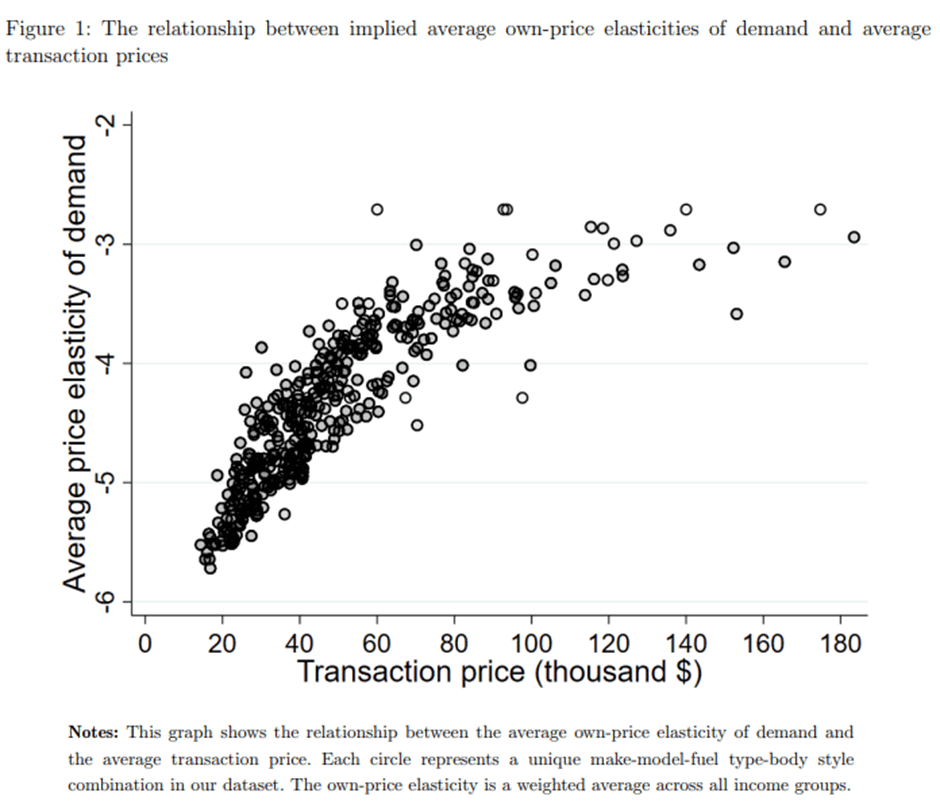
In August 2023, an academic paper specifically looked at the impact of prices on car sales. As the chart below shows, across all vehicle types, the PED was negative, albeit less pronounced for more expensive cars.

Source: ‘New Passenger Vehicle Demand Elasticities: Estimates and Policy Implications’ by Benjamin Leard and Yidi Wu, Resources for the Future, August 2023

In 2024, to try and reduce its losses, Aston Martin increased the prices of its cars. Compared to the previous year, its average selling price went up by 5.9% to £245,091. The result was an 8.9% drop in the number sold.

Don’t get me wrong, I’m not suggesting that the fall in vehicle sales of 590 was entirely due to the price increase. Undoubtedly, global economic uncertainty played a part. Sales in China were weaker than anticipated and there was also some supply chain disruption. But I’m certain charging more for its cars was also a contributory factor.

Car-mageddon?

That’s why I’m sure shareholders will be anxious about the impact of Trump’s tariffs. Of concern, the company’s biggest market is the Americas. In 2024, through its network of 45 dealers, the group sold 1,928 cars to the territory, with a value of £629m. Although this isn’t broken down by country, I think it’s reasonable to assume that the US accounted for most of the revenue.

Nobody knows for sure how the company’s top (and bottom) line will be affected but it’s highly unlikely to be good news.

Region Cars sold 2024 %
The Americas 1,928 32.0
Europe, Middle East and Africa 1,796 29.8
Asia Pacific 1,220 20.2
UK 1,086 18.0
Total 6,030 100.0
Source: company accounts

Mitigation

To strengthen its balance sheet, the company has announced that its major shareholder, headed by its current chairman, is to invest another £52.5m in the company. This will take the Yew Tree Consortium’s interest to 33%. Normally, increasing a shareholding above 30% would require a formal takeover bid to be launched. However, in this case, a waiver is being sought.

The group’s also selling its minority stake in the Aston Martin Aramco Formula One racing team.

But I suspect there will be some difficult times ahead.

In addition to tariffs, the company has to navigate its way through to full electrification of its vehicle range. And it’s a long way from being profitable at a post-tax level.

Of course, Trump could quickly realise that a trade war is in nobody’s interests. And the group still retains an iconic brand with its badge affixed to some beautiful sports cars.

However, with all this uncertainty surrounding the group, making an investment now would be too risky for me.

Why contributing to a SIPP before 45 is a really smart idea

Contributing to a SIPP (Self-Invested Personal Pension) is a great way to build wealth for retirement. With these pension accounts, one typically gets access to lots of different growth assets (stocks, funds, ETFs, etc), tax-free investing, and tax relief.

The key, however, is to start contributing early. If someone starts contributing before 45, the results can be quite remarkable.

Please note that tax treatment depends on the individual circumstances of each client and may be subject to change in future. The content in this article is provided for information purposes only. It is not intended to be, neither does it constitute, any form of tax advice. Readers are responsible for carrying out their own due diligence and for obtaining professional advice before making any investment decisions.

Starting early can lead to huge retirement savings

Let’s say that you were able to achieve a return of 8% per year from a SIPP over the long run. And let’s also say that you were contributing £800 per month as a basic-rate taxpayer (the government would add in another £200 per month for you taking the total monthly contribution to £1,000).

If you were to start contributing at 50, you’d have approximately £330,000 by the age of 65. Start at 45, and you’d have £550,000.

Start at 40, however, and you’d have a whopping £870,000 by 65. That’s obviously far more money for retirement.

What’s crazy is the difference between starting at 40 and 45. Despite putting just £48,000 more in over the five-year period, the pot would have an extra £320,000 in it by 65.

This illustrates the importance of starting early. The earlier you start, the more time you have to capitalise on the power of compounding (earning a return on past returns).

Generating solid returns

Now obviously, the 8% return plays a key role in these calculations and that’s in no way guaranteed. Many investors achieve less. So, how does someone aim to achieve that level of return over the long term?

Well, there are few strategies an investor could consider.

One is investing in a low-cost index fund. An example is the Legal & General Global Equity UCITS ETF (LSE: LGGG).

This is a simple tracker fund designed to mimic the performance of the Solactive Core Developed Markets Large & Mid Cap USD Index. In other words, it provides exposure to large and medium-sized companies in developed markets.

Overall, it provides access to around 1,400 stocks. Among the top 10 largest holdings are Apple, Nvidia, Microsoft, and Amazon.

This fund has performed very well over the last five years (to the end of February), returning about 14% per year. However, I wouldn’t expect that kind of return to continue.

Over the long run, these kinds of index products tend to return more like 7%-10% a year (assuming no big currency movements). If economic conditions are weak, or geopolitical issues scare investors, returns could be lower.

Aiming for higher returns

Another option to consider is putting together a portfolio of individual stocks. This is a riskier approach to investing but could lead to higher end results.

Just look at the returns generated by Amazon shares (which I think are worth considering today) over the long run. Over the last decade, they’ve risen about 880% or 25% per year (in US dollar terms).

That’s a brilliant return. But investors have had to put up with plenty of volatility along the way.

It’s worth pointing out that these approaches aren’t mutually exclusive. Personally, I like to do both.

I have passive index funds for diversification and portfolio stability. I then have stocks like Amazon for extra growth.

Financial News

Daily News on Investing, Personal Finance, Markets, and more!

Financial News

Policy(Required)