Here’s my Stocks and Shares ISA plan for 2025-26

By the time Monday (7 April) comes around, the Stocks and Shares ISA contribution limit will have reset. And I’ve been figuring out my plan for how I want to approach the new financial year.

As usual, my ambition is to invest as much as possible in my ISA – the tax benefits make it clearly worth it, in my view. But this year I’m in a slightly unusual situation.

Please note that tax treatment depends on the individual circumstances of each client and may be subject to change in future. The content in this article is provided for information purposes only. It is not intended to be, neither does it constitute, any form of tax advice. Readers are responsible for carrying out their own due diligence and for obtaining professional advice before making any investment decisions.

Investing strategies

Normally, I’d be in a position of choosing between investing as much as I can as soon as possible, or focusing on investing regularly over the year. There are merits to both.

The advantage of investing earlier is dividends. Other things being equal, owning a company’s shares for longer means there’s more time to collect cash returns from the business.

The benefit of investing regularly is it eliminates the need to work out when stocks are cheap. As long as share prices go up over time, buying at every time should yield good results.

There is however, a third option that’s available to me this year. And it involves moving some of the investments I have in other accounts into my ISA.

Transferring

I have a few investments that I own in taxable accounts and transferring them into my ISA could be beneficial. A good example is Diageo (LSE:DGE).

Moving my Diageo shares to my ISA would obviously help me avoid dividend tax. But there’s another reason I think this could be an attractive strategy. Like a lot of investors, I’m down on my investment in Diageo. But that means I could sell the stock and record an ‘allowable loss’, which I could use to offset gains I’ve made elsewhere.

Doing this would bring down the amount I owe in capital gains tax for this year. And while I’d have to pay stamp duty to buy the shares in my ISA, I think this could be a good plan.

Do I even want Diageo shares?

Of course, I don’t have to keep Diageo shares at all – I could just sell them and buy something else. And it’s easy to see why I might do this given the company’s recent struggles.

The ongoing tariff issues in the US are a particularly annoying challenge. But over the long term, I think a strong competitive position across the Atlantic is likely to be a big advantage.

Alcohol distribution in the US is somewhat unique, mostly as a result of Prohibition. Rather than negotiating prices directly with producers, retailers go through wholesale distributors. This tends to result in higher margins for the likes of Diageo. This means a strong position in the US is a big advantage for the company – and it’s one that’s still very much intact. 

Silver linings

My Diageo investment hasn’t exactly gone to plan, so far. But the chance to sell it at a loss and offset my capital gains liabilities might just be a silver lining to this particular cloud. 

That’s my plan for my Stocks and Shares ISA. It offers investors protection from taxes on dividends and capital gains and I’m hoping to get as much as I can from it.

Of the 20 highest-yielding FTSE 100 stocks, this is my top pick

The FTSE 100 index is full of high-yield dividend stocks. But not all are worth buying – many have been poor long-term investments.

Below, I’m going to highlight my top pick among the Footsie’s 20 highest yielders. Here’s why I think this stock is worth considering for a portfolio today.

An attractive long-term outlook

Of the 20 highest yielders in the FTSE 100 today, my favourite stock is banking giant HSBC (LSE: HSBA). It currently has a dividend yield of around 6.4%.

There are several reasons I’m bullish on this particular stock. It’s not just the attractive yield that stands out to me.

One is that the company has genuine long-term growth potential. With its focus on Asia and wealth management, this bank has the potential to get much bigger over the next decade.

It’s worth noting that long-term growth potential is often overlooked by dividend investors (who can get caught up in high yields). It’s really important, however.

Typically, business growth leads to higher earnings. And this supports dividends for investors (and often leads to increased payouts).

In recent years, we’ve seen many high yielders cut their dividends due to a lack of growth. Some examples here include BP and Imperial Brands.

Secure dividends

Another reason I like the look of the stock is that the dividend appears to be secure.

This year, analysts expect total dividend payments of 67 cents per share from HSBC. Meanwhile, they expect the bank to generate earnings per share of 133 cents.

That gives us a dividend coverage ratio (earnings per share divided by dividends per share) of about two. That’s a solid ratio and indicates that earnings should comfortably cover dividends.

I’ll point that not many high yielders in the FTSE 100 currently have this level of coverage. Right now, Legal & General has a dividend coverage ratio of just 1.1 while Taylor Wimpey has a ratio of 0.95 (a ratio under one is a red flag as it shows that earnings are not covering dividends).

There are always risks

Of course, dividends are never guaranteed. And we can’t rule out a scenario in which HSBC reduces its payout to investors in the future.

After all, banking is a cyclical industry (meaning that it has its ups and downs). In the future, a major global recession (or more isolated economic weakness) could lead to lower earnings for the group and lower dividends.

And that’s not the only risk to consider with this stock. While Asia and wealth management appear to offer potential for growth, the banking industry is at risk of disruption.

Today, digital banks and FinTech start-ups are aggressively trying to capture market share from legacy banks. So HSBC will have to innovate and ensure that it can offer customers a first-class digital experience.

Worth a look

Overall though, I think this stock – which trades on a price-to-earnings (P/E) ratio of just eight – looks attractive today. With its long-term growth potential and its 6.4% yield, I believe it’s worth considering.

Could Tesla’s share price jump over the next 12 months? These analysts think so!

Tesla‘s (NASDAQ:TSLA) share price has been on a roller coaster in recent months. After rising sharply at the back end of last year, it’s collapsed 29.5% since the start of 2025.

Signs of a growing image crisis, combined with fears over how a potential trade war could hit revenues and costs, have driven Tesla shares sharply lower. However, analysts believe the company should rebound before too long.

But just how realistic are these price estimates in the current climate? And should I consider buying Tesla shares for my portfolio?

A 22% price bump?

First of all, it’s important to note that forecasters are not unanimously positive about the motormaker’s share price forecast for the next 12 months.

Of the 48 analysts with ratings on Tesla stock, one believes the NASDAQ company will fall 55.1% in value over the next 12 months, to $120 per share.

That’s down from current levels of $267.40.

Having said that, broker consensus is overwhelmingly of the opinion that Tesla’s share will rebound sharply. The average price target among analysts is $326.30 per share, up 22% from current levels.

One especially bullish analysts thinks the company will rise 105.7% to $550 per share. That’s above December’s record closing highs of $479.86.

Sales slump

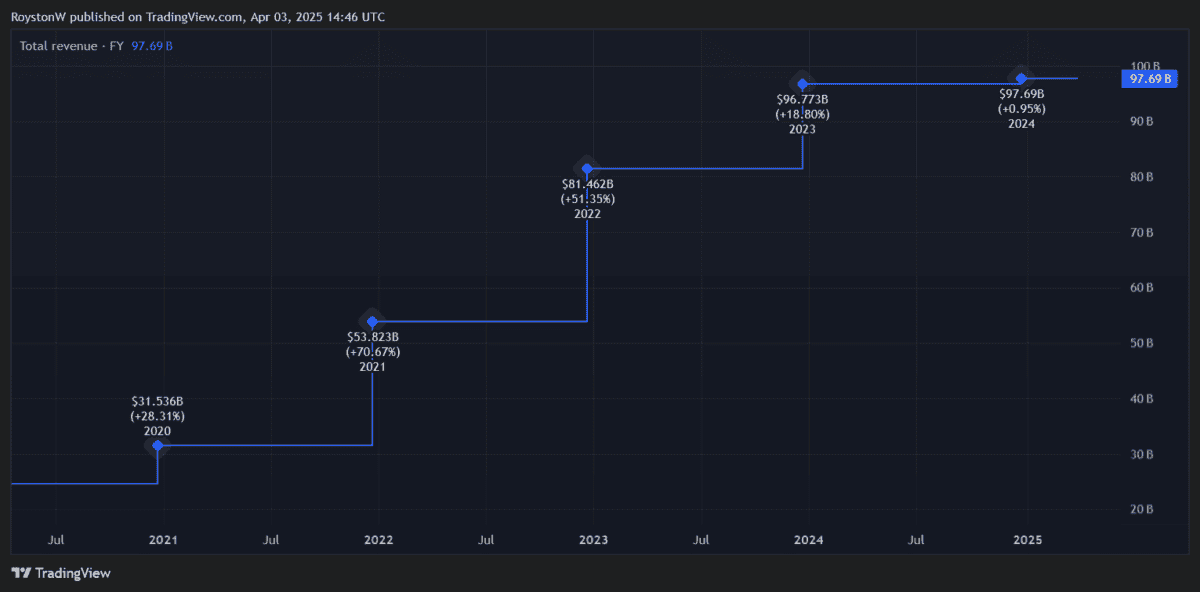
Source: TradingView

I can’t help but feel more than a little sceptical over market bullishness, though. As the chart above shows, Tesla’s sales growth has slowed to a crawl in recent years.

Concerns over quality continue to dog the business, exacerbated by a steady stream of product recalls (some 46,096 Cybertrucks have just been recalled over detaching panels). The firm’s also struggling against rising competition, and especially from China, as its rivals scale up production and improve their technologies.

Last year, BYD and Tesla both sold the same number of vehicles (1.8m).

In fact, things seem to be going from bad to worse as the company suffers from a growing brand crisis. Tesla sales dropped 13% year on year in the first quarter, with founder Elon Musk’s close association with the controversial Trump administration said to be turning customers (and especially those from overseas) off.

A ramping up in global trade tariffs also threatens to damage company sales, as well as disrupt supply chains and significantly elevate production costs.

Still pricey

Some may argue, though, that Tesla’s troubles are now baked into its much lower share price, providing the base for a share price rebound.

It’s not a view I personally subscribe to. And especially when one considers the huge valuation the carmaker continues to command.

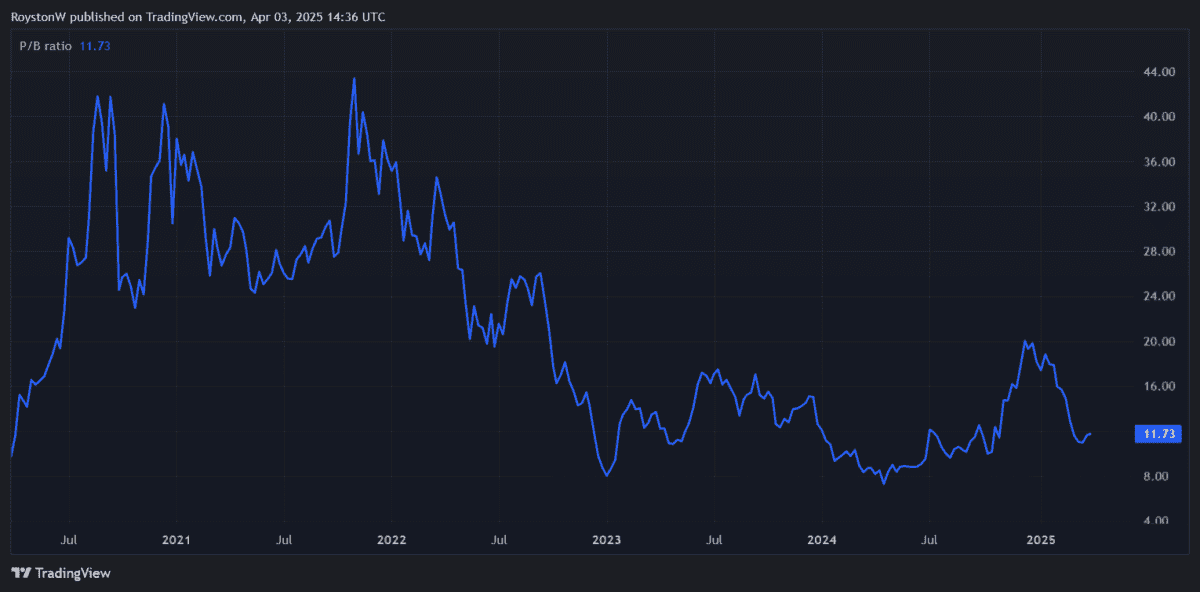
Predictions of an 18% earnings rise in 2025 results in a sky-high price-to-earnings (P/E) ratio of 102.4 times. Meanwhile, its price-to-book (P/B) ratio is miles above the accepted value watermark of one and below.

P/B ratio
Source: TradingView

In fact, this sort of high valuation leaves Tesla vulnerable to further share price drops, in my opinion.

Reports that Musk will soon leave his job as Trump’s efficiency tsar provide some cause for optimism. This could help Tesla repair its broken image, and would likely see its experienced chief executive give the company more of his attention.

Yet this isn’t enough to encourage me to invest. I think Tesla shares remain far too risky, so I’d rather buy other US and UK shares today.

I asked ChatGPT where the FTSE 100 will be in 6 months: here’s what it said…

The FTSE 100 has outperformed US markets since President Trump took office. I’m sure not many people had that on their bingo cards. It might seem obvious today, but it wasn’t a few months back.

And on that point of uncertainty, it’s important to recognise that many of the post-pandemic consensus viewpoints have been wrong. Perhaps the biggest misforecast of them all was “inflation is transitory” — it wasn’t.

A major part of understanding where the index will be in six months will reflect the impact of Trump’s tariffs. Tariffs on the UK will be one factor, but it’s important to remember that the FTSE 100 is a truly global index.

The mining, oil, and even banking institutions that are heavily represented operate globally. In fact, I don’t believe any of the FTSE 100 mining companies are actively mining in the UK — Anglo American’s Woodsmith project is under development.

Here’s what ChatGPT said

Firstly, the artificial intelligence (AI) platform suggested that the future of the index is inherently uncertain. However, ChatGPT did provide me with two institutional forecasts and pointed to the index moving higher in the latter part of the year.

  • Goldman Sachs’ revised forecasts: as of 1 April 2025, Goldman Sachs adjusted its 12-month forecast for the UK’s FTSE 100 index to 9,100 points, up from the previous estimate of 9,000 points.
  • AJ Bell’s projections: investment platform AJ Bell has projected that the FTSE 100 could reach 9,000 points by the end of 2025.

However, the platform cautioned that these forecasts are subject to change based on various factors, including economic developments, geopolitical events, and shifts in investor sentiment. It added that while these analyses provide a general outlook, they should not be interpreted as definitive predictions.

A top performer

Unimpressed by ChatGPT’s answer, I pushed for more, asking it to predict the best performing stock over six months. Its answer was AstraZeneca (LSE:AZN). ChatGPT noted that AstraZeneca is projected to “gain 36% in value” according to Barclays, driven by its significant advancements in cancer drug development and upcoming trial results.

AstraZeneca could indeed be a standout performer in the FTSE 100 over the next six months. The company has made significant strides in oncology, with recent FDA approvals and a robust pipeline of new medicines. And analysts are optimistic, with a consensus recommendation leaning heavily towards Buy and Outperform ratings. The company’s strong financial performance, including a 21% revenue increase in 2024, further supports its potential.

However, risks remain. AstraZeneca must navigate competitive pressures in oncology and manage regulatory challenges. Additionally, achieving its ambitious revenue targets will require flawless execution and continued innovation. What’s more, Trump’s tariffs could present challenges.

Despite these possible speed bumps, AstraZeneca’s strong pipeline and growth prospects make it an attractive choice for investors looking for potential in the pharmaceutical sector. It’s something I’ve genuinely been considering buying more of.

Could the Rolls-Royce share price hit £10?

The Rolls-Royce (LSE:RR) share price has surged almost 90% over the past 12 months, propelling the engineering giant to a market capitalisation of £65bn. This represents an extraordinary increase of over 800% compared to just a few years ago. It also highlights the transformative impact of CEO Tufan Erginbilgiç’s leadership since his appointment in 2023.

With European defence spending on the rise and operational efficiencies driving profitability, Rolls-Royce has re-established itself as a high-performing aerospace and defence leader. But can its share price continue climbing towards £10?

A turnaround story

Rolls-Royce’s remarkable recovery has been fuelled by a combination of operational improvements and favourable market conditions. The company’s 2024 results exceeded expectations, with revenues reaching £17.9bn. Meanwhile, operating profits surged to £2.5bn, and free cash flow doubled to £2.4bn. These figures marked a significant turnaround from the challenges faced during the pandemic years when Rolls-Royce struggled under heavy debt and declining demand for its civil aerospace products.

The reinstatement of dividends and a surprise £1bn share buyback further boosted investor confidence. Moreover, upgraded mid-term targets suggest sustained growth ahead. Management now anticipates free cash flow of £4.2bn–£4.5bn by 2028, alongside operating margins rising to as high as 17%. These developments have positioned Rolls-Royce as a financially strong, cash-rich enterprise with a net cash balance of £475m.

Can Rolls-Royce reach £10?

Despite its impressive performance, the Rolls-Royce share price currently trades at around £7.50, with analysts offering mixed predictions about its future trajectory. The average target price stands at 798p. This represents a modest 6% potential appreciation. While more optimistic forecasts suggest it could climb as high as £11.50.

However, the valuation raises concerns. On a forward price-to-earnings (P/E) basis, Rolls-Royce trades at 30.3 times projected earnings for 2025. That’s a discount compared to peers like GE Aerospace, which is expected to trade at a P/E ratio of 36.7 times in 2025 and decline further to 24.5 times by 2028. Of course, the difference is that GE is US listed, and these American stocks typically trade with a premium to their UK-listed counterparts.

Risks to consider

Investing in Rolls-Royce isn’t without risks. Supply chain disruptions remain a significant concern for aerospace businesses, particularly given geopolitical tensions in Eastern Europe. Any escalation could impact production schedules or increase costs, undermining profitability.

Additionally, while European governments have pledged increased defence spending, there’s no guarantee these commitments will materialise fully or benefit Rolls-Royce directly. Moreover, with such high expectations baked into its valuation, even minor setbacks could trigger sharp declines in the share price.

The bottom line

Personally, I’d suggest the current valuation is fair given the earnings forecast. However, the company keeps delivering earnings beats and has benefited from catalyst after catalyst. It’s got momentum, and it’s on a roll.

I don’t think there’s evidence that the company should be trading much higher than it is today, but if the business continues to execute, £10 a share seems entirely feasible in the medium term. But I’m probably not going to add more shares to my portfolio. It’s near fair value for now, and concentration risk’s an issue.

4 REITs Fools own for passive income

Real estate investment trusts (REITs) offer a combination of high dividend yields, potential for growth, and diversification benefits, making them an attractive option to consider for investors seeking passive income.

Here are a handful owned across the Fool.co.uk contract writing team!

Primary Health Properties

What it does: Primary Health Properties specialises in purchasing and renting primary healthcare facilities within the United Kingdom and Ireland.

By Mark Hartley. Primary Health Properties (LSE: PHP) is a real estate investment trust (REIT) that benefits from stable revenue through long-term leases backed by the NHS and Irish government. This makes it a good candidate for passive income, as it’s low-risk and provides consistent dividend payouts

It has a long track record of dividend growth and has seen moderate price appreciation during strong economic periods. Dividends have increased consistently for over 20 years at a compound annual growth rate of 3.24%.

However, the price has suffered during periods of high interest rates, ramping up borrowing costs and impacting profitability. Recent concerns about the wider property sector and potential government healthcare policy change risk hurting the share price.

Despite a slight decline in performance over the past three years, revenue and earnings have typically been within 1% of expectations. This makes it attractive to income investors looking for stable and reliable performance.

Mark Hartley owns shares in Primary Health Properties.

Primary Health Properties

What it does: Primary Health Properties owns and lets out medical facilities like GP surgeries in the UK and Ireland.

By Royston Wild. Primary Health Properties offers investors the dream blend of long-term dividend growth and market-beating dividend yields.

Cash rewards here have grown every year since the mid-1990s. And City analysts expect this trend to continue until at least 2026, representing 30th consecutive years of rises.

As a result, the yields on Primary Health Properties for this year and next stand at 7.6% and 7.7% respectively. To put that into perspective, the current forward average for FTSE 250 stocks sits way below these levels, at 3.4%.

This REIT’s dividend durability reflects its focus on the ultra-defensive healthcare market, providing profits stability across the economic cycle. It’s also because the lion’s share of rental income is directly or indirectly guaranteed by a government body.

Looking ahead, future dividends could be hurt by NHS policy changes that impact earnings. But with successive governments working to strengthen the role of primary care in Britain, the outlook here for the short-to-medium term at least looks pretty solid. 

Royston Wild owns shares in Primary Health Properties.

Supermarket Income REIT

What it does: Supermarket Income owns a £1.8bn portfolio of 74 stores, with the majority leased to Tesco and Sainsbury’s.

By Roland Head. Big UK supermarkets have regained their status as desirable retail properties since the pandemic. I added Supermarket Income REIT (LSE: SUPR) to my portfolio in July 2024, tempted by the 8%+ dividend yield and near-20% discount to book value.

Admittedly, there’s a risk that higher interest rates will put pressure on the dividend. But my sums suggest that this REIT will be able to refinance while maintaining its dividend.

Recent changes should deliver a sharp drop in management costs. This REIT also benefits from long leases and very reliable tenants. Occupancy is 100% and so is rent payment.

Property valuations also seem realistic – another area of possible concern. During the second half of 2024, Supermarket Income sold Tesco’s Newmarket store back to the retailer at a price 7.4% above its latest book value.

With a forecast yield of 8.3%, I’m quite happy to sit back and collect my quarterly dividends.

Roland Head owns shares in Supermarket Income REIT.

Warehouse REIT

What it does: Warehouse REIT owns and leases a portfolio of well-positioned warehouses across the UK catering primarily to the e-commerce industry.

By Zaven Boyrazian. In a world where e-commerce continues to slowly take market share from brick-and-mortar retail, demand for well-positioned warehouses is growing. This is a trend that Warehouse REIT (LSE:WHR) has been busy capitalising on since its IPO in 2017.

However, with interest rates rising rapidly in 2022, real estate investment trusts have had to endure much higher financial pressures. In the case of Warehouse, that ultimately culminated in property disposals to keep debt in check.

Despite this, dividends have kept flowing. And while elevated interest rates are still a cause for concern, the sell-off by investors seemed a bit overblown. It seems the private equity markets have also come to the same conclusion since acquisition offers began flying in February 2025. So far, they’ve all been rejected.

Even after the recent rise in stock price, the shares continue to offer an attractive 6.5% dividend yield. And with demand for warehouses unlikely to slow down in the long run, the passive income potential for Warehouse REIT continues to look rock solid, in my opinion.

Zaven Boyrazian owns shares in Warehouse REIT.

Up 272% in just a year, is Palantir stock just getting started?

It has been an incredible few years for shareholders in Palantir (NASDAQ: PLTR). It went public in 2020 at $10 a share, ending its first trading day below that price. Since then, Palantir stock has surged 817% — including 272% over the past year alone.

Does that mean the stock might be a bubble – or could things get even better from here? Should I consider adding the firm to my portfolio?

Strong business performance may power on

The price has surged but in part that reflects a booming business. Since its last full year before listing (2019), Palantir has grown revenues by 285%.

What was an operating loss of over half a billion dollars back then had turned into an operating profit north of $300m by last year.

The bottom line was even better: last year saw a net income of $462m, compared to a net loss of $588m back in 2019.

It is easy to point to radical shifts in the global security environment and expanded government in many countries over the past five years as a reason for that dramatic shift in Palantir’s numbers.

But that misses a couple of key points.

Palantir chose what markets to target strategically not by accident – and it has made good choices.

Secondly, while revenues have soared, the income trend looks even more impressive to me. That underlines the scaleable nature of Palantir’s business model, which means income could well grow much quicker than revenues.

The current valuation is hard to justify

Still, even if revenues do keep growing strongly and earnings even more so, can Palantir justify the valuation the stock market is putting on it?

At the moment, the tech company’s market capitalisation is a tad short of $200bn. So Palantir is trading on a price-to-earnings ratio of 442. Even its price-to-sales ratio is around 73.

Clearly, the market is building in very high expectations of growth for Palantir. Very high expectations.

I do not think such a price can really account for the risks Palantir faces, from rapidly evolving competitors to the uncertain spending priorities of key US government departments that use Palantir as a provider.

But even stepping aside from such risks (which I do not do as an investor) I think the valuation makes no sense.

It seems to presume that Palantir is going to grow at light speed. Yes, it is growing fast but we know from long experience of economic activity that as companies grow it is typically difficult for them to maintain their early rates of growth.

Selling for over 70 times sales strikes me as irrational. I see no value investing at such a price (but lots of risk) and reckon that even if Palantir’s business performs well, that price could mean the share falls rather than rises from here.

I have no plans to invest.

Up 50%? The Aston Martin share price forecast is mind-blowing! 

The Aston Martin (LSE: AML) share price should come with parachute as standard. It’s plunged 60% in a year and 90% over five years.

The shares have been hurtling to earth ever since floating at £19 in October 2018. Today, they cost just 70p. That’s a loss of more than 96%.

Few companies have a rockier history. Aston Martin went bust seven times after being founded in 1913. The latest incarnation has only been kept on the road by emergency fundraising rounds and cash injections from billionaire Lawrence Stroll. 

He’s now pumped in around £600m since taking control in 2020, and he’s not stopping.

Can this FTSE 250 stock fight back?

On 31 March, we learned his Yew Tree Consortium is injecting another £52.5m, snapping up 75m shares to lift its stake from 27.7% to 33%. Good luck with that.

Aston Martin is also selling its minority stake in the Aston Martin Aramco Formula One team to shore up its battered balance sheet.

Now the James Bond car maker has Donald Trump’s tariffs to contend with. A third of group revenues come from the US but yesterday’s 10% tariff slapped on British imports was lower than feared.

Aston Martin shares are down just over 2% today. That’s neither here nor there, by its volatile standards. This remains an extremely high-risk investment. The latest financials underline the challenge. Losses accelerated to £289.1m in 2024 from £239.8m a year earlier. Revenue dipped 3% to £1.58bn, while wholesale volumes slumped 9% to 6,030 cars.

Management is fighting back by axing 170 jobs, around 5% of its global workforce. It’s also rowing back on its planned electric vehicle launch. Publicly, it’s aiming for “the latter part of the decade” but given the net zero backlash I wouldn’t be surprised if it quietly parked this venture.

Despite the turmoil, there are flickers of hope. CEO Adrian Hallmark insists the luxury marque is poised for a big turnaround, with positive adjusted earnings and free cash flow in the second half of this year. That would be something.

To Valhalla and back

The upcoming Valhalla hybrid supercar could inject some life, with deliveries starting next year.

Analysts are optimistic. The eight experts making Aston Martin share price forecasts have a median target of just under 105p. If they’re right, that’s a rocket-fuelled increase of exactly 50% from today.

Which would be explosive if it happens, but wouldn’t quite cover my losses on the stock after throwing caution to the wind and buying it last year in a (thankfully rare) moment of madness.

I won’t be buying more. The ride has been far too wild for my liking, and even if the shares do start to perform, I can’t imagine it will be a smooth road to recovery.

Markets could decide the sell-off has gone too far. If interest rates fall, that would make it easier to service the company’s £1.1bn debt. Help could come from a Chinese recovery. Hope springs eternal.

Aston Martin has looked like a turnaround play for years, and just keeps plunging. Investors considering buying the latest dip should pack nerves of steel. And that parachute.

As the S&P 500 drops, here are 2 Stocks and Shares ISA holdings I’m watching

We’re seeing massive volatility in the stock market across the pond today (3 April). As I write, many US holdings in my Stocks and Shares ISA have opened lower as fear about a global trade war/recession grips Wall Street. The S&P 500 is down nearly 4%!

With this in mind, here are two stocks in my portfolio that I’ve got my eye on for different reasons. One because I’m worried about it due to tariffs and the other because I’m tempted to invest more money in it.

Is Toast toast?

The first one is Toast (NYSE: TOST), which admittedly isn’t in the S&P 500. But the stock had almost doubled since the start of 2023, pushing the market cap above $20bn. So it was starting to look like a future contender for the benchmark index.

However, it fell 9% today, taking its decline to 25% since November. I think today’s drop is understandable though.

The company provides point-of-sale payment systems and operates a cloud-based platform tailored for the restaurant industry, encompassing online orders, delivery, marketing, loyalty programmes, and more. 

Given Toast’s focus on the US market, the direct impact of tariffs may appear limited. However, tariffs on imported goods can lead to higher prices for packaging and food, which restaurants might not be able to pass on successfully to their customers. 

In a worst-case scenario, many restaurants could struggle badly or even be forced to close. This would negatively impact Toast because it generates a large proportion of its revenue from transaction fees, which are directly tied to sales processed through its system. 

Thing is unfortunate because the company has been doing really well. Last year, revenue jumped 28% to $5bn as it added 8,000 net locations to end the year with approximately 134,000. It generated $306m in free cash flow and achieved its first full year of profitability.

I don’t think the company is toast by any means, and I’m not selling my shares. But given the uncertainty with tariffs, I’m keeping the stock on a short leash.

Super-app Uber

With a market cap of $150bn, the second stock is most definitely in the S&P 500. That is Uber Technologies (NYSE: UBER).

The stock is up nearly 200% since the start of 2023, driven higher by Uber’s move into profitability. However, it fell 4.5% today, taking the stock to around $71 (the same level it was 14 months ago).

At this price, I think the long-term returns could be very attractive. That’s because the firm is building out adjacent growth avenues beyond its core ridesharing and food delivery businesses. These include advertising (both in-car and in-app) and train/plane ticket bookings.

Meanwhile, it ended 2024 with 171m regular monthly customers worldwide and over 30m Uber One subscription members. We’ve seen with Amazon Prime how successful such loyalty programmes can be at scale.

Now, Uber isn’t totally immune to Trump’s tariffs. Trade tensions could disrupt operations or affect local regulations, especially in countries that favour local competitors.

On balance though, I remain bullish here. Uber has just signed a deal with WeRide, which operates the largest robotaxi fleet in the UAE. So Uber’s platform is also well-placed to benefit from the rise of autonomous vehicles.

I plan to buy more shares at anywhere around $70.

£10,000 invested in Tesla stock at Christmas is now worth…

Investors holding Tesla (NASDAQ: TSLA) stock were laughing teacakes — or at least mince pies — at Christmas. Shares of the electric vehicle (EV) pioneer were up by a whopping 227% in two years — and 116% in just two months!

Yet the wheels have come off, so to speak. As I write, the stock is down 42% since Christmas Eve, meaning a £10,000 investment made then is now worth just £5,800 on paper. Bah, humbug!

But is this merely a chance to consider investing in Tesla at a massive discount? Let’s dig in to some details.

Fork in the road moment

Tesla has been hit by a whirlwind of challenges in recent months. These include falling sales, rising competition from Chinese rivals, CEO Elon Musk’s political antics, and margin pressure. Global tariffs are a new headache, as they could increase the costs of imported components, potentially raising production expenses.

Yesterday (2 April), the company released worse-than-expected Q1 delivery numbers. Total deliveries came in at 336,681 while it produced 362,615 vehicles. That was against the company’s own compiled analyst consensus for 377,590 deliveries.

This was 13% lower than the same period last year and 32% below Q4 2024 figures. Worryingly, this came even after lower prices and financing incentives. Weak figures like this will surely plant major seeds of doubt in investors’ minds about the direction and valuation of the company.

Analyst Dan Ives of Wedbush Securities, who has long been one of the biggest Tesla bulls on Wall Street, didn’t mince his words. On X, he wrote: “We are not going to look at these numbers with rose coloured glasses…they were a disaster on every metric. Refresh issues but brand crisis key. The time has come for Musk…fork in the road moment for Tesla.”

DOGE speculation

To be fair, Tesla did lose several weeks of production in all four of its factories during the quarter as it upgraded manufacturing lines for the refreshed Model Y SUV. This was the best-selling car model worldwide last year, and Musk thinks it will remains so.

Plus, the energy business remains strong. It deployed 10.4 GWh of energy storage products in the quarter, nearly 160% higher than the year before.

Perhaps surprisingly, the Tesla share price jumped 5.3% yesterday. But this was nothing to do with the numbers and seemingly everything to do with speculation that Musk could soon be done with his stint running the Department of Government Efficiency (DOGE). If so, that would obviously be a positive for shareholders as he refocuses on day-to-day operations at Tesla. 

Meanwhile, Dan Ives remains bullish on Tesla’s robotaxi and autonomous vehicle ambitions, valuing the global market opportunity at $1trn.

What about the stock?

Even after its fall from grace, Tesla stock is trading at around 130 times trailing earnings. On a forward-looking basis, that multiple falls to around 100, but that’s still a hefty valuation.

For context, Nvidia‘s price-to-earnings (P/E) ratio is 36. Yet the AI chip leader is expected to grow both revenue and profits above 50% this year — Tesla most certainly isn’t.

Tesla is one of the most unpredictable stocks around, so I certainly wouldn’t bet against it — or Musk — long term. But given the disappointing quarterly numbers here and the sky-high valuation, I think investors should tread carefully.

Financial News

Daily News on Investing, Personal Finance, Markets, and more!

Financial News

Policy(Required)