2 investment trusts to consider for a Stocks and Shares ISA

With a large number of investment trusts on the London market, it can take some time to sift through the options and decide what looks attractive.

This weekend, many investors’ minds may be focused on the end of one tax and year and the start of another, with ramifications for contributing to a Stocks and Shares ISA. As a new year’s ISA allowance beckons, here are two investment trusts for investors to consider.

Growth focus, with an impressive dividend history

Very few shares can claim not to have cut their dividend since the Wall Street stock market crash of almost a century ago. But that is the case with Scottish Mortgage Investment Trust (LSE: SMT).

Despite that stellar dividend record however, the focus of this trust is more on growth than income. While management recognises the importance of the dividend to some of its shareholders and has been growing it regularly, the trust’s yield is still below 0.5%.

The share price gain in recent years has been impressive however. It has moved up 68% over the past five years. In fact, that figure even includes a recent spell of underperformance, with the trust having lost a fifth of its value since the middle of February.

The reason for the long-term gain and short-term pain are the same as Scottish Mortgage is heavily exposed to growth stocks, which in many cases enjoyed large gains in recent years but have been struggling lately.

Case in point is the trust’s eighth largest holding, Nvidia (NASDAQ: NVDA). The chipmaker is down 24% so far in 2025, but still up 1,568% over a five-year timeframe.

Scottish Mortgage’s once large stake in Tesla is much reduced, now accounting for just 1.3% of assets. Its biggest holding is SpaceX.

With tech stocks struggling to justify their valuations as tariffs threaten trade, there is a risk that the Scottish Mortgage share price could keep falling too. It sells at a discount of 11% to net asset value already and if that discount deepens that could also hurt the share price.

But Scottish Mortgage takes a long-term approach to investment, as do I. I think its portfolio of leading tech shares mean it is worth considering.

Strong dividend focus

Some of the shares owned by Scottish Mortgage also appear in the portfolio of investment trust Henderson Far East Income (LSE: HFEL). For example, that trust’s biggest holding – Taiwan Semiconductor Manufacturing – is one of Scottish Mortgage’s top five holdings too.

But as its name suggests, Henderson Far East Income is focused on generating dividends. So while its dividend yield is currently a very impressive 11.8%, the share price performance is less impressive. Over five years, it has fallen 26%.

Unlike Scottish Mortgage, Henderson Far East Income sells at a premium to its net asset value, of 3%. That sort of high yield is never going to be without risks, as with any share. Henderson has a heavy exposure to Asian business performance, something that could mean lower income if global trade disputes escalate further.

Still, the investment trust focus includes trying to grow its annual dividend per share and it has managed to do that consistently in recent years.


Deutsche Bank reiterates Buy rating on 9.6% yielding FTSE 250 stock that was “most shorted in UK”

The FTSE 250 investment firm aberdeen group (LSE: ABDN) was once dubbed the “most shorted company in the UK”

CityAM made the remarks in December 2024, although Ocado and Domino’s Pizza have attracted even more shorts since. Obviously, that’s not an accolade that any company strives to achieve. 

Yet not everyone is so pessimistic. Deutsche Bank maintains a Buy rating on the stock that it reiterated this Wednesday, 2 April — albeit with a minor decrease in target price.

So with a 9.6% yield and a fairly impressive payment track record, why are analysts so down on aberdeen? It’s a well-established company that’s been around in one form or another for 200 years. However, a recent string of unfavourable events has brought its operations into question.

That may be cause for concern, so I decided to investigate further.

A wealth management powerhouse

Formerly known as abrdn, aberdeen is a global investment company headquartered in Edinburgh, Scotland. It offers a wide range of asset management services, including equity investing, fixed income, liquidity, sovereign wealth funds, real estate, and private markets. As of December 31, 2024, it managed and administered £511bn in assets under management and administration (AUMA), with operations in over 25 locations worldwide.

Dating back to 1825, it has undergone several changes. Most recently, it merged with Standard Life only to sell that arm to Phoenix Group a few years later. In 2021, it rebranded to abrdn, a controversial capital- and vowel-free name intended to appeal to a younger, digital-focused world.

Things have been rocky ever since, but this year it is showing signs of a potential recovery.

Growth and dividends

Prior to Covid, the company enjoyed spectacular dividend growth. It raised the final amount by around 7% every year, climbing from 11.7p per share to 21.6p (between 2008 and 2019).

But the pandemic forced a 32% cut down to 14.6p per share, where it has remained ever since. The result is negative growth over the past 10 years, during which time the share price has dropped 72.7%.

Understandably, shareholders are disappointed and becoming impatient.

Recovery potential?

In recent years, the firm underwent several crucial management changes and a catastrophic rebranding. Yet through it all, it has managed to uphold strong financial performance.

2022 saw a brief period of unprofitability, but it has since raised its net margin from -36% to 15.7%. For 2024, it reported a 2% increase in adjusted operating profit to £255m and a 3% rise in assets under management.

The improved performance follows a renewed focus on core investment management services and is the most likely reason Deutsche Bank remains optimistic about the stock.

The situation remains tense 

The controversial rebranding has been mostly reversed and CFO Jason Windsor is standing in as interim CEO after Stephen Bird stepped down. Whether a new CEO can turn things around for the company remains to be seen.

Although Deutsche Bank still has a Buy rating on the stock, it reduced its price target from 200p to 195p. It hasn’t traded above 195p since August 2023 — and traded below that level for most of 2022. A move above would bring many investors into profit, potentially igniting a rally for the stock.

If that happens, great. But I won’t consider the stock right now as it’s still a bit risky.

2 things to remember when stock markets are turbulent

By the time today’s (4 April) closing bell rings on the New York Stock Exchange, more than a few brokers will breathe a sigh of relief. It has been a dramatic week in world stock markets with the US’s tariff plan leading to high volatility for some leading UK shares among others.

Seeing a dramatic swing in share prices can feel unsettling.

Here are two things I think investors could do well to bear in mind.

A paper loss is just a paper loss

When stock prices fall and the valuation of an ISA or portfolio goes down, it can make for a sobering read.

Suddenly a valuation readout may be noticeably lower than it was before.

But an investor does not make a capital loss (or gain) on an investment until they sell it. For many investors there is no obligation to do that – or anything. They can simply sit on their hands and wait.

As a long-term investor, when the price of a share I own changes but its investment case does not, I will often simply hang on to it and ignore the short-term market noise.

Meanwhile, for income shares I own, dividends will hopefully keep piling up!

A stock market tumble can offer a great buying opportunity

If I have spare cash on hand to invest, a sudden drop in price may offer me the opportunity to load up on a share I want to own at a more attractive price than just days before.

For example, I own shares in US-listed shoemaker Crocs (NASDAQ: CROX).

They ended yesterday down 14%. That sort of share price fall in a short time is known as a correction. At one point during the day’s trading, however, they had fallen over 20% in a matter of hours. That level of decline in a short time, if seen across the wider market, is a crash.

It remains to be seen whether the US is headed for a full-on stock market crash in coming weeks following yesterday’s dramatic trading day.

But what is clear is that buying more Crocs shares yesterday would have been a lot cheaper than the same trade just one day before.

As a global company with complex international supply chains, additional costs could eat into Crocs’ profitability.

I reckon the same thing is also true of competitors in the company’s key US market, though. People will still need to buy footwear, so companies like Crocs could likely shift higher costs to consumers in the form of increased retail prices.

Meanwhile, the stock sells on a price-to-earnings ratio of just 6, despite having a hugely popular brand, proven business model and being highly cash generative.

I like Crocs shares so much I already own quite a few, so to keep my portfolio diversified I decided not to scoop up more at a lower price this week.

But I was sorely tempted! Amid market turbulence I will keep looking for other such potential bargains…

Are Trump’s tariffs a once-in-a-lifetime chance for ISA investors to get rich?

The imminent arrival of a new tax year means investors would typically be looking for shares to buy for the latest ISA period. But with global stocks sinking following President Trump’s worldwide tariffs, these are anxious times. Might it be a better idea for would-be ISA investors to sit on the sidelines instead?

I think not. Radical White House plans undoubtedly raise significant risks, but they might also create some fabulous (and rare) long-term investment opportunities worth considering. Here’s how investors could aim to build tax-free ISA wealth amid stock market chaos.

Please note that tax treatment depends on the individual circumstances of each client and may be subject to change in future. The content in this article is provided for information purposes only. It is not intended to be, neither does it constitute, any form of tax advice. Readers are responsible for carrying out their own due diligence and for obtaining professional advice before making any investment decisions.

Global trade war fears

Wall Street’s reaction to President Trump’s ‘Liberation Day’ speech erased an eye-watering $3.1trn from the US stock market. Upending decades of American foreign policy, Trump claimed other nations had “looted, pillaged, raped, and plundered” the world’s largest economy. No country was spared his wrath.

Those that got off lightly (the UK among them) will be subjected to a universal baseline 10% tariff. Only Canada and Mexico are exempt, but previous 25% tariffs on billions of dollars of goods remain in place. The “worst offenders” in Trump’s eyes, including China and some Southeast Asian countries, were whacked with duties over 40%.

This has sparked fears of a new era of global protectionism. Supply chain destruction, inflationary spikes, and a possible global recession are very real risks. It’s a testing time to be contributing to a freshly-minted or ongoing Stocks and Shares ISA!

Long-term investing

Unfortunately, investors may have to endure more bloody days ahead for their ISA portfolios. Tariff-fuelled uncertainty could freeze companies’ capital investments, and share prices suffer when extreme fear drives market sentiment.

That said, beaten-down stocks may ultimately offer generational buying opportunities to consider. For instance, ‘Magnificent 7’ stocks are in a bear market. Many of these businesses will likely be innovative, profitable enterprises long after Donald Trump leaves the White House, even if the near-term risks are considerable.

Stock YTD return
Alphabet -20%
Amazon -19%
Apple -17%
Microsoft -11%
Meta Platforms -11%
Nvidia -26%
Tesla -30%

Closer to home, I think FTSE 100 stocks like biotech giant AstraZeneca and defence contractor BAE Systems are worth considering for a new ISA year.

Granted, neither’s immune to widespread market panic. But at least pharmaceuticals appear to be exempt from the reciprocal tariffs for now, and rising military expenditure could help defence stocks defy the sell-off.

A stock that keeps going higher

One company that’s trading near an all-time high despite stock market turmoil is Warren Buffett’s Berkshire Hathaway (NYSE:BRK.A) (NYSE:BRK.B).

Armed with $334bn in cash reserves, Berkshire’s sitting on the largest stockpile ever held by a public company. It’s hard to think of another firm better prepared for a full-blown stock market crash.

Buffett’s spent more than 50 years at the conglomerate’s helm, steering the Berkshire Hathaway share price higher through the inflationary 1970s, Black Monday, the dotcom bubble, the global financial crisis, and the Covid-19 pandemic. Trump’s tariffs will likely be no match for the ‘Oracle of Omaha’.

At 94, Buffett’s age is a potential concern for investors. He won’t live forever. One day, his investing wisdom will be sorely missed by Berkshire shareholders.

Nonetheless, in difficult times, ISA investors keen to get rich would be wise to consider taking refuge in Berkshire Hathaway shares.

Here are the latest Persimmon share price and dividend forecasts

With the Persimmon (LSE:PSN) share price falling 25% since April 2020, the stock’s now (4 April) yielding an impressive 4.9%. This puts it comfortably in the top quarter of FTSE 100 dividend payers.

And if the analysts are correct, the payout should improve over the next couple of years. For 2024, the housebuilder returned 60p a share. Looking ahead, those crunching the numbers are forecasting 60.84p (2025) and 66.12p (2026). This means the forward yield could be as high as 5.4%.

However, I’m hoping future payouts will be higher than this. From 2020 to 2024, Persimmon paid out 81.2% of earnings. If this ratio is maintained, based on the average of the brokers’ earnings forecasts, the dividend would be 77.80p (2025) and 92.17p (2026). This would push the forward yield up to 7.6%.

Of course, dividends are never guaranteed.

At the moment, the company’s returning less of its profit to shareholders than it did previously. For 2024, the ratio is 65%. And I understand the company’s caution. The recent housing market downturn means the industry has been treading carefully. But the company’s most recent update suggests things could be on the turn.

Green shoots?

In 2024, it built 10,664 homes. That’s a 7.5% improvement on 2023. And its earnings per share (EPS) increased by 11.8%.

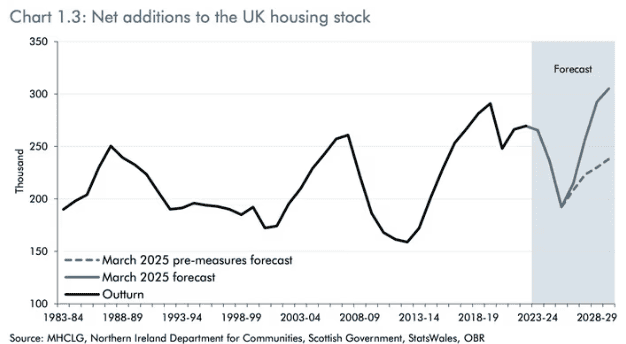
For 2025, it’s targeting 11,000-11,500 completions. The industry has welcomed government desire to boost construction, including its major overhaul of the planning system. The Office for Budget Responsibility (OBR) is predicting a large increase in the number of homes built during this Parliament.

Source: Office for Budget Responsibility

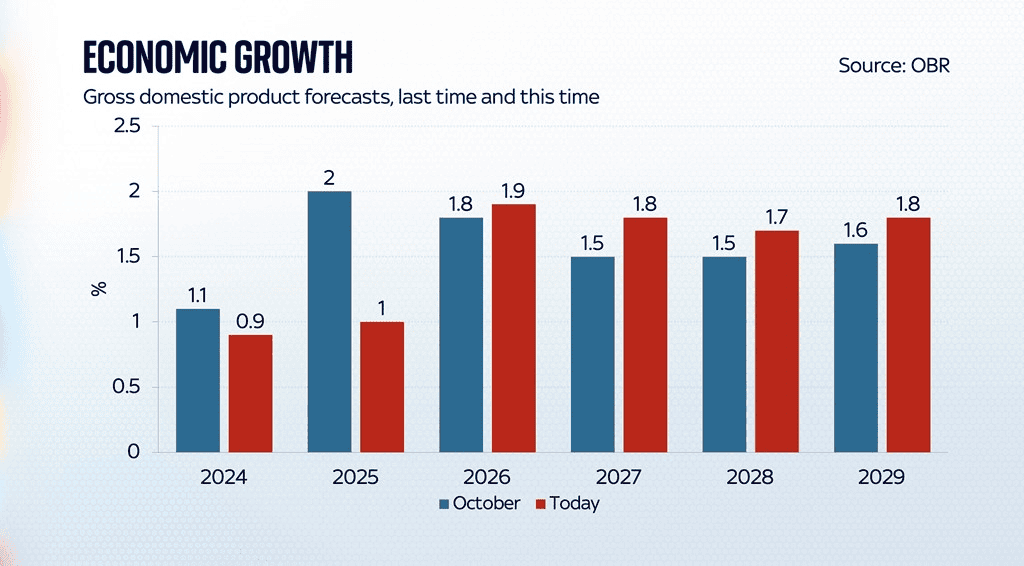
As announced during the Chancellor’s spring statement on 26 March, it’s also upgraded its UK growth forecast from 2026 through until 2029. If these estimates prove to be accurate, this should help secure the anticipated recovery in the housing market that’s likely to benefit from expected reductions in borrowing costs.

Still some challenges

But we’re not there yet. As a result of current global uncertainty, the OBR recently halved its growth forecast for 2025. And the ‘Trump tariffs’ could make things worse.

Also, inflation has eroded profit margins in the construction sector. In 2022, Persimmon recorded a profit before tax per completion of £68,086. For 2024, this was 46% lower at £37,050.

I doubt we are going to see a return to pre-Covid margins any time soon.

Source: Sky News

Broker opinion

However, with no debt on its balance sheet, a private sales order book of £1.15bn and a business that’s likely to escape the worst of the tariffs, I think the stock has strong growth prospects.

And I’m not alone in thinking the company has plenty of potential. Of the 18 analysts covering the stock, 13 say it’s a Buy. They also have an average one-year price target of £15.41 a share – 27% higher than it is today — with a range of £12.60-£23.

I first bought the company’s shares before the pandemic. This means I’m nursing a large loss. However, since then to help soften the blow, I’ve banked some healthy dividends. And that’s why I invested. I saw it as an excellent dividend share.

But I think the recent pullback in the share price means investors looking for a growth share could consider adding Persimmon to their portfolios. And the dividend’s not bad either.

Up 900%, could penny share Kodal Minerals have further to run?

Over the past five years, Kodal Minerals (LSE: KOD) has rewarded investors 10-fold. The sort of 900% increase seen in the share price during that period is the stuff of investor dreams. So, might the penny share have further potential gains ahead of it – and should I add it to my portfolio?

Promising moves towards commercial production

I do see some reasons to be optimistic about the outlook for the company.

In an update to the stock market today (4 April), Kodal provided some encouraging news on developments at its flagship lithium mining project in west Africa.

It said the mine (owned by a company in which Kodal has a 49% interest) is “ramping up towards commercial production”, having produced over 11,000 tonnes of spodumene concentrate to date. The plan is for that to be transported to a port in a neighbouring country and shipped to China, where the lithium can be extracted from it.

For now, the company is stockpiling spodumene concentrate in anticipation of future sales.

High-risk operating environment

So far, so good. But the process also demonstrates some of the risks I see as inherent in Kodal’s business model.

For now, its investment case is heavily focussed on one flagship project, meaning there is a lack of diversification both geographically and also in terms of product. For example, if lithium prices crash, the economics of the project would change dramatically.

But even if lithium prices are strong, there are risks.

The company in which Kodal has a stake in turn owns a local company in west Africa, in which the Malian government has taken a stake. The subsidiary “experienced delays beyond its control in relation to the finalisation of the mining licence transfer” to the local subsidiary. The company has accordingly requested a delay in making a payment due to the Malian government although for now has not received a response.

Clearly, the politics of running a mine in west Africa are not straightforward. Even once the spodumene concentrate is pulled out of the ground, however, it needs not only to be processed but also shipped over an international border from landlocked Mali and then loaded onto ships for a long voyage to China.

Whether it is geopolitical risk, the risk of arbitrary taxation in one of several countries or logistical issues, there is a lot that could go wrong here even if the mining does ramp up commercially as Kodal hopes.

Well outside my comfort zone!

None of that in itself is necessarily bad news. Kodal’s flagship project seems to be moving forward in a positive direction. If that continues, it could be excellent news for the penny share’s price.

But the set-up means that Kodal is far outside my risk tolerance as an investor. Some penny shares carry elevated risks, although as Kodal has shown that can also mean outsized rewards.

But the combination of risks here puts me off as an investor despite the potential gains if things go well. This is one penny share I will not be adding to my portfolio.

3 world-class stocks to consider buying, while they’re ‘on sale’

For those looking for stocks to buy, now’s an exciting time. With markets having sold-off due to uncertainty over Donald Trump’s tariffs, many top stocks are now ‘on sale’.

Here, I’m going to highlight three world-class stocks that are currently trading 20% or more below their highs. I think these shares are worth considering today.

Alphabet

Let’s start with Google and YouTube owner Alphabet (NASDAQ: GOOG). Because this stock looks really cheap right now. Down 27% from its 52-week high, it’s currently trading on a forward-looking price-to-earnings (P/E) ratio of just 17.8. That’s very low for a ‘Magnificent 7’ stock.

Of course, Alphabet’s more sensitive to economic conditions than some of the other Big Tech companies. If businesses reign in their advertising spending, its revenue and earnings growth could stall.

And that’s not the only risk here. Another is disruption to its business model from new generative AI apps like ChatGPT.

This company has plenty of growth levels it can pull however (for example, it could charge customers more for Google Drive). And in the long run, I see plenty of potential from YouTube, cloud computing, and self-driving cars.

So I think it’s worth a look today.

InterContinental Hotels Group

Turning to the FTSE 100, I like the look of InterContinental Hotels (LSE: IHG). It was trading near 11,000p back in February however, it’s now hovering around 7,900p – about 28% lower.

At that price, the P/E ratio is in the low 20s. I think that’s attractive given this company’s brands (InterContinental, Holiday Inn, Kimpton, etc) and very profitable, franchise-based business model.

It’s worth pointing out that in the near term there’s uncertainty here. Consumers are a little on edge right now, and they may reign in their spending on travel over the next 12 months.

Taking a five-to-10 year view however, I expect this company to do well on the back of the retirement of the Baby Boomers, rising incomes in emerging markets, and the general growth of the travel industry. Over time, I expect it to get much bigger so is worth considering.

Scottish Mortgage Investment Trust

Finally, I like the look of Scottish Mortgage Investment Trust (LSE: SMT) at the moment. It’s a growth-focused product that offers exposure to growth industries such as e-commerce, artificial intelligence (AI), self-driving cars, and space technology.

Back in February, its shares were trading near 1,130p. Today however, they can be snapped up for around 900p – about 20% lower.

Now, this investment trust could be volatile in the short term. At present, stocks in industries such as AI are under quite a bit of pressure. But taking a long-term view (as we always do at The Motley Fool), I think it will do well. Let’s face it – the world’s expected to become even more digitised in the years ahead.

This means that the industries I mentioned above are likely to get much bigger. With exposure to companies such as Amazon, Nvidia, and Meta Platforms, this trust is well positioned for the future, in my view and worthy of a closer look.

Could BP’s share price rebound over the next 12 months? These analysts think the answer is ‘yes’!

BP‘s (LSE:BP) share price have been up and down like a yo-yo so far this year. The oil major remains up 0.5% since 1 January, though on a 12-month basis it’s fallen a whopping 20.8%, pulled lower by declining energy prices.

But City analysts are broadly in agreement that BP shares will rise by double-digit percentages over the next year. And combined with the prospect of more juicy dividends, it seems an investment in the FTSE 100 firm today could yield solid near-term rewards.

So how realistic are these price forecasts? And should I consider buying BP shares for my portfolio?

21% price gains?

City analysts aren’t unified in their bullishness for the next 12 months. But the average share price amid the 27 brokers with ratings on BP sits at 491.1p. That’s up 21.2% from current levels of 405.25p.

One especially confident broker believes BP shares will balloon 60.1% over the forthcoming year, to 648.60p per share. However, it’s also worth noting that some believe they’ll tread lower over the period. The most pessimistic forecaster predicts a price of 393.6p, down 2.9% from today.

Price drivers

So what could be the potential drivers for BP’s share price over the next 12 months? First and foremost, its performance is likely to be chiefly influenced by the performance of the black liquid it produces.

Aside from this, signs of progress in its restructuring strategy will be crucial. Fears over debt levels have long plagued the company, so it hopes to cut net debt from $23bn to $14bn-$18bn by 2027, achieved through a blend of investment reductions, cost-cutting and asset sales (of $20bn).

This won’t be easy to achieve, but let’s give BP the benefit of the doubt and say it makes good progress on its aim. Yet this might not be alone if conditions in the oil market become challenging. And this is where I have a problem.

Dark clouds gathering?

A fragile outlook for oil prices has become decidely gloomy in recent hours, causing Brent crude to fall 6% on Thursday (3 April), to $70.22 a barrel.

President Trump’s estimate-busting trade tariffs, combined with likely retaliatory measures from the US’ major trade partners, threaten to stall the global economy and drive up inflation, hitting energy consumption. The demand picture was already clouded by chronic underperformance in China’s economy.

Existing supply-side worries have worsened too, as the OPEC+ cartel has vowed to triple its production target for next month. It will now increase output by 411,000 barrels a day, accelerating its plans to ditch previous output reductions.

Are BP shares a potential buy?

I’m not just concerned about BP’s share price over the next year either. With the company slashing renewables investments and increasing oil production, its longer-term outlook is also plagued with uncertainty as fossil fuels become increasingly unpopular.

Today, BP shares trade on an undemanding price-to-earnings (P/E) ratio of 9.3 times. But even at this level, I’m not prepared to invest in the FTSE 100 oilie. I’d rather find other UK shares to buy.

Is this an unmissable opportunity to buy Nvidia stock?

Nvidia (NASDAQ:NVDA) stock’s long-term performance is still incredible. It’s been a dominant force in the semiconductor industry, revolutionising artificial intelligence (AI), gaming, and data centre technologies.

However, the stock has slumped amid concerns about slowing demand for its chips as more efficient AI models are developed and after President Trump’s market-shocking tariffs.

Valuation

I’ve argued for some time that Nvidia isn’t expensive. Its trailing price-to-earnings (P/E) ratio of 36.9 times is significantly higher than the sector median of 21.7 times, reflecting a 70.2% premium. However, the company’s earnings trajectory is strong given its central role in the AI revolution.

As such, the forward P/E ratios show improvement, with a projected 24.3 times for fiscal 2026. That’s a more modest 18.7% above the sector median but far below its historical five-year average of 47.7 times (-49%). These figures suggest that while Nvidia remains expensive relative to its peers in the near term, its valuation is compressing compared to its historical highs, and growth-adjusted metrics are positive.

The price-to-earnings-to-growth (PEG) ratio provides a more optimistic outlook, with a forward PEG of 0.69. This indicates strong growth potential relative to its price. The traditional benchmark for an undervalued stock is anything under one. But this PEG ratio is actually a 56% discount to the sector average. The P/E falls to 17 times for 2028.

‘Liberation Day’ fallout

Nvidia faces significant challenges stemming from President Trump’s so-called Liberation Day tariffs, which impose reciprocal taxes on imports from countries with claimed higher tariffs on US goods.

While semiconductors from Taiwan are exempt from these tariffs, Nvidia’s broader supply chain could still experience disruptions, increasing costs for raw materials and manufacturing. This exemption provides some relief, given Taiwan’s critical role in Nvidia’s chip production, but the tariffs still complicate logistics and threaten to raise operational expenses.

What’s more, the Chinese government may ban Nvidia’s H20 chips due to new energy-efficiency regulations aimed at reducing environmental impact in data centres. These restrictions jeopardise Nvidia’s $17.1bn revenue stream from China, which accounts for 13% of its total sales.

Furthermore, stricter US export controls have already limited Nvidia’s ability to sell advanced chips like the A100 and H100 in China, forcing the company to develop downgraded models such as the H20 — now also under threat.

Market sentiment

Market sentiment has plummeted in recent months. While the forecasts suggest that analysts remain optimistic about Nvidia’s long-term prospects in AI and accelerated computing, there will be some revisions to these forecasts. Sadly, I expect all of these revisions to be negative.

In my opinion, it may be too soon to consider Nvidia stock following the tariff announcement. Downward revisions to the forecast will hurt the share price more. Investors should monitor how the company navigates these challenges while waiting for clearer signs of stabilisation or improved valuation metrics before making a move. For now, I’m just holding my position. Market sentiment could get worse.

Dividend investors! Here’s what Warren Buffett says builds wealth in the stock market

Billionaire investor Warren Buffett’s approach to the stock market is more complex than first appears. But while a lot of investors are familiar with some aspects of his ideology, others I think are often neglected.

One of these is about dividends. And the Berkshire Hathaway CEO has an important insight for investors who own stocks of companies that distribute their cash to shareholders.

Buffett on dividends

In a 2020 interview with CNBC, Buffett said the following about dividends:

We don’t get rich on our dividends that we receive, although we’re happy to receive them. We get rich on the fact that the retained earnings are used to build new earning power, repurchase shares, which increases your ownership in the company and Berkshire has retained earnings since we started. That’s the only reason Berkshire is worth a lot more – it’s that we retain earnings.

This is probably my favourite Buffett quote of all time. It speaks of something that’s hugely important, but often overlooked by investors who focus on dividends.

It’s natural to think reinvesting dividends in durable stocks with high yields is a good idea. But while it’s not bad, getting the most out of the stock market requires more than this.

Retaining earnings

Buffett’s approach to building wealth is to focus on what companies do with the cash they retain rather than the earnings they distribute. This is what drives earnings growth.

FTSE 100 catering firm Compass Group (LSE:CPG) is a great example. Over the last 10 years, the firm has retained around 45% of its net income and reinvested in back into the business.

Importantly, the company has managed to generate excellent returns on the cash it has retained. Outside the Covid-19 pandemic, returns on equity have consistently been above 20%.

I can’t think of many places where investors can get a return of over 20% without taking big risks. And I certainly don’t see opportunities to do this by reinvesting dividends.

Building wealth

That means investors looking to follow Buffett’s approach to building wealth should consider leaving their cash with the firm. It can almost certainly use it better than they can.

As always though, there are risks to consider. And with Compass, a key concern at the moment is the prospect of job cuts in the US, especially in the healthcare sector. This is a key market for the company and a decline could limit reinvestment opportunities. And while the share price falling offsets this risk somewhat, it doesn’t entirely remove it.

In general however, the stock’s a great illustration of Buffett’s point. As long as the firm can use its cash more efficiently than investors can, it’s a better way to build wealth than dividend stocks.

Compounding

Investing to build wealth is more complicated than just finding stocks with high returns on equity. As Buffett has noted several times, the price an investor pays is crucially important.

That’s the big drawback with Compass shares at the moment. It trades at a price-to-book (P/B) multiple of over 8, meaning investors only get around £12 in equity for every £100 they invest.

As a result, I see Compass as a stock to watch, rather than one to consider buying. But I’m aiming to follow Buffett’s advice by finding similar stocks trading at more attractive valuations.

Financial News

Daily News on Investing, Personal Finance, Markets, and more!

Financial News

Policy(Required)