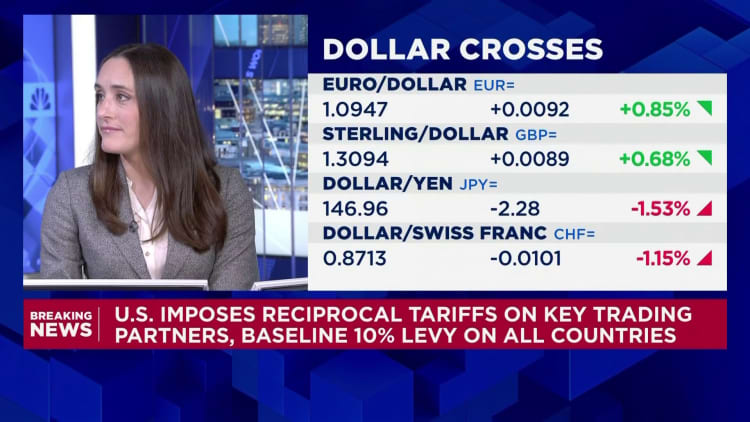
The Lloyds (LSE:LLOY) share price fell 5.5% on 4 April 2025, extending losses triggered by former President Donald Trump’s announcement of a 10% tariff on UK imports. This decline reflects broader market jitters, with the FTSE 100 down 1% and European indexes faring worse. For Lloyds, the sell-off underscores concerns about macroeconomic challenges and their impact on bank profitability.
Tariff turbulence
Trump’s tariffs have intensified fears of a US recession, with Barclays analysts assigning a ‘high risk’ designation. For Lloyds, the immediate threat lies in dampened global trade activity and potential retaliatory measures, which could strain UK economic growth.
While Lloyds’ domestic focus insulates it from direct tariff exposure, secondary effects loom. This includes a weaker UK consumer outlook that might elevate loan defaults, pressuring net interest margins already under scrutiny.
For example, some British businesses — many of which are Lloyds loan customers — may have significant exposure to the US market. In certain cases, a 10% tariff on UK exports could be enough to tip these businesses into financial distress, potentially resulting in bad debt for the bank.
Valuation maths
Lloyds’ forward price-to-earnings (P/E) ratio sits at 9.9 times for 2025, above its five-year average and peers like Barclays (7.2 times) and HSBC (8.9 times). However, analysts project this multiple to compress to 6.5 times by 2027 as earnings per share (EPS) climbs to 10.67p. This implies a 2027 share price of £1.03 if current multiples hold.
However, the caveat is that Lloyds is more expensive than usual in 2025 because of an expected earnings blip, with impairment charges weighing on the year’s forecast. Investors will likely need proof of growth beyond 2027 in order to get near to that £1.03 mark.
The price-to-book (P/B) ratio tells a similar story: at 0.99 times for 2025, Lloyds trades near book value. However, this could dip to 0.83 times by 2027 as equity grows faster than share price. It’s undervalued compared to global peers but not far from its own historic averages.
Dividend resilience
Despite the sell-off, Lloyds’ dividend profile remains robust. The 2025 payout of 3.44p per share offers a 4.8% yield, with coverage improving as EPS rises. By 2027, dividends are projected to hit 4.64p, yielding 6.7% at current prices. Crucially, the payout ratio remains below 50%, balancing shareholder returns with capital retention for regulatory buffers.
Praying for a trade deal
Lloyds shares are heavily reflective of the condition of the UK economy. It doesn’t have an investment arm, so it’s really focused on lending. Following these tariffs, I’m struggling to work out whether Lloyds stock is now undervalued or whether I should buy more. However, I would say that a trade deal that reduces US tariffs on the UK will be very positive Lloyds. I’m keeping my fingers crossed that a deal can be reached soon.
In the hope of picking up some cheap shares, I’ve moved a little bit of cash into my Stocks and Shares ISA. In common with many investors, ‘Liberation Day’ has resulted in my portfolio taking a bit of a battering. But I don’t think there’s any need to panic. I’ve seen many market pullbacks before.
A cautious approach
However, I don’t intend buying anything just yet. But soon, I’m sure a clearer picture will emerge. With any change in policy, there’s likely to be winners and losers. However, if the economists are right, and global economic growth weakens as a result of a trade war, everyone’s likely to be worse off. But that doesn’t necessarily mean there’s an absence of opportunities for those prepared to take a long-term view.
President Trump’s idea of ‘Making America Wealthy Again’ makes sense. But the fall in the US stock market suggests not everyone in his country agrees with his approach. Until this week, I thought his threat to impose tariffs was a bit of a negotiating ploy. Indeed, it could still be. But I think now’s a good time to plan for the worst and assume that import taxes are here to stay.
What I’m doing
That’s why I’ve topped up my ISA. And there’s one stock – BP (LSE:BP.) – that I’m keeping an eye on. That’s because it’s currently (4 April) close to its 52-week low. And with a “larger footprint in America than anywhere else in the world”, it’s better protected from tariffs than most. It’s also likely to benefit from the “drill, baby, drill” approach of the Trump administration.
However, its share price is closely correlated with the price of oil. This isn’t surprising given that approximately 65% of the group’s revenue is derived from oil-based products.
But world oil prices have been dropping as fears of a global trade war increase. Although an economic slowdown’s likely, businesses and consumers will still need oil and gas.
An increasing yield
Previously, I’ve said that BP’s dividend isn’t high enough to compensate me for the risk of investing in the energy sector. However, the stock has fallen 25% since April 2024, and it’s now yielding 6.4%.
The recent slide in the dollar has reduced this slightly. If the January exchange rate was used, the yield would be 6.8%.
But I think there could be further trouble ahead. China has announced a retaliatory tariff on the US, which could be the start of a series of tit-for-tat measures unveiled by governments around the world. As a result, I suspect the oil price will come under more pressure. Brent crude is currently trading at its lowest level for three years.
My plan
Of course, timing the market is notoriously difficult. Although I’m confident that the BP share price will stop falling, I’ve no idea when this will be.
Although there’s a wide discrepancy in forecasts, most economists agree that the world hasn’t reached peak demand for oil. And even when it does, it seems unlikely to fall quickly thereafter. That’s why I think BP could be a bit of a bargain.
But I’m going to keep the energy giant’s shares on my watchlist for now as it looks to me as though the current market volatility will continue for a little while longer.
Trump said his tariffs will bring jobs and factories back to the U.S.
Experts said some companies may return, but challenges remain, including business confidence, the necessary infrastructure and labor.
Arseniy45 | Istock | Getty Images
President Donald Trump may hope his tariffs jump-start a renaissance in manufacturing in the United States, but the reality is not so simple, according to experts.
The president announced sweeping tariffs Wednesday, including a baseline 10% levy across the board on all imports. He also targeted specific countries with steep tariffs, such as 34% on China, 20% on the European Union and 46% on Taiwan.
Trump said “jobs and factories will come roaring back.”
“We will supercharge our domestic industrial base, we will pry open foreign markets and break down foreign trade barriers and ultimately more production at home will mean stronger competition and lower prices for consumers,” he said during his news conference.
The U.S. has lost about 6 million jobs over the last four or five decades as companies moved operations overseas, largely because business could be done cheaper elsewhere, said Harry Moser, president of the nonprofit Reshoring Initiative.
He said the tariffs are a good start to overcoming that problem but that dealing with a strong dollar and building up the workforce is the best solution.
Moser said he would have preferred lower levies than those Trump announced.
“Smaller would be easier to defend, but still enough to drive reshoring and FDI [foreign direct investment] in excess of our ability to build and staff factories,” he said.
He said he expects Trump’s initial salvos to result in negotiations.
“As long as he convinces the other countries that he will keep attacking the problem until it’s solved, then they will come forward and maybe let their currency go up a little bit,” Moser said. “Maybe they’ll lower their tariff barriers to our products. Maybe they’ll encourage their companies to put factories here in the United States.”
Businesses expected to ‘proceed cautiously’
Still, there are a number of issues to overcome to bring companies back to the United States, including uncertainty around the tariffs and how long they will stay in place, experts said.
“Given the unpredictable nature of the path forward and the long lead times to build industrial capacity, we expect most businesses to proceed cautiously following this announcement,” Edward Mills, Raymond James’ Washington policy analyst, said in a note Wednesday. “New capacity can be added where feasible, but without certainty on longer-term policy, larger investments are more difficult.”
“These are investments, and as a businessman you’ve got to justify them and rationalize it,” said Panos Kouvelis, professor of supply chain, operations and technology at Washington University in St. Louis. “If there’s significant uncertainty, you might make some investments, but rather conservative, because you would like to see how it’s going to play out.”
Kouvelis’ research on Trump’s 2018 targeted tariffs found that they did not have a big impact on reshoring or the return of jobs to the U.S. He said there was a negative effect for manufacturers, who had to pay more for raw materials, with reduced demand and capacity in some cases. Finished goods was a mixed story, depending on demand, he said.
The latest levies are seen as “fluid and fickle” because they are based on executive orders from the president and were not done through Congress, said Christopher Tang, distinguished professor at the UCLA Anderson School of Management.
Unless we solve the crisis of confidence, the potential investments, the announced investments will not happen at a fast pace. It will slow down.
Manish Kabra
Societe Generale’s head of U.S. equity strategy
“A lot of companies, then, are not sure really how to redesign the supply chain when the trade policy is unclear, and also what happens four years down the road,” Tang said. “So because these are many, many billions of dollars in investments, they cannot change on a lurch.”
Morgan Stanley analyst Chris Snyder said he thinks tariffs are a “positive catalyst” for reshoring but that he doesn’t expect a massive wave of projects returning to the U.S. in the near term. Right now, he expects small, quick turnaround investments that could boost output by about 2%, he said.
“When we talk to corporations, there is a lot of uncertainty about what policy will be in three months,” he said.
In addition, consumer confidence has taken a hit — and that will be a factor in business’ decisions on whether and when they will reshore, said Manish Kabra, Societe Generale’s head of U.S. equity strategy. The Conference Board’s monthly consumer confidence index hit a 12-year low in March.
“When you have crisis of confidence, the confidence of global companies that have announced investments in the U.S., they are going to pause,” Kabra said. “Unless we solve the crisis of confidence, the potential investments, the announced investments will not happen at a fast pace. It will slow down.”
Rushing reshoring could be ‘dangerous’
A lot needs to happen before manufacturing can really ramp back up again in the U.S., experts said.
“The United States is not ready to reshore. We don’t have the infrastructure, we don’t have enough workers, and also, we need to examine how many Americans are willing to work in the factory,” Tang said. “If you rush it, it could be rather risky and dangerous.”
He said he expects some companies to return as a result of Trump’s tariffs but that there are still a lot of barriers for many. Executives are under pressure to show short-term results in quarterly earnings, he said, and managing an American workforce can be complicated.
“There’s so many regulations, so many laws, and also the cost is quite high, so the incentive for them to come back is not high,” Tang said.
There also needs to be a significant investment in training America’s workforce, Moser said.
Trump’s tariff program “will fail unless the nation commits to a vastly increased recruiting and training program for skilled manufacturing workers and engineers,” he said. “We need to go from ‘College for all’ to ‘A great career for all.'”
Morgan Stanley’s Snyder said he believes when companies are ready to build their next project, they will now be more likely to turn to the U.S.
“The U.S. is in the best position to get the incremental factories than it has been in the last 50 years,” he said. Plus, the wave of manufacturing starts that has occurred since the pandemic has stalled and the tariffs will give them more urgency to finish, he said.
What could be reshored
Companies have announced investments worth $1.4 trillion since the election, according to Societe Generale’s Kabra. That adds up to about 200,000 new jobs, he said.
Automobile makers are likely among the industries that will reshore, experts said. Trump imposed a 25% tariff on imported cars and has also vowed to tax key auto parts.
Manufacturers of gas-powered cars will have to weigh their options, since they already have a very streamlined supply chain, said University of Washington’s Kouvelis.
“The gas-powered car industry is in trouble with hard-to-adjust supply chains and not enough incentive to do it,” he said.
Electric vehicles are a different story, because they have fewer parts, the battery being the most important, so those companies are more likely to shift operations, he said.
“Everybody understands the U.S. market is lucrative to lose, and the competitors with an advantage [such as Chinese companies] more or less are kept out,” Kouvelis said.
Snyder also said that EVs are among those likely to come to the U.S., but because they will need more capacity. His thesis is that industries that need to expand — rather than close up shop in another country and move — will be the ones that return to the U.S. That includes industrial equipment and semiconductors, he said.
While semiconductors and pharmaceuticals were exempt from the tariffs, they may still be targeted at a later date. Experts said they expect both industries to reshore.
Semiconductor manufacturers got the incentive to return after Congress passed the CHIPS Act in 2022, which provided financial assistance and tax credits to those building and expanding facilities nationally. The computer and electronic products industry saw the most reshoring jobs announced in 2024, according to the Reshoring Initiative.
“Those are high tech, high-end technology and a lot of automation. They don’t need that many workers,” said Tang.
With pharma companies, just some of the supply chain may come back, Kouvelis said.
“The question is, where are you going to apply the tariff? Will you apply to the final or to the chemicals? Because right now, you want the chemicals and the active ingredients to be sourced from China,” Kouvelis said.
Formulation and packaging, however, can be done in the U.S., if that’s enough to avoid tariffs, he said.
“If you want them to bring all of the supply chain, you got to be very aggressive on how you apply tariffs on everything in the supply chain,” Kouvelis said.
Some pharma companies, including Eli Lilly and Johnson & Johnson, already began expanding in the U.S. before Trump took office.
Get Your Ticket to Pro LIVE
Join us at the New York Stock Exchange!
Uncertain markets? Gain an edge with CNBC Pro LIVE, an exclusive, inaugural event at the historic New York Stock Exchange.
In today’s dynamic financial landscape, access to expert insights is paramount. As a CNBC Pro subscriber, we invite you to join us for our first exclusive, in-person CNBC Pro LIVE event at the iconic NYSE on Thursday, June 12.
Join interactive Pro clinics led by our Pros Carter Worth, Dan Niles and Dan Ives, with a special edition of Pro Talks with Tom Lee. You’ll also get the opportunity to network with CNBC experts, talent and other Pro subscribers during an exciting cocktail hour on the legendary trading floor. Tickets are limited!
Once again, the annual deadline for ISA contributions has rolled around. That has got me thinking about how some leading shares have fared over the past year. For example, one-time stock market darling Tesla (NASDAQ: TSLA) has taken a hammering over the past year. As an investor though, what can I learn from the performance of Tesla stock in the year since the last ISA contribution deadline?
The stock has soared in the past year!
This is not merely a theoretical question for me. I think Tesla has a lot going for it, from its large installed user base to proprietary technology and a booming energy storage division.
If I could buy the stock at what I thought was an attractive valuation, I would be happy to own it. So I have been keeping an eye on the price to see whether it reaches a point I think offers me the right amount of value.
A lot of attention has been paid to the crumbling price over the past few months. Tesla has crashed 44% since December.
The longer term, picture, though, remains positive.
Over the past year, Tesla has gained 59%. So £20K invested in it a year ago would now be worth around £31,750.
Ongoing growth prospects – and concerns
There has been no dividend during that period. Tesla has never declared a dividend despite being profitable.
Instead, it puts excess cash to work back within the business. That is fairly common practice for growth companies.
Tesla has a lot of growth opportunities. Updating and expanding its range of vehicles and selling higher volumes is one. But there are others, from the energy storage division to as-yet-unlaunched products like driverless taxis and robots.
The first quarter was a great one for the energy business. Tesla announced this week that it deployed 10.4GWh of energy storage products in the first three months of this year. That was a big jump from the same period last year
Car delivery volumes, by contrast, fell 13% year on year (and production fell 16% but was still markedly higher than deliveries).
The stock price crash of recent months partly reflected investor concerns about weaker sales, as rivals like BYD ramp up sales and Tesla’s brand continues to be impacted in some markets by the high public profile of boss Elon Musk.
The share price still looks high to me
Clearly, Tesla has a tough sales challenge on its hands.
But it has large economies of scale, a proven vertically integrated model and much longer experience than some rivals. I continue to see this as a solid business with a potentially strong future.
I was not ready to invest a year ago because I felt it was overpriced. What about now?
That still looks very expensive to me especially for a company with a challenging competitive environment that is seeing sizeable sales falls in its core business.
I will continue to keep the stock on my watchlist without buying for now.
The answer to that question depends on three main variables.
First, what is the timeline?
In this example I presume a retirement age of 67 – so for someone who is 40 today, that means a 27-year timeframe.
The second variable is the amount invested.
Here I assume £600. In reality, everyone is different and will make their own choices about how much they can afford to put aside regularly into their SIPP.
Small differences can be magnified by time
The third variable is the compound annual growth rate achieved over the lifetime of the SIPP.
What seem like small differences can have a big impact, thanks to the compounding effect over a long timeframe.
For example, at a 5% compound annual growth rate, today’s 40-year-old contributing £600 a month will have a retirement fund at 67 worth around £402,600.
At an 8% compound annual growth rate, though, that fund will be almost £652,000. That is a big difference!
Choosing a realistic strategy for investing
That 8% compound annual growth rate does not necessarily require an 8% dividend yield (or any dividends at all, in fact).
It is a combination of dividends plus capital growth, minus any capital loss from shares sold for less than they cost.
So, in today’s market I think it is achievable.
But not everyone investing in a SIPP has much, or any, experience and they may not want to spend large amounts of time monitoring their investments over the next quarter of a century or so.
I think it helps to take a realistic approach – not being too greedy, sticking to what you understand, diversifying across a range of shares and weighing risks seriously.
On top of that, it makes sense to choose a SIPP that is competitive in terms of the fees it levies, as they eat into overall returns.
One share to consider for a SIPP
To illustrate that approach, one share I think investors should consider is insurer Aviva (LSE: AV).
Its current dividend yield of 6.7% would already go a significant way towards achieving an 8% compound annual growth rate. The annual dividend per share has been growing strongly in recent years, following a cut in 2020.
The Aviva share price is up 8% over the past year and has more than doubled over five.
I think the business can potentially keep performing strongly. Insurance is a market with high, resilient demand and Aviva has a commanding position in the UK’s general insurance sector.
That could get even stronger with its proposed takeover of rival Direct Line. That should offer economies of scale, although I also see a risk that Direct Line’s mixed performance of recent years could continue, acting as a drag on Aviva.
Still, with a proven business model, strong market share and juicy dividend, I see Aviva as a share SIPP investors should consider.
When it comes to dividends, insurer Phoenix Group (LSE: PHNX) is one of the big beasts in the FTSE 100. Its mammoth 9.9% dividend makes it among the most lucrative FTSE 100 dividend shares. When it comes to share price movement, though, Phoenix is more underwhelming.
Over the past five years, for example, it has moved up just 3% — yet during that period, the FTSE 100 index has soared 55%.
Five years ago the market was still in the middle of pandemic turmoil and that may be a factor in the gap. But even over a one-year timeframe, the Phoenix share price has underperformed relative to the index. Phoenix has fallen 1% in the past 12 months, while the FTSE 100 has moved up 5%.
What is going on – and might it still make sense for an investor to consider Phoenix despite its underwhelming share price performance?
A high dividend can be attractive, but also scary
Perhaps counterintuitively, I think part of the challenge for Phoenix could actually be its dividend.
That may sound odd, but when a company has a high yield, it can sometimes make investors fearful about how likely the payout is to be maintained.
M&G, for example, has a 10.5% yield and last month announced the latest increase in its annual dividend per share, yet the M&G share price is down 10% over the past year.
Still, it is up 74% over five years. Again though, I think that may simply reflect a pandemic-era baseline. Going slightly further back, to M&G’s listing in 2019, the performance to date has been a 15% share price fall despite a consistently high dividend yield.
In the case of Phoenix, I think the combination of a business seeming rather dull (as insurance can do) with being difficult to understand has also constrained investor enthusiasm for the stock.
Phoenix could be a high-yield bargain
Still, while some shares do not excite investors, money tends to talk. If Phoenix has strong potential as a business, why has its share price performed weakly over time even while the firm continues to hand out generous dividends?
There are risks here that could provide some explanation. Long-term valuation assumptions about the sorts of policies housed on Phoenix’s books can be challenged by unforeseen movements in the economy, for example. So a business that seems profitable for many years can suddenly start making far less money than expected as the economy shifts.
But while profits are an accounting concept, cash flows show the hard, cold cash a business is generating.
Last year, Phoenix’s operating capital generation was £1.4bn. It achieved that level two years ahead of schedule. It now expects operating capital generation to grow by mid-to-high single-digits annually, in percentage terms.
If it can achieve that, the dividend looks comfortably secure to me. Phoenix’s progressive dividend strategy foresees annual growth in the dividend per share, although no dividend is ever guaranteed.
For that level of operating capital generation, the market capitalisation of £5.4bn looks low to me.
Over the medium-to-long term, I would expect solid business performance could justify a higher share price for Phoenix. On top of that, I reckon the high yield makes this a share investors should consider.
The FTSE 100 is a safe bet when it comes to picking shares, but it seldom offers the best yields. To add a bit of ‘oomph’ to a passive income portfolio, it pays to dig a bit deeper.
Today, I’ve uncovered two mid-cap shares on the UK’s smaller indexes that could provide lucrative dividend returns.
But I’m not just going on the yield — both these shares have impressive return on equity (ROE) and a price-to-earnings growth (PEG) ratio below one. This shows they use their equity efficiently and are well-priced relative to earnings growth.
Let’s dive in.
Polar Capital
Polar Capital (LSE: POLR) seems like a small outfit on the face of things, with a market cap of only £400m. But it’s a major London-based fund manager with upward of £23bn in assets under management (AUM). Not only that, its AUM has grown almost 10% in the past year — during a period when many fund managers have experienced reduced AUM.
One risk is that the fund is largely focused on healthcare and technology, much of which derives revenue from the US. With new trade tariffs in place, these stocks may suffer, passing on losses to Polar Capital.
Price performance might not look that great at first; it’s up less than 10% in the past five years. But when adjusted for dividends, the full return on investment (ROI) rises to 57.23%. That equates to an annualised return of 9.86% per year — not bad!
Of course, there’s no guarantee that performance will continue. But annual dividends have increased 80% in the past 10 years, which is promising. Currently a meaty 11.4%, its dividend yield typically fluctuates between 7% and 15%.
Twenty-Four Income Fund
Twenty Four Income Fund (LSE: TFIF) is a relatively young investment company established in 2013 in Guernsey.
Its focus is on European asset-backed securities (ABS) with low liquidity and high yields. This strategy gives investors exposure to a segment of the fixed-income market that is often overlooked yet potentially valuable.
Consequently, the fund maintains a high and stable yield between 9% and 10%. Over the past decade, its final dividend has grown from 6.38p to 9.96p at a rate of 3.4% per year.
However, the focus on asset-backed securities (ABS) and mortgage-backed securities (MBS) also adds a moderate level of risk. Not only can they lack liquidity, but they are also sensitive to the quality of the underlying loans. If borrowers default, the fund’s income and capital could be affected. Reduced income can lead to dividend cuts.
As is common with dividend-focused funds, the share price has enjoyed only moderate growth of 30% in the past five years. However, total returns reach almost 87% when adjusted for dividends, equating to annualised returns of 13.3% per year.
While both the above stocks have experienced historical losses due to market downturns, I think they are worth considering for the high and reliable dividends. For investors looking to build a steady passive income stream, a reliable dividend history with consistent growth is a key element to look for.
As stock markets attempt to digest the impact of Trump’s tariffs, the Barclays (LSE: BARC) share price has been one of the hardest hit in the FTSE 100. Amid all the uncertainty, is this now the buying opportunity I have been waiting for?
Recession fears
Decades of ever-closer trading relations between countries was undone in an instant by Trump’s tariffs. His high-stakes gamble to bring back jobs and manufacturing to the US could spectacularly backfire if it leads to stagflation and a US recession.
It’s little wonder that the banking sector has been one of the hardest hit. The sector is notoriously cyclical and is a classic indicator of future economic prosperity.
Although all big five UK banks were down significantly, Barclays has been particularly badly hit because of its large US investment bank operations. A US recession would result in significantly lower fees from IPOs and mergers and acquisitions, for a start.
Structural hedge
The announcement of global tariffs certainly bodes poorly for future bank earnings, but one must not forget the importance of the structural hedge in cushioning the blow.
Elevated interest rates have really helped banks’ net interest income (NII) over the past few years. But wherever the economy goes next, that won’t affect a huge chunk of Barclays future earnings.
The structural hedge is designed to reduce income volatility and manage interest rate risk, notably falling ones. Economists are already forecasting steeper rate cuts in 2025, as a direct consequence of these tariffs. But that won’t concern it.
In its FY24 results released back in February, the blue eagle bank reported that NII from the hedge increased £1.1bn last year, to £4.7bn. It also stated that it has already locked in £9.1bn of gross income over the next two years. Its income will also continue to build as it constantly reinvests maturing assets at higher yields.
Costs
Another good sign for the bank is that costs have been moving in the right direction. In 2024 it achieved a cost-to-income ratio of 62%. In total, it delivered £1bn of gross efficiency savings throughout last year. All savings it made mean that cash can be deployed elsewhere to create business growth.
Over the next two years it’s targeting another £1bn in savings. If successful that will bring down the cost-to-income ratio into the high 50s.
Savings are expected to come from a number of buckets. Structural business actions include simplifying customer journeys and optimising people and technology. One note of caution though, the integration of recently purchased Tesco Bank will push up costs. However, it believes that efficiency savings elsewhere will more than offset that.
Shareholder returns
For income-focussed investors, a falling share price has pushed the dividend yield up to 3.6%. On top, it also announced a £1bn share buyback programme to commence immediately. Although the dividend won’t increase in absolute terms, dividend per share will increase as the number of shares in circulation decreases.
Amid all the uncertainty, I have no idea if the share price has further to fall. But tariffs or not, the fundamentals remain strong and I intend to buy some more shares in the near future.
Fundsmith Equity is a popular investment fund. And it’s easy to see why – since its inception in 2010, it has delivered impressive returns (around 14% per year). Recently however, the performance has been underwhelming. This begs the question: is the fund still a good option to consider for a Stocks and Shares ISA now?
Quality focus
Let me start by saying that I have a position in Fundsmith myself. The reason why is that I like portfolio manager Terry Smith’s ‘quality’-based investment strategy. Buy good companies, don’t overpay, do nothing is his approach. That’s a good strategy, in my view.
Now, there’s no doubt that Fundsmith’s performance over the last two years has been disappointing. In the tech-driven bull market of 2023/24, the fund wasn’t able to keep up. But I’m not too concerned here as returns were still decent. And most active fund managers weren’t able to beat the market with mega-cap tech stocks having such a strong run.
What I want to see is outperformance in normal and/or weak market environments. Can it beat the market in these conditions? That’s the big question for me. Because if it can, it could potentially play a valuable role in my portfolio as a diversifier/hedge against risk.
So, what has performance looked like this year?
Q1 2025
2024
2023
2022
2021
2020
Fundsmith
-5.7%
8.9%
12.4%
-13.8%
22.1%
18.3%
MSCI World
-4.7%
20.8%
16.8%
-7.8%
22.9%
12.3%
Well, it’s concerning, to be honest. Given the fund’s focus on quality, I would have expected it to outperform in 2025 as markets have fallen. But it hasn’t. For Q1, it returned -5.7% versus -4.7% for the MSCI World index – that’s not good.
March’s performance was particularly bad. Here, it returned -9.2% versus -6.8% for the MSCI World.
An underperformer
Looking under the bonnet to see what’s gone wrong, it seems a few top holdings have taken a big hit. An example here is Novo Nordisk (NYSE: NVO).
Year to date, it’s down about 20%. Over 12 months, it’s down roughly 45%.
What’s happened?
Well, the main issue is that investors have become concerned that the Danish company – which is the producer of weight-loss drugs Wegovy and Ozempic – is losing ground to US rival Eli Lilly. This has led to a major valuation re-rating.
Personally, I think the stock has fallen too far, could bounce back and is worth considering today. To my mind, it now looks cheap (the price-to-earnings ratio is just 18) relative to its forecast growth of a 20% revenue rise this year.
That said, the competition from Eli Lilly – which makes Zepbound and Mounjaro – is a legitimate risk. It could lead to a slowdown in growth for Novo.
Concentration risk
Now, if you own 100 stocks in your portfolio and one bombs like this, it’s not going to be the end of the world. However, if you only have 25-30 stocks, like Fundsmith does, this kind of underperformance can result in a real drag on performance. This concentration is one of the big risks here. If Smith picks the wrong stocks, it can lead to poor returns.
What I’m doing
Looking at Fundsmith today, the bottom line is that performance needs to pick up and quickly. For the fee, I’d want to see better returns.
I’m continuing to hold it and I still think it’s worth considering as part of a diversified portfolio. But right now, I’m putting more money into passive funds, niche funds, and individual stocks.
One share I have been eyeing as for possible inclusion my ISA for some time is chipmaker Nvidia (NASDAQ: NVDA), but the high price of the stock has put me off.
However, the share price has now come down by 24% since the start of the year.
So, is this the sort of opportunity I have been waiting for to add Nvidia to my portfolio?
Here’s why it’s been falling
A share does not lose almost a quarter of its value in three months for no good reason – and so it is with Nvidia.
Some investors were already concerned about the valuation of the company, which even now commands a $2.5trn market capitalisation.
The prospect of damaging trade conflicts between the US and other countries has brought a risk to both the top line and bottom line for the company. On the top line, tariffs and trade disputes could see clients delay orders, hurting revenues. At the bottom line, the additional costs of such tariffs could eat into profitability if they cannot fully be passed on to customers.
That is on top of longer-term concerns about Nvidia, after the stock grew 1,569% in the past five years.
Key among those is what the future demand landscape for AI chips may look like. Are recent strong sales indicative of what to expect in future? Or are they a temporary blip as companies scramble to make AI a bigger part of their business?
Another risk is one that the launch of the DeepSeek AI model brought into sharp focus. It is that it may be possible for firms to develop sophisticated AI solutions without necessarily using the sort of computing power most observers had previously assumed would be necessary. That could be bad news for Nvidia’s future sales volumes.
I’m increasingly tempted to buy
No shortage of risks there then!
Nonetheless, fast-growing Nvidia has proved itself to be both resilient and remarkable in recent years. Its proprietary technology means that many clients have no effective substitute for some of the chips they source from Nvidia.
Its pricing power is also impressive. Last year, revenues reached $131bn and net income was $73bn. That net profit margin of 56% is something a lot of companies could only dream about.
Currently, the stock is selling for around 35 times earnings. The prospective valuation is even cheaper given the potential for it to grow its earnings, which last year it did strongly.
I still do not think the valuation looks cheap. But does it look attractive relative to what I see as the long-term potential of the business? Increasingly I believe it does, but not yet to the point where I am ready to buy.
While Nvidia has got cheaper, the risks also now look higher than they did to me just a matter of weeks ago. So, I still feel the Nvidia stock price offers me insufficient margin of safety for comfort.
I will keep watching it to see if further falls bring it to a level where I would be comfortable buying.
Financial News
Daily News on Investing, Personal Finance, Markets, and more!