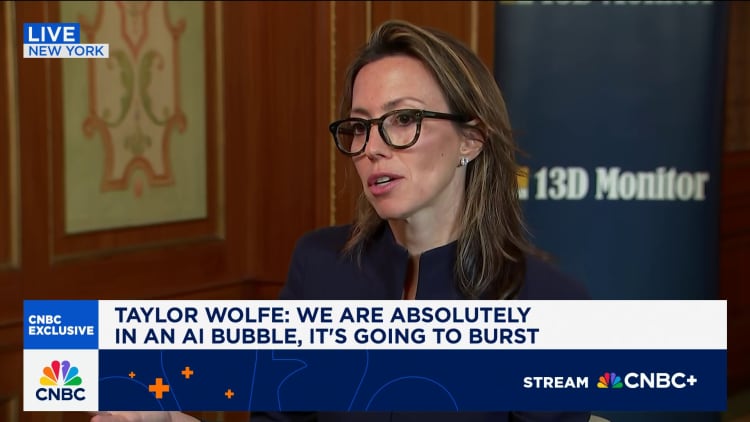
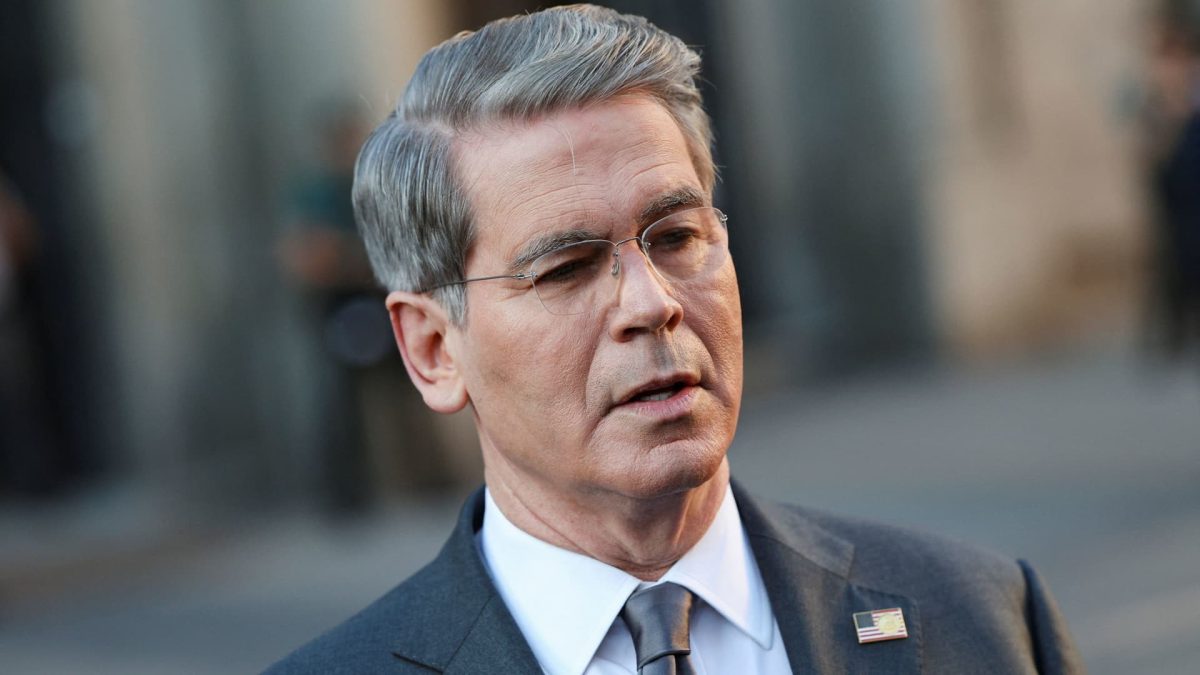
Lauren Taylor Wolfe, co-founder of activist investment firm Impactive Capital, said the surge in enthusiasm around artificial intelligence has all the markings of a bubble.
“We are absolutely in an AI bubble now. It is going to burst,” she said on CNBC’s “Squawk on the Street” Tuesday to David Faber. “I don’t know when, I don’t know the order of magnitude. A lot of people are going to lose money.”
Her remarks come as enthusiasm for AI continues to drive markets higher, with investors betting the technology will transform industries and lift corporate earnings. Taylor Wolfe said investors are underestimating the risks tied to the surge in AI-related spending by major technology companies.
“There are trillions of dollars that are being earmarked to be spent relative to hundreds of billions of dollars of free cash flow generated by the Mag 7,” she said, referring to the group of large-cap tech stocks that dominate the S&P 500. “They’re going to have to borrow to invest in all this CapEx, and we have yet to see the returns on investment.”
Her remarks come at a time when analysis shows the S&P 500 has become pretty much an AI index.
Taylor Wolfe believes the mismatch between capital expenditures and profit potential makes current valuations difficult to justify.
“Show me the trillions of dollars of profits that are going to be generated in the next five years,” she said. “And you just can’t. The math doesn’t work.”
She said the current environment is reminiscent of the late 1990s, when investors chased anything associated with the internet regardless of valuation or business model. During the dotcom era, the right thing to do wasn’t short the bubble companies; it was to look where no one else was looking, she said.
“You’d have been better off owning a railroad in 2000 than buying Cisco at 35 times earnings, Taylor Wolfe said. “So at Impactive, what we’re doing today is looking for our railroads.”
At the 13D Monitor’s Active-Passive Investor Summit Tuesday, Taylor Wolfe presented her new ideaAdvanced Drainage Systems, which she called the undisputed leader in plastic stormwater and residential septic systems. She said the company is AI proof.
Comfort Colors has seen demand take off for its shirts in recent years.
The Gildan-owned brand is planning an expansion to other categories such as hats and bags.
Comfort Colors t-shirts are seen on Oct. 16, 2025.
Danielle DeVries | CNBC
When looking through Wyatt Cannon’s T-shirt collection, there’s a common theme: the Comfort Colors label.
Growing up, Cannon would often find Comfort Colors apparel when looking for souvenirs during family trips. In college, Cannon convinced his a cappella group to screen print on the company’s blank shirts. When the 24-year-old has made tie-dye T-shirts for himself, it’s with Comfort Colors product.
“I’ve loved this brand my whole life,” said Cannon, who estimates around half of his shirts are Comfort Colors. “This kind of material and texture and vibe of T-shirt should just be more of the standard.”
Cannon is part of a loyal and growing base of consumers driving demand for the half-century-old, Gildan-owned shirt brand. The label’s ballooning success in recent years can help explain Gildan’s stock outperformance and has led to plans for an expansion into additional product categories.
Comfort Colors t-shirts.
Courtesy: Watt Cannon
Gildan is tight-lipped about specific brand performance and declined to share Comfort Colors’ sales data with CNBC. But company executives have said Comfort Colors took off, especially over the last year, and has become a leading brand within Gildan, which also sells apparel under its namesake label and American Apparel.
“Comfort Colors is probably the fastest-growing fashion brand,” Glenn Chamandy, Gildan’s co-founder and CEO, said during a call with analysts earlier this year. “When you walk into a souvenir store today, you’ll see Comfort Colors on every single one of those tables where you used to see fashion brands before.”
‘Knocking it out of the box’
Gildan acquired Comfort Colors for around $100 million in 2015 in hopes of expanding within the basics category of North America’s printwear market, according to a press release announcing the deal. At the time, Gildan called the Vermont-based apparel maker “one of the most recognized brands” in places like college bookstores and resorts.
The brand publicizes that its shirts are 100% cotton from the U.S. Its “pigment pure” dyeing system creates the shirts’ “signature faded look” and requires less energy and water use than other comparable processes, Gildan says.
Comfort Colors’ popularity exploded in 2024 with around 40% year-over-year growth, company executives have said on earnings calls. That helped drive sales in Gildan’s broader activewear category 6% higher in the same period.
Chamandy told analysts in late July that Comfort Colors is “knocking it out of the box again this year” and helped push the activewear category up 12% in the second quarter. The brand is planning to expand into hats, bags and women-specific clothing in 2026 as it rings in its 50th anniversary, Howard Upchurch, marketing and merchandise chief at Gildan, said in a statement to CNBC.
Gildan, which announced earlier this year it was acquiring Hanesbrands as it further builds out its basic apparel business, is expected to report earnings at the end of this month.
U.S.-listed shares of Gildan, which is a Canadian-based company, have surged more than 175% over the last five years. That’s almost double the widely followed S&P 500‘s return over the same period.
Though Gildan has touted Comfort Colors as a success story within its larger empire, consumers haven’t necessarily made the connection.
Cannon said he views Comfort Colors as “crunchy” and “granola,” while Gildan feels like the “peak of consumption capitalism.” The Connecticut-based marketing manager said Comfort Colors’ unique tag of woven fabric is one quality that makes the brand feel more “homey.”
A ‘good spot’
On Etsy, printers hawk Comfort Colors shirts withvariousdesigns and some even allow shoppers to upload their own. The brand has also gotten a boost from TikTok, where content creators sharevideos of their Comfort Colors products that viewers can purchase via the platform’s shopping feature.
Relative search volume for Comfort Colors in the U.S. spiked to all-time highs on Google this year, underscoring the brand’s growing awareness among consumers. On the other hand, Gildan has tumbled in search popularity from a peak in 2023.
Comfort Colors has amassed a “very loyal” base made up particularly of Gen Z customers, according to Sheng Lu, an associate professor at the University of Delaware whose research focuses on the apparel industry.
These young shoppers value comfort and vintage flair, both of which align with Comfort Colors’ products, Lu said. Comfort Colors’ emphasis on sustainability can also bode well with a customer base that’s conscious of their environmental footprint.
“This brand definitely is in a very good spot,” Lu said.
Comfort Colors’ rise is particularly interesting given that the brand focuses more on selling in bulk than directly to consumers, unlike other T-shirt makers like Nike, Lu said. He explained that since Comfort Colors is mainly selling product via middlemen who can screen print on them, the shirts end up appearing more unique — which is another desirable quality for Gen Z shoppers.
Behind the scenes, Gildan is likely benefiting from Comfort Colors’ sourcing in the Western Hemisphere, Lu said. While countries in this region have been hit by President Donald Trump’s tariffs, the levies have typically been less steep than those slapped on Asia, he said.
Because shoppers tend to view T-shirts as a staples, these items may show stability even when consumer sentiment falls, Lu said.
Frats to folk
Plus, across the country, Comfort Colors shirts are outfitting social groups and sitting on merchandise stands at events. Musical acts including Maggie Rogers and Mumford & Sons printed tour merchandise on Comfort Colors shirts. Brands ranging from Coors Light to Star Trek sell its apparel, as do local bars and eateries. Women’s soccer team Gotham Football Club has several official Comfort Colors spirit wear shirts.
When Chelsea Green opened The Yard Milkshake Bar, she already knew of Comfort Colors from seeing the brand on college campuses. She said it’s the most popular type of merchandise for The Yard Milkshake Bar, particularly with younger shoppers who are familiar the brand and sometimes use the shirts for sleepwear or as beach coverups.
“I knew that I had Comfort Colors T-shirts already in my closet,” Green said. “I was like, ‘that’s what I want.’ I didn’t even research it.”
Read more CNBC analysis on culture and the economy
To be sure, Green acknowledged that the shirts can be pricier than some competitors’ and she at times ran into supply shortages during the Covid-19 pandemic. However, the color options and quality have made overcoming these obstacles worthwhile, she said.
Social organizations such as Cannon’s collegiate a cappella group have also turned to Comfort Colors. Similarly, fraternity Sigma Chi and sorority Pi Beta Phi each sell dozens of Comfort Colors shirts in their online shops.
On a fraternity-focused Reddit forum, a user asked what T-shirt brands people used for screen printing. One respondee said Comfort Colors is their “go-to.” Use Comfort Colors, another said, “or you’re at risk of getting tar and feathered.”
The hedge fund, founded by Barry Rosenstein and known for pressuring companies to make changes that enhance shareholder value, also intends to urge Cooper to improve how it allocates capital in order to boost returns, said the Journal, which cited sources close to the matter.
CNBC reached out to Jana Partners for comment and didn’t immediately hear back.
Jana may encourage Cooper to consider merging its contact lens business with rival Bausch + Lomb, the Journal reported.
Cooper recently cut its full-year revenue outlook in August, citing weaker demand in some markets. The stock is down nearly 22% this year.
On Tuesday, Federal Reserve Chair Jerome Powell gave some hints about more interest rate cuts, mentioning the weakness in the labor market.
Bearing in mind an uncertain macroeconomic backdrop and potential rate cuts, investors can consider adding some dividend stocks to their portfolios to ensure stable income. The recommendations of top Wall Street analysts can help investors pick attractive dividend-paying stocks with strong fundamentals.
This week’s first dividend pick is EOG Resources (EOG), a crude oil and natural gas exploration and production (E&P) company with reserves in the U.S. and Trinidad. The company recently announced a deal to buy Encino Acquisition Partners for $5.6 billion. The deal will be accretive to EOG’s free cash flow, supporting its commitment to shareholder returns.
EOG raised its quarterly dividend 5% to $1.02 per share, payable October 31. With an annualized dividend of $4.08 per share, EOG offers a yield of 3.8%.
Recently, RBC Capital analyst Scott Hanold reiterated a buy rating on EOG and raised his price target to $145 from $140. TipRanks’ AI Analyst has an “outperform” rating on EOG stock with a price target of $133.
Hanold updated his estimates, valuations and EOG stock price target to reflect higher oil price expectations. Notably, the 5-star analyst raised his earnings per share (EPS) and cash flow per share (CFPS) estimates for 2025 and 2026 due to his revised commodity outlook. Hanold now expects EPS of $10.07 and $9.46 for 2025 and 2026, respectively, up from the prior projections of $9.54 and $7.15. Hanold initiated EPS and CFPS estimates of $11.63 and $23.59 for 2027 and at $12.97 and $25.65 for 2028, respectively.
Hanold is bullish on EOG and expects it to outperform its peer group over the next 12 months. “The leading-edge technological approach, strong balance sheet, low-cost operations and capital efficiency should continue to drive meaningful value and make EOG a core E&P holding,” said Hanold.
Hanold ranks No. 79 among more than 10,000 analysts tracked by TipRanks. His ratings have been profitable 64% of the time, delivering an average return of 26.5%. See EOG Resources Hedge Fund Activity on TipRanks.
Coterra Energy
Another dividend-paying energy company is Coterra Energy (CTRA), an exploration and production company with operations focused in the Permian Basin, Marcellus Shale and Anadarko Basin. Coterra paid a quarterly dividend of 22 cents per share in the Q2 of 2025 and yields 3.4%.
As part of his Q3 preview for oil & gas E&P companies, Siebert Williams Shank analyst Gabriele Sorbara reiterated a buy rating on Coterra, while cutting his price target to $32 from $35. By comparison, TipRanks’ AI Analyst has a “neutral” rating on CTRA stock with a price target of $26.
Given the ongoing macroeconomic uncertainty, Sorbara is more cautious and selective in the near term. Based on the recent stock performance, investor positioning and expectations, he said that Coterra is one of his “favorite names” heading into Q3 results.
Sorbara believes that investors will continue to focus on management’s oversight of the large oil production rampup in the second half of 2025 and its outlook for 2026. The analyst expects Q3 oil production to beat expectations, but lag estimates for EBITDA (earnings before interest, taxes, depreciation, and amortization) and free cash flow, likely due to “stale Consensus gas pricing.” Meanwhile, Sorbara sees upside to Q4 oil production expectations due to the potential for incremental upside from the Harkey remediation wells.
“We reaffirm our Buy rating, as we continue to find CTRA attractive on valuation (trading at an EV/EBITDA discount and above average FCF yield) with the potential for strong capital returns,” said Sorbara, referencing free cash flow.
Sorbara ranks No. 315 among more than 10,000 analysts tracked by TipRanks. His ratings have been successful 52% of the time, delivering an average return of 20%. See EOG Resources Financials on TipRanks.
AT&T
Wireless telecom giant AT&T (T) is this week’s third dividend pick. The company is scheduled to announce its third-quarter results on October 22. AT&T recently declared a quarterly dividend of 27.75 cents share, payable November 3. With an annualized dividend of $1.11 per share, AT&T yields 4.3%.
Heading into Q3 results, Citigroup analyst Michael Rollins reiterated a buy rating on AT&T with a base case price target of $32, calling the company a top-ranked pick. TipRanks’ AI Analyst also has an “outperform” rating on AT&T stock with a price target of $31.
Rollins expects AT&T to deliver a strong operating performance in Q3 across its strategic products and segments. Despite intense competition in wireless, the 5-star analyst expects AT&T to report 300,000 postpaid phone net additions in the Q3, with 2.5% year-over-year growth in wireless service revenue.
Further, Rollins estimates Q3 fiber net additions of 286,000 in a seasonally stronger quarter. He expects AT&T’s fixed wireless access (FWA) to continue to expand with net additions of 210,000. The analyst highlighted that his headline Q3 forecasts are slightly below the Street’s consensus estimates for revenue, EBITDA and EPS, and are in line with free cash flow expectations.
“Wireless churn, upgrades and gross adds are likely to have an upward bias in 3Q given the more active replacement rates,” noted Rollins. The analyst contends that AT&T’s broadband opportunity remains an under-appreciated component of the company’s annual financial growth prospects.
Rollins ranks No. 548 among more than 10,000 analysts tracked by TipRanks. His ratings have been profitable 62% of the time, delivering an average return of 11.7%. See AT&T Ownership Structure on TipRanks.
POLAND – 2024/12/08: In this photo illustration, the Keurig Dr Pepper company logo is seen displayed on a smartphone screen. (Photo Illustration by Piotr Swat/SOPA Images/LightRocket via Getty Images)
Sopa Images | Lightrocket | Getty Images
Company: Keurig Dr Pepper (KDP)
Business:Keurig Dr Pepper is a beverage company in North America that manufactures, markets, distributes and sells hot and cold beverages and single serve brewing systems. It has a portfolio of beverage brands, including Keurig, Dr Pepper, Canada Dry, Mott’s, A&W, Penafiel, Snapple, 7UP, Green Mountain Coffee Roasters, GHOST, Clamato, Core Hydration and The Original Donut Shop, as well as the Keurig brewing system. Its U.S. refreshment beverages segment is a manufacturer and distributor of liquid refreshment beverages. This segment manufactures and distributes concentrates, syrup and finished beverages of its brands and third-party brands, to third-party bottlers, distributors, retailers and end consumers. Its U.S. coffee segment is a manufacturer and distributor of single-serve brewers, specialty coffee (including hot and iced varieties), and ready-to-drink coffee. Its international segment includes sales in Canada, Mexico, the Caribbean and other international markets.
Stock Market Value: $36.11 billion ($26.59 per share)
Activist: Starboard Value
Ownership: n/a
Average Cost: n/a
Activist Commentary: Starboard is a very successful activist investor and has extensive experience helping companies focus on operational efficiency and margin improvement. They are known for their excellent diligence and for running many of the most successful campaigns. Starboard has taken a total of 161 prior activist campaigns in their history and has an average return of 21.49% versus 13.81% for the Russell 2000 over the same period.
What’s happening
Starboard has taken a position in Keurig Dr Pepper and has held meetings with the company’s management.
Behind the scenes
Keurig Dr Pepper is a leading North American beverage company. The core of the company is its U.S. refreshment beverage segment (63.9% of revenue), which includes the manufacturing and distribution of branded concentrates, syrups, and finished beverages. The U.S. coffee segment (22.77%) includes goods relating to Keurig pods, single-serve brewers and accessories, with the remaining revenue deriving from the international segment (13.33%). In January 2018, Dr Pepper Snapple Group and Keurig Green Mountain announced a merger, providing investors unique exposure to the fastest growing hot and cold beverage markets and their respective retail channels. However, this merger did not come without its challenges, including certain synergistic uncertainties.
Moreover, as a result of the merger, JAB Holdings — the owner of Keurig — became the majority owner of the combined company, reducing Dr Pepper shareholders to a minority stake of just 13%, and flooding KDP’s board with JAB affiliates. This dynamic changed earlier this year when three JAB-affiliated directors resigned following a series of divestures that reduced JAB’s ownership to below 10% — now 4.4% following an additional block sale.
As JAB began to turn over control and shareholders regained influence, investors began to advocate for a reseparation of the beverage and coffee assets. And management has responded — though not in the way shareholders expected — announcing a merger with coffee and tea company JDE Peet’s, followed by a separation of the beverage and coffee assets, now including both Keurig and Peet’s in the coffee business.
Coincidentally, or not so coincidentally, JAB owns a controlling 68% stake in JDE Peet’s.
The move shocked investors and sent KDP shares down 25% upon the announcement. It is not that shareholders don’t want a separation, but more the structure and negative consequences of the transaction as structured.
The logical way to have accomplished this would have been through a spin out of the coffee business by KDP into JDE Peet’s using a tax-free Reverse Morris Trust. This would be simpler, economically better for shareholders and make more sense since Keurig is smaller than Peet’s.
Instead, KDP structured it as an all-cash acquisition with a large premium and using an $18.5 billion loan to finance it, causing a projected leverage-to-earnings ratio of greater than 5x in 2026. Just as the Reverse Morris Trust would have been favorable to KDP shareholders, the structure ultimately agreed upon was as favorable, if not more, to JAB.
Starboard has entered this engagement in an unusual position. In the case of a pending strategic transaction, we typically see activists emerge where they can help influence or block a bad deal for shareholders. But that is not happening here — this is a cash deal, leaving KDP shareholders without a vote.
Starboard certainly has had extensive success operationally and from a board level with consumer and retail companies, including Kenvue,Papa John’s and Darden Restaurants, and we can see them adding significant value here. But the better analogy may be to Starboard’s prior engagement in Ritchie Bros Auctioneer, now RB Global. In that engagement, Starboard also became involved shortly after the company’s announced merger with IAA – a deal met with similar shareholder opposition. Starboard entered into a $500 million securities purchase agreement with the company that removed certain roadblocks and opposition to the merger, allowing it to consummate.
Importantly, Starboard was also granted a board seat for its CEO Jeff Smith, restoring a great deal of investor confidence in the company. By the time Smith resigned from RBA’s board less than two years later, the company’s stock had more than doubled.
Given this track record, Starboard’s involvement at KDP likely reflects a similar constructive approach, seeking board representation through amicable settlement, leveraging the fund’s expertise to help guide KDP behind the scenes through this inflection point and helping restore investor confidence among this rightfully skeptical shareholder base.
Moreover, given the recent decline in KDP’s share price, Starboard likely sees this entry as an opportunity to invest at a compelling discount, similar to RBA, where short-term merger headwinds could provide significant upside for long-term and value-oriented shareholders like Starboard.
KDP’s nomination deadline is not until February, but we do not think that will be relevant here as meetings have already taken place between Starboard and management and we expect an amicable resolution before then.
Ken Squire is the founder and president of 13D Monitor, an institutional research service on shareholder activism, and the founder and portfolio manager of the 13D Activist Fund, a mutual fund that invests in a portfolio of activist investments.
The U.S. Army on Tuesday launched a program to build micro nuclear reactors.
Investors have speculated heavily on the fortunes of NuScale, Oklo and Nano Nuclear despite the fact that none of the companies have deployed a reactor yet.
Nuclear stocks rallied Wednesday after the U.S. Army launched a program to deploy small reactors.
Shares of NuScale, a small reactor developer, soared 17%. Oklo and Nano Nuclear were up nearly 7% and 4%, resepectively. The uranium company Centrus was up 13%.
The U.S. Army on Tuesday launched a program to build micro nuclear reactors in partnership with the Defense Innovation Unit. The microreactors will be commercially owned and operated with the goal of helping developers scale up their businesses, according to the Army.
Stock chart icon
NuScale Power (SMR), 1 day
The Army launched the “Janus Program” in response to President Donald Trump’s May executive orders that aim to speed the deployment of advanced reactors. Trump ordered the Defense Department to have a reactor operating at a domestic military installation no later than Sept. 30, 2028.
Investors have speculated heavily on the fortunes of NuScale, Oklo and Nano Nuclear despite the fact that none of the companies have deployed a reactor yet. Oklo and Nano Nuclear have not generated any revenue. NuScale posted $8 million in revenue in the second quarter.
Stock chart icon
Oklo (OKLO), 1 year
AI power demand and Trump’s executive orders have fuelled a wave of market enthusiasm about nuclear power. Goldman Sachs recently told investors to exercise caution on Oklo.
Treasury Secretary Scott Bessent accused China of trying to weaken the global economy by slapping export controls on resources vital for technology.
“If they want to slow down the global economy, they will be hurt the most,” he said in an interview with the Financial Times.
U.S. Treasury Secretary Scott Bessent speaks to the press, on the day of U.S.-China talks on trade, economic and national security issues, in Madrid, Spain, September 15, 2025.
Violeta Santos Moura | Reuters
Treasury Secretary Scott Bessent accused China of trying to weaken the global economy by slapping export controls on resources vital for technology.
In an interview with the Financial Times, Bessent said the moves over rare earths and minerals are an attempt by China “to pull everyone else down with them.”
“If they want to slow down the global economy, they will be hurt the most,” he said.
The move by China comes just ahead of a scheduled meeting between President Donald Trump and China’s Xi Jinping.
In an Oct. 9 announcement Beijing said it won’t allow the export of rare earths materials for military use, the first time it has targeted that specific use. The U.S. uses rare earths magnets for many of its most important weapons systems such as the F-35 warplane, Tomahawk missiles and smart bombs.
Trump has responded with 100% tariffs on Chinese goods starting Nov. 1 and has threatened to cancel the meeting with Xi. Markets have been volatile since the dispute escalated, with Wall Street stock averages down sharply to start the day Tuesday.
“They are in the middle of a recession/depression, and they are trying to export their way out of it. The problem is they’re exacerbating their standing in the world,” Bessent told the FT.
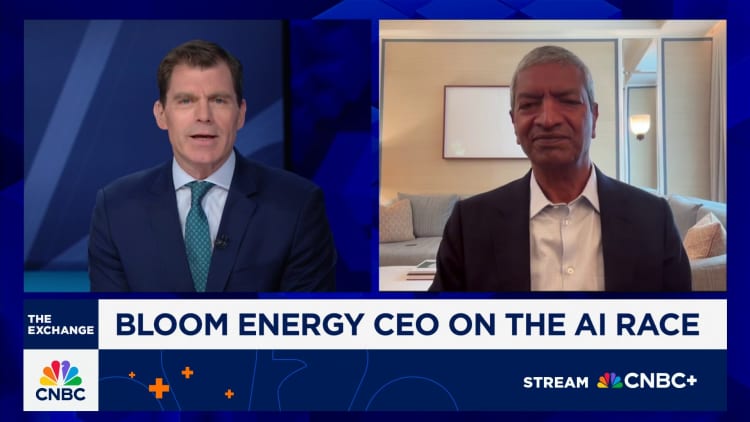
Brookfield will spend up to $5 billion to deploy Bloom Energy’s technology, the first investment in its strategy to support big AI data centers with power and computing infrastructure. Bloom’s fuel cells are “fuel-flexible” and can run on natural gas, biogas or hydrogen, the company says.
Brookfield and Bloom are collaborating to design and build what they are calling “AI factories” around the the world, including a site in Europe that will be unveiled before the end of the year.
Shares of Bloom Energy jumped more than 20%. Bloom’s fuel cells provide onsite power that can be quickly installed because they don’t rely on a connection to the electric grid.
Bloom has already positioned hundreds of megawatts of fuel cells through deals with utilities including American Electric Power and data centers developers such as Equinix and Oracle, according to the company.
The AI industry’s data center plans are growing in scale. Nvidia and OpenAI, for example, recently announced a partnership that aims to build 10 gigawatts of data centers, equivalent to the power consumed by New York City at the height of summer.
But AI companies’ plans are butting up against an aging U.S. electric grid that is often slow to provide additional power capacity. Data centers also threaten to raise electricity prices for residential customers.
Deploying power solutions “behind-the-meter,” or off the grid, “are essential to closing the grid gap for AI factories,” said Brookfield’s global head of AI infrastructure Sikander Rashid.
“AI infrastructure must be built like a factory—with purpose, speed, and scale,” Bloom Energy CEO KR Sridhar said.
Nvidia CEO Jensen Huang told CNBC last week that the AI industry will need to build power off the electric grid to quickly meet demand and protect consumers from rising electricity prices.
“Data center self-generated power could move a lot faster than putting it on the grid and we have to do that,” Huang said.
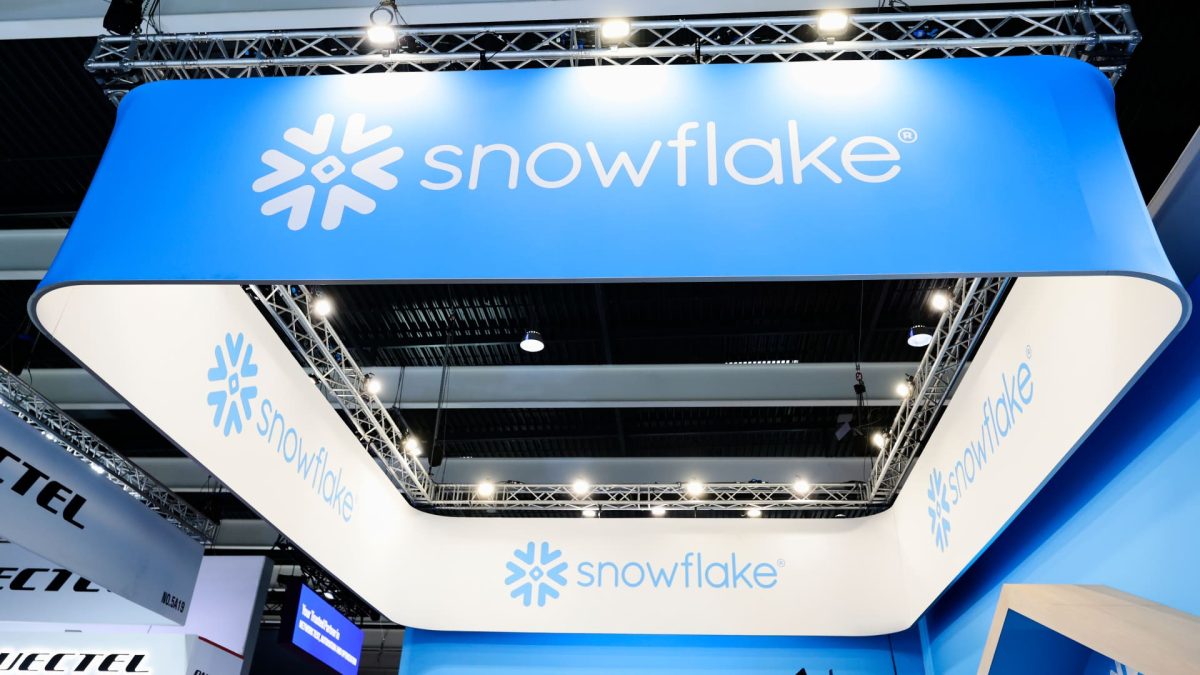
The Snowflake Inc logo, the American cloud computing-based data company that offers cloud-based storage and analytics services, is on their pavilion during the Mobile World Congress 2025 in Barcelona, Spain, on March 5, 2025.
Joan Cros | Nurphoto | Getty Images
Investors are looking beyond the prolonged U.S. government shutdown and remain optimistic about growth drivers like the artificial intelligence boom and expectations of further interest rate cuts.
Ignoring the short-term noise, those looking for attractive investment opportunities can consider the stock picks of top Wall Street analysts, whose recommendations are based on a thorough analysis of a company’s fundamentals and growth catalysts.
Here are three stocks favored by the Street’s top pros, according to TipRanks, a platform that ranks analysts based on their past performance.
Snowflake
First on this week’s list is Snowflake (SNOW), a cloud-native data platform. At the recently held Snowflake World Tour event in New York City, the company highlighted its product innovation and the vision for driving business transformation through data and artificial intelligence.
After attending this customer conference, Jefferies analyst Brent Thill reiterated a buy rating on SNOW stock with a price forecast of $270. Based on his conversations with customers and partners at the event, the analyst noted that Snowflake’s product innovation and velocity are accelerating.
Thill highlighted that while traction for Snowflake’s AI offerings is building, the inflection point is still ahead. For instance, the top-rated analyst noted that a retailer using Snowpark ML for demand forecasting, and a travel company integrating Snowflake ML models into its customer experience pipeline, both believe that broader usage across their organizations will take a few more quarters.
Another key takeaway was that Snowflake’s unstructured data capabilities have strengthened, but there are still some gaps to address. Overall, Thill believes that while traction is building for Snowflake, the “AI Blizzard” still lies ahead.
“SNOW remains one of our favorite data & AI stories and stands to benefit meaningfully as enterprise AI strategies mature and AI driven data volumes grow exponentially in the coming years,” concluded Thill. Interestingly, TipRanks’ AI Analyst has a “neutral” rating on Snowflake stock with a price target of $255.
Thill ranks No. 251 among more than 10,000 analysts tracked by TipRanks. His ratings have been successful 65% of the time, delivering an average return of 14.1%. See Snowflake Ownership Structure on TipRanks.
Advanced Micro Devices
Moving on to chipmaker Advanced Micro Devices (AMD), which recently made headlines after announcing a game-changing partnership with OpenAI. Under this deal, OpenAI will deploy up to 6 gigawatts of AMD Instinct GPUs over multiple years, starting with a 1-gigawatt rollout in the second half of 2026. The agreement also involves a warrant for up to 160 million shares (vesting tied to certain milestones), which, if fully exercised by OpenAI, will give it about a 10% stake in AMD.
Following the news, Jefferies analyst Blayne Curtis upgraded AMD stock to buy from hold and boosted the price target to $300 from $170. Additionally, TipRanks’ AI Analyst has an “outperform” rating on AMD stock with a price target of $232.
Curtis believes that AMD’s deal with OpenAI clearly changed the AI narrative for the semiconductor company. While the chipmaker will still have to achieve some milestones, the 5-star analyst believes that this partnership is a solid confirmation of AMD’s AI roadmap and a proof of robust AI demand in general.
Interestingly, Curtis recently raised his estimates for AMD following positive server checks. The analyst stated he was incrementally positive on AMD after his recent Asia trip, with the expectation of 500 basis points per year share gains in server CPUs with the company’s Venice platform.
However, these recent checks hadn’t helped Curtis grasp anything from the original device manufacturers (ODMs) in terms of AI ramps. “The announcement of OpenAI as a lead customer with the potential for $80-100B in revenue across 6GW of compute through 2030 materially changes that outlook,” said Curtis.
Curtis ranks No. 68 among more than 10,000 analysts tracked by TipRanks. His ratings have been profitable 65% of the time, delivering an average return of 27.5%. See AMD ETF Exposure on TipRanks.
Dell Technologies
IT infrastructure and personal computing solutions provider Dell Technologies (DELL) announced an increase in its long-term financial targets during its analyst meeting on Oct. 7. The improved outlook is backed by demand from the ongoing AI wave.
Following the event, Mizuho analyst Vijay Rakesh reiterated a buy rating on DELL stock and raised his price target to $170 from $160. Meanwhile, TipRanks’ AI Analyst has a “neutral” rating on DELL stock with a price target of $135.
Rakesh noted management’s commentary about momentum in enterprise and sovereign AI, with strong demand signals over 12-18 months. The top-rated analyst highlighted that the company raised its compound annual growth rate target for revenue for fiscal 2026 to 2030 to the range of 7% to 9%, with non-GAAP EPS expected to rise by 15% or more.
Furthermore, Rakesh noted that Dell’s fiscal 2026 AI server revenue estimate of $20 billion is in line with the Street’s consensus of $20.6 billion and reflects over 100% growth from $9.8 billion in the previous year. The company expects a 20% to 25% CAGR through Fiscal 2030, implying AI server revenue of $46 billion.
However, the analyst believes that this growth outlook could be conservative, as the company is involved in all at-scale AI cluster deployments and leads in T2 CSP (tier 2 cloud service providers) and enterprise AI deployments with more than 3,000 customers.
Rakesh ranks No. 81 among more than 10,000 analysts tracked by TipRanks. His ratings have been successful 65% of the time, delivering an average return of 24.3%. See Dell Technologies Hedge Fund Activity on TipRanks.
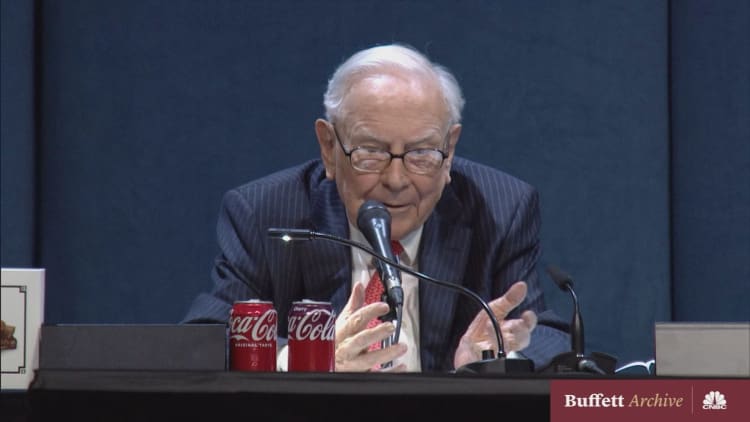
(This is the Warren Buffett Watch newsletter, news and analysis on all things Warren Buffett and Berkshire Hathaway. You can sign uphereto receive it every Friday evening in your inbox.)
Berkshire’s Japanese stock positions top $30 billion
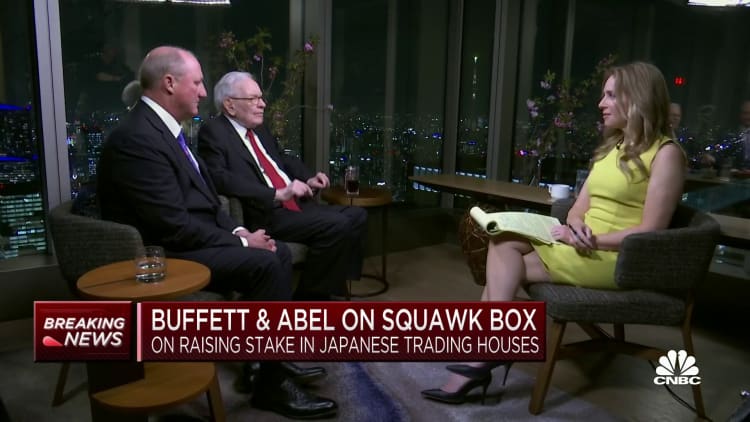
The total value of the five Japanese “trading houses” in Berkshire Hathaway’s equity portfolio has topped $30 billion in recent weeks, and Warren Buffett is apparently still buying.
Berkshire had already been building its positions for twelve months when Buffett initially revealed the stakes of around 5% each on August 30, 2020, his 90th birthday.
At that time, the total value of the five positions was roughly $6.3 billion.
It’s up 392% to $31.0 billion today, with Berkshire buying more over the years and the stocks soaring between 227% and 551%.
The total could be even higher because some additional purchases may not have been disclosed yet.
We know Warren Buffett has been adding to what was already a tremendously successful investment, with public acknowledgements recently that two of the stakes have gone above 10%.
One of the two, Mitsui, detailed this week exactly how many shares Berkshire owns.
In a news release Thursday, the company relays word from Berkshire that its National Indemnity subsidiary owned 292,044,900 shares as of September 30.
At Friday’s close, they’re valued at around $7.1 billion.
It’s a 10.1% stake, making Nation Indemnity its biggest shareholder.
It’s also an increase of 2.3% from the 285,401,400 shares, a 9.7% stake, reported in March.
This week’s news release is a follow-up to one issued two weeks ago by Mitsui in which it said it had been “informed” by Berkshire that “they now hold 10% or more of the voting rights in Mitsui,” but had not been told the exact number of shares Berkshire owned.
In late August, Mitsubishireported it had been told by Berkshire that its holding had increased to 10.2% from 9.7% in March.
We haven’t heard anything since March about Berkshire’s three other Japanese holdings, Itochu, Marubeni, and Sumitomo, but it would not be a surprise to learn those stakes have also gone above 10%.
Back in 2020, Buffett promised the companies he would not raise Berkshire’s stakes above 10% without permission.
In his annual letter to shareholders released in February, however, Buffett wrote, “As we approached this limit the five companies agreed to moderately relax the ceiling.”
As a result, he said, “Over time, you will likely see Berkshire’s ownership of all five increase somewhat.”
In 2023, Buffett told CNBC’s Becky Quick he was first attracted to the stocks in 2020 because “they were selling at what I thought was a ridiculous price, particularly the price compared to the interest rates prevailing at that time.”
This year, he told shareholders Berkshire will hold onto them for “50 years or forever.
BUFFETT AROUND THE INTERNET
Some links may require a subscription:
HIGHLIGHTS FROM THE ARCHIVE
Why Buffett and Munger don’t trust financial projections (1995)
BERKSHIRE STOCK WATCH
Four weeks
Twelve months
BERKSHIRE’S TOP U.S. HOLDINGS – Oct. 10, 2025
Berkshire’s top holdings of disclosed publicly traded stocks in the U.S., Japan, and Hong Kong, by market value, based on today’s closing prices.
Please send any questions or comments about the newsletter to me at alex.crippen@nbcuni.com. (Sorry, but we don’t forward questions or comments to Buffett himself.)
If you aren’t already subscribed to this newsletter, you can sign up here.
Also, Buffett’s annual letters to shareholders are highly recommended reading. There are collected here on Berkshire’s website.
— Alex Crippen, Editor, Warren Buffett Watch
Financial News
Daily News on Investing, Personal Finance, Markets, and more!