Is the S&P 500 heading for an epic stock market crash?

The S&P 500 dropped 4.8% on 3 April — it’s worst one-day loss since 2020. Then, it fell over 4% the day after!

Of course, 2020 was the dark days of the global pandemic, and in many ways this latest market panic reminds me of that. Back then, shutdowns in China and other major manufacturing hubs disrupted supply chains. Now, increased tariffs are threatening global supply chains, leading to stock sell-offs in manufacturing, retail, and tech. 

In 2020, there were widespread fears of a depression-style economic downturn, just as there are now. 

Will there now be a stock market crash, as there was in 2020? Here are my thoughts on the market chaos.

A huge bite into Apple’s core profits?

In his recent ‘Liberation Day’ address, President Trump announced “kind reciprocal” tariffs (import taxes) on goods entering the US. These were much higher than previously feared, leading to massive uncertainty. As we know, uncertainty is like kryptonite to the stock market.

These taxes are a massive problem for some tech companies, notably Apple (NASDAQ: AAPL). Shares of the S&P 500’s largest firm dropped 14% in two days, shedding over $400bn in value from the iPhone maker.

Apple makes most of its iconic products in China, Vietnam, Taiwan, and India. All those nations are about to be hit with huge new tariffs.

Semiconductors are exempt, which is a positive, as Apple relies on Taiwan Semiconductor Manufacturing Company (TSMC) for its chips. The US has put a 32% levy on the island nation.

Yet the idea of manufacturing iPhones in the US to avoid these tariffs is for the birds, unless consumers want to stump up $3,000+ for one (unlikely). So the impact on the tech giant’s profit margins could be significant, especially if it chooses to accelerate its supply chain away from Asia (which would take years).

It is no exaggeration then to say that these challenges are the equivalent of a Category 5 hurricane for Apple.

Now, there is still a chance that Apple gets an exemption from some taxes, as it did during the first Trump administration. And it has world-class management schooled in navigating trade complexities, which will be crucial moving forward.

However, the stock is trading at 30 times earnings, which still seems quite high to me. Therefore, I’m not looking to buy any shares at the moment.

What I’m doing

Without wanting to sound like a fence-sitter, I have absolutely no idea whether there will be a severe market crash. Or hyperinflation. Or a global economic crisis.

Many still think these tariffs are President Trump’s opening gambit, merely designed to encourage trade concessions rather than permanent policy. In other words, the headline figures will be negotiated down in the coming months, leading to less economic carnage.

Again though, nobody really knows for sure. It’s a bit of an economic experiment, in my eyes. Even a binary bet.

In the coming quarters, I wouldn’t be surprised if some companies start suspending their guidance due to all the uncertainty, like they did during Covid. This will cause even more uncertainty.

What I do know is that previous crises like the financial crisis of 2007-2008 and the 2020 pandemic crash proved to be lucrative times to invest. So I will be looking for potential bargain stocks over the coming weeks.


Is Diageo still a great stock for passive income investors? Here’s what the CEO says

Until a couple of years ago, Diageo (LSE:DGE) shares were an obvious choice for passive income investors. But the company seems to have lost its way.

CEO Debra Crew however, believes the difficulties are temporary. And in a recent interview with Nicolai Tangen, she set out the FTSE 100 firm’s strategy for long-term growth.

Short-term concerns

Diageo has been facing several challenges, but Crew thinks the ones the company can do least about are either cyclical or short-term in nature. A lot comes down to inflation.

Higher living costs have cut into consumer spending. But Crew points out the amount people spend on alcohol as a proportion of their disposable income has been resilient over time.

I think this is encouraging for shareholders. Diageo can’t do much about inflation, but it’s a positive sign that consumer spending on alcohol is likely to recover when it does. 

Crew sees the recent tariffs introduced by the US as a similar issue. While they’re a short-term challenge, Diageo operates in 180 countries that have various duties and taxes to be paid.

This means the FTSE 100 firm has a lot of knowledge and experience when it comes to mitigating these issues. And the CEO thinks this will be the case over the long term.

Diageo is clearly facing some short-term issues it can’t control and the risk is these are more durable than Crew believes. But what matters most for investors is the long-term growth plan. 

Long-term growth

There’s been a lot of talk about how younger consumers are spending less on alcohol and the difficulty this presents for drinks businesses. This includes the effect of GLP-1 drugs. 

The trend towards moderation is real, but – as Crew notes – it’s been going on for over a decade. And the Diageo CEO sees the chance to do more than just offset the declining market.

Spirits are currently gaining popularity over beer and wine, especially around meal times. This is a trend that (mostly) works in Diageo’s favour in terms of its portfolio.

There’s also been major growth in non-alcoholic drinks and ready-to-drink lines. And Diageo has been making use of its scale and brand power to launch products in both categories.

The biggest trend though, is towards premium products. As Crew points out, this makes up around 35% of the wider industry, but 62% of the FTSE 100 firm’s range.

Consumer habits are evolving, but Diageo isn’t standing still. The company has clear ideas about where the industry is headed and is making strategic moves to get ahead of the trend.

Long-term passive income?

It should be no surprise that Crew has a positive view of the company’s prospects. But regardless of the source, her message to investors is clear and – in my view – plausible.

The firm can’t do much about inflation or tariffs, but revolving consumer tastes present long-term opportunities. And Diageo’s competitive advantages are firmly intact.

If this is right, buying the stock today with a 4% dividend yield could be a great passive income investment. I think it’s well worth considering at today’s prices.

Tesla shares plummet 50% in 4 months! Is it one of the best stocks to buy now?

The best stocks to buy have often been unpopular stocks as investors end up overlooking hidden value. Tesla (NASDAQ:TSLA) definitely fits into the unpopular category right now, with its 2025 first-quarter vehicle delivery numbers coming in far worse than expected.

The shares tumbled almost 10% in aftermarket trading on the news, continuing its downward streak that started after reaching a peak in mid-December. In total, Tesla shares have fallen close to 50% in the last four months or so. But is the situation really as dire as investors think? And could we actually be looking at a phenomenal long-term buying opportunity?

A closer look at deliveries

Elon Musk’s new involvement in US and European politics has sparked a lot of controversy. With politics becoming more polarised in recent years, most consumer-facing CEOs have stayed politically neutral to avoid potentially alienating part of their customer base. And given there are now ongoing protests outside Tesla dealerships in the US, Musk is seemingly learning this first-hand.

For reference, the average consensus among analysts was 372,410 vehicles. The actual figure came in significantly lower at 336,681 – the weakest performance since the second quarter of 2022.

Year 2022 2023 2024 2025
Q1 Deliveries (thousands) 310 422.9 386.8 336.7
Q2 Deliveries (thousands) 254.7 466.1 444
Q3 Deliveries (thousands) 343.8 435.1 462.9
Q4 Deliveries (thousands) 405.3 484.5 495.6

However, politics aside, there may be other more impactful reasons why Tesla deliveries suffered in this latest quarter. The company recently launched the long-anticipated refresh to its Model Y SUV and, throughout 2024, management promised to launch a much more affordable electric vehicle (EV) in the first half of 2025.

The anticipation of two new TVs coming to the market has likely dented demand as customers wait to see what’s coming. Looking towards Europe, the business is experiencing some of the worst slowdowns in places like the Netherlands, Sweden and Denmark.

Is this entirely because of political involvement? I’m not convinced. Instead, I think it’s far more likely that competition within the EV space has increased significantly in recent years. In particular, Volkswagen now offers a far more diverse portfolio of EVs across its brands (including Audi, Skoda, Cupra, and VW) than Tesla.

Time to buy?

Seeing a stock lose half its value over one bad quarter seems a bit overblown, especially since the company is far from doomed. Instead, this looks more like a valuation correction. After all, the stock doubled between October and December last year, seemingly due to unrealistic expectations.

Looking out to the future, Tesla has a lot of promising developments on the horizon. In particular, its investments in AI & robotics are building up an impressive patent and technology portfolio that could set it apart from its rivals. Later this year, its self-driving car technology will hit the roads as the first critical milestone for robotaxis. And in 2026, its Optimus robots will also be entering the market, diversifying the revenue stream beyond the world of EVs.

So is the recent volatility an opportunity to consider the shares? Personally, I think it’s worth waiting a little bit to see the full extent of Tesla’s financial situation and strategy moving forward. Luckily, with the company reporting earnings later this month, investors won’t have to wait long.

Just opened a Stocks and Shares ISA? Here are 10 stocks to consider buying, according to AI

The £20,000 annual allowance of Stocks and Shares ISAs across Britain has just been reset. And with the start of a new tax year, many new investors are entering the market as economic conditions slowly improve and savings rates fall.

One of the biggest challenges investors face is building a well-balanced portfolio. But with artificial intelligence (AI) models constantly getting smarter, why not outsource this task to ChatGPT?

After tasking the chatbot to build an ISA portfolio, it made 10 recommendations. And some of the suggestions actually look like decent foundational stocks. However, ChatGPT also made some pretty risky and volatile suggestions. In fact, the model doesn’t appear to have taken risk tolerance into account at all.

Building a balanced ISA

The list of stocks that ChatGPT recommended is:

  • AstraZeneca (LSE:AZN)
  • Apple
  • Microsoft
  • Tesla
  • Unilever
  • Diageo
  • Shell
  • Johnson & Johnson
  • NextEra Energy
  • Ørsted

The portfolio offers exposure to a variety of industries, such as beverages, pharmaceuticals, consumer staples, energy, technology, and automotive. What’s more, half of the companies are listed outside of the UK, with operations spanning the globe, offering even more geographical diversification benefits.

The businesses themselves are also well-known industry titans, with large market capitalisations and deep financial pockets that reduce the risk of bankruptcy. And with some touting a long history of paying dividends, this portfolio offers a nice blend of both growth and income investments.

Overall, everything appears to be in place. So what’s wrong with this ISA portfolio?

Understanding risk

Despite the large scale of these businesses, several of ChatGPT’s suggestions are pretty risky stock picks. For example, Tesla has recently seen almost half of its market-cap wiped out in just the last few months, Diageo has been on a similar decline since 2022, as has Ørsted.

Of course, not all of these companies are on a downward trajectory. AstraZeneca is one of these exceptions, and the pharma giant’s steady stream of successful clinical trial results has propelled the stock price higher. In fact, it’s now the largest enterprise on the entire London Stock Exchange.

Sadly, that still doesn’t make it a risk-free investment. Clinical trials are notoriously challenging and expensive to execute. And just because it’s been enjoying successes recently doesn’t mean it will continue to do so. In fact, the company has experienced many painful clinical trial failures over the years.

Case in point, in 2017, its phase-three MYSTIC trial failed in the final home stretch, resulting in the AstraZeneca share price collapsing by over 15% in a single day.

In other words, investing in pharmaceuticals can be a volatile journey, even among the biggest names, such as AstraZeneca and Johnson & Johnson.

The bottom line

Every one of ChatGPT’s recommended ISA stocks has its risks, some bigger than others. Diversification can help take some of the sting away. But it’s still paramount that investors dig into the details to understand exactly what sort of investments they are making and whether they fit within their risk tolerance limits.

I asked ChatGPT for the best stocks to earn a second income and it recommended…

Earning a second income in the stock market is a relatively straightforward process. Investors can just snap up some shares in a dividend-paying enterprise and then just wait for the money to roll in. The challenge is knowing which income stocks are actually worth buying.

Sure, there are metrics like the dividend yield that can be helpful in an initial search. But this measure of payout doesn’t really give much insight into the long-term sustainability of dividends. Not to mention that stock prices also have a habit of moving… and not always going in the right direction.

With that in mind, I decided to explore what artificial intelligence (AI) algorithms had to say about the matter. And when I prompted ChatGPT about the best UK stocks to buy for a second income, it produced an interesting result.

Boring could be best

The FTSE 100 is filled with top-notch dividend-paying stocks, so it’s not entirely surprising that ChatGPT made four recommendations, all of which are from the UK’s flagship index:

  1. Unilever (LSE:ULVR)
  2. GSK
  3. National Grid
  4. Shell

What’s interesting is that none of these have particularly high dividend yields. In fact, the largest payout comes from National Grid at 4.8%. And that pales in comparison to the payouts of some FTSE 100 stocks like M&G at 9.9%.

However, as previously mentioned, a high yield isn’t great if the dividends can’t keep flowing. And a common theme among all these businesses is that they each have steady cash flows.

Unilever’s vast portfolio of consumer products can be found in almost every supermarket, and GSK’s life-saving drug portfolio is likely not going to fall out of fashion. Meanwhile, the constant rising demand for modern energy infrastructure is going to keep National Grid busy, while oil, gas and renewable energy will likely do the same for Shell.

So it should come as no surprise that each of these businesses has an extensive history of paying dividends every year for decades. And that includes during disruptive periods like the pandemic.

Boring is not risk-free

Let’s take a closer look at Unilever. During 2024, the group delivered respectable results with a 4.2% boost to underlying sales and a 170 basis point expansion of operating margins. Yet the stock actually fell by almost 10% a few days following the report. And zooming out, Unilever shares have actually massively underperformed over the last five years versus the FTSE 100 index.

A big concern is the limits of Unilever’s pricing power. Its branded products are already priced at a premium, and with further hikes, sales volumes may start to suffer as consumers simply switch to cheaper alternatives. This fear was only intensified when management’s outlook for 2025 included the statement: “We anticipate a slower start to 2025 with subdued market growth in the near term”.

Of course, this isn’t the first time Unilever’s branding power has been tested. And so far, the company has managed to land on top, suggesting it’s worthy of a closer look, in my mind.

The other businesses on this list also have their own set of challenges to overcome. And investors need to carefully investigate the threats as well as potential rewards when exploring investment opportunities, even when using tools like ChatGPT.

I’m planning to keep investing with my Stocks & Shares ISA! Here’s why

With the new tax year beginning today, holders of tax-efficient ISA products like the Stocks and Shares ISA have seen their annual contribution allowance refreshed. Individuals now have room to invest up to £20,000 in a range of assets like shares, trusts, and funds over the next year.

But investing in the market may be the last thing many are thinking of as global share prices collapse. The FTSE 100 has fallen almost 7% over the past five days, on fears that escalating trade wars will smash the global economy and hammer corporate profitability. On Friday, the Footsie posted its largest one-day drop since the Covid-19 pandemic erupted in 2020.

The stock market correction may have further to go as the full impact of trade tariffs becomes clearer. But this doesn’t necessarily I’m planning to sell everything and run for cover.

Indeed, I’ve continued to add to my own portfolio in recent hours.

Please note that tax treatment depends on the individual circumstances of each client and may be subject to change in future. The content in this article is provided for information purposes only. It is not intended to be, neither does it constitute, any form of tax advice. Readers are responsible for carrying out their own due diligence and for obtaining professional advice before making any investment decisions.

Thinking long term

Investing in shares can be a hair-raising experience at times. Unlike people who hold their money in a Cash ISA, those who invest in a Stocks and Shares ISA can see the value of their portfolio plummet. And that’s never a nice experience.

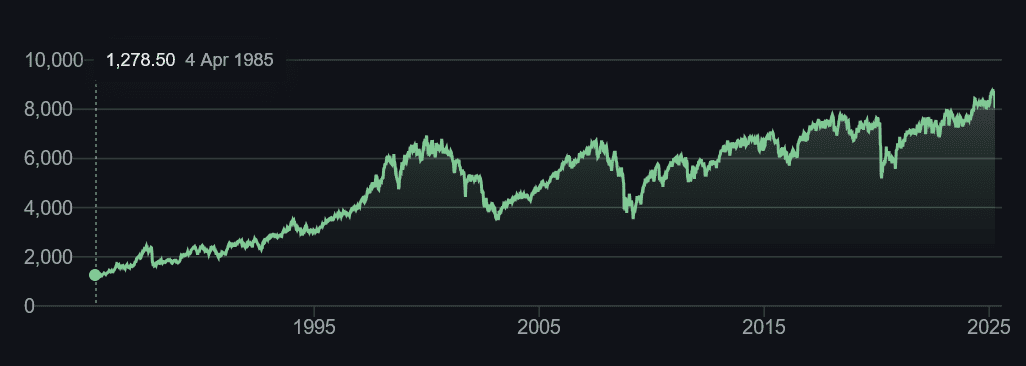
So during volatile periods like this, it’s important to remember that, over the long term, having stock market exposure is still an excellent way to build wealth. That’s even after accounting for the sort of market downturns we’re currently seeing.

Take the FTSE 100, for instance. During the last 40 years, it’s soared 527.7% in value, providing a solid average annual return of 7.7%. That’s a better return than most other asset classes in that time, and especially that of low-yielding Cash ISAs.

Source: Google Finance

In that time, it’s faced a plethora of crises, like a run on the pound, foreign wars, a banking sector meltdown, a eurozone debt crisis, Brexit, a pandemic, and more recently, the introduction of those thumping trade tariffs. And yet the FTSE’s still proved highly resilient.

Past performance isn’t always a reliable guide to future returns. But I’m confident that major stock indexes like this will continue to rise over the long term.

A top ISA buy?

As I say, I’ve continued to buy for my own portfolio in recent days. Stock markets are packed with brilliant bargains following recent weakness. Even companies in highly resilient sectors have plummeted amid the panic, proving excellent buying opportunities.

Coca-Cola Europacific Partners (LSE:CCEP) is a rock-solid share I’m considering buying soon. It trades on a forward price-to-earnings-to-growth (PEG) ratio of just 0.5.

Any reading below 1 indicates that a share is undervalued.

As a major global company, it won’t be immune to the impact of acclerating trade tariffs. Consumer spending may be affected in European and Asian markets, while production costs could also rise.

But on balance I expect earnings to remain broadly resilient. Its lack of exposure to the US, combined with the star power of brands like Coke, should see it hold up well. And over the long term, I expect it to deliver exceptional returns, driven by its substantial emerging market exposure and continuing innovation across its drinks ranges.

These FTSE 100 dividend stocks have 9% yields!

When it comes to dividend stocks, the UK’s flagship index has plenty for investors to pick from. And looking across all projections for 2025, an estimated £83.6bn worth of shareholder payouts are expected to be delivered by FTSE 100 companies throughout the year – a 5% increase compared to 2024.

However, among these income-producing industry titans stand three businesses currently holding the crown for the highest dividend yields in the entire index.

  1. M&G (LSE:MNG) – 9.9% yield.
  2. Phoenix Group Holdings (LSE:PHNX) – 9.5% yield.
  3. Legal & General (LSE:LGEN) – 8.8% yield.

On an equal-weighted basis, this basket of insurance stocks offers an impressive 9.4% annual payout. What’s more, each firm has been hiking dividends for years – a pattern that forecasts anticipate will continue moving forward. So are these dividend stocks incredible income opportunities? Or is the high yield a warning of trouble ahead?

The life insurance industry’s booming

While all three businesses have their niches, there’s some overlap when it comes to offering financial products relating to pensions, such as annuities. And lately, the bulk-purchase annuity (BPA) market has been highly active.

Out of the three, Legal & General currently holds the largest portion of the market share in the world of BPAs, with M&G the smallest. Regardless, even M&G has benefitted from the rise in BPA demand driven by higher interest rates. As a quick crash course, a BPA allows the trustees of final-salary pension schemes to pass on the risk of meeting future payments to scheme members.

But it’s not just the institutional markets driving growth. Higher interest rates have also made retail annuities more popular, with Legal & General selling a record £2.1bn worth of these in 2024. Overall, M&G surpassed its 2024 guidance, while Phoenix Group holdings actually hiked its targets for 2026.

All things considered, business appears to be booming. And it’s how dividends have kept flowing even at near-double-digit yields. But if that’s true, why is this basket of stocks actually down over the last 12 months?

A double-edged sword

Higher interest rates are sparking lots of activity in the pension risk transfer segment. But that’s also taking business away from asset management firms, including these three companies.

With pension funds taking part in BPAs, money is subsequently getting pulled out of equities in the process. As such, client cash outflows for M&G and Phoenix Group have been growing, while Legal & General reported a drop in profits from its asset management arm.

In other words, these firms seem to be partially cannibalising their own businesses. This is only made worse by the fact that rising competition within the BPA space will likely impact the profitability of these deals, creating a new headwind.

Are these shares worth buying?

The situation at M&G, Phoenix Group, and Legal & General is complicated. However, this complexity seems to be keeping the share prices low and yields high.

On a forward price-to-earnings basis, none of these stocks are particularly expensive, trading at 8.0, 11.2, and 10.1 respectively. And given these inexpensive valuations, all three dividend stocks could be worthy of a closer look. After all, complicated financial statements could be hiding brilliant bargains in plain sight.

Is Warren Buffett getting ready for a stock market crash?

With uncertainty on the rise, a lot of investors are looking to billionaire investor Warren Buffett to get his insight into what’s coming for US stocks. While the ‘Oracle of Omaha’ hasn’t explicitly called for a market crash in 2025, his actions imply a storm might be just around the corner. And actions often speak louder than words.

A cash hoard

Looking at Buffett’s investment firm, Berkshire Hathaway (NYSE:BRK.B), he appears to be growing increasingly cautious. In fact, since the last nine quarters, Buffett and his team have been a net seller of stocks, resulting in a record cash pile of $344bn.

Some of the positions he’s been reducing include Ulta Beauty, Bank of America, Capital One Financial, Citigroup, Nu Holdings, Charter Communications, T-Mobile US and, most recently, DaVita.

At the same time, the famous Buffett Indicator, which compares the total market-cap of US stocks with US GDP, is now sitting at 187%. As a quick reminder, any value above 158% is a signal that stock prices are significantly overvalued.

Pairing the elevated indicator with Berkshire’s selling activity and the fact that the US could potentially fall into a recession later this year due to short-term tariff impacts certainly suggests that Buffett is preparing for the worst. And if the market does indeed go into a freefall, Berkshire’s enormous cash pile perfectly positions the investment firm to start snapping up terrific companies at discounted prices.

Another explanation?

Under Buffett’s leadership, Berkshire Hathaway’s investment portfolio has delivered an average annualised return of 19.9% since 1965. That’s essentially double what the S&P 500 achieved over the same period. So it’s understandably concerning to see such a great investor make bearish moves.

However, there may be another factor to consider here – age. Buffett is 94. Greg Abel has already been named as his successor to Berkshire Hathaway. And the decision to start building a cash war chest could also be a move to provide Abel with a strong jumping-off point when he takes over. While it may be a coincidence, the increased selling activity at Berkshire did start to ramp up following the passing of Buffett’s partner and friend, Charlie Munger.

What to do now?

Insulating a portfolio with a sizable cash position is a proven risk management strategy, especially during periods of economic uncertainty. While cash can be a drag on performance, it also provides investors more flexibility to capitalise on buying opportunities when markets wobble.

So following Buffett’s footsteps and building up some cash may be a prudent move right now, especially if investors’ fears surrounding tariffs turn out to be true. Of course, there’s another solution – simply buy shares in Berkshire Hathaway.

Such a move would still expose a portfolio to potential short-term panic from Berkshire shareholders who are not focused on the long run. However, it also allows investors to benefit directly from Buffett’s investment decisions. Of course, this comes paired with the risk that Buffett may not be around for much longer. With his departure, shareholders’ faith in Abel will undoubtedly be tested.

Want a comfortable retirement? Here’s how big your SIPP needs to be

When it comes to investing for retirement, a Self-Invested Personal Pension (SIPP) is one of the most powerful tools in a British investor’s arsenal. Apart from granting all the usual tax relief and deferral benefits that private pension schemes offer, SIPPs offer complete control over a pension portfolio.

But how much money do investors need to put aside to enjoy a comfortable retirement?

Reaching financial freedom

According to the Pensions and Lifetime Savings Association, retirees require an income of £43,100 a year to enjoy a comfortable retirement. That’s sufficient to cover holidays, birthday presents, a new car every five years, home remodelling, and, of course, general living expenses.

The British State Pension will undoubtedly help towards this goal. Right now, someone earning the full State Pension is receiving £221.20 each week, or roughly £11,502.40 a year. However, for someone retiring in 30 years, the State Pension could be wildly different to today, potentially even smaller.

So let’s be on the safe side and plan for the entirety of retirement income coming from a SIPP. How large does it need to be? Around £1.1m when following the 4% drawdown rule.

Reaching a £1m pension pot

Building a SIPP worth £1.1m isn’t as impossible as it might seem. Assuming an investor receives 20% tax relief based on their income bracket, putting aside £500 each month would result in £625 of investment capital being available. And investing this at a 10% rate of return for 30 years would build a SIPP worth £1.4m – ahead of what’s needed today.

Sadly, due to inflation, £43,100 a year is likely not enough in the future. Assuming that inflation averages 2% over the next 30 years, investors could actually need closer to £78,100 to enjoy a comfortable retirement, or a £2m SIPP.

To achieve this without increasing capital contributions, investors will need to aim for a return greater than 10%. Fortunately, this is where stock picking provides a solution.

Take Games Workshop (LSE:GAW) for example. The Warhammer creator has proven itself to be a remarkable business designing high-quality plastic miniatures for hobbyists to battle with across the tabletop in addictive games. So much so that it now commands incredible pricing power over its products that remain in high demand, even during the ongoing cost-of-living crisis.

Subsequently, over the last 30 years, investors who bought and held onto Games Workshop shares have earned an average annualised return of 16.3%. And at this pace, a SIPP could reach the £2m target, not in 30 years, but in 24.

Please note that tax treatment depends on the individual circumstances of each client and may be subject to change in future. The content in this article is provided for information purposes only. It is not intended to be, neither does it constitute, any form of tax advice. Readers are responsible for carrying out their own due diligence and for obtaining professional advice before making any investment decisions.

Risks and rewards

Games Workshop’s stellar track record should be celebrated. However, whether it can maintain double-digit gains for new investors today is far from certain. After all, past performance doesn’t guarantee future results, and the business is significantly larger today.

There are also operational risks to consider. With manufacturing concentrated in Nottingham, exporting products to key markets like North America and Australia introduces a lot of logistical complexity. Even more so with tariffs being thrown around today.

So while Games Workshop may no longer be the millionaire-making stock it once was, studying its success could lead investors to discover new opportunities that might be.

How much passive income can an investor get each year from a new £20,000 ISA?

The new Stocks and Shares ISA year has just started. This means account holders are able to invest another £20,000 to try and generate tax-free share price returns, passive income, or both.

Let’s look at how much can someone reasonably expect to generate from a £20k ISA portfolio.

Please note that tax treatment depends on the individual circumstances of each client and may be subject to change in future. The content in this article is provided for information purposes only. It is not intended to be, neither does it constitute, any form of tax advice. Readers are responsible for carrying out their own due diligence and for obtaining professional advice before making any investment decisions.

Dividend yield

The simplest way to know what to expect would be to deploy the full lot into a single stock. That way, an investor would be able to quickly work out what to expect by looking at the forecast dividend yield.

For example, banking giant HSBC (LSE: HSBA) is forecast to pay a dividend of 67 cents (51p) per share for the current financial year. This translates into a yield of 6.82%, based on the current share price.

Therefore, an investor could expect approximately £1,364 back in annual dividends from a 20 grand investment. That would be more than double the forecast yield for the FTSE 100, which is currently around 3.7%.

There are even higher yields for more adventurous investors, including a pair of double-digit yielders. These are asset manager M&G and insurer Phoenix Group, whose forward-looking yields are 10.5% and 10.3%, respectively.

Investors putting £20,000 into these ultra-high-yield dividend stocks could therefore generate over £2,000 per year in passive income.

Diversification

Of course, putting the full ISA allowance of £20k into a single stock — or even just two or three — is very risky. Dividends aren’t guaranteed and each business faces its own set of unique risks. That’s why a decent level of diversification is necessary.

Returning to HSBC, its share price has fallen 19% in just one month. This is due to the brewing trade war between the US and China. The bank has widespread operations in Asia, which could be about to face significant economic pressure due to steep US tariffs.

Were a global recession to occur (which cannot be ruled out), then there would be significant earnings pressure across the financial sector. That certainty wouldn’t be a supportive backdrop for dividend growth in the near term.

Cheap-looking valuation

Taking a long-term view though, HSBC still strike me as one of the best UK dividend stocks. The bank currently has a solid dividend coverage ratio of 2. In theory, this means it should be able to pay the forecast dividend yield even if earnings take a bit of a hit.

Meanwhile, the price-to-earnings multiple is 7.9 and the price-to-book ratio is just over 1. These metrics suggest to me that the stock isn’t obviously overpriced.

While it may not seem like it with the Trump administration’s tariffs causing chaos, Asia is still tipped for strong long-term growth. That’s due to favourable demographics, a rising middle class, and continued urbanisation across the region. Tourism dollars also continue to flow into Thailand, Vietnam, Indonesia, and elsewhere.

This is why I own HSBC shares myself.

Long-term compounding

If a £20k ISA returns 8% annually on average, it would grow to around £137,000 after 25 years, with dividends reinvested. By that point, the passive income potential would be nearly £10k a year, assuming a 7% yield.

That’s without investing any more capital. Obviously, regular monthly investments along the way would likely catapult those figures much higher.

Financial News

Daily News on Investing, Personal Finance, Markets, and more!

Financial News

Policy(Required)