Forecast: in 1 year, the Tesco share price could be…

Until a few weeks ago, the Tesco (LSE:TSCO) share price was on a solid run, rising by almost 30% since last April. Yet, following an announcement by one of its leading competitors, the stock got sold off by double-digits. And year to date, Britain’s largest supermarket has seen its market-cap shrink by more than 10%.

Is this a buying opportunity? Let’s explore what the latest analyst forecasts are predicting over the next 12 months.

Competitive price cuts might be no big deal

One of the leading reasons behind the sudden drop in Tesco’s share price last month is the announcement that competitor Asda is slashing prices. The UK’s third-largest supermarket has been struggling with falling profits, and management’s now looking to turn things around, sparking a £4bn industry-wide sell-off that Tesco got caught in the middle of.

The fear is that Asda’s actions will squeeze the already-thin profit margins of supermarkets like Tesco and Sainsbury’s. And when paired with a general rise of consumers seeking better prices on their weekly shopping trips, there’s understandable concern circulating the stock.

Roughly one week later, institutional investors updated their forecasts and reviewed their recommendations. A year ago, 12 analysts had recommended Tesco shares as either a Buy or Outperform. Following this latest update, that figure now stands at 14, with an average 12-month price target of 409p.

In other words, institutions are now seemingly more bullish about Tesco than before, even predicting the share price could rise as much as 25% from current levels.

Why so bullish?

Despite what the headlines suggest, there’s scepticism among analysts regarding Asda’s ability to execute the announced price cuts. The strategy only really works if sales volumes subsequently improve, which isn’t guaranteed.

Data from Kantar reveals that Asda’s market share over the last three years has shrunk from 14.6% to 12.6%, while Sainsbury’s and Tesco both expanded their territory along with Aldi and Lidl. Whether Asda’s new strategy will be sufficient to recapture lost customers is unclear.

This uncertainty is further increased by Asda’s new chair, Allan Leighton, who has said the process of turning Asda around could take five years. That’s plenty of time for Tesco to adapt, not to mention the grocer has a much stronger market and financial position.

However, despite the positive outlook from analysts, Tesco’s still exposed to some notable threats. Barclays’ latest consumer spending report reveals that grocery shopping activity fell into the red in February as more consumers become price conscious. If this trend continues, it’s a welcome tailwind for established discount retailers like Aldi and Lidl that could put pressure on Tesco’s market share.

The bottom line

Stepping back, I think investors might have jumped the gun on selling off Tesco shares. It’s possible that after a solid rally, Asda’s announcement was sufficient to spark some profit-taking activity. However, while there’s some notable short-term uncertainty surrounding a new price war, Tesco’s long track record of success makes me cautiously optimistic about Britain’s biggest supermarket. That’s why I think investors may want to consider taking a closer look at Tesco now that the share price has tumbled.

As collapsing share prices send dividend yields soaring, which income shares look attractive?

Dividend investors looking for shares to consider buying have a lot to think about right now. There are some stocks with attractive yields – and some of them just got even more so.

Stocks with high dividend yields can be great long-term opportunities. But they can also be risky and investors need ot think carefully about which ones are which.

Global oil

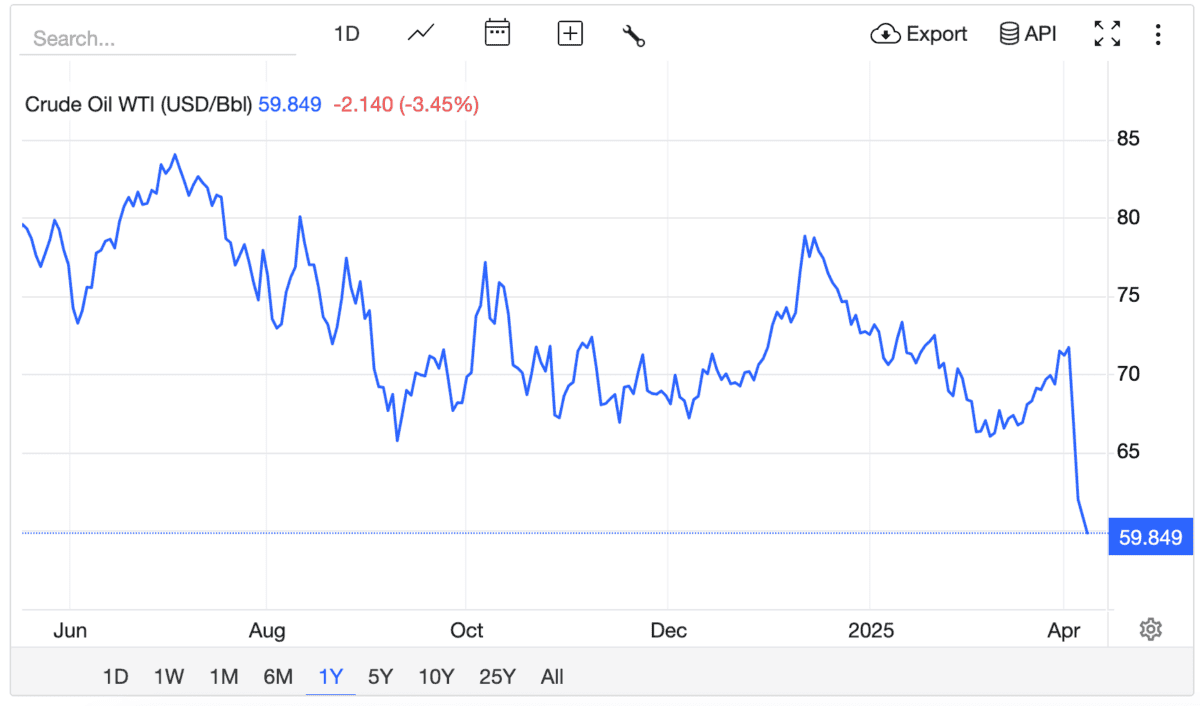
On both sides of the Atlantic, shares in oil companies have been among the hardest-hit in the last week. And reciprocal trade tariffs from the US are only part of the reason.

Source: Trading Economics

Following ‘Liberation Day’, analysts at JP Morgan estimate the chance of a global recession in 2025 to be 60%. This isn’t a positive sign for short-term oil demand.

But this isn’t the only issue. In the last week, eight OPEC+ members reported plans to boost oil production. This should result in 411,000 extra barrels per day in May (rather than 135,000).

Combining increased supply with subdued demand is a formula for lower oil prices. And that’s why energy has been the worst-performing sector in the S&P 500 over the last week.

BP

In the UK, things have been largely similar. BP (LSE:BP) has seen its share price fall 14% in the last week, while the FTSE 100 is down around 7%.

As a result, the stock now has a 6.5% dividend yield, which I think is worth paying attention to. Especially for investors with a positive long-term view of oil.

The situation with BP is complicated. Activist investor Elliott Management is pushing the firm to divest some of its operations including – but not limited to – its renewables division.

I like the strategy, but I’m not sure that now is a good time to be selling wind and solar assets. Renewables have been under pressure recently and this is enough to make me look elsewhere.

Chord

Chord Energy (NASDAQ:CHRD) is a more straightforward organisation. The company’s exclusive focus is on getting oil out of the Williston Basin as cheaply as possible.

Importantly, it’s also intent on returning as much cash as possible to shareholders. As long as its leverage ratio stays below 0.5, the firm plans to return 75% of its free cash flow to investors.

Towards the end of 2024, this ratio was 0.3, but there’s a risk lower oil prices could threaten this position. Even if debt levels stay the same, lower profits could push the ratio higher.

This is something investors should take seriously. But I think Chord’s clear focus on extracting oil and returning cash to shareholders makes it preferable to BP, for me at least.

I’m buying

In the space of about a week, things have changed dramatically for oil companies. Supply is up, demand is down, and crude prices have fallen sharply as a result. 

One thing this shows, however, is that things can change suddenly. And the current situation might be about as bad as it gets for oil stocks.

The risk is that things stay this way for some time. But I see discounted prices across the sector as an unusually good buying opportunity.

BP might be a decent stock to consider, but I prefer Chord’s uncomplicated focus on oil and cash flows. So if prices stay where they are, I’ll be adding to my existing investment later this week.

Forecast: in 1 year, the Tesla share price could be…

With the Tesla (NASDAQ:TSLA) share price getting slashed in half these last few months, investors are understandably getting spooked. Yet, with seemingly impressive technologies and the start of the robotaxi rollout kicking off later this year, can the stock bounce back?

Here are the latest analyst forecasts.

Tesla on track for growth

Despite fear, uncertainty, and doubt circulating through the headlines, analyst projections for this business remain relatively positive. In particular, sales and earnings are expected to jump significantly in 2026 following the launch of its Robotaxi and Optimus robots.

2025’s certainly off to a weaker start with lower-than-expected vehicle deliveries. However, it’s still possible CEO Elon Musk will deliver on his January promise of a return to growth later this year. After all, the firm’s entire vehicle line-up is in the process of being revamped.

The new Model Y SUV has just started leaving the factories, with the Model S and X also getting a long-awaited refresh. At the same time, the next-generation Tesla Roadster is also expected to make a debut later this year. And to top things off, the company’s also expected to unveil its Model Q by June – Tesla’s first low-cost EV with an estimated price tag of $30,000.

Subsequently, analysts are expecting sales and earnings per share for 2025 to land at $107.4bn and $2.62 respectively. Then, in 2026, revenue could reach 19% higher at £128bn, with a 32% surge in profits per share to $3.48. And looking at the average 12-month share price projections, the Tesla share price could be on track to reach around $320 by this time next year.

A good stock to buy?

As a long-term investor, I’m constantly looking for opportunities to snap up great companies at a great price. So when a leading business like Tesla suddenly gets a nearly 50% haircut, I’m definitely paying attention. However, even with this price crash, the stock’s far from cheap.

The most optimistic 2026 earnings per share forecast for Tesla is $5.52. A lot has to go right for the firm to deliver on this figure. But even if it does, that still puts the forward price-to-earnings ratio at a demanding 51. That’s more than double the S&P 500, highlighting just how lofty investor expectations for this business have become.

What’s more, these projections are being made before Tesla reports its first-quarter results for 2025. Based on its weak vehicle deliveries during the period, it’s possible that analysts may re-evaluate and adjust expectations for 2026, making today’s valuation even more expensive.

Of course, paying a premium is often the cost of admission for investing in a top-notch stock. However, the biggest concern I have surrounding Tesla is the state of competition.

For years, Tesla has enjoyed next-to-no competition within the electric vehicle (EV) space. That’s changed drastically in recent years. And now Chinese rival BYD has officially taken the lead with higher annual revenues in 2024, expanding its estimated market share to 15.7% versus Tesla’s 15.3%.

A big part of BYD’s success has been its more affordable EV offerings. So if Tesla’s Model Q meets expectations and is released on time, the company could retake the lead in the future. But that’s far from guaranteed. As such, despite the promising upcoming technology, I’m staying on the sidelines for now.

Forecast: in 1 year, the Lloyds share price could be…

Over the last 12 months, the Lloyds (LSE:LLOY) share price has enjoyed a pretty remarkable rally. After years of hovering between 40p and 50p, the bank stock finally broke free and climbed by over 20% since last April (40% if we ignore the recent tariff-induced sell-off).

With economic conditions in the UK steadily improving and interest rates falling, the housing market is starting to heat back up. That’s given Lloyds a welcome boost to its mortgage business, along with a general rise in borrowing demand from businesses, all translating into a larger loan book.

Considering these trends are expected to continue throughout 2025, is the Lloyds share price on track to climb even higher? Or should investors consider using the recent rally as an exit? Here’s what the latest analyst forecasts say.

Lloyds is at a crossroads

Given that Lloyds is one of the biggest banks listed on the London Stock Exchange, it should come as no surprise that it also has a large following from institutional investors. In fact, there are currently 20 analysts tracking this business, more than half of which have the stock rated as Hold.

A similar distribution of opinions exists when looking at the 12-month price targets. Right now, the average consensus among analysts is that the Lloyds share price will reach 75p by this time next year. That’s roughly where the stock trades today, suggesting that its growth potential from higher borrowing activity may already be baked into the share price.

However, one analyst believes the bank could reach as high as 90p, signalling a 25% potential gain. But at the same time, another is forecasting an 18% decline to 60p. These different possibilities appear to be linked to the ongoing debate surrounding the motor financing scandal and undisclosed commissions to car loan brokers.

Last week, Lloyds, along with other British banks, went to the Supreme Court to plead their case. However, investors are likely going to have to wait several more weeks before the court issues its opinion. If Lloyds wins, the £1.15bn of cash it’s put aside to settle complaints would be freed for reinvestment, buybacks, or dividends. However, should the court rule against the banks, the £1.15bn may not be enough.

In the long term, Lloyds looks more than capable of bouncing back and thriving should the worst come to pass. After all, this isn’t the first time it’s found itself at the centre of such a fiasco. Even the chief executive of the Financial Conduct Authority has said that car finance mis-selling is unlikely to be on the same scale as the PPI scandal of the 2010s.

Nevertheless, an unfavourable outcome will likely cause short-term disruption. And that could translate into the Lloyds share price taking a tumble, especially given the rally it’s enjoyed in recent months.

The bottom line

I’m not a Lloyds shareholder, and given the uncertainty, I’m not rushing to become one right now. There’s no denying that the stock still looks reasonably cheap at a forward price-to-earnings ratio of 10, even after the recent rally. But with its near-term future largely out of management’s control, I think it’s best to consider staying on the side of caution and wait for some much-needed clarity.

Down 22%, this FTSE stock offers a 9.3% dividend yield for investors

There are plenty of FTSE stocks offering impressive dividend yields right now. And one of the highest rewards currently on offer comes from Greencoat UK Wind (LSE:UKW) at 9.3%. The renewable energy trust hasn’t received much love from investors lately, with the share price taking a 22% hit over the last 12 months.

But despite what the downward trajectory implies, the underlying business continues to chug along nicely with a steady stream of cash flows and dividends. So is this a stock to consider buying today? Or is there a valid reason for caution?

The bull case

Let’s start with the fact that despite the high dividend yield, Greencoat actually generates more than enough cash flow to cover this expense. Admittedly, the dividend coverage ratio’s getting a bit tight at 1.3 times during 2024. That’s a notable drop compared to the group’s average of 1.8 since it was listed in 2013.

The cause is a combination of falling electricity prices and lower-than-expected wind speeds, highlighting a key risk of investing in a wind farm company. However, moving into 2025, management expects cash flows to climb, boosting dividend coverage in the process.

How? Apart from an anticipated increase in energy prices, the company’s busy expanding its wind farm portfolio to capitalise on the investment tailwinds being created by the new-ish UK government. Labour has outlined its ambitions to make the UK’s energy grid produce net zero emissions. And that includes the rapid expansion of wind power capacity across the country – terrific news for renewable energy firms like Greencoat.

The bear case

While the outlook for Greencoat’s operating environment looks promising, there are some more immediate issues that need addressing. The biggest one is arguably the firm’s impressive pile of debt, which currently stands at £1.76bn of loans & equivalents.

That is a slight improvement versus the £1.79bn reported in 2023. However, with interest rates remaining elevated, the interest expense surged from £58.8m in 2023 to £94.1m in 2024. Not only does this add pressure to the bottom line, but it also eats away at cash flow that could be used to reward shareholders.

Given the capital-intensive nature of building and acquiring renewable energy infrastructure, the use of debt is largely unavoidable. And management has placed debt-reduction among its top priorities. However, with gearing now sitting exceptionally close to its 40% limit at 39.7%, the dividend could be impacted in the short term if an emergency loan repayment is needed to stop this metric from tipping over the edge.

A stock worth buying?

Despite the stretched appearance of the balance sheet, Greencoat’s still a highly cash-generative enterprise with ample room for growth. There’s no denying that interest rate pressure is a notable threat to dividends. And we’ve already seen some of this materialise as the firm failed to hike shareholder payouts in 2024 for the first year since its IPO.

However, with interest rates slowly starting to fall, debt refinancing becomes a more attractive option to reduce this pressure. And subsequently, management has outlined its plans to resume its dividend hiking spree in 2025. Is this guaranteed? Of course not. However, with the shares trading at a forward price-to-earnings ratio of 12, it may be worth considering taking this risk, given the impressive dividend yield.

Now more than ever, this Warren Buffett quote’s one to remember!

In his 1986 letter to Berkshire Hathaway’s shareholders, Warren Buffett wrote: “We simply attempt to be fearful when others are greedy and to be greedy only when others are fearful”.

With Donald Trump’s ‘Liberation Day’ causing havoc with global equity prices, I think it’s a good time to keep the American billionaire’s quote (Buffett’s not Trump’s) at the forefront of our minds.

Opportunities galore

The fear that’s currently affecting markets means, in my opinion, there are plenty of bargains to be had. And if investors pick wisely, in five years’ time, they could be applauding their bravery.

After all, it’s easy to forget that five years ago, the UK was in lockdown and the stock market tanked. Those who followed Buffett’s advice and, at the time, bought the stocks of “companies with good economics and good management” that were trading below their “intrinsic business value” have done well.

I’m not comparing today’s economic outlook with the pandemic. But investor nervousness can be profitable.

If only…

In April 2020, with very few people flying, Rolls-Royce Holdings‘ share price fared particularly badly. However, five years later, its stock has increased seven-fold.

Centrica’s shares have risen nearly 350% over the same period. In 2020, energy prices hit rock bottom as global demand collapsed.

And Britain’s banks, which tend to act as a barometer for the wider economy, saw their stock market valuations slide. As an example, NatWest Group‘s now worth three times more than it was half a decade ago.

All three of these companies are well-managed and have strong brands. And given the recent fallout from President Trump’s desire to ‘Make America Wealthy Again’, I think now could be a good time to consider JD Sports Fashion (LSE:JD.), the FTSE 100’s ‘King of Trainers’. Remember, in five years’ time, Trump will (probably!) have left office.  

Tracksuits and trainers

The sports retailer’s shares are currently (4 April) trading very close to their 52-week low. In fact, they’re changing hands for less than at the start of the pandemic, when its stores were forced to close.

The problem is that around half of the group’s revenue comes from the sale of Nike’s products. Most of these are made in Asia which means they now face substantial tariffs when imported into America, where JD Sports recently bought Hibbett.

There are also fears that a global trade war will make everyone poorer.

But the company looks incredibly cheap to me. For the year ended 25 January (FY25), analysts are expecting earnings per share (EPS) of 12.2p. We will know next week how accurate this is. But if the ‘experts’ are right, it means the stock’s trading on just 5.5 times earnings.

However, it’s the future that counts. At the moment, analysts are expecting EPS of 12.3p for FY26. But even if the current uncertainty reduces this by 25%, the stock’s multiple (7.3) is still comfortably below its historical average.

But I’m not expecting such a dramatic impact. Sportswear remains popular with younger shoppers and the group sells other non-American brands. Also, sales on the other side of the Atlantic account for a small proportion of group revenue. On balance, I think JD Sports Fashion could be a stock for ‘greedy’ long-term investors to look at.

UK stocks are still where the discounts are! Here’s what I’m buying

The last few days notwithstanding, UK stocks still trade at lower valuations than their US counterparts. On top of this, they’re also trading at discounts to their own historic multiples.

As a result, I’m still looking for opportunities on this side of the Atlantic at the start of the new financial year. And there are a couple of stocks in particular I’ve been buying.

UK valuations

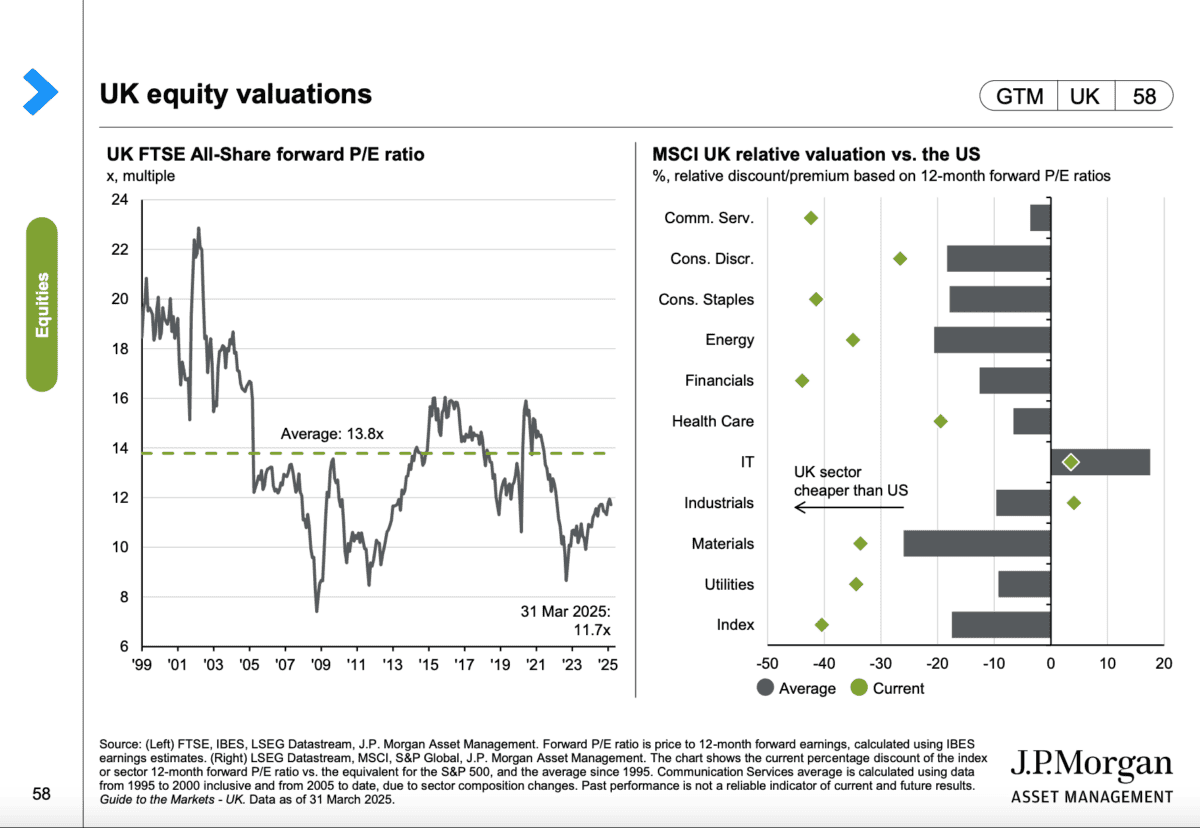
JP Morgan’s Guide to the Markets has some valuable insights. Despite the FTSE 100 starting 2025 strongly, UK shares are below their historical average in terms of multiples.

JP Morgan Q2 2025 Guide to the Markets (UK)

The FTSE All-Share – a pretty good measure of UK stocks as a group – trades at a forward price-to-earnings (P/E) ratio of just under 12. That’s below its historical average of almost 14.

UK shares also trade at an abnormally large discount to their US counterparts. Where they usually trade at lower multiples, the difference is greater than normal in almost every sector.

The exception is industrials, where UK stocks are unusually trading at higher multiples than US equities. But even in technology, the valuation gap’s wider than normal.

Size matters

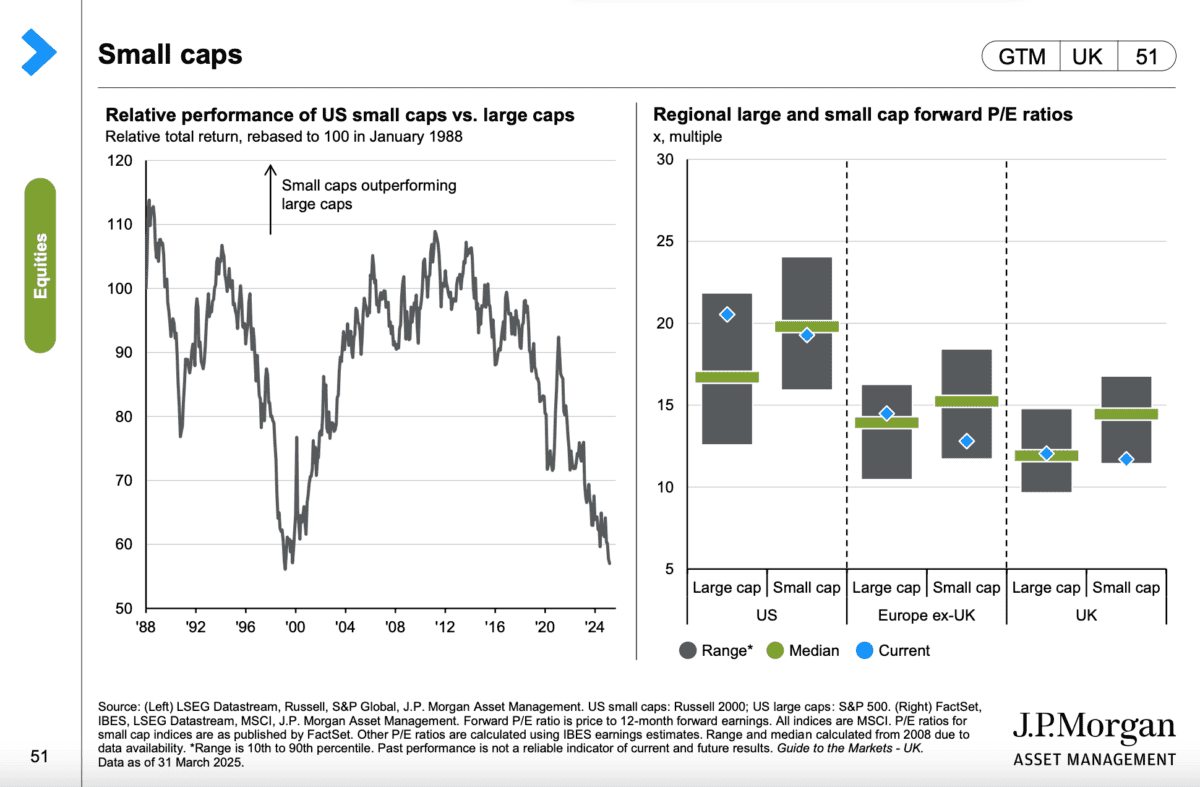
There’s another theme emerging on both sides of the Atlantic. In general, shares in smaller companies are trading further below their average multiples than their larger counterparts.

JP Morgan Q2 2025 Guide to the Markets (UK)

In the US, there isn’t much to get excited about. Shares in smaller companies are in line with their historic average multiples, but large-cap stocks are quite a bit higher.

The UK situation’s similar, but different in one key way. Shares in larger companies are level with their averages, small-caps are well below – towards the lowest they’ve ever been.

By itself, an unusually low P/E multiple doesn’t make a stock cheap. But it is a sign it’s out of favour with investors and this can create opportunities for investors to take advantage of.

A stock I’m buying

One stock I’ve been buying is Celebrus Technologies (LSE:CLBS). It’s a tech stock, which isn’t the sector showing the biggest discount to the US, but I think its P/E ratio is misleading.

The stock’s down almost 30% since the start of the year. And the big risk is that tariff-induced inflation could be a problem for a company with 78% of sales coming from the US.

In my view though, the current share price more than reflects this. Officially, the stock trades at a P/E ratio of just below 20, but the business has over 25% of its market value in net cash.

The company also has a number of non-cash and one-off costs that weigh on its net income. Factoring in all of this brings the P/E multiple down to around 12, which I think is a bargain.

Opportunity knocks

My plan for the new financial year was to focus on UK growth stocks. And I haven’t seen anything in the stock market’s response to the latest US tariffs that changes my outlook.

JP Morgan’s data suggests that UK shares typically trade at discounts to their US counterparts even after the latest sell-off. So I’m focusing on stocks like Celebrus at the moment.

How much passive income could an investor earn if they put £200 a month in an ISA?

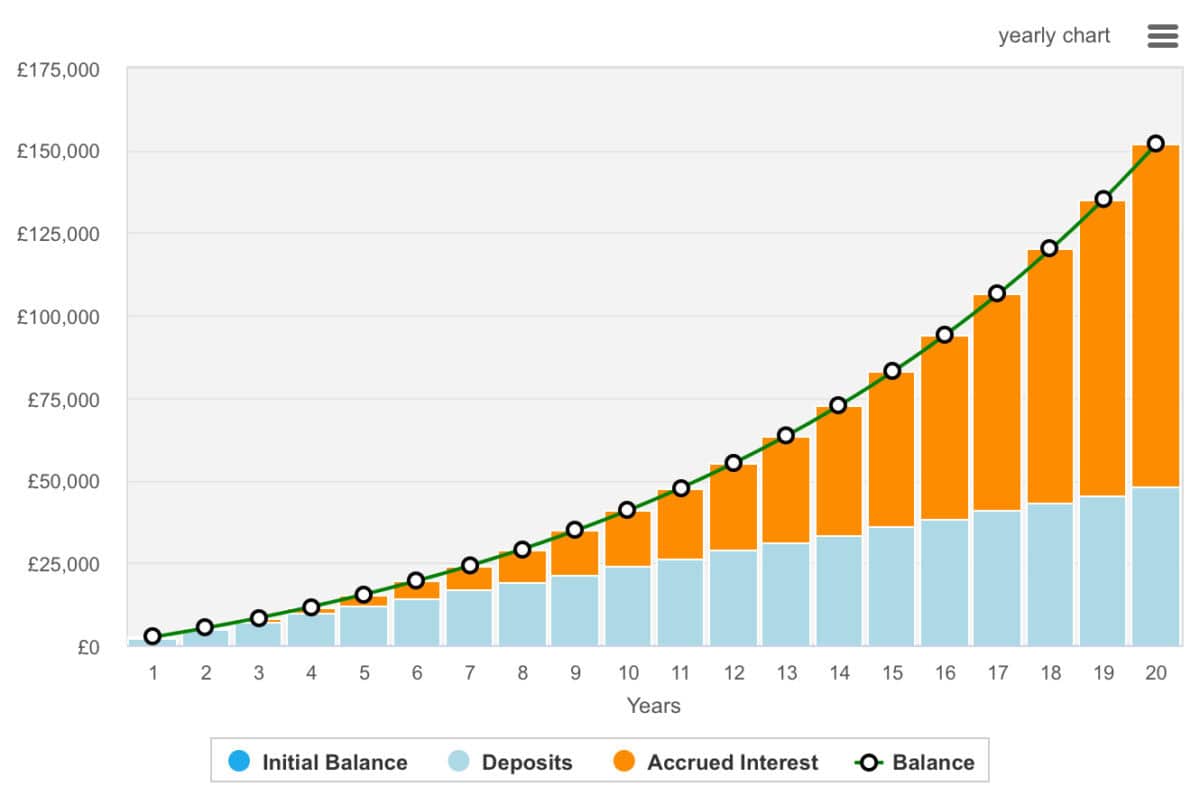
Investing £200 a month in a Stocks and Shares ISA can be a transformative strategy for building wealth over the long term. With a 20-year horizon and assuming a 10% annualised return, the power of compounding can turn modest monthly contributions into a substantial portfolio capable of generating significant passive income. Let’s examine how this works.

Starting with the maths

Over 20 years, monthly contributions of £200 would total £48,000. However, with a 10% annualised return, the portfolio could grow to around £151,874 by the end of the period. This includes £103,874 in interest earned through compounding. The formula for compound growth demonstrates how reinvesting returns amplify portfolio growth over time.

At this point, assuming a 5% dividend yield, the portfolio could generate an annual passive income of £7,594 a year — or £633 a month — providing a steady stream of cash flow that far exceeds the initial monthly investment.

Created at thecalculatorsite.com

Of course, there are several things to note here. Firstly, the investor might not achieve a 10% return. Some get more, but many others get less. Then, £633 won’t go as far in 20 years as it does today. In fact, in two decades tat would feel like around £386.34 in today’s money, assuming a steady annual inflation rate of 2.5%.

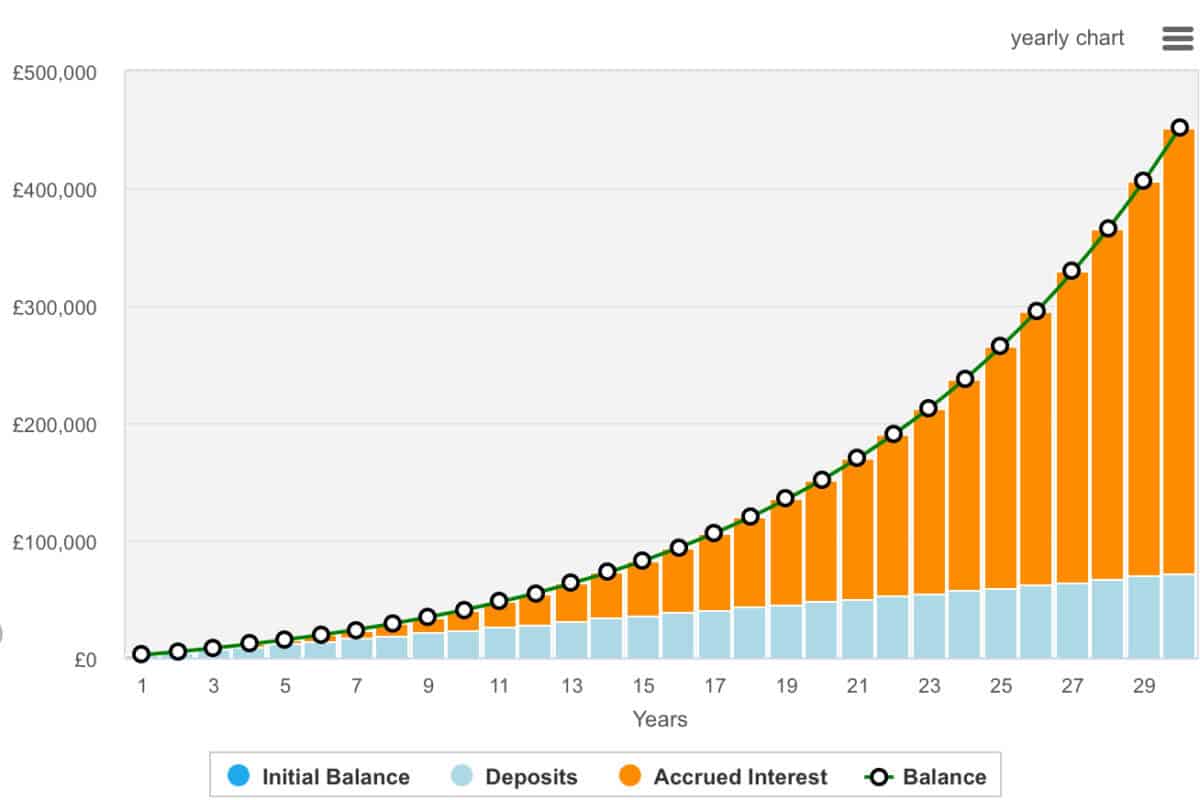
And this is why investors typically take a very long-term approach. And that’s because the portfolio will start earning interest on interest. This is something of a snowball effect. After a further 10 years of investing, that £200 a month would be worth more than £450,000.

Please note that tax treatment depends on the individual circumstances of each client and may be subject to change in future. The content in this article is provided for information purposes only. It is not intended to be, neither does it constitute, any form of tax advice. Readers are responsible for carrying out their own due diligence and for obtaining professional advice before making any investment decisions.

Created at thecalculatorsite.com

One for consideration

One standout option for consideration is Scottish Mortgage Investment Trust (LSE:SMT). Managed by Baillie Gifford, this trust offers exposure to some of the world’s most innovative and disruptive companies. Its portfolio spans both public and private firms, providing access to opportunities that are often unavailable to retail investors.

Current holdings include high-growth businesses like Amazon, Nvidia, and SpaceX, alongside emerging market leaders such as MercadoLibre and Meituan. This global diversification makes Scottish Mortgage an attractive choice for long-term investors seeking exposure to technological change and future market leaders.

Scottish Mortgage’s high-conviction approach is central to its appeal. Managers Tom Slater and Lawrence Burns focus on identifying companies capable of creating new markets or disrupting existing ones. This thematic strategy has delivered outsized returns in the past, with notable successes like Nvidia and Moderna.

However, it’s not without risks. The trust’s significant allocation to private companies introduces liquidity risks. These assets can be harder to sell during market downturns. Another key risk is gearing, or borrowing to invest. This is a strategy employed by Scottish Mortgage to enhance long-term returns.

While gearing can amplify gains in rising markets, it also exacerbates losses during downturns. The trust’s net gearing currently stands at 11%. This means its exposure to equities exceeds its shareholders’ funds by this proportion.

Despite these risks, Scottish Mortgage remains an appealing option for adventurous investors with a long-term perspective to consider. It’s a stock I’ll top up on with the market pulling back.

2 ‘safe-haven’ defensive shares to consider buying as tariffs hammer the stock market

The stock market seems to be worrying about the potential impact of US tariffs. And that makes it a good time to be thinking about buying shares. 

For some stocks, this might be justified – increased costs could well weigh on corporate profits. But in other cases, the market might be overreacting.

Inflation 

The immediate issue with tariffs is that companies manufacturing outside the US will have to deal with higher costs. The likes of Nike and Apple are good examples.

There’s a decent chance this will result in higher prices for consumers. And this happening on a large scale could mean significantly more pressure on household budgets. 

In that situation, demand for non-essential items might well fall sharply. And that could present a challenge for companies like Disney and Netflix – even with their US-based operations.

This means looking for stocks that are insulated from the effect of tariffs isn’t as simple as finding businesses with US operations. But there are some I think are worth considering.

Compass Group

Compass Group (LSE:CPG) is one example. The contract caterer is a FTSE 100 company with around two-thirds of its operations based in the US.

People need to eat even in an inflationary environment. And a huge scale advantage means customers are unlikely to save money by switching away from the firm.

The pressure the US healthcare sector’s under could have consequences for Compass. But while that’s a potential risk, it has nothing to do with inflation or tariffs.

Compass has the benefit of economies of scale and supplies a product people can’t do without. That’s given it the power to pass on higher costs before and I think it will continue to do so. 

Berkshire Hathaway 

It’s not the most imaginative choice, but I expect Warren Buffett’s Berkshire Hathaway (NYSE:BRK.B) to be good in a crisis. To some extent, it’s what the company’s built for.

There’s a risk some of the firm’s core operations – such as energy and railroads – could see weaker demand in a recession. On top of this, inflation isn’t good for insurance costs.

Nonetheless, I think Berkshire’s huge cash reserves make it more resilient than its rivals. And lower share prices could present Buffett’s team with some outstanding opportunities.

A lot of commentators were critical of Buffett’s inaction during Covid-19. But with the Federal Reserve looking less forthcoming, things might be different this time.

Defensive growth 

US tariffs aren’t just a problem for firms that sell products in the US and make them elsewhere. Inflation in general could be a challenge even for domestic businesses.

When it comes to the stock market, there’s no such thing as complete safety. But I think Compass Group and Berkshire Hathaway are likely to prove more resilient than most.

I expect Compass to benefit from relatively resilient demand. And for a company with Berkshire Hathaway’s cash reserves, lower share prices might be an opportunity.

Forecast: here’s how far the S&P 500 could crash in 2025

The S&P 500 has had a bit of a rough start to 2025. Despite delivering a stellar 26% total return in both 2023 and 2024, America’s flagship index dropped into correction territory last month.

There’s been a bit of a rebound since. However, continued uncertainty surrounding tariffs, inflation, and potential negative GDP growth is sparking fresh volatility in the markets. And the latest analyst forecasts suggest more pressure could be just around the corner.

Forecasts for 2025

The Economy Forecast Agency has outlined its expectations for the S&P 500 throughout the remainder of the year. And the situation appears to be quite bleak in the short term.

Month S&P 500 Close Gain/Loss vs Today
April 4,647 -7.9%
May 4,256 -15.7%
June 4,026 -20.2%
July 3,969 -21.4%
August 4,076 -19.2%
September 4,101 -18.7%
October 4,318 -14.4%
November 4,333 -14.1%
December 4,379 -13.2%

Assuming these predictions are accurate, the next couple of months look to be quite unpleasant for US stock investors.

However, the forecast also reveals that the worst might be over between June and August, potentially creating a window of opportunity to snap up some top-notch stocks at a discount. Even more so, given that the same group of analysts has placed a price target on the S&P 500 of 5,708 by the end of 2026. That’s 44% higher than the projected lows in July this year.

A potential winner in 2026?

Forecasts should always be taken with a healthy pinch of salt. After all, they rely on some key assumptions that rarely come true. As such, investors shouldn’t try timing the market with these figures.

Nevertheless, planning for a further decline in the S&P 500 is likely a prudent move right now. Personally, I’m building up cash in a high-interest savings account to ensure I’ve got plenty of dry powder if US stocks continue to tumble. At the same time, I’m building a shopping list of which stocks look tempting at a lower price. That list includes CrowdStrike (NASDAQ:CRWD).

Despite the chaos the company caused with a botched software update last year, most of its customers have continued to stick with the cybersecurity platform. What’s more, the group’s net retention rate currently sits at 112%. In other words, customers are also spending more.

As such, the company remains on track to achieving its $10bn annualised recurring revenue goal by 2031. For reference, this figure currently stands at $4.2bn as of January 2025 – up 23% year on year.

Given its impressive growth trajectory and track record, it’s not surprising that the stock trades at a lofty premium. Even on a price-to-sales basis, the stock is valued at almost 22 times revenue. But if it ends up getting caught in the middle of another S&P 500 downturn, then a much better buying price could emerge.

Risk and reward

CrowdStrike is far from a risk-free enterprise. We’ve already seen the damage that a bad software update can cause. And customers may not be so forgiving if this incident is repeated in the future, regardless of the quality of its technology. Don’t forget there are plenty of competing cybersecurity firms out there.

As for the S&P 500, it’s impossible to know for certain where it’s heading in the short term. But in the long run, I remain bullish.

Financial News

Daily News on Investing, Personal Finance, Markets, and more!

Financial News

Policy(Required)