2 stocks that have been crushed and now offer a ton of value

Around the world, share prices have come down significantly in recent days. As a result, many stocks now appear to offer a lot of value.

Here, I’m going to highlight two stocks that currently look cheap to me. I think they’re worth considering today.

A top digital payments stock

First up, we have PayPal (NASDAQ: PYPL). It’s one of the largest digital payments companies in the world.

Back in late January, this stock was trading near $90 (it’s listed in the US). Today however, it can be snapped up for less than $60.

I see a fair bit of value at current prices. As I write, the forward-looking price-to-earnings (P/E) ratio is around 11, which is not high at all for a payments company, especially one with a strong brand like PayPal.

Now, this company is facing quite a bit of competition today. Apple Pay, in particular, is one product that poses a threat to the business.

And that’s not the only risk here. If consumer spending slows down due to a recession or inflationary pressures, PayPal’s revenues could be impacted negatively.

In the long run though, I continue to see significant potential. Over the next decade, the online shopping industry is expected to get much bigger and this should support growth for the company, which recently introduced a new one-click checkout feature called ‘Fastlane’ to make payments quicker.

Another source of growth could be its subsidiary Venmo. This is a peer-to-peer payments app that has a large and growing user base in the US (nearly 100m users).

Given the long-term potential associated with the growth of the digital payments industry, I think the stock is worth a look today.

A play on the ageing population

Another stock that offers value in my view is Smith & Nephew (LSE: SN.). It’s a British healthcare company that specialises in joint replacement technology.

In early March, this stock – which is in the FTSE 100 – was trading near 1,200p. Now however, it can be bought for around 990p.

At that price, the forward-looking P/E ratio is around 12.3. That’s quite low for a medical technology company.

As for the dividend yield, it’s now about 3%. So, this stock offers two potential sources of return for investors.

Of course, there is tariff uncertainty here in the near term. So, the earnings forecast (the ‘E’) I used for the P/E ratio may not be accurate.

Another risk is competition from more powerful, US-based rivals such as Stryker and Johnson & Johnson. These companies could steal market share from Smith & Nephew if it fails to innovate.

Given that the global population is set to age dramatically over the next 10 years, however, I think there’s a lot of growth potential here. With the number of people aged 65 and older expected to increase by 36% between now and 2035 (to 1.2bn), the backdrop for this company remains favourable.

£10,000 invested in Aston Martin shares at Christmas is now worth…

Aston Martin (LSE: AML) shares have performed woefully for ages. In the three months leading up to Christmas, the share price was skidding downhill like a car on an icy bend. But that 34% drop was nothing compared with what had gone before — down 93% in the previous five years!

The FTSE 250 stock has fallen another 44% since Christmas Eve and currently sits at just 58p. This means anyone who made a £10k investment when presents were still under twinkling trees would now have just £5,600.

What has gone wrong?

There are a few key reasons why the stock has crashed, but most relate to the luxury automaker’s balance sheet. At the end of 2024, Aston Martin’s net debt was approximately £1.16bn, reflecting a 43% increase from the previous year. 

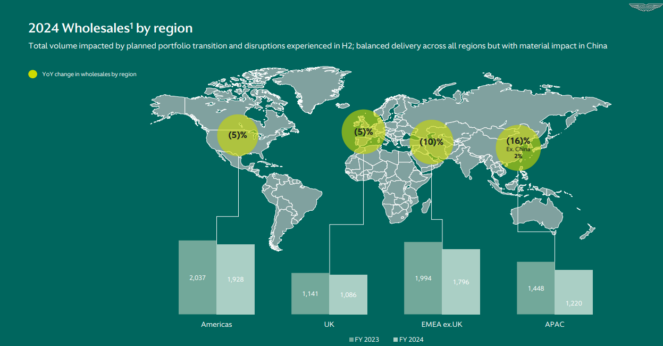
The annual pre-tax loss came in at £289m, up from £240m, on revenue of £1.58bn (down 3%). Supply chain issues and weak markets saw wholesale volumes slip 9% to 6,030 vehicles. China sales were especially bad, as they have been for most luxury goods companies.

Source: Aston Martin.

Taking necessary measures

To shore up the balance sheet, the Yew Tree Consortium, led by executive chairman Lawrence Stroll, increased its stake in the carmaker to 33%. The company also sold its minority stake in the Aston Martin Aramco Formula 1 team, raising about £125m from both transactions. 

On top of this, Aston will cut roughly 5% of its global workforce.

CEO Adrian Hallmark commented: “By strengthening the balance sheet, this investment provides additional headroom to support our future product innovation and business transformation activities, which combined, will accelerate our progress into being a sustainably profitable company.”

This fundraise is well-timed, as the company will need “additional headroom” now that President Trump’s 25% tariffs on all foreign-made carmakers have been announced. The company doesn’t have the capital to set up manufacturing stateside, so these looming taxes will almost certainly heap more pressure on margins.

New models on sale

Aston does have a refreshed line-up of vehicles, including high-margin special edition models like Valkyrie, Valour, and Valiant. Deliveries of Valhalla, its hybrid supercar, are due to start in the second half. The CEO says this is the “strongest product portfolio in our 112-year history.”

Meanwhile, the development of its first electric vehicle (EV) has been put on the backburner for a few years. This makes sense to me as we don’t even know whether Aston customers will really want EVs by 2030. Or whether government net-zero targets will be watered down.

Recovery potential?

I’ve often looked at Aston shares over the past 18 months and thought they could stage an epic comeback at some point. But that would ultimately depend upon improving fundamentals and we’re not seeing that.

The firm’s history of losses and balance sheet risk means I don’t feel comfortable investing here. Also, the sheer amount of uncertainty being unleashed by the developing global trade war isn’t going to be great for sales of almost anything.

Right now, the stock market is crashing due to these fears. In this situation, I want to be adding shares of resilient companies to my portfolio. Ones that I think can weather this Category 5 hurricane and possibly emerge stronger.

Unfortunately, I don’t think that’s Aston Martin.

Up 5% in the last crazy week! Are these 2 income stocks the ultimate FTSE defensive plays?

It’s been a brutal few days for stock markets but some dividend income stocks have shown their defensive capabilities.

While the FTSE 100 is down nearly 11.5% over the last week, two quiet achievers have managed to climb almost 5% each. 

In turbulent times like these, that kind of resilience grabs my attention. Especially when it’s from a sector I’ve ignored for years: water utilities.

Utilities have long been seen as classic defensive stocks. People don’t suddenly stop turning on the taps or boiling the kettle during a downturn. Their earnings are typically regulated too, which can help smooth the financial ride.

Of course, they’re not perfect. Utilities tend to lag in boom times and often carry high levels of debt. 

In today’s world of elevated interest rates, that means bigger borrowing costs. It also makes their dividends look less appealing compared to the return on cash and bonds, which carry little or no capital risk.

Even so, these two water giants have defied the market panic

United Utilities is this week’s biggest winner

United Utilities (LSE: UU) is the best performer on the FTSE 100 over the past week, the shares jumping 4.9%. Over 12 months, it’s barely moved (up less than 1%), but over five years, it’s climbed 25%.

That’s before factoring in its dividend, which currently yields a tempting 4.88%. Last year, it hiked the dividend by 9.4% to 49.78p per share.

There are higher yields out there, but few come with the same level of perceived stability. That said, United Utilities isn’t cheap. At 33 times earnings, the stock trades on a premium valuation.

The group is also committed to a £13bn investment programme over the next five years, which will go towards the biggest infrastructure upgrade in more than a century. And it’s putting aside £525m to help low income households pay their bills. Net debt is already high at around £9bn, bigger than its £7bn market cap.

Despite that, the board expects to increase dividends in line with inflation, while the balance sheet still looks sturdy, with £2.6bn in liquidity.

Personally, I’m more interested in stocks that have dropped but for more cautious investors, this kind of performance may be worth considering.

The Severn Trent share price is on the up

Severn Trent (LSE: SVT) has also made a splash this week, with its share price up 4.77%. It’s gained 5% over the year, and 22% over five years (again, before dividends). That’s also a pretty solid total return from an easily overlooked FTSE stock.

Like United Utilities, it’s not cheap, with a price-to-earnings ratio of around 33. It has net debt of around £7bn against a £7.7bn market cap.

The group tripled half-year profits to £192m in November but came under fire for missing drinking water standards, while paying CEO Liv Garfield £3.2m despite a £2m fine for a sewage spill in the River Trent. Last year, it hiked the dividend more than 9% to 116.84p per share. The current trailing yield is a solid 4.57%.

If markets recover quickly, these steady climbers could fall out of favour. But if interest rates drop or market volatility continues, these are worth considering for investors who prize a good night’s sleep.

2 beaten-down UK shares that now look really cheap

The stock market’s taken a big hit in recent days. As a result, a lot of shares now look very cheap. Of course, not every ‘cheap’ stock is worth buying. But here are two I think are worth considering due to their long-term potential.

A future FTSE 250 star?

First up, we have Gamma Communications (LSE: GAMA). It’s a digital communications business that operates in the UK and Europe and has a strong growth track record (revenues have jumped 76% over the last five years).

Gamma shares are currently trading for about 1,175p – nearly 25% below where they were trading at the start of the year. At the current share price, the price-to-earnings (P/E) ratio here’s only 13, which strikes me as great value for this growth company.

Looking beyond the low valuation, there are lots of reasons to be bullish here. One is that the company plans to move from the UK’s Alternative Investment Market (AIM) to the main market in May. This should make the stock eligible for the FTSE 250 index. Inclusion in this index would allow far more institutions to invest in the company.

Another reason is that the company’s raising its dividend aggressively (a 13% increase for 2024) and also doing share buybacks. So it’s rewarding investors with multiple forms of capital returns.

Of course, a recession across the UK and/or Europe is a risk here. This could lead businesses to reduce their spending on technological transformation. Taking a five-year view however, I think this stock will do well.

A tasty proposition at current levels

One stock that’s already in the FTSE 250, and looking very cheap, is Greggs (LSE: GRG). It operates one of the most popular food-on-the-go chains in the UK.

Back in early January, Greggs shares were trading for around 2,800. Today however, they’re about 40% lower at 1,685p.

At 2,800p, I didn’t see a lot of appeal as the valuation was quite lofty. At today’s share price it’s a different story though.

Currently, the P/E ratio here is only 13. Given Greggs’ strong brand name, high level of profitability, and solid growth track record, I think that multiple’s good value.

One thing I like about this company from an investment perspective is that it sells cheap food. This should provide an element of resilience if economic conditions deteriorate from here. Another is the dividend yield. After the recent share price fall, the yield has climbed to about 4%.

A risk factor here is costs. Looking ahead, the company’s likely to be facing higher staff wage costs due to the recent National Insurance (NI) changes.

All things considered though, I think the shares have a lot of potential at current levels, especially when the 4% yield’s factored into the equation.

As stocks tank, is this a rare chance for ISA investors to get rich?

As global stock markets reel from the Trump administration’s sweeping tariff policies, ISA investors may find themselves at a crossroads. While the sell-off has erased trillions from equity markets, it could also present rare opportunities for those willing to navigate the chaos.

What we’ve learned so far

The tariffs, ranging from 10% to as high as 54% on imports from countries around the world, present huge disruptions to globally supply chains and hammer companies reliant on overseas production.

In short, the implications of Trump’s drive to eliminate trade deficits remain a looming threat. The administration’s goal of zero trade imbalance introduces persistent uncertainty for companies exposed to tariffs.

The response and resilience of individual stocks has reflected their exposure to these tariffs and the potential impact on demand for their goods and services — after all, these tariffs will likely be very inflationary in the US.

We’ve also seen retaliatory tariffs from China and a willingness to negotiate from the likes of Vietnam and Cambodia. The impact of these negotiations have actually been very interesting. Companies like RH — formerly Restoration Hardware — have jumped from their lows.

However, the broader market continues to move down on the fears that these tariffs, if not reduced immediately, will cause irreparable damage to supply chains and break demand.

Something’s got to give

High-profile investors like Bill Ackman have voiced concerns about the economic fallout this policy could trigger. Moreover, despite the significant impact on industries such as textiles and electronics, the reality is that it would be near-impossible to reshore these jobs to the US. For one, the average salary in Vietnam is just 7% of that in the US.

For stocks to recover meaningfully, political dynamics would need to shift. While Trump’s rhetoric suggests a long-term strategy to “pry open” foreign markets, history shows that such aggressive measures often soften over time. Investors betting on a reversal could be positioning themselves for substantial gains if tariffs are scaled back.

A rare chance to get rich?

Stocks rarely sell off with such vigour. And as we all know, buying when others are fearful and stocks being depressed can magnify long-term gains. In other words, this could be a rare chance to buy high-potential stocks at lower prices, offering an opportunity to build wealth over the long run, and maybe even get rich.

One UK stock that’s understandably suffering is Scottish Mortgage Investment Trust (LSE:SMT). The Baillie Gifford-managed trust has seen its share price fall 20% over a month.

The FTSE 100 investment trust is very popular with investors, providing access to US-listed stocks and unlisted companies like SpaceX. Over the long run, the stock’s performed well, however it’s highly volatile given its exposure to tech and because of gearing (borrowing to amplify returns). While gearing can boost gains in rising markets, it also magnifies losses during downturns. This is a real risk to bear in mind.

Nonetheless, assuming a normalisation of US trade policy over the long run, I’d expect to see Scottish Mortgage stock outperform. It’s highly volatile, but picking the stock up at this price could be highly beneficial. It’s certainly a stock I’m looking to top up.

2 strong FTSE 100 dividend shares to consider as recessionary risks increase

No one yet knows the full impact that fresh trade tariffs will have on the global economy. But the damage to corporate earnings and, by extension, to the dividends that FTSE 100 shares could pay, may be considerable.

Investors should therefore keep a close eye on economic developments. But in the meantime, here are two FTSE shares I think may be worth considering.

Aviva

UK shares that have little-to-no US exposure like Aviva (LSE:AV.) may be attractive stocks to consider as transatlantic trade wars heat up. Its regional footprint covers just Britain, Ireland and Canada.

Yet this isn’t the only reason I believe the financial services giant merits serious attention. Thanks to its huge general insurance division, Aviva derives a large chunk of profits from defensive operations that are largely unaffected by economic conditions.

In the UK and Ireland, the firm has 7m customers using its motor, home, pet and travel insurance. Spending on policies like these tends to remain resilient at all points of the economic cycle. It’s a legal requirement for drivers to have adequate insurance as well.

Through its upcoming acquisition of FTSE 250 operator Direct Line, Aviva’s exposure to this highly resilient market will grow further too.

These two factors alone don’t provide Aviva’s profits column with complete protection however. It’s important to note that it sprawling life insurance, wealth and retirement divisions are highly cyclical and prone to weakening when consumers feel the pinch.

This naturally casts a shadow over what future dividends could be. But I think the firm’s large defensive businesses, allied with its cash-rich balance sheet, leave it in good shape to continue paying market-beating dividends.

Aviva’s Solvency II capital ratio was 203% as of December, more than double regulatory requirements. For 2025, the business is tipped to raise the annual dividend to 37.85p per share, resulting in a 7.6% dividend yield.

United Utilities

Some believe that water companies like United Utilities (LSE:UU.) are among the greatest dividend shares to buy during tough times. Access to running water is one of life’s essential needs and the same can be said for electricity and gas.

But a higher proportion of energy consumption is reliant on cyclical sectors like manufacturing and construction compared with that for water. So water suppliers may be a safer pick as economic uncertainty grows.

Resilient consumer demand has given United Utilities the strength to pay a growing, market-beating dividend over time. The business — which provides water and wastewater services in the North West of England — is tipped to raise the reward to 53.14p per share this financial year (to March 2026).

Consequently, the FTSE company carries a robust 5.2% dividend yield.

Despite the predictability of the market it operates in, there are some important threats investors need to consider with United Utilities shares. Worsening tariffs could fuel inflation that eat into United Utilities’ asset values and push up borrowing costs. It’s also critical to remember the firm operates in a highly regulated industry in which Ofwat dictates pricing and can issue hefty fines for operational issues.

But in the current climate, I still feel that both United Utilities and Aviva shares are worth a close look.

Can Greggs shares offer shelter from Trump’s tariff chaos?

The global economic landscape’s shifting, and Donald Trump’s newly-imposed tariffs have added layers of complexity to international trade. Stock market volatility has been unprecedented.

But what does this mean for shares such as Greggs (LSE:GRG)? Can the beloved purveyor of sausage rolls and steak bakes provide a safe haven amid this turmoil?

A domestic champion

Greggs is a UK-focused business, with over 2,000 company-managed shops and 561 franchised units. Its business model is firmly rooted in domestic operations, which shields it from direct exposure to international trade tariffs.

Unlike companies reliant on imports or exports, Greggs sources much of its raw materials locally, mitigating risks associated with global supply chain disruptions. This domestic focus means that Greggs could offer insulation from Trump’s tariff chaos. However, while the retailer avoids direct tariff impacts, it faces its own set of challenges.

A slowing growth story

In 2024, Greggs achieved record-breaking revenue of £2bn, with like-for-like sales growth of 5.5%. Yet, early 2025 has been less kind. Sales growth slowed to just 1.7% in the first nine weeks of the year, attributed to challenging weather conditions and subdued consumer spending. This slowdown has spooked investors, leading to a sharp decline in the share price. The stock’s now down 40% since the turn of the year.

Inflationary pressures remain a significant concern. It expects input cost inflation of around 6% in 2025, compounded by rising employment costs due to increases in National Insurance contributions and the Minimum Wage. These factors could squeeze margins further unless mitigated by strategic pricing adjustments.

Despite these challenges, it remains optimistic about its future. The company continues to expand its footprint, adding 145 net new shops in 2024 and refurbishing existing locations. It’s also investing in evening trading hours and home delivery services to diversify revenue streams.

However, I’m personally a little concerned about the company’s capacity for growth. It’s tried to expand internationally before, and elected not to continue these operations in Belgium. The brand’s seemingly a British phenomenon. What’s more, Greggs appears to be reaching saturation point, in my opinion. There simply aren’t that many places left for it to expand into.

The bottom line

Greggs’ domestic focus offers some insulation from the disruption caused by tariff policies. However, the bakery chain is contending with internal pressures that may weigh on investor sentiment. Slowing sales growth and rising costs remain key concerns that warrant attention.

That said, many investors will still see merit in the brand. It enjoys strong recognition and affection across the UK. Even so, there are evident risks to the company’s growth strategy.

Furthermore, with the shares trading at 13.2 times forward earnings, the valuation doesn’t appear especially compelling. Earnings growth looks flat over the next two years, though a dividend yield approaching 4% provides some consolation.

For now, I won’t be investing in Greggs.

Income of almost 12%! 3 stunning FTSE dividend stocks now have double-digit yields

As global stock markets plunge, bargain hunters can get some incredible rates of income from FTSE 100 dividend stocks.

Three of the companies I hold in my self-invested personal pension (SIPP) now yield 10% or more. One is closing in on a jaw-dropping 12%. That’s a truly stunning rate of income.

All three are all in the financials sector: Phoenix Group Holdings (LSE: PHNX), M&G (LSE: MNG) and Legal & General Group (LSE: LGEN).

There’s a lot of crossover here, but I hold 20 FTSE stocks in total, so have diversified by investing in other sectors too.

All three were already dishing out generous payouts but thanks to today’s market turmoil, they’ve become even more attractive. That said, this isn’t free money. Each carries risks, especially in today’s unpredictable climate.

Phoenix Group Holdings is a huge income share

Phoenix is a closed-book life insurer, which means it mainly manages policies taken over from other firms. That’s helped keep things fairly stable, and I’ve always liked its income focus. Today, it offers a meaty 10.86% yield. But its share price has slipped 7% in the last week, and is still 4% lower than a year ago.

Phoenix also holds a massive £280bn investment portfolio to back its insurance liabilities. Right now, that’s falling in value. While I still believe in the company’s ability to pay dividends, I’m watching closely.

Last month, it increased the final 2024 dividend by a solid 2.6%. If today’s market volatility continues, next year’s may be lower. It could be frozen or even cut. As yet, nobody knows.

For patient investors with a long-term view, Phoenix could still be a rewarding one to consider. That’s assuming current market chaos doesn’t do too much damage.

No company pays more than M&G

M&G currently offers the highest yield on the entire FTSE 100 – a staggering 11.53%. That figure alone will turn heads, and I won’t pretend it didn’t catch my attention. I hold the shares, but with my eyes wide open. 

Over the last week, the M&G share price has fallen 9%, and over the past year it’s down nearly 13%.

As an asset manager, M&G is also heavily exposed to market mood swings. When investors panic, they pull money out, and that hits earnings. I still see long-term value here, but I’m also bracing for the possibility that this sky-high dividend may not be fully secure.

Legal & General’s 10.02% yield may be the lowest of the three but is still remarkable. Again, there’s risk. The shares are down 9% in a week, and 13% over the year. The company also holds £1.2trn in assets tied to the markets, a number that is no doubt sliding as I write this.

The board was already planning to cut dividend growth from 5% a year to just 2% between 2025 and 2027, and that was before current turmoil. I’m not selling Legal & General either. I believe in its income potential and relative resilience, but I’m braced for a lot more bumpiness, and potential threats to the dividend. 

I think any of these are worth considering today, for investors who are feeling brave. They should aim to hold for a minimum five years, and ideally much longer.

As vehicle sales slump, should I buy Tesla stock on the dip?

Tesla (NASDAQ:TSLA) investors have had a terrible start to 2025, with the stock down a whopping 30%. But with Elon Musk recently telling employees to hang on to their stock, is now the time for me to take advantage of its slide and buy some for my ISA portfolio?

Q1 deliveries

On Wednesday (April 2), Tesla released its production and deliveries report for Q1 and they didn’t make for pleasant reading. Global deliveries fell 13% from the same time last year to 336,681.

For me, these numbers are a disaster and highlight that something is fundamentally not right at the company. Only last year, Musk had been forecasting 25%-30% growth in sales in 2025, on the back of its new Cybertruck. The reality has been a model dogged with safety concerns, which recently led to a complete recall of the model.

In Germany, home to its European operations, registered sales slumped in 2024 to less than 38,000. The country’s Federal Motor Transport Authority has similarly reported a weak start to 2025, with registrations down over 70% compared with a year ago.

Brand image

What these falling sales figures highlight, is that political leanings of Musk have tarnished the brand’s image.

Last month, in an all-hands call, he had this to say about the stock. “Tesla stock goes up and it goes down, but it’s actually still the same company. It’s just people’s perception of the future, I don’t know, I guess it’s very emotional.”

I would agree that Tesla does invoke significant emotions these days. In both the Europe and the US its sites have become vandalism targets and owners’ cars set on fire.

But it also faces stiff competition from Chinese EV maker BYD. That recently became the first EV maker to report sales in excess of $100bn. In addition, it’s also getting squeezed in the lower end of the market. The Renault Twingo is set to be launched with a price tag of €20,000.

Beyond EVs

In the early days of the motor car in the 20th century it looked like a few global players would rule the roost. It didn’t turn out like that and I don’t think the EV market will either. For starters, the differing adoption rates across the globe are turning into a major headache for the big boys.

Ultimately, Musk doesn’t see Tesla’s future as a pureplay EV manufacturer but more as a player in AI and robotics. As such the company is behaving more like it was 15 years ago, a speculative play in nascent, experimentation technologies. This brings additional risks but also the opportunity for big returns.

The promise of self-driving cars has so far disappointed, with hype not matching reality. But Musk believes that the research into this technology provides it with a competitive advantage as it seeks to mass produce Optimus, its human-like robot.

The company’s charismatic CEO believes the opportunity here is the biggest in history and has the potential to provide Tesla with a $30trn valuation. But in the short-term a global trade war is what matters here. With so much uncertainty, I won’t be buying.

Why this stock market correction is great for passive income investors

UK stocks took a hit last week following the news about reciprocal tariffs from the US on countries around the world. Some companies are more impacted than others, but the weak sentiment from investors saw most shares fall. This is bad news for some, but it’s a source of positive news for those trying to make passive income.

Prices down, yields up

To understand why falling share prices can be good for income investors, let’s go back to understanding what these investors look for. Most focus on the dividend yield calculation. This provides (as a percentage) the yield based on the dividends paid over the last year, factoring in the current share price. Usually, the higher the yield, the more attractive it is.

Given the fall in the share price for many stocks and the fact that the dividend per share doesn’t update that often, the dividend yield for some shares has increased in recent days. So, if an investor bought a stock today versus last week, their yield will likely be higher. That’s why I refer to this correction as good news.

However, there’s an important caveat. For companies likely to struggle due to the tariffs, there’s the potential for the future dividend to be cut if finances suffer. So the yield in the long run could fall. Rather, investors should be targeting stocks that aren’t impacted by the announcement. The stocks could have been caught up in the broader selling for no good reason.

A lack of major impact

For example, consider Aviva (LSE:AV). The insurance and pension provider’s share price dropped 6% last week. Over the last year, the stock is up 6%. With the recent fall, the dividend yield has increased to 6.8%.

Aviva sold its US business back in 2013 and since then hasn’t had any major operations across the. So there shouldn’t be any issues with cross-border trade here going forward. It’s true that some of the pension funds that it runs that have exposure to stocks will have underperformed. This is one reason why the stock dropped. Some investors might look to pull their money out from being managed by the company.

Yet in reality, the 6% drop lacks any real meaning to me. I believe this is just a fall based on general investor fear, rather than it being based on anything fundamental for Aviva. If anything, insurance operations shouldn’t be impacted at all, with revenue and profits remaining on track. Therefore, the dividend shouldn’t be under threat, and it could be an attractive option for income investors to consider now.

One risk is that the company is exposed to large payouts should a natural disaster, extreme weather or something else occur that impacts the insurance claims. Yet overall, I think it’s a business that’s well run with good potential.

Financial News

Daily News on Investing, Personal Finance, Markets, and more!

Financial News

Policy(Required)