With global markets down 10%+ investors should remember this legendary quote from Warren Buffett

Over the last week, global stock markets have experienced a major crash. Here in the UK, the blue-chip FTSE 100 index just fell nearly 10% in the space of two days. In this kind of environment – where’s the panic in the air – I always come back to one well-known quote from investing guru Warren Buffett. He sees this type of stock market environment as a major buying opportunity.

A great tip

Over the last half century, Buffett has come out with some absolutely brilliant pieces of wisdom. There’s almost a great Buffett quote for every aspect of investing.

When stocks are in freefall and investors are in panic mode, however, it’s hard to beat this one:

I will tell you how to become rich. Be fearful when others are greedy. Be greedy when others are fearful.

His advice here is pretty clear. If you want to make a lot of money from stocks, the best time to buy is when others are fearful (like they are now).

Real-life examples

It’s worth noting that Buffett has made a lot of money following this strategy.

At the height of the Global Financial Crisis in 2008, for example, he invested $5bn in investment bank Goldman Sachs. This trade was rather complicated as it involved preferred shares and warrants, but he ended up generating a great return from it.

More recently, his investment company Berkshire Hathaway bought back a load of its own stock in the first quarter of 2020 (in the early stages of the coronavirus pandemic when markets were volatile). That trade worked out very well – over the last five years Berkshire Hathaway Class A shares have risen about 150% (roughly 20% per year).

So, I think this quote is worth remembering. Especially in the current environment, where a lot of investors are fearful.

Investing like Buffett

It’s worth pointing out that Buffett won’t invest in a company just because its share price has fallen. He has a very specific investment strategy.

In short, he likes to buy into high-quality businesses at reasonable valuations. Things he looks for in a company include a strong competitive advantage (or wide economic moat), a high level of profitability, a solid balance sheet, and a good track record when it comes to generating returns for investors.

The good news is that there are plenty of Buffett-type stocks that look appealing today. One example is, I think, Meta Platforms (NASDAQ: META), which owns Facebook and Instagram. I feel this company ticks a lot of boxes for those wanting to emulate warren Buffett’s investing style.

Not only is it very profitable and financially sound, but it also has competitive advantages and a great track record in terms of shareholder returns (the stock has risen more than 500% over the last decade).

In terms of the valuation, it looks reasonable to me after some share price weakness over recent months. Currently, the price-to-earnings (P/E) ratio is around 20, which isn’t high for a ‘Magnificent 7’ stock.

Of course, this stock isn’t for everyone. This social media company can be controversial at times and in the future, I wouldn’t be surprised to see it get more attention from regulators.

I do think it has potential from an investment perspective though. So it could be worth considering.


I asked ChatGPT for the best safe havens in the FTSE 100 amid Trump’s tariffs 

The FTSE 100 has not been an oasis of calm during the stock market carnage. In fact, the blue-chip index is down 10.26% in a week, as Footsie banks and miners have been hit especially hard.

With all global indexes tumbling, I asked ChatGPT for ‘safe haven’ Footsie stocks to consider as President Trump’s tariffs cause mayhem. Here’s what the AI chatbot said.

Consumer staple

To start, it quickly pumped out Diageo (LSE: DGE). As a major player in the global drinks industry through brands like Guinness and Smirnoff, it enjoys consistent demand and “steady performance regardless of economic cycles“.

Hmm. Try telling that to shareholders, of which I was one until recently. The share price is down 23% year to date and 51% since the start of 2022. So much for steady performance!

That said, Diageo stock now appears to offer real value, trading at 15.6 times earnings and offering a 4.1% dividend yield. Those figures were closer to 24 and 2% just three years ago. So it’s possible the bottom might finally be in (or near).

However, things have changed since 2022. Surging inflation has ripped a hole in many drinkers’ budgets, driving some to downgrade from Diageo’s premium labels. Gen Z is drinking less.

Meanwhile, GLP-1 weight-loss drugs, which suppress cravings for alcohol among other things, have started to go mainstream. Fund manager Terry Smith cited them as a key reason for dumping his long-held Diageo stake last year.

I’m not convinced that Diageo is a great defensive play, given its exposure to some US tariffs and the rising possibility of a global economic downturn.

Utility

Next, ChatGPT plumped for National Grid (LSE: NG.). It said operating the UK’s electricity and gas transmission networks means it “provides essential services with regulated revenue streams, offering stability amid market fluctuations.”

I’d add that the firm has strategically shifted its focus from gas to electricity transmission. This aligns with the UK’s aim to decarbonise its energy sector and achieve net-zero emissions. Unfortunately though, this transition is eye-wateringly expensive, with National Grid planning to spend up to £35bn between April 2026 and March 2031.

My fear here is that these large-scale infrastructure projects will end up costing more, as they typically do on these shores. This could threaten long-term dividend growth and increase National Grid’s already colossal debt pile.

To be fair, the stock has proven to be a bit of a safe haven, edging up 2.4% this year. It might have further to run, given the uncertainty around global trade right now. So it may be worth considering by investors.

While I don’t see any immediate threat to National Grid’s dividend, the forecast yield for its current financial year is 4.8%. That isn’t high enough to tempt me to invest, given the debt situation.

Big Pharma

Finally, the bot highlighted AstraZeneca and GSK. Again though, are pharmaceuticals really a safe-haven sector in this environment? Tariffs on the industry are also being drawn up, which could directly impact profitability and lead to a cut in research and development.

Of these, I’d say National Grid is the best defensive play. But given the potentially lucrative opportunities elsewhere after the sell-off, I intend to go on the front foot in the coming weeks.

2 world-class shares to consider buying in the market sell-off

Over the last week, major stock market indexes such as the FTSE 100 and the S&P 500 have fallen significantly. As a result, a lot of attractive investment opportunities have emerged. Looking for high-quality shares to buy right now? Here are two strong stocks to consider.

One of the world’s top financial data companies

Let’s start with London Stock Exchange Group (LSE: LSEG). It’s a financial markets infrastructure and data company and one of the leading financial data players globally today.

Back in February, this stock was trading above 12,000p. Today however, it can be snapped up for around 10,300p. At the current price, the price-to-earnings (P/E) ratio is in the mid-20s. And I think that’s a very reasonable valuation.

This is a software company with a world-class product, institutional clients that are unlikely to suddenly stop paying for its data services), and the ability to raise its prices, especially now that it’s rolling out artificial intelligence solutions.

It also has several ways to potentially create value for shareholders. For example, it could sell off the London Stock Exchange itself. Or it could list its shares in the US, where it would probably get a higher valuation.

Of course, there are risks to consider with this stock. One is competition from the likes of Bloomberg and FactSet, which are both major players in the financial data space.

All things considered, however I’m very bullish on this one. Currently, it’s my largest UK stock holding.

A wide economic moat

Another high-quality stock I like the look of right now is Visa (NYSE: V), which is listed in the US. It operates one of the world’s largest electronic payments networks.

In early March, it was trading for around $360. Now though, Visa shares can be picked up for around $310. At that share price, the forward-looking P/E ratio using the earnings forecast for the year ending 30 September 2026 (next financial year) is under 25. Again, that strikes me as a very reasonable valuation.

This is a business with a very wide economic moat (meaning new competitors can’t easily steal market share) and plenty of long-term growth potential given the global shift away from cash towards electronic payments. And it doesn’t face any credit risk from credit card loans as it doesn’t issue cards – it simply operates the payments network.

There are other risks to consider, however. A major collapse in consumer spending is one. This would most likely lead to lower revenues for the company as it takes a small slice of every transaction on its network. Changes in the way people pay for things in the long run (such as a shift to cryptocurrencies) are another risk to think about.

Yet I think this company has all the hallmarks of a brilliant long-term investment though. For me, it’s a core holding and I think it’s worth considering today.

Consider targeting £8,840 of annual passive income from 363 shares in this FTSE 100 heavyweight stock!

Legendary investor Warren Buffett best summed up the idea behind passive income investments. He said: “If you don’t find a way to make money while you sleep, you will work until you die.”

The best way I have found of generating such income is by investing in high-yield shares with certain other qualities.

I then effectively turbocharge the dividends they pay by reinvesting them back into the stocks. This is known as ‘dividend compounding’ and is like leaving interest in a bank account to grow.

Qualities I want in income stocks

The beating heart of any firm is its earnings. It is growth here that pushes its share price and dividend higher over time. So, the first quality I want in my passive income stocks is strong earnings potential.

I also want the yield to be high even before this earnings growth kicks in – over 7%, in fact. Why this figure? It is because I can currently receive around 4.6% from the risk-free rate (10-year UK government bonds). As recent market turbulence has underlined, stock investment is not risk-free, and I want compensation for taking that additional chance.

The final quality I look for in my passive income stocks is that they trade significantly under their ‘fair’ value. This reduces the chance of my making a loss on the share price if I decide to sell the stock.

A case in point from my portfolio

I think a prime example of these three qualities at work is British American Tobacco (LSE: BATS).

Analysts forecast the tobacco and nicotine replacement product firm’s earnings will increase 16% a year to end-2027.

The FTSE 100 heavyweight’s 2024 results showed adjusted organic revenue increasing 1.3% year on year to £25.867bn.

A risk here is that its move towards nicotine replacement products from tobacco ones fails for some reason. However, as of the 2024 figures, earnings per share also increased – by 3.6% to 136p – and the dividend rose 2% to 236p. This generates a current yield of 7.8%.

That said, analysts forecast the dividends will increase to 245.4p in 2025, 252.8p in 2026, and 264p in 2027. These will give respective yields of 8.1%, 8.3% and 8.7%.

A discounted cash flow analysis shows British American Tobacco shares are 54% undervalued at their current price of £30.29. So the fair value for them is technically £65.85, although market forces could push them lower or higher than that.

How much passive income could be made?

At the current 7.8% yield, 363 shares (£11,000-worth, the average UK savings amount) would make £858 in first-year dividends. On the same average yield this would rise to £8,580 after 10 years and to £25,740 after 30 years.

Crucially though, these returns would be much higher if dividend compounding were used. In this event and on the same average 7.8% yield, there would be £12,936 in dividends not £8,580. And after 30 years on the same basis, this would increase to £102,332 rather than £25,740.

By that time the total holding would be worth £113,332, which would be paying £8,840 a year in passive income, although of course this is not guaranteed!

But given this and the firm’s strong earnings growth prospects, I will buy more shares very soon.

16% lower in 10 days, does Prudential’s share price look a compelling bargain to me?

Prudential’s (LSE: PRU) share price has fallen 16% from its 28 March 12-month high of £8.47.

In my view, this loss had little to do with company specifics. Instead, it was prompted by the run-up to and aftermath of the US’s 2 April tariffs announcement.

Consequently, it may be that now is a great time to buy a terrific stock at a fabulous price. But it might not be.

The answer depends on how much value the stock holds and whether it suits an individual’s portfolio requirements.

Relative valuations with its peers

Prudential currently trades at a price-to-earnings ratio of 10.4. This is bottom of its peer group of global insurance and investment firms, which averages 15.5. These companies comprise MetLife at 11.6, ManuLife at 13.9, Allianz at 14, and Aviva at 15.5.

So Prudential looks undervalued on this measure.

The same is true of its 1.4 price-to-book ratio compared to its competitors’ average of 1.8.

However, it is overvalued on the price-to-sales ratio, trading at 1.9 compared to its peer average of 1.

It is in cases of contrasting valuations like this where I find using future cash flows to be especially helpful. In Prudential’s case, the resultant discounted cash flow analysis shows the stock is 65% undervalued at its current £7.14 price.

Therefore, the fair value for the stock is in theory £20.40, although market vagaries could push it lower or higher.

In short, I think there is a huge amount of value remaining in Prudential shares.

Looking deeper into the business

Having established a baseline technical undervaluation, I then dive further into the business to see how that looks.

A longstanding risk for the firm is intense competition in the insurance and investment sector, in my view. This could squeeze its margins and reduce profits over time.

Shorter-term risks relate to a potential global economic recession that could cause customers to close their accounts with Prudential. The chance of such an economic contraction have increased from around 40% to about 60% according to various market sources.

That said, the firm’s 2024 results released on 20 March showed adjusted operating profit up 10% year on year to $3.129bn (£2.42bn).

For 2025, Prudential forecasts 10% growth in new business profit and basic earnings per share.

Consensus analysts’ projections are even more upbeat at 11.6% earnings growth every year to the end of 2027.

Will I buy the stock?

I have several other holdings in the same sector that I am very happy with. These are Phoenix Group Holdings, M&G, and Legal & General.

All three are forecast to see higher annual earnings growth than Prudential — Phoenix Group’s is 91.6%, M&G’s 42.4%, and Legal & General’s 28.8%.

And M&G is also slightly more undervalued than Prudential’s – at 67% below its fair value.

All three as well have much higher dividend yields than Prudential’s meagre 2.5%. M&G currently yields 11.6%, Phoenix Group 10.7% and Legal & General 9.9%.

Therefore, although Prudential shares look a bargain, they are not sufficiently compelling for me to buy.

Down 17% in a week! This FTSE 100 growth stock is one I’m watching

Informa (LSE:INF) isn’t the only growth stock to have had a difficult few days. But a 17% decline in the FTSE 100 company’s share price in a week puts it firmly on my radar.

Over the last few years, I think the business has shown itself to be incredibly resilient. And while the stock doesn’t look cheap at first sight, a closer inspection reveals a different picture.

Resilience

Informa’s main line of business is trade shows. These are events where companies in various industries meet to show off their products, take orders, make connections, and enhance their visibility.

They’re global events, which means things that make international trade more difficult – such as tariffs – are likely to be bad for Informa’s business. That’s why the stock is down.

This is a genuine risk for investors to take note of. Over the last few years, however, the FTSE 100 firm has shown itself to be a remarkably resilient operation. 

Covid-19 was a huge disruption to live events, but Informa weathered that storm successfully. So while I’m wary of short-term disruption, I don’t doubt the firm’s long-term durability.

Valuation

Informa’s share price might be down 17% in a week, but the stock trades at a price-to-earnings (P/E) ratio of around 32. That’s not an obvious bargain – especially in a falling market. 

Yet this is misleading. A big recent acquisition means there are a lot of things weighing on Informa’s net income that are either unusual or don’t involve cash leaving the business.

Looking at free cash flow is a good way of seeing this. In 2024, the firm generated £771m in free cash and a market value of £9.5bn implies a multiple of between 12 and 13.

That’s much more attractive, especially for a firm that has been growing sales at around 12% per year over the last decade. And the business model is an extremely attractive one.

Intangible assets

The key thing for investors to note is that trade shows don’t cost much to run. Informa doesn’t own the venues that host its events, meaning it doesn’t have maintenance costs.

But its most important strength is its intangible assets. To anyone who – like me – isn’t involved in masonry, the World of Concrete trade show probably doesn’t mean much.

To the right people, however, it absolutely does. Events like these are an indispensable part of an industry professional’s calendar – and it’s not just concrete.

The acquisition of Ascential in 2024 has added Cannes Lions – the biggest event for marketers – to Informa’s portfolio. And the firm has a number of these events across various industries.

Worth a look

Informa is the kind of FTSE 100 company that it’s very easy for investors to overlook. But there’s an awful lot to like about the stock and the underlying business.

The popularity of the firm’s live international events has shown itself to be resilient in the toughest of environments. And I think this bodes well for the long term. 

With share prices falling across the board, investors might naturally find themselves focusing on more household names. But I think that’s a mistake – Informa is well worth considering.

2 defensive US growth stocks to consider even as the S&P 500 slides

The S&P 500 is under renewed pressure following fresh trade tariffs, with many US growth stocks suffering losses. The index is now down 14% this year, with most of those losses occurring this month. Investors searching for more resilient opportunities in 2025 may want to look to defensive options.

Given the current market uncertainty, defensive growth stocks with broad-reaching international diversification may offer more stability. In particular, it may be worth looking for stocks with limited exposure to physical goods trade with the US.

Two major US-listed companies that stand out to me as worth considering are Microsoft (NASDAQ: MSFT) and McDonald’s (NYSE: MCD). Both have proven track records of weathering macroeconomic turbulence and offer compelling long-term potential.

Microsoft

Most tech shares aren’t doing well at the moment, particularly those linked to the semiconductor market. However, as a global technology leader, Microsoft benefits from multiple revenue streams that are largely insulated from direct trade tariffs.

Yet the price is down 14% this year so clearly it isn’t entirely immune to the issue. And even with that drop, it still has quite a high price-to-earnings (P/E) ratio of 29. There’s a risk it might struggle to make significant gains in the short term, at least until economic conditions improve.

But its cloud computing arm, Azure, continues to grow rapidly, while Office365 and Windows maintain high customer retention rates. For the fiscal year 2024, it posted a 16% increase in revenue to $245.1bn, with operating income rising 24% to $109.4bn.

McDonald’s

Arguably the world’s most popular fast-food chain, McDonald’s operates over 40,000 restaurants across more than 100 countries, generating around two-thirds of its revenue from outside the US. This broad geographic exposure helps mitigate the impact of trade policy, including potential tariffs on imported goods.

Of course, for such an international business, a key risk is currency fluctuations. US tariff policies are causing volatility in foreign markets, which can lead to unexpected exchange losses for the fast food chain. Labour shortages and wage inflation are other risk factors that may arise from new US policies.

Still, the company exhibits strong defensive qualities. Despite the recent challenging economic conditions, it managed to achieve full-year sales growth of more than £1bn in 2024. Its franchised business model also offers strong margins and predictable cash flow.

Consistent dividend growth is another strong sign. It recently increased them for the 48th consecutive year, revealing an unwavering commitment to shareholder returns. Although a yield of 2.36% might seem small compared to the UK average, it’s almost double the S&P 500 average.

Safe havens

While broader US markets may remain volatile amid trade policy uncertainty, some businesses have the scale, brand strength and pricing power to deliver steady performance. Microsoft and McDonald’s are worth considering as they each present unique advantages for adding defensiveness to a portfolio.

Their global reach, recurring revenue models and limited sensitivity to tariffs position them as potential safe havens in today’s rocky trade landscape. As always, a well-balancing portfolio of stocks is essential when aiming for stable, long-term growth.

As Trump’s tariffs sink the FTSE 100, I’m following Warren Buffett’s advice and shopping for bargains

In signs reminiscent of March 2020, the last three trading days has seen the FTSE 100 lose 10% of its value. However, I believe smart investors who are able to move quickly to deploy capital into this market could profit extremely handsomely in the years ahead.

Don’t lose your head

My Stocks and Shares portfolio is deep in the red at the moment. Although highly disconcerting, one thing I refuse to do is panic and sell out. In fact, I’m doing the exact opposite and actively moving to buy shares.

Billionaire investor Warren Buffett once famously said: “Opportunities come infrequently. When it rains gold, put out the bucket, not the thimble”. At moments like this, investing becomes purely a psychological phenomenon.

I say that because many investors fear buying today in case the market continues to tumble tomorrow. In my experience, that’s the wrong approach to take.

Come prepared

I’ve spent the last few months undertaking research into stocks that I’d love to buy in the eventuality they go on a fire sale. Undertaking fundamental analysis makes it a lot easier for me to press the buy button during periods of panic, even though I have absolutely no idea if my buys will continue to fall.

Of course, I need to assess the news in real time too. So do I believe these tariffs warrant a huge sell off? I don’t believe so. What do you think will happen in the next few days or weeks as countries begin to negotiate deals with the US? Exactly. Stock markets will surge.

The manner of the sell-off has many drawing parallels with the Covid crash. I don’t see it. This is an event-driven correction. JP Morgan might have upped the chances of a global recession to 60%, but that’s purely speculative on its part. And even if a recession does ensue, many stocks are more than priced for such an eventuality.

Diversified business

One stock I really like the look of at the moment is Associated British Foods (LSE: ABF). This fashion-to-food company is capable of thriving both in boom periods and recessions. In its latest trading update back in January, its Primark fashion/lifestyle retail brand saw like-for-like sales declined 6%. Cautious consumers were pulling back on discretionary spending.

It’s worth noting that following the scandal surrounding the former CEO of Primark, rumours have begun circulating that the parent group is considering selling it off. Being the crown in the jewels, this would leave the company cash rich, but considerably smaller. Regardless, I do believe the value proposition of the retailer resonates with its core customer base and don’t expect that to change.

Should a recession ensue, other parts of its business are also capable of taking the slack. I can’t see sales of Kingsmill bread falling off a cliff edge regardless of what happens to the economy.

This is predominantly a family run business in which the original founder’s lineage still owns a significant slice of the shareholding. Conservatively run, with £1bn in cash, a leverage ratio of 0.7 times, and a trailing dividend yield of 4.7%, It has all the qualities I look for in these uncertain times.

I believe it’s one any investor should consider owning. I certainly will be adding to my position.

2 reasons why this stock market crash isn’t a repeat of 2020

Buying shares when the stock market crashed during the Covid-19 pandemic proved to be a great idea. But investors should note things are different this time.

I think right now could – once again – be an unusually good opportunity for investors. But that’s not a reason to go buying stocks without due care and attention.

What’s different?

I think there are two big differences between now and the Covid-19 crash. One is probably bad news for investors and the other is much more positive.

When share prices fell during the pandemic, the US Federal Reserve was quick to respond with a supportive monetary policy. This helped stabilise markets relatively quickly.

That doesn’t seem to be the case this time around. As a result, I think investors hoping for the kind of rapid recovery they saw since 2020 are likely to be disappointed. 

The other difference is much more positive. Unlike Covid-19, the policies that have shaken the stock market might conceivably benefit the US in the long term.

This isn’t by no means guaranteed. But the aim is to increase US jobs, boost its manufacturing capacity, and make its products more competitive – all of which could be long-term positives.  

In other words, the latest stock market crash looks different to the pandemic. I think things look worse in the short term, but potentially better from a long-term perspective.

Recession-resistance? 

There are no guarantees, but a longer period of low share prices before a more durable recovery is probably good for investors. The big question is which stocks to consider buying.

One name that stands out to me is Rentokil Initial (LSE:RTO). The FTSE 100 company generates 58% of its sales in the US, but it has an important benefit over other companies.

Unlike other industries, demand for pest control tends to be resilient in a recession. Rodents and insects tend to behave the same way in most economic environments.

Rentokil shareholders therefore probably have less to worry about in a recession than other investors. But that’s not to say they don’t have other issues to think about.

The firm still has a lot of debt on its balance sheet following a big acquisition in 2022. That makes the possibility of inflation causing higher interest rates a genuine risk.

Nonetheless, the share price falling 11% in the last week looks like an opportunity to me. There are quite a few stocks I’m considering at the moment, and Rentokil is one of them.

Buying opportunities

Not every stock market crash is the same. And investors can’t afford to ignore the differences between the current situation and the Covid-19 pandemic.

Despite this, I think lower share prices can mean big opportunities. But it’s important to be selective and think carefully about which stocks to consider buying.

I see Rentokil as a durable business that has good long-term prospects. So a sharp fall in the company’s share price puts it firmly on my radar.

I don’t expect inflation or even a recession to have a meaningful impact on the business. As a result, I think it’s one that investors should consider buying.

Car-mageddon! The Aston Martin share price has tanked 30% in a month

Since 7 March, the Aston Martin Lagonda (LSE:AML) share price has fallen nearly a third. Fears that President Trump’s 25% tariff on foreign cars will affect sales have understandably spooked investors. And the chances of a global recession appear to have increased.

American exposure

In terms of volume, 32% of the British icon’s 2024 sales were made through dealers in the Americas. Although a breakdown of vehicle sales by country isn’t available, we do know that £591m of revenue (37.3%) came from the United States.

Proportionately, this is slightly more than some of its rivals, but it’s not massively different. For example, Ferrari (NYSE:RACE), generated 28.8% of its top line in America.

But setting aside the recent uncertainty surrounding import taxes, the share price of Aston Martin’s rival has performed much better.

This makes me think investors have more concerns than just tariffs. And a look at the 2024 accounts for the British and Italian car makers is illuminating. It’s a bit like comparing oil and water.

Getting into the detail

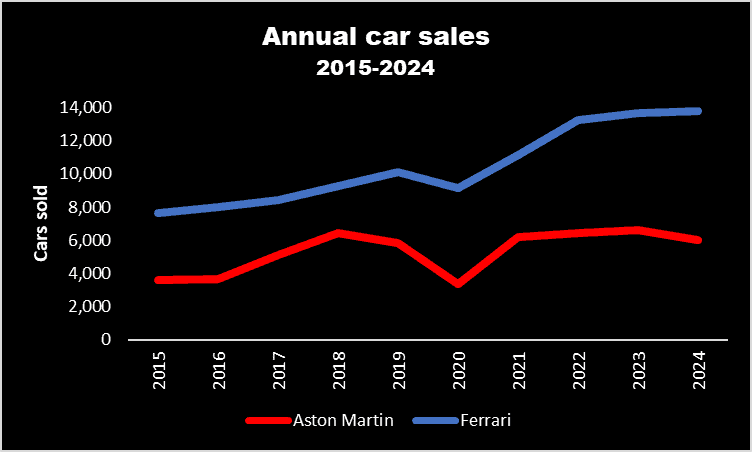
Aston Martin sells fewer cars than Ferrari and, concerningly, the gap between the two is growing.

Source: company annual reports

Also, the Italian sports car maker commands a higher average selling price and gross profit margin. In my opinion, this is a strong indication that its models are seen as being more desirable. In theory, this means it should suffer less from Trump’s tariffs.

However, to strengthen its balance sheet, the British marque has recently secured additional investment from its largest shareholder. Also, prior to Trump’s announcement, it was expecting a better 2025, largely on the back of the first deliveries of its new Valhalla model.

And at the time of announcing its 2024 results, the company reconfirmed its medium-term targets. By 2028, it aims to have annual revenue of £2.5bn and a gross profit percentage in the ‘mid-40s‘.

2024 performance Aston Martin Ferrari
Vehicles sold (no.) 6,030 13,752
Revenue (£m) 1,584 5,519
Revenue per vehicle (£) 262,670 401,343
Gross profit margin (%) 36.9 50.1
Profit/(loss) after tax (£m) (324) 1,261
Profit/(loss) per vehicle (£) (53,648) 91,725
Earnings per share (pence) (38.9) 6.99
Source: company annual reports / data for Ferrari converted at the EUR:GBP exchange rate on 31 December 2024

What I think

But despite its beautiful cars, amazing brand and loyal customer base, I don’t want to invest in Aston Martin. It may have a price-to-book (PTB) ratio of less than one but it remains loss-making. Since floating in October 2018, it’s reported losses of nearly £2bn. And it’s a long way from selling enough vehicles to be profitable. In these circumstances, it’s difficult to value a company, and I wouldn’t be surprised if the stock had further to fall.

The company also appears to be lagging some its peers when it comes to fully electrifying its range. Its first full EV isn’t expected before 2030. BY contrast, Ferrari’s is due to be launched later this year. Having said that, the UK government has just announced plans to let smaller manufacturers continue to produce petrol cars beyond the current 2030 deadline, so that should help ease the pressure to ‘go green’.

However, despite the Italian company’s faster transition to EVs — and its superior financial performance — I don’t want to buy its stock either.

Its shares currently change hands for an eye-watering 44.7 times its 2024 earnings per share (EPS) of €8.46. For 2025, analysts are expecting EPS of €9.11. Even so, this implies a forward price-to-earnings ratio of 41.5. And it has a PTB ratio of over 17.

A bit like its fabulous cars, this is far too expensive for me.

Financial News

Daily News on Investing, Personal Finance, Markets, and more!

Financial News

Policy(Required)