1 key fact to remember in this stock market correction

Both the US and UK stock markets fell over 10% in the space of three days recently. This sharp correction will have pummelled the value of many investors’ portfolios. It certainly hit both my Stocks and Shares ISA and SIPP quite severely.

Whether this will develop into a full-on stock market crash to rival 1987 or 2008 is still unknown at this point. As I write (8 April), the S&P 500 is ‘only’ around 17% off its recent high, so could have further to fall before the selling is done.

The key thing to bear in mind

When scary headlines are everywhere like they are now, it might be tempting to sell one’s stocks and hide out in cash. Then, once the chaos subsides, the positions can be rebought and everything will be hunky-dory. Disaster averted.

But there is one inconvenient problem with this theory. Nobody knows when the bottom will arrive or when the market will suddenly start surging upwards to recovery and beyond.

According to research from JP Morgan covering the years between 2004 and 2024, seven of the 10 best days in the market happened within 15 days of the 10 worst days. This shows how quickly the market turns, as investors rush to pile back in.

Moreover, JP Morgan shows that missing out on just a couple of those huge rallies can really impact performance for the worse.

My solution to this? Stay the course and invest strategically on big down days. This can really turbocharge my portfolio whenever things turn around.

We’ve just had a couple of the worst market days on record. While nothing is guaranteed, history suggests that there could be a massive rebound day coming in the next fortnight. I certainly don’t want to sell off my portfolio and miss out on that.

FTSE 100 hedge fund

In recent days, I’ve been buying a handful of stocks while they have been beaten down. I intend to buy a couple more too.

One I’m considering is Pershing Square Holdings (LSE: PSH), whose share price has fallen 25% since mid-February.

This is the FTSE 100 investment trust that gives exposure to the investing strategies of hedge fund manager Bill Ackman. He has a very solid track record of generating fantastic returns during periods of market stress, as we’re seeing today.

He can do this in two ways. First, by making bold bets on companies he believes have been massively oversold. Second, by using hedging strategies — including options and credit default swaps — to profit from major market dislocations.

Admittedly, this level of complexity does add risk, as the strategies might not pay off or offset declines in the value of Pershing Square’s stock portfolio. 

Also, the fund is very concentrated, with one holding (Nike) taking a battering in recent weeks. The global sportswear giant is facing huge operational challenges, as pretty much all of its manufacturing is in Asia, which has been hit with stiff US tariffs. 

Despite these risks, Pershing Square shares look undervalued, trading at a whopping 37% discount to the fund’s underlying net asset value. 

I’m optimistic that Ackman can spot and seize bargains during this market chaos, making me tempted to buy more shares.  
I was wrong about the Tesla stock price!

If someone had invested £10,000 in Tesla (NASDAQ:TSLA) stock in the middle of December, it would now (7 April) be worth £4,650. That’s a loss of just over 53%.

By contrast, even after the recent pullback, the same amount invested last April would have increased by 64%.

And that was the point I was trying to make when I last wrote about the electric vehicle (EV) company. I argued that the Tesla stock price has, over the past five years or so, ebbed and flowed. And even though the post-Trump bubble couldn’t be justified, I said there was no need to panic when the company’s shares started to fall. I thought it was time to get a sense of perspective.

And now…

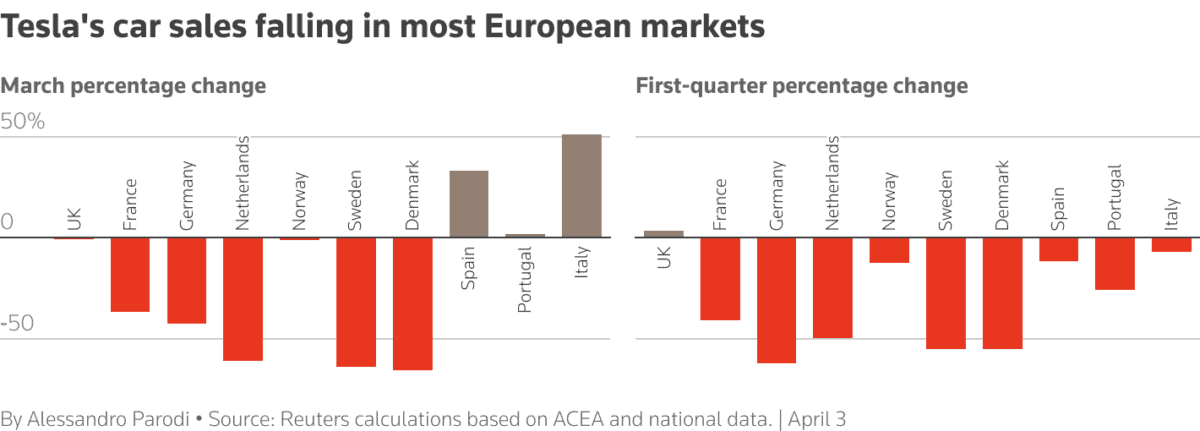
However, this belief was challenged by two events last week. First, on 2 April, the company reported a disappointing Q1 2025. Compared to the same period 12 months ago, deliveries were 13% lower at 336,681. It was the worst quarterly performance since spring 2022.

Crucially, it’s now fallen behind BYD for the first time. And closer to home, sales are falling in many of its key European markets.

Source: Reuters

The second concern I have – in common with many other investors, I’m sure – is the impact of President Trump’s decision to impose a 25% tariff on cars imported into the United States.

In simple terms, this could be a good thing for Tesla. No doubt Americans will buy more of their (cheaper) ‘own’ cars. However, other governments are likely to retaliate. This should concern Tesla’s shareholders because the company sells more cars overseas than it does in America.

As is often the case with global supply chains, the situation’s more complicated because the group has factories in Germany and China. These countries might be reluctant to penalise domestic production, despite expressing their horror at Trump’s tariffs. But whatever they decide, I believe a ‘trade war’ isn’t in anyone’s long-term interests.

What now?

Nobody knows what’s going to happen over the coming days and weeks but even with the recent pullback in the stock price, Tesla’s shares are still expensive.

Looking at adjusted earnings per share over the past four quarters ($2.42), the stock’s now trading on 94 times historic earnings. But to be honest, this is largely irrelevant. In my opinion, using conventional valuation techniques, the company’s always been overvalued.

However, questions remain as to whether Elon Musk’s entry into politics has damaged the brand. Anecdotally, I suspect more Democrats are likely to buy EVs than Republicans.

There are also reports that his support of Trump is the reason behind falling sales in Europe, although it’s impossible to know for sure. In my experience, some who claim to be boycotting a particular product or service were, conveniently, never going to buy in the first place.

But if I was a shareholder, I’d be worried that much of Tesla’s valuation appears to be built around its self-driving capabilities. It’s viewed as a tech stock rather than a car maker. However, BYD gives away a similar technology, including its ‘God’s Eye’ system, for free.

Despite the company repeatedly proving its critics wrong and having a very loyal customer base, I don’t want to buy any Tesla stock. There’s too much uncertainty surrounding the company to make me want to part with my cash.

What’s happening to the Rolls-Royce share price now?

As I write on Tuesday morning (8 April) the Rolls-Royce Holdings (LSE: RR.) share price is up 6%.

It’s a rebound after the initial fallout from President Trump’s global tariff war. Since a peak of 818p in March, Rolls-Royce shares fell 22% to close Monday at 635.8p.

Jumping ship?

Investors who’ve watched growth shares for any time will know that a strong bullish spell is often knocked off-course by a specific event. People see the fall and decide to get off the short-term ride. And we all nod sagely and decide that yes, the shares maybe were getting a bit pricey.

Is that what’s happening to Rolls-Royce shares now? I don’t think so.

For one thing, the stock market rout kicked off by Trump’s unique take on economics really says nothing about the long-term prospects for the company. Or for any global company, for that matter.

Valuation

And Rolls-Royce shares really haven’t reached the kind of sky-high valuations that often precede a growth bubble burst. At least, I don’t think so, judging by what the analyst forecasts say.

Maybe the spike kicked off by February’s full-year results might have pushed up a bit far, but I don’t think I’m seeing more than that.

We’re looking at a price-to-earnings (P/E) ratio of about 25.5 for 2025. Earnings per share growth forecasts out to 2027 are solid rather than stunning. But they’d still drop the P/E to around 21 by then.

The P/E doesn’t come close to painting the whole picture and investors need to consider far more measures. But things gets better.

Adjust for cash

Rolls has turned round its debt position of just a few years ago in spectacular fashion. Not only is net debt wiped out now, but Rolls is on for £1.6bn net cash this year. And the analysts see that soaring to nearly £7.2bn by 2027.

A pile of cash adds to the value of a company. I mean, the business plus billions in cash is worth more than just the business, right? If I adjust these P/E forecasts to allow for the cash and work out an equivalent for the business alone, something interesting happens.

I get a cash-adjusted effective P/E for 2025 of 25, just a bit lower. But the adjusted 2027 P/E drops to 19. That’s not down at banking sector levels, but it makes it look even less like a bubble valuation to me.

Tariff risk

While all this might look good, we shouldn’t simply ignore the tariff challenge. Rolls is in a global business, one of the world’s few large-scale aero engine makers. And one of its big markets might suddenly have been made a whole lot harder. Even without that specific risk, a global slowdown will likely make an impact.

If Trump’s tariffs remain where they are, I expect the whole industry will feel pain. And it could be more than a short-term effect.

It might make sense to wait and see where this all goes. But then, I think long-term investors should definitely consider a price dip like this as a possible opportunity.

10 UK shares that are 50% or more off their 52-week highs

A lot of UK shares have been hammered in recent weeks as global stock markets have plummeted. According to my data provider, over 100 FTSE 350 stocks are currently trading 30% or more below their 52-week highs.

Here, I’m going to highlight 10 UK stocks that are sitting a whopping 50% or more below their 52-week highs at the moment. Could there be some buying opportunities to consider here?

10 stocks that have been smashed

In the table below, I’ve highlighted the 10 shares from the FTSE 350 index that have fallen the furthest from their 52-week highs. It’s an interesting mix of stocks – there’s a mining company, a housebuilder, a technology company, a bank, and much more.

Stock % below 52-week high
Aston Martin Lagonda Global Holdings 67%
Vistry 64%
THG 64%
Ferrexpo 62%
JD Sports Fashion 61%
Glencore 55%
Kainos 54%
4imprint 53%
Close Brothers 52%
Dr Martens 52%

Now, there are a few stocks on that list that I’ll be steering clear of. Automotive business Aston Martin Lagonda Global Holdings is one example. It’s an unprofitable company that has a history of disappointing investors. Its shares have been locked in a nasty downtrend for a long time.

But there are a few names that look interesting to me and that I believe could be worth considering (for the long term) at current levels. One is JD Sports Fashion (LSE: JD.). It sells athletic footwear and apparel and operates globally today.

Worth a closer look?

JD Sports Fashion shares look really cheap right now. With the consensus earnings per share (EPS) forecast for the year ending 31 January 2026 sitting at 12.2p, the forward-looking price-to-earnings (P/E) ratio is only 5.2 at the current share price of 64p – that’s a low valuation.

Of course, that EPS forecast is likely to be too high. Realistically, JD’s business is going to take a hit from tariffs as it now has a lot of US exposure (it will potentially face higher wholesale prices from retailers like Nike).

It could also take a hit from an economic slowdown. In a recession, consumers tend to hold off on buying discretionary items like trainers.

But even if we were to slash the EPS forecast by 50% to 6.1p, the stock still looks cheap! That would take the P/E ratio to 10.4, which is not a high valuation for a company with plenty of long-term potential in a world where people are exercising more and dressing more casually.

Now, I’ll point out that buying today is risky. While the shares have fallen a long way in recent months, they could have further to fall.

Tomorrow, the company is set to provide a company update in which it will provide some guidance and an update on its medium-term plan. This could lead to share price volatility — the stock could rise but could also fall.

Taking a five-year view, however, I think the stock has potential. After all, trainers aren’t likely to go out of fashion any time soon.

Could IAG’s share price surge over the next year? These analysts think so!

The International Consolidated Airlines (LSE:IAG) share price is plummeting as worries over the global economy mount. At 236.9p a share, the British Airways owner is down 21.1% since the start of 2025.

February’s record closing high of 366.3p now seems a very distant memory. Yet for City analysts, a rebound to this level and then beyond is set to happen before too long.

In fact, all forecasters are unanimous in their belief that IAG shares will bounce back. But how realistic are their estimates? And should investors consider buying the FTSE 100 travel giant for their portfolios?

66% rebound?

As of today, some 26 of the City’s finest have ratings on the company. And the average price target for the next 12 months sits substantially above current levels, at 393.5p.

That’s 66.1% higher from the price at which IAG shares are currently changing hands.

The most optimistic forecaster thinks the shares will rocket 112.5% during the next 12 months, to 503.4p. The least bullish estimate sits at 250p, although this is still 5.5% higher than today’s price.

Challenges

Yet despite these confident estimates, IAG faces a series of challenges that could derail any share price recovery.

The first is the state of the global economy, and particularly growing recessionary risks in the key US market. Tellingly, BlackRock chief executive Larry Fink said this week that “most CEOs I talk to would say we are probably in a recession right now.

Economic downturns tend to be especially cruel for airlines as people and businesses trim non-essential spending. Alarmingly, Fink said that the industry is already showing signs of buckling, noting that “one CEO specifically said the airline industry is a proverbial… canary in the coal mine — and I was told that the canary is sick already.”

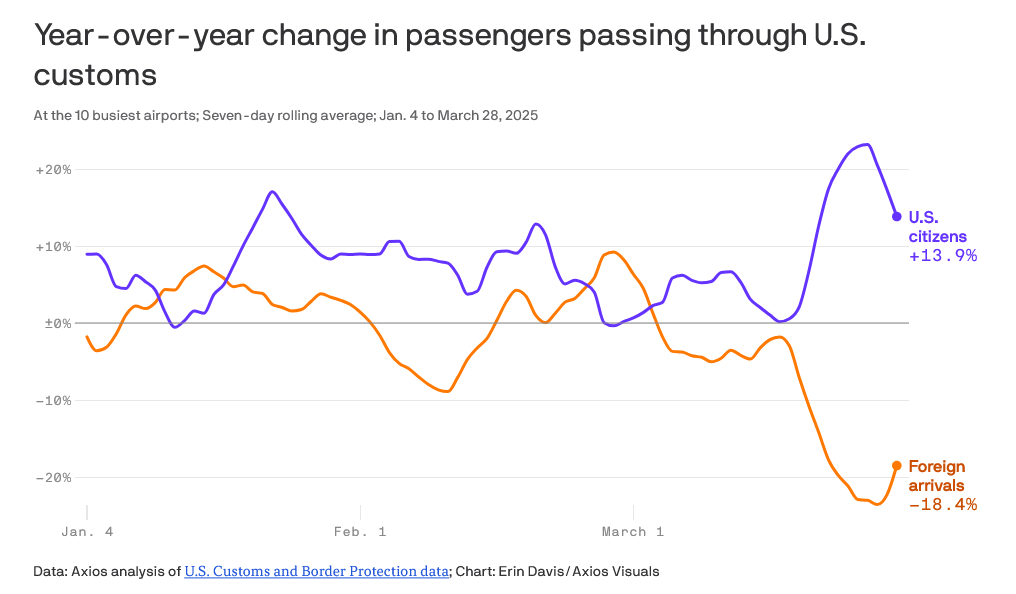
Another obstacle for IAG is a sharp fall in tourism to the US. Transatlantic travel is a huge money-spinner for carriers like British Airways, so news that flights to the States are sinking so early in Donald Trump’s administration is a troubling omen.

Source: Axios

Analysis suggests this drop-off reflects a negative reception to Trump’s aggressive geopolitical and economic strategy outside the US. But this isn’t all, with Goldman Sachs suggesting the decline “Is likely attributable to tighter immigration policy” Stateside as well.

The attractiveness of the US as a travel destination could well pick up in the short-to-medium term. But I wouldn’t bet the farm on it right now.

Opportunities

However, it’s also important to say there are opportunities for IAG, as demand for its non-US routes could pick up as travellers shun the US. Its budget carriers like Aer Lingus could also see benefit as cheaper plane tickets become more popular.

Finally, the business could enjoy a big boost to margins if fuel costs continue reversing. Brent crude has dropped to $64.60 a barrel from $76 at the start of 2025. And recent supply and demand news suggests it could keep shuffling lower.

I don’t believe these factors alone are sufficient to spark a rebound in IAG’s share price. And since its shares aren’t particularly undervalued — with a forward price-to-earnings (P/E) ratio of 4.2, just slightly below the industry average — it’s unlikely that bargain hunters will rush in and drive the price up significantly.

On balance, I think investors should consider avoiding IAG shares.

£10,000 invested in Apple shares last week is now worth…

Apple (NASDAQ:AAPL) shares have fallen sharply, driven by escalating tariffs imposed by the Trump administration. £10,000 invested a week ago would be worth just £8,200 today. The tech giant’s stock dropped over 7% on 4 April alone, closing just above $188, its lowest level since May 2024.

The tariffs, which target Asian manufacturing hubs like China and Vietnam, will, in their current form, hurt Apple’s supply chain and increased production costs. China, its primary assembly location for flagship products such as iPhones and iPads, now faces a tariff of 34%, up from 20%.

Vietnam and India have also been impacted, with tariffs rising to 46% and 26%, respectively. These levies have rattled investors, compounded by broader market volatility that tends to hit high-growth stocks hardest.

Still not dirt cheap

While Apple shares are cheaper than they were on paper just months ago, they largely remain expensive relative to sector and index norms. To start, the company’s trailing 12-month price-to-earnings (P/E) ratio currently stands at 28.8, which is 4% lower than its five-year average.

On a forward basis, Apple’s P/E ratio declines gradually as earnings grow. By fiscal year 2028, consensus estimates project a P/E of 15.8, reflecting robust earnings-per-share (EPS) growth rates that accelerate from 7.8% in September 2025 to an impressive 28.6% by September 2028.

However, the price-to-earnings-to-growth (PEG) ratio — P/E adjusted for growth — suggests that the stock isn’t cheap compared to the technology sector average. The 2.3 PEG is 74% higher than the sector average, but represents a 10% discount to Apple’s five-year average.

Of course, it’s important to recognise that these figures are based on forecasts. The forecasts were made before Trump’s tariffs were announced.

A closer look at tariffs

The impact of tariffs on Apple’s business could be substantial if the company fails to secure exemptions. UBS estimates that retail prices for key Apple products assembled in heavily tariffed regions could rise significantly. It forecasts prices will rise by as much as 29% for the iPhone 16 Max produced in China, 12% for the iPhone 16 Pro made in India, and 19% for the Apple Watch assembled in Vietnam.

Such increases could dampen consumer demand and further pressure margins if Apple chooses not to pass on these costs to customers. Analysts at Needham predict that fiscal year 2025 EPS could drop by up to 28% if tariffs remain in place. This scenario underscores the precariousness of Apple’s current position amid an unpredictable trade environment.

Apple has also grown margins impressively in recent years. These tariffs look set to derail this progress.

Uncertainty galore

Looking ahead, uncertainty looms large over how the tariff situation will evolve. Recent developments suggest China is unwilling to back down in the face of Trump’s tariffs. What’s more the US administration may look to escalate things further.

While some analysts remain optimistic about the possibility of exemptions based on Apple’s past successes in navigating trade disputes, the outcome is far from assured. Investors must weigh these risks against the company’s long-term growth prospects and its ability to adapt to shifting geopolitical dynamics.

Apple would need to be a lot cheaper for me to consider buying. It’s a quality company, but earnings will likely be hammered by the trade policy.

Are shares like Tesco a safe haven for investors?

When markets are highly volatile – as they have been lately – some investors start looking for a safe haven. Some turn to an industry with resilient long-term customer demand and start eyeing shares like National Grid or Tesco (LSE: TSCO). I own neither share in my portfolio although like many investors the idea of a safe haven appeals to me.

So why do I have no plans to add Tesco shares to my portfolio?

There’s no guaranteed stock market safe haven

The key point to understand is that no share is guaranteed to be a safe haven. Some shares show less volatility than others – but that is not always predictable ahead of time.

Take Tesco shares as an example. Before even getting into the details of its business, the share price chart alone can teach us some things.

Over the past year alone, Tesco’s highest share price (close to £4) was well above its lowest (£2.78). The high point was in February. If an investor had bought then, by the worst moment last month (that is, just one month after the purchase), the value of their holding would be down by almost a fifth.

Businesses change over time

But the share price is just a reflection of what the market thinks a company is worth. So might Tesco have a stable long-term value? I do not think so. Any business’s valuation can change over time.

Yes, demand for groceries is resilient. But that in turn has brought increased competition into the UK supermarket sector in recent decades, pushing down profit margins even for an industry leader like Tesco.

The company has evolved over time, pulling out of markets such as the US and Asia. Not only that, but even a successful company can run into difficulties an investor would be hard pushed to foresee.

Back in 2014, for example, it was embroiled in an accounting scandal. That is water now long under the bridge but it underlines why seeing a single share as a safe haven can be dangerous. Diversification is a key risk-management tool for any investor.

Using the stock market to make money

If I wanted a safe haven for my money I would likely stick it in a bank. The stock market inherently involves some risk, — but it can sometimes also offer potential rewards far above the interest I earn from a bank account.

Tesco has a leading position in a market I expect to benefit from long-term demand. It has a strong brand, industry-leading customer loyalty programme, proven business model and huge customer base.

At the right price, I would be happy enough to buy some Tesco shares for my ISA.

Currently though, Tesco trades on a price-to-earnings ratio of 18. Yes, the Tesco share price has come down notably since February, but that valuation still does not strike me as a bargain.

Tesco faces intense competition. Profit margins in grocery retailing are tight and current trade disputes could add more costs onto supermarkets like Tesco, that it may not be able to fully pass onto customers. That is on top of additional costs from changes to National Insurance contributions that kicked in this week.

At the current price then, I will be leaving this share on the shelf rather than adding it to my stock market shopping basket.

The 2025 stock market sell-off could be a once-in-a-decade opportunity to build wealth in an ISA

Over the last week, global stock markets have taken a huge hit due to tariff uncertainty. As a result, many stocks are currently down 20% or more from their 52-weeks highs. For long-term investors, this could be a major opportunity. If someone has cash sitting in their Stocks and Shares ISA right now, I think it’s time to consider putting some of it to work.

This kind of volatility is rare

It’s not often that we see this kind of volatility, where markets are literally in freefall and major indexes such as the FTSE 100 and the S&P 500 are falling 4% to 5% in a day (for several days in a row).

The last time we saw this kind of thing was in early 2020 at the start of the coronavirus pandemic when the world was faced with huge uncertainty.

Before that, it was in late 2008, during the Global Financial Crisis, when the global banking system was on the brink of collapse.

So, we might not see this kind of market event again for a while. It could be another five years. It could be another 10.

Investing now could pay off

Now, investing in stocks in moments like this isn’t easy. When uncertainty is high and markets are tanking, it often feels safer to sit on the sidelines.

However, history shows that investing during these periods of volatility – when investors are indiscriminately dumping stocks – can pay off in a big way. Had someone put some capital into the S&P 500 index in March 2020 when the index crashed to 2,500, for example, they could have potentially doubled their money in just a few years.

Of course, there are no guarantees that the stock market will recover in the years ahead given the current level of economic uncertainty. A full recovery could take time.

But in the long run, global stock markets have always recovered from crises. I’m fairly certain that in a decade’s time, the current meltdown will just look like a blip on a long-term chart.

Different risk levels

It’s worth pointing out that it’s possible to take on different levels of risk today.

For example, if someone was looking to get into the market but not wanting to take on too much risk, they might want to consider a dividend-focused fund such as the iShares UK Dividend UCITS ETF (LSE: IUKD).

This is a diversified product that focuses on UK-listed companies that pay dividends. Stocks in the fund include the likes of British American Tobacco, National Grid, and Legal & General.

This fund has held up pretty well in the current sell-off. Year to date, it’s only down about 4%. That’s a good performance on a relative basis. This year, a lot of individual stocks have fallen 30% or more.

The best thing about this fund, however, is that investors have two potential sources of return. Not only is there potential for capital gains but there’s also income on offer (the yield is currently about 5.5%).

Of course, this ETF isn’t perfect. If the market rallies hard in the months ahead, it could underperform due its focus on slow-moving dividend-paying companies.

An investor could easily combine this product with a few individual stocks, however. This would involve taking on a little more risk, but it could potentially lead to higher gains in the long run.

Hunting for passive income? These falling insurance giants offer 10% yields

Investors seeking passive income may find themselves drawn to the impressive dividend yields offered by Phoenix Group (LSE:PHNX) and Legal & General (LSE:LGEN). Both stocks boast yields approaching double digits, with Phoenix offering a 10.7% yield and Legal & General providing 9.6%. These yields have risen over the past week as the stocks dipped following Trump’s sweeping tariff policy.

A dividend powerhouse

Phoenix Group is the FTSE 100’s top dividend payer. The dividend yield currently sits at 10.7%, based on the payout from 2024, and is expected to rise to around 11% for 2025. That’s based on the current share price.

However, investors should be aware that Phoenix Group typically offers very little in the way of share price appreciation. The stock is actually down 15% over five years. That’s a huge underperformance versus the index.

One factor weighing on Phoenix may be investor concerns about the sustainability of such high payouts. Historically, companies with elevated yields often face scepticism regarding their ability to maintain dividends over time. While much of the disparity relates to accounting practices, the forward dividend payout ratio is around 350%, indicating that earnings are several times less than the dividend.

Moreover, Trump’s newly announced tariffs could present some new challenges for Phoenix. The insurance sector is particularly vulnerable to external economic pressures, as rising costs in industries like automotive and construction directly impact claims expenses.

For example, tariffs on auto parts are driving up repair costs, which insurers must absorb through higher premiums or reduced profitability. Additionally, increased costs for construction materials could lead to higher claims in property insurance.

Nonetheless, Phoenix remains a compelling passive income investment opportunity. It has a robust track record on dividends, and insurance is a necessity for consumers and businesses alike, ensuring that demand persists even during economic downturns. It’s a stock I’ll definitely consider in the current environment.

A little more sustainable

Legal & General offers a slightly lower yield at 9.6%, but it remains one of the UK’s most reliable dividend stocks. The company has built a reputation for progressive payouts, supported by strong cash flow generation and diversified operations across pensions, asset management, and insurance. The stock is up just 3% over five years.

The business has many of the same pain points as Phoenix Group. However, it also operates a diversified business and has benefitted from supportive trends like those in bulk purchase annuity.

On paper, dividend sustainability is stronger than Phoenix, with an 90% payout ratio. Furthermore, its Solvency II coverage ratio stood at an impressive 212%, underscoring its financial resilience.

Like Phoenix Group, Legal & General operates in an industry where demand is non-negotiable. Individuals rely on pensions and insurance regardless of economic conditions. This inherent stability provides a solid foundation for sustaining dividends even during periods of uncertainty.

Legal & General is also on my watchlist, and I’ll consider adding it to my portfolio. Despite near-term challenges, insurance remains an essential service. However, there may be more volatility to come as the current trade chaos unfolds. There may even be better entry points and the ability to lock in even bigger dividend yields.

Considering a Stocks and Shares ISA this April? Avoid these mistakes!

A new tax year has rolled around, so the £20k annual allowance for a Stocks and Shares ISA has been reset. That means investors can start piling a fresh allocation of assets into their accounts. And for those who don’t have one yet, now may be a good time to think about opening one to build up a tax-free pot.

Please note that tax treatment depends on the individual circumstances of each client and may be subject to change in future. The content in this article is provided for information purposes only. It is not intended to be, neither does it constitute, any form of tax advice. Readers are responsible for carrying out their own due diligence and for obtaining professional advice before making any investment decisions.

However, there are some important pitfalls to be aware of when getting started. Not all ISAs are created equal and there are some specific factors to take into account, depending on individual needs.

Consider the following two mistakes that many first-time investors make.

Holding too much cash

While it’s natural to want to wait for the ‘perfect’ time to invest, holding a lot of capital in cash funds can be counterproductive. These accounts are designed for long-term investing in the stock market, not for storing idle funds. With inflation eroding the real value of uninvested cash, waiting too long to deploy funds could mean missing out on potential gains.

Instead, a strategy of pound-cost averaging – investing small amounts regularly over time – can help smooth out market volatility and ensure capital doesn’t stagnate for months on end.

Ignoring fees and platform charges

Choosing the wrong ISA provider can eat into long-term returns. Some platforms charge a percentage-based fee on assets held, while others apply flat fees regardless of account size. For smaller portfolios, percentage fees may seem harmless, but they can quickly mount up. On the other hand, fixed fees might be less suitable for those starting with only a modest sum.

It’s also important to watch out for fund management charges. Actively managed funds typically carry higher fees than passive options like index trackers. Being cost-conscious when selecting both a provider and investments could have a significant impact on long-term performance.

A stock to consider

With the above in mind, first-time ISA investors may want to consider a ‘starter stock’ like Diageo (LSE: DGE). The global drinks giant owns household names like Guinness, Johnnie Walker, and Tanqueray. Its diverse mix of top-shelf and affordable brands ensures it brings in revenue from both developed and emerging markets.

When looking at recent performance, Diageo might seem like an odd choice to consider. The stock has had something of a rough time lately, dropping 51% in the past three years. A perfect storm of Covid-era losses combined with high inflation and declining sales in Latin America drove the decline.

Add to that a trend towards lower alcohol consumption among youth and the losses are understandable. If things don’t improve soon, it may have to cut dividends to save money — or raise funds by diluting shareholders. Both options pose a risk to investor sentiment.

But Diageo and its brands have been a staple of global celebrations and gatherings for decades. Demand is unlikely to disappear completely, particularly as the company pivots toward low- and no-alcohol products.

Plus, the falling price means it now has an attractive price-to-earnings (P/E) ratio of only 15.6.

Recent results show signs of stabilisation, with £11bn in net sales for the first half of fiscal 2024 and a notable recovery in Asia-Pacific and Latin America. Another strong sign of stability is its commitment to dividends, which have increased at a rate of 5.45% every year for decades.

Financial News

Daily News on Investing, Personal Finance, Markets, and more!

Financial News

Policy(Required)