Down 44% this year, could the Aston Martin share price bounce back?

Aston Martin (LSE: AML) seems to have a lot going for it. Its sleek cars sell for a high price thanks to a well-heeled customer base. The same however, cannot be said of its shares. The Aston Martin share price has tumbled 44% so far in 2025 and 88% over the past five years.

Selling for pennies, could this be a recovery play that deserves a place in my portfolio?

The problem with Aston Martin shares

For now, at least, my answer is a firm no. The share price fall reflects a number of problems faced by Aston Martin. As I see it though, one problem looms above all others. In short, the company has not yet demonstrated it can convert sales into profits.

I am also put off my the balance sheet. The luxury carmaker ended last year with net debt of £1.1bn, close to double its current market capitalisation of £563m.

But again, I see the problem as being the business model. If Aston Martin could figure out how to make money, it would be in a stronger position to pay down that debt.

For now though, the business remains heavily lossmaking. Last year saw the pre-tax loss rise to £289m.

The company has some possible fixes

In the past, the company has raised cash by issuing more shares. It could decide to do that again and use the proceeds to improve its balance sheet, although that would dilute existing shareholders. That could hurt not help the Aston Martin share price in the short term, although over the longer term I think a healthier balance sheet is in the company’s best interests.

But even setting aside the debt, Aston Martin’s business model is currently not working, in my view. Last year, the operating loss was £100m. That was a slight improvement on the previous year, but it still means the company is losing over £16k on average for every car it sold on a wholesale basis.

Maybe that is fixable. The business’s premium brand and loyal following gives it pricing power. It could increase the selling price of vehicles without necessarily hurting sales.

It also sells pricy special edition cars – by changing the mix of products sold, Aston Martin may be able to generate more revenue without necessarily needing to sell higher volumes.

Things may get worse from here

But that has been true for some years already and the company has not yet proven its business model can be consistently profitable. Meanwhile, economic uncertainty could now dent demand for high-end vehicles.

Tariffs are another risk. The Americas was the company’s key sales territory last year, representing 32% of wholesale volumes. Aston Martin makes its cars in England so the latest tariff disputes could hurt sales in the US.

Heading into a possible crisis from a position of strength can be challenging enough. But I reckon Aston Martin potentially faces serious short-term challenges to its sales while the base business is already failing to make money.

I would prefer to invest in a proven company that I think has higher chances of long-term success. Despite the price being in pennies, I will not be adding Aston Martin shares to my portfolio.

A 9.28% dividend yield? Here’s the forecast for HSBC in 2025 and beyond

The dividend yield for the UK’s largest bank, HSBC (LSE: HSBA), recently enjoyed a decent boost thanks to its final dividend.

In it’s FY24 results it announced a fourth-quarter dividend of 36c a share, which brings the total up to 66c a share. And when adding the 21p special dividend it ramps the full amount up to 87c — equivalent to 9.28% of the current share price.

However, since it has already gone ‘ex-dividend’, that’s only applicable to existing shareholders. For investors considering the stock this year, it’s important to look ahead at the dividend forecast.

Let’s see what the analysis is for HSBC going forward and how its future dividends may unfold.

A sobering outlook

So far, HSBC has demonstrated a relatively strong commitment to delivering returns to shareholders through dividends and buybacks. This year’s final amount equates to a 30% increase on last year, continuing a trend of notable dividend growth since Covid.

Yet its dividend history is sketchy, with several large cuts spoiling an otherwise impressive track record. Naturally, as a bank, it’s highly sensitive to economic downturns, so 2008 and 2020 saw the biggest cuts. With US trade tariffs threatening further economic turmoil, there’s a significant risk of another cut in the near future.

Last year’s special dividend came as the result of the sale of the bank’s Canadian business. As such, it’s unlikely to be repeated. The forecast for 2025 envisions a final dividend of 66p per share, rising to 71p in 2026 and 77p in 2027.

The payout ratio is expected to find a stable footing in the range of 50% for all three years. If those figures unfold, it could make for a decent and reliable income stock. Unfortunately, the current uncertainty infecting all global markets makes any forecasts hard to trust.

Share price action

The share price has already taken a 17% hit since the Trump Administration announced 10% trade tariffs on the UK. It’s exposure to the US is notable so this rout may extend further. Still, HSBC is no small player in global markets meaning its strong foundations make it a strong contender for a rebound.

Management remains optimistic about sustaining strong dividends despite global economic uncertainties. Chairman Mark Tucker emphasised the bank’s solid position to continue rewarding shareholders, citing a $19bn return through dividends and buybacks in 2023 and the additional $8.8bn announced in 2024.

The bank aims for a mid-teens return on average tangible equity (RoTE) from 2025 to 2027, acknowledging the volatile and uncertain outlook for interest rates.

Analyst forecasts

Analyst ratings are fairly mixed, with nine out of 21 sticking to a Hold, while six say it’s a Strong Buy. Although the majority are positive, two analysts feel it’s a Strong Sell.

The average 12-month price target of 962p is 30% higher than today’s price. Considering annualised growth over the past five years has only been 11.36% a year, that may be somewhat optimistic.

When combined with dividends, that average would still amount to an annual return of almost 20%.

HSBC has long been a solid earner for me and I don’t see that changing. As such, I think it’s a stock well worth considering for both new and seasoned investors.

A rally could be coming for the UK stock market! Here’s how I aim to profit

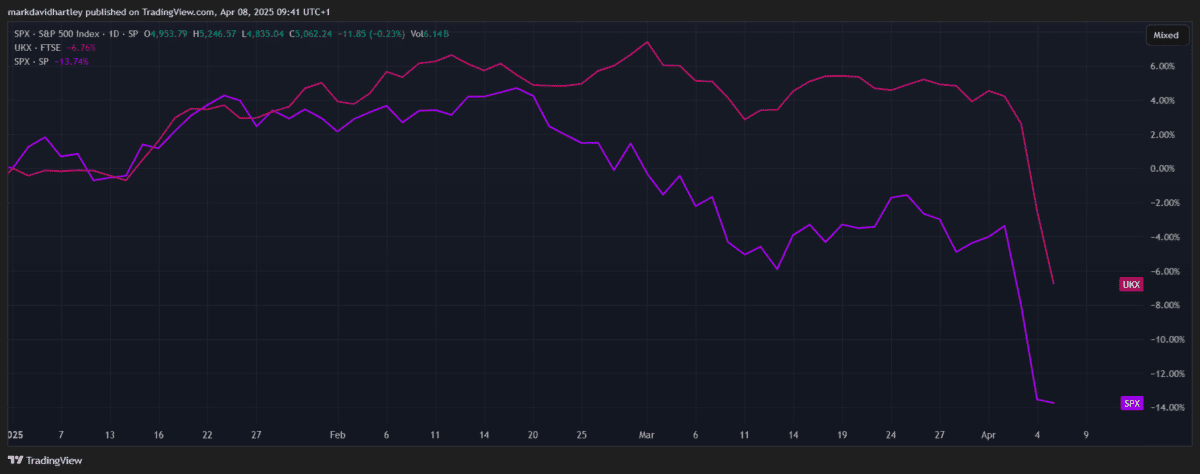
In an unusual twist of fate, the UK stock market could take a lead over the US this year. Already, the S&P 500‘s down almost 14% this year while the FTSE 100 has only dipped 6.7%.

Created on TradingView.com

Last month it was reported that fund managers are overweight on British stocks — marking only the second such occurrence since 2022. Statistics reveal investors are making strategic shifts away from US stocks and into UK equities.

This could lead to a much-needed revival for the FTSE 100 and other UK indexes. So what’s the play?

Here’s my plan.

Seeking value

The 10% trade tariffs placed on the UK last week hurt the domestic market but already things are improving. Now might be the perfect time to seek out some undervalued stocks. At the same time, it may be wise to avoid companies that rely heavily on sales in the US.

Here are three relatively insulated UK stocks that may be worth looking closely at for their defensive qualities.

Domestic insurance

As a leading UK insurer, Admiral Group focuses primarily on the domestic market. Insurance is a hugely competitive sector but the company has a decent 4.9% dividend yield and has demonstrated consistent performance, so it could be one to consider for investors seeking stability

Local hospitality

As the owner and operator of the Premier Inn hotel chain, Whitbread has a substantial UK footprint. The company’s implementing an Accelerating Growth Plan, converting underperforming food and beverage sites into higher-profit hotel rooms, which could enhance profitability so may be worth further research.

A food favourite

Tesco (LSE: TSCO) is the nation’s leading supermarket chain and a favourite among shoppers. It commands around 28% of the local market, with a significant presence both physically and online.

With a predominantly UK-based supply chain, it’s well-positioned to avoid the worst effects of US trade policy. It’s for this reason that I think analysts look favourably towards Tesco — due to its minimal reliance on imports, it seems to be less vulnerable to the tariff chaos.

But renewed competition from rival Asda has been weighing heavily on the stock. It’s down 12% in the past month, driven by news that Asda plans to undercut prices and steal back customers. If that happens, it could put pressure on Tesco’s already thin operating margins of only 4%.

It’s enjoyed several years of dividend growth, so I would hate to see it have to cut dividends to save money.

A history of resilience

While competition’s a risk, the retailer’s history suggests strong resilience in the face of such adversity. I’m optimistic it will once again develop a competitive strategy to meet and overcome this challenge.

It’s already announced cost-cutting measures to simplify operations and enhance efficiency. It also aims to ramp up its food waste reduction plans by offering items for free in the run-up to closing time.

For UK investors, domestically-focused companies like Tesco may help to provide a buffer against international trade uncertainties. And as things look to be improving, these companies are well-positioned to benefit from a UK stock market rally.

Is the rare dip in this FTSE powerhouse’s share price just the right time for investors to consider buying it?

Shares in FTSE 100 bank Standard Chartered (LSE: STAN) are down 29% from their 3 March one-year £12.81 traded high.

This is an unusual dip in the share’s price, but is still up 44% from its 17 April 12-month low of £6.35.

I have been sorely tempted to buy the stock for a while now for reasons analysed below. However, the fact that I own shares in two other banks – HSBC and NatWest – prevents me from doing so. Adding another banking stock to these would unbalance the risk-reward profile of my overall portfolio.

However, for investors whose portfolios this suits, the current price dip might mean a great buying opportunity to consider.

A clever shift in business strategy

A key long-term risk for all banks – and Standard Chartered is no different – has been declining interest rates in key markets.

This has already reduced the net interest income (NII) many have made. The NII is the difference between the interest they gain on loans they make and on deposits taken in.

Standard Chartered has increasingly shifted from an interest-based business to a fee-based one to counter the effects of this. Its 2024 results showed non-NII jumped 20% to $9.3bn (£7.09bn) as a result.

Interesting as well from an investment perspective is that the bank’s total NII rose 10% over the same period, to $10.4bn. This is because it has multiple banking operations in many countries where interest rates have not fallen.

Moreover, Standard Chartered is continuing to expand its fee-based private banking services quickly. It opened a global investment service for ultra-high-net-worth (UHNW) clients in Singapore in March.

It also launched a centre in the UAE offering bespoke wealth management solutions for HNWs in the Middle East, Europe, and Africa in the same month. And to lay the groundwork for these developments, it expanded its frontline private bankers by 20% in the UAE on February.

Consensus analysts’ estimates are that the bank’s earnings will increase by 11% a year to the end of 2027. And it is growth in these that drives a firm’s share price and dividend in the future.

Where does all this leave the share valuation?

Standard Chartered’s 1.5 price-to-sales ratio is the joint lowest in its peer group, which averages 2.2. These banks comprise Barclays at 1.5, Lloyds at 2.3, NatWest at 2.5, and HSBC at 2.7. So it looks very undervalued on this basis.

The same applies to its price-to-book ratio of 0.6 compared to its competitors’ average of 0.8.

And its 7.8 price-to-earnings ratio also looks cheap compared to the 8.1 average of its peers.

The second part of my standard value assessment establishes where a share should be priced based on future cash flows. The resulting discounted cash flow analysis shows that Standard Chartered shares are 63% at their current £9.15 price.

Therefore, their fair value is technically £24.73, although shares go down and up in price.

One to consider?

As I said earlier, if it were not for my other bank stock holdings, I would buy Standard Chartered shares as soon as possible.

Its core business, earnings growth, and undervaluation look extremely compelling to me. And they look all the better on the share price dip. I believe the stock is worth considering.

After an 18% fall, is Rolls-Royce’s share price now just too cheap for me to ignore?

Rolls-Royce’s (LSE: RR) share price has tumbled 18% from its 19 March one-year traded high of £8.18. Much of this fall followed US President Donald Trump’s 2 April rollout of 10% tariffs on UK imports into the country.

Higher tariffs will be applied on goods from around 60 countries and/or trading blocs claimed to show a high trade deficit with the US. These include China (now 104%) and the European Union (20%).

My key question when a stock has fallen in such circumstances is whether it is worth me buying on the dip. So I took a deep dive into the business and ran the key numbers to find out if it is.

How will the tariffs affect the firm?

I think it critical here to clarify that the Rolls-Royce shares quoted in the FTSE 100 relate to the firm’s aerospace, defence, and power systems businesses. So these are subject to the standard 10% tariff applied to the UK.

Since the licensing of the name rights in 1998, Rolls-Royce Motor Cars is unconnected to the UK-listed firm. It is a subsidiary of BMW (and in this context, all automobiles are now subject to 25% tariffs when imported into the US).

That said, the US tariffs on the listed Rolls-Royce business are a risk for its share value over time. This is broadly derived from the earnings a company is expected to generate in the future.

The company has significant operations in 27 US states, which provides it with additional supply and production capacity in-country. Rolls-Royce stated recently that it will use this: “To ensure our global internal supply chain is optimised for delivery to customers in the US”.

Was the business in good shape before?

I think broadly that the stronger a business was at the onset of the tariffs, the better positioned it is to handle them effectively.

In Rolls-Royce’s case, it looked very strong to me, with revenue rising 16% year on year to £17.848bn. Operating profit leapt 55% to £2.464bn over the same period, and free cash flow soared 89% to £2.425bn.

At that point, the firm forecast a 2025 underlying operating profit of £2.7bn-£2.9bn. It also projected free cash flow of the same £2.7bn-£2.9bn in the year.

These strong numbers enabled it to announce a £1bn share buyback this year, with buybacks tending to support stock prices.

As of now – with the tariffs news included – analysts forecast its earnings will grow 3.2% annually to end-2027.

So how does the share valuation look?

Rolls-Royce looks cheap on the key price-to-earnings ratio at 22.6 against a competitor average of 29.2. These comprise Northrup Grumman at 17, BAE Systems at 24, RTX at 33.7, and TransDigm at 42.

The same is true of its price-to-sales ratio of 3 compared to its peer group average of 3.5.

I ran a discounted cash flow analysis to nail down what this means in share price terms. The results show that Rolls-Royce stock is 49% undervalued at its current £6.72 price.

Therefore, the fair value for it is technically £13.18, although share prices can go down as well as up.

I think there is just too much value in the stock for me to ignore now, so I will buy it very shortly.

11% yield! Could this UK stock  be a huge opportunity for investors targeting a second income?

With share prices falling, investors looking to earn a second income are almost spoilt for choice. And I think RWS Holdings (LSE:RWS) is one that’s well worth a look.

When a stock comes with a dividend yield as high as 11%, it’s always worth asking why. But if the market is making a mistake, the potential opportunity could be massive.

Artificial intelligence 

RWS specialises in language translation and the stock is down by as much as 82% over the last couple of years. During this time, sales have gone from £749m in 2022 to £718m in 2024.

The big question for investors is why? One reason is the rise of artificial intelligence (AI). Cheap (or free) translation systems have put pressure on operators across the industry.

This is a clear risk, but it isn’t the only issue. Part of the downturn is the result of cyclical economic pressures and issues around the integration of an acquisition the firm made in 2020.

Recently however, RWS has been showing positive signs on both fronts. And the market might just be underestimating the significance of these.

Resilience

In terms of AI, it’s worth noting that RWS might not be as easy to disrupt as it seems. It focuses on specialist translations in areas where the cost of a mistake can be extremely high.

These include warnings for industrial equipment, documentation for medical devices, and legal documents like patent applications. In a number of cases, these industries are highly regulated. 

That makes cutting corners on costs and ending up with the wrong documentation a big risk. RWS brings specialist technical expertise that other translation systems can’t match.

On top of this, the company is using its specialist knowledge to develop its own AI-based translation systems. And there are signs that these are proving popular with customers.

Resilience

While sales in 2024 were lower than the previous year, there were positive indicators. Revenues started increasing in the last six months and this was driven by the firm’s AI-based solutions. 

Investors might see this as evidence that the challenges RWS have been facing in recent years are more temporary than they looked. And then there’s that big dividend.

In 2024, the company generated just under £41m in free cash flow and paid out £45m in dividends. That looks unsustainable, but there’s a catch.

A big part of this was the result of unusually high capital expenditures. With these set to fall in 2025, I think there’s a good chance RWS increases its dividend for the 22nd consecutive year.

Undervalued

I think RWS is a much more resilient business than its current share price gives it credit for. And I therefore see the 11% dividend yield as a real opportunity for investors to consider.

While the rise of AI is a challenge, the company has a differentiated offering. And in highly specialised markets where there’s a lot at stake, the value of this shouldn’t be underestimated.

Share prices are falling across the board at the moment and a recession could maintain the pressure on the business. But I think RWS is a stock to keep a firm eye on.

This FTSE 250 REIT’s been unaffected by Trump’s tariffs. And it’s yielding 8.3%

I reckon shareholders in Supermarket Income REIT (LSE:SUPR), one of the FTSE 250’s real estate investment trusts, will have been delighted with its share price performance over the past week or so.

On 3 April, the day after President Trump unveiled his tariffs, and when many investors around the world appeared to go into panic mode, its share price went up.

Its simple business model, which involves leasing supermarket space to well-known grocery chains, isn’t going to be directly affected by a global ‘trade war’. And even if the world goes into recession, supermarkets will still need premises to trade from.

Of course, there’s a risk that an economic slowdown will result in some of its tenants going out of business. But its blue-chip customer base, including Tesco and Sainsburys, are likely to survive the worst of any downturn.

It currently has 82 stores on its books, which have been valued by the company at £1.8bn.

Special treatment

And because it’s a REIT, it has to return at least 90% of its profit to shareholders. If it doesn’t, it will lose some of the tax advantages that it presently enjoys.

Please note that tax treatment depends on the individual circumstances of each client and may be subject to change in future. The content in this article is provided for information purposes only. It is not intended to be, neither does it constitute, any form of tax advice.

Impressively, Supermarket Income REIT’s been steadily increasing its dividend in recent times. It also makes quarterly payments, which helps ensure a steady flow of income for shareholders. In cash terms, its four payouts over the past 12 months were 4.5% higher than they were during its June 2020 financial year.

Presently (8 April), the stock’s yielding a very impressive 8.3%. This is over twice the average for the FTSE 250.

Also, with a weighted average unexpired lease term of 12 years, it has good visibility over its future income streams. Some of its contracts carry provisions for rent increases linked to the current rate of inflation.

Its shares are currently trading at an 18% discount to the trust’s net asset value. This is common for many investment trusts, not just those exposed to the property sector. I think it reflects, in part, investor concerns about difficulties in accurately valuing unquoted assets. However, the trust recently sold a store in Newmarket for a 7.4% premium to its book value. This gives me some comfort that the management team’s conservatively valuing its properties.

Pros and cons

However, there are some risks. As with all investments, there’s no guarantee that current dividend levels will be maintained. In particular, they could come under pressure if interest rates remain at their present relatively high levels.

In common with many REITs, its earnings are also sensitive to borrowing costs as property acquisitions are usually funded by debt. Also, the commercial property sector can be volatile. If property values fall, it could impact on its future borrowing capacity. Rents could also come under pressure.

But I think Supermarket Income REIT’s share price performance in recent days demonstrates that is has defensive qualities. Although it’s unlikely to expand rapidly in the coming years, it does offer a generous dividend.

For these reasons, during the turbulent times that we are currently living through, it could be a stock for cautious income investors to consider.

Blimey, what’s happened to the Barclays share price?

Just over a month ago, the FTSE 100 index hit a record high of 8,908.82 points on 3 March. As I write on Monday afternoon (7 April), it stands at 7,738.24, down 13.1% in five weeks. But many Footsie stocks have been hit much harder, such as the Barclays (LSE: BARC) share price.

Blame the Trump slump

Also on 3 March, Barclays shares hit a multi-year high of 316p, before easing back to close at 311.1p. By my calculations, this took the stock close to a 15-year high, reached following the collapse of the shares during the global financial crisis of 2007-09.

As Barclays shareholders, my wife and I were pleased to see this value play paying off handsomely for our family portfolio. Alas, our positivity didn’t last long, as the Barclays share price has plunged over the past two weeks.

As I write, the stock trades at 241.45p, valuing the Blue Eagle bank at £33.6bn. This means that the bank’s market value has crashed by around £10.4bn from its March high. This leaves this popular and widely held share down 23.6% from its 2025 peak. Ouch.

Despite this crash — which resulted from a global market sell-off worsened by President Trump’s trade tariffs — Barclays shares are still up by a quarter (25%) over the past 12 months. Nevertheless, this stock is now back to price levels last seen on Halloween (31 October 2024).

Barclays looks a bargain

It could be argued that the Barclays share price went too far, too fast in the run-up to this crash. From 5 August 2024 to 28 February 2025, the shares rose by more than half, up 51% in under seven months. However, after this steep slide, I see this stock as clearly undervalued today.

Trump’s trade war is likely to cause US (and global) economic growth to slow or even turn negative. After all, tariffs are simply taxes — and when taxes and prices rise, disposable income falls and consumer spending slows. What’s more, economists expect this trade war to lift US inflation and unemployment, further hitting the American public.

But even taking this gloomy economic outlook into account, Barclays stock looks mispriced to me. At 241.45p, the shares trade on a mere 6.9 times trailing earnings, delivering a bumper earnings yield of 14.5%. This means that Barclays’ dividend yield of 3.5% a year is covered almost 4.2 times by historic earnings.

To me, these resemble the fundamentals of companies in crisis, rather than those of one of the UK’s largest and best-capitalised lenders to homeowners, consumers, and businesses. Of course, a global downturn or full-blown recession would increase British banks’ bad debts and loan losses. Credit growth could also reverse. But I think these possibilities may already be fully baked into the Barclays share price.

If I had cash earmarked for investment and the Fool’s trading rules would allow, I would fill my boots by buying more Barclays shares now. However, we intend to pay off our mortgage when our low-rate home loan expires in September, so we can’t risk this cash. Nevertheless, I’d urge investors to consider buying low-priced stocks during this latest market meltdown!

On 8.6 times earnings and a cash yield of 9%, this FTSE 250 share seems too cheap

What a week it’s been for investors. Over five days, the FTSE 100 is down 8.4%, while the FTSE 250 dropped 6.3%. This leaves both indexes down over one year, by 0.4% and 7.6%, respectively.

Notably, the FTSE 100 has outperformed the FTSE 250 for some time. Over five years, the Footsie has risen 35.4%, while the mid-cap index has gained 11.8%. Furthermore, Footsie firms pay much higher dividends than mid-caps, with the blue chips’ cash yield nearing 4% a year.

As a long-term value/income investor, I often scour the blue-chip index for undervalued stocks. I hunt among the mid-caps much less frequently. But given that the FTSE 250 is one of the cheapest stock-market sectors around, I’m now paying it much more attention.

A FTSE 250 faller

Reviewing the mid-cap market earlier today, I spotted one stock that has lost considerable value. The shares in question are those of asset manager Man Group (LSE: EMG). Man is the world’s largest listed hedge-fund manager. It offers actively managed investment funds in public and private markets to institutional and private investors.

Man’s origins date back to in 1783, when it started out as a commodity trader. Over centuries, it grew to become a leading UK provider of algorithmic and trend-following funds. At end-2024, it had $168.6bn of financial assets under management or administration. However, this was 5.4% below the $178.2bn recorded in mid-2024.

Man’s share price currently stands at 169.8p, valuing this business at £2bn. At their 52-week high, Man shares peaked at 278.8p on 10 April 2024. They have since plunged by 39.1% in 11 months. At their one-year low on Monday, 7 April, they dipped to 161.8p before recovering. The share price remains close to the bottom of its trading range.

Too cheap?

My wife and I own Man shares in our family portfolio, having paid 214p a share in August 2023. To date, our paper loss is over a fifth (-20.8%), but we have no intention of selling at current price levels. Also, our loss is partially offset by Man’s generous cash dividends — what first attracted me to this stock.

After steep price falls, this FTSE 250 share trades on just 8.6 times trailing earnings, delivering an earnings yield of 11.6%. Therefore, Man’s bumper dividend yield of 8% a year — over twice the FTSE 100’s cash yield — is covered 1.45 times by earnings. I’d prefer dividend cover closer to two, but this is some margin of safety.

In 2024, Man produced a pre-tax profit of $398mn, 43% ahead of 2023’s result. This performance allowed the group to lift its dividend and kickstart $100m of share buybacks. Then again, given financial markets’ recent ructions in the ‘Trump/tariffs slump’, 2025 is shaping up to be a much tougher year for asset managers.

Of course, things could well get tougher for Man shareholders, especially if the group’s asset base falls due to market meltdowns. Even so, I’m optimistic that the group will get through this latest shake-up, so I view this FTSE 250 stock as deeply undervalued!

Here’s why I just bought this gold stocks fund for my SIPP!

Stock markets can still offer excellent investing opportunities despite the increasingly uncertain economic landscape. So as the tax year drew to a close last week, I was seeking last-minute buys for by Self-Invested Personal Pension (SIPP).

More specifically, my plan was to capitalise on gold’s impressive bull run by increasing my existing exposure. Its up 27% over the past year, and is being tipped for further substantial gains.

But instead of buying the metal itself, or an exchange-traded fund (ETF) that tracks bullion prices, I opened a position in a fund that mirrors the performance of gold stocks.

Here’s why I just added the L&G Gold Mining UCITS ETF (LSE:AUCP) to my portfolio.

Big benefits

Investing in gold miners can have significant advantages over simply owning physical metal (or a gold-price-tracking fund).

First of all, they offer leveraged exposure to the gold market, which during periods of strong metal prices can deliver far greater returns.

This is why. If gold prices appreciate more than 5%, a producer’s profits may increase more than this because their costs stay relatively fixed while their turnover rises. This can prompt their share prices to increase even more sharply than the gold price.

A gold stock may also outperform bullion prices during periods of strong operational performance. And unlike physical gold or a gold-tracking fund, mining stocks and mining stock ETF also often provide dividend income.

The L&G Gold Mining ETF is an accumulation fund, meaning dividends from its underlying holdings are automatically reinvested to achieve further growth.

Strong performance

There are many gold producer ETFs for investors I could have chose from. But I plumped for this Legal & General one because of its market-leading returns:

Top six performing ETFs One-year return
L&G Gold Mining 58.7%
VanEck Junior Gold Miners 47.5%
iShares Gold Producers 43.6%
Market Access NYSE Arca Gold Bugs 43%
VanEck Gold Miners ETF 42.8%
HANetf AuAg ESG Gold Mining 40.5%

Source: justETF

I’m optimistic it can continue outperforming rival funds too, thanks to the way it’s structured. For instance, some 14.3% of the fund is invested in Agnico-Eagle Mines shares, making it the fund’s single largest holding.

The Canadian company is one of my favourite sector players. As Edison analysts explain, Agnico-Eagle “has delivered earnings per share growth approximately 30% greater than gold’s price movement” between 2010 and 2024.

The bottom line

That said, there are risks to owning a gold producer ETF like this. Leveraged exposure means losses can be amplified should gold prices fall. What’s more, purchasing mining stocks directly or indirectly exposes investors to the inherently challenging nature of metals extraction.

But on balance, I believe it could be a highly profitable investment for me. Growing economic and political challenges, allied with a worsening outlook for the US dollar, mean bullion prices look in good shape to keep climbing, I feel.

And with holdings in 34 different companies, the fund allows me to effectively spread risk across the mining sector.

Financial News

Daily News on Investing, Personal Finance, Markets, and more!

Financial News

Policy(Required)