Down 28% in 8 months, is AstraZeneca’s share price too cheap for me to pass up right now?

AstraZeneca’s (LSE: AZN) share price is down 28% from its 3 September 12-month traded high of £133.38. At that point, this made the firm the first in the UK with a market capitalisation of £200bn+.

However, this slide looks to be mainly US tariffs-related rather than a signal of anything untoward at the firm itself. Over the long term, I believe the markets will rebound from the current shock, as they have from all others in the past.

As such, the present market bearishness may be a golden opportunity for me to pick up a terrific stock on the cheap.

I took a deep dive into the business and ran some key numbers to find out if this is true.

How does the core business look?

So far, the UK’s pharmaceutical sector has not been hit by additional US tariffs as had been feared. Firms like AstraZeneca are subject to the baseline 10% levies on most US imports from Britain.

This could change, of course, and additional import charges remain a key risk for the firm, in my view.

Nevertheless, even with these new fees in place, analysts forecast AstraZeneca’s earnings will increase 15.9% each year to end-2027. This is key for me, as it is growth here that powers a firm’s share price higher over the long term.

These projections look solid to me, given the firm’s excellent 2024 results. Revenue rose 21% year on year to $54.073bn (£43.59bn) and core earnings per share jumped 19% to $8.21.

The firm also reiterated its target of delivering $80bn in revenue by 2030.

How does the valuation appear?

In assessing any stock’s price, I begin by comparing its key valuations with those of its competitors.

In AstraZeneca’s case, its price-to-sales ratio of 3.5 is very cheap relative to its peers’ average of 8.8. This group consists of AbbVie at 5.6, Novo Nordisk at 6.2, Pfizer at 8.3, and Eli Lilly at 15.

The same is true of its 27.3 price-to-earnings ratio against the 46.7 average of its competitors.

I ran a discounted cash flow analysis to pinpoint what these undervaluations mean in share price terms.

The DCF for AstraZeneca shows its shares are 59% undervalued at their current £96.44 price.

Therefore, the fair value for them is £235.22, although share prices can go down as well as up.

So will I buy more of the shares?

I am in the later part of my investment cycle – aged 50 – and focus on stocks paying a high yield. These have provided me with a very sizeable passive income for many years. I hope they will continue to do so, enabling me to keep reducing my working commitments.

That said, I have some legacy stocks geared to growth, and very occasionally buy more if I see a gem.

I already hold shares in AstraZeneca as a legacy stock, but will buy more very soon. Its valuation simply looks too cheap for me to pass up right now, given its very strong earnings growth forecasts.


Is April a great time to start investing?

 A friend of a friend asked me a few weeks ago whether it was a good time to start investing. While my answer is generally yes — getting the ball rolling is certainly a smart move — I was hesitant because markets were riding high. 

Indeed, both the FTSE 100 and S&P 500 indexes were at record levels. Some well-known tech stocks, including Tesla (NASDAQ: TSLA) and Palantir, looked grossly overvalued to me. Like an overly frothy latte, a bit probably needed skimming off the top.

But I wasn’t expecting the earthquake unleashed by President Trump’s tariffs last week, which sent share prices tumbling. Then the plot thickened yesterday (9 April) as the market absolutely surged when most higher tariffs were paused by Trump.

So, is now a good time to start investing? I’d say it is. The tech-driven Nasdaq remains nearly 15% off its recent high, while many stocks are 20%+ lower than they were in February.

Consequently, I still see a lot of value around.

Mag 7 stumble

The last US bull market was driven by excitement about the artificial intelligence (AI) revolution. The so-called Magnificent Seven group of AI-related tech stocks — Alphabet (NASDAQ: GOOGL), Amazon, Apple, Meta Platforms, Microsoft, Nvidia, and Tesla — were all the rage.

However, these have all pulled back sharply in recent weeks, as we can see below.

Fall from 52-week high
Alphabet -22%
Amazon -21%
Apple -23%
Meta -21%
Microsoft -16%
Nvidia -24%
Tesla -43%

While these seven are all world-class tech companies, lumping them together makes little sense to me. They’re distinct businesses with different growth rates and opportunities, as well as risks and challenges.

Take Tesla, whose shares have fallen the most. The brand has become a political symbol since CEO Elon Musk aligned himself directly with the Trump administration. This appears to be turning off some potential buyers, with sales plummeting across Europe.

Meanwhile, Tesla is facing rising competition, notably from BYD. The Chinese EV giant is extremely vertically integrated, even making its own batteries and semiconductors. Therefore, it’s able to churn out high-quality EVs and hybrids at bargain-basement prices, which is fuelling impressive growth in China, Latin America and Europe.

Tesla can still turn things around, especially if Musk returns to it full time and finally launches the long-awaited robotaxi network. But the stock’s price-to-earnings ratio is 133, which is far too high for my liking.

Gobsmacking Google valuation

Having said that, some Magnificent Seven stocks now look very attractive to me. One is Alphabet, the firm behind Google and YouTube.

After its pullback, the stock is trading at just under 18 times forecast earnings for 2025, which is lower than the wider S&P 500. At that price, I see a lot of value, even if a recession were to cause a downturn in digital advertising across its search and YouTube businesses (this is a risk).

The rise of generative AI bots like ChatGPT was meant to threaten Google’s search empire. However, revenue in its core search business grew 12.5% to $54bn in Q4, which is very impressive.

Moreover, advances like AI Overviews in search are actually increasing user engagement, according to the firm. While ever users aren’t shifting significantly away from Google, advertisers will continue to spend heavily on search-based ads. 

Therefore, I think investors starting out today could consider Alphabet stock at its current valuation.

1 beaten down dividend stock investors could consider for passive income

Passive income investors tend to like the stability and predictability of a steady income stream from their investments. This past week or so has been anything but stable, with the Trump administration’s recent ‘Liberation Day’ tariff announcement, then its reversal, wreaking havoc on the global stock market.

The FTSE 100 Index fell 10.8% in five days to 7,679 points to 9 April before despite a strong rebound on Tuesday (8 April). However, the longer-term picture isn’t as bleak with the UK large-cap index is still up 34% in the last five years.

I think there are some hidden gems that could deliver for passive income investors in the long run. Here’s one of my favourite dividend payers that I’ve been watching closely during the recent volatility.

Resources giant with a juicy payout

Rio Tinto (LSE: RIO) shares have been up and down of late. One big factor has been softening demand for key commodities from China and a subsequent drop in iron ore prices.

The Rio Tinto share price closed down 21.3% compared to the previous 12 months at £41.19 as I write on 10 April, but looks set to jump higher on Thursday after President Trump announced a 90-day pause on his proposed reciprocal tariffs.

Being a dual-headquartered, commodity-based and Australian company, Rio may be able to weather the storm of the recent tariffs. A weaker Australian dollar could make Rio’s key exports more attractive on the global market and help to prop up demand.

Additionally, many analysts are expecting the Trump administration’s tariffs to potentially drive more trade towards China if they come into force. That could well provide the demand boost from the Asian powerhouse to fuel economic growth and require further minerals from the likes of Rio.

Valuation

Mining stocks tend to be quite cyclical and that’s reflected in valuations. For example, Rio’s price-to-earnings (P/E) ratio of 7.4 is less than half the 15.2 average for the Footsie.

Similarly, the company is known as a consistent dividend payer. While the large-cap index has an average 3.8% trailing dividend yield, the mining giant’s 7.5% payout looks attractive.

Of course, cyclicality introduces more risk. If a global recession happens, demand for key commodities like iron ore is likely to decline and that could hit Rio’s earnings harder than those of companies in non-cyclical industries.

The key is to evaluate whether the compensation is high enough for the additional risk. Further escalation of geopolitical tensions, a global recession, or regulatory intervention are all things that could hamper trade and negatively impact Rio’s earnings.

Key takeaway

Given the strong track record of dividend payments, I think Rio Tinto is certainly one that passive investors should consider buying. It looks to be worthwhile on relative valuation metrics and has shown an ability to weather the ups and downs of the commodity and business cycle of late.

While there are risks in buying a cyclical mining stock, I think an allocation to the company could provide a handy boost to a portfolio’s overall yield.

Of course, diversification is key over the medium-to-long term. Having some exposure to a variety of companies and industries is the key to building a long-term passive income that can deliver for investors through market cycles.

3 FTSE 100 investment trusts to consider for a new ISA in 2025

As the 2025/26 tax year begins, many investors may be considering some new options for their Stocks and Shares ISA

Investment trusts, particularly those listed on the FTSE 100, offer an attractive combination of diversification, active management and long-term growth potential. They have the added benefit of tax-free gains within an ISA wrapper. That means they can be effective for building wealth over time.

Please note that tax treatment depends on the individual circumstances of each client and may be subject to change in future. The content in this article is provided for information purposes only. It is not intended to be, neither does it constitute, any form of tax advice. Readers are responsible for carrying out their own due diligence and for obtaining professional advice before making any investment decisions.

Unlike open-ended funds, investment trusts are closed-ended, meaning they have a fixed number of shares. This structure allows managers to take a longer-term view without the pressure of daily redemptions. Many UK trusts trade at a discount to net asset value (NAV), which can be attractive for value-focused investors.

Here are three FTSE 100 trusts that I think are options to consider for an ISA this year.

Polar Capital Technology

Polar Capital Technology Trust (LSE: PCT) is the smallest stock on the FTSE 100. It has a market cap of ‘only’ £3bn. In fact, it’s smaller than the four largest companies on the FTSE 250. That means it could be replaced in the next reshuffle. But for now, it holds its place in the country’s main index.

The trust specialises in global technology stocks, providing exposure to a high-growth sector that continues to shape the modern economy. While based in the UK, it predominantly invests in US tech giants such as Apple, Microsoft, and Nvidia, as well as emerging innovators across Asia and Europe.

However, the tech sector is inherently volatile, often subject to regulatory scrutiny and wild price swings. Valuations can be stretched, leaving it vulnerable during market corrections or interest rate hikes. In addition, a lack of diversification can add risk during periods of tech underperformance.

Scottish Mortgage

Scottish Mortgage Investment Trust (LSE: SMT) is one of the best-known investment trusts in the UK. It has backed disruptive global companies early in their growth journeys, including Amazon, ASML, and private firms such as SpaceX and Stripe.

But the focus on disruptive and early-stage businesses can lead to volatility or long periods of weak performance. With a significant allocation to unlisted companies, liquidity and accurate valuations can be a problem.

The trust has experienced a challenging few years due to a rotation away from growth stocks. But its long-term investment goals remain a key strength. The managers tend to have a contrarian ‘higher-risk, higher-reward’ approach. Yet it seems to work, with many decades of good performance in the past.

Pershing Square

Pershing Square Holdings (LSE: PSH) is a concentrated, high-conviction trust that is managed by renowned investor Bill Ackman. It focuses on large-cap North American companies such as Chipotle Mexican Grill, Hilton and Universal Music Group.

What sets it apart is its activist investment style and a disciplined approach to capital allocation. The trust has a strong record of delivering returns through both fundamental stock selection and strategic hedging. 

However, as it holds fewer than a dozen positions, poor performance in one or two key holdings could have a big impact on overall returns. Plus, while activist strategies can be potentially lucrative, they’re unpredictable and may not always deliver the desired results.

Still, with years of consistent performance, it’s likely to appeal to UK investors looking for currency diversification and exposure to established US businesses.

Is there still time to pick up Nvidia stock cheaply?

At market close on 8 April, Nvidia (NASDAQ: NVDA) stock was priced at $96.30. A day later it was up 18.7% to $114.33. What, in that 24-hour period, changed about Nvidia? Absolutely nothing.

There was some political game-playing going on, and investors the world over have been terrorised by the prospects of all-out global trade war. But here’s a question to ask ourselves.

What if we’d switched off the news on 1 April, and not looked in again until today (10 April). We’d see a net result that the US has imposed fairly modest 10% trade tariffs, and even those are likely to be negotiable in the coming months.

Missed the bottom

We’d also see plenty of investors who hadn’t panicked and who picked up Nvidia shares at the cheapest they’d been for nearly a year. How many times have we thought: “If only I could turn the clock back a year and snap up that opportunity I missed“?

Let me make a few predictions.

The trade protection mania we’ve seen over the past week or so, with equations containing Greek letters and all that, will pass. One way or another, the world will move back to the ideal of free trade (or as close as we can get to it). We’ve seen the huge wealth that trade freedom has helped the planet to create since the end of World War II.

Economics will sweep away politicians. A decade from now, the tariff slump will make a barely perceivable wrinkle on all those upwards-moving stock market charts.

On what basis do I make these suggestions? Just based on looking at the long-term effects that all the last century’s crises have had on stock markets. Hardly any.

Nvidia for the long term

What does all this mean for investors considering Nvidia? Simply that the long-term prospects for the company and the industry it’s in are what really matter. Not what opportunities we might have missed.

On that score, some people fear the billions being ploughed into artificial intelligence (AI) infrastructure is over the top. There may be some truth in that.

There’s further risk from increasing competition from other chip makers. And to be fair, the hanging threat of protectionism and trade war can only push countries like China to boost their efforts.

Valuation, valuation

I expect stock market analysts have been working hard on revising their forecasts pretty much day by day. And now they’re probably back close to where there were a week ago.

Forecasts suggest Nvidia’s earnings per share could more than double between 2025 and 2028. And that could drop the price-to-earnings (P/E) ratio under 18. One of the world’s leading Nasdaq tech stocks for little more than the average FTSE 100 valuation? That could be a steal if it comes off.

Plenty, however, could happen between now and then.

Does Nvidia’s current stock valuation look cheap compared to its long-term prospects? That’s what matters. And I think it’s definitely worth considering at today’s valuation.

Investors considering Legal & General shares could aim for £10,075 a year in passive income from a £5,500 stake!

Legal & General (LSE: LGEN) shares paid a 2024 dividend of 21.36p, giving a current yield of 9.8%.

Yields vary as a stock’s price moves and annual dividends change. In the case of this FTSE 100 financial services and asset management firm, analysts project they will rise over the next three years at least.

Specifically, projections are for the annual payout to increase to 21.9p in 2025, 22.3p in 2026, and 22.6p in 2027.

This would give respective yearly yields based on the current £2.23 share price of 10%, 10.3%, and 10.4%.

By comparison, the average yield of the FTSE 100 is 3.6% and of the FTSE 250 3.4%.

Dividend income generation

£11,000 is the average savings amount in the UK. Investors considering using just half of this in Legal & General would make £539 in dividends in the first year.

On the same yield over 10 years this would rise to £5,390 and over 30 years to £16,170.

This is a lot more than could be made in a standard UK bank savings account. It also easily outstrips the current 4.8% available from the ‘risk-free rate’ (the 10-year UK government bond yield).

Turbocharging the payouts

These annual dividend payouts can be supercharged by using a standard investment practice known as ‘dividend compounding’. This simply involves reinvesting the dividends paid by a stock back into it.

It is like leaving interest to keep accruing in a saving account, and the effects on the payouts are astonishing.

In Legal & General’s case the same £5,500 invested at the same average 9.8% yield would make £9,096 in dividends after 10 years not £5,390. And after 30 years on the same basis, this would rise to £97,302 rather than£16,170!

Adding in the initial £5,500 stake and the holding would be worth £102,802. This would generate £10,075 a year in passive dividend income! This is money made with minimal effort.

Potential share price bonus

I think Legal & General shares are also extremely undervalued at their current price.

This conclusion reflects a discounted cash flow valuation using other analysts’ figures and my own. The model pinpoints the price at which any stock should be trading, based on a firm’s future cash flows.

What it shows here is that Legal & General shares are 61% undervalued right now.

Therefore, the fair value for them is £5.56, although the markets are unpredictable.

A risk to this for the firm is the cut-throat competition in its sector which may squeeze its earnings. Another is ongoing financial market volatility resulting from the US’s recently announced trade tariffs.

As it stands though, consensus analysts’ expectations are that Legal & General’s earnings will rise 29% every year to end-2027.

Will I buy more of the stock?

I believe such earnings growth would push the firm’s share price – and dividend – much higher over time.

Given this, I have no hesitation in adding to my Legal & General holding at the earliest opportunity.

Is it game over for Rolls-Royce shares after the biggest single-week fall since Covid?

In the first week of the month (April 2025), the Rolls-Royce (LSE: RR.) share price suffered its largest single-week drop in over five years. Back in mid-March of 2020, after the Covid pandemic hit, the stock fell 25% in one week. Since then, it’s made a spectacular recovery, climbing 452% over the past five years. 

But here we are again, only this time it’s US trade policy that’s wiped 15% off the company’s share price.

So is that the end of Rolls’ spectacular five-year rally? I wouldn’t panic just yet — the stock may be down but it’s certainly not out. Let’s look at some of the recent developments driving growth and why Rolls might just emerge from this storm better than ever.

A comeback king

Rolls has been one of the most impressive comeback stories of the past decade. After losing 87% of its value in 2019 and 2020, many thought it was over for the aerospace and defence manufacturer. But in 2024, it had a great year, with revenue increasing by nearly 16% to £17.8bn, surpassing analyst expectations. Operating profit rose by 57% to £2.5bn and free cash flow doubled to £2.43bn — an impressive boost in cash generation. ​

The spectacular turnaround has been largely attributed to strategic initiatives put in place by CEO Tufan Erginbilgiç. His hands-on approach and aggressive restructuring — with a strong focus on commercial optimisation and cost efficiencies — has been praised by many. Now, many of those who bemoaned the stock five years ago probably wish they had bought.

Is it too late now?

Growth forecast

Analysts remain optimistic, with operating profit forecast to reach between £2.7bn and £2.9bn this year. Ten out of 18 analysts have a Strong Buy rating, with only one Strong Sell and four Holds. Yet the average 12-month price target remains moderate at only 780p — a 17.5% increase from today’s price of around 660p.

That’s not all that surprising, considering the recent growth (although I’ve been saying that for months and somehow it keeps climbing). Its price-to-earnings (P/E) ratio has risen considerably over the past year but at 22, it is still within an acceptable range.

Usually when I see a stock rise almost 500% in five years, I expect the P/E ratio to be through the roof. In Rolls’ case, it simply spent much of the past five years heavily undervalued.

But that doesn’t mean it’s infallible.

Risks to consider

Rolls is fairly susceptible to supply chain disruptions, particularly raw material shortages. The current geopolitical situation in Europe exacerbates this, not to mention causing volatile oil prices. Plus, much of its revenue is dependent on defence spending and is tied to the cyclicality of the aerospace industry.

All the above issues pose a risk to Rolls’ bottom line and could hurt the share price.

So what’s the verdict?

Operations-wise, Rolls doesn’t look like a company on the brink of collapse. However, the recent price dip reveals just how sensitive it is to the current market turmoil. In many ways, it’s the opposite of a defensive stock: it could soar again if the economy stabilises, or take a more devastating hit if it doesn’t.

Highly risk-tolerant investors may see it as worth considering, but I’m looking for something a little less nerve-wracking.

Here’s why the IAG share price could rally to 300p again soon!

The IAG (LSE:IAG) share price is down 35% from its highs. It’s a phenomenal drop from one of the best rated stocks on the FTSE 100. So, what’s behind the sell-off? Well, perhaps unsurprisingly, it’s got a lot to do with tariffs.

Trump compounds Heathrow challenges

IAG was heavily impacted by the closure of Heathrow Airport for a full day after a fire broke out at an electrical substation. The fire, which disrupted over 1,300 flights, also caused severe scheduling challenges in the following days. British Airways, owned by IAG, was worst hit, with nearly half of the affected flights.

The disruptions have led to immediate financial impacts. That means compensation costs projected to reduce IAG’s 2025 earnings by up to 3%. These operational setbacks come amid strong transatlantic travel demand that had previously bolstered its profitability forecasts.

Adding to these challenges are Donald Trump’s tariffs — be they 10% or much higher. The US is the UK’s largest export partner and these tariffs make British goods more expensive in the US. They reduce demand and threaten UK economic growth. Retaliatory measures could further distort trade flows and depress global demand.

The tariffs’ impact extends beyond trade too. Economists warn they could push the US into recession, as reflected in Delta Air Lines’s recessionary outlook. Its CEO said on 9 April that the business was “on a recession footing”. Recessions typically mean less demand for air travel.

Falling fuel prices could push IAG higher

The recent decline in jet fuel prices, from $2.31 a gallon on 2 April to $2.04 on 8 April, is an important development for airlines like IAG. Fuel typically accounts for around 25%-30% of an airline’s operating costs. Lower prices provide immediate relief, improving profitability and enabling greater financial flexibility. This price drop is, as most things are, linked to Trump’s tariffs, which have dampened global trade and manufacturing activity, reducing oil demand and driving prices down.

IAG has hedged “a proportion” of its fuel consumption for up to two years. But it does have some exposure to spot prices. However for IAG, balancing the benefits of cheaper fuel against potential declines in revenue will be critical moving forward.

The valuation picture remains attractive

IAG’s valuation metrics suggest strong growth potential, particularly when looking at forward price-to-earnings (P/E) ratios. The P/E is forecast to decline steadily from 6.6 times in 2024 to 4.3 times in 2025 and further to 3.6 times by 2027, reflecting anticipated earnings growth. Analysts project robust profitability improvements, supported by recovering travel demand, operational efficiencies, and a healthier balance sheet.

Broadly, these figures support the notion that the stock should be trading higher. In fact, even at 300p, the stock was cheap on paper, trading at a near 25% discount to major US peers. What’s more, I’d suggest that lower fuel prices really could make a big difference to summer earnings if they hold and passenger demand doesn’t fall of a cliff — my base case. I’m not buying more stock as this price as I’m currently favouring Jet2. But I do think IAG is worth considering for those with an airline-shaped hole in their portfolios.

Here’s how to produce a £1,400 second income from a £20k ISA in the next year

Earning a second income sounds like hard work – but it doesn’t have to be. In fact, it’s possible to build one simply by investing in dividend-paying shares inside a Stocks and Shares ISA.

One of the best things about this approach is that it can generate passive income, money that rolls in without lifting a finger. FTSE 100 companies do the heavy lifting, investors sit back and enjoy the results. All free of tax thanks to the ISA wrapper.

Please note that tax treatment depends on the individual circumstances of each client and may be subject to change in future. The content in this article is provided for information purposes only. It is not intended to be, neither does it constitute, any form of tax advice. Readers are responsible for carrying out their own due diligence and for obtaining professional advice before making any investment decisions.

Here’s how my strategy would pan out. Let’s say an investor puts this year’s full £20,000 ISA allowance into a basket of FTSE 100 dividend shares. 

Targeting FTSE 100 dividend stocks

With careful stock picking, they could deliver an average dividend yield of around 7%. If they did that, they could be looking at £1,400 in income over the next 12 months. Any share price growth will be on top of that, but obviously, there’s a danger the original capital may shrink in today’s volatile markets.

One dividend stock I think’s worth considering is Land Securities Group (LSE: LAND), one of the UK’s biggest real estate investment trusts (REITs).

Its shares have had a rough time lately, down 5.5% in the last week and almost 20% over the past year. 

A mix of trends has worked against it — the shift to remote working has hit demand for office space while high street retail continues to struggle due to the cost-of-living squeeze and march of online shopping.

But Landsec’s adapting. It’s pivoting towards residential property, with plans to build a £2bn platform in the years ahead. At the same time, it’s scaling back new office developments to free up capital, and targeting stronger rental income from its £3bn retail arm, which includes successful retail and leisure destinations like Liverpool One.

In February, the company reaffirmed its aim to grow earnings per share (EPS) by 20% by 2030, supported by portfolio reshuffles and cost cutting. It also announced that dividends will now be paid twice a year, making things a bit more predictable for investors.

Check shareholder payouts are sustainable

Landsec currently offers a juicy trailing dividend yield of 8.01%. That’s very attractive, and the shares look decent value with a price-to-earnings ratio just above 10.

But as with everything right now, these numbers should be treated cautiously. The wider uncertainty caused by Trump’s tariffs could drag on earnings, by knocking business confidence and consumer spending.

As with any dividend, whether those payouts hold up depends on what comes next. Retailers are struggling and now have to absorb April’s employer’s National Insurance hike, along with an increased Minimum Wage. This could hit Landsec’s rental income. Struggling companies could also cut back on office space. House prices could dip, hitting the group’s residential venture. We are in uncharted waters today.

Landsec’s ambitious EPS growth target was set before Trumpian volatility, and maybe harder to deliver today. That’s why I’d spread this year’s ISA across several different shares. That way, if one falters, others might help smooth out the bumps.

Markets are likely to stay choppy for a while. But reinvested dividend income can scoop up more shares at today’s lower prices and, with luck, keep that second income growing over time. Not just in 2025, but 2026, 2027 and beyond…

The BP share price keeps falling. But should I put the energy giant in my SIPP?

If anyone had any doubts about the strength of the relationship between the price of oil and the BP (LSE:BP.) share price, then the events of the past few days should help clarify matters.

Since close of business on 2 April — just before President Trump’s ‘Liberation Day’ speech — a barrel of Brent crude was selling for $74.95. A week later, after five successive days of falls, it’s down to $59.15. That’s a drop of 21.1%.

Date Brent crude ($ per barrel) Change (%)
3 April 70.14 -6.4
4 April 65.58 -6.5
7 April 64.21 -2.1
8 April 62.82 -2.2
9 April (lunchtime) 59.15 -5.8
Source: Google Finance

Over the same period, BP’s stock has fallen 23%. This isn’t a surprise to me given that around 65% of the group’s revenues are derived from the sale of oil-based products.

But I fear there may be further falls ahead. The last time oil prices were at this level was in February 2021. At the time, BP’s shares were changing hands for less than £3. And the current uncertainty on the impact of tariffs on the global economy could make things even worse.

Taking a long-term view

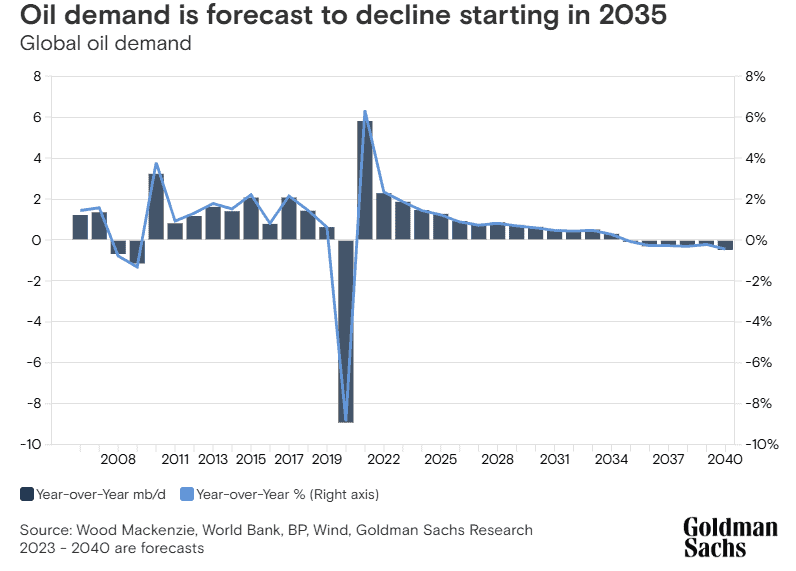
However, most economists are expecting the demand for oil to continue to rise over the next few years. For example, Goldman Sachs is forecasting ‘peak oil’ to occur in 2034. And as the chart below shows, there will only be a small reduction in demand thereafter.

Source: Goldman Sachs

The investment bank’s also produced an alternative scenario in which the adoption of electric vehicles (EVs) is slower than currently anticipated. This model shows oil demand continuing to rise until 2040.

And this could be the path we’re on. The UK government’s recently announced plans to allow smaller volume car manufacturers to continue to produce petrol cars beyond the current deadline of 2035.

The recent fall in BP’s share price has also created an opportunity for income investors.

Based on its last four quarterly dividends, the stock’s now yielding an impressive 7.3%. In April 2024, the return was a less generous 4.2%. Of course, much of this has been caused by the fall in its share price — it’s down 34% over the past 12 months — but unless the oil price remains depressed for a sustained period, I think the energy giant’s dividend is safe for now.

What I’m thinking

Despite these positives, I’m aware of the risks of investing in the energy sector. Volatile oil and gas prices mean it’s impossible to accurately predict BP’s earnings from one year to the next. And a fall in profit could have an impact on the dividend.

Also, the Deepwater Horizon disaster shows how dangerous the industry can be. The tragedy resulted in 11 deaths and cost the group over $65bn in clean-up costs, fines and compensation.

But after weighing up the pros and cons, I’m seriously considering putting the stock into my Self-Invested Personal Pension (SIPP).

However, although investing for retirement requires taking a long-term view, I’m going to wait a little longer before making a final decision. I don’t think the current market volatility will end soon, which makes me reluctant to invest right now. In the mean time, I’m going to keep BP on my watchlist.

Financial News

Daily News on Investing, Personal Finance, Markets, and more!

Financial News

Policy(Required)