The Warren Buffett advice I’m using to build passive income

Warren Buffett is not a dividend investor. However, he has built a portfolio of high-quality dividend stocks over the past couple of decades, which generate billions of dollars in passive income

How did he do this? He focuses on finding companies that have the potential to enjoy high profit margins. Businesses with high profit margins can afford to return lots of cash to shareholders. By contrast, corporations with low margins may struggle to increase shareholder returns. 

5 Stocks For Trying To Build Wealth After 50

Markets around the world are reeling from the coronavirus pandemic… and with so many great companies trading at what look to be ‘discount-bin’ prices, now could be the time for savvy investors to snap up some potential bargains.

But whether you’re a newbie investor or a seasoned pro, deciding which stocks to add to your shopping list can be a daunting prospect during such unprecedented times.

Fortunately, The Motley Fool UK analyst team have short-listed five companies that they believe STILL boast significant long-term growth prospects despite the global upheaval…

We’re sharing the names in a special FREE investing report that you can download today. And if you’re 50 or over, we believe these stocks could be a great fit for any well-diversified portfolio.

Click here to claim your free copy now!

And that focus on high margins is the approach I am following to build a passive income portfolio

Warren Buffett’s strategy

It is all too easy to look for the market’s top income stocks when building an income portfolio (I mean companies with the highest dividend yields when I say ‘top income stocks’). 

This strategy can produce returns, but it can also come with significant risks. A high dividend yield can signify that the market does not believe the payout is sustainable. In these situations, buying a high-yield stock can lead to more issues than it is worth. For example, if a company does have to cut the payout, the resulting share price fall could significantly exceed any potential income earned. 

That is why I favour Warren Buffett’s approach. The Oracle of Omaha does not pursue dividends. They are simply a happy result of his desire to find companies that look after shareholders. 

Coca-Cola is a great example. When he first bought the stock in the late 1980s, the shares offered a dividend yield of around 3%. Today, the investment produces a dividend equivalent to 50% of the initial capital investment. As the company has increased its dividend, the return for long-term investors has steadily increased. It has become a high-yield stock as a result for anyone who bought and held. 

Passive income investments

I think a couple of companies could help me replicate this approach. 

The first is the generic drugs producer Hikma. The corporation only pays out a small percentage of its earnings every year and reinvests the rest. Its dividend has grown steadily over the past 10 years, as profits have expanded. There is no guarantee this trend will continue, but if the world continues to consume more pharmaceutical products, it seems likely the company’s profits will continue to expand. 

Another example is AG Barr. This business has a good track record of returning cash to investors with dividends and share buybacks. As such, I think it has scope to become a Warren Buffett style passive income investment over the next few years. 

Of course, buying these companies does not guarantee a high return or passive income as company- or sector-specific issues can always derail my strategy. However, I think that by adding these firms to my portfolio, I will increase my chances of earning an income from dividend shares. There could also be potential for significant dividend growth over the next few years. 


Rupert Hargreaves has no position in any of the shares mentioned. The Motley Fool UK has recommended AG Barr and Hikma Pharmaceuticals. Views expressed on the companies mentioned in this article are those of the writer and therefore may differ from the official recommendations we make in our subscription services such as Share Advisor, Hidden Winners and Pro. Here at The Motley Fool we believe that considering a diverse range of insights makes us better investors.


Can using a price-to-earnings (P/E) ratio help me invest better?

A lot of investment commentators refer to a price-to-earnings ratio when writing about shares. But what is this P/E ratio? Why does it matter?

Valuation metric

To understand the role of a P/E ratio, it’s helpful to start by thinking about share prices. A company’s share price helps explain its market capitalisation. If a company has a share price of £1 and 1m shares in circulation, its market cap is £1m. If the share price doubles to £2 and the number of shares remains the same, the market capitalisation would be £2m.

5 Stocks For Trying To Build Wealth After 50

Markets around the world are reeling from the coronavirus pandemic… and with so many great companies trading at what look to be ‘discount-bin’ prices, now could be the time for savvy investors to snap up some potential bargains.

But whether you’re a newbie investor or a seasoned pro, deciding which stocks to add to your shopping list can be a daunting prospect during such unprecedented times.

Fortunately, The Motley Fool UK analyst team have short-listed five companies that they believe STILL boast significant long-term growth prospects despite the global upheaval…

We’re sharing the names in a special FREE investing report that you can download today. And if you’re 50 or over, we believe these stocks could be a great fit for any well-diversified portfolio.

Click here to claim your free copy now!

What does that mean? In theory, it means that if someone came along with £2m to spend, they would be able to buy all of the company’s shares and thus the company. In practice things may be more complicated, as for example a bidder may need to offer a premium to persuade existing shareholders to part with their shares. Nonetheless, a market cap is a good albeit rough guide to a company’s valuation. But how do investors decide such a valuation?

P/E ratio and valuation

One way to do this is by looking at a company’s earnings. Let’s say that to buy the company with a £2m valuation, I want to borrow the £2m. I could hopefully use the earnings from the company to pay back my loan. If the company earnings are £200,000 per year, it would take me 10 years to pay off the £2m. If the price (£2m) is divided by the earnings (£200,000) the arithmetic result is 10. So, we say that the company has a P/E ratio of 10.

In reality, things wouldn’t work quite like that. The longer I took to repay my debt, the more I would usually have to pay in interest. Plus, many companies’ earnings aren’t smooth. So just because a company earns £200,000 this year, it doesn’t mean the same will happen next year.

But a P/E ratio could still give me some important information. A low P/E ratio can suggest the company may be trading cheaply. A high P/E ratio may mean it is overvalued. Even as a private investor looking at the share price, not a takeover firm thinking of buying the whole company, that valuation metric could be useful to me.

Looking at the bigger picture

So, does that mean that Imperial Brands with its P/E ratio of less than seven is a bargain, or that Spirax-Sarco with a P/E ratio over 60 is overpriced?

Not necessarily. That is because earnings could change in future. Imperial’s tobacco focus risks earnings falling as people quit smoking. Spirax-Sarco has demonstrated it can grow earnings, for example by making acquisitions. Using my example above of buying a company with debt then repaying the loan from future earnings, that could help explain Imperial’s low P/E ratio and Spirax-Sarco’s high P/E ratio.

It’s important to remember that a P/E ratio is only one of a number of valuation metrics many investors use. Used properly, though, I do find a P/E ratio is a useful and simple analytical tool to help me make investment decisions. It can help me identify possibly undervalued companies that merit further investigation as potential additions to my portfolio.

FREE REPORT: Why this £5 stock could be set to surge

Are you on the lookout for UK growth stocks?

If so, get this FREE no-strings report now.

While it’s available: you’ll discover what we think is a top growth stock for the decade ahead.

And the performance of this company really is stunning.

In 2019, it returned £150million to shareholders through buybacks and dividends.

We believe its financial position is about as solid as anything we’ve seen.

  • Since 2016, annual revenues increased 31%
  • In March 2020, one of its senior directors LOADED UP on 25,000 shares – a position worth £90,259
  • Operating cash flow is up 47%. (Even its operating margins are rising every year!)

Quite simply, we believe it’s a fantastic Foolish growth pick.

What’s more, it deserves your attention today.

So please don’t wait another moment.

Get the full details on this £5 stock now – while your report is free.


Christopher Ruane owns shares in Imperial Brands. The Motley Fool UK has recommended Imperial Brands. Views expressed on the companies mentioned in this article are those of the writer and therefore may differ from the official recommendations we make in our subscription services such as Share Advisor, Hidden Winners and Pro. Here at The Motley Fool we believe that considering a diverse range of insights makes us better investors.

Could this FTSE 100 stock outperform in 2022?

2021 might have been a year of growth in the FTSE 100 index, but it was not without its drama. Stocks rose and fell, and until very recently, it looked like stock markets may even crash because of the Omicron variant. With only a couple of trading sessions to go as I write, it seems quite unlikely now. In fact, even stocks that were struggling until very recently are now showing signs of pickup. In another article today, I talk about the International Consolidated Airlines Group in this context. Another one that is doing even better is the multi-commodity miner Anglo American (LSE: AAL).

Before I dive into the rest of its story, let me first just say that I bought the FTSE 100 stock a few months ago when it first started falling. It just looked like a really good stock to buy on the dip to me, and I maintain that view, even though it fell some more after that. At one point, it was down by more than 28% from its early August highs. It has recovered quite a bit since, though. In fact, at its last close at the time of writing, it is up by almost 24% from a year ago. 

5 Stocks For Trying To Build Wealth After 50

Markets around the world are reeling from the coronavirus pandemic… and with so many great companies trading at what look to be ‘discount-bin’ prices, now could be the time for savvy investors to snap up some potential bargains.

But whether you’re a newbie investor or a seasoned pro, deciding which stocks to add to your shopping list can be a daunting prospect during such unprecedented times.

Fortunately, The Motley Fool UK analyst team have short-listed five companies that they believe STILL boast significant long-term growth prospects despite the global upheaval…

We’re sharing the names in a special FREE investing report that you can download today. And if you’re 50 or over, we believe these stocks could be a great fit for any well-diversified portfolio.

Click here to claim your free copy now!

Strong performance for Anglo American

I can see why. Its last results, which were released in July, were great. The company saw a huge spurt in both revenue and profits. Its outlook is positive too, with expectations of an even better next year than 2021. With its price-to-earnings (P/E) ratio still at a small 7.5 times compared the average FTSE 100 ratio of 18 times, it is clear to me that the stock price could rise significantly more from here. 

I’m doubly confident on this because it has a strong dividend yield. At 6%, the Anglo American yield is much higher than the 3.5% yield for the average FTSE 100 stock. It might not be as high as those for its Footsie peers like Evraz and Rio Tinto, which boast double-digit yields. But then they cannot say that their performance will be better next year than that in 2021 either. 

Risks to the FTSE 100 stock

There are, of course, still risks to the Anglo American share price. No one knows how next year will turn out. We might put the pandemic behind us, the recovery could happen and it would be a good times for commodity stocks once again. Or the pandemic will stick around, creating yet another year of tepid growth. And there might not be any government support to commodity producers this time around, either. 

What I’d do

On balance, though, I think there is a lot of upside to the FTSE 100 stock. I am now planning to increase my holdings, because I think there is a good chance that it could outperform next year. 

5 Stocks For Trying To Build Wealth After 50

Markets around the world are reeling from the coronavirus pandemic…

And with so many great companies still trading at what look to be ‘discount-bin’ prices, now could be the time for savvy investors to snap up some potential bargains.

But whether you’re a newbie investor or a seasoned pro, deciding which stocks to add to your shopping list can be a daunting prospect during such unprecedented times.

Fortunately, The Motley Fool is here to help: our UK Chief Investment Officer and his analyst team have short-listed five companies that they believe STILL boast significant long-term growth prospects despite the global lock-down…

You see, here at The Motley Fool we don’t believe “over-trading” is the right path to financial freedom in retirement; instead, we advocate buying and holding (for AT LEAST three to five years) 15 or more quality companies, with shareholder-focused management teams at the helm.

That’s why we’re sharing the names of all five of these companies in a special investing report that you can download today for FREE. If you’re 50 or over, we believe these stocks could be a great fit for any well-diversified portfolio, and that you can consider building a position in all five right away.

Click here to claim your free copy of this special investing report now!


Manika Premsingh owns shares in Anglo American, Evraz, International Consolidated Airlines Group and Rio Tinto. The Motley Fool UK has no position in any of the shares mentioned. Views expressed on the companies mentioned in this article are those of the writer and therefore may differ from the official recommendations we make in our subscription services such as Share Advisor, Hidden Winners and Pro. Here at The Motley Fool we believe that considering a diverse range of insights makes us better investors.
5 ‘no-brainer’ dividend shares for a passive income in 2022

Dividend shares can be a great way to produce passive income. I own several myself and each provide a reasonable semi-regular income. The UK is home to some excellent dividend shares, in my opinion. In particular, the FTSE 100 includes several companies that offer dividend yields of over 5%.

If I invested £10,000 in a selection of these shares in 2022, I could end the year with an extra £500 of dividends. Passive income from shares isn’t just about the dividend yield though. Over time, I’d hope for the value of the shares to grow too. If my selection of shares can grow in value by just 5% a year, I’d be looking at 10% in total, including dividends. That’s around the long run total return for the FTSE All-Share index looking back over the past 35 years.

5 Stocks For Trying To Build Wealth After 50

Markets around the world are reeling from the coronavirus pandemic… and with so many great companies trading at what look to be ‘discount-bin’ prices, now could be the time for savvy investors to snap up some potential bargains.

But whether you’re a newbie investor or a seasoned pro, deciding which stocks to add to your shopping list can be a daunting prospect during such unprecedented times.

Fortunately, The Motley Fool UK analyst team have short-listed five companies that they believe STILL boast significant long-term growth prospects despite the global upheaval…

We’re sharing the names in a special FREE investing report that you can download today. And if you’re 50 or over, we believe these stocks could be a great fit for any well-diversified portfolio.

Click here to claim your free copy now!

The power of reinvesting dividends

To gain an even larger passive income, I’d want to start with a larger sum of money. But that’s not always possible. Alternatively, I’d try to reinvest my dividends over time to grow my pot. Reinvesting dividends is a powerful way of making my money work harder. It works by using every dividend payment to automatically purchase new shares. Over time, I’d build up plenty of shares purchased just from dividends and each of these shares would in turn pay dividends, thus amplifying the effect.

Here’s an example. Let’s say I invest £10,000 in quality shares that yield 5% and the dividends grow at 5% per year. Let’s also assume the share price climbs by 5% per year and I’m investing for 25 years.

Using these assumptions, I calculate that my total pot without reinvesting dividends would total almost £59,000. Over 25 years, it should have paid out around £25,000 in dividends. This doesn’t sound too bad to me. But now consider this. By reinvesting my dividends over the same timeframe, I’d potentially own a total pot worth almost £115,000. That’s almost double. Also, it would have paid around £54,000 in dividends over that time.

That’s a considerable difference and it shows I could achieve a much greater passive income if I invest for a long period of time and reinvest my dividends.

Top 5 passive income shares

But what if I don’t have that long and want a passive income in 2022? I’d look for the best high-yielding shares right now. My list of ‘no-brainer’ dividend shares I’d consider includes Ferrexpo, Evraz, Rio Tinto, BHP group and Persimmon.

On average, these five shares currently yield around 8%. That’s far above the average FTSE 100 dividend yield of 3.5%. That sounds great, but I wouldn’t just look at the dividend yield in isolation. There are several other factors I’d want to consider. For instance, are they regular dividend payers? Yes, they are. On average, they’ve been paying regular dividends for 12 years. I prefer dividends to be affordable too. And that appears to be the case here. On average, dividends are well-covered by earnings.

A word of warning, however. Earnings can fall and occasionally companies can decide to suspend or cut dividends. Also, many of the shares in this group operate in the mining sector. This concentration of stocks could be a risk if the whole sector comes under pressure.

Overall, I reckon the pros outweighs the cons though, and I’d be happy to consider these shares for passive income for my portfolio in 2022.

5 Stocks For Trying To Build Wealth After 50

Markets around the world are reeling from the coronavirus pandemic…

And with so many great companies still trading at what look to be ‘discount-bin’ prices, now could be the time for savvy investors to snap up some potential bargains.

But whether you’re a newbie investor or a seasoned pro, deciding which stocks to add to your shopping list can be a daunting prospect during such unprecedented times.

Fortunately, The Motley Fool is here to help: our UK Chief Investment Officer and his analyst team have short-listed five companies that they believe STILL boast significant long-term growth prospects despite the global lock-down…

You see, here at The Motley Fool we don’t believe “over-trading” is the right path to financial freedom in retirement; instead, we advocate buying and holding (for AT LEAST three to five years) 15 or more quality companies, with shareholder-focused management teams at the helm.

That’s why we’re sharing the names of all five of these companies in a special investing report that you can download today for FREE. If you’re 50 or over, we believe these stocks could be a great fit for any well-diversified portfolio, and that you can consider building a position in all five right away.

Click here to claim your free copy of this special investing report now!


Harshil Patel owns Persimmon. The Motley Fool UK has no position in any of the shares mentioned. Views expressed on the companies mentioned in this article are those of the writer and therefore may differ from the official recommendations we make in our subscription services such as Share Advisor, Hidden Winners and Pro. Here at The Motley Fool we believe that considering a diverse range of insights makes us better investors.

1 top investment for a Junior ISA

Investing in a Junior ISA can be a great way for parents to put money away for their children. Within this type of investment account, all capital gains and dividends are completely tax-free. And parents can invest up to £9,000 per year for each child.

One challenge with this type of ISA however is choosing the best investments. Those putting money aside for their children and grandchildren in a Junior ISA generally have a very long time horizon in which to invest. So what’s the best approach to investing? 

5 Stocks For Trying To Build Wealth After 50

Markets around the world are reeling from the coronavirus pandemic… and with so many great companies trading at what look to be ‘discount-bin’ prices, now could be the time for savvy investors to snap up some potential bargains.

But whether you’re a newbie investor or a seasoned pro, deciding which stocks to add to your shopping list can be a daunting prospect during such unprecedented times.

Fortunately, The Motley Fool UK analyst team have short-listed five companies that they believe STILL boast significant long-term growth prospects despite the global upheaval…

We’re sharing the names in a special FREE investing report that you can download today. And if you’re 50 or over, we believe these stocks could be a great fit for any well-diversified portfolio.

Click here to claim your free copy now!

The best investment for a Junior ISA?

Personally, if I was investing in a Junior ISA for my child today, I’d be focusing heavily on the technology sector. The reason is that we’re in the midst of a technology revolution that looks set to last for years, if not decades. Given this backdrop, I think tech stocks are likely to generate strong returns in the next decade and beyond.

One easy way to get broad exposure to tech stocks is through a NASDAQ 100 tracker fund such as the iShares NASDAQ 100 UCITS ETF. This is a technology-focused index that’s made up of the 100 largest non-financial companies listed on the NASDAQ Stock Exchange. One of the world’s preeminent large-cap growth indexes, it contains an attractive mix of technology companies that are driving the tech revolution and look set for strong growth in the years ahead.

The world’s best tech stocks

One thing I like about the NASDAQ 100 is that it contains both mega-cap tech stocks and smaller, more under-the-radar names. This means that it provides exposure to companies that are dominant today, as well as those that could be the giants of tomorrow.

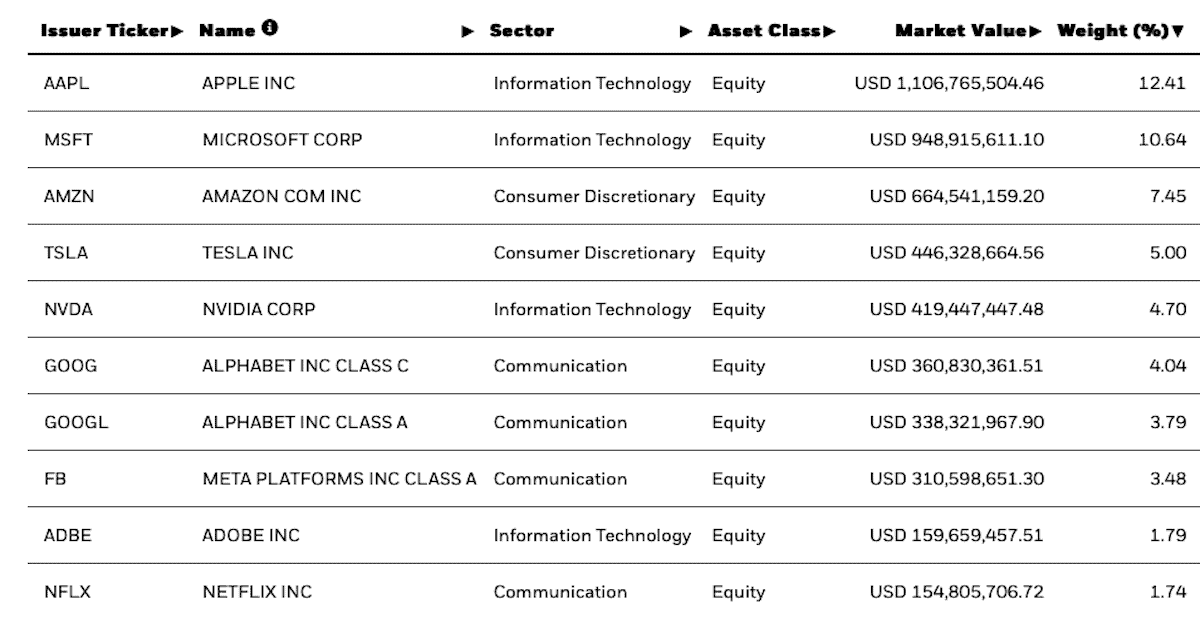
The largest holdings in the index are Apple, Microsoft, Amazon, and Alphabet (Google). These companies are already enormous. However, I think there’s plenty of growth to come from them in the years ahead. Looking further down the list of index constituents, there are a number of exciting, high-growth companies that could turn out to be tomorrow’s heroes:

  • Nvidia – which looks set to power the artificial intelligence revolution and the metaverse with its high-power computing technology

  • Intuitive Surgical – a leader in the robotic surgery space

  • CrowdStrike – one of the biggest cybersecurity companies in the world

  • Zoom Video Communications – the leader in video conferencing technology

NASDAQ 100 Top 10 Holdings

ETF for Junior ISA

Source: iShares. Data: 16 December 2021

Another attractive feature of this index is that it’s ‘self-cleansing’. What I mean by this is that if a company becomes obsolete, it’s likely to be removed from the index. Similarly, if a company becomes more dominant, its weight in the index is likely to increase. This means that no matter what happens in the technology space in the years ahead, investors in this index should be able to capitalise on the growth of the industry.

Risks

Of course, there are risks here. If technology stocks crash (as they quite often do in the short term), this index is likely to underperform. Similarly, if the US market falls, this index could struggle. I’d want to have other investments in my child’s Junior ISA for diversification.

Overall however, I think the NASDAQ 100 is a top index for long-term growth. That’s why I’d invest in it via an ETF within a Junior ISA.

Suzanne Frey, an executive at Alphabet, is a member of The Motley Fool’s board of directors. Teresa Kersten, an employee of LinkedIn, a Microsoft subsidiary, is a member of The Motley Fool’s board of directors. John Mackey, CEO of Whole Foods Market, an Amazon subsidiary, is a member of The Motley Fool’s board of directors. Edward Sheldon owns Alphabet (C shares), Amazon, Apple, Microsoft, and Nvidia. The Motley Fool UK has recommended Alphabet (A shares), Amazon, Apple, CrowdStrike Holdings, Inc., Microsoft, and Zoom Video Communications. Views expressed on the companies mentioned in this article are those of the writer and therefore may differ from the official recommendations we make in our subscription services such as Share Advisor, Hidden Winners and Pro. Here at The Motley Fool we believe that considering a diverse range of insights makes us better investors.

4 of my favourite dividend stocks for 2022!

I’m searching for the best dividend stocks to buy for my shares portfolio in 2022. Here are four big-yielding UK shares on my shortlist today.

#1: A big-yielding metals mammoth

I think Sylvania Platinum shares look unmissably cheap right now. The South Africa-focussed business trades on a forward P/E ratio of just 3.5 times at current prices. It also carries a 5% dividend yield for this fiscal year (to June 2022).

5 Stocks For Trying To Build Wealth After 50

Markets around the world are reeling from the coronavirus pandemic… and with so many great companies trading at what look to be ‘discount-bin’ prices, now could be the time for savvy investors to snap up some potential bargains.

But whether you’re a newbie investor or a seasoned pro, deciding which stocks to add to your shopping list can be a daunting prospect during such unprecedented times.

Fortunately, The Motley Fool UK analyst team have short-listed five companies that they believe STILL boast significant long-term growth prospects despite the global upheaval…

We’re sharing the names in a special FREE investing report that you can download today. And if you’re 50 or over, we believe these stocks could be a great fit for any well-diversified portfolio.

Click here to claim your free copy now!

Prices of platinum group metals (PGMs) are slipping at the moment as concerns over demand from the critical automotive sector grow. It’s possible they could keep dropping too if semiconductor shortages keep hitting vehicle production rates.

That said, I expect PGM demand from carbuilders to rise strongly over the long term as emissions regulations tighten. And I think Sylvania could still have a brilliant 2022 if investor nervousness continues to grow and safe-haven demand for precious metals grows. So as a long-term value investor I’d use recent share price weakness at Sylvania as an opportunity to buy.

#2: A FTSE 100 dividend hero

Persimmon is one of my favourite FTSE 100 dividend stocks today. Its 8.8% dividend yield makes it one of the biggest yielders on the blue-chip index. I’d buy the housebuilder because I’m expecting another solid year of profits in 2022. Interest rates remain well below historical norms and the mortgage market is ultra competitive, helping first-time buyers to continue getting their foot on the ladder. The government’s Help to Buy loan scheme also remains in business, of course.

I’d buy Persimmon shares despite the problem of building product shortages that’s pushing up costs and might threaten construction work.

#3: Capitalising on rising infrastructure spending

The 4.7% forward dividend yields over at HICL Infrastructure for 2022 has also whetted my investment appetite. In fact, I think this income stock’s a particularly good buy as the economic stormclouds gather. This is because it invests in essential infrastructure, like highways, hospitals, railways and police stations. You know, the kinds of projects and assets that make society function.

HICL Infrastructure generates the lion’s share of earnings from the UK, though it also has some exposure to North American and European markets to provide a little strength through diversification. I think the company’s a top stock to own, even though higher-than-expected asset lifecycle costs can hit earnings.

#4: The property powerhouse

I’d also stock up on Primary Health Properties shares for the new year. This real estate powerhouse specialises in letting out healthcare properties, the kind of assets where rent collection will remain strong, even if the Covid-19 crisis continues and inflation keeps rocketing. Indeed, this dividend stock will benefit from a sustained inflationary rise as property values and rent levels will subsequently increase.

My main concern for Primary Health Properties comes from its hunger for asset acquisitions. I’m confident this will deliver decent profits growth in the years ahead. However, acquisition-led growth strategies do leave businesses open to making expensive mistakes that can hit shareholder returns. This UK dividend share boasts a 4.4% dividend yield for the year to September 2022.

5 Stocks For Trying To Build Wealth After 50

Markets around the world are reeling from the coronavirus pandemic…

And with so many great companies still trading at what look to be ‘discount-bin’ prices, now could be the time for savvy investors to snap up some potential bargains.

But whether you’re a newbie investor or a seasoned pro, deciding which stocks to add to your shopping list can be a daunting prospect during such unprecedented times.

Fortunately, The Motley Fool is here to help: our UK Chief Investment Officer and his analyst team have short-listed five companies that they believe STILL boast significant long-term growth prospects despite the global lock-down…

You see, here at The Motley Fool we don’t believe “over-trading” is the right path to financial freedom in retirement; instead, we advocate buying and holding (for AT LEAST three to five years) 15 or more quality companies, with shareholder-focused management teams at the helm.

That’s why we’re sharing the names of all five of these companies in a special investing report that you can download today for FREE. If you’re 50 or over, we believe these stocks could be a great fit for any well-diversified portfolio, and that you can consider building a position in all five right away.

Click here to claim your free copy of this special investing report now!


Royston Wild has no position in any of the shares mentioned. The Motley Fool UK has recommended Primary Health Properties. Views expressed on the companies mentioned in this article are those of the writer and therefore may differ from the official recommendations we make in our subscription services such as Share Advisor, Hidden Winners and Pro. Here at The Motley Fool we believe that considering a diverse range of insights makes us better investors.

These are 5 of my top passive income ideas

Some of my favourite passive income ideas are UK dividend shares. I like the juicy dividends and the fact I don’t need to work for the income. Here are five I would consider buying now for my portfolio to try and increase my passive income streams.

Direct Line

The insurer and financial services company Direct Line (LSE: DLG) has built an iconic brand. Even in an age when many customers shop for insurance online rather than over the phone, the red telephone logo and brand identity help build customer awareness and loyalty.

5 Stocks For Trying To Build Wealth After 50

Markets around the world are reeling from the coronavirus pandemic… and with so many great companies trading at what look to be ‘discount-bin’ prices, now could be the time for savvy investors to snap up some potential bargains.

But whether you’re a newbie investor or a seasoned pro, deciding which stocks to add to your shopping list can be a daunting prospect during such unprecedented times.

Fortunately, The Motley Fool UK analyst team have short-listed five companies that they believe STILL boast significant long-term growth prospects despite the global upheaval…

We’re sharing the names in a special FREE investing report that you can download today. And if you’re 50 or over, we believe these stocks could be a great fit for any well-diversified portfolio.

Click here to claim your free copy now!

That is good for the company’s business because it can help reduce customer acquisition costs. It can also help lower customer churn. Both of those things can be good for Direct Line’s profits, which last year came in at £367m after tax. Profits help fund dividends and this is where I think things get interesting with Direct Line from a passive income perspective. With a yield of around 8% lately, the company has been offering one of the more attractive payouts in the FTSE 100.

All shares have risks and that’s true for Direct Line too. The rising cost of second-hand vehicles is making it costlier to settle some claims. That could lead to lower profits. But I would happily consider Direct Line for my portfolio.

Imperial Brands

Another of the bigger dividends in the FTSE 100 comes from Imperial Brands (LSE: IMB). As its former name Imperial Tobacco indicates, the Bristol company has a global tobacco empire. It owns brands including Winston, West, and John Player Special. Tobacco companies are able to generate high free cash flows and that can fund chunky dividends. Even after a big cut last year, the Imperial yield has been hovering close to 9% recently.

That may partly reflect an obvious risk tobacco companies like Imperial face. A decline in the number of smokers in many markets threatens both revenues and profits. Imperial is facing this head on. But its strategy, of trying to increase market share in some countries, could be a risky one. It may end up with Imperial simply getting a comfier seat on a boat that’s still sinking. Then again, maybe cigarettes and cigars will endure for decades. Meanwhile, Imperial may be able to grow volumes. It also has pricing power, so can partly mitigate declining smoking rates by increasing prices.

Although there are clear risks here, Imperial’s yield is attractive to me. I hold it in my portfolio because of the passive income stream it provides.

Diversified Energy

I bought Diversified Energy (LSE: DEC) for the first time this year. With its large network of oil and gas wells, the company has been pumping money out of the ground – and sharing a lot of it with shareholders in the form of dividends. The yield has been in the double-digits recently, making it one of the most lucrative passive income ideas I own.

On top of that, Diversified has raised its dividend over the past several years. It also pays out quarterly. Both can be attractive when considering passive income, although past dividends are no guarantee of future ones.

There are risks here too. When wells reach the end of their working life they need to be capped. That costs money. With Diversified operating around 67,000 wells, over time those capping costs could add up to a large amount. That may hurt the company’s profits. Energy prices can also be volatile, as  we have seen in 2021. That could also lead to lower profits in future.

Vodafone

The telecoms operator Vodafone (LSE: VOD) has a large network across many markets. In the UK alone it has over 18m customers and that’s just one of the company’s markets. It has spent decades building a leading position in European telecoms and that has led to a large, profitable business.

That profitability allows the company to reward shareholders with dividends. With the payout lately being north of 6% of the Vodafone share price, I find it attractive. The company is one of the passive income ideas I would consider buying for my portfolio now.

One concern I have, though, is the capital intensive nature of the business. Bidding for licenses, and building and maintaining networks can be very costly. Not only could that dent profits in future, it has also led to Vodafone carrying substantial debt. Servicing that could threaten the dividend, which the company already cut several years ago.

Set against that, Vodafone continues to generate enormous cash flows. I think it can do so far into the future. New technologies such as 5G may increase its ability to make profits as users sign on for more services.

GlaxoSmithKline

To help reduce my risk, I try to diversify my portfolio across different business areas.

When it comes to pharma, one of the companies I would consider buying for my portfolio is GlaxoSmithKline (LSE: GSK). Offering a yield of around 5% lately, I think the company could be a handy addition to my passive income streams.

2022 could be transformative for GSK. It is planning to split into two companies. The combined dividend yield could be lower than the current GSK one. However, I reckon the strategy could help the company focus more on two distinct areas, pharma and consumer goods. In the long term, if that unlocks more value than the current structure, I reckon the move could actually be good for the dividend.

But there is a risk the break up could distract management attention and bring additional costs such as professional fees. That could lead to lower profits.


Christopher Ruane owns shares in Diversified Energy and Imperial Brands. The Motley Fool UK has recommended GlaxoSmithKline and Imperial Brands. Views expressed on the companies mentioned in this article are those of the writer and therefore may differ from the official recommendations we make in our subscription services such as Share Advisor, Hidden Winners and Pro. Here at The Motley Fool we believe that considering a diverse range of insights makes us better investors.

How I’d target passive income with £30 a month

The end of the year can be a good time to review one’s finances. One common New Year’s resolution is to boost one’s income. But often that involves working longer hours. Instead, I would focus on increasing my passive income in 2022. I think I could do that by putting aside a relatively modest sum each month and investing it in dividend shares.

Here’s an example of how I could do that with £30 a month, roughly a pound a day.

5 Stocks For Trying To Build Wealth After 50

Markets around the world are reeling from the coronavirus pandemic… and with so many great companies trading at what look to be ‘discount-bin’ prices, now could be the time for savvy investors to snap up some potential bargains.

But whether you’re a newbie investor or a seasoned pro, deciding which stocks to add to your shopping list can be a daunting prospect during such unprecedented times.

Fortunately, The Motley Fool UK analyst team have short-listed five companies that they believe STILL boast significant long-term growth prospects despite the global upheaval…

We’re sharing the names in a special FREE investing report that you can download today. And if you’re 50 or over, we believe these stocks could be a great fit for any well-diversified portfolio.

Click here to claim your free copy now!

Getting ready to invest

To buy dividend shares, I would need some sort of trading account. That could be a share dealing account, or maybe a tax-efficient structure like a Stocks and Shares ISA. It doesn’t need to take much time or effort to set up such an account. First I’d do some research to figure out which one would suit my needs best. That monthly £30 adds up to £360 a year. Investing that sum, I’d want to minimise costs. So I’d look carefully at the fees and charges of the different options available to me.

Then I’d start saving. I think putting a pound coin in a piggy bank each day would be a good physical reminder to me of the disciplined progress I was making as an investor. But another option would be to set up an automatic bank transfer for each month.

Learning about dividend shares

After that, I would use the time while my pounds piled up to learn more about dividend shares.

Not all companies pay dividends, and those that do can cancel them at any moment. So I would want to look into companies that I thought might be able to pay me attractive dividends in years to come.

To do that, two things would be important. First would be the company’s dividend paying capacity. Does the company have a business that is likely to continue producing surplus cash it can use to fund dividends? Some clues to that would come from its financial reports. But I’d also want to consider what might happen in future. For example, will demand for its products and services be sustained? Does it have some competitive advantage which would allow it to charge a price premium?

Secondly I’d want to consider the current share price. What is known as dividend ‘yield is basically a company’s dividend expressed as a percentage of its share price. Let’s say a company pays out a 10p per share dividend. If its shares trade at £1, the yield is 10%. So a £360 investment could generate £36 of passive income per year. But if the share price when I buy is £10, the yield would only be 1%. In that case, a £360 investment would give me £3.60 of passive income in a year. The price at which I buy a share can have a big impact on yield and therefore on the size of my potential passive income streams.

Buying shares for passive income

I wouldn’t want to put all of my money in one share, though. To help reduce my risk, I would diversify across different companies. With £360 a year, I would have enough to buy a couple of different companies a year, at least.

I might start, though, by getting some diversification from a single pick. A unit trust which invested in different companies could work well in this regard. One such share I have held myself in the past for its passive income potential is Income & Growth VCT. But like any shares, it carries risks. The trust invests in early stage companies, so if they do not turn out well its own income can fall.

Once I had enough money, I would be more interested in investing in individual shares, although still as part of a diversified portfolio.

Some shares seem to be favourites among dividend investors and come up often in discussion. For example, tobacco high yielders such as British American Tobacco and utilities like United Utilities can be popular with many investors. But I would want to make my own decisions about what shares best meet my own investment objectives. What suits other investors might not be right for me. For example, I might decide for ethical reasons that I didn’t want to invest in tobacco shares. From a financial perspective, I may decide that the yield from utilities didn’t compensate me enough for the risk of low revenue growth and price regulation at a time of inflationary pressures.

Passive income mistakes

What I definitely wouldn’t do, though, is just look to maximise my passive income by putting my money straight into the highest yielding dividend shares.

Why not? After all, if passive income is my objective surely the more I get the better it is? Not necessarily. That’s because a high yield can often be a red flag. It may be that the City is anticipating lower profits or dividends in future, and has marked down the share price accordingly. That can lead to a juicy looking yield. But if I buy that share and the dividend cut comes to pass, I might not get nearly as much passive income as I had expected. This is an example of what is known as a ‘value trap.

Consider as an example the company Ferrexpo, which at times this year has offered a yield of 13%. That sounds amazing. But on closer examination, a couple of important factors stand out. Last year’s dividend was more than triple that of the year before. On top of that, Ferrexpo’s profits come from a group of mines concentrated in one area in Ukraine. With political risk currently threatening Ukraine, that could mean profits fall in future. 

That doesn’t mean Ferrexpo might not still be a suitable investment for some people. It could maintain profits, after all, and political tensions in Ukraine may fall. It may turn out not to be a value trap at all, but just a cheap share with a high yield. But with £30 a month to invest, my risk tolerance would be modest. I wouldn’t want to tie up a sizeable proportion of my investments in shares that may well not give me the level of passive income I expected when I bought them. Instead, I’d focus on finding shares that offered me an attractive combination of passive income reward with risk. I’d be willing to trade some reward in return for lowering my risk.

Is this little-known company the next ‘Monster’ IPO?

Right now, this ‘screaming BUY’ stock is trading at a steep discount from its IPO price, but it looks like the sky is the limit in the years ahead.

Because this North American company is the clear leader in its field which is estimated to be worth US$261 BILLION by 2025.

The Motley Fool UK analyst team has just published a comprehensive report that shows you exactly why we believe it has so much upside potential.

But I warn you, you’ll need to act quickly, given how fast this ‘Monster IPO’ is already moving.

Click here to see how you can get a copy of this report for yourself today


Christopher Ruane owns shares in British American Tobacco. The Motley Fool UK has recommended British American Tobacco. Views expressed on the companies mentioned in this article are those of the writer and therefore may differ from the official recommendations we make in our subscription services such as Share Advisor, Hidden Winners and Pro. Here at The Motley Fool we believe that considering a diverse range of insights makes us better investors.

My three top stocks for passive income in 2022

As a veteran investor, I’m a big fan of passive income — those earnings that I don’t have to work to collect. For me, the best form of passive income is share dividends. These regular cash payments made by companies to shareholders typically come half-yearly or quarterly. But not all UK-listed companies pay dividends, so I usually rely on members of the FTSE 100 index for my unearned income. Here are three Footsie shares that I don’t own, but would happily buy today to boost my cash flow.

#1: passive income stock Evraz

Of my three top stocks for passive income, I view Evraz (LSE: EVR) as the riskiest share. This global steelmaker and miner has major operations in Russia, Ukraine and North America. Its products include steel (13.6m tonnes in 2020), iron ore, coal and vanadium. Its largest shareholder is billionaire businessman Roman Abramovich, owner of Premier League club Chelsea FC. At Friday’s closing price of 608.45p, this group was valued at £8.9bn. Currently, Evraz shares trade on a price-to-earnings ratio of 7.7 and an earnings yield of 12.9%. Furthermore, its dividend yield of 13.5% is among the highest on offer in the FTSE 100. But dividends are not guaranteed and can be cut or cancelled at any time. Also, generally speaking, the higher the dividend yield, the higher the risk (all else being equal). Hence, even though I’d buy it, I’d expect this mining stock to be fairly volatile in 2022-23.

5 Stocks For Trying To Build Wealth After 50

Markets around the world are reeling from the coronavirus pandemic… and with so many great companies trading at what look to be ‘discount-bin’ prices, now could be the time for savvy investors to snap up some potential bargains.

But whether you’re a newbie investor or a seasoned pro, deciding which stocks to add to your shopping list can be a daunting prospect during such unprecedented times.

Fortunately, The Motley Fool UK analyst team have short-listed five companies that they believe STILL boast significant long-term growth prospects despite the global upheaval…

We’re sharing the names in a special FREE investing report that you can download today. And if you’re 50 or over, we believe these stocks could be a great fit for any well-diversified portfolio.

Click here to claim your free copy now!

#2: dividend stock M&G

My second stock for passive income in 2022 is a staid — even boring — business. It’s investment manager M&G (LSE: MNG) and was part of Prudential until M&G floated in October 2019. At Friday’s closing price of 198.9p, M&G was valued at under £5.2bn. Despite global stock markets rising strongly in 2021, M&G’s shares have fallen behind, dropping by 1.8% over one year. Indeed, this stock stands 55.4p (-21.8%) below its 52-week high of 254.3p that it hit on 1 June. As a result, the shares now offer a mouth-watering dividend yield of 9.2% — more than 2.3 times the FTSE 100’s 4% cash yield. Although M&G is a relatively small player in global asset management, I’m surprised that its shares are so lowly valued. Yes, it faces stiff competition from much larger rivals, but this might lead to it being taken over at a premium some day.

#3: high-yielding share Imperial Brands

My third stock for passive income is Imperial Brands (LSE: IMN). Imperial’s shares are hardly popular among ethical investors, as it’s one of the world’s leading tobacco and cigarette suppliers. Yet the Bristol-based firm’s origins date back 235 years to 1786. In 2020, Imperial sold more than 330bn cigarettes in 160 countries, including brands such as Davidoff, Gauloises, JPS, Kool, West, and Winston. At Friday’s closing price of 1,612p, M&G was valued at almost £15.3bn. At present, its shares trade on a lowly price-to-earnings ratio of 5.4 and a bumper earnings yield of 18.6%. Imperial’s huge cash flows mean that its stock offers a dividend yield exceeding 8.6% a year. Of course, this share is hardly one I’d recommend to ESG (Environmental, Social and Governance) investors. Also, Imperial carries a high level of debt on its balance sheet. Nevertheless, its high dividend still appeals to me as an income-seeking investor!

Inflation Is Coming: 3 Shares To Try And Hedge Against Rising Prices

Make no mistake… inflation is coming.

Some people are running scared, but there’s one thing we believe we should avoid doing at all costs when inflation hits… and that’s doing nothing.

Money that just sits in the bank can often lose value each and every year. But to savvy savers and investors, where to consider putting their money is the million-dollar question.

That’s why we’ve put together a brand-new special report that uncovers 3 of our top UK and US share ideas to try and best hedge against inflation…

…because no matter what the economy is doing, a savvy investor will want their money working for them, inflation or not!

Best of all, we’re giving this report away completely FREE today!

Simply click here, enter your email address, and we’ll send it to you right away.


Cliffdarcy has no position in any of the shares mentioned. The Motley Fool UK has recommended Imperial Brands. Views expressed on the companies mentioned in this article are those of the writer and therefore may differ from the official recommendations we make in our subscription services, such as Share Advisor, Hidden Winners and Pro. Here at The Motley Fool, we believe that considering a diverse range of insights makes us better investors.

Value and growth stocks: my top picks from the FTSE 100

Growth investing and value investing. These two terms are thrown around quite a lot in investment circles and can be quite confusing for those who are just starting out. In this article, I’ll attempt to demystify the terms as well as provide actionable FTSE 100 stock picks that I would buy using each approach. 

Value investing: the long game

Value investing is kind of the bargain hunters’ approach to investing. There’s probably no greater lover of a good bargain-but-high-quality stock than Warren Buffett. He and his early mentor, Benjamin Graham, embraced and popularised this style of investing and it has since made both of them and countless others, fabulously wealthy.

5 Stocks For Trying To Build Wealth After 50

Markets around the world are reeling from the coronavirus pandemic… and with so many great companies trading at what look to be ‘discount-bin’ prices, now could be the time for savvy investors to snap up some potential bargains.

But whether you’re a newbie investor or a seasoned pro, deciding which stocks to add to your shopping list can be a daunting prospect during such unprecedented times.

Fortunately, The Motley Fool UK analyst team have short-listed five companies that they believe STILL boast significant long-term growth prospects despite the global upheaval…

We’re sharing the names in a special FREE investing report that you can download today. And if you’re 50 or over, we believe these stocks could be a great fit for any well-diversified portfolio.

Click here to claim your free copy now!

So, what’s it all about? Well, imagine I go to an auction where a rare Rolex watch is being offered. For some reason, the other potential buyers don’t see as much value in the watch as I do. As a result, they don’t make any substantial offers or bid up the price and I get the watch at a slight discount to what I think is its true value. Some 30 years later, the watch is rarer than ever and the market is now well aware of its value. I sell it for 200 times what I bought it for. That’s value investing in a nutshell.

It’s all about buying high-quality companies for a discount to their true worth. Buffett actually goes into the transaction with the mindset that he is not only buying a piece of the business but the entire business. Accordingly, his mental framework is always to hold for the long term. Value stocks are characterised by the lower risk afforded by the underlying quality of their companies.

Some notable FTSE 100 picks I see as value stocks are companies like Tesco and Rio Tinto. They have low price-to-earnings ratios of  3.37 and 5.66 respectively. This is despite both companies having a long history of positive earnings and a strong market presence. So in my opinion, they are trading below their fair value and I would buy them.

Growth investing: high risk, high reward

Growth investing is simply a bet on potential. Such companies are often young and often have little or no proven track record of being consistent money-maker (although this isn’t always the case). They are often from emerging industries such as tech or renewable energy and therefore come with a lot of hype. This brings lots of market attention and therefore they often trade at high valuations because of their popularity. 

When a growth stock succeeds, it can be spectacular from a returns perspective. Amazon is one such example of a growth stock that exploded and produced huge returns. However, due to the uncharted nature of the territory they operate in and high capital expenditures associated with new product R&D, these companies can also fail spectacularly.

One FTSE 100 company that falls within the growth category is Entain. It operates as a high-tech pioneer of new technologies in the gambling and gaming industries. Entain is profitable but has a P/E ratio of 72.  I have previously said that I would buy Entain and still would.

FREE REPORT: Why this £5 stock could be set to surge

Are you on the lookout for UK growth stocks?

If so, get this FREE no-strings report now.

While it’s available: you’ll discover what we think is a top growth stock for the decade ahead.

And the performance of this company really is stunning.

In 2019, it returned £150million to shareholders through buybacks and dividends.

We believe its financial position is about as solid as anything we’ve seen.

  • Since 2016, annual revenues increased 31%
  • In March 2020, one of its senior directors LOADED UP on 25,000 shares – a position worth £90,259
  • Operating cash flow is up 47%. (Even its operating margins are rising every year!)

Quite simply, we believe it’s a fantastic Foolish growth pick.

What’s more, it deserves your attention today.

So please don’t wait another moment.

Get the full details on this £5 stock now – while your report is free.


Stephen Bhasera has no position in any of the shares mentioned. John Mackey, CEO of Whole Foods Market, an Amazon subsidiary, is a member of The Motley Fool’s board of directors. The Motley Fool UK has recommended Amazon and Tesco. Views expressed on the companies mentioned in this article are those of the writer and therefore may differ from the official recommendations we make in our subscription services such as Share Advisor, Hidden Winners and Pro. Here at The Motley Fool we believe that considering a diverse range of insights makes us better investors.

Financial News

Daily News on Investing, Personal Finance, Markets, and more!

Financial News

Policy(Required)