Find out the 5 best and worst performing US stocks of 2021!

Image source: Getty Images


Whenever we start a new year, it’s always useful to look back at the previous year for some insight. Of course, past performance doesn’t dictate future results, but there are definitely lessons we can learn and apply to the present. This is certainly true for stocks and shares!

So, I’m going to break down some of the best- and worst-performing US stocks of 2021 and provide you with some investing tips to carry with you over the next 12 months.

What were the five best-performing US stocks of 2021?

According to research from Investopedia, using data from the Russell 1000 index, these were the five US stocks with the best-performing share prices in 2021:

Position Company 2021 return
1 GameStop (GME) 815%
2 Upstart Holdings (UPST) 321.1%
3 Moderna (MRNA) 193.6%
4 Devon Energy (DVN) 175.3%
5 Continental Resources (CLR) 167.1%

And the 5 worst-performing US stocks of 2021?

Here are the stocks that had a particularly bad 2021 and will be hoping for a better 2022:

Position Company 2021 Return
1 StoneCo (STNE) -81.83%
2 C3.ai (AI) -78.56%
3 Paysafe (PSFE) -77.62%
4 GoHealth (GOCO) -74.89%
5 Peloton Interactive (PTON) -71.3%

Are there trends in the best-performing stocks?

Not much more can be said about the whole GameStop (GME) saga, and I don’t want to give the stock any more airtime. Although it posted the highest returns, it was one of the weirdest things to ever happen in the stock market. The only lesson you can take from its success is to expect the unexpected!

Overall, Moderna (MRNA) had another great year as vaccines played a big part in 2021. I expect vaccines to still play a role in 2022 but not on the same scale, which could mean lower returns. But who knows what the coronavirus pandemic will throw at us next?

Devon Energy (DVN) and Continental Resources (CLR) are both in the oil and natural gas sector. It’s an area that has seen huge price explosions for customers in the US and the UK in the past year. These issues don’t seem to be resolved, meaning low supply and high demand could lead to another good year for stocks like these.

What about the worst stocks?

It’s interesting to see that four out of the five worst stocks are all tech-related, albeit within different sectors. Tech did pretty well across the board in 2020. Then 2021 saw investors start to shy away from the highly valued, speculative picks.

The only non-tech stock, Peloton (PTON), suffered from a consumer trend reversal. Home gym equipment was highly popular during worldwide lockdowns. But, as normal life has resumed, and people are spending more time outside, Peloton (PTON) investors have been hit with a reality check.

So during 2021, it’s a good idea to stay alert and be cautious with anything that could be considered a ‘trendy’ investment. But still keep an eye on wider macro trends and large economic patterns around industries such as energy, finance and consumer goods.

How can you invest to make the most of stock gains?

For every great stock pick, there’s an equivalent stinker. It’s extremely difficult to predict how companies will fare throughout the year because the best and worst performances can be due to unexpected events.

However, one way you can make sure you’re exposed to the best performers is by using a top-rated share dealing account to invest in an index fund. For example, if you had invested in a broad US index fund like the S&P 500 or Russell 1000 in 2021, you would have seen returns of 26.9% and 20.5% respectively.

Granted, that’s a lot less than the 800+% returns posted by GameStop, but it’s really important to understand how much of an anomaly that event was.

There are also risks to passive investing like this. An index fund exposes you to the top performers, but it also exposes you to the worst stocks in the index. This is why the overall performance of an index can pale in comparison to the best shares it holds.

Make sure you have realistic expectations for 2022 and remember that you may get out less than you put into the market. So try and keep a long-term mindset and do plenty of research before jumping into an investment.

Was this article helpful?

YesNo


Some offers on The Motley Fool UK site are from our partners — it’s how we make money and keep this site going. But does that impact our ratings? Nope. Our commitment is to you. If a product isn’t any good, our rating will reflect that, or we won’t list it at all. Also, while we aim to feature the best products available, we do not review every product on the market. Learn more here. The statements above are The Motley Fool’s alone and have not been provided or endorsed by bank advertisers. John Mackey, CEO of Whole Foods Market, an Amazon subsidiary, is a member of The Motley Fool’s board of directors. The Motley Fool UK has recommended Barclays, Hargreaves Lansdown, HSBC Holdings, Lloyds Banking Group, Mastercard, and Tesco.



A top FTSE 100 income stock to buy

The FTSE 100 index is a great place to screen for income stocks. In fact, the FTSE 100 alone has a forecasted dividend yield of almost 4% for 2022. It shows that the UK market can be a great hunting ground for high yielding dividend stocks.

But I think I can aim a bit higher than the 4% dividend yield on offer from the FTSE 100. Here’s one stock I’d buy and hold for 2022 and beyond as I build my passive income.

5 Stocks For Trying To Build Wealth After 50

Markets around the world are reeling from the coronavirus pandemic… and with so many great companies trading at what look to be ‘discount-bin’ prices, now could be the time for savvy investors to snap up some potential bargains.

But whether you’re a newbie investor or a seasoned pro, deciding which stocks to add to your shopping list can be a daunting prospect during such unprecedented times.

Fortunately, The Motley Fool UK analyst team have short-listed five companies that they believe STILL boast significant long-term growth prospects despite the global upheaval…

We’re sharing the names in a special FREE investing report that you can download today. And if you’re 50 or over, we believe these stocks could be a great fit for any well-diversified portfolio.

Click here to claim your free copy now!

A FTSE 100 income stock

The company is Aviva (LSE: AV), the well-known insurance company. It’s undergone a dramatic shift in its strategy in recent times through a corporate restructuring. This has been spearheaded by the current CEO, Amanda Blanc, who was appointed in July 2020.

The new strategy has been to focus on its key markets in the UK, Ireland, and Canada. Previously, Aviva owned a number of international businesses, but these have now all been sold, raising £7.5bn in the process. The company now says it is “significantly simpler and completely focused on its strongest businesses”.

The bull case

The biggest attraction to me in Aviva shares is the commitment to return at least £4bn of cash to shareholders as a result of the restructuring. In mid-December, the company increased its share buyback programme to £1bn, up from the previous £750m commitment announced in August. I view this as sensible capital allocation from Aviva’s management because the shares look cheap. The forward price-to-earnings ratio is nine as I write today.

In addition to the share buyback programme, City analysts are forecasting a bump up in the dividend in 2022. The yield last year was 5.4%, but this is expected to increase to 6.1%. Of course, forecasts can change based on future developments.

The bear case

Beyond the potential for significant cash returns to shareholders, I still have to be confident in the remaining businesses. This places a heavy reliance on Aviva to develop its remaining core markets in the UK, Ireland, and Canada. Any economic slow-down in these developed countries may impact growth potential, and therefore future dividend payments.

Meanwhile, the Aviva share price saw a huge drawdown during the initial Covid-related market crash in March 2020. The stock almost halved at the time, so there’s a risk of future volatility in the share price due to Omicron, or any new Covid strain.

Should I buy this FTSE 100 stock?

All things considered, I’m going to add Aviva shares to my portfolio. The new CEO has executed the restructuring of the company extremely well so far, and has already committed to return a huge £4bn of cash to shareholders. This, to me, is an ideal income stock. Now that the management team can focus on its core markets, I also think there’s growth potential in the share price in the months ahead.

5 Stocks For Trying To Build Wealth After 50

Markets around the world are reeling from the coronavirus pandemic…

And with so many great companies still trading at what look to be ‘discount-bin’ prices, now could be the time for savvy investors to snap up some potential bargains.

But whether you’re a newbie investor or a seasoned pro, deciding which stocks to add to your shopping list can be a daunting prospect during such unprecedented times.

Fortunately, The Motley Fool is here to help: our UK Chief Investment Officer and his analyst team have short-listed five companies that they believe STILL boast significant long-term growth prospects despite the global lock-down…

You see, here at The Motley Fool we don’t believe “over-trading” is the right path to financial freedom in retirement; instead, we advocate buying and holding (for AT LEAST three to five years) 15 or more quality companies, with shareholder-focused management teams at the helm.

That’s why we’re sharing the names of all five of these companies in a special investing report that you can download today for FREE. If you’re 50 or over, we believe these stocks could be a great fit for any well-diversified portfolio, and that you can consider building a position in all five right away.

Click here to claim your free copy of this special investing report now!


Dan Appleby owns shares of Aviva. The Motley Fool UK has no position in any of the shares mentioned. Views expressed on the companies mentioned in this article are those of the writer and therefore may differ from the official recommendations we make in our subscription services such as Share Advisor, Hidden Winners and Pro. Here at The Motley Fool we believe that considering a diverse range of insights makes us better investors.

Is this UK share a Warren Buffett ‘cigar butt’?

Famed investor Warren Buffett often talks about how he changed his investment style at a certain moment in his life. When he and his partner Charlie Munger bought retailer See’s Candies in 1972, Buffett almost walked away from the deal. He thought the price tag was too expensive. Munger reckoned that the strong brand and business model could generate so much cash in future that paying a little more for it in the beginning wouldn’t really matter.

Buffett credits this as being the moment when he moved from being a value investor to looking for great companies at good prices. So, what had been doing before that purchase?

5 Stocks For Trying To Build Wealth After 50

Markets around the world are reeling from the coronavirus pandemic… and with so many great companies trading at what look to be ‘discount-bin’ prices, now could be the time for savvy investors to snap up some potential bargains.

But whether you’re a newbie investor or a seasoned pro, deciding which stocks to add to your shopping list can be a daunting prospect during such unprecedented times.

Fortunately, The Motley Fool UK analyst team have short-listed five companies that they believe STILL boast significant long-term growth prospects despite the global upheaval…

We’re sharing the names in a special FREE investing report that you can download today. And if you’re 50 or over, we believe these stocks could be a great fit for any well-diversified portfolio.

Click here to claim your free copy now!

Warren Buffett on cigar butts

Early in his career, Buffett focussed on buying shares in companies that had limited future prospects, but whose share prices were so cheap he could still make money from them. As Buffett explained it in his 1989 shareholders’ letter: “A cigar butt found on the street that has only one puff left in it may not offer much of a smoke, but the ‘bargain purchase’ will make that puff all profit.”

That can be a profitable approach to choosing shares. But it means that an investor frequently has to find new shares to buy. By contrast, Buffett’s company still owns See’s Candies today, half a century after buying it. Finding a great company to buy and hold for decades takes less work than hunting for new cigar butt shares to purchase every couple of years.

Diversified Energy

That brings me to Diversified Energy (LSE: DEC). It is the world’s biggest owner of oil and gas wells, yet has a market capitalisation of under a billion pounds. That is because many of those wells are very small and have limited production capacity left. Diversified’s business model is to buy wells that other companies are selling, perhaps because they see limited future economic benefit from holding them. Through doing this at scale, it reckons it can build a substantial business. It believes that small wells can be profitable even after decades of pumping oil.

The company believes this has the benefit of low capital expenditure requirements compared to maintaining newer wells. There is a risk, though. When the wells reach the end of their lives, they need to be capped. With 67,000 wells in its portfolio, future capping costs for the company could eat into profits. Fluctuating energy costs are also a big risk, as for the company’s peers. A fall in oil prices could lead to smaller revenues and profits.

Double-digit dividend yield

Yet for now, its strategy seems to be working. Diversified pays a quarterly dividend and currently the yield sits at 10.3%.

But aren’t ageing gas wells the sort of cigar butt Warren Buffett mentions? In isolation, I think a single well could be. But what Diversified is doing as a company is buying thousands of such wells. Many have an expected working life of decades remaining. That does mean the company needs to work hard to keep identifying new purchases. But as the company name suggests, Diversified is spreading its bets across thousands of wells. It can also operate with economies of scale as it hones its business model. So I don’t see this double-digit-yielder as a cigar butt and am happy to own it in my portfolio currently.

FREE REPORT: Why this £5 stock could be set to surge

Are you on the lookout for UK growth stocks?

If so, get this FREE no-strings report now.

While it’s available: you’ll discover what we think is a top growth stock for the decade ahead.

And the performance of this company really is stunning.

In 2019, it returned £150million to shareholders through buybacks and dividends.

We believe its financial position is about as solid as anything we’ve seen.

  • Since 2016, annual revenues increased 31%
  • In March 2020, one of its senior directors LOADED UP on 25,000 shares – a position worth £90,259
  • Operating cash flow is up 47%. (Even its operating margins are rising every year!)

Quite simply, we believe it’s a fantastic Foolish growth pick.

What’s more, it deserves your attention today.

So please don’t wait another moment.

Get the full details on this £5 stock now – while your report is free.


Christopher Ruane owns shares in Diversified Energy. The Motley Fool UK has no position in any of the shares mentioned. Views expressed on the companies mentioned in this article are those of the writer and therefore may differ from the official recommendations we make in our subscription services such as Share Advisor, Hidden Winners and Pro. Here at The Motley Fool we believe that considering a diverse range of insights makes us better investors.

The top 10 most stolen cars in the UK revealed: is yours on the list?

Image source: Getty Images


Though not as common as it was a decade ago, car theft still remains a significant problem in the UK. Indeed, new figures show that a car is reported stolen every 11 minutes. But which cars are most prone to theft? A new list comprising the most stolen cars in the last year has been released.

Read on to find out if your car model is on the list and some steps you can take to protect yourself from the personal and financial stress that comes with having your car stolen.

Which are the most stolen cars in the UK?

Analysis of DVLA data by car leasing comparison website LeaseLoco shows that 43,603 cars were reported stolen by the police to the DVLA up to 30 November 2021.

According to experts, the total number of thefts in 2021 could exceed the 46,876 recorded in 2020, but it is unlikely to exceed the 58,642 recorded in 2019, prior to the pandemic.

So, which vehicle was the most frequently targeted car by thieves in 2021?

Topping the list is the Ford Fiesta Zetec. The stats show that a total of 418 Fiesta Zetecs were stolen in 2021.

This is not entirely surprising given that the Ford Fiesta is the best-selling car in the UK. It implies that there are more of them on the market for criminals to prey on. In fact, Ford Fiesta models accounted for seven of the top ten most stolen vehicles in the UK in 2021.

Other models that make up the top 10 include the Range Rover Sport HSE SDV6 and the BMW 520D M Sport.

Here is the full list of the top 10 most stolen cars in 2021.

Rank

Car model

Number stolen

1

Ford Fiesta Zetec

418

2

Ford Fiesta Titanium Turbo

351

3

Range Rover Sport HSE SDV6

315

4

Ford Fiesta Titanium X

311

5

Ford Fiesta ST-2 Turbo

300

6

Ford Fiesta ST-3 Turbo

272

7

Ford Fiesta Titanium

241

8

Ford Fiesta Zetec Turbo

204

9

Range Rover Sport HSE Dynamic SDV6

174

10

BMW 520D M Sport

131

How can you protect your car from theft?

Commenting on this data, LeaseLoco chief executive, John Wilmot, said that just because these cars are on the list should not be a reason not to buy them. The most important thing is to take the right precautions to avoid becoming a victim of car theft.

He advises that motorists always make sure their vehicles are locked when walking away from them, and overnight. He also recommends that car owners upgrade their car security by installing an alarm, immobiliser and tracking system. A steering wheel lock can also add an extra layer of security in addition to acting as an effective visual deterrent.

Willmot’s other recommendations for keeping your vehicle safe are:

  • Storing your keys in a safe place and away from open places, including near windows and doors
  • Never leaving your car running with the keys in the ignition (a common issue on cold mornings at this time of year)
  • Using a signal-blocking key pouch to block radio signals if your car uses a keyless entry system

Is car theft covered by your car insurance?

Whether or not your car insurance covers theft will depend on your situation as well as the kind of car insurance policy that you have.

Typically, a fully comprehensive car insurance policy will cover theft. You are also likely to be covered if you have a third-party, fire and theft (TPFT) policy.

If you have a third-party only policy, you will not be covered for theft. This type of insurance policy only covers repairs to damage you might have caused to other people’s cars.

It is important to note that if your car is stolen and the insurer agrees to settle your claim, you will only receive the car’s current market value rather than the amount you paid for it.

Finally, keep in mind that even if you have a comprehensive or TPFT policy, your claim may be denied if your insurer believes you were not cautious enough.

To avoid this, take the precautions outlined above to keep your car safe. In addition to deterring theft, improving your car security can also help you save money on your car insurance.

Could you be rewarded for your everyday spending?

Rewards credit cards include schemes that reward you simply for using your credit card. When you spend money on a rewards card you could earn loyalty points, in-store vouchers, airmiles, and more. The Motley Fool makes it easy for you to find a card that matches your spending habits so you can get the most value from your rewards.

Was this article helpful?

YesNo


Some offers on The Motley Fool UK site are from our partners — it’s how we make money and keep this site going. But does that impact our ratings? Nope. Our commitment is to you. If a product isn’t any good, our rating will reflect that, or we won’t list it at all. Also, while we aim to feature the best products available, we do not review every product on the market. Learn more here. The statements above are The Motley Fool’s alone and have not been provided or endorsed by bank advertisers. John Mackey, CEO of Whole Foods Market, an Amazon subsidiary, is a member of The Motley Fool’s board of directors. The Motley Fool UK has recommended Barclays, Hargreaves Lansdown, HSBC Holdings, Lloyds Banking Group, Mastercard, and Tesco.


Could Dry January kickstart my passive income?

Early in a year, many people make resolutions. A common one is to start earning passive income. But for a lot of people, such income remains a dream rather than a reality by the time December comes around again.

I think an easy answer to that for me could lie in another common resolution — to cut down on drinking alcohol.

5 Stocks For Trying To Build Wealth After 50

Markets around the world are reeling from the coronavirus pandemic… and with so many great companies trading at what look to be ‘discount-bin’ prices, now could be the time for savvy investors to snap up some potential bargains.

But whether you’re a newbie investor or a seasoned pro, deciding which stocks to add to your shopping list can be a daunting prospect during such unprecedented times.

Fortunately, The Motley Fool UK analyst team have short-listed five companies that they believe STILL boast significant long-term growth prospects despite the global upheaval…

We’re sharing the names in a special FREE investing report that you can download today. And if you’re 50 or over, we believe these stocks could be a great fit for any well-diversified portfolio.

Click here to claim your free copy now!

The cost of drinking

Dry January is a time when many people try to stop or reduce their alcohol intake. That can be good for their health. But it can also bring some financial benefits.

The Office for National Statistics estimates that last year, the average household spend on alcohol was £9.30 per week. That equates to about £3.88 per person. In reality, many people don’t drink. So people who do normally spend on alcohol will be paying out more than £3.88 per week on average. For simplicity, let’s say it’s around £5. Over the course of a year, not spending £5 a week on alcohol could cut out about £260 of expenditure for a drinker. In January alone, it could save over £20.

Using the savings to start a different habit

Saving money can be a good thing. But what if instead of simply frittering those savings away on other indulgences, I used them to start earning passive income?

I think that is possible by investing in UK dividend shares. Such shares would typically pay me a dividend each year for holding them. So, if I invested £260 in shares this year and held them for the long term, I would hope to get passive income from them for years to come. But dividends are never guaranteed and the fortunes of companies can change. So I would seek to reduce my risk by diversifying across different shares. With limited capital that can be harder, but still possible. I reckon £260 would be sufficient for me to diversify across a couple of different shares by the end of 2022, for example.

Choosing the shares

I’d probably set up a regular payment so the money I saved on drinking went into a Stocks and Shares ISA. I would save the money regularly until I had enough to start investing.

Meanwhile, I would do some research into what sort of UK dividend shares might suit my individual investing style and risk tolerance. I’d probably begin by investing in blue-chip companies with strong free cash flows and decent yields. For example, energy distributor National Grid has a dividend yield of 4.6% and Tesco yields 3.1%. Both come with risks though. Changing patterns of electricity use and shopping could hurt revenues and profits at the two companies, for example. But if I diversify across different stocks, I ought to be able to reduce my risk and still build long-term passive income streams.

I could make a start right now, in January. But one month alone wouldn’t make much difference to my long-term financial health. Instead, I would seek to use it as a starting point. Then I could continue with the new habit every month after that.

5 Stocks For Trying To Build Wealth After 50

Markets around the world are reeling from the coronavirus pandemic…

And with so many great companies still trading at what look to be ‘discount-bin’ prices, now could be the time for savvy investors to snap up some potential bargains.

But whether you’re a newbie investor or a seasoned pro, deciding which stocks to add to your shopping list can be a daunting prospect during such unprecedented times.

Fortunately, The Motley Fool is here to help: our UK Chief Investment Officer and his analyst team have short-listed five companies that they believe STILL boast significant long-term growth prospects despite the global lock-down…

You see, here at The Motley Fool we don’t believe “over-trading” is the right path to financial freedom in retirement; instead, we advocate buying and holding (for AT LEAST three to five years) 15 or more quality companies, with shareholder-focused management teams at the helm.

That’s why we’re sharing the names of all five of these companies in a special investing report that you can download today for FREE. If you’re 50 or over, we believe these stocks could be a great fit for any well-diversified portfolio, and that you can consider building a position in all five right away.

Click here to claim your free copy of this special investing report now!


Christopher Ruane has no position in any of the shares mentioned. The Motley Fool UK has recommended Tesco. Views expressed on the companies mentioned in this article are those of the writer and therefore may differ from the official recommendations we make in our subscription services such as Share Advisor, Hidden Winners and Pro. Here at The Motley Fool we believe that considering a diverse range of insights makes us better investors.

‘Why are UK stock prices quoted in pence not pounds?’


At The Motley Fool, we always love to hear from our readers. One reader got in touch last week to ask why the London Stock Exchange still quotes UK stock prices in hundreds or thousands of pence and not pounds.

I found this question very interesting, so I decided to look into why UK stock prices are quoted in this way. Read on to find out what I discovered.

How are UK stock prices quoted?

On the London Stock Exchange, UK stock prices are quoted in pence. You’ll see this price when you’re trading shares.

So, the price of a stock could be quoted as ‘GBX 520’. This means the stock costs £5.20. Similarly, if a stock is quoted as costing ‘GBX 1,190’, it will cost you £11.90 to buy one share.

The sums can split into smaller values than pence too. For example, it’s possible for the price of a stock to be ‘GBX 400.5’. This would cost you £4 and half a penny to buy one share.

What is GBX?

GBX represents a form of currency. While GBP refers to Great British pounds, GBX refers to 1/100th of a pound or one penny.

Why are UK stock prices quoted like this?

There is no official explanation from the London Stock Exchange on its reasoning behind quoting UK stock prices in this way. However, there are a number of plausible explanations.

The UK is one of the only major economies that quotes its share prices in this way. Other countries, like the US, use dollars and cents for quoting their stock prices.

It is thought that the LSE’s system has roots in the old days of the pound – pre-1971. This was before the GBP was decimalised and one pound was worth 20 shillings. Each shilling was worth 12 (old) pence. This meant one pound was worth 240 pence.

Stock exchange quotations need to be reduced to the lowest sub-unit of currency – in this case, pence. It was much clearer to say ‘470 pence’ than ‘one pound, 19 shillings and two pence’.

It could also be expressed as 1.958 pounds, but this would be even more confusing as it doesn’t really have any relation to the actual currency.

Given it’s been over 50 years since decimalisation, it would make sense to change the process now. However, no system is simple to change. It seems to have worked for the past 50 years, so there is little desire to change it to reflect the decimalised currency we have at the moment. 

Are there any other theories?

One theory is that most stocks are only worth a few pounds, so it makes sense to use a smaller currency unit. Some think it is easier to read a stock price as ‘102’, for example, rather than ‘£1.02’.

Many also believe that quoting UK stock prices in pence improves accuracy and reduces errors. Decimal points are easily missed out and people could find themselves buying £102 worth of shares rather than £1.02. This could clearly be an unfortunate – and costly – error!

Will the way stock prices are quoted ever change?

While some find this way of quoting UK stock prices frustrating, there doesn’t appear to be any clear movement to change it. However, it’s impossible to say that the practice will never change. It is more than possible we will see a change in the future, but it is not imminent.

For now, love it or loathe it, you will have to put up with UK stock prices being listed in pence rather than pounds.

Was this article helpful?

YesNo


Some offers on The Motley Fool UK site are from our partners — it’s how we make money and keep this site going. But does that impact our ratings? Nope. Our commitment is to you. If a product isn’t any good, our rating will reflect that, or we won’t list it at all. Also, while we aim to feature the best products available, we do not review every product on the market. Learn more here. The statements above are The Motley Fool’s alone and have not been provided or endorsed by bank advertisers. John Mackey, CEO of Whole Foods Market, an Amazon subsidiary, is a member of The Motley Fool’s board of directors. The Motley Fool UK has recommended Barclays, Hargreaves Lansdown, HSBC Holdings, Lloyds Banking Group, Mastercard, and Tesco.


Could new car insurance rules mean the end of switching discounts?

Image source: Getty Images


If you’ve often found your loyalty to a certain car insurance provider penalised at renewal time in form of a higher quote, then there may be some relief on the horizon. New rules from the Financial Conduct Authority (FCA) banning insurers from using your history to charge you more at renewal time have come into effect as of 1 January 2022.

While this is undoubtedly great news for loyal motorists, what does it mean for those who prefer to shop around for new deals every year? Is this the end of low-cost new switching deals? Let’s take a look.

What are the insurance rules?

In many other areas of life, loyalty usually pays. This has not been the case in the insurance industry, however.

Rather than being rewarded for staying with their current insurance provider, motorists who choose to remain loyal usually see their price ramped up on renewal each year. This is commonly known as the ‘loyalty penalty’.

In a nutshell, new customers are typically offered cheaper deals to entice them, while existing customers are forced to pay over the odds for sticking with their current provider.

Now, new rules that effectively end this practice are coming into effect. From 1 January, premiums offered to an existing policyholder must not be higher than those offered to an equivalent new customer for the same policy.

The new rules, which also apply to the home insurance market, are expected to save consumers an estimated £4.2 billion over the next 10 years.

What do the new car insurance rules mean for cheap switching deals?

The new rules basically mean that switching discounts may not be as common or as significant anymore. There could be fewer enticing introductory deals for new customers. Some experts believe that premiums will be rebalanced between new and existing customers. Prices could be slightly raised for new customers and lowered for existing customers to meet somewhere in the middle.

However, that does not mean that it’s not worth looking for a better and potentially cheaper car insurance deal elsewhere when renewal time comes around.

According to Sheldon Mills, the FCA’s executive director for consumers and competition, you can still shop around and negotiate for a better deal. You just won’t be forced to switch just to avoid being charged a loyalty premium.

Remember that differences in provider products and customer service quality are still good reasons to look around and consider a switch.

How can you lower your car insurance premiums?

There are steps you can take to make sure that you’re not paying over the odds for your car insurance.

1. Pay annually

If you pay your car insurance premiums monthly, you will ultimately end up paying more because of interest. If possible, consider making an annual lump sum payment to save on interest costs.

2. Consider telematics or black box insurance 

With telematics or black box insurance, your premiums are based on the way that you drive. If it’s proven that you are a safe driver, you could be rewarded with lower premiums. This is particularly relevant to young or new drivers.

3. Add a second low-risk driver to your policy

If you are a young or inexperienced driver, adding a more experienced driver to your policy may reduce your overall risk in the eyes of insurers. This could lower the premiums you are charged.

4. Tweak the job title on your car insurance policy

Your occupation is one of the key factors considered by insurers when calculating the cost of your premiums. A minor change could have a significant impact on the quote you receive.

There’s a tool on the Money Saving Expert website that you can use to find some legal job title alternatives that could potentially help lower your premiums.

However, don’t lie about your job role or select a role that is not directly related to your occupation. If you do this, you risk being charged with fraud and invalidating your insurance policy.

Could you be rewarded for your everyday spending?

Rewards credit cards include schemes that reward you simply for using your credit card. When you spend money on a rewards card you could earn loyalty points, in-store vouchers, airmiles, and more. The Motley Fool makes it easy for you to find a card that matches your spending habits so you can get the most value from your rewards.

Was this article helpful?

YesNo


Some offers on The Motley Fool UK site are from our partners — it’s how we make money and keep this site going. But does that impact our ratings? Nope. Our commitment is to you. If a product isn’t any good, our rating will reflect that, or we won’t list it at all. Also, while we aim to feature the best products available, we do not review every product on the market. Learn more here. The statements above are The Motley Fool’s alone and have not been provided or endorsed by bank advertisers. John Mackey, CEO of Whole Foods Market, an Amazon subsidiary, is a member of The Motley Fool’s board of directors. The Motley Fool UK has recommended Barclays, Hargreaves Lansdown, HSBC Holdings, Lloyds Banking Group, Mastercard, and Tesco.


Is this ETF the easiest way to follow a value investing strategy?

Value investing is the process of using financial and non-financial tools to calculate the true value of companies and investing in these companies when the stock price is less than this true, or intrinsic, value.

This would usually require meticulous research and careful calculations. However, I’ve been looking into the idea of value investing through ETFs (exchange-traded funds) for my own portfolio. An ETF is a fund that tracks an index or sector and can be bought and sold like a share through most online brokers.

5 Stocks For Trying To Build Wealth After 50

Markets around the world are reeling from the coronavirus pandemic… and with so many great companies trading at what look to be ‘discount-bin’ prices, now could be the time for savvy investors to snap up some potential bargains.

But whether you’re a newbie investor or a seasoned pro, deciding which stocks to add to your shopping list can be a daunting prospect during such unprecedented times.

Fortunately, The Motley Fool UK analyst team have short-listed five companies that they believe STILL boast significant long-term growth prospects despite the global upheaval…

We’re sharing the names in a special FREE investing report that you can download today. And if you’re 50 or over, we believe these stocks could be a great fit for any well-diversified portfolio.

Click here to claim your free copy now!

The ETF

I’ve been looking at Xtrackers MSCI World Value Factor UCITS ETF (LSE: XDEV), which tracks the MSCI World Enhanced Value Index. The index follows medium and large-sized firms in the developed world, with the companies selected based on three variables: price-to-book value, price-to-forward earnings, and enterprise value-to-cash flow from operations.

I generally like ETFs as they offer me diversification through owning a single share. This ETF is well diversified across sectors and countries. The US accounts for the largest percentage of firms at over 40% of the fund. Japan represents the second-largest proportion at just under 25%. Firms from the UK constitute about 10% of the fund. Sectors covered include technology, financial services, and healthcare to name but a few. Companies in the fund include household names like Intel, Toyota, and International Business Machines (IBM).

Performance and outlook

It’s too early in the year to talk about year-to-date performance, but the fund has fared well over both the last 12 months and five years (up almost 30% and 40% respectively). That said, generally, the value sector has underperformed the wider market over the last few years. For example, over the last five years, the S&P 500 has increased by over 80%.

However, as we enter 2022 the economic backdrop is changing. Inflation is running high and there is a good chance that interest rates will trend upwards over the next coming years. In this scenario, it’s entirely possible that value stocks could do well.

For my portfolio

So, can I use this ETF as a hands-off approach to value investing? I think it’s possible.

Rather than pick individual shares on an ongoing basis, this ETF already covers a wider variety of firms and sectors. Moreover, the fact that the ETF is rebalanced twice a year means that the fund is constantly updated. In that respect, the ETF does the heavy lifting for me in terms of selecting companies.

Even so, there are limitations to this ETF. I can’t see how it takes into account the qualitative measures such as brand, business model, and competitive advantage. In the long run, factors like these are likely to be just as important to how the companies perform.

Despite the limitations of this ETF, as Warren Buffett said, “Price is what you pay. Value is what you get” and on balance I’m seriously considering adding this fund to my holdings as part of a balanced portfolio.

Is this little-known company the next ‘Monster’ IPO?

Right now, this ‘screaming BUY’ stock is trading at a steep discount from its IPO price, but it looks like the sky is the limit in the years ahead.

Because this North American company is the clear leader in its field which is estimated to be worth US$261 BILLION by 2025.

The Motley Fool UK analyst team has just published a comprehensive report that shows you exactly why we believe it has so much upside potential.

But I warn you, you’ll need to act quickly, given how fast this ‘Monster IPO’ is already moving.

Click here to see how you can get a copy of this report for yourself today


Niki Jerath has no position in any of the shares mentioned. The Motley Fool UK has no position in any of the shares mentioned. Views expressed on the companies mentioned in this article are those of the writer and therefore may differ from the official recommendations we make in our subscription services such as Share Advisor, Hidden Winners and Pro. Here at The Motley Fool we believe that considering a diverse range of insights makes us better investors.

What are the warning signs for house prices in UK Finance’s latest quarterly report?

Image source: Getty Images


UK house prices have been on the rise. In 2021 they grew by more than 10%, according to Halifax, which is the fastest rate of growth in 15 years. 

Will this high growth continue into 2022? Unlikely if you read UK Finance’s latest quarterly report into the state of the UK households’ personal finances. They say it is “inevitable” activity will be weaker this year. What are the warning signs for the housing market in 2022?

Consumer spending is increased

People are increasingly getting back to old spending habits, and with inflation rising they are using unsecured debt to fund this spending. There are still significant weaknesses in certain sections of the economy: while some are close to “pre-pandemic levels”, there are others that continue to struggle. This means household incomes remain vulnerable to shocks in the labour market.

Personal loans also on the increase

Although not back to pre-pandemic levels, personal loans have also been on the increase. UK Finance reckon that’s a sign that borrowers aren’t “yet sufficiency confident in the wider economic outlook or their own position to take on additional debt to fund bigger ticket purchases”. In this context, it’s unlikely that house prices will continue to grow at the levels we’ve seen previously since if consumers aren’t confident enough to take a personal loan then it’s unlikely they will be confident enough to commit to a bigger mortgage, which will limit demand and therefore house price growth.

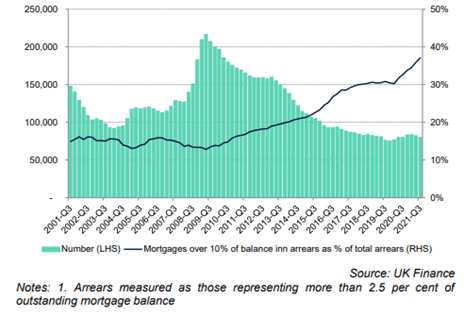
Heavier mortgage arrears increasing and risk of repossessions looms

At the moment most people are coping with their monthly mortgage repayments, but the signs are that those who are struggling are continuing to sink deeper. The furlough scheme has protected people from unemployment but now that has come to the end, the big question mark is what will happen in the labour market in the early part of 2022. If unemployment rises, then it’s inevitable that the big rises in mortgage arrears will become a big rise in repossessions. That will increase the supply of houses available on the market, which will result in downward pressure, as banks look to recoup their losses.

These three factors show that there is a real vulnerability in the UK economy from a household perspective. There is a lack of resiliency to people’s finances, which means that increases in either inflation or interest rates could set off a tailspin.

There’s still a lot of money in overdrafts

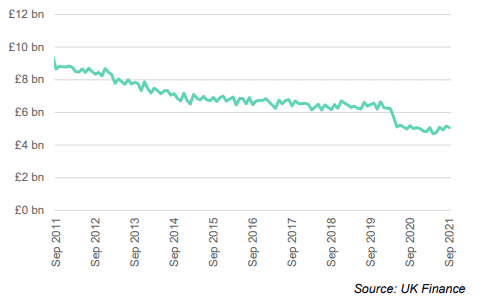
To underline this reality, take a look at overdraft balances. Although the market has restructured over time, and overdraft balances feel at the start of the first lockdown, lots of people are still entrenched in their overdraft, with well over £4bn being lent to UK consumers via this facility. UK Finance observe that this is likely a sign that there is no “increasing household financial stress”, recognising there is an inbuilt level of vulnerability within household finances.

Inflation will bite in 2022

There are growing concerns that higher inflation will be around for longer and it will eat into income growth. Interest rates were increased in November, and although the official line from the Bank of England was ‘wait and see’, if the inflationary pressures that are expected flow through into prices early next year, we will see more interest rate rises. This means that not only will day-to-day expenditures be more costly for consumers, but mortgages will become more expensive. 

The reality is that higher interest rates affect affordability and increase risk to mortgage lenders. Therefore, the amount they’re willing to offer you on a mortgage is reduced. This means there’s less money available in the market for buying houses and therefore demand is reduced, which softens prices.

Homeowners have been leveraging equity to fund purchases

The evidence says more and more people have been using the equity built up in their homes to finance the purchase of larger properties. This is likely to have contributed to the boom in 2021, as people took advantage of the Stamp Duty holiday to buy bigger properties than they otherwise would have been able to afford.

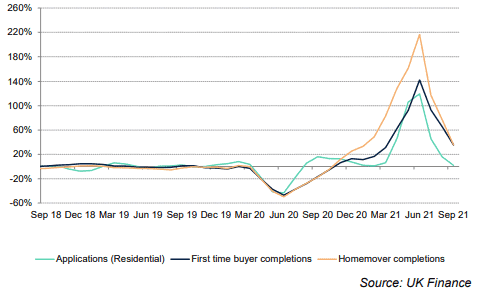
House purchases fell sharply after the Stamp Duty holiday

The three-month rolling average of applications and completions collapsed following the end of the Stamp Duty holiday in June. The chances are people brought forward purchases into the first half of 2021 so it’s likely activity will end up being even weaker in 2022, further reducing the upward pressure on house prices.

What does it all mean?

It’s likely that the increases we’ve seen in 2021 were a one-off and will not continue into 2022. We know that inflation will materialise and therefore stretch household incomes that are already vulnerable. The real threat is the labour market, as there are a lot of people out there with high levels of mortgage arrears. All in all, 2022 could be a tough year for the UK housing market.

5 ‘must-see’ mortgage tips to help save money…

The mortgage application process can seem overwhelming, and down-right unaffordable at times. So where do you start if you’re looking to save money on your mortgage?

We’ve created this free report, “5 must-see tips to save money on a mortgage” to help you learn where the money-saving opportunities may be…

Just enter your email below for instant access to your free copy.

Was this article helpful?

YesNo


Some offers on The Motley Fool UK site are from our partners — it’s how we make money and keep this site going. But does that impact our ratings? Nope. Our commitment is to you. If a product isn’t any good, our rating will reflect that, or we won’t list it at all. Also, while we aim to feature the best products available, we do not review every product on the market. Learn more here. The statements above are The Motley Fool’s alone and have not been provided or endorsed by bank advertisers. John Mackey, CEO of Whole Foods Market, an Amazon subsidiary, is a member of The Motley Fool’s board of directors. The Motley Fool UK has recommended Barclays, Hargreaves Lansdown, HSBC Holdings, Lloyds Banking Group, Mastercard, and Tesco.


Is Scottish Mortgage Investment Trust a no-brainer buy?

Scottish Mortgage Investment Trust (LSE: SMT) has been one of the best performing investments on the UK market over the past five years.

Thanks to the trust’s exposure to high-growth stocks such as Tesla, it has returned a staggering 300% over the past five years. By comparison, the FTSE All-Share Index has returned just 10% over the same time frame. Both of these figures exclude dividends paid to investors. 

5 Stocks For Trying To Build Wealth After 50

Markets around the world are reeling from the coronavirus pandemic… and with so many great companies trading at what look to be ‘discount-bin’ prices, now could be the time for savvy investors to snap up some potential bargains.

But whether you’re a newbie investor or a seasoned pro, deciding which stocks to add to your shopping list can be a daunting prospect during such unprecedented times.

Fortunately, The Motley Fool UK analyst team have short-listed five companies that they believe STILL boast significant long-term growth prospects despite the global upheaval…

We’re sharing the names in a special FREE investing report that you can download today. And if you’re 50 or over, we believe these stocks could be a great fit for any well-diversified portfolio.

Click here to claim your free copy now!

However, Scottish Mortgage Investment Trust has underperformed over the past six months. Since the beginning of July, the stock has lost 3% compared to a return of 5% for the FTSE All-Share Index, an underperformance of 8%. Once again, these figures exclude dividends. 

I think this could be an opportunity for risk-tolerant investors like myself to buy the trust at an attractive valuation. 

Scottish Mortgage Investment Trust falls out of favour

There has been a shift in market sentiment over the past six months. Investors have moved away from high-growth tech stocks and reinvested their cash in recovery plays. Growth stocks are out, and value stocks are in, even though many of these companies are struggling to recover. 

Scottish Mortgage Investment Trust has not been able to escape the pain. 

According to its latest factsheet, at the end of November, approximately 16% of its assets were invested in Moderna and ASML. Over the past month, Moderna has returned -12%. ASML has produced a positive return of 3%, but that is still below the FTSE All-Share return of 4%. 

These figures are only designed to illustrate the shift away from growth stocks that has affected the value of the trust during the past couple of weeks. 

But I think this shift is only likely to be temporary. Most of the companies in the trust’s portfolio are high-quality stocks. They have large profit margins and substantial economies of scale and competitive advantages. They may have fallen out of favour with the market, but their competitive advantages should translate into earnings growth in the long term. 

As share prices should track earnings growth in the long run, I think investors will likely return to these stocks at some point in the future. 

Growth opportunity

These are the main reasons I see Scottish Mortgage Investment Trust is a no-brainer buy for me today. The trust has a strong track record of picking growth companies, and this experience should help it find new businesses as we advance. At the same time, I think the market’s short-term mentality presents an opportunity for long-term investors like myself. 

That being said, there are some risks associated with the stock that I will be keeping in mind. Growth stocks are trading at elevated valuations, and therefore, they could continue to decline in value. These companies may also face disruption in the future, which could remove their competitive advantages. 

Nevertheless, even after taking these risks into account, I would be happy to buy the stock today. 

Is this little-known company the next ‘Monster’ IPO?

Right now, this ‘screaming BUY’ stock is trading at a steep discount from its IPO price, but it looks like the sky is the limit in the years ahead.

Because this North American company is the clear leader in its field which is estimated to be worth US$261 BILLION by 2025.

The Motley Fool UK analyst team has just published a comprehensive report that shows you exactly why we believe it has so much upside potential.

But I warn you, you’ll need to act quickly, given how fast this ‘Monster IPO’ is already moving.

Click here to see how you can get a copy of this report for yourself today


Rupert Hargreaves has no position in any of the shares mentioned. The Motley Fool UK has recommended ASML Holding. Views expressed on the companies mentioned in this article are those of the writer and therefore may differ from the official recommendations we make in our subscription services such as Share Advisor, Hidden Winners and Pro. Here at The Motley Fool we believe that considering a diverse range of insights makes us better investors.

Financial News

Daily News on Investing, Personal Finance, Markets, and more!

Financial News

Policy(Required)