20%+ dividend yield as this FTSE 100 share plunges! Should I buy right now?

I like high-yielding shares that can help me build my passive income streams. Many UK dividend shares offer low to mid-single digit percentage yields, although there are some double-digit yielders around. But after crashing 30% in trading today, one FTSE 100 share offers a 20%+ dividend yield right now!

Should I act and buy it for my portfolio?

5 Stocks For Trying To Build Wealth After 50

Markets around the world are reeling from the coronavirus pandemic… and with so many great companies trading at what look to be ‘discount-bin’ prices, now could be the time for savvy investors to snap up some potential bargains.

But whether you’re a newbie investor or a seasoned pro, deciding which stocks to add to your shopping list can be a daunting prospect during such unprecedented times.

Fortunately, The Motley Fool UK analyst team have short-listed five companies that they believe STILL boast significant long-term growth prospects despite the global upheaval…

We’re sharing the names in a special FREE investing report that you can download today. And if you’re 50 or over, we believe these stocks could be a great fit for any well-diversified portfolio.

Click here to claim your free copy now!

Mining giant

The share in question is miner Evraz (LSE: EVR). The steel producer is best known for its mines in Russia, but it does have operations in other countries including Ukraine and the US.

So, why has the market pummelled Evraz shares in today’s trading session? In short, mounting political concerns about Ukraine and Russia are hurting investor sentiment on the company. There are concerns that political developments could impede Evraz’ ability not only to produce steel but also to sell it on the world markets. Sellers have been offloading their Evraz positions, pushing its already unusually high yield up to an incredible 26%.

In other words, if I buy the shares now and the dividend remains at the current level then in just four years I will already have covered my purchase price. Anything else would be pure profit.

Is a 20%+ dividend yield sustainable?

The $64,000 question is contained in that little word “if”. Will Evraz maintain its dividend, making today’s price crash the buying opportunity of a lifetime for my portfolio? Or does the unbelievably high yield signal market expectations of tumbling profits leading to a dividend cut at the miner?

First, it is worth noting that Evraz does have a strong recent dividend history. Last year, it paid out 95c of dividends. Although that was almost double what it paid out the prior year, it was actually less than the total 2019 level. So, the current Evraz dividend amount is not an exceptional one-off, in my view. Like many mining companies, the dividend has moved up and down reflecting shifts in commodity prices and trading conditions. But it has paid dividends for the past five years in the row.

There is a lot of press speculation about political risks in Ukraine and what that could mean for the business of Evraz, given its strong Russian links. But that remains speculation. As a miner with experience in frontier markets, Evraz has a developed understanding of political risk, I think. That does not mean it is immune from any fallout of Russian foreign policy, such as economic sanctions. But it is an established miner and with high demand for steel, I expect it can continue to find end markets for its product.

I am tempted to buy – but am not

I am sorely tempted by the 20%+ dividend yield on offer, which might not last.

But I am an investor, not a trader. Even before today’s share price crash, Evraz had an attractive yield. But I had decided not to buy it for my portfolio, as it looked too risky for me. One concern I had is the risk that commodities markets will cool in the next few years, hurting revenues and profits at Evraz.

That risk remains, in my opinion. A higher yield would offer me more compensation for accepting it, but I remain uncomfortable with it. So I will not be adding Evraz to my portfolio.

FREE REPORT: Why this £5 stock could be set to surge

Are you on the lookout for UK growth stocks?

If so, get this FREE no-strings report now.

While it’s available: you’ll discover what we think is a top growth stock for the decade ahead.

And the performance of this company really is stunning.

In 2019, it returned £150million to shareholders through buybacks and dividends.

We believe its financial position is about as solid as anything we’ve seen.

  • Since 2016, annual revenues increased 31%
  • In March 2020, one of its senior directors LOADED UP on 25,000 shares – a position worth £90,259
  • Operating cash flow is up 47%. (Even its operating margins are rising every year!)

Quite simply, we believe it’s a fantastic Foolish growth pick.

What’s more, it deserves your attention today.

So please don’t wait another moment.

Get the full details on this £5 stock now – while your report is free.


Christopher Ruane has no position in any of the shares mentioned. The Motley Fool UK has no position in any of the shares mentioned. Views expressed on the companies mentioned in this article are those of the writer and therefore may differ from the official recommendations we make in our subscription services such as Share Advisor, Hidden Winners and Pro. Here at The Motley Fool we believe that considering a diverse range of insights makes us better investors.

Here’s the outlook for bitcoin as geopolitical tensions heat up and interest rates rise

Watch Daily: Monday – Friday, 3 PM ET
Artur Widak | NurPhoto | Getty Images

The bitcoin narrative could be tested this week as investors monitor tense developments between Ukraine and Russia and weigh the possibility of the Federal Reserve hiking interest rates by 50 basis points, or 0.5 percentage point, in March.

The largest cryptocurrency by market capital currency has long been regarded by early investors and enthusiasts as a safe haven asset – one that ideally could offset risk in investors’ portfolios and limit exposure to negative shocks.

However, in recent months bitcoin has has been trading like equities, specifically like riskier growth-oriented stocks. It’s still recovering from a big drop from earlier in the year, when rising rates led investors to shed positions in tech and other risky assets.

“Bitcoin is labeled by some as a stateless currency and it has indeed performed well in the past when there were geopolitical tensions, so we could expect some demand as a safe haven asset,” said Yuya Hasegawa, crypto market analyst at Japanese bitcoin exchange Bitbank.

However, “the change in the landscape made bitcoin fragile to the U.S. stock market volatility, so bitcoin investors may not be able to feel at ease until the situation at the Russia-Ukraine border starts to settle down,” he added.

Crypto winter for a few months

The price of bitcoin is about 10% down for the year, according to Coin Metrics, and about 38% from its November all-time high.

With a rising rate environment, tech and growth stocks could remain in a chokehold for a while. That means if this is crypto winter, a term that refers to an extended bearish period, it could last for several months more.

“If we are in a bear market we’ll see another eight or nine months of sideways to down [movement], which is an opportunity for the tourists to leave the market and the real players to continue building this technology,” said Chris King, CEO and founder of Eaglebrook Advisors.

Katie Stockton, founder of Fairlead Strategies, said a resistance level at $46,730 should remain intact this week. Support is near $37,360, but bitcoin doesn’t look in store for a near-term test, she added.

Seasoned crypto investors have been here before and are rarely spooked by extended low periods. Bitcoin has only experienced one crypto winter before: In 2018, its price crashed by about 80% from its then all-time high. The market has evolved significantly since then.

Setting the stage for the next bull market

Low periods are a time for the industry to clean up and build the infrastructure and applications that will make it easier for the next wave of newcomers in the next bull market. Between decentralized finance, non-fungible tokens, the metaverse and more, there’s plenty of interest in new sectors of crypto that go beyond bitcoin.

“Use cases in adoption are burgeoning,” said Rodrigo Vicuna, chief financial officer at Prime Trust. “We’re just beginning to scratch the surface of where a lot of blockchains are going.”

For example, interest – and money – in NFTs boomed in 2021. Most people still only see them as digital art, a concept that’s hard to grasp for many. People also overlook other potential uses for NFTs. For instance, an NFT of a house deed could provide a history of property ownership, while NFT medical records may offer patients a safe way to share information with doctors, Vicuna said.

King noted that despite new interest in decentralized finance, or DeFi, its still too early and underdeveloped for it to take off. DeFi allows users to participate in lending and other financial activities using blockchain and do so without any middlemen.

“We’re very long DeFi in some of our strategies,” King said as an example. “DeFi is still speculative. The infrastructure is still being built, it’s still clunky and hard to use. “Bitcoin in 2013 through 2016 was hard to buy, but companies like Coinbase and Gemini made it easier. DeFi needs that onramp to improve it and make it less speculative. It just takes time.”

With the bitcoin cycle lengthening and returns diminishing, these other assets play a big role in ushering new entrants into crypto broadly and increasing adoption. Bitcoin itself hasn’t found its killer app yet – that is, the feature that makes it indispensable – King said, but increasing adoption will get it there.

“The most important thing that we follow and look at both from a short and long-term perspective is adoption, it’s really all that matters,” King said. Like Facebook, Instagram and Uber, he said, “hype around these assets and the price going up led to more users joining the network, which is ultimately what we care about.”

I’d buy this share in a stock market crash

Nobody know what might happen next in stock markets but they are certainly on edge right now. Legendary investor Warren Buffett says to be greedy when others are fearful. There seems to be a lot of fear in markets currently. I have a shopping list of high-quality companies whose shares I would like to buy for my portfolio if there is a stock market crash.

One of them has already seen its price tumble in recent weeks. If it keeps heading down, I see a buying opportunity for my portfolio.

5 Stocks For Trying To Build Wealth After 50

Markets around the world are reeling from the coronavirus pandemic… and with so many great companies trading at what look to be ‘discount-bin’ prices, now could be the time for savvy investors to snap up some potential bargains.

But whether you’re a newbie investor or a seasoned pro, deciding which stocks to add to your shopping list can be a daunting prospect during such unprecedented times.

Fortunately, The Motley Fool UK analyst team have short-listed five companies that they believe STILL boast significant long-term growth prospects despite the global upheaval…

We’re sharing the names in a special FREE investing report that you can download today. And if you’re 50 or over, we believe these stocks could be a great fit for any well-diversified portfolio.

Click here to claim your free copy now!

Cause for alarm?

The share in question is Halma (LSE: HLMA). The company specialises in life-saving equipment like alarms. But lately the most alarming thing for the company’s shareholders may have been the decline in the Halma share price. It has tumbled over a quarter since the start of the year. Over the past 12 months, the decline has been a more modest 9%.

What’s behind the share price fall?

I think it has been driven by valuation concerns more than worries about the health of the underlying business. After all, at the interim stage in November, Halma reported revenue up 19% on the equivalent period the year before. Adjusted earnings per share rose 25% and the company increased its interim dividend by 7%.

The company has a profitable, established business in a lucrative niche. That has enabled it to increase its dividend annually for the past 43 years. That is rare among UK shares and gives an indication of the quality of Halma’s business. But such quality often does not come cheaply. In recent years, Halma’s shares had been looking more and more expensive. Even now, I think the price-to-earnings ratio of 34 looks expensive for my portfolio.

Cheaper but not cheap

The interim results were strong and Halma has a proven business model. But being a successful investor does not just involve spotting great companies. It is also about buying at the right price.

Despite the share price fall, I still do not see Halma shares as cheap. The price reflects ongoing high expectations for the business. But despite its proven ability, the company continues to face risks. It has said that ongoing disruption in its supply chain and the labour market could add costs. That may hurt profits.

My move in a stock market crash

Halma shares have already fallen significantly. If there is a stock market crash, they could head down further in line with the broad market. At that point, Halma shares may trade on a valuation that makes them an attractive addition to my portfolio.

So the alarm company is one of a number of shares on my shopping list. The names are all high-quality companies I would like to add to my holdings, at the right price. If there is a stock market crash, I am ready to swing into action like Buffett and start shopping for potential bargains.


Christopher Ruane has no position in any of the shares mentioned. The Motley Fool UK has recommended Halma. Views expressed on the companies mentioned in this article are those of the writer and therefore may differ from the official recommendations we make in our subscription services such as Share Advisor, Hidden Winners and Pro. Here at The Motley Fool we believe that considering a diverse range of insights makes us better investors.

Should I buy Lloyds shares for my portfolio?

Interest rates are rising. When interest rates go up, this can be good for bank stocks. I currently own shares of Citigroup (NYSE:C) in my portfolio. I’ve been thinking about adding shares in Lloyds Banking Group (LSE:LLOY) to capitalise on rising interest rates in the UK. With this in mind, I’ve been looking at how Lloyds and Citigroup compare as investments to see whether or not I should consider buying Lloyds shares.

Net interest margin

Net interest margin is the difference between the interest rate that a bank receives on its loans and the rate it pays on its deposits. I view this as one of the most important metrics when it comes to analysing bank stocks. A net interest margin above 2% is a good sign. Both Lloyds and Citigroup have net interest margins around 2.5%. Furthermore, both Lloyds and Citigroup have consistently maintained net interest margins in excess of 2% over the past few years. I think that both score equally well in this regard.

5 Stocks For Trying To Build Wealth After 50

Markets around the world are reeling from the coronavirus pandemic… and with so many great companies trading at what look to be ‘discount-bin’ prices, now could be the time for savvy investors to snap up some potential bargains.

But whether you’re a newbie investor or a seasoned pro, deciding which stocks to add to your shopping list can be a daunting prospect during such unprecedented times.

Fortunately, The Motley Fool UK analyst team have short-listed five companies that they believe STILL boast significant long-term growth prospects despite the global upheaval…

We’re sharing the names in a special FREE investing report that you can download today. And if you’re 50 or over, we believe these stocks could be a great fit for any well-diversified portfolio.

Click here to claim your free copy now!

Price-to-book

The book value of a company is the result of subtracting the company’s liabilities from its assets. When I analyse bank stocks, I like to look at how the book value of the company compares to the share price.  Shares in both Lloyds and Citigroup currently trade below their book value. At the time of writing, Lloyds shares trade at 73% of their book value, while Citigroup’s shares trade at 74% of their book value.

Geographic diversification

One difference between Lloyds and Citigroup is that the former is primarily concentrated in one area, where the other is more diversified geographically. With Lloyds, around 95% of the company’s asset base is located in the UK. Citigroup, on the other hand, has much more diverse geographic operations. This leaves Lloyds disproportionately exposed to the UK economy, which may or may not prove to be a good thing. Personally, I prefer Citigroup’s broader geographic footprint.

Loan risk

I think that one of the most significant sources of risk with bank stocks is the possibility of customers defaulting on loans, especially mortgages. When interest rates are rising, this risk is especially prevalent. In this regard, I think that Lloyds is quite attractive. The average Lloyds mortgage is only worth 63% of the asset that it is secured against. I think that this is encouraging. With Citigroup, their current restructuring makes this more difficult to assess. 

Overall, I think that Lloyds and Citigroup are similar propositions. Both are banks that I think are likely to be fairly steady low-risk investments. Where Citigroup has better diversification, Lloyds has a more visible protection against the threat of loan defaults. I think that there might be a place for both in my portfolio and so I’m planning on watching carefully for an opportunity to buy Lloyds shares.

Inflation Is Coming: 3 Shares To Try And Hedge Against Rising Prices

Make no mistake… inflation is coming.

Some people are running scared, but there’s one thing we believe we should avoid doing at all costs when inflation hits… and that’s doing nothing.

Money that just sits in the bank can often lose value each and every year. But to savvy savers and investors, where to consider putting their money is the million-dollar question.

That’s why we’ve put together a brand-new special report that uncovers 3 of our top UK and US share ideas to try and best hedge against inflation…

…because no matter what the economy is doing, a savvy investor will want their money working for them, inflation or not!

Best of all, we’re giving this report away completely FREE today!

Simply click here, enter your email address, and we’ll send it to you right away.


Stephen Wright owns shares of Citigroup. The Motley Fool UK has recommended Lloyds Banking Group. Views expressed on the companies mentioned in this article are those of the writer and therefore may differ from the official recommendations we make in our subscription services such as Share Advisor, Hidden Winners and Pro. Here at The Motley Fool we believe that considering a diverse range of insights makes us better investors.

Here’s 1 of my best ETF picks right now!

Key points

  • US inflation is at a record high and could result in faster and steeper interest rate rises
  • This might be good for the profits of banks and insurance companies
  • A financial services ETF can be used to invest in a large number of these firms by holding a single share

As US inflation reaches its highest level in 40 years, some market analysts think that the US Federal Reserve might have to raise interest rates sooner and more aggressively than first thought. Against this backdrop, this fund, focussed on US banks and insurance companies, is one of my best exchange-traded fund (ETF) picks right now.

How financial institutions can benefit

These firms in the finance sector are usually sitting on lots of cash from depositors and from their other business activities. They earn money from taking these funds and either lending them out or investing them.

5 Stocks For Trying To Build Wealth After 50

Markets around the world are reeling from the coronavirus pandemic… and with so many great companies trading at what look to be ‘discount-bin’ prices, now could be the time for savvy investors to snap up some potential bargains.

But whether you’re a newbie investor or a seasoned pro, deciding which stocks to add to your shopping list can be a daunting prospect during such unprecedented times.

Fortunately, The Motley Fool UK analyst team have short-listed five companies that they believe STILL boast significant long-term growth prospects despite the global upheaval…

We’re sharing the names in a special FREE investing report that you can download today. And if you’re 50 or over, we believe these stocks could be a great fit for any well-diversified portfolio.

Click here to claim your free copy now!

When interest rates rise, they can benefit in two ways.

First, banks can charge more on loans and mortgages, but don’t usually pay savers much more interest. This means their profits should rise as they collect more money from borrowers than they have to pay depositors. Additionally, higher interest rates tend to reflect a period of greater economic growth. A stronger economy might mean that more consumers seek loans.

Second, financial companies can make more money from investments, such as short-term government debt. US banks tend to invest in Treasury bills (short-term US government debt) and these will now pay more.

A best ETF pick

The ETF I’m looking at is iShares S&P 500 Financials Sector (LSE:UIFS). This fund aims to track the performance of the S&P 500 Capped 35/20 Financials Index. At present this contains 67 holdings, representing the largest US financial services firms.

The largest holding at just under 13% is Berkshire Hathaway. Warren Buffett’s company holds large cash reserves, has sizeable holdings in other banks, and most importantly has a huge insurance business generating massive inflows of money in the form of customer premiums. The second and third largest holdings are JP Morgan Chase and Bank of America, at around 10% and 8% respectively. Both of these are multinational investment banks and financial services companies. 

Over the last 12 months, this fund has performed strongly, increasing over 30%. However, year-to-date performance has been subdued. Because of the general pullback in the financial markets this year, at the time of writing, this ETF is pretty much flat.

This serves as a note of caution for me. Though increasing US interest rates could be bullish for these companies, this fund is not immune to the normal up and downs of the stock market. After all, in investing, nothing is guaranteed.

However, historically periods of increasing interest rates have generally been positive for financial services and that’s why iShares S&P 500 Financials Sector is one of my best ETF picks right now. For this reason, I’m seriously considering adding this fund to my holdings as part of a balanced portfolio.


Niki Jerath has no position in any of the shares mentioned. JPMorgan Chase is an advertising partner of The Ascent, a Motley Fool company. Bank of America is an advertising partner of The Ascent, a Motley Fool company. The Motley Fool UK has no position in any of the shares mentioned. Views expressed on the companies mentioned in this article are those of the writer and therefore may differ from the official recommendations we make in our subscription services such as Share Advisor, Hidden Winners and Pro. Here at The Motley Fool we believe that considering a diverse range of insights makes us better investors.

2 simple Warren Buffett techniques I use to try and boost my ISA returns

The famous investor Warren Buffett uses a lot of simple but effective investment techniques to improve his likelihood of success.

Here are two Buffett approaches I use to try and improve the returns of shares in my ISA.

5 Stocks For Trying To Build Wealth After 50

Markets around the world are reeling from the coronavirus pandemic… and with so many great companies trading at what look to be ‘discount-bin’ prices, now could be the time for savvy investors to snap up some potential bargains.

But whether you’re a newbie investor or a seasoned pro, deciding which stocks to add to your shopping list can be a daunting prospect during such unprecedented times.

Fortunately, The Motley Fool UK analyst team have short-listed five companies that they believe STILL boast significant long-term growth prospects despite the global upheaval…

We’re sharing the names in a special FREE investing report that you can download today. And if you’re 50 or over, we believe these stocks could be a great fit for any well-diversified portfolio.

Click here to claim your free copy now!

Focus on long-term advantage

Buffett has a laser focus on the question of what sort of long-term advantage a company can enjoy from its business model. Take as an example his ownership of the Burlington Northern and Santa Fe Railway. This is the largest freight railway in North America. The prohibitive cost of building a railway network means no one else is likely to replicate it. But demand to move freight across the US and beyond will remain high for decades to come, if not centuries. So the railway has exactly the sort of long-term profit generating potential Buffett looks for when it comes to buying businesses.

I think the same sort of long-term focus on a business’s ability to generate profits could help me pick better performing shares for my ISA. For example, one of the reasons I do not own detergent maker McBride is because its manufacturing model puts it close to being in a commodity market. There are costs and knowledge required to set up and run a detergent factory, so McBride does have some competitive advantage – but I see it as a thin one. By contrast, companies such as Reckitt or Unilever own iconic brands no competitor can exactly match. That gives them an enduring source of pricing power, which can translate into higher profits.

Profits today not just prospects tomorrow

Another part of Warren Buffett’s investment approach is his focus on companies that have already shown their cash generation potential. Buffett’s investments, no matter how they are doing when he buys them, have all demonstrated at some point an ability to generate business profits. Buffett does not invest in companies that have consistently lost money throughout their history in the hope that in future they will find some magic formula for profitability.

That is one reason I do not own loss-making companies like ITM Power in my ISA. Sure, ITM has some promising technology that could turn out to be profitable in future. But so far, it has not. By contrast, other companies in the power generation and distribution space already have proven business models to make profits.

For example, power distributor National Grid is profitable and its existing network gives it the sort of competitive advantage Buffett loves, much like the railway he owns. So while I would not buy ITM Power for my ISA, I would consider purchasing National Grid. High network maintenance costs could yet eat into profits at National Grid. That sort of risk is exactly why I always diversify my ISA across different companies.

Warren Buffett and ISA returns

Individual shares can do well in the short term for all sorts of reasons.

But in the long term, I think Buffett’s method of identifying promising investments makes sense for me. Not only by buying shares in good companies, but also by avoiding stocks that seem promising but end up disappointing investors, I hope that over time I can boost my ISA returns.

Christopher Ruane owns shares in Unilever. The Motley Fool UK has recommended Reckitt plc and Unilever. Views expressed on the companies mentioned in this article are those of the writer and therefore may differ from the official recommendations we make in our subscription services such as Share Advisor, Hidden Winners and Pro. Here at The Motley Fool we believe that considering a diverse range of insights makes us better investors.

How I would invest £20,000 in UK dividend shares

If I had £20,000 to invest in UK dividend shares today, this is how I would do it.

Rule 1: focus on quality

One common mistake I would want to avoid is just chasing a high dividend yield regardless of the underlying business prospects.

5 Stocks For Trying To Build Wealth After 50

Markets around the world are reeling from the coronavirus pandemic… and with so many great companies trading at what look to be ‘discount-bin’ prices, now could be the time for savvy investors to snap up some potential bargains.

But whether you’re a newbie investor or a seasoned pro, deciding which stocks to add to your shopping list can be a daunting prospect during such unprecedented times.

Fortunately, The Motley Fool UK analyst team have short-listed five companies that they believe STILL boast significant long-term growth prospects despite the global upheaval…

We’re sharing the names in a special FREE investing report that you can download today. And if you’re 50 or over, we believe these stocks could be a great fit for any well-diversified portfolio.

Click here to claim your free copy now!

I think that puts miners like Ferrexpo and Evraz out of the picture for my portfolio despite their double-digit yields. That is because I see risks to their future earnings and dividends. Those risks exist because I think metal prices are at a high point in their cycle. On top of that, those two miners both face political risks from their operations in Ukraine.

Rule 2: spread the money

One can have too much of a good thing – and that is true in the stock market too. No matter how good a company may be, it can run into unexpected problems. So I would diversify across different companies and business sectors.

With £20,000, I would easily have enough money to let me diversify. I would put £2,500 into each of the eight shares below.

Financial services

I would start by investing in two financial services companies. Asset manager M&G yields 8.7%. I like its established reputation, which can help attract new customers. Insurer Legal & General benefits from a similarly strong brand. It pays a 6.5% yield. One risk with financial services companies is any economic downturn could lead customers to shop around for lower fees. That could hurt profit margins.

Consumer goods

I like both Surf manufacturer Unilever and retailer Tesco. They offer a 3.8% and 3% yield respectively. I expect demand for consumer goods to be resilient. Both companies enjoy strong positions in their markets. That could hopefully translate into ongoing profits, though those may be hurt by high logistics costs.

Tobacco

Last week’s results at British American Tobacco showed that it is possible to make big profits even as many cigarette smokers give up the habit. That financial dynamic translates into a substantial dividend, both at the company and its competitor Imperial Brands. I would buy both for my portfolio, recognising that declining cigarette use could well end up hurting revenues and profits.

Energy

With high energy prices, now can be a profitable time to sell oil or gas. Things may not look so rosy if prices fall and profits follow. But whatever the pricing, I see long-term sustained demand for energy so would consider a couple of such companies for my dividend portfolio. First would be BP. The energy major yields 4.0% currently. I would also buy Diversified Energy. Its unusual model of buying up aging wells carries the risks of cleanup costs eating into profits. But I think that is reflected in its hefty 10.3% yield.

Building a portfolio of UK dividend shares

If I invested £20,000 evenly across these eight shares, I would hopefully be looking at annual passive income of around £1,260.

Dividends are never guaranteed, but my risk should be reduced through the diversification I have used. Having bought the shares, I could then sit back and let others do the hard work while, hopefully, my dividend income begins to mount up.

FREE REPORT: Why this £5 stock could be set to surge

Are you on the lookout for UK growth stocks?

If so, get this FREE no-strings report now.

While it’s available: you’ll discover what we think is a top growth stock for the decade ahead.

And the performance of this company really is stunning.

In 2019, it returned £150million to shareholders through buybacks and dividends.

We believe its financial position is about as solid as anything we’ve seen.

  • Since 2016, annual revenues increased 31%
  • In March 2020, one of its senior directors LOADED UP on 25,000 shares – a position worth £90,259
  • Operating cash flow is up 47%. (Even its operating margins are rising every year!)

Quite simply, we believe it’s a fantastic Foolish growth pick.

What’s more, it deserves your attention today.

So please don’t wait another moment.

Get the full details on this £5 stock now – while your report is free.


Christopher Ruane owns shares in British American Tobacco, Imperial Brands and Unilever. The Motley Fool UK has recommended British American Tobacco, Imperial Brands, Tesco, and Unilever. Views expressed on the companies mentioned in this article are those of the writer and therefore may differ from the official recommendations we make in our subscription services such as Share Advisor, Hidden Winners and Pro. Here at The Motley Fool we believe that considering a diverse range of insights makes us better investors.

What is up with the Peloton stock price?

The Peloton (NASDAQ:PTON) stock price is down 77% from its December 2020 all-time high. Over the last two years, the company has lost about $35bn in market capitalisation. The recent poor performance of Peloton might come as a surprise, as it was, at least initially, a pandemic success story.

Figure 1. Interactive Peloton Stock Price Chart

Peloton supplies high-end stationary bikes and treadmills. A monthly household subscription, which costs $39, transforms the equipment into an interactive fitness platform. Subscribers access live classes to fit their schedule, activity tracking, leaderboard competitions, and connection with other members. No Peloton hardware is required to subscribe to the Peloton app for $12.99 per month, but the features are less extensive.

5 Stocks For Trying To Build Wealth After 50

Markets around the world are reeling from the coronavirus pandemic… and with so many great companies trading at what look to be ‘discount-bin’ prices, now could be the time for savvy investors to snap up some potential bargains.

But whether you’re a newbie investor or a seasoned pro, deciding which stocks to add to your shopping list can be a daunting prospect during such unprecedented times.

Fortunately, The Motley Fool UK analyst team have short-listed five companies that they believe STILL boast significant long-term growth prospects despite the global upheaval…

We’re sharing the names in a special FREE investing report that you can download today. And if you’re 50 or over, we believe these stocks could be a great fit for any well-diversified portfolio.

Click here to claim your free copy now!

Pelotons bikes and treadmills cost anywhere between $1,745 and $2,845, including delivery and set-up. This also includes a recent price hike, which the company blamed on inflation and supply-chain issues. At those costs, I was sceptical. However, during 2020, as gyms closed, Peloton bikes flew off the shelves. Revenues doubled in the 2020 fiscal year and more than doubled the year after.

Table 1. Selected annual income statement items (in USD) and ratios for Peloton.

  29/06/2018 29/06/2019 29/06/2020 29/06/2021
Total Revenue 435,000 915,000 1,825,900 4,021,900
Gross Profit 189,000 383,600 836,700 1,452,000
Operating Income (47,600) (202,200) (917,600) (187,900)
Net Income (47,900) (195,600) (71,600) (189,000)
Gross Profit Margin 43.4% 41.9% 45.8% 36.1%
Operating Profit Margin -10.9% -22.1% -50.3% -4.7%
Net Income Margin -11.0% -21.4 -3.9% -4.7%

Source: Peloton 10-K forms

As a percentage of revenue, operating and net income losses narrowed in 2021. Peloton continued to add subscriptions throughout the 2021 fiscal year, bettering its 2020 performance on this metric. It appears existing customers are sticking with the monthly subscription even as gyms reopen. Peloton products are expensive. That might motivate people to keep using them. Peloton has been clever with its marketing in placing bikes and treadmills as centrepieces in the home. They are high-quality items that people want to display and not stick in the garage.

Post-pandemic Peloton

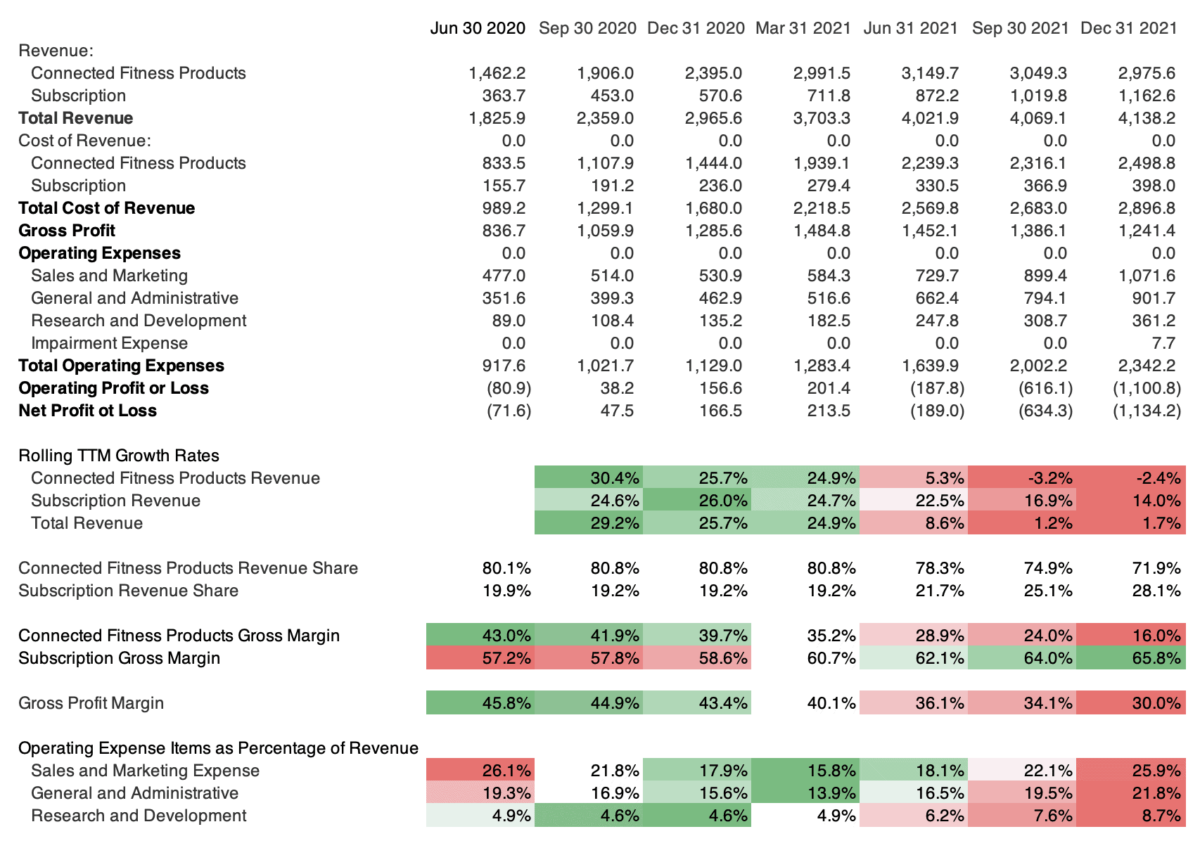
Choosing Peloton when other options are unavailable is one thing. The company is marketing to the converted. When gyms are open, a different strategy has to be employed. It would appear that Peloton management failed to notice this. A scathing presentation by Blackwells Capital lays the blame at the door of Peloton’s CEO. Looking at rolling trailing 12-month income statements reveals that Peloton’s financial performance started to deteriorate in early 2021. People spent less time and money on Pelton’s equipment as the world began to open up. However, the company was forecasting increasing demand, and inventories were building even as growth rates slowed. There were also product recalls after reports of serious incidents caused by Peloton equipment, which the company handled poorly.

Table 2. Rolling Trailing 12-Month Income Statements for Peloton (all figures in millions of USD)

Source: Peloton 10-Q forms

Last week, Peloton’s under-fire CEO was replaced, although he will remain as executive chairman. At the same time, the company rolled back its forecasts for the 2022 fiscal year and laid off 2,800 staff, which is consistent with an outfit that had scaled its operations and expectations too far.

Existing shareholders seem satisfied with the change of direction as the share price rose to 25% in response. Will it rise more? Well, Amazon and Nike are suggested to be interested in acquiring the business. Any offer would likely move the Peloton stock price higher. Aside from an acquisition, the company and its new CEO will have to get revenue growing again. After all, Peloton is priced for growth, so investors will want to see it.


James J. McCombie does not own shares in any of the companies mentioned in the article.  The Motley Fool UK has recommended Peloton Interactive. Views expressed on the companies mentioned in this article are those of the writer and therefore may differ from the official recommendations we make in our subscription services such as Share Advisor, Hidden Winners and Pro. Here at The Motley Fool we believe that considering a diverse range of insights makes us better investors.
Premium Bonds jackpot has dropped by 50%! Is now a good time to invest?

Image source: Getty Images


Premium Bonds are an investment product supported by the NS&I in which investors are entered into a monthly prize draw to win a jackpot. The jackpot is famous for turning regular savers into millionaires overnight. However, this fantastic prize has lost significant value over the past few years.

Here’s how inflation has slashed the Premium Bonds jackpot over time and whether now is a good time to invest in the savings account.

Has inflation cut the Premium Bonds jackpot?

The first Premium Bonds million-pound jackpot was won in 1994. Since that time, the cost of living in the UK has doubled as a result of inflation. Therefore, £1 million in 1994 is only worth around £500,000 now.

The Premium Bonds jackpot has not risen with inflation. If it had, the jackpot would now be £2 million, which is worth the same as £1 million was back in the 90s! As a result, it could be argued that the Premium Bonds jackpot is only worth 50% of its original value.

There are currently over 21 million Premium Bonds accounts held in the UK. However, with inflation continuing to rise, are Premium Bonds still a good investment in 2022?

Should you open a Premium Bonds account in 2022?

Premium Bonds savings accounts work differently from regular savings accounts. Instead of earning interest on your savings, account holders are entered into a monthly prize draw. As a result, account holders are given the chance to win between £25 and £1 million tax-free!

The jackpot prize was created in 1994 when inflation was significantly lower. Due to this, £1 million isn’t as valuable as it was when the savings account was created. However, lucky winners could still win enough money to buy a house in the UK!

Nonetheless, only one account holder will win a cash prize each month. For those who don’t win, the value of your savings will remain the same. Unlike other savings accounts, Premium Bond savings do not earn interest or dividends. Therefore, if you’re looking to increase the value of your savings steadily each month, Premium Bonds may not be the best option for you.

However, those who do choose to invest have the chance of winning life-saving money!

What other savings account options are there?

If you would prefer to gradually increase the value of your savings over time, it may be worth considering other savings account options. While a Premium Bond account could reward you with a lump sum of extra cash, high-interest savings accounts are a guaranteed way to build wealth for the future.

Here are some savings accounts that offer excellent interest rates that you could consider for your savings.

1. M&S Bank Monthly Saver

The M&S Monthly Saver offers a competitive 2.75% interest rate. Furthermore, you can open an account for as little as £25! The account offers easy access to savings, making it a great option for short-term savings.

2. Paragon 3-year fixed-rate bond

If you are able to stash your savings away for three years, the Paragon 3-year fixed-rate bond could be an excellent option. This savings account offers a 1.55% interest rate and you can deposit up to £1 million! The minimum deposit to open an account is £1,000.

3. HSBC Regular savings account

The HSBC Regular Savings account is a great account for anyone who is able to make monthly contributions. The account has a 1% interest rate and allows users to save between £25 and £250 each month. You can hold up to £3,000 in the account and can withdraw your money after 12 months.

You can find more excellent savings accounts in our list of top-rated savings accounts for 2022.

Please note that tax treatment depends on the individual circumstances of each individual and may be subject to future change. The content of this article is provided for information purposes only. It is not intended to be, nor does it constitute, any form of tax advice. Readers are responsible for carrying out their own due diligence and for obtaining professional advice before making any investment decisions.

Was this article helpful?

YesNo


Some offers on The Motley Fool UK site are from our partners — it’s how we make money and keep this site going. But does that impact our ratings? Nope. Our commitment is to you. If a product isn’t any good, our rating will reflect that, or we won’t list it at all. Also, while we aim to feature the best products available, we do not review every product on the market. Learn more here. The statements above are The Motley Fool’s alone and have not been provided or endorsed by bank advertisers. John Mackey, CEO of Whole Foods Market, an Amazon subsidiary, is a member of The Motley Fool’s board of directors. The Motley Fool UK has recommended Barclays, Hargreaves Lansdown, HSBC Holdings, Lloyds Banking Group, Mastercard, and Tesco.


Financial News

Daily News on Investing, Personal Finance, Markets, and more!

Financial News

Policy(Required)