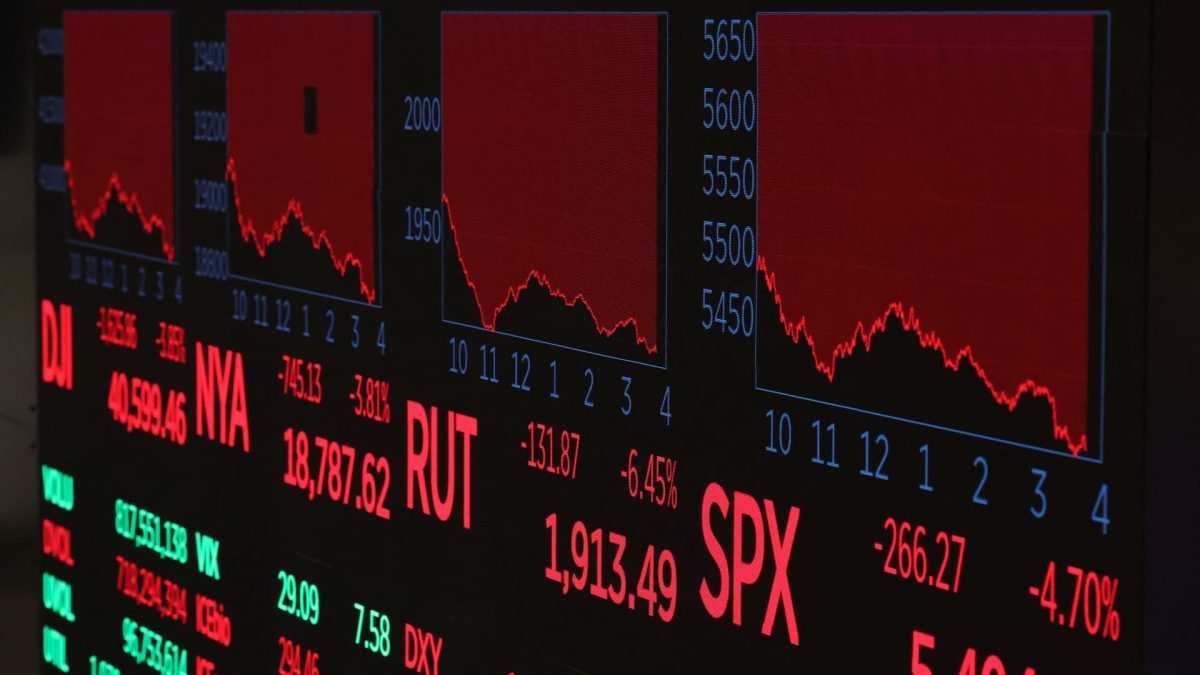
It’s been a crazy week on global stock markets. The FTSE 250 Index fell 9% in recent days to sit as low as 17,890 points but recovered strongly after US President Donald Trump’s tariff pause to sit at 18,570 as I write on April 11.
The market moves caused by the ‘Liberation Day’ tariff announcements mean many companies making up the UK mid-cap index have suffered sharp share price falls — and one online retailer in particular has caught my eye.
Beaten down FTSE 250 retailer
ASOS (LSE: ASC) is the company in question. The online retailer has seen its share price plummet 37% since the start of the year to 274p per share as I write.
The company’s market cap is sitting around £327m — a far cry from the £530m valuation held as recently as December. So, what’s put the company’s share price under so much pressure?
Fierce competition
Online fast-fashion is a tough business. The FTSE 250 company built its success on rapidly producing fashion garments for consumers but the nature of the game can quickly change.
One big factor weighing on the company’s share price of late is the explosion in popularity of other, lower-cost fast-fashion e-tailers such as Shein. Higher cost-of-living pressures are also a factor as consumers watch their purses a little more closely.
This has hurt sales and profitability, with the company’s revenue falling 18.1% in 2024 to £2.9bn as sales declined across all geographies.
Operating losses also widened by 33% during the year from £248.5m in 2023 to £331.9m last year. I wouldn’t expect to see any dividends from the online retailer any time soon.
The share price has been under pressure in recent days as investors weigh the impact of proposed tariffs on China — a key part of ASOS’s supply chain.
To buy or not to buy?
You may have heard the phrase: “Don’t try to catch a falling knife”. This is when investors try to buy the dip in a falling share price, only for it to fall further and cause more losses.
The company’s share price was already under significant pressure before the tariff announcements. Fierce competition in a consumer-facing industry makes ASOS a tricky stock to value at present.
However, if the company can implement cost-cutting measures and boost profitability, I think it could turn things around. Online retailing is a fast-moving game, and the ability to spot trends and maintain a low-cost and agile operating model is key.
There’s also the chance that the company could be a beneficiary if it can navigate the impact of the tariffs by shifting production and focusing on key growth markets.
One other potential carrot dangling in front of investors is the company’s rumoured status as a takeover target which could attract a premium bid from potential suitors.
My verdict
I personally think the challenges facing the company outweigh the potential opportunities. While the recent share price declines has pushed ASOS’s valuation lower, opportunities in non-cyclical industries like pharmaceuticals are of higher priority for me at present.
It could be one to keep on the watchlist and revisit once the valuation has stabilised and there are signs of a clear pathway to recover sales and profitability in the future.
In today’s tumultuous economic environment, building a second income is more important than ever. Markets are in turmoil, politics are getting heated and the future is uncertain at best.
When looking at some of the political developments unfolding this week, it’s hard to be positive about the future. Having a financial safety net may soon become a necessity — not just a luxury.
But passively sitting back and waiting for it to happen won’t help. What I really need is my money passively sitting in an investment account and paying me dividends.
So how can that happen?
For many, the idea of extra earnings conjures thoughts of side hustles, freelancing, or part-time work. But I think one of the easiest ways to grow a second income is through investing in quality stocks.
And the good news? Getting started doesn’t require a small fortune.
The power of compounding dividends
Investors looking to build passive income often turn to dividend shares as the first port of call. These are companies that pay out a portion of their profits to shareholders on a regular basis — often quarterly or annually.
Let’s say an investor puts just £200 a month into a portfolio of dividend-paying shares. That might not sound like much, but thanks to compounding — reinvesting dividends to buy more shares — it can snowball over time. Assuming a realistic 7% annual return from high-yielding stocks, that regular investment could grow to over £34,000 in 10 years. Stretch that out to 25 years and it could balloon to over £160,000.
At that point, withdrawing the dividends would give the investor almost £1,000 a month of passive income. Sure, today’s economic issues may be long gone in 25 years. But some of the wealthiest income investors of today probably started their journey after the dot-com bubble burst in 2000.
History has a tendency to repeat itself so no matter how long it takes, it’s never a bad time to start.
Shares to consider
Well-established FTSE 100 companies like Legal & General (LSE: LGEN), Unilever,and Phoenix Group have a strong track record of paying reliable dividends. By building a diversified portfolio of such companies, it’s possible to earn regular payouts that can either be reinvested or taken as income.
Take Legal & General, for example. It’s one of the UK’s largest financial services firms, providing pensions, insurance, and investment management. Crucially, for income investors, it offers an attractive dividend yield — currently hovering around 9% — and has a strong track record of returning cash to shareholders.
One big advantage is the company’s stable, cash-generative business model. It benefits from long-term trends like ageing populations, which drive demand for retirement products and life insurance. It also has a sizeable investment management arm, which adds an element of diversification.
However, there are some drawbacks. It operates in a highly regulated industry, which can limit flexibility and lead to higher expenses for compliance. It’s also sensitive to interest rates and market volatility, both of which can impact asset values and customer behaviour.
When it comes to building a second income through dividends, investors must weigh up the risks and benefits. Compared to other options, I find this simple approach attractive — but only for those with patience and a long-term outlook.
The ‘Magnificent 7’ stocks have bounced off their lows. When Donald Trump announced a 90-day pause on tariffs earlier this week, share prices in this area of the stock market jumped. The thing is, many of these growth stocks are still well below their highs and currently ‘on sale’. With that in mind, here are two Mag 7 stocks that I believe are worth considering today.
A ‘generational’ buying opportunity?
First up is Nvidia (NASDAQ: NVDA). It’s currently trading for around $108, roughly 29% below its all-time high of $153.
This stock looks really cheap right now. At present, it sports a price-to-earnings (P/E) ratio of 25.
That’s low relative to the company’s earnings growth. This year, Nvidia’s earnings are expected to jump 52%, so the price-to-earnings-to-growth (PEG) ratio is only 0.48 (a ratio below one typically signals that there’s value on offer).
It’s worth noting that one well-known Wall Street analyst recently stated that Nvidia is offering a ‘generational’ buying opportunity at the moment. This analyst’s view was that trillions of dollars are going to be spent on artificial intelligence (AI) in the next few years, and that Nvidia – which develops AI chips – will be one of the primary beneficiaries of this spending.
I agree that a lot of money will be spent on AI. Recently, Google-owner Alphabet (NASDAQ: GOOG) said that it’s going to spend $75bn this year alone.
Of course, a global recession could change the outlook here. This would most likely result in companies spending less on technology in the medium term.
Taking a five-year view, however, I think this stock has a lot of potential. After all, AI is most likely here to stay.
The cheapest Mag 7 stock
Speaking of Alphabet, I think this Mag 7 stock is worth considering too at current levels. It’s trading for around $155 – about 26% below its all-time high of $209.
This is another stock that looks cheap. In fact, it’s the cheapest among the Mag 7.
Currently, the forward-looking P/E ratio is just 18. This falls to 15.8 using next year’s earnings forecast.
These multiples strike me as a great value. This is a company that operates in many growth industries including digital advertising, AI, cloud computing, self-driving cars, and streaming (it owns YouTube), so it has a lot of long-term potential.
That said, there are a few risks to be aware of. One is disruption to its search business from ChatGPT. For 20 years, Google pretty much had a monopoly on search. However, the way we look for information is now changing rapidly due to generative AI.
Another risk is economic weakness. This would most likely result in less advertising spending globally, which would hurt Google’s and YouTube’s revenues.
Weighing up the risks with the potential rewards though, I like the set-up. I think this stock has the potential to generate solid returns in the years ahead.
One UK stock after another in my portfolio has tumbled in the last few turbulent days but investment company 3i Group (LSE: III) has held the line.
It’s down just 6% over the last month, which I think is pretty decent, given the chaos caused by Donald Trump’s tariff threats.
Look back a little further, and it’s frankly magnificent. The shares are up 30% in the past 12 turbulent months, and a staggering 365% over five years. That makes them second only to Rolls-Royce.
Can this FTSE 100 star keep shining?
The FTSE 100-listed private equity specialist never really attracts much attention from private investors. That’s their loss. I’m thrilled I took a chance on it.
Yet in recent months, I’ve been having debating whether to bank some of my profits. After its winning streak, it’s now the biggest individual stock in my self-invested personal pension (SIPP), making up more than 10% of the total. So what’s the issue?
A huge chunk of 3i’s success comes from just one company, European discount retail chain Action, which it bought in 2011. Back then, Action had just 250 stores.
Today, it’s closer to 3,000 and 3i reckons it can increase that to 4,850 locations. It’s been a powerhouse, with sales up another 22% last year to €13.78bn and operating earnings climbing 29% to €2.08bn.
But nothing grows forever, and I do worry what happens if Action starts to slow down, even a little. It would hardly be surprising, given the fragile state of the European economy. Although maybe being a discounter helps.
Action now accounts for around three-quarters of 3i’s total assets, so it really is carrying the show. The board says the rest of its holdings are “resilient”. That’s fine in today’s challenging times, but hardly thrilling.
Low yield but bags of growth potential
Another worry is the price. The investment company trades at a whopping premium of 45% to the value of its net underlying assets, which would normally scare the beans out of me. But when the business is this strong, maybe that’s fair.
The 1.8% yield is nothing special, but it’s covered more than eight times by earnings. So there’s room to grow. And if 3i ever decides to cash in its Action stake, shareholders could be in for a treat.
The analysts are still upbeat. Of the nine offering a 12-month forecasts, the median target is 4,361p. That’s about a 12% lift from today’s price. Not spectacular, but respectable. Of course, these days forecasts are even more guesswork than they were.
Still, out of 10 brokers, seven say Strong Buy, two say Buy, and just one sits on the fence. No one’s calling it a Sell, which says something.
So despite the concentration risk and the premium price tag, I’m sticking with it.
What I thought was a risky stock barely flinched during recent stock market volatility, and given that its track record stretches back to 1945, there may be a good reason for that. Investors considering 3i must look past its stellar past performance though. Sheer size means Action simply can’t keep growing at the same speed, but like those analysts, I’m not selling.
After falling sharply following ‘Liberation Day’ announcements, the stock market has been surging after news of a 90-day pause. But what happens after that?
As things stand, the tariffs that sent share prices down sharply are set to return. So investors need to think about what to do to prepare themselves and their portfolios.
The current situation
Where the stock market goes in July depends in large part on how negotiations between the US and its trading partners go between now and then. And investors have a few options available.
One approach is to wait and see if share prices fall again, presenting another chance to buy at a discount. The trouble is, if negotiations go well, this might not happen.
An alternative strategy is to buy while the market’s rising and look to take advantage of the recent momentum. But if negotiations go badly, this might prove to be a mistake.
Attempting to predict what might happen over the next 90 days looks very risky. Fortunately, I don’t think this is the most important thing for investors to consider right now.
Long-term investing
Ultimately, what investors need to focus on is how much cash a company is going to generate. And while tariffs are an important part of this, they’re not the only thing that matters.
Diageo (LSE:DGE) – a stock I’ve been buying recently – is a good example. Its biggest-selling product is Johnnie Walker – a scotch whisky – which means tariffs are a genuine risk.
Unlike Apple or Nike, Diageo can’t start producing scotch whisky in a different country. So it’s going to have to work around whatever the trade agreement between the UK and the US is.
Investors need to account for this, but it’s not the most important thing. Things like the company’s market position and long-term trends in alcohol consumption matter much more.
Outlook
I think Diageo shareholders have a lot to be positive about. Younger consumers might be spending less on alcohol, but the spirits category has been relatively resilient.
On top of this, the firm’s competitive advantages are still firmly in place. One of these is the scale of its distribution network, which puts it in a position to acquire smaller competitors.
A good example is Casamigos – the tequila brand founded by George Clooney. Diageo paid around $1bn for the business, which is a lot, but it’s an investment that’s worked out well.
While the company retains its ability to make deals like this successfully, I think it looks like an attractive stock. And this is what investors need to focus on.
Tariffs
If trade negotiations go badly, the stock market could crash in July. But investors should think about what this means for corporate profits, rather than share prices.
The Diageo share price has gone from £20.55 to £19.17 and back to £20.82 over the last week. There might be more volatility on the way, but I think the long-term outlook’s positive.
The company does business in around 180 countries, so it’s no stranger to import taxes. While the outlook for the share price might be unclear, I like it for myself and see it as a long-term investment for others to consider.
Investing in Stocks and Shares ISAs can be a powerful way to build wealth and achieve millionaire status over time. And one of the most important tools in an investor’s arsenal is diversification. Diversification helps mitigate risk by spreading investments across a range of asset classes, sectors, and geographies. Rather than relying on the performance of a single company or industry, a well-diversified portfolio balances exposure so that losses in one area can potentially be offset by gains in another.
Investment trusts
Investment trusts offer built-in diversification by holding a wide range of global companies across different sectors and regions. They also trade like regular shares making them easily accessible. While there are many investment trusts to choose from, two of my favourites are the popular Scottish Mortgage Investment Trust (LSE:SMT) and The Monks Investment Trust (LSE:MNKS). Both are managed by Baillie Gifford and have a strong track record of delivering for investors. They both also offer global exposure.
What’s so great about Scottish Mortgage?
Scottish Mortgage is well known for identifying exceptional growth companies across public and private markets. It offers long-term investors exposure to innovative firms like Tesla, SpaceX, and Nvidia, and its unconstrained approach enables investments in emerging sectors and unlisted companies, making it a compelling choice for growth-oriented portfolios.
However, the portfolio carries notable risks. Its heavy reliance on volatile tech stocks makes it susceptible to market downturns and cyclical pressures, particularly during economic slowdowns or geopolitical instability.
What’s more, the trust employs gearing (borrowing to invest), which amplifies returns but also increases losses when investments underperform. And this explains why the trust is down 30% since its year high in early February.
Furthermore, its significant exposure to private companies introduces liquidity risks, as these assets can be difficult to sell during adverse market conditions.
Nonetheless, the trust’s long-term performance remains strong with the share price increasing threefold over the past decade. It might be volatile, but personally I’m willing to endure the blips. That’s why I’m continuing to top up.
Monks Investment Trust lags slightly behind
The Monks Investment Trust lags its larger peers slightly in terms of shareholder returns. The share price has doubled in value over the past decade, but like Scottish Mortgage, has fallen considerably over the past month.
The Monks Investment Trust invests in innovative companies across sectors and regions, including tech, healthcare, and emerging markets. Its strategy balances risk by categorising investments into Stalwart, Rapid, Cyclical, and Latent growth opportunities.
It also carries risks. Its exposure to overseas securities makes it vulnerable to currency fluctuations. Likewise, the use of gearing amplifies potential returns but increases losses during downturns.
However, I’m actually quite bullish on its top five holdings, Meta, Microsoft, Nvidia, Amazon, and TSMC. These are some of the stocks experiencing a lot of pain right now, but I still believe in their long-term potential.
I’ve recently added this trust to my daughter’s SIPP. I may add it to my own portfolio soon.
The long game
Past performance is not indicative of future prospects. However, I do believe these two trusts offer a diversified offering to propel a Stocks and Shares ISA. And if Scottish Mortgage continues to triple in value every decade, well, it’s not hard to see how millionaire status could be reached.
Greggs‘ (LSE:GRG) share price has made many retail investors a lot poorer over the last year. However, I never quite understood its popularity, and certainly didn’t understand why a sausage roll-maker was trading for 25 times forward earnings.
However, it’s returned to earth with a thump, shedding 37% of its value over 12 months, and even more from its peak. The stock’s now trading at 13 times forward earnings. This is definitely seems more reasonable, although I have some concerns about its capacity to hit this target in 2025.
What’s more, its forward dividend yield’s 4%. That’s not an insignificant figure and it may complement the portfolio of an income-focused investor.
Growth’s slowing and it’s reaching saturation point
Greggs is facing a slowdown in growth as it nears market saturation. After years of rapid expansion and double-digit sales increases, like-for-like sales grew by just 1.7% in the first nine weeks of 2025. That’s down from 2.5% in late 2024. The company blamed the weather for lower footfall.
However, this deceleration has raised concerns among analysts about whether Greggs’ UK market is reaching its limits, particularly as the chain now operates over 2,600 outlets, with plans for another 140-150 openings this year.
The ’Food on the Go’ market is stagnating amid weaker consumer spending. What’s more, Greggs faces challenges balancing affordability with rising costs. Inflationary pressures and higher input costs have forced price hikes, potentially alienating its value-conscious customer base.
Moreover, with only 27,000 potential customers per outlet — one of the lowest among competitors — analysts an Panmure Liberum suggests oversupply could be an issue in regions like northern England and central Scotland.
The CEO disagrees. Roisin Currie believes the brand’s underrepresented in some areas. Personally, and anecdotally, I’m not sure if that’s the case.
Maturing into a dividend stock
On paper, with revenue slowing, the stock slumping, and the dividend yield rising, it may be argued that Greggs has, rather quickly, matured into a dividend stock.
The dividend payments will increase modestly over the medium term, according to the forecast, and dividend coverage is around two times. In other words, the company’s distributing around 50% of earnings to shareholders. This is broadly considered to be a sensible and sustainable ratio.
With this in mind, it could now be a desirable investment for investors looking for passive income, or drawing on a pension. The yield’s modest, but broadly and despite my concerns about the longevity of its expansion, the business is healthy.
However, it’s still not the type of investment I’m looking for. I’m unconvinced by its economic moat, and in the same way I wouldn’t invest in tobacco stocks, I’m not too keen on pastries and baked goods. They’re not good for us, and regulation could account for that in the future.
FTSE 100 retailer Tesco (LSE:TSCO) has seen its share price drop sharply in recent weeks. Yet someone who made a lump sum investment in the business a year ago would now still be sitting on a tidy profit.
At 315.7p per share, Tesco shares were recently dealing 12% higher than they were 12 months ago. It means that someone who invested £10,000 in the supermarket chain back then would have seen the value of their holdings rise to approximately £11,197.
On top of this, our investor would have received dividend income of roughly £443 in that time.
Signs of growing competition are a troubling omen for Tesco’s share price going forwards. Indeed, the grocer said as much on Thursday (10 April) when it warned profits would drop this financial year.
But then the firm’s strong operational performance of late suggests it may withstand the worse of such pressures. So can Tesco shares bounce back from recent weakness, and should investors consider buying the business for their portfolios?
Recent resilience
Food competition has always been fierce in the UK. It went up several notches after the 2008 financial crash, when cost-conscious shoppers flocked to discount chains Aldi and Lidl and sparked a rapid programme of expansion.
Yet despite this ongoing problem, Tesco’s position at the top of the tree has never been under threat. In fact, last year market share improved 67 basis points to 28.3%. Over the Christmas period, it rose to its highest level since 2016.
To put this in context, the market share of second-placed Sainsbury’s sits way back at 15%-16%.
Tesco’s has some really powerful weapons that it’s used to great effect to defend its position, like a huge online grocery operation and significant brand power. It also operates the gigantic Clubcard reward scheme, which keeps millions of loyal members streaming through its doors with special deals and coupons.
These factors drove Tesco’s revenues 3.5% higher in the 12 months to February, Tesco said this week. Consequently, adjusted operating profit jumped 10.6% year on year.
Under pressure
Yet while Tesco’s recent resilience has been impressive, I haven’t been tempted to buy its shares for my portfolio. I feared that it was a matter of time before it started having to fight fires again. This week’s trading statement has confirmed my suspicions.
Despite last year’s profits bounce, Tesco’s warned that “we have seen a further increase in the competitive intensity of the UK market” in recent months. And so it predicted adjusted operating profit would drop to between £2.7bn and £3bn in financial 2026, down from £3.1bn last year.
The increased strain Tesco’s recently felt could get much worse, too, as Asda prepares to overhaul its pricing strategy. Britain’s third-biggest grocer is about to launch its deepest price cuts for 25 years, a move analysts think could see it undercut its major rivals by as much as 10% on some goods.
At the same time, Aldi and Lidl plan to cut the ribbon on hundreds of new stores over the next several years, potentially adding further strain to Tesco’s weak margins. These were up last year but still too thin for comfort, at 4.5%.
I think Tesco’s share price could keep sinking as the reality of its tough trading landscape becomes clearer. So I’d rather buy other stocks for my portfolio.
Stocks have been on a wild ride since President Donald Trump announced a slate of tariffs on April 2.
In the four-session stretch ending Tuesday, the Dow Jones Industrial Average dropped more than 4,500 points, while the S&P 500 lost 12%.
Retail investors have swooped in to snap up stocks at depressed values, pointing to a buying opportunity as the major averages slid.
A screen shows trading indexes at the New York Stock Exchange on April 3, 2025.
Brendan McDermid | Reuters
While Wall Street spent the past week sweating over whether President Donald Trump’s now-altered tariff plan would push the economy into a recession or ignite a bear market, Rachel Hazit knew exactly what to do.
The Philadelphia-based marketer used cash she had on the sidelines to buy equities like the Vanguard S&P 500 ETF (VOO) and the Invesco Nasdaq 100 ETF (QQQM) last week. After learning about investing last year, the 32-year-old felt like she was seeing her first big drop in the market as someone with skin in the game.
“I see this time now as an opportunity,” Hazit said in an interview with CNBC this week. When the market declined last week, she remembers thinking: “This is on sale.”
Hazit’s investments are part of a flood of money totaling billions of dollars from everyday investors who have entered the stock market in recent days. These retail traders appear to following the conventional market wisdom of “buying the dip,” which refers to a strategy of purchasing stocks when they decline because they’re considered discounted.
Trump’s April 2 announcement of broad and steep tariffs sent the stock market reeling as investors feared the taxes on imports would hamstring consumer spending and drive up inflation. Several Wall Street strategists cut their outlooks for the S&P 500, a benchmark index of the largest public companies in the U.S., while multiple economists for these firms hiked the likelihood for a recession.
That all came to a head exactly one week later: Trump on Wednesday rolled back most of his planned levies, citing investor fears as one driver of the decision. An afternoon rally following the news pushed the S&P 500 up more than 9% in the session, marking its best day since 2008.
Institutional investors ran for the hills during that week, causing the S&P 500 to briefly dip into bear market territory, which refers to a 20% drop from recent highs. But data from market insights firm Vanda Research, a trusted authority on retail investor trends, showed mom-and-pop traders like Hazit doing the exact opposite.
“What marks an equity drawdown? It’s usually retail capitulation as the final shoe to drop,” said Marco Iachini, vice president of research at Vanda. “We’re clearly not seeing that.”
Consider that on April 3, while the S&P 500 cratered nearly 5% in the wake of Trump’s initial announcement, self-directed retail investors pushed more than $3 billion into U.S. stocks on balance. That’s the largest daily net haul on record, per Vanda data going back to 2014.
Small investors continued to buy stocks on balance over the following three days as the market tanked. In total, retail traders sent around $8.8 billion in net inflows to the U.S. stock market between last Thursday and this Tuesday, per Vanda.
Those purchases took place during an especially rocky stretch for the market. In the period between the April 2 close and the end of trading on April 8, the Dow Jones Industrial Average lost more than 4,500 points and the S&P 500 tumbled 12%.
Similarly, JPMorgan found retail traders bought around $11 billion in equities over the past week ended Wednesday. That’s about 2.5 times higher than the average seen over the past year, the firm said.
What retail investors want
Some trading during this period appeared tied to speculation on if Trump would roll back the levies he slapped on foreign countries, Vanda’s Iachini said. But Vanda has also seen strong inflows into exchange-traded funds tracking the broader market like Vanguard’s VOO and State Street’s SPY.
Purchasing these diversified indexes can signal individual investors are looking to buy into the market and hold onto their positions for a longer-term period, Iachini said. That’s a strategy retail trading experts favor over stock picking and day trading.
This drive into broad market funds reflects the sentiment among the retail crowd that “buying the dip” is a successful strategy, Iachini said. The logic, he said, goes something like this: If it’s mostly worked and produced great returns over the last 15 years, why stop now?
To be sure, these investors are raising their exposure to an increasingly risky market. The CBOE Volatility Index, Wall Street’s “fear gauge” known in short as the VIX, closed at levels this week not seen since early 2020. The Dow, a blue-chip index closely followed by everyday traders, saw its largest intraday point swing in its history on Monday.
Loading chart…
Retail investors have stood firm despite the turbulence. Mark Malek, investing chief at Siebert Financial, said his firm’s team that handles retail traders saw strong demand to buy on Wednesday, even as Trump’s announcement of pared-back import taxes catapulted the market higher.
Malek said there’s been significant interest in megacap technology names. In this vein, JPMorgan said Nvidia received about 6 of every 7 retail dollars sent into individual stocks on balance between April 2 and April 9.
Investing-focused influencers have tried to spread the word about the buying opportunity and dissuade panic-selling during the recent market decline. Tori Dunlap, who runs a platform focused on teaching women and minorities how to build wealth through investing, reminded followers that “millionaires are made during market downturns.”
But there’s also some key reasons for retail to sit out at this moment. One retail investor told CNBC that while he would have liked to buy the dip, he needed to save his cash on hand to pay the IRS by the April 15 federal tax filing deadline.
‘Along for the ride’
While Hazit has been sending cash into the market when it slides, she isn’t happy with the overall economic outlook. For example, she’s concerned about how Trump’s tariff policy could affect her spending power when she wants to buy a new phone in the future.
“This isn’t something that I’m out here celebrating. I’m quietly just buying one stock at a time when I can,” she said. “It’s definitely not a good time. It’s scary.”
Namaan Mian moved up his timeline to make his annual investments, knowing the decline in recent days provided an entry point. He bought shares of the Vanguard S&P 500 ETF on Tuesday, which aligns with his strategy of focusing on broad market indexes.
The 33-year-old said he wasn’t thinking about the potential for an economic downturn or what would ultimately happen with Trump’s tariffs. Because Mian looks longer term and has been investing since his teen years, he’s learned to detach emotion and always plans to keep holdings for at least several years. With this mindset, he said it can even become “fun” to watch the market gyrate.
“If I was 65 years old, I’m giving you a different answer,” Mian, the operations chief at a consultant training firm, told CNBC. “But because I’m not, I’m kind of just along for the ride.”
Economist Erica York said Thursday that the cumulative U.S. tariff rate on China of 145% would cut off most trade between the two countries.
The Tax Foundation estimates that Trump’s new tariffs lead to more than $170 billion increase in federal tax revenues for 2025.
York’s comments come as the market reversed some of the gains seen in Wednesday’s historic rally.
U.S. President Donald Trump attends a cabinet meeting at the White House in Washington, D.C., U.S., April 10, 2025.
Nathan Howard | Reuters
President Donald Trump’s tariff increase on imports from China would basically end most trade between that country and the U.S., according to economist Erica York.
“It depends on how narrowly the tariff is applied or how broadly it’s applied, but generally if you get north of a triple-digit tariff, you are cutting off most trade,” the vice president of federal tax policy at the Tax Foundation’s Center for Federal Tax Policy said on CNBC’s “The Exchange” on Thursday. “There may still be some things without any substitutes that companies just have to foot the bill, but for the most part, that cuts it off.”
Her remarks came amid the market wiping out some of its monster gains seen on Wednesday. The market accelerated declines on Thursday once a White House official confirmed to CNBC that the U.S. tariff rate on Chinese goods now stands at 145%. That total includes the recent hike to 125% from 84% that Trump announced Wednesday as well as a 20% fentanyl-related duty that the president had previously put into effect.
Taking into account the China tariffs, the baseline 10% levies still in place and other sector tariffs, Trump has still taken the country into its most protectionist stance in decades, even with the pause.
“It’ll take the average tariff rate still to highs that we haven’t seen since the 1940s, so this is major,” the economist added. “It’s huge cost increases. It’s an economic hit. It’s clearly not setting us on a very good path.”
The Tax Foundation estimates that all of the new Trump tariffs will lead to an increase in federal tax revenues of $171.6 billion for this year. That would make Trump’s tariffs the biggest tax increase since 1993, more than the hikes under both former presidents George H.W. Bush and Barack Obama, the institution revealed.