£500 to invest? 4 penny stocks to buy today

The prospect of more market volatility isn’t damaging my investing appetite. I buy UK shares based on the rewards I can expect to make over the long term. Thus the prospect of some further near-term choppiness isn’t enough to put me off.

Here are four top penny stocks Id happily sink £500 into right now.

5 Stocks For Trying To Build Wealth After 50

Markets around the world are reeling from the current situation in Ukraine… and with so many great companies trading at what look to be ‘discount-bin’ prices, now could be the time for savvy investors to snap up some potential bargains.

But whether you’re a newbie investor or a seasoned pro, deciding which stocks to add to your shopping list can be a daunting prospect during such unprecedented times.

Fortunately, The Motley Fool UK analyst team have short-listed five companies that they believe STILL boast significant long-term growth prospects despite the global upheaval…

We’re sharing the names in a special FREE investing report that you can download today. We believe these stocks could be a great fit for any well-diversified portfolio with the goal of building wealth in your 50’s.

Click here to claim your free copy now!

A high-energy growth stock?

Hydrogen power could be a massive growth market in the 2020s as people seek cleaner energy sources. It’s why I’d buy AFC Energy (LSE: AFC) for my portfolio. It’s a company whose alkaline fuel cells are used to power vehicles in the Extreme E racing series.

AFC’s contribution to Extreme E (for which it extended its contract last month) has given it a stage to show off its technology and prove its reliability. It’s a strategy that could reap huge rewards because sales of hydrogen-powered vehicles are tipped to boom.

Indeed, Transparency Market Research thinks demand for hypercars — a category which is leaning more heavily on hydrogen technology to improve speeds — will grow at an annualised rate of 11.6% between now and 2031.

It’s possible that AFC could enjoy soaring demand for its products for other applications as well. Just this week, the business announced an agreement with Spain’s ACCIONA to deploy its first hybrid fuel cell at a site near Cádiz, Spain.

AFC Energy faces intense competition from other providers of energy-producing technology. But this is still a penny stock that’s packed with potential as the clean energy revolution takes off.

Going for gold

I think gold stocks remain an attractive asset class to buy today. Buying bullion-producing companies rather than the metal itself exposes investors to the often-risky mining sector. Exploration, development and production setbacks that smack profits can be common.

That being said, the pull of big dividends still makes many gold producers highly attractive, in my book. This is why I’d buy shares in Centamin (LSE: CEY) today. The dividend yields here sits at 5% for 2022 and 5.1% for next year.

Gold prices recently exploded to their highest since late 2020 as tension surrounding the Ukraine war intensifies. At $1,940 per ounce, it seems that the yellow metal could be primed for a charge to fresh record highs in the days ahead too.

But it’s not just geopolitical and macroeconomic worries that are spooking investors as the West and Russia collide. Gold prices have been steadily gaining ground because of fast-rising inflation in parts of the world. This is a problem that threatens to worsen too as energy values increase along with prices of other key commodities, from wheat and aluminium to coffee beans.

Consumer prices are rising at a rate not seen for decades in the US and the UK. And data earlier this week showed such inflation hit 5.8% in February. This was up sharply from 5.1% a month earlier and the highest level on record.

I wouldn’t just buy Centamin shares because of the positive near-term outlook for gold prices however. I think the penny stock could deliver excellent shareholder returns as it steadily ramps up annual production from its African assets. It is looking to produce half a million ounces of gold each year from its Sukari mine.

Riding the gaming revolution with penny stocks

The mobile gaming segment looks set for further strong growth in the post-pandemic era. It’s why I’m considering buying Gaming Realms (LSE: GMR) today. This penny stock develops and licences games software to betting companies and broadcasters. The business is perhaps best known for the blockbuster Slingo line of games.

I like the aggressive steps the business is taking to exploit this theme as well. The US market is opening up rapidly to the gambling industry and Gaming Realms last year launched its products into Pennsylvania and Michigan. Its rapid international expansion has also seen the software giant launch its titles in the Netherlands and Spain in more recent months.

Gaming Realms added dozens more licensing partners to its books in 2021. This helped revenues and adjusted earnings rise 27% and 70% respectively year-on-year.

But I am concerned about the threat of tightening regulations to the gambling industry and, by extension, to Gaming Realms. Last week, UK regulators slapped 888 Holdings with one of the largest fines in history in a sign that patience is beginning to wear thin. But, on balance, I still think the potential benefits of owning Gaming Realms outweigh the possible risks.

Things are warming up

I think demand for insulation products could also soar as fears over the climate crisis increase. This is why I’m considering loading up on Kingspan Group (LSE: KGP) shares right now. The business sells a wide range of building materials across 70 countries, but is perhaps best known for its energy-saving products.

Kingspan reckons the total energy saved by its insulation boards, panels and similar products between 1993 and 2018 was equivalent to 20m cars being taken off the road. The huge difference that these types of products can make to reducing carbon footprints means people are spending small fortunes to improve their home insulation. Businesses are also spending increasing amounts here to help them meet their carbon targets.

Sales of Kingspan’s insulated panels leapt 45% year-on-year in 2021. And I think they could continue rising strongly too as people take steps to protect themselves from soaring energy costs. A recent study showed that Britons living in F- and G-rated homes on the energy efficiency scale stand to be £390 worse off than those in C-rated properties when new price-cap rules come into force in April.

It’s true that Kingspan could see demand for its materials sink if the global construction market slows. But, on balance, I still think the pivotal role of its products in tackling climate change could help me make solid long-term returns.

Is this little-known company the next ‘Monster’ IPO?

Right now, this ‘screaming BUY’ stock is trading at a steep discount from its IPO price, but it looks like the sky is the limit in the years ahead.

Because this North American company is the clear leader in its field which is estimated to be worth US$261 BILLION by 2025.

The Motley Fool UK analyst team has just published a comprehensive report that shows you exactly why we believe it has so much upside potential.

But I warn you, you’ll need to act quickly, given how fast this ‘Monster IPO’ is already moving.

Click here to see how you can get a copy of this report for yourself today

Royston Wild has no position in any of the shares mentioned. The Motley Fool UK has no position in any of the shares mentioned. Views expressed on the companies mentioned in this article are those of the writer and therefore may differ from the official recommendations we make in our subscription services such as Share Advisor, Hidden Winners and Pro. Here at The Motley Fool we believe that considering a diverse range of insights makes us better investors.


Is Lloyds’ share price cheap after recent results?

I previewed Lloyds’ (LSE: LLOY) annual results in my last column, after the bank published updated analyst consensus forecasts.
 
With the results now in, let’s have a look at how the numbers measured up against the forecasts and how the market reacted. Also, at the current valuation of the stock and the outlook for 2022 and beyond. 

Market reaction

Lloyds was the last of the big five FTSE 100 banks to report. And its results happened to coincide with Russia’s full-scale invasion of Ukraine.
 
World stock markets plunged on the day. The Footsie closed 3.9% down — its biggest one-day fall since June 2020. However, I think we can separate out the market’s reaction to Lloyds’ results from the general malaise on the day.
 
All five Footsie bank stocks tumbled but Lloyds was the worst performer of the lot, plummeting 10.8%. Almost double the drop of its fellow UK-focused bank, Natwest (-5.5%).
 
This suggests to me the market was disappointed by Lloyds’ results. 

5 Stocks For Trying To Build Wealth After 50

Markets around the world are reeling from the current situation in Ukraine… and with so many great companies trading at what look to be ‘discount-bin’ prices, now could be the time for savvy investors to snap up some potential bargains.

But whether you’re a newbie investor or a seasoned pro, deciding which stocks to add to your shopping list can be a daunting prospect during such unprecedented times.

Fortunately, The Motley Fool UK analyst team have short-listed five companies that they believe STILL boast significant long-term growth prospects despite the global upheaval…

We’re sharing the names in a special FREE investing report that you can download today. We believe these stocks could be a great fit for any well-diversified portfolio with the goal of building wealth in your 50’s.

Click here to claim your free copy now!

Results vs forecasts

Lloyds’ net income of £15.8bn came in ahead of a consensus forecast of £15.5bn. However, while operating costs were broadly in line, a number of other costs were materially higher than forecast.
 
Remediation charges — including a hefty hit relating to historical fraud at HBOS Reading — were £622m higher than consensus, restructuring costs £332m higher, and volatility and other items £179m higher. These were only partially offset by an impairment credit of £537m above consensus.
 
The upshot was that Lloyds’ profit before tax of £6.9bn was over 4% below market expectations. And with a higher taxation charge than analysts had forecast, bottom-line profit of £5.9bn and earnings per share (EPS) of 7.5p missed consensus by over 7%.
 
The 10.8% drop in Lloyds’ share price would seem to make sense — the EPS miss accounting for around 7% and the general market sell-off around 4%.

Dividends and share buybacks

In addition to earnings, the market was keenly awaiting news on Lloyds’ dividend. Not only the ordinary dividend, but also how much of its substantial excess capital it would distribute by way of a special dividend and/or a share buyback programme.
 
The consensus was that the ordinary dividend for the year would be 2.07p a share (about £1.5bn gross) with an additional distribution of around £1.4bn of excess cash. The majority of analysts expected this to be via share buybacks rather than a special dividend.
 
In the event, the board announced a 2p-per-share ordinary dividend and a buyback programme of up to £2bn.
 
I’ve no objection to buybacks, because they give loyal long-term shareholders a larger stake in the business, and a bigger cut of future dividend pots down the line. However, I can understand why investors who own Lloyds for a cash income stream may have preferred a special dividend. A bird in the hand is worth two in the bush and all that.

Valuation

Ahead of the results — with the share price at 52p and based on the consensus forecasts — I thought Lloyds may have investment appeal. I saw three measures pointing to good value.
 
The price-to-earnings (P/E) ratio was just 6.4, the dividend yield was a sector-leading 4%, and the price-to-tangible net asset value (P/TNAV) was a discount 0.92.
 
Based on the actual results, and with the share price below 48p as I’m writing, the metrics now read: P/E 6.3, dividend yield 4.2% and P/TNAV 0.83. Viewed on these measures, the UK’s bellwether bank has become even better value since the results. 

Looking ahead

On past form, Lloyds will compile and publish updated analyst consensus forecasts for 2022-25 ahead of its Q1 results scheduled for 27 April.
 
These forecasts should be particularly interesting, because the bank’s chief executive, Charlie Nunn (who took charge in August), laid out an ambitious new strategy for growth alongside the recent results. The strategy will be supported by incremental investment of £3bn over the next three years, and a total of £4bn over five years.
 
The planned investment for growth, the somewhat lower 2021 ordinary dividend than forecast, and the board’s preference for a share buyback programme over a special dividend, suggest to me that Lloyds’ cash distributions over the next few years may not be quite as ‘progressive’ as the market was previously anticipating.
 
Having said that, a 4.2% yield on the ordinary dividend with potential for reasonable annual increases (UK economy permitting) wouldn’t be too shabby, in my book. One for my watch list…

Should you invest £1,000 in Lloyds right now?

Before you consider Lloyds, you’ll want to hear this.

Motley Fool UK’s Director of Investing Mark Rogers has just revealed what he believes could be the 6 best shares for investors to buy right now… and Lloyds wasn’t one of them.

The online investing service he’s run for nearly a decade, Motley Fool Share Advisor, has provided thousands of paying members with top stock recommendations from the UK and US markets. And right now, Mark thinks there are 6 shares that are currently better buys.

Click here for the full details

G A Chester has no position in any of the shares mentioned. The Motley Fool UK has recommended Lloyds Banking Group. Views expressed on the companies mentioned in this article are those of the writer and therefore may differ from the official recommendations we make in our subscription services such as Share Advisor, Hidden Winners and Pro. Here at The Motley Fool we believe that considering a diverse range of insights makes us better investors.

Does the Rolls-Royce share price make the stock a bargain?

Just as the world begins to emerge from the darkest days of the pandemic, the Rolls-Royce (LSE: RR) share price plunges again. At prices near 89p, the stock is around 24% lower than its level in late February and roughly 21% lower than a year ago.  

But in fairness, Rolls-Royce isn’t the only stock that’s fallen because of the recent escalation of troubles in Eastern Europe — there have been many. And value-seeking investors have been presented with several choices for potentially enduring stocks to hold for the long term.

5 Stocks For Trying To Build Wealth After 50

Markets around the world are reeling from the current situation in Ukraine… and with so many great companies trading at what look to be ‘discount-bin’ prices, now could be the time for savvy investors to snap up some potential bargains.

But whether you’re a newbie investor or a seasoned pro, deciding which stocks to add to your shopping list can be a daunting prospect during such unprecedented times.

Fortunately, The Motley Fool UK analyst team have short-listed five companies that they believe STILL boast significant long-term growth prospects despite the global upheaval…

We’re sharing the names in a special FREE investing report that you can download today. We believe these stocks could be a great fit for any well-diversified portfolio with the goal of building wealth in your 50’s.

Click here to claim your free copy now!

But how about Rolls-Royce? Is it a viable candidate for my portfolio?

Turning itself around

The arrival of the pandemic and the grounding of most of the world’s aircraft hit the business hard. And for a while, it looked as if its very existence was under threat. Indeed, operations had been unprofitable leading up to the crisis. So the pandemic dealt the company a bitter blow when it was already struggling to get back on its feet.

But after some financial manoeuvres and re-financing, the company pulled through. And now, after making huge losses in 2020, the business has been scratching a small profit.

In fact, City analysts expect earnings to increase by almost 50% in 2023 to about 7p per share. But to put that in perspective, it’s around 15% of the level of earnings the business achieved in 2017.

Set against that expectation, the forward-looking price-to-earnings ratio is just over 13. And at first glance, that valuation seems fair. However, Rolls-Royce has a patchy multi-year record of earnings and it hasn’t paid a shareholder dividend for years.

On top of that, the firm’s debt load is big. And adjusting for that would add about two thirds again to the valuation multiple making the stock look less attractive.

A positive outlook

In February, the company delivered its full-year results report for 2021. And the headline said: “A better balanced and sustainable business”. There’s no doubt Rolls-Royce has been working hard to turn its business around.

Underlying profit came in at £414m in 2012, which is a vast improvement on the £513m loss made the year before. And the directors said free cash flow “substantially” improved “ahead of expectations”. 

The company achieved restructuring “run-rate” savings of more than £1.3bn, which the directors said arrived a year ahead of expectations. And the company expects to gain around £2bn from disposals.

Chief executive Warren East said the Civil Aerospace division is positioned to benefit from increasing international travel. And the Defence division is seeing growth driven by “strong” demand. Meanwhile, the Power Systems division saw “record” order intake in the final quarter of the year.

Looking ahead, East said the company is making “disciplined” investments to develop new and existing technologies. And that will, he reckons, enable Rolls-Royce to benefit from “significant” commercial opportunities arising because of global energy transition.

I don’t believe Rolls-Royce is a bargain, despite its ongoing operational progress. However, it’s possible for the stock to make decent long-term progress for shareholders as the underlying turnaround continues. However, I’ve decided to watch events from the sidelines.

Should you invest £1,000 in Rolls-Royce right now?

Before you consider Rolls-Royce, you’ll want to hear this.

Motley Fool UK’s Director of Investing Mark Rogers has just revealed what he believes could be the 6 best shares for investors to buy right now… and Rolls-Royce wasn’t one of them.

The online investing service he’s run for nearly a decade, Motley Fool Share Advisor, has provided thousands of paying members with top stock recommendations from the UK and US markets. And right now, Mark thinks there are 6 shares that are currently better buys.

Click here for the full details

Kevin Godbold has no position in any of the shares mentioned. The Motley Fool UK has no position in any of the shares mentioned. Views expressed on the companies mentioned in this article are those of the writer and therefore may differ from the official recommendations we make in our subscription services such as Share Advisor, Hidden Winners and Pro. Here at The Motley Fool we believe that considering a diverse range of insights makes us better investors.

1 ‘set and forget’ ETF!

I’m always on the lookout for a long-term exchange-traded fund (ETF) to buy and hold. It’s an investment that I can use to try and to reduce the stress of buying and selling shares on a regular basis. The ‘set and forget’ ETF that I’m looking at for 2022 is Xtrackers MSCI World Value Factor UCITS ETF (LSE: XDEV).

A ‘set and forget’ ETF

This fund tracks the MSCI World Enhanced Value Index. The index follows medium- and large-sized firms in the developed world. The companies are selected based on three variables: price-to-book value, price-to-forward earnings, and enterprise value-to-cash flow from operations.

5 Stocks For Trying To Build Wealth After 50

Markets around the world are reeling from the current situation in Ukraine… and with so many great companies trading at what look to be ‘discount-bin’ prices, now could be the time for savvy investors to snap up some potential bargains.

But whether you’re a newbie investor or a seasoned pro, deciding which stocks to add to your shopping list can be a daunting prospect during such unprecedented times.

Fortunately, The Motley Fool UK analyst team have short-listed five companies that they believe STILL boast significant long-term growth prospects despite the global upheaval…

We’re sharing the names in a special FREE investing report that you can download today. We believe these stocks could be a great fit for any well-diversified portfolio with the goal of building wealth in your 50’s.

Click here to claim your free copy now!

I like ETFs as they offer me diversification through owning a single share and this is no exception. Rather than pick individual shares on an ongoing basis, this fund covers a wider variety of countries, firms, and sectors. It also rebalances twice a year meaning that it’s constantly updated. In that respect, the ETF does the heavy lifting for me in terms of buying and selling single stocks.

What’s included?

This ETF is well diversified across sectors and countries. The US accounts for the largest percentage of companies at over 40% of Xtrackers MSCI World Value Factor UCITS ETF. Japan represents the second-largest proportion at just under 25%. Firms from the UK constitute about 10% of the fund. Sectors covered include technology, financial services, and healthcare to name but a few. Companies in the fund include well-known names like Intel, Toyota, and International Business Machines (IBM).

Performance

The performance has been mixed. Year-to-date, the ETF’s share price is down by almost 4%. Also at the time of writing, it’s about 6% off its high this year. However, over the last 12 months it has increased by over 15%.

One drawback of a ‘set it and forget it’ ETF is that I do not get to choose the individual companies myself. Nor when to buy and sell the individual firm’s shares. At the back of my mind, I think that perhaps if I bought and sold the stocks myself, I might outperform this fund.

For example, I’ve been looking at oil and gas stocks for some time now. It’s possible that if I had invested in companies from that sector at the beginning of the year, I would already have a healthy return.

That said, nothing is certain in investing and even if I could time the buying and selling of individual stocks to perfection, there are the transaction costs, which would have chipped away at any return.

All things considered, I think that this really is a ‘set and forget’ ETF. This year seems to be full of uncertainty so far and in such an environment I’m not so confident about timing the market myself. Therefore, for my own holdings, I would be happy to include Xtrackers MSCI World Value Factor UCITS ETF as part of a balanced portfolio.

FREE REPORT: Why this £5 stock could be set to surge

Are you on the lookout for UK growth stocks?

If so, get this FREE no-strings report now.

While it’s available: you’ll discover what we think is a top growth stock for the decade ahead.

And the performance of this company really is stunning.

In 2019, it returned £150million to shareholders through buybacks and dividends.

We believe its financial position is about as solid as anything we’ve seen.

  • Since 2016, annual revenues increased 31%
  • In March 2020, one of its senior directors LOADED UP on 25,000 shares – a position worth £90,259
  • Operating cash flow is up 47%. (Even its operating margins are rising every year!)

Quite simply, we believe it’s a fantastic Foolish growth pick.

What’s more, it deserves your attention today.

So please don’t wait another moment.

Get the full details on this £5 stock now – while your report is free.

Niki Jerath has no position in any of the shares mentioned. The Motley Fool UK has no position in any of the shares mentioned. Views expressed on the companies mentioned in this article are those of the writer and therefore may differ from the official recommendations we make in our subscription services such as Share Advisor, Hidden Winners and Pro. Here at The Motley Fool we believe that considering a diverse range of insights makes us better investors.

3 FTSE 100 fallers to buy in March

The terrible events in Ukraine are rightly dominating the news. The biggest FTSE 100 fallers this year have links to Russia, so I’m avoiding them.

Instead, I’m focusing my attention on lead index shares whose prospects look much safer to me. Here are three of this year’s big fallers I’m interested in buying for my portfolio in March.

5 Stocks For Trying To Build Wealth After 50

Markets around the world are reeling from the current situation in Ukraine… and with so many great companies trading at what look to be ‘discount-bin’ prices, now could be the time for savvy investors to snap up some potential bargains.

But whether you’re a newbie investor or a seasoned pro, deciding which stocks to add to your shopping list can be a daunting prospect during such unprecedented times.

Fortunately, The Motley Fool UK analyst team have short-listed five companies that they believe STILL boast significant long-term growth prospects despite the global upheaval…

We’re sharing the names in a special FREE investing report that you can download today. We believe these stocks could be a great fit for any well-diversified portfolio with the goal of building wealth in your 50’s.

Click here to claim your free copy now!

A slump too far?

My first pick is postal and parcel group Royal Mail (LSE: RMG), whose share price has fallen by more than 20% so far this year.

I think this pullback has been driven by market fears that rising wage and fuel costs will put pressure on Royal Mail’s profits. There’s also some uncertainty about whether parcel volumes can be maintained at the levels seen during the pandemic.

Rising fuel costs are likely to hit all transport firms. But an update on 25 January suggested that parcels volumes are holding up well. CEO Simon Thompson said parcel revenue was down by just 5% during the final three months of 2021, compared to the same period in 2020.

Royal Mail shares now trade on just six times forecast earnings, with a 6% dividend yield. That looks too cheap to me. I’d buy this FTSE 100 faller for my portfolio at this level.

A cheap, market-leading business?

Shares in fellow FTSE 100 advertising giant WPP (LSE: WPP) hit a three-year high of 1,231p at the start of February. The WPP share price has since fallen by more than 15% as the market has delivered a harsh judgement on the outlook for the year ahead.

I think this is probably too cautious. Although I am worried the conflict in Ukraine could lead to a wider economic slowdown, I don’t think WPP’s profits are likely to be hit too hard.

Earnings rose by 60% last year as CEO Mark Read continued to deliver a strong recovery from the pandemic. Cash generation was very strong, supporting a 30% dividend rise.

Broker forecasts suggest WPP’s earnings will rise by 35% in 2022, as the business returns to normal. For me, the shares look decent value today, trading on 11 times 2022 forecast earnings with a 3.5% dividend yield. I’d be happy to buy WPP.

This FTSE 100 faller has exciting plans

UK share platform Hargreaves Lansdown (LSE: HL) describes itself as “the original disruptor”. The company helped to create the direct-to-consumer business that allows private investors to have direct access to a wide range of funds and shares.

Hargreaves is still the market leader, but these days it has a lot more competition. Growth has slowed. To make matters worse, the record trading volumes seen during the pandemic are returning to more normal levels.

CEO Chris Hill is planning a major revamp to try and reboot the group’s growth rate. He’s planning to expand Hargreaves’ in-house fund range and build “the best digital and human advice service”.

It sounds to me like Hargreaves Lansdown could become a mini-fund manager, focused on the needs of private investors who want to manage their own affairs. I reckon this could be a successful strategy.

Hargreaves shares have fallen by around 30% over the last year. That’s left the stock trading on 20 times forecast earnings, with a dividend yield of 3.7%. I reckon that’s reasonable value for a business with 40%+ profit margins. I may pick up a few shares in March.

Inflation Is Coming: 3 Shares To Try And Hedge Against Rising Prices

Make no mistake… inflation is coming.

Some people are running scared, but there’s one thing we believe we should avoid doing at all costs when inflation hits… and that’s doing nothing.

Money that just sits in the bank can often lose value each and every year. But to savvy savers and investors, where to consider putting their money is the million-dollar question.

That’s why we’ve put together a brand-new special report that uncovers 3 of our top UK and US share ideas to try and best hedge against inflation…

…because no matter what the economy is doing, a savvy investor will want their money working for them, inflation or not!

Best of all, we’re giving this report away completely FREE today!

Simply click here, enter your email address, and we’ll send it to you right away.

Roland Head has no position in any of the shares mentioned. The Motley Fool UK has recommended Hargreaves Lansdown. Views expressed on the companies mentioned in this article are those of the writer and therefore may differ from the official recommendations we make in our subscription services such as Share Advisor, Hidden Winners and Pro. Here at The Motley Fool we believe that considering a diverse range of insights makes us better investors.

5.2% and 7% dividend yields! Should I buy these cheap FTSE 100 shares?

I’m searching for the best cheap FTSE 100 stocks to buy following recent market volatility. Here are two top shares whose big dividend yields have caught my attention.

Barclays gets battered

Heavy weakness for the Barclays (LSE: BARC) share price means the bank now trades on a forward price-to-earnings ratio of 5.8 times. It also means the FTSE 100 firm carries a mighty 5.2% dividend yield.

5 Stocks For Trying To Build Wealth After 50

Markets around the world are reeling from the current situation in Ukraine… and with so many great companies trading at what look to be ‘discount-bin’ prices, now could be the time for savvy investors to snap up some potential bargains.

But whether you’re a newbie investor or a seasoned pro, deciding which stocks to add to your shopping list can be a daunting prospect during such unprecedented times.

Fortunately, The Motley Fool UK analyst team have short-listed five companies that they believe STILL boast significant long-term growth prospects despite the global upheaval…

We’re sharing the names in a special FREE investing report that you can download today. We believe these stocks could be a great fit for any well-diversified portfolio with the goal of building wealth in your 50’s.

Click here to claim your free copy now!

Fans of Barclays would argue that this recent price reversal provides a chance to grab a bargain. Profits from Barclays’ lending activities look set to rise sharply as the Bank of England increases interest rates. Higher rates increase the difference between what Barclays et al provide to savers and to borrowers. And analysts think the Bank of England will raise interest rates a further four times in 2022 alone.

However, the rate at which inflation is rising means that interest rates could well exceed those levels. Panmure Gordon chief economist Simon French has said that inflation could hit 10% because of rising energy costs. This could increase pressure on the Bank of England to supercharge rate rises in a boost to the banks.

It’s my opinion, though, that the benefits of higher interest rates don’t outweigh the other threats to Barclays’ earnings. I worry about how sanctions on Russia could hit the already-fragile economic recovery in the bank’s UK and US markets. I’m also concerned by the impact of soaring inflation on its activities, as well as the growing danger posed by challenger banks.

I’m worried by the outlook for Barclays’ huge investment bank as well. Stock markets are sinking and they could continue doing so as concerns over the macroeconomic and geopolitical environment ratchet up, hitting profits here in the process. The Barclays share price looks amazingly cheap. But I believe the company’s low price is an indication of its high risk profile.

A cheap FTSE 100 stock I’d rather buy

I’d much rather invest in Barratt Developments (LSE: BDEV) today. This FTSE 100 share trades on a P/E ratio of 6.9 times for this financial year (to June 2022). This makes it slightly less attractive on paper than Barclays. However, the housebuilder’s superior 7% dividend yield makes up for this.

The Barratt share price has dropped 18% in the past six weeks. And as a long-term investor I think this could provide a great dip buying opportunity. The risks have risen for the business following tragic events in Ukraine. The conflict is worsening inflationary pressure and, as a result, raising the chances of multiple rate hikes by the Bank of England. This has the potential to hit buyer demand hard.

As things stand, however, I believe the profits outlook for Barratt and its peers remains robust. The pressure on buyer affordability is worsening but so far sales at the company remains robust. Indeed, last month Barratt raised its completion target for this year thanks in part to its “strong” order book. I for one believe demand for its newbuilds should remain strong given the ongoing lack of total new homes supply in the UK, pushing profits higher in the process.

FREE REPORT: Why this £5 stock could be set to surge

Are you on the lookout for UK growth stocks?

If so, get this FREE no-strings report now.

While it’s available: you’ll discover what we think is a top growth stock for the decade ahead.

And the performance of this company really is stunning.

In 2019, it returned £150million to shareholders through buybacks and dividends.

We believe its financial position is about as solid as anything we’ve seen.

  • Since 2016, annual revenues increased 31%
  • In March 2020, one of its senior directors LOADED UP on 25,000 shares – a position worth £90,259
  • Operating cash flow is up 47%. (Even its operating margins are rising every year!)

Quite simply, we believe it’s a fantastic Foolish growth pick.

What’s more, it deserves your attention today.

So please don’t wait another moment.

Get the full details on this £5 stock now – while your report is free.

Royston Wild owns Barratt Developments. The Motley Fool UK has recommended Barclays. Views expressed on the companies mentioned in this article are those of the writer and therefore may differ from the official recommendations we make in our subscription services such as Share Advisor, Hidden Winners and Pro. Here at The Motley Fool we believe that considering a diverse range of insights makes us better investors.

The Lloyds share price yields 5.1%! I think that’s too good to ignore

The yield on the Lloyds (LSE: LLOY) share price has jumped to 5.1%. There are two reasons why the yield has risen to this level.

First of all, shares in the lender have been under pressure recently as investors have been moving away from risk assets as geopolitical tensions have flared up. 

5 Stocks For Trying To Build Wealth After 50

Markets around the world are reeling from the current situation in Ukraine… and with so many great companies trading at what look to be ‘discount-bin’ prices, now could be the time for savvy investors to snap up some potential bargains.

But whether you’re a newbie investor or a seasoned pro, deciding which stocks to add to your shopping list can be a daunting prospect during such unprecedented times.

Fortunately, The Motley Fool UK analyst team have short-listed five companies that they believe STILL boast significant long-term growth prospects despite the global upheaval…

We’re sharing the names in a special FREE investing report that you can download today. We believe these stocks could be a great fit for any well-diversified portfolio with the goal of building wealth in your 50’s.

Click here to claim your free copy now!

The yield on the company’s shares has also increased after it announced that it would be hiking its distribution to investors for the year following its full-year earnings release. 

Lloyds share price dividend growth 

Two weeks ago, the company reported a pre-tax profit of £6.9bn for its 2021 financial year. Off the back of this result, the lender announced that it would repurchase £2bn of shares and hike its final dividend to 1.33p.

To put this figure into perspective, for its 2020 financial year as a whole, Lloyds paid total dividends of just 0.6p. 

City analysts expect the bank to increase its payout further in the years ahead. Analysts have pencilled in a dividend of 2.5p per share for the 2022 financial year, and 2.7 p per share for 2023.

Based on these projections, shares in the bank could yield 5.6% next year. Of course, these numbers are subject to change. In the past, the bank has issued special dividends to supplement regular payouts.

Unfortunately, at the beginning of 2020, it was also forced to eliminate its dividend. This is a major risk investors have to deal with when buying income stocks. The payout is never guaranteed. 

Still, I think the Lloyds share price looks too good to pass up with this dividend on offer. Not only is the lender benefiting from rising profitability, but it also has a relatively strong balance sheet.

This is the reason why management has been able to return additional cash to investors by repurchasing shares. The company has enough cash to chase other growth initiatives and return even more money to investors.

Risks ahead

That said, with pressures such as the cost of living crisis, rising interest rates and the supply chain crisis all weighing on UK economic activity, the lender’s growth could fail to live up to expectations in the months and years ahead. I will be keeping an eye on these challenges as we advance. 

Despite these potential risks, I think the Lloyds share price has enormous potential as an income investment. As the economy returns to growth after the pandemic, I think the bank can capitalise on this recovery.

It is also set to benefit from other growth initiatives, such as its push into wealth management and buy-to-let property. These initiatives are unlikely to provide the sort of profits the core business generates. Still, they may offer some much-needed diversification in an increasingly uncertain environment. 

As such, considering the lender’s growth potential and its current dividend yield, I would buy the stock for my portfolio today. 

Inflation Is Coming: 3 Shares To Try And Hedge Against Rising Prices

Make no mistake… inflation is coming.

Some people are running scared, but there’s one thing we believe we should avoid doing at all costs when inflation hits… and that’s doing nothing.

Money that just sits in the bank can often lose value each and every year. But to savvy savers and investors, where to consider putting their money is the million-dollar question.

That’s why we’ve put together a brand-new special report that uncovers 3 of our top UK and US share ideas to try and best hedge against inflation…

…because no matter what the economy is doing, a savvy investor will want their money working for them, inflation or not!

Best of all, we’re giving this report away completely FREE today!

Simply click here, enter your email address, and we’ll send it to you right away.

Rupert Hargreaves has no position in any of the shares mentioned. The Motley Fool UK has recommended Lloyds Banking Group. Views expressed on the companies mentioned in this article are those of the writer and therefore may differ from the official recommendations we make in our subscription services such as Share Advisor, Hidden Winners and Pro. Here at The Motley Fool we believe that considering a diverse range of insights makes us better investors.

Is your ISA safe from Rishi’s tax grabs?

The public finances are a mess. To blame? Covid-19, largely.
 
Government borrowing soared during the pandemic, with huge amounts of cash being splashed on the National Health Service, on government support for businesses and the self-employed, and on huge amounts of personal protective equipment. I’ll say nothing about the wisdom—or not—with which some of that money was spent.

Meanwhile, tax revenues slumped. Shuttered businesses, empty pubs and restaurants, unemployed self-employed, and a dearth of spending as people stayed home instead of splashing cash in shopping malls and on the High Street, or on going on holiday.
 
No wonder, then, that Rishi Sunak, the Chancellor of the Exchequer, took the decision to hike taxes sharply upwards from April. Frozen income tax bands—for five years, no less—plus an increase in the National Insurance rate, plus an increase in Corporation Tax.
 
It’s not going to be pretty. According to The Economist, the tax burden by 2026 will be 36% of GDP — a post-war high.

5 Stocks For Trying To Build Wealth After 50

Markets around the world are reeling from the current situation in Ukraine… and with so many great companies trading at what look to be ‘discount-bin’ prices, now could be the time for savvy investors to snap up some potential bargains.

But whether you’re a newbie investor or a seasoned pro, deciding which stocks to add to your shopping list can be a daunting prospect during such unprecedented times.

Fortunately, The Motley Fool UK analyst team have short-listed five companies that they believe STILL boast significant long-term growth prospects despite the global upheaval…

We’re sharing the names in a special FREE investing report that you can download today. We believe these stocks could be a great fit for any well-diversified portfolio with the goal of building wealth in your 50’s.

Click here to claim your free copy now!

Déjà vu

Older investors have lived through this sort of thing before. The 1970s, the 1980s, Gordon Brown’s tax raid on pensions in the 1990s, George Osborne’s austerity regime: we’ve seen it all.
 
And on an Internet discussion board the other day, I saw a suggestion that Rishi Sunak wouldn’t stop with the tax rises scheduled for April, but would go on to tax ISAs as well, levying income tax on dividend income (and presumably interest income on cash ISAs as well).
 
You can see the logic. Inside an ISA, investors’ savings and investment portfolios prosper freely, free from income tax and capital gains tax. A sizeable slug of wealth now sits in such accounts: for a chancellor on the take, the appeal is obvious.

Temptation meets political reality

Or is it? I don’t think so.
 
In fact, I’m fairly certain that investors can safely disregard such a suggestion.
 
First, consider the political damage—not just to the already-unpopular Conservative party, but also to Rishi Sunak personally. Many older investors still angrily remember Gordon Brown’s tax raid on pensions: tax people’s ISAs, and Rishi Sunak’s name would be mud. And Mr Sunak, don’t forget, is one of the leading contenders to take over from Boris Johnson.
 
Second, consider the logic. Quite apart from there being little point to a tax-sheltered account that wasn’t in fact tax-sheltered, there would be howls of anguish from the ISA industry, which would be tasked with collecting the tax.
 
And third — at least as far as income tax goes — it simply wouldn’t raise very much. Particularly in relation to the political pain caused.

Do the maths

How so? Because dividend taxation is — at least for standard rate taxpayers — fairly low, and therefore unattractive for a chancellor with tax-raising in mind.

The Dividend Allowance was introduced with effect from the 2016/17 tax year, and was set at £5,000, where it remained for the tax year 2017/18 as well. It was then cut to £2,000 for the year 2018/19, where it has remained. Dividend income above this, if held outside an ISA, is liable to income tax at the applicable dividend tax rate.
 
And what is the applicable level of income tax for standard rate tax payers? 7.5%, with the first £2,000 of dividend income, as we have seen, being tax free (assuming that there are no non-ISA holdings).
 
Higher rate tax payers? 32.5%, which is a rather heftier grab. But, of course, there are rather fewer such ISA holders — and presumably they represent a core Conservative-voting constituency. Would the Chancellor be so daft? I don’t think so.

Howling voters

What about other taxes on ISAs? A savings tax on cash ISAs, say? Well, from 6 April 2016, basic-rate taxpayers can earn up to £1,000 in savings income tax‑free — so presumably, an ISA tax would kick in after that. For higher rate taxpayers, granted, the allowance is £500. But the resulting howls of anguish can be imagined.
 
Capital gains tax? Again, there would be howls of anguish. The record-keeping burden imposed on ISA-holding ordinary tax-payers and voters would be enormous, and again, what would be the point of an ISA if they were subject to income tax and capital gains tax?

In other words, I’m fairly convinced that our collective ISA earnings are fairly safe. And while that remains, ISAs — especially stock and shares ISAs, rather than cash ISAs — remain an attractive investment opportunity.

Inflation Is Coming: 3 Shares To Try And Hedge Against Rising Prices

Make no mistake… inflation is coming.

Some people are running scared, but there’s one thing we believe we should avoid doing at all costs when inflation hits… and that’s doing nothing.

Money that just sits in the bank can often lose value each and every year. But to savvy savers and investors, where to consider putting their money is the million-dollar question.

That’s why we’ve put together a brand-new special report that uncovers 3 of our top UK and US share ideas to try and best hedge against inflation…

…because no matter what the economy is doing, a savvy investor will want their money working for them, inflation or not!

Best of all, we’re giving this report away completely FREE today!

Simply click here, enter your email address, and we’ll send it to you right away.


I’d follow Warren Buffett and buy cheap UK shares

Warren Buffett has built a considerable fortune over the past seven decades by investing in undervalued equities. I believe it is also possible for me to achieve attractive investment returns by using a similar approach with UK shares. 

I am looking for equities that appear cheap compared to their potential over the long run, although I will not buy a stock just because it looks cheap.

5 Stocks For Trying To Build Wealth After 50

Markets around the world are reeling from the current situation in Ukraine… and with so many great companies trading at what look to be ‘discount-bin’ prices, now could be the time for savvy investors to snap up some potential bargains.

But whether you’re a newbie investor or a seasoned pro, deciding which stocks to add to your shopping list can be a daunting prospect during such unprecedented times.

Fortunately, The Motley Fool UK analyst team have short-listed five companies that they believe STILL boast significant long-term growth prospects despite the global upheaval…

We’re sharing the names in a special FREE investing report that you can download today. We believe these stocks could be a great fit for any well-diversified portfolio with the goal of building wealth in your 50’s.

Click here to claim your free copy now!

Before I acquire any investment, I need to be sure it has the potential to grow over the next couple of years. If a business faces years of shrinking earnings and also has a weak balance sheet, it seems unlikely it will produce positive returns for investors. 

With that in mind, here is the investment strategy I would use to uncover cheap UK shares. 

The Warren Buffett strategy

When Buffett is looking for stocks to add to his portfolio, they must exhibit two qualities. Firstly, these businesses must be high-quality enterprises. This means they must have strong profit margins and unique competitive advantage. These qualities will help them stand out from the competition. 

Secondly, to make it into Buffett’s portfolio, investments must also appear undervalued compared to their potential. 

One company that I think currently looks fits the bill is S&U, a business that provides short-term financing solutions for customers.

It is still majority-owned by its founders, and I think this gives the business a competitive edge. S&U’s founders want to achieve the best returns. Therefore, they will likely stick to the best deals and not try to grow at any cost, which could dilute profitability. 

As Buffett does not tend to invest in the UK, I do not think he would buy this stock for his portfolio. However, I think it ticks all the boxes of a Buffett-style investment. That is why I would add it to my portfolio of cheap UK shares. 

Rightmove is another company on my list. The business is one of the most recognised websites in the UK. It dominates the online property market, and as long as the corporation continues to invest, I think it is unlikely it will lose this position anytime soon. 

Considering its growth potential over the next couple of decades, I think the stock looks undervalued. 

Challenges with cheap UK shares

I would buy both of these companies for my portfolio, but following Buffett’s approach is not that easy. The investor spends a vast amount of time analysing the risks of his investments and any challenges they may face.

When it comes to Rightmove an S&U, these companies could face competitive challenges and rising costs, which may eat into their profit margins. Economic disruption in the UK could also de-stabilise growth. 

Still, even after taking these risks and challenges into account, I would buy both Buffett-style firms for my portfolio today. Compared to other cheap UK shares, I think these businesses stand out. 

FREE REPORT: Why this £5 stock could be set to surge

Are you on the lookout for UK growth stocks?

If so, get this FREE no-strings report now.

While it’s available: you’ll discover what we think is a top growth stock for the decade ahead.

And the performance of this company really is stunning.

In 2019, it returned £150million to shareholders through buybacks and dividends.

We believe its financial position is about as solid as anything we’ve seen.

  • Since 2016, annual revenues increased 31%
  • In March 2020, one of its senior directors LOADED UP on 25,000 shares – a position worth £90,259
  • Operating cash flow is up 47%. (Even its operating margins are rising every year!)

Quite simply, we believe it’s a fantastic Foolish growth pick.

What’s more, it deserves your attention today.

So please don’t wait another moment.

Get the full details on this £5 stock now – while your report is free.

Rupert Hargreaves has no position in any of the shares mentioned. The Motley Fool UK has recommended Rightmove and S & U. Views expressed on the companies mentioned in this article are those of the writer and therefore may differ from the official recommendations we make in our subscription services such as Share Advisor, Hidden Winners and Pro. Here at The Motley Fool we believe that considering a diverse range of insights makes us better investors.
Stock market crash – are there safer FTSE 100 stock picks?

When the stock market crashes, it usually drags all stocks with it. All stocks are sensitive to the wider market to some degree. But some stocks are less sensitive than others. The FTSE 100 might fall 5%, but a particular stock might be down only 2%. There is a measure, called beta, that captures the sensitivity of a stock to wider market moves.

What’s the beta of FTSE 100 stocks?

Beta describes how a stock has been observed to react to market moves. A stock with a beta of one behaves in line with the market. Stocks with betas greater than one magnify market moves. For example, if the beta of a stock is 1.5 and the market goes up/down 10%, then the stock is expected to move up/down 15% (10% times 1.5). Stocks with smaller betas tend to under-react to market moves, dropping or rising to a smaller degree than the market. These are the stocks that I want to include in my portfolio if I want to try and protect it somewhat against a market crash.

5 Stocks For Trying To Build Wealth After 50

Markets around the world are reeling from the current situation in Ukraine… and with so many great companies trading at what look to be ‘discount-bin’ prices, now could be the time for savvy investors to snap up some potential bargains.

But whether you’re a newbie investor or a seasoned pro, deciding which stocks to add to your shopping list can be a daunting prospect during such unprecedented times.

Fortunately, The Motley Fool UK analyst team have short-listed five companies that they believe STILL boast significant long-term growth prospects despite the global upheaval…

We’re sharing the names in a special FREE investing report that you can download today. We believe these stocks could be a great fit for any well-diversified portfolio with the goal of building wealth in your 50’s.

Click here to claim your free copy now!

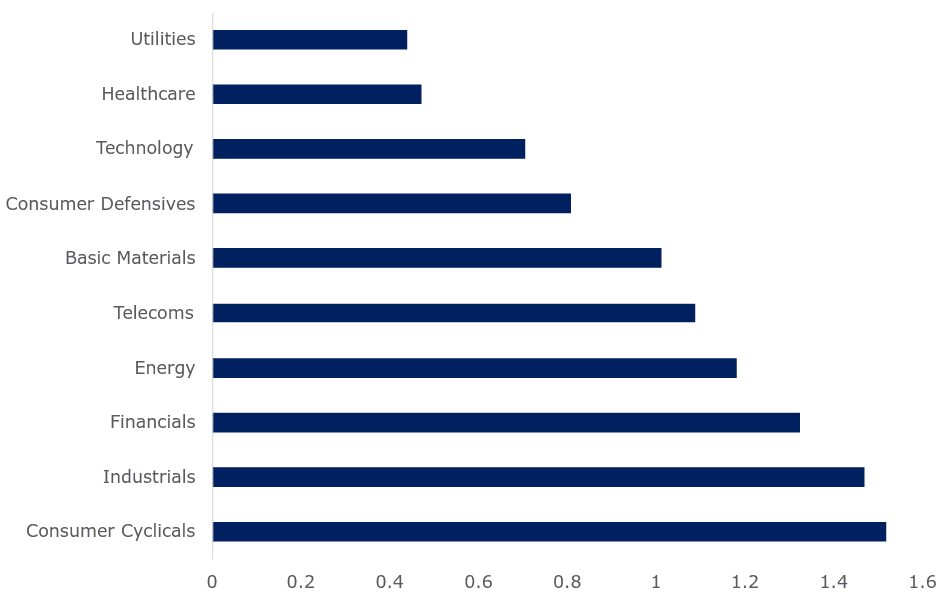
There are about 100 stocks in the FTSE 100. Which ones have betas less than one? Well, rather than sorting a list, I find it more instructive to look at sectors. There are four sectors whose average beta is less than one. The consumer defensive sector average beta is 0.8, technology is 0.7, healthcare comes in at 0.5, and the utilities sector’s average beta is 0.4.

Figure 1. Average beta values for the 10 FTSE 100 sectors

A chart showing FTSE 100 sector average beta

Source: Financial Times and author’s own work

Those results did not surprise me, asides from technology. Healthcare, utilities, and consumer defensives are the types of sectors I would imagine are safer than the others.

Stock market crashes and volatility

Focusing on four sectors has cut the number of FTSE 100 stocks I have to consider down to 25. This is a more manageable bunch to work with when considering another measure of risk: daily volatility.

Beta gives an idea of the riskiness of stock when considering the broader market. It suggests how a stock moves when events that affect all stocks occur. However, if the stock market is marching higher and a biotech company’s star drug gets withdrawn from the market, its stock price will not go up, no matter what the beta is. Company-specific risk is better measured with the daily volatility of a stock price. So, a table of FTSE 100 stocks from the low beta sectors arranged by their daily volatility seems in order.

Table 1. FTSE 100 stocks from four sectors with low beta and daily volatility

Table showing FTSE 100 stocks from four sectors with low beta and volatility

Source: Financial Times

It would be wrong to call any stock ‘safe’. A safe investment has a guaranteed return; stocks do not and are therefore inherently risky. But, some FTSE 100 stocks are safer than others. From the table above it appears that GlaxoSmithKline, Tesco, Unilever, Reckitt, and National Grid offer a combination of both low daily volatility and low beta, at least historically. These are the types of stocks I would want in my Stocks and Shares ISA when the stock market crashes to hopefully protect it, at least to some degree, against a sizeable drawdown. But, as with all things in investing, there are no guarantees.

Inflation Is Coming: 3 Shares To Try And Hedge Against Rising Prices

Make no mistake… inflation is coming.

Some people are running scared, but there’s one thing we believe we should avoid doing at all costs when inflation hits… and that’s doing nothing.

Money that just sits in the bank can often lose value each and every year. But to savvy savers and investors, where to consider putting their money is the million-dollar question.

That’s why we’ve put together a brand-new special report that uncovers 3 of our top UK and US share ideas to try and best hedge against inflation…

…because no matter what the economy is doing, a savvy investor will want their money working for them, inflation or not!

Best of all, we’re giving this report away completely FREE today!

Simply click here, enter your email address, and we’ll send it to you right away.

James J. McCombie owns shares in GlaxoSmithKline, National Grid, Reckitt plc, Tesco, and Unilever. The Motley Fool UK has recommended GlaxoSmithKline, Reckitt plc, Tesco, and Unilever. Views expressed on the companies mentioned in this article are those of the writer and therefore may differ from the official recommendations we make in our subscription services such as Share Advisor, Hidden Winners and Pro. Here at The Motley Fool we believe that considering a diverse range of insights makes us better investors.

Financial News

Daily News on Investing, Personal Finance, Markets, and more!

Financial News

Policy(Required)