2 shares I just bought for my ISA during the stock market sell-off

The stock market has sold off sharply since the start of April, with some shares falling 20% or more. I’ve been using this weakness to add to a couple of holdings in my Stocks and Shares ISA.

So here are two that I bought in recent days.

Mining mayhem

One of the worst-hit sectors lately has been mining. The Glencore (LSE: GLEN) share price, for example, has plunged 20% in a month, bringing the two-year loss to 50%!

This makes sense, of course, as the Trump administration’s tariff war with China could weaken demand for raw materials. Mining is cyclical, so a major slowdown in the global economy is a risk to the sector here.

However, as well as being a major copper producer, Glencore is also one of the world’s biggest commodity traders. This means its trading division can make big profits during periods of massive turbulence, like in 2022, and possibly now.

Longer term, I fail to see how surging demand for copper — which is used in everything from electric vehicles (EVs) to solar panels and turbines — when combined with constrained supply will not lead to much higher prices. Therefore, Glencore’s profits should one day be significantly higher than they are today.

So why didn’t I buy this FTSE 100 stock then? Well, I tend to avoid individual mining stocks as they’re a bit risky for my liking. Production at strategically important mines can run into trouble, for example.

But the FTSE 250‘s BlackRock World Mining Trust offers diversification through a range of companies and metals, including gold. It has Glencore as one of its top holdings, as well as other copper giants such as BHP and Freeport-McMoRan.

The current dividend yield is 5.14%, which is higher than Glencore’s 3.63%. I see it as a less risky option for my portfolio.

Of course, the same risks apply here. Another sell-off in metals could cause future earnings to dip sharply across the sector. However, analysts at Jefferies recently said that hammered mining stocks could now be attractive “for those who can ride out the near-term volatility”.

I agree, so I bought more shares of BlackRock World Mining at 395p.

Shocking Shopify sell-off

Another stock I bought after a massive dip was Shopify (NASDAQ: SHOP). The stock lost 23% in just two-and-a-half days near the start of April!

Shopify’s platform allows businesses to easily set up and run an online store. Last year, its share of the US e-commerce market reached an impressive 12%, while international revenue grew 33%.

In 2023, the company sold its capital-intensive logistics business, a move that has markedly improved profitability. Its free cash flow margin grew sequentially each quarter last year, reaching 22% by Q4. And for the full year it reported an operating profit of $1.1bn on revenue of $8.9bn (26% year-on-year growth).

Now, I accept this is an incredibly volatile holding, even more so when a global recession could impact growth. Also, the stock’s still pricey, even after the recent 23% pullback.

However, the global e-commerce market is projected to expand at a compound annual rate of 15.2% from 2024 to 2033, according to Precedence Research. And Shopify’s revenue is tipped to soar above $19bn by 2028. I remain bullish.

These 4 FTSE shares have crashed hard. Which do I like today?

Wow, what a week (and month) it’s been for stocks. After hitting record highs in February, stock markets have plunged on fears of a new trade war. Even after Thursday’s (10 April) big rebound, the FTSE 100 index is down 6.3% in a week and 7.6% over a month. Meanwhile, the US S&P 500 has dropped 0.4% and 6.2% over those periods, respectively.

My family portfolio is heavily weighted to US stocks and UK shares, so it’s taken a few hard knocks. Indeed, some of our holdings have fallen so far and fast, I’ve been baffled by these recent market moves.

My biggest FTSE fallers

Earlier today, I produced a list of the 20 biggest FTSE 100 fallers over the past month. Alas, I found four of my family’s blue-chip holdings in this list of laggards and losers. Here they are (sorted from biggest to smallest price decline over the past month):

Company Business Market value (£bn) One month One year Five years
Barclays Bank 37.6 -19.1% 27.9% 147.6%
BP Energy 55.4 -19.5% -35.6% -0.8%
Glencore Miner 30.2 -25.4% -49.6% 64.6%
Anglo American Miner 25.5 -25.9% -19.5% 20.7%

Two of these worst-hit stocks are from the same sector: mining. With Trump’s trade tariffs predicted to cause a global economic slowdown, miners, oil & gas, and banking stocks have all taken a beating. Indeed, the wider list of Footsie losers over one month is dominated by companies in the financial and commodity sectors.

Of course, the reason for the sharp declines in share prices is President Trump’s threat of hefty trade tariffs on imports to the US. Sadly, the US has tried trade/tariff wars of this kind before — most notably in 1828 (the ‘Abomination tariffs’) and 1930 (Smoot-Hawley tariffs). Both contributed to long, deep US recessions, including the Great Depression that began with the Wall Street Crash in October 1929.

And when the American economy sneezes, other countries usually catch cold, which is stoking fears of a potential global recession in 2024/25. Hence the slump in stocks right across the globe, less than two months since stock markets hit record highs.

I like the look of Barclays

As mentioned, my wife and I own all four of the stumbling shares above. I’m wary of buying commodity-related stocks in the current turmoil, so three of these slumpers are not for me right now.

However, I can’t see big British bank Barclays (LSE: BARC) suffering savagely from US trade tariffs. As I write (11 April), the Barclays share price stands at 258.4p, valuing the Blue Eagle bank at £37.1bn. At its one-year high, this stock hit 316p, so it’s fallen steeply from this top.

After this latest setback, this FTSE share trades on a multiple of just 7.4 times earnings, generating an earnings yield of 13.5% a year. Thus, the bank’s dividend yield of 3.3% a year is covered a juicy 4.1 times by trailing earnings. To me, this offers a huge margin of safety, giving confidence that future cash payouts will be similar or even higher.

Then again, nothing is certain in financial markets, including future dividends. Also, if this stock-market swoon continues, Barclays’ investment-banking revenues might plunge. And a UK recession could lift loan losses and bad debts. Even so, I have no intention of selling this FTSE 100 stock at current price levels!

1 FTSE 250 stock that analysts are calling a ‘Strong Buy’

Oxford Nanopore Technologies (LSE:ONT) is an exciting FTSE 250 stock and is massively undervalued according to analysts. However, despite its groundbreaking technology and recent collaborations, the stock has slumped. Unlike many of its peers, the slump actually has very little to do with Donald Trump’s tariffs.

A DNA pioneer

For those unfamiliar, Oxford Nanopore is a pioneer in third-generation DNA sequencing technology. The company’s devices use nanopores — these are tiny protein-based structures — to sequence DNA or RNA in real time by detecting electrical changes as molecules pass through these pores. This technology is all available on handheld devices.

Its technology is used across multiple fields, ranging from infectious disease analysis to genomic surveillance in remote locations. For instance, its devices were used during the Ebola outbreak in 2015 to sequence viral genomes rapidly.

However, things haven’t gone to plan since listing in late 2021. Oxford Nanopore’s share price has plummeted by over 80%, reducing its market capitalisation to over £1bn. This dramatic decline stems from a combination of factors, including persistent losses, heightened competition, and macroeconomic challenges such as rising interest rates. Analysts have also flagged concerns about slower-than-expected growth and a worsening funding environment.

Analysts call this a ‘Strong Buy’

Despite the collapsing share price, analysts seem remarkably bullish. Of the 10 analysts covering the stock, four have Buy ratings and four have Outperform ratings. What’s more, the average share price target is now 69% higher than the current share price. This is typically a good sign. Incidentally, the highest share price target is 138% above where we are today.

However, shrewd investors will need to question this call. The company’s operating loss has nearly doubled to £152m since 2019, and the forecast suggests it won’t reach adjusted EBITDA breakeven until 2027. For 2025, analysts expected negative earnings per share (EPS) of 15.9p. That’s not insignificant for stock valued at 114p per share.

The saving grace is the net cash position which currently stands at £292m and is set to fall to £158m by the end of 2026 based on the forecast. That means it does have some runway until its long-awaited profitability.

Of course, it may not reach profitability in its current state. Ongoing losses and a falling share price have made the stock vulnerable, with some suggesting it could become a takeover target for larger players like Thermo Fisher Scientific or Danaher.

The bottom line

On 9 April 2025, Oxford Nanopore announced a strategic collaboration with Cepheid to develop automated sequencing solutions for infectious diseases. The could expand into other areas like cancer diagnostics and human genetics, potentially opening new revenue streams.

However, investors should be wary that Oxford Nanopore is a classic high-risk, high-reward investment. Its innovative technology and strategic collaborations position it well for future growth, but I’m reluctant to throw my own money behind it. Nonetheless, I’ll continue to keep a close eye on developments.

I asked ChatGPT to name 5 FTSE shares for the perfect SIPP. Here’s what it picked

Recent stock market volatility could be a good opportunity for long-term investors to fill up a Self-Invested Personal Pension, or SIPP.

Pension investing is a long-term game. Loading up on shares when prices are down like today may be the perfect time to start, for those who can withstand short-term risks.

With that in mind, I decided to have a bit of fun by asking ChatGPT to name five FTSE 100 stocks to create the perfect SIPP. I asked to spread my risk across five different sectors, to avoid doubling up.

Unilever is a defensive stock

I should start by saying that ChatGPT is not a stock picker or adviser. It just hoovers up other people’s opinions from the web, and must be approached with caution.

It played safe by coming up with five of the biggest UK blue-chip shares. While all are worth considering, at least three are far riskier than ChatGPT made out.

The first pick was consumer goods specialist Unilever (LSE: ULVR), which owns a portfolio of household name brands, including Dove, Hellmann’s, and Ben & Jerry’s, that people keep buying in good times and bad. 

“It’s highly cash generative and pays a consistent dividend”, ChatGPT purrs, adding, “Global reach and brand power mean it can pass on inflation through price increases”.

The Unilever share price has dipped 3% in the last month, but that’s pretty decent given today’s market volatility. Over 12 months, it’s up almost 20%. The trailing yield is 3.2%.

Unilever lost its way as the group became too sprawling, while the cost-of-living crisis squeezed consumers and drove up input costs. ChatGPT didn’t mention that. Investors must do their own research before buying, and see what human experts have to say.

Its second pick was financial services firm Legal & General Group, which now boasts a bumper trailing 9.25% yield.

My robot buddy neglected to mention that long-time share price performance has been poor. Personally, I would favour more sure-footed rival Aviva.

Next, ChatGPT picked electricity and gas infrastructure operator National Grid, highlighting its regulated earnings and reliable dividend yield.

These FTSE 100 have hidden risks

It claimed the utility “has growth potential from investing in clean energy infrastructure“, neglecting to mention that it must invest tens of billions to get there. Last year, it called on investors for more cash. Personally, I wouldn’t buy it (despite that juicy 5.6% yield).

My bot bro’s next pick is high on the risk scale: spirits giant Diageo. It shares are down 30% over one year and 50% over three.

While ChatGPT points to its “strong margins and pricing power in the premium drinks segment”, it doesn’t mention Diageo’s profit warnings or that young people are drinking less alcohol. Buyer beware here – don’t blindly follow the robots.

The final pick is oil giant BP, which ChatGPT claims is “investing heavily in renewables to future-proof the business as the energy landscape evolves”.

That’s plain wrong. BP has just dumped net zero plans to focus on fossil fuels. ChatGPT also claims BP remains “a cash machine“, but I fear share buybacks and dividends will slide from here as oil prices slide.

Like every stock, all five listed here have pros and cons. A quick search on ChatGPT isn’t enough. I’ll continue to research my own stocks, rather than relying on robots.

Should I load up on Rolls-Royce shares after the 17% drop?

Rolls-Royce (LSE: RR) shares were at 812p just under one month ago. As I type (11 April), they’re priced at 676p, which means they’ve suffered a 17% haircut.

Zooming out further though, the FTSE 100 stock is up 350% over the past two years. So it’s still been a massive winner.

Is this dip large enough for me to consider buying more shares? Let’s find out.

Heightened risks

To answer this, I want to know the reason for the recent sell-off. As we know, this was tiggered by the Trump administration’s sweeping US tariffs, which hit nearly all stocks.

However, the Rolls-Royce share price fell more than most. Why? Well, it had already gone up a lot and was trading above 30 times forecast earnings. That was a rich valuation, and it’s normally high-value stocks that take a pounding when markets sell off aggressively.

Beyond that though, there are some worries here. Rolls-Royce relies on a complex international supply chain, sourcing components from various countries. That’s just become a minefield, as tariff uncertainty is likely to exacerbate the supply chain problems that were already present.

Also, a severe trade war between the US and China may yet cause a global recession, which would almost certainly impact international travel. Obviously that wouldn’t be ideal for airlines or engine makers.

Given this context, it doesn’t surprise me that the share price has experienced a significant pullback.

SMR progress

Even if the global economy entered a downturn though, at least there is Rolls-Royce’s defence division. This is poised to benefit from the huge military spending that Europe is ready to embark upon. It’s not inconceivable that this could be a multi-decade opportunity for the firm.

Beyond that, there are small modular reactors (SMRs). Each factory-built mini reactor is expected to generate enough low-carbon electricity to power 1m homes for 60+ years.

Rolls-Royce is a global leader in this technology and has been shortlisted with three other firms to deploy SMRs in the UK. Today we got news that Rolls-Royce SMR has submitted its final tender to Great British Nuclear after a six-month period of detailed negotiations.  

Rolls-Royce SMR has already been selected by utility ČEZ in the Czech Republic for up to 3GW of power, as well as being shortlisted in Sweden.

The company expects SMRs to be immediately cash-flow positive and generate a strong double-digit return on capital. They hold out the promise of decarbonising energy systems while meeting the world’s growing electricity demand, so it is a huge long-term opportunity.

My move

Based on current forecasts for 2025, the stock’s forward-looking price-to-earnings ratio is around 29. The forecast dividend yield is just 1.1% though.

I’d say the stock still looks a bit pricey, based on what we know. If supply chain issues worsen due to ongoing uncertainty relating to tariffs, then the share price could fall back a bit more.

I bought Rolls shares at 149p in 2023, then more at 477p last summer. I’m happy with the size of that position for now.

For those not invested, I think this dip might be worth considering. Personally though, I wouldn’t bet the farm when there is so much uncertainty in the global economy.

Things could be volatile all year long, presenting even better buying opportunities.

Is this the best S&P 500 stock to consider buying in these volatile times?

The S&P 500 remains highly volatile as tension over a widescale trade war intensifies. In this climate, it can be a good idea for investors to consider buying some classic defensive stocks.

Some like Newmont Corporation (NYSE:NEM) even have the potential to soar in value over the short term (and even beyond). Here’s why I think the gold miner’s worth serious consideration right now.

Dividend boost

Investing in gold mining stocks remains an attractive proposition to consider. The yellow metal’s price surge continues and it struck new highs of above $3,230 an ounce just now. Conditions seem to be perfect for further substantial gains.

As the world’s largest gold company — metal reserves are a whopping 135.9m ounces — I believe Newmont Corporation could be one of the best stocks to buy to capitalise on this.

Owning gold stocks and price-tracking funds are the most popular ways that people gain metal exposure nowadays. But owning the companies that actually produce the precious metal has multiple advantages.

Gold itself doesn’t actually provide an income, unlike many mining shares that pay a dividend. Newmont’s one of these that provides cash rewards to shareholders. For 2025, its dividend yield is a solid 2%.

Strong performance

Gold stocks can also outperform gold if operational performance is strong. On this front, owning Newmont shares could have substantial advantages, given recent production news.

Gold production rose 9% in the fourth quarter, latest data showed, meaning total production of 5.9m ounces for the full year beat forecasts. All-in sustaining costs (AISCs) also dropped 1.5% in the quarter to $1,463 per ounce, well below the current price of gold.

All that said, even the best-run miners can sink in value due to factors outside of their control. Major base and precious metal-producing regions are often located in politically unstable places, creating substantial risks through possible potential unrest, regulatory changes or conflict.

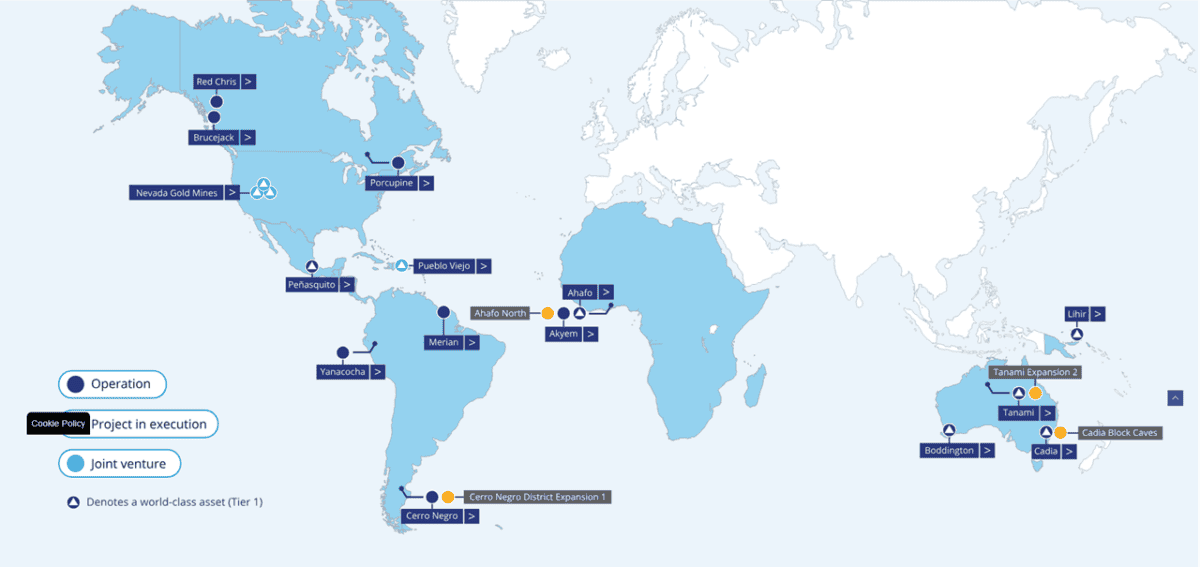
This is one reason why Newmont’s one of my preferred sector picks. While it’s also vulnerable to such events, with assets spanning The Americas, Africa and Australasia, such problems can be better absorbed at group level.

Source: Newmont Corporation

An S&P 500 bargain?

The largest risk however, for any commodities-producing business is a sharp fall in the value of their product. In the case of gold, a sudden pick-up in risk appetite could see a wide scale dumping of the safe-haven metal.

But as I mentioned earlier, I think the landscape is ripe for gold (up 37% over the past year) to keep on soaring.

The trade spat between the US and China continues to intensify, posing a substantial threat to the global economy. Uncertainty over future trading relationship between the US and its other major trading nations also rumbles on during the 90-day tariff pause.

A gloomy outlook for the US dollar also bodes well for greenback-denominated assets like gold. The US dollar index fell below the critical level of 100 earlier today for the first time in years.

City analysts expect Newmont’s earnings to rise 18% in 2025. This leaves it trading on a price-to-earnings growth (PEG) ratio of 0.9, suggesting it’s underpriced relative to predicted profits.

All things considered, I think investors should give the mining giant a close look.

Yielding 7.25% but with a P/E of 186x! What’s up with the BP share price?

The BP (LSE: BP) share price has taken a real beating. In a turbulent time for global markets, the oil giant has been hit harder than most.

BP shares have tumbled 15% in just a week and are down a full 35% over the past 12 months. That’s a bruising run for the FTSE 100 heavyweight. The share price spike during the Putin-fuelled energy shock of 2022 is now a fading memory.

So what’s gone wrong? A lot, actually. Obviously, there’s Donald Trump. His tariff talk has sent oil prices sliding with Brent crude now hovering closer to $60 a barrel. 

Can this FTSE 100 big beast roar again?

That’s bad news for energy giants like BP. While it can break even at around $40 a barrel, falling prices inevitably hit earnings and profits. If trade tensions sink the global economy then energy demand will follow, along with BP shares.

BP has problems of its own. It’s spent the last few years tying itself in knots over its strategy. It swung hard toward green energy, only to backtrack in recent months after coming under heavy pressure from activist investor Elliott, which took a 5% stake and is pushing for a reset.

BP’s chairman Helge Lund – a key backer of the net zero transition – is stepping down. New CEO Murray Auchincloss is scaling back renewables investment and ramping oil and gas spending back up. 

That has left the company under fire from angry climate critics and equally frustrated shareholders alike.

BP’s earnings nosedived even before the latest bout of market chaos, with 2024’s earnings per share down a staggering 97%. As a result, the company’s price-to-earnings ratio has shot up to 186. A few months ago, the P/E was around five or six times and looked a bargain. Today, I’m not so sure.

The recent trading update, published on 11 April, didn’t help. BP said gas and low-carbon energy production is down, with only a slight rise in oil. Gas trading was “weak” while net debt jumped by $4bn in the quarter. While BP expects that to reverse due to seasonal factors, it added to the gloom.

I just hope the dividend holds

Its stellar share buybacks have been trimmed. BP was spending up to $1.75bn a quarter buying back its own shares. Now that’s been cut back to between $750m and $1bn. Rightly so, given falling earnings, but still a blow.

Following the share price slump, BP’s forecast to yield 7.4% in 2025 and 7.72% in 2026. Let’s hope the dividend proves sustainable. A cut can’t be ruled out.

If central banks start slashing interest rates to offset a slowdown, its $23bn debt will get cheaper to service and energy demand could pick up. That might throw BP a lifeline.

I bought BP shares a couple of months ago, taking advantage of the low P/E and improved yield. Obviously, it hasn’t gone well so far. I’m holding, but this is a highly risky stock today. In fact, it has been ever since the Deepwater Horizon blow-out in 2010, some 15 years ago now.

Bargain hunters considering the stock should approach with extreme caution. There’s an awful lot going on here, and we don’t know how it will pan out. Or even if it’s a bargain!

Down 26% with a 7% yield! Could this little-known FTSE 250 gem make a comeback?

The lesser-known FTSE 250 recruitment company Page Group (LSE: PAGE) is down 26% this year after weak fourth-quarter results hit the stock hard. Growing uncertainty in the UK jobs market has led the firm to suffer its worst start to a year since 2022. Now at 250p a share, it’s worth less than half what it was at the end of 2021.

In its latest results released this Wednesday (9 April), it reported an 11.7% drop in gross profit, down from £220m to £194.2m. The EMEA region was hit the hardest, down 14.5%, with the UK dipping 12.7% and America down 1.1%.

The company noted the unpredictable economic environment that could make 2025 a difficult year. As a result, it didn’t provide any forward-looking guidance at this time. However, it does plan to implement cost savings of £15m by simplifying its management structure and reducing the workforce by 25%.

Page Group’s earnings have been in decline for several years now, slipping from £139m in 2022 to £28.4m last year. While revenue has also dropped, it’s done so at a slower rate, bringing the company’s net margin down to a worrying 1.39%.

Notably, earnings in the US increased 7% due to higher demand in the engineering and manufacturing sectors.

A dividend play?

Page Group has a long history of dividend growth, barring an understandable cut during Covid. Global lockdowns led to an almost complete cessation of recruitment operations during that period.

However, in 2021, dividends were reinstated at 15p per share and have since increased to 17.11p. Overall, its annual dividends have increased at a compound annual growth rate of 5.2% a year. I would expect that growth to continue — unless more lockdowns occur, of course.

After the price dip, the yield’s up to 7%, making the stock an attractive option for income investors. However, if the price keeps falling, it may negate any dividend gains.

What’s the likelihood of that happening? 

Valuation

Along with the falling price, Page Group’s price-to-earnings (P/E) ratio has also dipped by around 25%. However, now at 29.6, it’s still well above the FTSE 100 average of 11.4. At 9.63, its price-to-cash flow (P/CF) ratio is also slightly above average. These metrics indicate that, despite the falling price, the stock could still be somewhat overvalued.

Subsequently, there’s a fair chance the price may dip lower before stabilising or recovering. But analysts remain optimistic in the long term, with the average 12-month forecast 380p — a 44% rise. The current economic situation is dire but will likely stabilise and improve by next year. If the company can maintain its dividends through it all, it could deliver decent value to shareholders in the long run.

However, I’m not convinced enough to consider the stock just yet. Looking at other similar stocks on the FTSE 250, I’d consider price comparison company MONY Group to have better potential. It has a 6.5% yield and a P/E ratio of only 12.45. Specialist manufacturer Morgan Advanced Materials also looks promising, with a 6.6% yield and P/E ratio of 10.5.

Analysts are calling Diageo shares a strong buy! Are they mad?

Diageo (LSE: DGE) shares were tumbling long before Donald Trump’s trade war rattled markets, but the uncertainty hasn’t helped one bit. 

Mexican tequila and Canadian whisky exports to the States would both take a beating, if those tariffs come through. The furore couldn’t come at a worse time for the global drinks giant. 

One of the FTSE 100’s proudest blue-chips has taken a right old beating. The Diageo share price is now down nearly 30% over the past year, and a hefty 50% over three.

Can this FTSE 100 flop fight back?

The problems run deep. The cost-of-living crisis has left shoppers reluctant to splash out on premium drinks. 

Diageo’s push into the premium end of the market has stumbled as a result, and stocking issues in key regions, especially Latin America, have only made matters worse. 

I’ve tried to see the brighter side, averaging down on the stock several times, but each time the shares have sunk lower. So has my mood. Well they do say alcohol is a depressant.

Sure, Guinness is the height of fashion but there’s a growing concern that younger generations simply aren’t drinking the way their parents did. 

That casts a long shadow over Diageo’s long-term story. Once seen as a solid, defensive pick, the company now looks anything but dependable.

In February, Diageo reported that net sales had dipped 0.6% to $10.9bn, and operating profit fell 4.9% to $3.16bn, with currency headwinds and shrinking margins both playing a role. 

While there were encouraging signs in North America, boosted by Don Julio and Crown Royal, that’s all up in the air. Tariffs appear to have scuppered hopes of building momentum in the second half of the year.

At least the valuation has come down to earth. Diageo now trades on a price-to-earnings ratio below 15, which feels cheap given where it used to sit. 

Rising yield, but is it good value?

The dividend yield is up to 3.86%, and forecasts suggest it could hit 4% in 2025. So, what might that mean for returns?

The 22 analysts covering the stock have a median one-year target of 2,547p. If they’re right, that’s a potential 24% gain from today’s price of 2,063p. 

Add in the yield, and investors could be looking at a total return of almost 28%. I’d love that to happen, but can’t see it today. Forecasts feel shakier than ever right now.

They say it’s darkest before the dawn, and maybe better days lie ahead. But any investor considering Diageo today must look past the share price slide and ask if they truly believe in the company’s future. The P/E ratio may be lower, but that doesn’t make it cheap.

Of the 25 analysts who’ve issued a rating recently, 10 labelled Diageo a Strong Buy, with another three rating it a Buy. Three said Hold. Only three said Sell. Their glass is half full, but after the losses I’ve suffered, mine feels half empty. I believe investors’ patience could be tested for a long while yet.

Any investor considering this stock must be ready to commit for the long haul, or sit this one out.

Up 17% in 2 days! At last, some good news for those interested in the JD Sports share price

I’m relieved by the way in which the JD Sports Fashion (LSE:JD.) share price responded to the company’s latest trading update on Wednesday (9 April). The stock jumped 10.7% after the sports and leisure retailer said that trading was in line with expectations. The next day, it increased another 6.1%, although some of this increase was probably helped by President Trump’s change in tariff policy.

The ‘King of Trainers’

Unusually, the announcement was made at midday. Normally, these updates are released at 7am, before the market opens.

However, for long-suffering shareholders like me, it was worth waiting for. Not that it contained anything new. It simply reiterated that adjusted profit before tax (PBT) for the year ended 1 February 2025 (FY25) will be £915m-£935m.

Looking ahead to FY26, the company said it expects “the trading environment in our key markets to be volatile”. It said adjusted PBT will be in line with “current consensus expectations” of £878m-£982m, with an average of £920m.

This is a wide range and reflects the current level of global uncertainty. But as the year progresses, it will inevitably narrow.

If the £920m is achieved, this is equivalent to earnings per share of 12p. This means the stock’s trading on a multiple of 6.3 times forward earnings. This is cheap by FTSE 100 standards and remains below the company’s own five-year average of around 15.

An elephant in the room

However, there’s one issue that investors appear to have overlooked. The press release cautioned that the FY26 forecast “excludes any potential impact from changes to tariffs”.

In my opinion, the events of the past two days demonstrate that investors were concerned more about the company’s current trading than tariffs. After all, the group hasn’t upgraded its earnings forecast. It’s almost as though investors have breathed a collective sigh of relief.

To try and maintain the momentum in the share price, the company’s announced a £100m share buyback programme. This is in addition to the meagre 1p dividend that analysts are expecting for FY26.

Compared to the previous year, FY25 like-for-like (LFL) sales were 2.5% lower in the UK. Conscious of its reliance on the domestic market, the group’s expanded into America and Europe. Here, both organic sales and those on a LFL basis grew.

Pros and cons

However, the group faces some challenges. A global recession can’t be ruled out.

And the company now has to manage and supply 4,850 physical stores, which isn’t easy.

Significantly, the company‘s hugely reliant on Nike. The American sportswear giant is struggling against competition from some of the newer entrants into the athleisure market. This dependency is likely to have increased further following the acquisition of Hibbett, which operates 1,169 stores in the US.

Overall, I think JD Sports remains in good shape. It has net cash (before lease liabilities) on its balance sheet. In the medium-term, capital expenditure will be reduced. It’s also deferred a commitment to buy the non-controlling interest of the parent company of its North American business until 2029 -2030. This means the group’s likely to generate more cash than previously expected.

In conclusion, I’m confident about the group’s growth prospects. I think it’s the sort of stock that long-term investors looking to take a position in a financially robust business could consider.

Financial News

Daily News on Investing, Personal Finance, Markets, and more!

Financial News

Policy(Required)