£1k in savings? Here’s how investors can aim to turn that into a £9,600-a-year second income

I’m aiming to build a high-and-rising second income from a portfolio of stocks and shares, and I don’t think I need to be an investment genius to do it. Which is pretty handy, because I don’t have the stock-picking skills of billionaire investor Warren Buffett. Hard experience has taught me that.

The truth is most of us don’t. But that’s okay because private investors have one weapon at their disposal. Time.

Over the years and decades, building a diversified spread of FTSE 100 stocks can be a great way to turn relatively small sums into a juicy passive income. And it’s possible to get started with as little as £1,000 (or even less).

Generating a second income through shares isn’t without risks. Stock markets rise and fall all the time but over the years, history shows the returns beat almost every other asset class.

FTSE 100 shares are a great source of income

Even big UK blue-chips can be volatile. A good way to get round this is to invest in a spread of around 15-20 different stocks, prioritising solid, established names with loyal customers and track records of steadily rising dividends.

Cigarette maker British American Tobacco‘s (LSE: BATS) a brilliant example of the type of dividend stock the FTSE 100 excels in that’s worth considering.

Although smoking’s under constant regulatory pressure, British American Tobacco still shifts 500 billion sticks a year. Plus it’s making a big push into what it calls ‘smokeless products’.

Personally, I don’t buy tobacco stocks but it means I miss out on a brilliant source of dividend income. British American Tobacco has a trailing yield of 7.95%. Any share price growth comes on top of that. Last year, the stock grew 25% to give a total return of almost 33%.

There are risks, of course. Cigarettes kill. Vapes will meet growing resistance. It’s a competitive sector. But British American Tobacco has survived these threats, thanks to its range of strong brands.

Over the past 20 years, the FTSE 100’s delivered an average return of 6.9% a year, with all dividends reinvested. Investors could potentially beat that by picking individual stocks. But even if they don’t, UK shares will still build wealth over time.

At 6.9% a year, if an investor put £1,000 into the FTSE 100 at age 30 and left it in the market until they turned 68, they’d have £12,623. If they drew 5% of their pot each year, that would give them £631 of passive income in retirement.

How stocks grow in value over time

That’s not riches, but it isn’t bad from an initial £1k. However, investing isn’t a case of just once-and-done. If they invested £1,000 a year for each of those 38 years, they’d have £192,691 by 68.

Again, this assumes average growth of 6.9% a year. Drawing 5% of that would give them a second annual income of £9,635.

There are no guarantees when investing. The investor could generate a lower return than 6.9% a year. On the other hand, they could get a higher one.

In practice, most of us should aim for more than £192,691 to secure a comfortable retirement so far into the future. That means investing more than £1k a year.

But it’s a start. And it isn’t necessary to be an investment genius to get cracking.

5 investment trusts to consider for a new 2025 ISA

Are investment trusts the best thing ever? They might be.

Here are five I think anyone starting a Stocks and Shares ISA in 2025 could do well to consider. I already bought two of them myself.

The key attractions for me? An investment trust can provide diversification in just a single purchase. And we have a whole range of investing strategies to choose from.

Five top trusts

Stock Strategy 5-year price
change
Forecast
dividend yield
Dividend rises
(years)
Premium/
discount
City of London
Investment Trust
UK equity income -2.4% 4.9% 58 -1.1%
Murray Income
Trust
UK equity income -9.0% 4.8% 51 -12%
Bankers
Investment Trust
Global +17% 2.4% 57 -13%
Scottish Mortgage
Investment Trust
(LSE: SMT)
Global +68% 1.8% 42 -12%
Schroder
Oriental Income
Asia Pacific
equity income
+11% 4.3% 18 -6.5%
Source: Association of Investment Companies

I’d challenge anyone to pick five stocks for a new ISA that can equal this lot for diversification — in both industries and global spread.

The first thing I note is that Premium/discount column. A negative number means a stock is selling for less than the net asset value (NAV) of the things it invests in.

On that score, these look cheap. But a discount also reflects the risk that the market sees in an investment trust.

Cheap vs risky

Look at Scottish Mortgage Investment Trust. The risk comes from the stocks it puts its shareholders’ money in. We’re talking high-flying Nasdaq stocks here — the so-called Magnificent 7 of artificial intelligence (AI), and the rest.

Scottish Mortgage holds Amazon, Nvidia, Tesla… and a few analysts are calling an AI bubble right now.

The Nasdaq has even been easing a bit after hitting an all-time high in September. But I think it’s way too early to give up on world-leading tech stocks, at least with my investing horizon of at least five years.

With that outlook in mind, I think the 12% discount has to make Scottish Mortgage a worthwhile consideration for those who want a more diversified tech growth investment.

Better bargain

Bankers Investment Trust is on a similar discount, with investments in some of the same Nasdaq stocks. But its also holds stocks like Visa and Chevron. It looks less exposed to tech stock risk to me. And I wonder if it might be an underpriced anomaly. I need to dig deeper.

I’m also surprised by the difference in discounts between City of London and Murray Income Trust. They’re very similar in their strategies, dividends, and holdings. Both include Unilever, AstraZeneca, and RELX in their top 10, plus other top FTSE 100 shares.

I wonder if the fact that Murray Income is managed by abrdn might have anything to do with it? That company is out of favour with investors, down 20% in the past 12 months. Again, more research needed.

Good mix

These trusts I’ve looked at have all raised their annual dividends for many years. If any should falter one year, that’s a share price risk (on top of any specific strategy risk).

But looking at the current discounts, there’s a very good chance I’ll add another of these five to my 2025 ISA.

Have I left it too late to buy Nvidia shares?

I have a confession: I don’t own Nvidia (LSE: NVDA) shares. In my defence, I’m British.

I hold plenty of FTSE 100 stocks directly, but only invest in the US via trackers. That’s one reason why I don’t hold Nvidia, but there’s another more important one.

When the AI chipmaker’s bandwagon started rolling last summer – I mean, really rolling – I decided I’d already missed my chance. The Nvidia share price had been going gangbusters and I thought: it can’t go on like that.

It’s my typical response to red-hot momentum stocks. I’m scared of hopping on board just as the wheels come off. As a result, I’ve missed out on a lot of excitement from Nvidia, Tesla, Amazon and the like.

I need to stop worrying and buy growth stocks

It’s time to rethink my attitude to growth stocks. But I still keep banging my head against the wall with the same question, only more so. Have I left it too late?

Nvidia shares are up 165% over the past year. Over five years, they’ve soared 2,195%. The company has a market cap of $3.3trn. It can’t keep growing at the same rate, it would swallow the entire global economy.

Then there’s its valuation. The shares now have a price-to-earnings ratio of 55.1. That’s very expensive.

By comparison, the S&P 500’s P/E is around 33 times (and most investors think that’s pricey). Yet Nvidia’s earnings continue to soar. They jumped 94% year on year in Q3 to $35.1bn. Suddenly, Nvidia doesn’t look so expensive. Its forward P/E is just 30 times earnings.

A big attraction is that Nvidia isn’t pouring huge sums into building AI infrastructure. It leaves that to others. It doesn’t even manufacture its high-performance graphics processing units (GPUs). That’s outsourced to third-parties like the Taiwan Semiconductor Manufacturing Company and Samsung.

I’m late to the party but will go anyway

This makes it a capital-light business. On the other hand, it brings geopolitical risk. What happens if China invades Taiwan? Plus there are potential supply chain issues, if these manufacturers are unable to keep up with demand. US President-elect Donald Trump’s mooted trade tariffs could also cause disruption.

Nvidia also has to keep innovating to maintain its leadership in GPU and AI chip technology. Plus there’s the underlying risk AI hype has been overdone.

The shares slumped more than 6% on Tuesday (7 January) amid a wider tech sell-off triggered by surging US government bond yields. That wiped out $220bn off its market value. I’m struggling to get my head round that sum. So is this my buying opportunity?

The 50 analysts offering one-year Nvidia share price forecasts have produced a median target of $174.6. If correct, that’s an increase of around 24% from today. That’s pretty good, but also shows how growth expectations are slowing.

I’ve clearly left it pathetically late to buy Nvidia. Better late than never though. I could hang around for another dip, but who knows if we will get one? So I’ll play safe by investing a smaller sum and if the share price does retreat, I’ll buy more.

I asked ChatGPT to pick me the best passive income stock. Here’s the result!

The rise in use of ChatGPT over the past year’s been huge. Even though investors need to be careful about basing any decisions purely on artificial intelligence (AI) sources, I thought it would be interesting to see which passive income stock it would select for me to consider buying now. The result might surprise some.

The stock pick

ChatGPT first informed me of a disclaimer, noting that dividend yields are subject to change. It told me to conduct thorough research or consult with a financial adviser before making investment decisions. So far, so good.

Then it outlined the case for buying British American Tobacco (LSE:BATS). The FTSE 100 stock’s up 25% over the past year, with a yield of 7.95%. As such, it’s one of the highest yielding options in the entire index.

The generous yield was one of the main reasons why the chatbot suggested it could be a good share for passive income. Further, it noted that the company operates in an area that produces strong cash flow. It’s also considered a defensive stock.

The cash flow should enable dividends to be easily paid. As for the defensive nature of the stock, it could help cushion share price falls during a market crash. The constant demand for the products could help the dividend to be maintained even during difficult times.

The other side of the coin

Somewhat surprisingly, it didn’t really flag up any material risks, simply saying that “regulatory risks in the tobacco sector are a factor to weigh”.

I’m slightly surprised it didn’t expand more on the risks associated with the company. In my view the risks are the main reason why I wouldn’t say British American Tobacco is the best income share to buy now.

The trading update in December noted that full-year performance was being driven by New Categories innovation. This includes vapes and other e-cigarettes. It’s trying to pivot away from traditional tobacco sales, given that globally there’s a push from governments to curb smoking.

Yet this trend of lower tobacco demand has been in tact for several years, hindering revenue growth for the business. For example, 2024 projected revenue’s £26.28bn. In 2019 it was £25.88bn. So the firm hasn’t really grown in the past five years.

Human wisdom

Although some wouldn’t see this as a massive risk, I think it’s a big enough concern to not give it the title of being the best income stock. I’d rather pick a company with a slightly lower yield that’s growing revenue and profitability, in a sector that’s increasing in size. This provides a more sustainable source of income going forward, in my view.

ChatGPT goes on more objective information, so I understand why it picked this stock. But when I add in my subjective view of the sector outlook, it causes me to stop and think. It shows that even with the best AI in the world, the need for humans will remain in the investment process for a while yet!

Hargreaves Lansdown’s clients are buying loads of this US growth stock. Should I?

MicroStrategy (NASDAQ:MSTR) is a growth stock with an unusual history. It started life as a software company but in late 2020, it began buying cryptocurrency as a means of shoring up its balance sheet. It now claims to be the “largest corporate holder of Bitcoin in the world”.

And it appears to have caught the attention of many investors on both sides of the Atlantic.

Of the 11 US analysts covering the company, 10 consider it a Buy.

Closer to home, during the week ended 3 January, it was the most popular stock with Hargreaves Lansdown’s clients. Of all that week’s purchases on the platform, MicroStrategy saw the most activity, both in terms of trades (3.21%) and the value of deals placed (5.04%).

An extended bull run

Not surprisingly, this interest has helped drive its price higher.

Since January 2024, it’s increased by 470%.

And this impressive performance shows no signs of slowing down. Helped by the prospect of a second Trump presidency (he’s seen as being more pro-crypto than Joe Biden) during the first eight days of 2025, the stock’s up 18%. Past performance is not an indicator of future performance though, of course.

But a closer look at the statistics is revealing.

Although it was the post-Christmas number one with Hargreaves Lansdown’s buyers, it was also popular with sellers, accounting for 4.55% of all trades.

This could be a sign that the stock’s being bought with a view to making a quick profit, rather than for its long-term growth prospects.

It might also explain why it’s the most volatile stock on the S&P 500. Although its done well in 2025, I think it’s worth noting that it’s fallen 28% from its November 2024 peak.

Looking to the future

But the company does have a growth strategy, albeit a simple one. It plans to buy more Bitcoin, and lots of it.

Over the next three years, it hopes to purchase $42bn of the digital asset.

However, given that MicroStrategy’s software business isn’t cash generative — during the nine months ended 30 September 2024, it reported a post-tax loss of $48m — all of the funds will have to come from a combination of debt ($21bn) and equity ($21bn).

And as long as Bitcoin doesn’t crash, I’m sure everything will be okay. Otherwise, I fear it’ll be catastrophic for the company and its shareholders.

The content in this article is provided for information purposes only. It is not intended to be, neither does it constitute, any form of investment advice. Bitcoin and other cryptocurrencies are highly speculative and volatile assets, which carry several risks, including the total loss of any monies invested. Readers are responsible for carrying out their own due diligence and for obtaining professional advice before making any investment decisions.

Leverage

Latest reports suggest that the company currently owns 447,470 Bitcoin, worth approximately $43bn. Its market cap is $84bn — 95% higher.

In other words, investors are happy to pay more for the Bitcoin held by MicroStrategy than if they bought it directly themselves.

To my surprise, this means its share price has outperformed the value of the cryptocurrency over the past 12 months by a factor of four.  

This doesn’t appear sustainable to me.

And it suggests that if the value of Bitcoin falls, the stock market valuation of MicroStrategy will crash by a lot more.

Personally, I don’t want to add this level of risk (or volatility) to my share portfolio. I’m therefore going to steer clear of MicroStrategy, despite the hype surrounding the stock.

Greggs shares plunge 11% despite growing sales. Is this my chance to buy?

Shares in Greggs (LSE:GRG) are down 11% on Thursday (9 January) after the company’s Q4 trading update. And looking at the report, I don’t think it’s hard to see why.

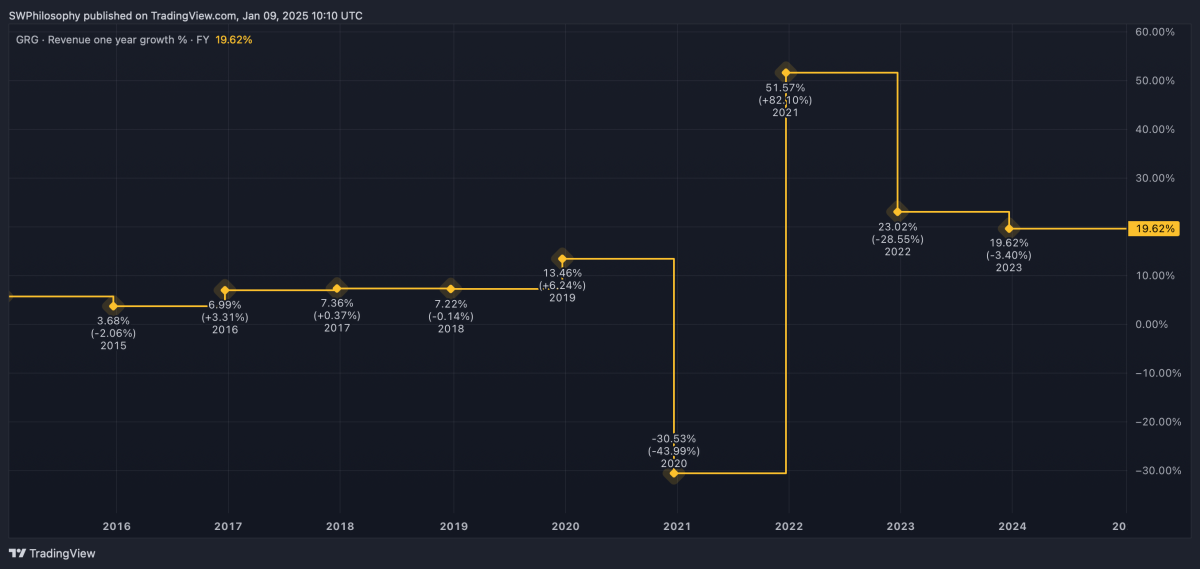
Overall, revenues increased by just under 8%, with around 2.5% coming from like-for-like sales growth. That’st strong, but is the big drop in the stock the buying opportunity I’ve been waiting for?

Sales growth

While 8% growth might seem pretty good, context is everything when it comes to the stock market. It means the firm’s rate of sales growth has been slowing consistently since 2021.

Greggs revenue growth 2015-24

Created at TradingView

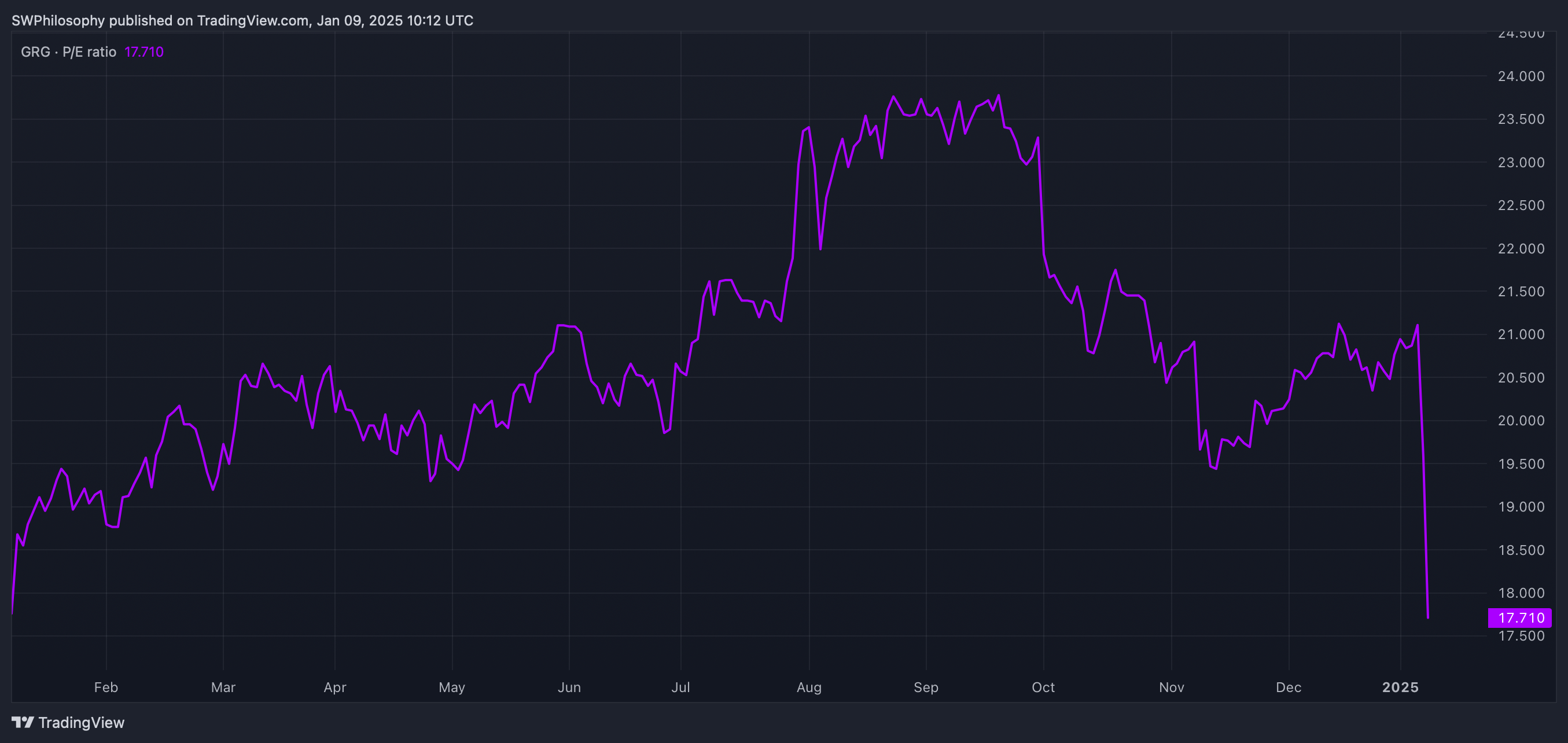
Furthermore, Greggs is a growth stock – and is priced like one. At the start of the week, it was trading at a price-to-earnings (P/E) multiple of 21, which indicates investors are expecting solid growth ahead.

Greggs P/E ratio 2024-24 


Created at TradingView

On top of this, like-for-like sales increasing by 2.5% is a slightly worrying sign. It means that the rest of the increase has come from Greggs opening more stores, which it won’t be able to do indefinitely.

When the firm reaches its eventual capacity in terms of stores, the only way it will be able to keep growing will be like-for-like sales. And the most recent update coming in below inflation is a concern.

Outlook

The outlook for 2025’s also fairly underwhelming. Greggs is expecting to open between 140 and 150 new outlets this year, as well as relocating 50 of its existing stores.

Again, context is key. The company currently has 2,618 venues, meaning the anticipated new openings will only increase the existing store count by around 5.5%.

That means like-for-like revenues are going to have to pick up in order to generate significant sales growth. Given the difficulties in the last quarter, I’m not surprised to see the share price falling. 

Is this my opportunity?

From an investment perspective, I think there’s a lot to like about Greggs as a stock. Despite weak Q4 sales, its business model of providing low-cost food to people is one I think’s going to prove durable.

Over the long term I expect this to also be relatively resilient in difficult economic environments. And the firm has a very strong balance sheet with £125m in net cash, which should add to its resiliency.

The big question in my mind is what price I’m willing to buy it at – and that comes down to its future growth prospects. The company’s aiming for 3,000 outlets, but it’s rapidly closing in on that level.

That doesn’t leave a lot of room for further growth, especially if same-store sales don’t do much more than offset the effects of inflation. And that’s why I’m not rushing to buy the stock right now.

It’s getting close

Even after the latest decline, the Greggs share price is still around 10% higher than where I’d like to buy it. But given the pressure UK stocks have been under, it might well get to this level.

Given the competitive pricing of its products, I think overpaying for Greggs shares would be an ironic mistake. So I’m looking to be patient with this one – but I am hoping for a buying opportunity.

Will ‘biggest ever Christmas’ help keep the Tesco share price climbing in 2025?

The Tesco (LSE: TSCO) share price didn’t do much on Thursday morning (9 January), after the supermarket giant posted a strong trading update for the festive season.

That’s despite CEO Ken Murphy telling us that “we delivered our biggest ever Christmas, with continued market share growth and switching gains.”

He went on to describe Tesco as “the UK’s cheapest full-line grocer for over two years.”

Market share

The third quarter to 23 November, saw a 2.8% rise in total like-for-like sales. And then a bumper 3.8% Christmas lift pushed sales up 3.1% overall for the combined 19-week period.

Perhaps more importantly for the long term, the company said it hit its highest market share since 2016.

Kantar Worldpanel gives Tesco 28.5% of British market share as of 29 December. It’s edged up 1.2 percentage points in the past five years. Aldi and Lidl also gained over the same period, with Asda and Morrisons losing out.

The threat from the cheapies isn’t over. But they haven’t made the inroads that Tesco shareholders might have feared. And we’ve had a tough inflationary time for shoppers too, when the ‘pile it high, sell it cheap’ retailers should have enjoyed an advantage.

Cracking two years

Is the subdued market reaction on the day a surprise or a disappointment? No, I don’t think so, not looking at the recent past. The Tesco share price is already up 19% in the past 12 months, and 47% over two years.

It looks like the 2024-25 year is going in line with forecasts. So this healthy trading was largely expected. Much of the optimism will have already been built in to the share price. And it’s likely that some investors will have been taking some profit off the table.

For the full year, Tesco expects to see around £2.9bn in retail adjusted operating profit. And retail free cash flow should be within the range of £1.4bn to £1.8bn.

Finest

Tesco’s success in the past couple of years has to be down to its two-pronged attack on its rivals.

At one end of the scale, the latest update spoke of a “traditional Christmas dinner available at a 12% lower price year on year.” And that’s got to be the way to lure customers away from Aldi and Lidl.

And the company also reported a 15.5% rise in sales of Finest brand products, taking the challenge to its traditionally more upmarket rivals like Waitrose and J Sainsbury.

What it means

Forecasts put Tesco shares on a full-year price-to-earnings ratio of close to 14. For my money, I think that would probably price the stock about right, with a modest forecast dividend yield of 3.4%.

I might buy Tesco some day. But this year, I’ll be aiming for bigger FTSE 100 dividends.

Still, looking at the Tesco share price history of the past two years, buying sector leaders when their prices are down has to be a strategy worth considering for long-term investors, doesn’t it?

This dirt cheap UK income stock yields 8.7% and is forecast to rise 45% this year!

It’s always a good time to buy a top UK income stock in my view, but some times are better than others. I think that’s the case with housebuilder Taylor Wimpey (LSE: TW). It looks a brilliant buy to consider right now.

After a difficult run, the builder appears to be trading at bargain basement levels. It offers a ridiculously rate of high rate of dividend income, plus outsized capital growth prospects on top.

If forecasts are correct, it could deliver a total return of more than 50% this year. Of course, that’s a big if. Stock predictions must be taken with a mighty dollop of scepticism. Like weather forecasters, analysts can get it badly wrong.

They understandably find it particularly hard to predict hurricane-level events, global shifts that can shake markets to their foundations. Yet barring one of those, I think Taylor Wimpey is well set.

Can the shares recover from their recent beating?

I say that as somebody who holds the stock, and was having a high old time with it last year. Then everything went wrong.

I bought Taylor Wimpey because I expected interest rates to fall sharply in 2024, as most forecasters did.

Instead of the anticipated six base rate cuts, the Bank of England handed us just two. Forecasters now expect two at most this year. They could be wrong again, of course, but that expectation is influencing investor behaviour.

Higher interest rates hit dividend income stocks like Taylor Wimpey. That’s because they allow investors to get a decent inflation-beating return from cash and bonds, without risking their capital.

Taylor Wimpey certainly has risks. House prices remain a stretch, especially for young buyers. Resurgent inflation could drive up the cost of materials and labour, squeezing margins. April’s employer’s national insurance hikes won’t help.

Its shares have fallen by more than 30% in the last three months. Over one year, they’re down 25%.

While the stock now offers a blockbuster trailing yield of 8.69%, investors are still badly down over the last year. I’m disappointed, but not worried. I don’t buy shares with a one-year view.

I plan to hold my Taylor Wimpey shares for years, and with luck decades. That should give its share price plenty of time to recover, and plenty of time for my reinvested dividends to compound and grow.

That’s a stunning dividend

Despite its troubles, Taylor Wimpey has actually performed quite well lately. It now plans to build up to 10,000 ‘units’ over the next year.

Higher interest rates have driven up mortgage rates, making life harder for buyers, but given today’s shortages the housing market remains buoyant.

I like buying shares at reduced valuations. It gives me an extra margin of safety. Taylor Wimpey looks staggeringly cheap, trading at just 11 times earnings. That’s well below the FTSE 100 average of more than 15 times.

The 16 analysts offering one-year share price forecasts have produced a median target of just over 160p. If correct, that’s an increase of a stunning 45% from today’s price of 110p per share (like I said, no guarantees).

In a further vote of confidence, 10 out of 16 analysts rate Taylor Wimpey a Strong Buy. I already hold a big stake so won’t buy more, but I can see why other investors would consider it.

With much to be cheerful about, why is this FTSE 250 boss unhappy?

When JD Wetherspoon (LSE:JDW) floated in October 1992, it reported annual sales of approximately £30m. Today, it’s a member of the FTSE 250, with FY24 (52 weeks ended 28 July 2024) turnover of £2.04bn.

Tim Martin, the founder of the group, retains a near-25% shareholding. Having started in 1979 with one pub in London, he’s now responsible for over 800 of them, throughout the UK and Ireland.

And yet despite this success, he often appears unhappy.

Doom and gloom

A flick through the winter/spring edition of Wetherspoon’s in-house magazine confirms this.

On page four, Martin describes the government’s plans for pubs as “daft”. Understandably, he doesn’t like the sound of reports (now denied) suggesting that opening times should be restricted further.

He also expresses his concerns about an idea floated by academics at Cambridge University to discourage drinking. Reducing the size of pint glasses by around a third would fail, simply encouraging more drinking at home, he claims.

But Martin’s biggest gripe appears to be that supermarkets pay “virtually no VAT” in respect of food sales. In contrast, pubs have to add 20% to bills. He also takes aim at other “large pub companies” who, he claims, have remained silent about this so-called “tax inequality”.

And if this isn’t depressing enough, the pub chain’s chairman is “concerned about the possibility of further lockdowns”.

Let’s raise a glass

But ‘Spoons’ has much to celebrate.

Its FY24 results revealed a 5.7% rise in revenue and a 74% increase in adjusted pre-tax profits, compared to FY23. It also reinstated its dividend, which was suspended during the pandemic.

Earnings per share increased by 77%, to 46.8p.

In its most recent trading update — for the 14 weeks to 3 November 2024 — it reported a 5.9% increase in like-for-like sales, compared to the same period in 2023.

And yet its share price appears to be going in the opposite direction. It’s down 27% since January 2024.

This means it currently trades on a historical price-to-earnings ratio of 12.6. Pre-Covid it was over 20. Now could be a good time for me to invest.

What should I do?

However, the government’s decision to increase the rate of employer’s national insurance contributions has major implications for the business.

It’s expected to add an additional £60m to its annual costs. And given that its pre-tax profit for FY24 was £74m, this is a big hit to its bottom line.

No wonder Wetherspoon’s boss is unhappy about the decision.

In my opinion, the pub chain — famous for its cheap beer and distinctive carpets — is a British icon. But this doesn’t mean I want to invest. I think the national insurance hit is too big to overlook.

And I’ve noticed that the company’s share price started falling before the budget. It fell 8% in the week up to the Chancellor’s statement and, since then, it’s down a further 9%.

This suggests a loss of investor confidence even before the full implications of the government’s new tax policies were known. It seems to me that the stock’s fallen out of favour for no apparent reason.

It’ll need something to change fundamentally for sentiment to recover. And at the risk of sounding as gloomy as Tim Martin, I don’t know what this could be.

For these reasons, I’m not going to buy.

2 huge investment risks I’m worried about in 2025

Investing is risky as well as rewarding, and I’ve been thinking about two investment risks that I’m worried about in particular.

2024 was a fairly good year for the UK share market with the FTSE 100 gaining nearly 6%. But now, with the year becoming a distant memory, my mind has turned to protecting my portfolio in the months ahead.

While I’m optimistic about investing in UK stocks, there’s plenty of uncertainty in the world and I’m considering buying GSK (LSE: GSK) shares as a result. But first, let’s look at those two risks.

Geopolitics

Last year was the year of elections. A big chunk of the world’s population headed to the polls including the US where Donald Trump claimed victory to secure a second term.

Analysts are watching carefully to see what policy changes the new administration will put in place. Many are tipping that deregulation could pave the way for more investment activity including mergers and acquisitions.

On the other hand, tariffs are widely expected but just how much and on which products are unclear for now. These could well stifle global and UK economic growth in 2025, despite the British government’s efforts to boost spending in key areas like housing.

Inflation pressures

Stubborn inflation is also weighing on my mind. Potential trade policy changes in the US could raise prices just as it had seemed inflation was coming under control.

Similarly, increased UK government spending could increase demand (and prices). Any large surprises may well spook investors as that could well mean the Bank of England takes a different interest rate policy path versus expectations.

Where I want to invest

These are just two investment risks that are on my mind right now and I’m looking to add more defensive exposure to my portfolio.

The Footsie boasts a number of large pharmaceutical companies, including AstraZeneca and GSK. The latter is the one that I’ve been narrowing in on in recent weeks as a potential buy.

The resiliency of the sector is certainly one part of my thinking. However, I also like that it’s a UK-based company with global footprint including strong links to the US.

Pharmaceutical companies can often pass on rising costs quite effectively to their customers, which can provide something of an inflation hedge. I also think the company’s track record as a dividend payer shows it can be investor-friendly in returning capital.

Key risks

Of course, GSK isn’t immune to risks. While the company has been actively building its research and development pipeline, there’s always uncertainty surrounding drug approvals as well as fierce competition from rivals.

Customers may also eventually reject price increases, which could hurt profitability, as could fierce competition from rivals.

Valuation

Yet the company’s 13.9 price-to-earnings (P/E) ratio is below the 14.5 average for the Footsie and looks a little cheap for a large player in a defensive industry. Rival AstraZeneca’s shares are trading at a multiple of 32, albeit it does have a £167bn market cap compared to GSK’s £56bn.

I’m certainly considering GSK shares as a way to help hedge against some of the investment risks I see looming in 2025. It’s one of the names up the top of my list to buy when I gather the funds to buy.

Financial News

Daily News on Investing, Personal Finance, Markets, and more!

Financial News

Policy(Required)