Why it’s hard to build wealth with a Cash ISA (and some other options to explore)

The Cash ISA is a popular financial product. Government figures show that today, millions of Britons have savings in them.

They’re a good way to save money, earn tax-free interest on it and know that it’s safe. What a lot of people don’t realise though is that it’s hard to build real wealth with a Cash ISA. Below, I’ll explain why, and also highlight some other options to consider.

Please note that tax treatment depends on the individual circumstances of each client and may be subject to change in future. The content in this article is provided for information purposes only. It is not intended to be, neither does it constitute, any form of tax advice. Readers are responsible for carrying out their own due diligence and for obtaining professional advice before making any investment decisions.

Cash ISA returns aren’t great

History shows that it’s hard to get ahead financially with a simple cash savings product like the Cash ISA. The issue is inflation. Often, it averages between 2%-3% per year (in the UK it spiked up over 10% during the coronavirus pandemic).

If it’s running at 2.5% and you’re earning 4% from a Cash ISA, you’re really only growing your money at 1.5% a year in ‘real’ terms after inflation. That’s not ideal.

Invest £100,000 for 20 years at a return of 1.5% a year, and you’ll end up with just £135,000.

Building real wealth

To actually build wealth over the long term, it’s smart to consider stock market-based investments such as stocks, funds, and exchange-traded funds (ETFs). These can be held inside products such as the Stocks and Shares ISA, Lifetime ISA, and Self-Invested Personal Pension (SIPP).

Over the long term, the stock market tends to return around 7%-10% per year on average. So, it can be a powerful tool in the battle against inflation.

For example, let’s say that one was able to generate a return of 9% per year from stocks for 20 years. And over that time, inflation stayed at 2.5%.

In this scenario, the investor would be looking at real returns of 6.5% per year. That kind of return would take a £100,000 investment to about £352,000 over the course of two decades (that’s £352k in today’s money).

That would be a good result. The investor would have more than tripled their wealth.

Investing in stocks

Of course, investing in the stock market is more complex than investing in a cash savings product. But you’d be surprised how easy it is to build a basic long-term portfolio today.

A good place to start is a global tracker fund. One example to consider here is the Vanguard FTSE All-World UCITS ETF (LSE: VWRP).

This provides exposure to over 3,500 stocks from a range of countries. So it could be a great foundation for a portfolio.

With this fund, one gets exposure to lots of world-class businesses including the likes of Apple, Nvidia, and Visa. And ongoing fees are low at just 0.22% per year.

In terms of performance, it returned 61% for the five-year period to the end of 2024 (in US dollar terms). That equates to an annualised return of about 10%, but past performance isn’t an indicator of future returns.

It’s worth pointing out that this kind of product can be volatile in the short term. If there are concerns about the global economy, or geopolitical risks, its share price can fall.

I think it’s a great place to consider starting though. From there, one could potentially look at adding in some growth stocks such as Amazon or Microsoft to try and boost returns. Over the last 20 years, these stocks have returned far more than 10% per year.


I bought this FTSE stock to beat the index over the next 4 years

A week can be a long time in financial markets. So when I recently found a FTSE company that I thought could outperform the broader market for several years, I understood why some of my friends were sceptical. Yet the addition to my portfolio is one that I feel could do very well. Here’s why.

Already on the move

I’m talking about Balfour Beatty (LSE:BBY). The multinational infrastructure group specializes in construction and support services. Over the past year, the stock is up an impressive 25%.

Part of the reason behind the move over this period has been improved financial results. Even though the company is a mature firm, it’s still managing to post yearly growth. The latest trading update from December showed that profit before tax should be ahead of prior year and “slightly ahead of market expectations”.

Looking forward, the order book is growing, which is good news for 2025 and beyond. Importantly, this is being “driven by momentum in the Group’s chosen growth markets, principally UK energy and US buildings”.

The fact that focus is on the UK and US markets leads me to the exact reason why I think the next few years could be strong for the share price.

Higher fiscal spending

As we start 2025, the UK Labour Government are starting the first full year in power, and a new US President about to take power. Both leaders have made it clear they are planning on boosting infrastructure spending in the coming four years.

Balfour Beatty is well placed to take advantage of this, given the existing ties to government departments and a history of securing contracts in these areas. I feel that the US could enact more (and more lucrative) spending plans. The half-year results showed that US construction revenue was £1.7bn, higher than the £1.5bn from UK construction. This shows that the US is already a larger market than the UK in this area. It’s not like Balfour Beatty is just beginning to tap into this market.

Of course, the contract wins will take time to come through. It’ll also take time for the money to filter down to Balfour profits. But I’m thinking about holding this stock for the next few years. Over this time horizon, I expect the share price to rally from current levels as investors realise the benefits that the contracts bring.

One eye on funding costs

There are risks associated with the company. One is that although it has a disciplined approach, it still uses some debt to finance projects. As a result, the fact that interest rates are remaining higher than many thought will mean that funding costs in both the UK and US could be higher than anticipated.

I’m happy to own the stock and feel that investors can consider doing the same.

The Sainsbury’s share price dips despite a bumper Christmas – it’s now cheap as chips

By all rights the Sainsbury’s (LSE: SBRY) share price should be climbing today (10 January). Instead, it’s dropped almost 3%.

This morning’s Q3 results should have the champagne corks popping with sales jumping 3.8% over the four weeks to January 4.

Party food sales were up nearly 40%, with more than 200 bottles of fizz sold every minute over Christmas. This is brilliant news because retail stocks can take a beating if they don’t deliver some festive fun.

It also puts today’s economic gloom into perspective. Shoppers still have money to spend as wages rise faster than inflation.

A happy New Year for this FTSE firm?

Sainsbury’s now expects annual underlying retail operating profit to increase 7% in the current financial year. That puts it bang in the mid-point of its guidance range of between £1.01bn and £1.06bn.

Hargreaves Lansdown equity analyst Aarin Chiekrie praised the Sainsbury’s drive to improve quality, value and service: “It’s managed to claw more market share from the competition and deliver its seventh consecutive quarter of volumes growing ahead of the sector average.” Given all the good news, why are its shares falling?

Third-quarter sales rose at the slightly slower rate of 2.8% on an underlying basis. While grocery sales jumped 4.1%, general merchandise and clothing fell 0.1%. Sales at the group’s Argos business fell 1.4%.

Chiekrie warned its general merchandise operations puts it in the most cyclical area of the supermarket economy: “This really slows you down when times get tough.”

Sainsbury’s has cemented its position as the UK’s second-biggest grocer after Tesco, with market share up to 16%, according to Kantar. That’s comfortably ahead of Asda at 12.5%.

Sadly, its share price hasn’t done anywhere near as well. It’s slumped almost 15% over the last year. Over the same period, Tesco is up more than 22%.

A top dividend stock with a low valuation

On 17 December I wrote that stock markets had underestimated Sainsbury’s. That still appears to be the case. It now looks incredibly cheap, with a price-to-earnings ratio of 11.91, and I feel it’s worth considering. The trailing dividend yield has crept above 5%. Shareholder payouts look well supported by £500m of free cash flow.

It’s yet another example of how downbeat economic sentiment has hammered FTSE 100 valuations. This offers an opportunity for long-term investors to pick up a solid blue-chip at a reduced price, and hope it enjoys a re-rating at some point.

The 12 analysts offering one-year share price forecasts have produced a median target of just over 310p. If correct, that’s up more than 20% from today. Combined with that yield, this would deliver a total return of 25%. No guarantees, of course!

2025 still looks like being a tough year. Resurgent inflation will drive up costs and squeeze shoppers. Plus Sainsbury’s also has to cover Labour’s employers’ National Insurance hike, as well as the inflation-busting rise in the minimum wage. The UK grocery market remains intensely competitive.

The shares look like a bargain but investors may have to be patient. That re-rating will take time. It may never happen. But today’s low valuation gives a margin of safety, and there’s always that yield.

Here are the official 2024 returns for the FTSE 100 and FTSE 250 (including dividends)

The FTSE 100 and the FTSE 250 are closely-followed UK stock market indexes. A lot of British investors have exposure to them via tracker/index funds.

Interested to know how these indexes performed in 2024? Here’s a look at their total returns for the year (gains plus dividends).

The figures

Earlier this week, FTSE Russell published its factsheet for the FTSE UK series. And the performance figures were interesting.

For 2024, the FTSE 100 delivered a total return of 9.7%. This was its best performance since 2021 when the large-cap index returned 18.4%.

As for the mid-cap FTSE 250, it delivered a lower return of 8.1%. However, this was also its best performance since 2021 when it returned 16.9%.

Some observations

Looking at these figures, I have several thoughts.

First, the indexes produced respectable performances in 2024. Over the long term, the stock market tends to return around 7%-10% a year on average. Last year, both indexes delivered that kind of return.

That said, these figures are a little disappointing relative to the percentages other major stock market indexes managed. Over in the US, the S&P 500 delivered 25% in total. Meanwhile, for the Nasdaq 100 it was 25.9% (both of these are calculated in dollar terms). This shows the importance of diversifying globally when investing in stocks. By taking a global approach, a British investor could have potentially generated more wealth.

Second, dividends played a large role in these figures. I calculate that in price terms, the FTSE 100 rose 5.7% for the year while the FTSE 250 climbed 4.7%, so dividends boosted overall performance significantly.

Another takeaway is that the FTSE 250 underperformed the FTSE 100 by a decent margin. Clearly, the domestic focus of the FTSE 250 hurt its performance. While FTSE 100 companies tend to have more global revenues, FTSE 250 companies are often more focused on the UK. Again, this highlights the importance of global diversification.

Building a global portfolio

It’s worth pointing out that it’s very easy to build a global portfolio today.

One simple option to consider is a global tracker fund such as the iShares Core MSCI World UCITS ETF (LSE: SWDA). With this exchange-traded fund (ETF), one gets exposure to about 1,400 stocks from a range of countries including the US, the UK, Japan, Australia, France, and Germany.

Among these stocks are names such as Apple, Microsoft, and Amazon. In other words, it offers access to world-class businesses.

In terms of performance, this ETF returned 18.7% last year (in dollar terms), which is excellent. Over the five-year period to the end of 2024, it delivered a return of 11.2% a year. These figures don’t include trading fees and platform charges though. And as always, past performance isn’t an indicator of future returns.

It’s worth pointing out that there are some risks to consider with a product like this. One is that it has a lot of exposure to the US market (about 74% currently). Another is that it trades in US dollars. So GBP/USD fluctuations can have an impact on returns for UK investors.

I think this ETF could be a great foundation to consider for a portfolio though. I like the idea of having this as a core holding and then buying some high-quality individual stocks such as Nvidia or Uber to try and boost long-term returns.

Why isn’t the promise of 1.5m more homes helping these FTSE 100 stocks?

It’s been a miserable time for shareholders in the FTSE 100’s builders. Following a dismal performance over the past three months or so, all four stocks are trading close to their 52-week lows.

Persimmon‘s (LSE:PSN) been particularly badly affected. Its shares have crashed nearly a third since early October.

In terms of market-cap, three of them are now in the bottom seven of Footsie stocks. Two of the other places are occupied by British Land and LondonMetric Property, further evidence that UK property shares are currently out of favour with investors.

And yet the government’s pledged to build 1.5m new homes during the lifetime of the current parliament. It wants to implement a series of planning reforms to increase the supply of housing.

The real issue

But in my opinion, this isn’t the problem. The emphasis needs to be on stimulating demand. When the final figures are tallied for 2024, Persimmon expects to have built 10,500 homes. This is 28.6% below its 2019-2022 average (14,712).

At 30 June 2024, the company owned 81,545 plots. Of these, 38,067 had “detailed planning”. If the demand was there, I’m sure the company would welcome the opportunity to build (and sell) more houses. Based on its current run rate, it has sufficient plots — with planning permission — to see it through the next 43 months.

But there aren’t enough people out there wanting to buy a new property. The government’s reduced the incentives available for first-time buyers, which is a particular problem for Persimmon with its houses costing less than its rivals.

And consumer confidence has been further dented by the government’s decision to increase employer’s National Insurance and borrow more to invest. The yield on 10-year gilts is at its highest level since 2008. This is the benchmark used by financial institutions to price mortgages.

Reasons to be optimistic

However, in my opinion, it’s important not to get distracted by short-term price volatility. And looking further ahead (three to five years), I believe there are may reasons why the sector will recover. That’s why I plan to hold on to my Persimmon shares.

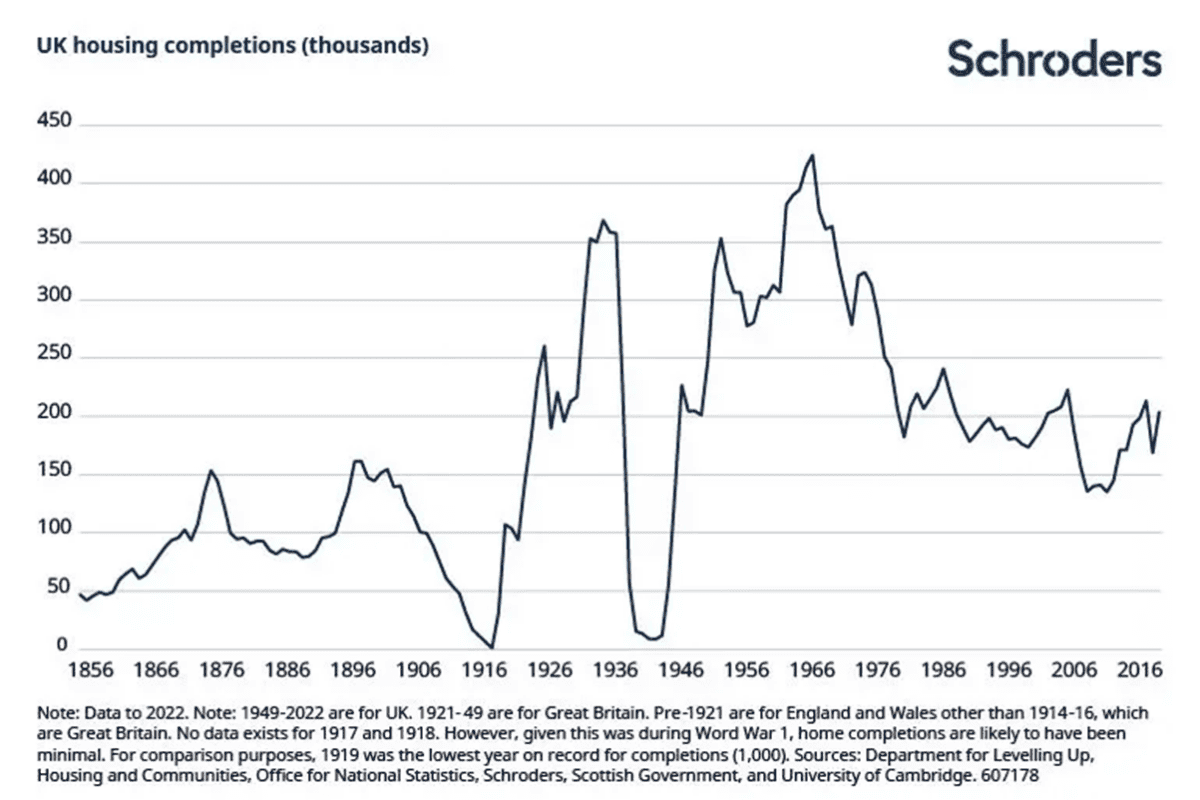
I know history isn’t necessarily a good guide but, in the absence of a crystal ball, it’s a useful indicator of future trends. And a look back at completions since 1856 shows there have been plenty of slumps — and subsequent recoveries — in the UK property market.

Source: Schroders

A recovery is dependent on the fortunes of the wider economy. And most ‘experts’ are expecting UK GDP to grow in 2025 — for example, KPMG (1.7%), International Monetary Fund (1.5%) and Goldman Sachs (1.2%).

Also, UK interest rates are expected to fall further over the next 12-24 months.

And looking more closely at Persimmon, despite its recent woes, it doesn’t have any debt on its balance sheet. What’s more, based on the anticipated dividend in respect of its 2024 financial year (60p), it’s currently yielding an impressive 5.6%.

I believe the government’s planning law changes are more likely to help the FTSE 100’s builders in the next parliament. Before then, I believe a recovery in their share prices will be driven by improved consumer confidence, lower interest rates and generous dividends. For these reasons, I plan to hold on to my Persimmon shares.

3 great investment trusts to consider for a Stocks and Shares ISA in 2025

When choosing assets for a Stocks and Shares ISA, it’s worth considering investment trusts. These closed-end funds provide exposure to a variety of assets and can add a level of stability to a portfolio. This can be particularly beneficial for beginners who are uncertain about which stocks or sectors to invest in.

However, like any asset, the value can rise and fall. A trust’s past performance gives some insight into its growth potential and volatility but is no indication of future results.

Investment trust Dividend yield Ongoing charges Key sectors 5-Year total return
F&C Investment Trust 1.6% 0.51% Global, diversified 48.4%
City of London Trust 5.2% 0.38% UK equity income -3.5%
Scottish Mortgage 0.5% 0.34% Tech, healthcare 68%

F&C Investment Trust

F&C Investment Trust (LSE: FCIT)  is one of the oldest and most diversified trusts in the UK, with a strong track record of dividend growth. The yield may be low but payments are reliable.

In addition to shares in popular S&P 500 companies like Nvidia, Microsoft, and Apple, it also invests in emerging markets across Latin America, Asia, and Europe.

Often cited as one of the best global investment trusts, its price typically trades at an 8% to 10% discount to the net asset value (NAV). It’s up 21.16% in the past year and 48.42% over five years.

However, its global exposure makes it sensitive to geopolitical events, such as trade tensions, wars, and regulatory changes. These could affect the fund’s performance.

City of London Investment Trust

The City of London Investment Trust (LSE: CTY) is a popular high-dividend investment trust with a 5.2% yield. It has increased its dividend for 58 consecutive years, putting it at the top of the Association of Investment Companies (AIC) ‘Dividend Heroes’ list.

It’s renowned for stable income generation, adopting a defensive portfolio with a focus on blue-chip UK companies. Holdings include leading FTSE 100 companies like HSBC, Relx, Shell, and Unilever

However, this can leave it overly exposed to the domestic economy. If the UK economy struggles, the price is likely to suffer too. This likely contributed to the trust’s weak performance over the past five years, as inflation hurt local markets.

Yet through it all, it’s continued to deliver value via dividends.

Scottish Mortgage Investment Trust 

Scottish Mortgage Investment Trust (LSE: SMT) is a high-growth investment trust with a focus on global innovation. In addition to popular tech stocks like Amazon and Meta, it diversifies into some healthcare and retail companies, such as Mercadolibre and Moderna.

It’s grown at an annualised rate of 14.5% per year over the past 20 years. However, due to its propensity for emerging tech, it can be volatile. Between March 2020 and June 2022, the price fluctuated wildly between £5 and £15. This makes it better suited to investors with a higher risk appetite.

Since stabilising around £6.20 in April 2023, it’s increased by 58%. As a growth-focused stock, it has a negligible dividend and low fees of only 0.34%.

Conclusion

A key advantage of including investment trusts in an ISA is to better align it with macroeconomic trends. With a high level of diversification, they can provide stability against interest hikes and inflationary pressures.

While their short-term gains pale in comparison to high-growth stocks, they can be lucrative over the long run. I believe any investor looking to build wealth with an ISA should consider including some investment trusts in their portfolio.

Why Warren Buffett fears AI – and where savvy investors could spot an opportunity

Last year, billionaire investor Warren Buffett famously compared artificial intelligence (AI) to nuclear weapons. Like letting a genie out of a bottle, he fears the technology could have disastrous and irreversible effects.

When the first nuclear weapon was tested in 1945, he was 15 years old and had already been investing for four years. Regardless of that, his track record means It’s safe to say his words shouldn’t be taken lightly.

But like it or not, AI isn’t going away. By now, it’s so deeply embedded in all aspects of society that any attempt to ‘rebottle the genie’ would likely fail. One thing I’ve learned in my 40-odd years is that there’s no point standing in the way of progress.

So rather than fear an imminent AI meltdown, I’m doing what any good investor would do and searching for opportunities.

Hidden value

AI stocks are a plentiful these days, so it’s important to separate the wheat from the chaff. The trick is to avoid value traps while identifying true innovators.

Some may assume the obvious options are semiconductor giants — Nvidia, Broadcom, and AMD. In some ways, yes. After all, they’re the ones “selling shovels in a gold rush“, that is, providing the tools to power AI models. 

But while that may be true, I think there are more lucrative opportunities elsewhere.

If Buffett’s right and AI is more nuclear than gold, we’ll need security not shovels. That’s where the world’s third-largest cybersecurity firm comes in.

Fighting fire with fire

Even the brightest minds in AI have admitted that they “don’t really know how it works“. 

That’s by design. It wouldn’t be very intelligent if it was just following instructions. As hackers increasingly adopt it to streamline their attacks, only AI-enhanced security will be fast enough to respond effectively.

Fortinet‘s (NASDAQ: FTNT) one of the companies at the forefront of developing AI-enhanced cybersecurity. Its FortiAI generative AI assistant is aimed at automating tasks to help analysts rapidly respond to threats and develop pre-emptive defence strategies. According to the company, it can “adapt and evolve, continuously learning from new data and improving its ability to identify and counter emerging threats”.

But if 2024 has taught us anything, it’s that even the world’s toughest security giants are vulnerable. In September last year, Fortinet revealed it had suffered a data breach on a third-party cloud drive. The hacker reportedly demanded a ransom and released 440GB of confidential data when the company refused.

In this instance, the breach was small but a bigger one could cause a lot of reputational – and financial – damage. When you’re responsible for the world’s data, a slight error can be devastating. Just ask Crowdstrike.

Solid performance

With a profit margin of 36% and return on equity (ROE) of 168.5%, its recent performance speaks for itself. In the latest Q3 2024 results, revenue and profits exceeded analysts’ expectations by 1.9% and 58% respectively.

Based on future cash flow estimates, the $96 shares are trading at 30% below fair value. Currently, at around 48 times earnings, that price initially seems a bit overvalued. But that ratio’s only slightly above the industry average for US software companies.

So while Apple, Meta and Amazon dominate the headlines, I think Fortinet could emerge as a dark horse in the race for the AI crown.

Is the 12.3% yield on this UK dividend stock too good to be true?

Vanquis Banking Group‘s (LSE:VANQ) a dividend stock that caught my eye over Christmas. I noticed that the sub-prime lender was listed as the 11th best on the FTSE All-Share index for passive income.

But these league tables need to be treated with caution.

As nobody’s able to predict future payouts with any certainty, yields tend to be calculated on a historical (‘trailing 12 months’) basis. And using this methodology, having returned 6p to shareholders over the past year — and given its current (8 January) share price of 48.95p — it’s fair to say that the bank’s stock is, indeed, yielding 12.3%.

Bad news

But in March 2024, the bank’s shares halved in value after it said it had received an increase in complaints and that the “associated costs are likely to materially impact the Group’s profitability in 2024”.

The directors immediately cut the dividend for 2024 to 1p. Therefore, based on the company’s current share price, the ‘true’ yield’s a more modest 2.1%.

With the company promising only “measured progression in 2025”, it’s likely to be several years before the bank’s in a position to return (in cash terms) to its previous level of dividend.

However, although the stock’s status as a dividend share has been tarnished, I wonder whether it could be an excellent growth share for me.

A specialist lender

Vanquis provides finance to those with a “less than perfect credit history”. Due to the increased risk of default, its lending rates are high. For example, its credit cards have an APR of 37.9%.

At first sight, this feels like the most vulnerable are being exploited. But it’s estimated that 3m people borrow on the black market where there’s no regulation and interest rates are far higher.

By charging more, the bank’s able to earn a higher margin than rivals. During the first six months of 2024 (H1 24), it reported a net interest margin of 18.8%. Lloyds Banking Group’s was 2.94%.

However, these margins are reported before potential bad debts and loan write-offs. And this is where Vanquis has a major problem. During H1 24, these accounted for 43% of total income.

A different approach

To counter this, the bank‘s transitioning to a new business model. At the moment, most of its 1.7m customers are described as “under financial pressure”. Vanquis is now looking to expand into the “stretched but managing” cohort.

And to help further manage the risk of default, it plans to adopt a new money management app called ‘Snoop’. This uses artificial intelligence (AI) and open banking data to help users control their spending. It reckons the average customer can save £120 a month with the product.

In future, these savings will be used to help those customers in financial difficulty. Until now, bad loans would’ve been written-off with a negative impact on the bank’s bottom line. Under this new approach, an impairment charge is avoided helping to maintain earnings. In this situation, the bank claims “everybody wins”.

I think the new strategy being pursued by Vanquis is an interesting one. But I think it’s a little too early to tell whether it’s going to work. I’m therefore going to watch how the bank performs over the next six months or so before revisiting the investment case later in 2025.

2 dividend growth stocks analysts think are strong buys right now

Growth stocks can be great investments for generating wealth. But the best businesses can increase their revenues and profits while also distributing cash to shareholders as dividends. 

There are a couple of companies I think are especially interesting from this perspective. And analysts seem to agree at the moment. 

Games Workshop

Shares in Games Workshop (LSE:GAW) are up 35% over the last 12 months. Nonetheless, the three analysts covering the stock still seem to think investors should consider buying it. 

The stock looks expensive at a price-to-earnings (P/E) ratio of around 29. But the company’s low capital requirements allow it to distribute almost all of its income to shareholders as dividends.

As a result, Games Workshop shares currently come with a dividend yield of almost 3%. That’s close to the FTSE 100 average from what I think is an extremely high-quality business.

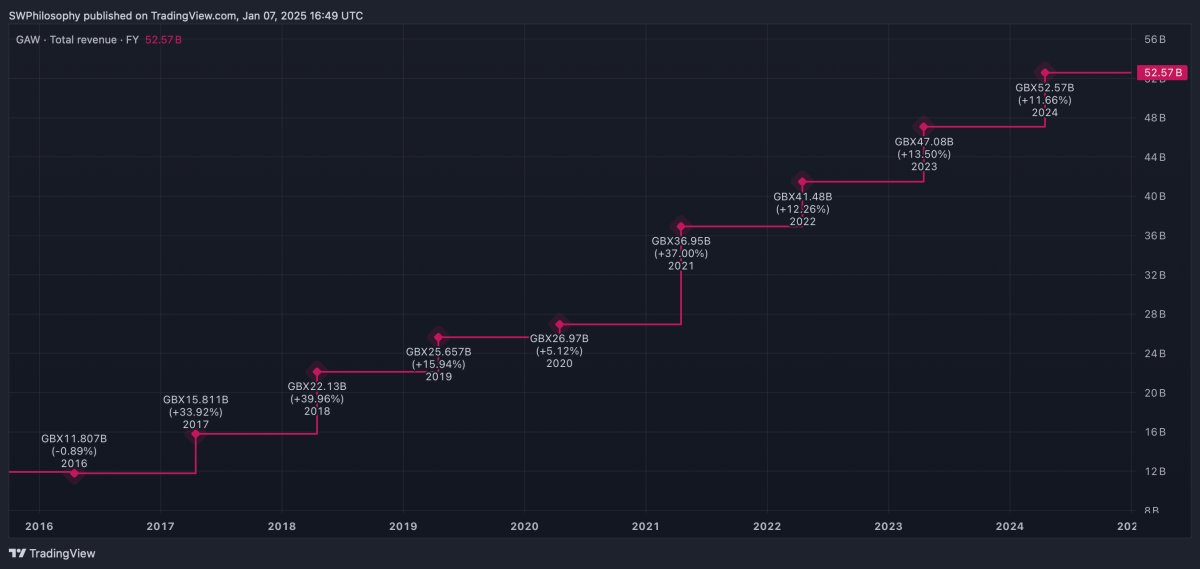
Over the last decade, the company’s grown its revenues at an average of almost 16% a year. And the most impressive thing is it’s done this while reinvesting almost none of the cash it’s generated.

Games Workshop Total Revenues 2015-24

Created at TradingView

The biggest risk with Games Workshop is demand. While its Warhammer products are extremely popular, they’re also non-essential and therefore at risk during downturns in consumer spending. 

Investors should therefore be prepared for ups and downs. But I think the firm’s strong intellectual property and impressive cash generation make this a good stock to consider buying.

James Halstead

James Halstead (LSE:JHD) manufactures vinyl flooring for commercial venues. And despite the share price being down almost 9% over the last year, it still attracts a Strong Buy analyst rating.

Revenues fell almost 10% during 2024. The company put this down to weaker demand due to an economic downturn in the UK and Europe – two of its largest markets.

That’s an ongoing risk with the business. But there’s also a lot to like about it and I think investors should see the decline in the share price as an opportunity to consider buying the stock.

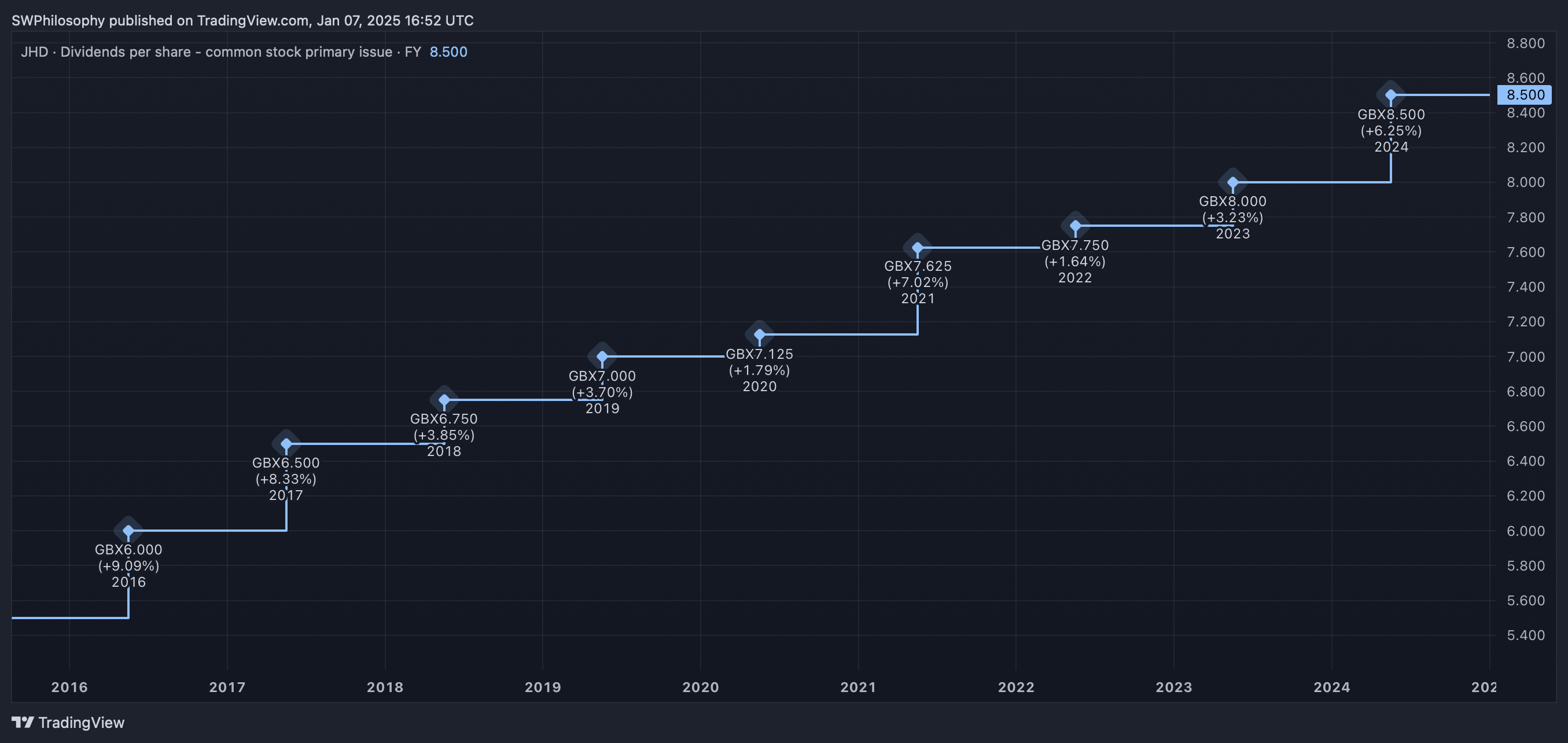
Like Games Workshop, James Halstead distributes the vast majority of its net income to shareholders. And it has increased its dividend each year for almost half a century.

James Halstead Dividends 2015-24


Created at TradingView

Right now, the dividend yield’s 4.72%. And that compares favourably with the return on offer from a 10-year government bond, which is currently 4.6% a year.

This means that, even before thinking about future growth, investors have a good chance of doing better with the stock over the next decade than with a bond. And that’s why I think it’s one to consider buying.

Quality shares

Games Workshop and James Halstead both come with Strong Buy recommendations from analysts. While these are likely driven by short-term considerations, I think long-term investors should take a look.

Both businesses have the ability to keep growing while returning cash to shareholders. That’s something I think marks them out as quality companies that are worth considering.

I asked Anthropic’s Claude for the best FTSE 100 stock to buy right now. I’m impressed with what it said

Artificial intelligence (AI) is giving some businesses a real edge over their competitors. So I thought I’d try asking Anthropic’s Claude about investing in the FTSE 100

I asked it what the best FTSE 100 stock to buy right now is. And while I had some high expectations, I was impressed with the answer it gave. 

What I expected

Before asking, I thought it might give 3i (LSE:III) as an answer. Over the last five years, the stock is up 235% – more than any other FTSE 100 stock – and this hasn’t happened by accident. 

Around 75% of the private equity firm’s portfolio consists of a stake in a European discount retailer called Action. And this has been growing rapidly and is still increasing sales by around 21% per year.

On top of this, 3i has managed to get itself into a position where it has a huge advantage over its peers. This comes from the fact it invests its own capital, instead of that of external investors.

As a result, the company can be patient and wait for opportunities to present themselves, which allows it to be greedy when others are fearful. But there are clear risks for investors to consider.

These include the concentrated nature of its portfolio and fact that even the best capital allocators – like Warren Buffett – can make investment mistakes. But no stock is entirely without risk.

That’s why I thought Claude might have identified 3i as the best FTSE 100 stock to buy right now. But it didn’t and I think the answer it gave is much better.

What the AI said

What Claude actually said was the following:

“I aim to be direct and clear about investment advice: I cannot and should not recommend specific stocks to buy, as this would constitute financial advice, which I’m not qualified to give.”

Instead, it suggested I do my own research, consider my time horizon, and focus on the fundamentals of the businesses I might invest in. Claude doesn’t give financial advice, but that looks like a good plan.

It’s actually better than if Claude recommended me a specific stock. Even if it had been right, without understanding the company – by doing my own research – it would be very difficult to invest in it.

All stocks go through ups and downs. And the only way for investors to be confident enough to persist with them when things are volatile is by having a clear idea about the underlying business.

When a company’s share price falls, it’s either due to a temporary issue or a permanent problem. In the former case the stock is likely to recover, but in the latter it might be time to consider selling. 

The only way to know is to understand how the business works and what’s going on with it. And that’s something that can only come from proper research, rather than looking to AI for stock tips.

Is AI the future?

While I’m still convinced AI has huge potential, there are some things that people have to figure out for themselves. Investing is one of them.

I don’t see buying stocks on the basis of recommendations from an AI assistant as a recipe for long-term success. So I’m impressed Claude knows where its limits are.

Financial News

Daily News on Investing, Personal Finance, Markets, and more!

Financial News

Policy(Required)