2 super-value FTSE 100 shares to consider right now!

Despite worries over the global economy and stubborn inflation, the FTSE 100 continues to make tracks at the start of 2025. In fact, the UK’s leading share index is now within a whisker of last May’s record highs above 8,400 points.

It’s been a strong couple of years for the Footsie. Yet long periods of underperformance mean that many top blue-chips are still trading at dirt cheap prices.

Here are two of my favourite FTSE 100 value shares today. Not only do they trade on rock-bottom price-to-earnings (P/E) ratios, they also carry tremendous market-beating dividend yields.

FTSE 100 share P/E ratio Dividend yield
HSBC (LSE:HSBA) 7.7 times 6.5%
Rio Tinto (LSE:RIO) 8.5 times 6.6%

Let me explain why I think they’re worth serious consideration.

Top bank

Asia-focused HSBC’s tipped to endure a slight earnings drop in 2025. This reflects in part the ongoing threat posed by China’s weak economy, and more specifically its slumping property sector.

But encouragingly, the bank’s so far managed to effectively navigate the tough trading environment. In the third quarter of 2024, it beat broker forecasts to post revenues and profits growth of 5% and 10% respectively.

I wouldn’t bet against HSBC beating full-year estimates for this year either, helped by ongoing efforts to accelerate cost cutting. According to Bloomberg, the bank’s targeting £3bn of savings through restructuring efforts that it aims to complete by June.

I think HSBC shares could deliver great long-term returns as financial product demand surges across its emerging markets. It has the scale and the brand power to supercharge its earnings growth, and plans to split its operations between ‘East’ and ‘West’ should help meet its goals.

Great miner

Rio Tinto’s another Footsie share expected to post a slight earnings dip in 2025. This also reflects problems in China’s commodities-hungry economy, allied with a broader slowdown of global growth.

Yet I believe it’s a value stock for patient investors to consider. I hold it in my own Stocks and Shares ISA and plan to increase my holdings when I next have spare cash to invest.

Over a longer time horizon, the outlook for major mining stocks like this remains compelling. Rio Tinto — which has a market-cap of £59bn — has the strength to weather temporary weakness in metal prices.

Expertise across a range of commodities including copper, iron ore and lithium means it’s well-positioned to capitalise on demand growth when the market upturn eventually comes. Factors like global decarbonisation, emerging market urbanisation and the growing digital economy should all lift industrial metals consumption substantially from current levels.

What’s more, a strong balance sheet gives Rio room to boost earnings growth through acquisitions and organic investment. Latest financials showed its net debt to underlying EBITDA ratio at just 0.4 times.

Prediction: these FTSE 100 stocks could be among 2025’s big winners

Which FTSE 100 stocks have the best chance of leading the index by the end of 2025? I think the odds are good for these three.

BP (LSE: BP.) is among the top 10 FTSE 100 buys at Hargreaves Lansdown of late, and I think I can see why.

Yes, the world has to turn away from fossil fuels eventually. And yes, renewable energy investments might prove to be profitable in the long term — if we can find the right ones.

But I’m seeing a change in sentiment, with the love for alternative energy stocks fading a bit. And there’s a growing feeling that big oil could provide fat profits for some years yet.

BP’s low valuation

The BP share price had been sliding in 2024, but its already started to pick up. Why? Maybe because investors are looking past the expected earnings fall for 2024 and to a forecast price-to-earnings (P/E) ratio of just eight for 2025?

Oh, and there’s a 5.6% dividend yield on the cards.

Vodafone comeback?

After falling 55% in five years, can Vodafone (LSE: VOD) switch into top gear in 2025? I see a very good chance of it.

I think it could all depend on results for the year ending March 2025, due in May. We all know the dividend should be slashed to half of last year’s.

That’s part of CEO Margherita Della Valle’s plans to kickstart the company, launched in 2023. And 2024’s dividend was the last at the old rate.

Still, with the Vodafone share price falling since then, we’re already back up to a projected yield of 8.5% for this year.

Show us the results

Will the full-year update show results of the company’s shake-up, and provide confidence in the dividend going forward?

That’s what I think any possible 2025 resurgence could hinge on.

Sporting rebound?

JD Sports Fashion (LSE: JD.) was one of the worst FTSE 100 performers in 2024, losing more than 70% after the Christmas 2023 trading season fell short of expectations.

But it’s started to pick up a bit this year, and as we await 2024 festive figures.

One of my colleagues at The Motley Fool recently spoke of healthy footfall at JD. So I poked my head into my local branch, and yes, there were plenty of people in there.

Current fundamentals might not make JD look like a screaming buy, not with a forward P/E of 12 and only a 1% dividend yield. But that’s after a tough 2024. And analysts see the P/E dropping to around 7.3 in the 2025-26 year.

Watch for recovery

If JD looks like it might be hitting those forecasts, I wonder if it might even become a takeover target in 2025? I’d never buy just on that hope. And it’s always important to be cautious about forecasts. Oh, and retail could still face a tough year.

But JD Sports is one of my top recovery candidates to consider in 2025.

Eyes peeled

Will I buy any of these myself? I’m not sure yet.

I do think all of them stand a good chance of coming out on top in 2025. But I want to get a better handle on where I think they might go in the next five years first.

This UK dividend share is currently yielding 8.1%!

Based on payouts over the past 12 months, Harbour Energy (LSE:HBR) is one of the best dividend shares on the FTSE 250. Due to its generous yield, it sits comfortably within the top 10% of stocks in the UK’s second tier of listed companies.

And following the acquisition of assets previously owned by Wintershall Dea, it’s now the largest oil and gas producer in the North Sea. This transformational deal, which was completed in September 2024, means the group now has the financial firepower to further increase its dividend.

Indeed, the company intends to pay $380m to legacy shareholders over the next 12 months. At current (9 January) exchange rates, this equates to 21.5p (26.4 cents) a share. At the time of writing, Harbour Energy’s shares are changing hands for around 265p. This implies a yield of 8.1%, more than twice the FTSE 250 average.

But returns to shareholders are never guaranteed, particularly in the oil and gas sector. Earnings can be volatile, which means dividends can fluctuate significantly from one period to another.

However, in it’s short existence as a listed company, Harbour has an impressive record of steadily increasing its payout (see table below).

Financial year Dividend type Dividend per share ($)
2021 Final 0.11
2022 Interim 0.11
2022 Final 0.12
2023 Interim 0.12
2023 Final 0.13
2024 Interim 0.13
Source: company annual reports / financial year = 31 December

Excess profits

Undoubtedly, this has been made possible by spikes in wholesale oil and gas prices, particularly in 2021 and 2022.

But this is a double-edged sword.

In response to public pressure, the previous government introduced a ‘windfall tax’, officially known as the Energy Profits Levy (EPL). Not surprisingly, the company’s share price has been steadily declining since the May 2022 announcement.

Subsequent increases mean the group now faces an effective corporation tax rate of 78% on its profits derived from the UK Continental Shelf.

In part, this explains the acquisition of Wintershall Dea’s oil and gas fields. None of these are in UK waters, therefore the EPL doesn’t apply. And as a result of the deal, the group is now producing 90% more than previously. This gives me some confidence that it can continue to grow its dividend.

Commodity prices

Current legislation means the EPL will remain until 31 March 2030. But there are provisions for it to be scrapped.

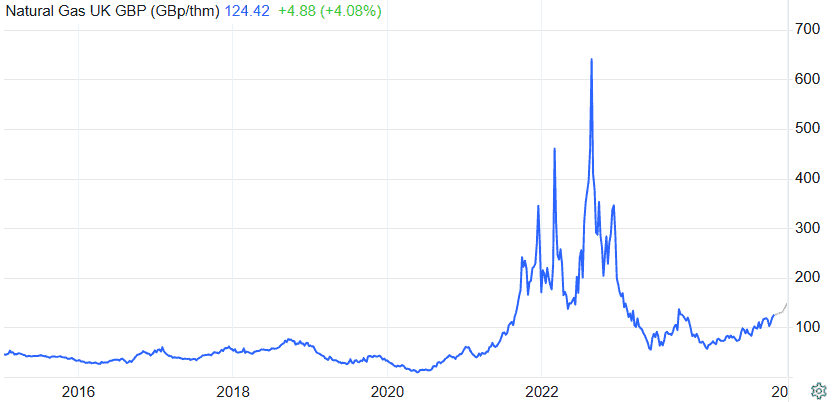
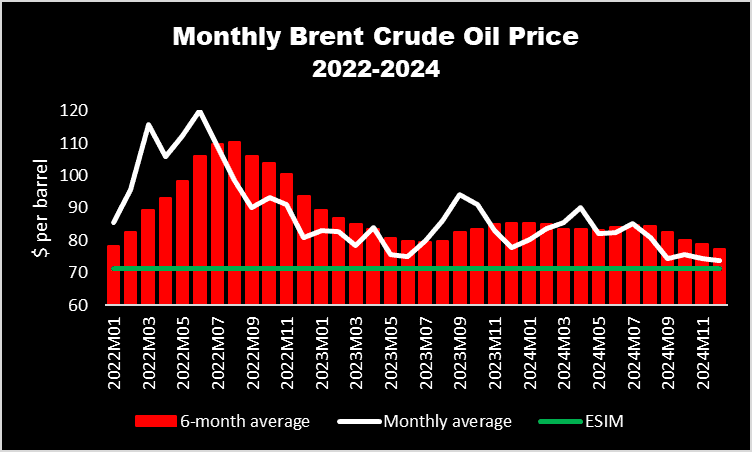
On the one hand, a falling oil and gas price would damage revenue. However, if (for six consecutive months) the average monthly oil price falls below $71.40 — and the gas price goes under 54p a therm — the ‘windfall tax’ will be abolished.

But this appears unlikely to happen any time soon.

Although Brent crude is falling, it still remains above the price floor.

Source: World Bank / ESIM = Energy Security Investment Mechanism (below this level, the energy profits levy will be suspended)

And I wonder if gas prices will ever drop below 54p again.

Source: Trading Economics

In my opinion, it looks as though the EPL is here to stay.

My opinion

Despite this, I plan to keep my Harbour Energy shares.

That’s because I think diversifying away from the UK is a good move.

And although it’s impossible to accurately predict future energy prices, the additional profits earned outside of Britain’s waters should help ensure that the group is able to — at least — maintain (in cash terms) its generous dividend.

If an investor put £10,000 in Aviva shares, how much income would they get?

For me, Aviva (LSE: AV) shares will always be the ones that got away. When loading up my self-invested personal pension (SIPP) last year, I bought almost every high-yielding, dirt-cheap FTSE 100 financial stock I could find.

I didn’t buy Aviva, which went onto outperform the lot. While its shares have idled in recent months, they’re still up 10% over one year and 20% over five. That isn’t exactly Nvidia territory, but top UK blue-chips like Aviva have a different role to play in a balanced portfolio.

Instead of quick-fire growth, they offer the prospect of solid long-term returns, in periods measured over years or even decades. That doesn’t just come from a rising share price, but the steady stream of dividends they pay investors.

Can this top blue-chip give me growth too?

FTSE 100 stocks pay some of the most attractive dividend yields in the world. Currently, shares on the index pay average income of 3.6% a year. That compares to a meagre 1% on the growth-friendly S&P 500. Those dividends close the difference between the two over time (although not totally, sadly).

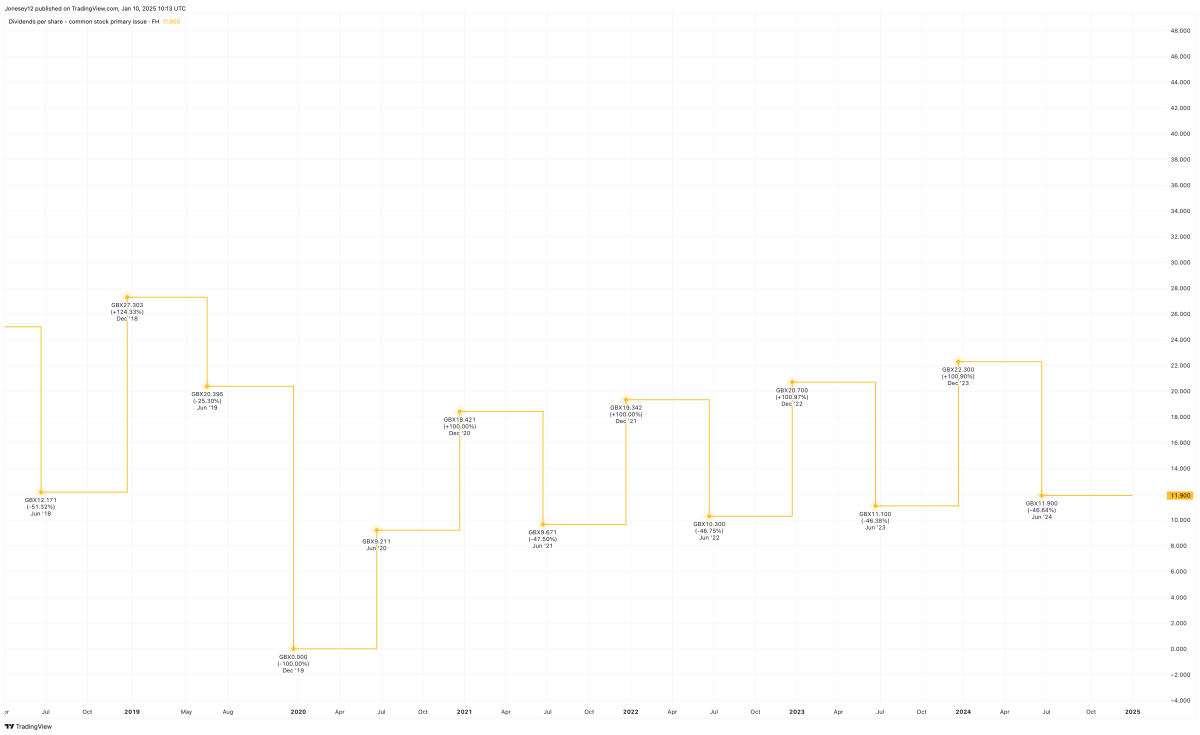
Aviva has a bumper trailing yield of 7.31%. It also has a solid track record of increasing shareholder payouts, year after year. It’s not perfect though, having suspended the dividend during the pandemic. It’s recovered since, as this chart shows.

Chart by TradingView

Aviva CEO Amanda Blanc is aiming to increase shareholder payouts every year, targeting “mid-single-digit growth”. The forecast yield for 2025 is an even more tempting 7.82%. Blanc has also promised “further regular and sustainable returns of capital”, probably via share buybacks.

If an investor put £10,000 into the stock today, they would potentially get income of £782 this year. Any share price growth would be on top.

The 12 analysts offering one-year share price forecasts have produced a median target of just over 550p. If that pans out, it would mark an increase of more than 16% from today’s 472p. Combined with that yield, this would give investors a total return of around 24%. Time will tell.

This FTSE 100 stock has plenty of cash

Aviva has a healthy balance sheet and generates plenty of cash, but as with any stock, there are risks. First, it looks like interest rates are going to stay higher for longer. That’s bad news for income stocks like Aviva, because it gives investors a decent return from cash and bonds, with no risk to their capital.

Higher interest rates will also squeeze stock markets generally, hitting the value of its £376bn of assets under management.

Aviva is also under pressure to make a success of its £3.6bn takeover of Direct Line. While it stands to make potential savings, the anticipated £125m of capital synergies will only arrive if the board gets its strategy right.

Eight out of the 14 analysts following Aviva name it a Strong Buy. None recommend selling. Sadly, I’ve already made my choice. Having bought rivals Legal & General Group, M&G, and Phoenix Group Holdings, another insurer would be overload.

All three FTSE 100 stocks have even higher yields than Aviva. Now I just hope they can match its share price performance.

Here’s why I’m still holding out for a Rolls-Royce share price dip

If I look back over the past five years and choose one stock I wish I owned, it would have to be Rolls-Royce Holdings (LSE: RR.), and not just because of the share price climb.

Yes, the shares are up 470% in the past two years. And I confess I’m a bit sore that I missed out on that. But more importantly, I see Rolls-Royce as a company with a great long-term future.

Perhaps ironically, the 2020 stock market crash might have been just what Rolls needed to kick it out of complacency. Today, it’s a slimmed-down and more efficient operation, headed by first-class management.

Share price dip?

If I think that, maybe I should just go with my long-term convictions and buy now? But then I think of something a friend once told me, a long time ago. He said: “You sure know how to buy shares after they’ve already gone up.

So, here I am still hoping for a share price dip that could give me a better buying opportunity.

Does that mean I’m trying to time the market, which is usually a hopeless task? It would make no more sense than buying into something just because everyone else is.

But I reckon plenty have done exactly that, bought simply because it’s been going up. And if the price surge should end and the momentum investors jump ship…? I’ve seen that happen with probably 90% or more of all the growth stocks I’ve watched over the decades.

Market timer?

I’m really thinking more in terms of valuation than timing. I want to buy cheap, and I don’t care when that might be.

I don’t actually see Rolls-Royce shares as overvalued, even now. A forward price-to-earnings (P/E) ratio of 32 might look high. But compared to the global aerospace sector, it could be about right.

Then again, most of Rolls-Royce’s peers are US-listed stocks, where valuations are typically higher than on the London Stock Exchange.

Still, if the P/E drops to 25 by 2026 as forecasts suggest, Rolls shares could well be fair value now.

I want cheap

I know billionaire investor Warren Buffett, head of head of Berkshire Hathaway, urges us to buy great companies at fair prices. And yes, he’s done better than me at this game.

But surely even he’d prefer to buy his great companies at cheap prices rather than merely fair, wouldn’t he?

Right now, I see companies that I rate as having equally great long-term prospects to Rolls-Royce. But they’re on more attractive valuations, and with good dividends thrown in.

At the late stage in my investing career, those are the stocks I really should be buying today. And not chasing the high-flying but riskier growth stocks that might better suit younger investors.

Still watching

But I do see a chance that, one quarter, Rolls might not quite hit its lofty forecasts. That could lead to a nice buying opportunity, and I plan to keep a bit of cash ready just in case.

Greggs shares became 23% cheaper this week! Is it time for me to take advantage?

The value of Greggs (LSE:GRG) shares fell sharply yesterday (9 January) after the group released a trading update for the last quarter of 2024. The headline figure was impressive. Total sales increased 7.7%, compared to the same period in 2023. But for those shops managed directly by the company, on a like-for-like basis, the increase was a more modest 2.5%.

The distinction between franchised stores — which account for around 20% of the group’s footprint — and other premises is an important one. That’s because — perhaps surprisingly — the baker earns a lower margin from the shops that it manages itself.

In 2023, Greggs reported a trading profit margin of 20.7% on franchised shops (including other wholesale activities). Its own shops – which contributed 89% of revenue that year — recorded a margin of 15.5%.

I suspect this was the principal reason why the baker’s shares performed so poorly. The company observed “subdued High Street footfall” during the quarter, which affects its own stores the most.

One person’s trash could be another’s treasure

It’s been a miserable week for shareholders. During the five trading days ended 10 January, the shares fell 23%.

But this could be a good opportunity for me. As Warren Buffett advises:Be fearful when others are greedy. Be greedy when others are fearful.

Indeed, this echoes the advice given by RBC Capital, in December. The investment bank was telling its clients to “buy the dip”. At the time, the shares were changing hands for £28.34p. Today, they’re 24% lower. And it set a price target of £32.40 — a 50% improvement on today’s value.

This optimism is based on a belief that the group is well positioned to cope with the post-Budget higher labour costs that the company faces.

Income prospects

One positive from the recent fall in its share price is that the stock’s yield has been pushed higher.

Having said that, it’s difficult to precisely calculate the current yield. Over the past five years, the company’s paid three special dividends. Based on the amounts paid in 2024 (105p), the yield is 4.9%. However, using payouts made in 2023 (60p), it’s 2.8%.

Remember, though, that dividends are never guaranteed.

Not so fast

Although Greggs continues to grow, the pace is slowing.

It’s true that revenue has increased rapidly since the pandemic — the average annual increase, from 2021 to 2024, was 26%. But it slowed to 11.3%, in 2024.

I think this is inevitable given that the company doesn’t have any overseas stores. There’s a limit to the number of pies and sausage rolls that UK consumers can eat.

But it means the group’s vulnerable to a slowdown in the domestic economy. With its reputation for low prices, Greggs is ideally placed to take advantage when incomes are squeezed. Consumers are more likely to ‘trade down’ when cash is tight.

However, it’s not immune from a wider economic slowdown. Although the UK economy is expected to grow in 2025, recent data has cast some doubt on the accuracy of the most optimistic of forecasts.

Therefore, after reviewing the investment case, I don’t want to invest in Greggs. Its revenue and earnings growth are slowing. And it’s over-reliant on the UK economy. Personally, I believe this week’s dramatic pullback in the share price is an indication that other investors share my concerns.  

Insurance stocks sell off sharply as potential losses tied to LA wildfires increase

In this aerial view taken from a helicopter, the Kenneth fire (below) approaches homes while the back side of the Palisade fire (above) continues to burn Los Angeles county, California on January 9, 2025. 
Josh Edelson | Afp | Getty Images

Insurers exposed to the California homeowners’ market sold off sharply Friday as the devastation caused by the Los Angeles wildfires spread.

Shares of Allstate and AIG both dropped 5% in premarket trading, while Chubb and Travelers fell 4% each. These four stocks were the biggest losers in the S&P 500 Friday morning.

AllState, Chubb and Travelers are the most exposed carriers to insured losses in the wildfires, according to JPMorgan. The Wall Street firm noted that Chubb could have a particularly high exposure due to its high-net-worth focus in the region.

Shares of insurers drop Friday

The destructive fires this week could become the most costly in California history. The insured losses from this week’s fires may exceed $20 billion, and the estimate could be even higher if fires spread, the JPMorgan estimated Thursday. Those losses would far surpass the $12.5 billion in insured damages from the 2018 Camp Fire, which was the costliest blaze in the nation’s history, according to data from Aon.

Moody’s Ratings expected insured losses to run well into billions of dollars given the area’s high values of homes and businesses in the affected areas.

The Palisades Fire is the largest of the five blazes. It has burned more than 17,000 acres, destroying over 1,000 structures, according to California authorities. Pacific Palisades is an affluent area where the median home price is more than $3 million, according to JPMorgan.

Insurance companies have asked Southern California Edison to preserve evidence related to the devastating wildfires that have swept Los Angeles, according to a company filing to regulators.

Certain reinsurers were also affected. Arch Capital Group and RenaissanceRe Holdings declined 2% and 1.5% Friday, respectively. JPMorgan believes that rising loss estimates increase the likelihood of reinsurance attachments at various insurers being breached.

— CNBC’s Spencer Kimball contributed reporting.

Down 33% in 2024 — can the UK’s 2 worst blue-chips smash the stock market this year?

I’ve been looking at last year’s UK stock market returns and two FTSE 100 companies leap out at me. Sadly, for the wrong reasons.

They’re the two worst performers on the blue-chip index, both having fallen around 33% over the last 12 months. But one year’s loser can turn out to be next year’s big winner. So do they have serious comeback potential?

I actually considered buying one of the stocks in September: international sports betting and gambling company Entain (LSE: ENT).

It caught my attention after jumping more than 18% in a month following a successful Euros football tournament, as results went in its favour.

Should I entertain Entain shares?

Investors had another reason to feel upbeat as gaming industry veteran Gavin Isaacs took over from CEO Jette Nygaard-Andersen, whose acquisition spree hadn’t yet paid off.

Thankfully, I didn’t part with my money. Although Chancellor Rachel Reeves didn’t tighten gambling regulation in her autumn Budget, Brazil and the Netherlands did.

Then on 16 December, Australian regulators hit Entain with a money-laundering lawsuit and the shares went down under. Its price is down 33% over 12 months and 60% over three years.

I’m no fan of the gaming industry but I can see there’s an opportunity here. The 17 analysts offering one-year share price forecasts have produced a median target of just over 955p. If correct, that’s a bumper increase of more than 50% from today.

Entain has a huge opportunity in the US via its 50:50 BetMGM joint venture with MGM Resorts International. I can’t imagine President-elect Donald Trump announcing a gaming crackdown. The shares look decent value with a price-to-earnings ratio of 14.7, although not dirt cheap. The yield is a modest 2.83%.

The Entain share price could suddenly rocket but with regulators marauding at every turn, it could go either way. It’s one for gamblers. Not for me.

Will Spirax shares spiral in 2025?

Last year’s second big flop is a stock I’ve never considered buying. Spirax (LSE: SPX) specialises in niche products such as industrial and commercial steam systems. It’s flown completely under my radar.

As well as falling by a third over the last year, the Spirax share price has slumped ped 55% over three years. I’m glad I overlooked it.

Sales have been hit by the global industrial slowdown, with falling Chinese demand hitting the group’s Steam Thermal Solutions division.

Yet once again, analysts are upbeat. The 17 brokers offering one-year forecasts produce a median target of 7,825p, up 18% from today’s 6,630p.

The shares look expensive despite their recent dismal run, with a P/E of 21.46 times. That’s well above the FTSE 100 average of 15 times.

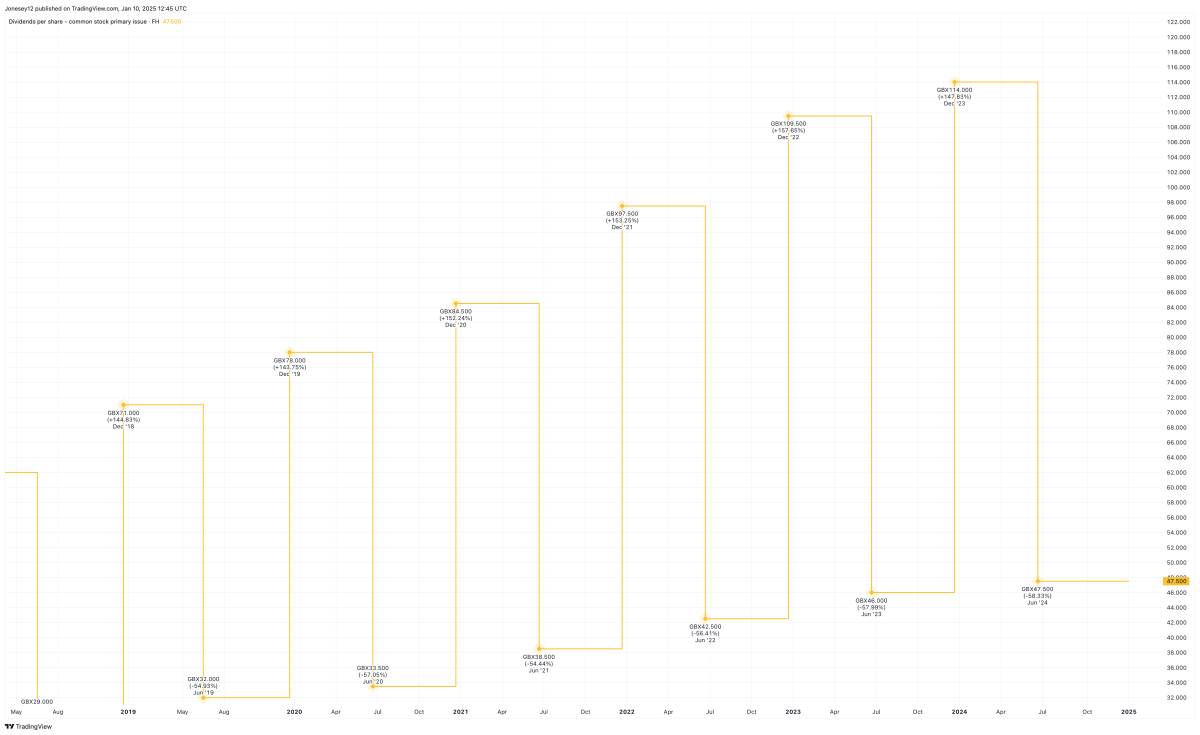
The big attraction is the group’s excellent dividend track record, with 55 years of consecutive annual dividend growth. It’s a true Dividend Aristocrat. The growth continues as this chart shows.

Chart by TradingView

Today the shares are forecast to yield a modest 2.6%, covered 1.8 times by earnings.

Yet I’m not convinced. Especially when I see net debt of £1bn. That’s pretty steep given the £5bn market cap. Spirax should fare better in 2025 as some of its more profitable end markets recover, but I think I can find better value on the FTSE 100 right now.

Are National Grid shares all they’re cracked up to be?

I’ve regularly seen National Grid (LSE: NG) shares called a no-brainer buy. Perhaps even the FTSE 100‘s ultimate no-brainer buy. In fact, I have a vague memory of using that description myself.

I’ll tread carefully in future. It seems to be tempting fate. Also, stock picking always involves a bit of brain power, even when purchasing a company that’s apparently as solid as this.

There’s much to like about power monopoly National Grid. It’s stringently regulated by Ofgem, with more than 80% of its total revenues tied to regulatory agreements. That gives clear earnings visibility.

Should I be worried by this FTSE 100 stock?

Many investors use National Grid as a portfolio building block. They assume its shares won’t be particularly volatile, while the dividends should keep rolling in. I guess that’s where the no-brainer bit comes in.

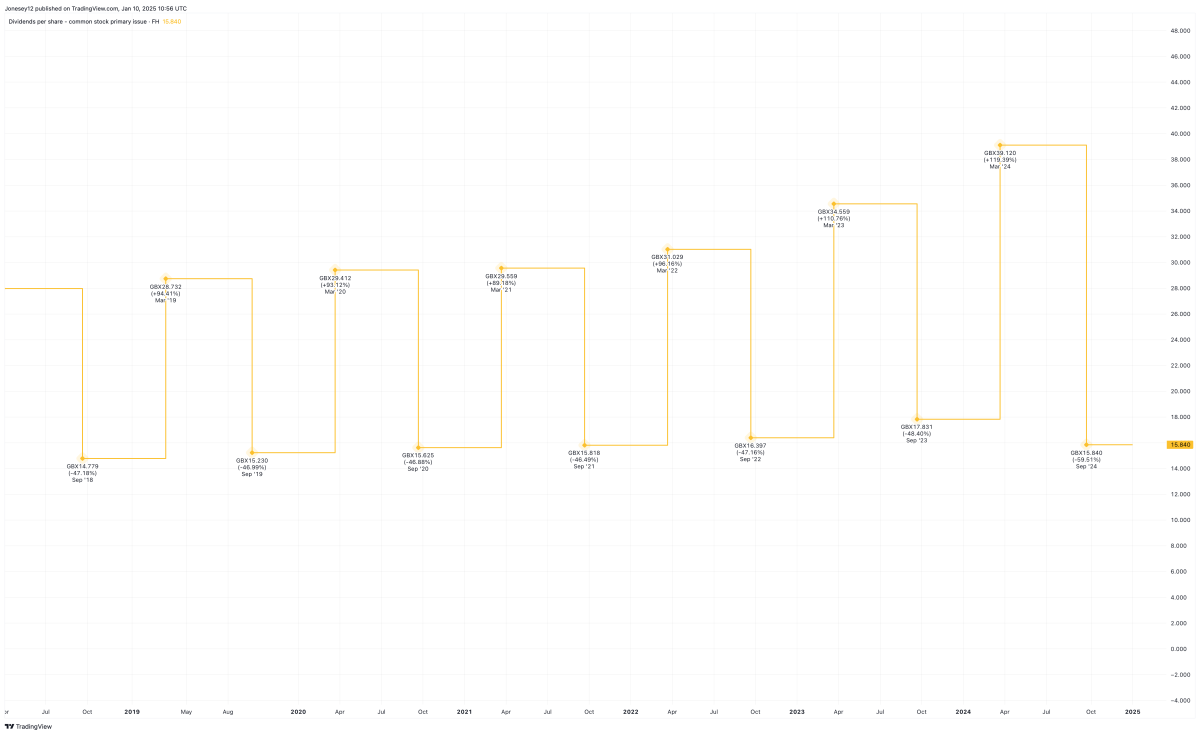
So far, they’ve been right about the income. The board’s steadily increased shareholder payouts over time, as this chart shows.

Chart by TradingView

Unlike many FTSE 100 dividend stalwarts, National Grid maintained dividends throughout the pandemic. Today, it boasts a bumper trailing yield of 6.1%. That’s way above the FTSE 100 average of around 3.5%.

However, the yield’s forecast to drop to 4.9% in 2025. At least it will be well covered, roughly 1.6 times by earnings. But what’s going on?

For a supposed no-brainer buy, National Grid has a few worries on its mind. It has to meet high operational and maintenance expenses while investing huge sums in network improvements and renewable energy projects.

The UK’s creaking energy infrastructure requires massive investment. Upgrades cost National Grid billions and the bill can only rise with the green transition. This squeezes the funds available for expansion or innovation.

I’ll activate my stock-picking brain next time

In May, the shares plunged more than 6% after the board announced a major rights issue to raise around £7bn to fund future investments. It also announced it would cut the dividend from 53.1p to 45.3p per share, from this year. Hence that falling forward yield.

While the National Grid share price quickly recovered, it’s still down 5.3% over the last 12 months. Over five years it’s up a modest 8.5%. Combined with five years of reinvested dividends, that pushes the total return towards a respectable 35%.

I can’t stop myself casting nervous glances at its huge £42bn debt pile. Especially since it’s forecast to hit £46bn next year.

Yet analysts remain upbeat. The 15 who offer one-year share price forecasts have produced a median target of just over 1,137p from today’s 930p. If correct, that’s an increase of around 22% from today. Combined with that yield, this would deliver a total return of 27% if true. We’ll see.

Eleven brokers consider National Grid a Strong Buy, one a Buy and six say Hold. None recommend selling.

But I won’t buy it. Yes, the income’s nice but I can find plenty of stocks on the FTSE 100 that yield 5% or more, and with better capital growth prospects too. Although I wouldn’t call them no-brainer stocks. As National Grid shows, there are always risks.

Here’s what the crazy moves in the bond market could mean for UK shares

Over the past few days, there’s been a lot of chatter about movements in the UK bond market. These Government bonds are known as gilts, with the yields being reflective of where investors believe future interest rates could be. Long-term yields have jumped, with the Government bond maturing in 30 years hitting the highest level since 1998. Here’s the impact it could have on UK shares.

Worries galore

It’s key to note what the movement in gilts is signifying. Investors are concerned that the UK economy is in a period of stagflation. This means rising inflation without economic growth. Q3 GDP growth was flat. Yet the latest inflation reading at 2.6% was the highest since March 2024.

Due to this, some expect that interest rates will have to remain high to counter inflation. We also need to add in the mix of concerns around fiscal stability. The Government borrows money via gilts in order to fund some spending. Yet with yields rising so much, the cost to finance new bonds is significantly higher. This calls into question how the UK is going to afford this higher interest bill when the authorities are trying to balance the public finances.

If an investor owns UK Government bonds and is now worried, they might sell them. As a result, this pushes the price down and the yield up. It makes the problem even worse!

Being selective

So far, the stock market hasn’t fallen due to the concerns about the economic outlook and fiscal stability. But that doesn’t mean that the fear might not cause a drop in the coming weeks or months.

What to do? One share that investors could consider buying as it might not get caught up in this is Games Workshop (LSE:GAW). The stock isn’t cheap and is up 35% over the past year.

It could tick the box because it has no debt. This means that if interest rates stay higher for longer, it’s not going to be impacted as it doesn’t need to borrow money.

Further, it has no ties or contracts with the Government. So if spending with private contractors in some sectors is cut, it doesn’t matter to Games Workshop.

Finally, the products and games it makes aren’t tied to rate-sensitive customers in as, says, the property or the automotive sectors are. Their customers have rate-sensitive customers with mortgages and car loans. And while Games workshop clients may also include such consumers, there’s less of a direct effect and the company should see fairly stable demand. Of course, one risk is that if inflation was to get back out of control, it could increase the costs of production.

No reason to panic

For now, I think it’s too early to tell if the events in the bond market are going to spill over to stocks. Yet even if stocks do start to fall, I think the worry around the economic outlook will primarily impact companies that either have strong ties to the Government or that have high debt levels. I’m not saying to completely write off such stocks, but it’s just worth considering these points before investing.

Financial News

Daily News on Investing, Personal Finance, Markets, and more!

Financial News

Policy(Required)