2 FTSE 100 shares I plan to hold until 2050!

I typically buy stocks with a view to holding them for a decade, or more. Here are two FTSE 100 shares I plan to hold in my portfolio for the next 25 years, at least.

Barratt Redrow

Housebuilders like Barratt Redrow (LSE:BTRW) remain largely out of fashion with investors today. Justifiable fears over cost inflation and future interest rates weighed heavily on the sector in the final months of 2024 and still do.

Yet I’ve clung on to my Barratt shares and plan to continue holding them for the long haul. Following its merger with Redrow last year, it’s by far the UK’s biggest builder by volume. And it has plans to supercharge production to take advantage of the market upturn when it comes.

It intends to ramp home completions up to 22,000 a year over the medium term, the firm announced at autumn’s AGM. That’s up from the planned 16,600-17,200 properties it expects for the current financial year (ending June).

After house prices moved back into growth last year, industry experts are largely confident of a sustained market recovery. Estate agent Hamptons, for instance, expects average house price growth of 3% this year, accelerating to 3.5% for 2026 and remaining robust at 2.5% the following year.

Driven by rapid population growth, I’m expecting house prices to maintain their steady climb through the coming decades. And I believe Barratt Redrow, which is also set to benefit from substantial post-merger revenues and cost synergies, is in the box seat to capitalise on this.

Coca-Cola HBC

Coca-Cola Hellenic Bottling Company (LSE:CCH) offers a delicious blend of growth potential and enduring resilience that I couldn’t resist.

As its name suggests, the FTSE 100 firm bottles and sells some of the world’s biggest drinks brands. Alongside Coke, it produces other heavyweight names like Sprite, Fanta and Monster Energy.

This provides me as an investor with excellent peace of mind. These labels remain in high demand at all points of the economic cycle, reflecting their reputation for quality and fashionability. Such qualities also allow Coca-Cola HBC to raise prices without suffering a painful drop in volumes, allowing the firm to grow earnings over time.

Its resilience was demonstrated in November’s most recent trading statement, which showed organic revenues up 13.9% in the third quarter and organic revenue per case up 9.5%. This was despite the tough economic conditions and inflationary pressures in a number of markets.

Yet, as I say, resilience isn’t Coca-Cola HBC’s only attractive characteristic. It also has exceptional growth potential, thanks to its wide geographic footprint that also straddles fast-growing emerging and developing economies in Eastern Europe and Africa.

On the downside, the bottling giant faces significant market competition from the likes of PepsiCo and is very dependent on its relationship with US-based Coca-Cola Co. But given its powerhouse brands and strong record of innovation, I believe it can continue to thrive in the decades ahead.


Looking for ISA dividend shares? 2 passive income heroes to consider today

Buying dividend shares can be a great way to grow one’s Individual Savings Account (ISA).

The cash rewards from high-yield dividend stocks can be used to buy lots more shares. This in turn can lead to exponential potential growth over time thanks to the mathematical miracle of compounding.

With this in mind, here are two top dividend shares I think are worth serious consideration.

The PRS REIT

Dividends from share investing can fluctuate wildly according to broader economic conditions. So given the uncertain outlook for 2025, now could be the time to consider buying dividend payers in defensive sectors.

The PRS REIT (LSE:PRSR) is one stock that could prove a wise buy. As a major build-to-rent specialist — it has more than 5,400 residential homes on its books — rent collection remains stable at all points of the economic cycle.

Furthermore, Britain’s ongoing housing shortage means it doesn’t have to seriously worry about falling occupancy that would impact profits.

There’s another good reason I think the firm’s an attractive dividend share to consider. Under real estate investment trust (REIT) regulations, it must pay a minimum of 90% of annual profits from its rental activities out in the form of dividends. This is in exchange for certain tax breaks.

Please note that tax treatment depends on the individual circumstances of each client and may be subject to change in future. The content in this article is provided for information purposes only. It is not intended to be, neither does it constitute, any form of tax advice.

For this financial year (to June 2025), PRS REIT offers a 4% dividend yield. This is ahead of the 3.6% and 3.4% averages for the FTSE 100 and FTSE 250 indexes respectively.

And for financial 2026, predictions of dividend growth drive the yield to 4.2%.

Not even residential property stocks are completely risk free. A particular problem for PRS REIT could be if interest rates remain at or around current levels, dampening asset values and impacting borrowing costs.

But on balance, I think the FTSE 250 company is worth a close look.

Pan African Resources

A bright outlook for gold prices means Pan African Resources (LSE:PAF) also demands serious attention, in my opinion.

In sterling terms, gold struck fresh record highs last week. On a US dollar basis it also reached new multi-week peaks. I believe prices are likely to continue climbing as macroeconomic and geopolitical worries — exacerbated by US President Trump’s words on trade tariffs and foreign policy — drive demand for safe-haven assets.

Investors have a multitude of UK precious metal stocks to choose from to capitalise on this. Those seeking dividends may wish to consider Pan African Resources, a mid-tier gold supplier in South Africa.

Predicted dividend growth over the short term means the miner’s dividends are a chunky 4.4% and 7.7% for the next two financial years (to June 2025 and 2026).

Of course there’s no guarantee that gold prices will continue rising. They could fall for a variety of reasons, for instance if the US dollar strengthens or the economic landscape improves.

Yet even if these affect Pan African’s earnings, the business still looks in good shape to pay those large predicted dividends. Payouts are covered between 3.1 times and 3.9 times by anticipated profits, comfortably above the safety benchmark of two times and above.

If a 40-year-old put £500 a month in FTSE 250 shares, here’s what they could have by retirement

Over the long term, investing in the FTSE 250 has proved an effective way to build wealth. Since 2004, the UK’s second-most-prestigious share index has delivered an average annual return of nearly 9%.

The past isn’t a reliable guide to future returns. But if the FTSE 250 can maintain its impressive performance, how much could a 40-year-old investing £500 monthly in the index make by the time they reach retirement age?

Growth + dividends

The FTSE 250’s success is thanks in large part to its composition of mid-cap shares. Companies in this bracket typically have more room for earnings growth compared to the larger, more established firms in the FTSE 100, often resulting in significant share price gains.

But the index isn’t just about growth. Thanks to a good concentration of established and financially robust companies, it is also a reliable provider of decent dividend income.

It’s not as high as the Footsie’s forward average of 3.7%. But the FTSE 250’s prospective dividend yield of 3.5% isn’t far off.

A near-£30k passive income

A blend of healthy capital gains and passive income means the FTSE 250’s delivered an average annual return of 8.9% during the last 21 years.

If this continues, a 40-year-old investing £500 a month in an index tracker fund could — once they reach the State Pension age of 68 — have a portfolio worth £739,874. That figure excludes broker-related costs and fund charges.

But here’s the thing: I’m not convinced the FTSE 250 can continue delivering the sort of return it has in recent decades.

How so?

A much larger percentage (roughly 55%) of the index’s earnings come from UK versus, say, the more internationally-flavoured Footsie. And so returns are highly sensitive to economic conditions at home.

Unfortunately the UK looks set for a prolonged period of low economic growth, worsened by higher business costs following October’s Budget. Inflation is also ticking higher, while major structural problems (like low productivity and high public debt) persist.

Such issues have cooled the FTSE 250’s average annual return to just 1.5% over the past five years. Looking ahead, I’m not expecting a vast improvement (if any).

A top FTSE 250 stock

That’s not to say the index is a bad place to invest, though. While I believe investors should think about avoiding FTSE 250 tracker funds, I think buying individual shares is still worth serious consideration.

Bloomsbury Publishing (LSE:BMY) is one such share I feel is really worth checking out. During the past decade, it’s delivered a stunning 17.8% average annual return.

That’s more than three times better than the FTSE 250’s average over the same period (5.3%).

The blockbuster Harry Potter range of books remains a huge money spinner, but it’s not the only string to the publisher’s bow. Its consumer division is packed with bestsellers and award winners, particularly in the fantasy fiction field.

Bloomsbury also has a successful academic publishing arm that it continues to grow through acquisitions. Combined, its consumer and academic units delivered revenues and profits growth of 32% and 58%, respectively, between February and August.

Weak consumer spending poses a danger to sales right now. But I’m confident Bloomsbury could remain a great investment option for long-term investors.

1 key stock market indicator to watch this week

There’s always uncertainty when it comes to the stock market. But there are some things investors can do to try and demystify movements in share prices.

One of these is paying attention to key leading economic indicators. And there’s an important one coming from the US this week.

Consumer sentiment

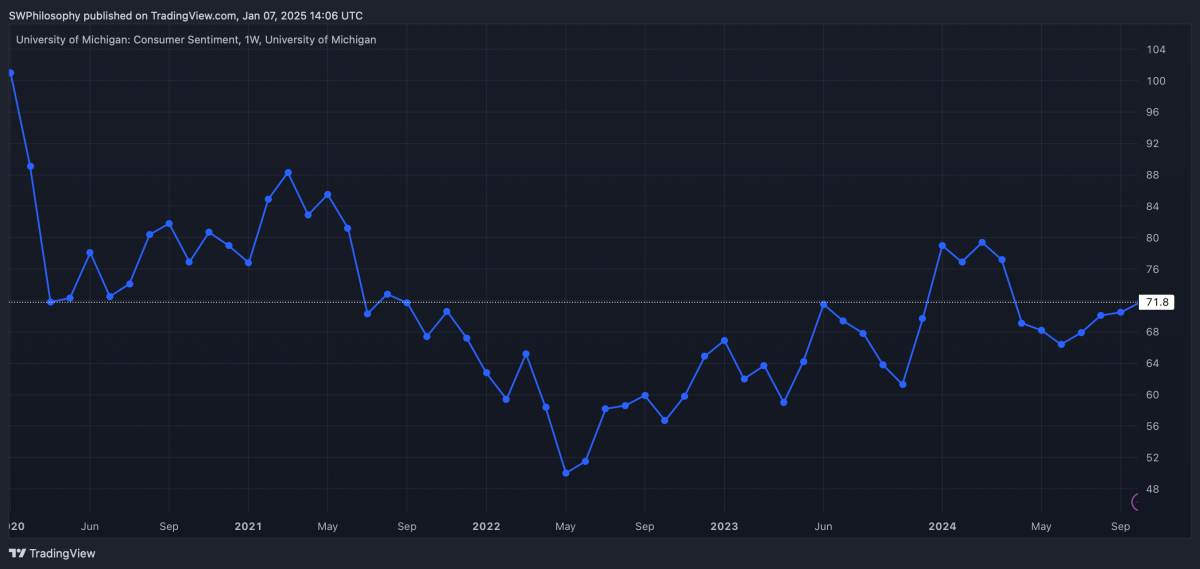
On Wednesday, the latest update from the Michigan Consumer Sentiment Index is due. It should give investors a key insight into how US consumers are thinking about their finances.

Michigan Consumer Sentiment Index 2020-2025

Created at TradingView

The index is made up of the survey results from 500 households and is published monthly. As important as the overall number is the direction in which it is moving.

In general, when consumers are feeling more positive, they’re likely to spend more. And when they’re more cautious, the reverse is true. 

Based on the results, investors like me can get a feel for what might happen in the near future. But the reading needs to be handled with care. 

Finding stocks to buy

There are two reasons the consumer sentiment reading is important. One is that a weak outlook can cause share prices to fall, which can create buying opportunities in a couple of different ways. 

If a decline in spending is likely to be temporary, long-term investors might consider buying shares in companies that will be able to endure short-term challenges before emerging stronger. This is one idea.

Alternatively, if a stock falls because the market overestimates how willing consumers are to cut back on its products, it might be undervalued. This could generate an opportunity for investors to consider.

The other reason the reading is significant is it can help predict when companies in a cyclical downturn are likely to turn around. And this doesn’t just apply to US stocks.

Dr Martens

Dr Martens (LSE:DOCS) is UK stock. It’s had a difficult time over the last few years and a lot (though not all) of this is due to weak consumer spending in the US, which accounts for 37% of sales.

The share price has started to bounce back, recovering 50% from its 52-week lows set in September. But unless things start to pick up with the underlying business, there’s a real risk this will be short-lived. 

The firm has made progress in fixing its own mistakes, in terms of its inventory and distribution. And while it has rebooted its marketing to try and boost demand, there are some things it can’t control.

That’s why I’m keeping a close eye on the US consumer sentiment data. It could be a good indication of whether the business is heading towards recovery, or whether the stock has further to fall.

Finding stocks to buy

I’m not saying a strong consumer sentiment update by itself is a reason to buy Dr Martens – or any other stock. But I do think being aware of what’s going on can be useful for understanding the stock market.

That’s why I’ll be paying attention this week when the latest data comes out. With around 68% of the US economy coming from consumer spending, I’ll be looking at it for much more than just Dr Martens.

I’m on the hunt for cheap shares to buy this January! Here’s one I found

The past few years have been good ones for bargain hunting in the London stock market, in my view. While some US shares have hit what I see as unjustifiable valuations, my hunt for shares to buy on this side of the pond keeps throwing up what I think are potentially real bargains.

Nobody knows how long that may last, but I am continuing to make hay while the sun shines (metaphorically, of course: a bit of actual sunshine feels more than overdue!)

Are British shares as cheap as they seem?

The stock market contains thousands of companies and some of them look expensive, not cheap, to me.

Taken in the round, however, there is a perception that even though the FTSE 100 hit a new all-time high last year, many blue-chip UK shares look fairly cheap.

Look at the five biggest shares in the index, for example.

AstraZeneca trades on a price-to-earnings (P/E) ratio of 32 and Relx on 38. But Shell is on 13, HSBC just 8, and Unilever on 21.

Bear in mind those are the most valuable companies. At the other end of the FTSE 100, British Land is on a P/E ratio of 18, Persimmon 14, Londonmetric 16, Hiscox 6, and Endeavour Mining was loss-making last year so a P/E ratio is not applicable.

Still, the overall picture is clear. There are quite a few blue-chip companies trading on a fairly low P/E ratio.

Now, a P/E ratio is only one way to assess value when looking for shares to buy. So while HSBC looks cheap on that metric, I also value bank shares in other ways. But even looking at price-to-book value, for example, HSBC looks cheap to me.

What’s going on in the London market?

Sometimes, a low price is low for a reason. So, just because a share looks cheap, does not necessarily mean that it will be a bargain.

I have started the year by looking for shares to buy for my portfolio.

While I like HSBC’s large customer base, proven business, and attractive dividend yield of 6%, I remain concerned about the risks that an economic slowdown could pose to loan default rates and bank profits. So for now I do not plan to buy HSBC shares.

One share I’ve been buying

By contrast, one share I have been buying lately is JD Sports (LSE: JD).

The retailer has seen its share price fall 14% in a year – and 41% over five years. The potential for an economic slowdown I mentioned above could eat into consumer spending and hurt JD’s sales.

So, when I was looking for shares to buy this month, why did I land on JD Sports?

The market for sportswear is large. Over the long term, I expect it to remain that way.

JD Sports has proven its model in the UK. That market is still ticking over well, but the company has rolled out its formula in markets spanning the globe. Last year’s acquisition of a large US rival ate into the company’s cash but hopefully can add sales and profits in years to come.

The firm has a market capitalisation of £5bn yet expects full-year profit before tax and adjusting items to be close to £1bn. To me, the share price still looks cheap.

4 SIPP mistakes I’m avoiding like the plague!

I think a SIPP can be an excellent way to try and build wealth ahead of retirement, which is why I invest in one.

But while a SIPP can hopefully help me make money, some mistakes along the way could also cost me.

Here are four errors I am hoping to avoid in 2025 (and always!)

Ignoring the ‘small’ costs

Different SIPPS come with their own cost and fee structures.

As the amount in a SIPP grows, such costs may seem like a fairly small proportion of the amount invested. But it is important to remember that a SIPP is a long-term investment vehicle.

While 1% or 2% (or even 0.5%) might not sound much this year or next year, over the course of three or four decades a small annual levy can add up to a huge amount.

So I am paying attention right now to whether my SIPP provider offers me good value for money.

Lacking an investment strategy

Another mistake I am trying to avoid is investing without a strategy.

That does not need to be a formal plan. It need not be complicated. But I reckon it is important to sit down and think about how I hope to grow the value of my SIPP.

For example, what is the right balance of growth and income shares? How much of the SIPP do I want to invest and how much will I keep in cash at any one time (if any)? Are markets beyond the UK potentially more attractive for me?

My point here is not about the specifics of my strategy, but rather than by developing an approach and adapting it as I go I hope to try and miss out on some avoidable errors.

For example, I would not want to miss out on a huge surge in growth shares because I was 100% focused on dividend shares.

Not diversifying enough

That brings me to another error: not spreading a SIPP across enough shares.

As most seasoned investors know, even the most brilliant share can suddenly tank unexpectedly.

That hurts financially – but even more so if its role in a SIPP is too large relative to other holdings.

Not learning from mistakes

It is easy to revel in great investments. But what about lousy ones?

A lot of us like to forget about them. But I think that can be costly, as it means we may just make similar errors in future.

For example, one of the worst performers in my SIPP is boohoo (LSE: BOO). From MFI to Superdry, I have owned quite a few awful retail shares. So although I still invest in the sector, I am wary.

What was my key mistake with boohoo?

I think one was ignoring the market signal: a massive price decrease before I bought was not the bargain I hoped. Rather, it was other investors signalling their declining confidence in the retailer’s prospects.

I thought past profitability equated to a proven business model. But – and I know this – past performance is not necessarily a guide to what will happen in future. Competition from the likes of Shein changed boohoo’s marketplace dramatically.

I still own the shares and hope boohoo’s large customer base and strong brands can help it recover. But I have learnt a hard lesson!

Up 28% in a month, I’ve been loading up on this penny share  

I generally invest in medium- and large-sized companies with proven business models. But I own the odd penny share. One I am particularly excited about has soared 28% in the past month, although over five years it has fallen 90%.

But some recent developments led me to buy more shares in this company – here’s why.

A nice problem: lots of cash getting dusty

The company in question is Logistics Development Group (LSE: LDG).

With a market capitalisation of £75m, this is a fairly modest operation. It also has significant shareholders that have specific (and competing) visions of how the company ought to be run. I see that as a risk for a small shareholder like me, but it is also a potential opportunity.

Last year, an activist investor launched a campaign — ultimately unsuccessfully — seeking to wind down the company and distribute its assets to shareholders.

The reason for that is interesting in my view. LDG is basically sitting on a large pile of cash. The group’s cash position last month was about £44m, almost 60% of its entire current market capitalisation.

Unlocked value in investment portfolio

Not only that, but the company owns stakes in a number of other firms.

For example, it is a shareholder in Alliance Pharma. Last week, it was announced that Alliance had agreed to a takeover bid at a price 41% higher than its share price the day before the takeover was made public.

LDG indirectly owns 13% of Alliance. It will receive an equivalent stake in the new private company. Last month, LDG also announced that it had redeemed a £10m debt note it held in another company for £13.1m.

At that point, the company also laid out a plan I think is aimed at mollifying its activist shareholder, proposing a tender offer at 19p per share to return up to £21m to shareholders.

If that is approved by shareholders (which I expect it will be), LDG will buy back a certain amount of shares for 31% higher than they can be bought for on the open market right now.

Why I’ve been buying

That news led me to increase my stake in this penny share. The sizeable discount of the share price versus the proposed tender offer points to ongoing risks.

The tender offer may not complete, for example. Even if it does, its scale is capped, so there is no guarantee of how many shares I may be able to sell back to the company at the 19p price.

Even considering that though, I continue to see potential deep value here. LDG is sitting on a large cash pile it has explicitly set out to reduce by buying back some shares at well above their current price. It is also sitting on a number of investments that, as the debt note sale and Alliance takeover illustrate, could ultimately turn out to be worth more than their current carrying value on the company’s balance sheet.

They may not, of course. But on balance, I reckon LDG is a share that could ultimately be worth substantially more than its current price suggests.

Top Wall Street analysts like the growth opportunities for these three stocks

An Uber rideshare sign is posted nearby as taxis wait to pick up passengers at Los Angeles International Airport (LAX) on February 8, 2023 in Los Angeles, California.
Mario Tama | Getty Images

The new year has only just started, but macro uncertainty is already hanging over investors, with Federal Reserve officials raising concerns over inflation and its impact on the rate-cutting path.

In these shaky times, investors can enhance their portfolio returns by adding stocks backed by solid financials and long-term growth opportunities. The investment thesis of top Wall Street analysts can inform investors as they pick the right stocks, as pros base their analysis on a strong understanding of the macro environment and company-specific factors.

Here are three stocks favored by the Street’s top pros, according to TipRanks, a platform that ranks analysts based on their performance.

Uber Technologies

We start with ride-sharing and food delivery platform Uber Technologies (UBER). The company delivered better-than-expected revenue and earnings for the third quarter of 2024, though gross bookings fell short of expectations.

Recently, Mizuho analyst James Lee reiterated a buy rating on Uber Technologies stock with a price target of $90. The analyst sees 2025 as a year of investment for UBER. While these investments could impact the company’s earnings before interest, taxes, depreciation and amortization over the near term, they are expected to fuel long-term growth.

Based on his analysis, Lee expects Uber’s growth investments to drive a compound annual growth rate of 16% in core gross bookings from FY23 to FY26, in line with the company’s analyst-day target of mid- to high-teens growth. The analyst is confident that Uber’s EBITDA growth is on track with its analyst-day target of high-30s to 40% CAGR. “Despite leaning into growth investments, economies of scale and increased efficiency should offset margin risks,” said Lee.

Additionally, Lee thinks that worries over the growth of the company’s Mobility business seem overstated. The analyst expects FY25 gross bookings growth (forex neutral) in the high-teens, with the pace of deceleration moderating compared to the second half of 2024.

Further, the analyst projects the gross bookings for Uber’s Delivery business to remain in the mid-teens in FY25. This increase is expected to be supported by the growing adoption of new verticals while maintaining the food delivery market share. The analyst added that Mizuho’s checks revealed that order frequency has reached another all-time high. Checks also indicate solid grocery adoption in the U.S., Canada and Mexico along with robust user penetration.

Lee ranks No. 324 among more than 9,200 analysts tracked by TipRanks. His ratings have been profitable 60% of the time, delivering an average return of 12.9%. See Uber Technologies Stock Charts on TipRanks.

Datadog

We move to Datadog (DDOG), a company that offers cloud monitoring and security products. In November, the company announced better-than-anticipated results for the third quarter of 2024.

On Jan. 6, Monness analyst Brian White reiterated a buy rating on Datadog stock with a price target of $155. The analyst thinks that the company has a more balanced approach toward the generative artificial intelligence trend, “avoiding the absurd claims propagated by many across the software complex.” He noted that DDOG fared well compared to its peers in a challenging software backdrop in 2024, but added that it lagged behind other stocks in Monness’ coverage universe.

That said, White thinks that Datadog, and the broader industry, will start to see incremental activity over the next 12 to 18 months from the long-term boom in generative AI. Highlighting DDOG’s outperformance compared to peers and its transparency with regard to its generative AI progress, the analyst noted that AI-native customers accounted for more than 6% of the company’s annual recurring revenue (ARR) in Q3 2024, up from over 4% in Q2 2024 and 2.5% in Q3 2023.

White also highlighted some of the company’s AI offerings, including LLM Observability and its gen AI assistant, Bits AI. Overall, the analyst is bullish on Datadog and thinks that the stock deserves a premium valuation compared to traditional software vendors due to its cloud-native platform, rapid growth and robust secular tailwinds in the observability space, as well as its new generative AI-led growth opportunities.

White ranks No. 33 among more than 9,200 analysts tracked by TipRanks. His ratings have been profitable 69% of the time, delivering an average return of 20%. See Datadog Ownership Structure on TipRanks.

Nvidia

Semiconductor giant Nvidia (NVDA) is this week’s third stock pick. The company is considered one of the major beneficiaries of the generative AI wave and is experiencing stellar demand for its advanced GPUs (graphics processing units) that are required to build and run AI models.

Following a fireside chat with Nvidia’s CFO Colette Kress, JPMorgan analyst Harlan Sur reaffirmed a buy rating on the stock with a price target of $170. The analyst highlighted the CFO’s assurance that the ramp-up in the production of the company’s Blackwell platform is on track despite supply chain challenges, thanks to solid execution.

Moreover, the company expects spending in the data center space to remain strong in calendar year 2025, supported by the Blackwell ramp-up and broad-based strength in demand. Further, Sur noted that management sees massive revenue growth opportunities, as it grabs a larger chunk of the $1 trillion-worth datacenter infrastructure installed base.

Sur added that Nvidia expects to benefit from the shift to accelerated computing and growing demand for AI solutions. Management thinks that the company has a solid competitive advantage compared to ASIC (application-specific integrated circuit) solutions due to several strengths, including ease of adoption and its comprehensive system solutions.

Agreeing with this viewpoint, Sur said, “We believe that enterprise, vertical markets, and sovereign customers, will continue to prefer Nvidia-based solutions.”

Among the other key takeaways, Sur highlighted the rollout of next-generation gaming products and opportunities to expand beyond high-end gaming into markets like AI PCs. 

Sur ranks No. 35 among more than 9,200 analysts tracked by TipRanks. His ratings have been profitable 67% of the time, delivering an average return of 26.9%. See Nvidia Hedge Funds Activity on TipRanks.

How to aim for a reliable 6% dividend yield when picking stocks

When considering dividend yields, UK investors tend to get wary around the 7% mark. This is often thought of as an area where the sustainability of payments is questionable. If a company is allocating too much cash to dividends it can lead to operational issues and weaker performance.

At that point, dividends are usually cut, leaving shareholders disgruntled. This in turn dissuades new investment, leading to a downward spiral.

There is the occasional exception to the rule but it’s considered a good estimate to go on with.

With that in mind, I prefer to aim for an average yield of around 6% to stay on the safe side. Yields in such a portfolio may occasionally stray above 7% but generally level out.

Look beyond the yield

Even a yield below 7% doesn’t guarantee anything as the company may still struggle to cover payments. To truly assess the sustainability of payments, it helps to check debt and free cash flow.

Companies spend their free cash in different ways. It can be saved up, used to reduce debt, spent on share buybacks, or used to pay dividends. 

Debt isn’t a problem so long as interest payments are covered. If not, dividends could face the chopping block. But with cash flowing and debt well covered, there’d be little reason to cut dividends.

Don’t forget to diversify

Businesses in similar industries tend to have similar financials. So when looking for sustainable yields, an investor may end up picking four insurance companies. Sure, they may all be reliable dividend payers but the portfolio would be too exposed to one sector.

It would be better to pick the most reliable high-yield dividend stock from four different industries. Diversification is all about balance.

Two examples

Consider National Grid and ITV (LSE: ITV). They operate in different sectors with consistently high yields and dividend coverage ratios above two.

As the UK’s main gas and electricity supplier, National Grid is a company that enjoys consistent demand and stable revenue. Its operations are well regulated, so it tends to be quite stable, with annual dividends increasing consistently for over 20 years.

But it faces pressure from energy price caps and costly upgrades to meet decarbonisation goals. This has resulted in growing debt, a problem compounded by rising interest rates. With cash flow dwindling, it recently cut dividends by 15%.

ITV, on the other hand, has enjoyed growing equity while reducing its debt lately. It lacks the solid payment track record of National Grid but enjoys steady cash flow. This lessens the chance of dividend cuts, making the 7% yield attractive.

Competition is fierce, though, with the likes of Netflix, Disney, and Amazon muscling in on the digital streaming market. While ITV continues to extract decent value from its Studios arm, profits are at risk from losses in streaming.

This partially contributed to a minor revenue decline in 2023, from £3.73bn to 3.62bn. But its first-half 2024 results show some recovery, with revenue up 2.4% and profit margins soaring to 17% from 2.6% a year earlier.

These examples show how dividend stocks can differ, yet both remain popular options and worth considering as part of an income portfolio.

Investing £20,000 in this FTSE 250 stock today could net investors £1,944 in passive income this year

Shares in B&M European Value (LSE:BME) could be a passive income goldmine for investors in 2025 – and beyond. On top of its usual dividend, the firm just announced a one-off £151m distribution.

That means the company is set to return just under 10% of its market cap to shareholders this year in cash. But investors thinking of jumping at the opportunity should consider a few things first.

The issues

B&M announced the special dividend this week as part of its trading update for the period covering the last three months of 2024. But the report as a whole went down like a lead balloon. 

Adjusting for exchange rates, revenues were 2.8% higher than the previous year. And while profits were also higher (by an unspecified amount), that’s largely where the good news ended for investors.

Sales growth was entirely the result of the company increasing its store count. On average, revenues per outlet were down 2.8% – and this is the continuation of a worrying trend. 

Like-for-like sales were down 1.9% in the previous quarter and 5.1% in the one before that. That’s why the stock has been falling so consistently over the last nine months.

Sooner or later, that has to change if B&M is going to avoid stagnation. The company isn’t going to be able to keep opening stores indefinitely without them getting in each other’s way.

The current rate of store expansion is around 6%. So unless the decline in like-for-like sales can stop soon, the business is going to find its revenue growth falls behind inflation, which would be a problem.

Dividends

A £151m special dividend – equivalent to 15p per share – sounds like a result for shareholders. But this is below what B&M has distributed in previous years.

Over the last five years, the company has paid one-off distributions of either 25p or 20p per share each year. So the 15p announcement from this week represents a dividend cut.

I think this should make B&M shareholders think carefully about the outlook for the dividend in 2025. But there are also some clear reasons for optimism.

While like-for-like sales were lower over the last quarter, management reported that these started to improve in December. And the company is starting 2025 in a strong inventory position.

The stock has also reached a level where it could be a good passive income investment without the business growing. The regular dividend plus the special distribution amounts to a yield of 9.72%. Of course, dividends are never guaranteed.

This means a £20,000 investment today could return £1,944 in dividends this year. And that’s enough to make me take it seriously.

Opportunity?

A 9.72% dividend yield is the kind of thing that investors typically find with tobacco companies. But unlike British American Tobacco, I don’t believe B&M’s core business is in terminal decline. 

Like-for-like sales have been going backwards, but the company as a whole continues to move forward. The stock is risky, but I think investors looking for passive income should seriously consider it.

Financial News

Daily News on Investing, Personal Finance, Markets, and more!

Financial News

Policy(Required)