These are my top 3 defensive shares to buy in 2025!

When considering which shares to buy in 2025, I’ve become increasingly concerned about the uncertainty ahead. From interest rate fluctuations in Europe to trade tariff threats in the US, markets look set for a rocky year.

Sure, when the economy is strong, it can pay to consider riskier growth stocks. But as a risk-averse investor, the current environment has drawn me to consider the benefits of defensive stocks. With slow growth, these stocks may appear less attractive but are usually more stable. I’m thinking consumer goods, healthcare, and utility stocks as they remain in demand even when the economy falters.

With that in mind, I think the following stocks are worth considering. I already own them and plan to buy more as the year progresses.

Consumer Goods

British American Tobacco (LSE: BATS) has experienced volatility of only 1.09% over the past month. It’s also a solid and reliable dividend giant and a top 10 constituent of the FTSE UK High Dividend Low Volatility Index (as of December 2024).

Its yield looks high at 8% but, unlike some others, this isn’t due to a falling price. In fact, the stock is up 26% in the past year. What’s more, its dividends have been increasing consistently for over 20 years. 

However, it’s fair to say that tobacco is controversial and might face a questionable future. Although it’s working hard to transition to less harmful smoke-free products, there’s no guarantee this strategy will work. Increasingly strict regulations could derail its progress.

Based on future cash flow estimates, it’s trading at 54% below fair value with the average 12-month forecast targeting a 9.7% price increase.

Utilities 

National Grid (LSE: NG.) is another solid dividend stock with low volatility. As the core supplier of gas and electricity to the UK, it’s well positioned to maintain steady revenue. 

The stock has weathered previous market dips relatively well. Over the past two decades, it’s up 158% — an annualised growth of 4.85% per year. It also has a 5.4% yield and experienced only 1.33% volatility over the past month.

Yet it does face challenges. Balancing the need to supply low-cost energy while meeting carbon-reduction goals has proven difficult, pushing it into debt. It needs to find a way to balance these requirements without risking losses.

Earnings are expected to fall to 71p per share in the next full-year results. Despite this, the average 12-month price target envisions a 23.4% rise.

Healthcare

AstraZeneca (LSE: AZN) is one of the most well established UK healthcare companies.

It’s slightly more volatile than others, at 1.48% in the past month. During Covid, it experienced unusually high growth and has since gone through several corrective periods. If faces risks from an ongoing government probe in China and clinical trial setbacks that could threaten profits.

Historically, long-term price growth has been good, increasing at an annual rate of 7.4% since 2005. It’s also a reliable dividend payer although the yield is currently low, at only 2%.

Analysts expect earnings to rise to £6.59 per share in the next full-year results, up from £5.70 in 2003. The average 12-month forecast predicts a 28% increase in price, with the most bearish analyst expecting only a 0.42% loss.


After rising 2,081%, has Nvidia stock peaked?

The performance of Nvidia (NASDAQ: NVDA) over the past five years has been mind-boggling. During that period, Nvidia stock has soared 2,081%.

But the chipmaker now has a market capitalisation of $3.3trn and trades on a price-to-earnings (P/E) ratio of 54.

While that is far from unheard of – Amazon is on 47, for example – it is far higher than some investors such as myself would feel comfortable paying.

Back to the future

Step back five years, however.

Amazon had then long been a darling growth stock and looked fully priced. Since then, however, its stock has grown 135%.

That is far less dizzying than Nvidia during that period. Longer term, though, Amazon had already delivered the sort of phenomenal growth we have seen from Nvidia in the past five years – but it still managed to more than double from the start of 2020 until now.

So, might the same turn out to be true for Nvidia stock?  

Could it be that, even if recent amazing gains are not repeated on the same scale, it nonetheless moves up even further in the next few years? Or has it peaked already?

The case against buying Nvidia today

To begin with, consider the bearish case about the chipmaker. I already said above that its current P/E ratio puts me off investing, as it looks expensive to me.

But earnings at the company have ballooned over the past several years. If they fell back to anywhere close to what they were just a few years back, the prospective P/E ratio would be in the hundreds, not at 54.

Might that happen?

There has been a rush by companies to buy up chips as they attempt to gain first mover advantage in their respective industries when it comes to AI. After the initial round of installations, though, demand for AI chips could fall back in years to come.

Meanwhile, competitive pressure could reduce the pricing power enjoyed by the current industry leaders such as Nvidia and Taiwan Semiconductor Manufacturing.

Here’s how things could get better from here

On the other side of the coin, though, what if AI really is a transformative trend that is here to stay?

Just as Amazon was once seen as wildly overvalued for an online retailer, Nvidia could yet exploit its competitive advantages in chip design and manufacture to get even stronger in a fast-growing part of the economy then use that strength to expand its business footprint further.

In November, the company’s chief executive proclaimed, “the age of AI is in full steam, propelling a global shift to NVIDIA computing”.

While he may want to ask ChatGPT “how can I sound more modest?”, the underlying point could turn out to be accurate. The recent surge in demand for Nvidia chips may not be a one-off blip, but rather an indication of future sales potential for the industry leader.

I’m in no rush to buy

I think either of the above scenarios could yet play out.

So, while I think the company’s technology, customer base, and ambition could yet mean that its stock has more potential ahead, the current valuation does not sit comfortably with me, given the risks.

At the right valuation, I would buy Nvidia stock in a heartbeat. For now, though, I will sit on my hands.

This UK share is already up 27% in 2025! I think it could go even higher

One UK share I own has jumped by 27% in value so far this year. Yes, this year. Not the past 12 months, but rather the past 12 days!

As a long-term investor, such a share price jump grabs my attention but my focus is on the picture over a more extended time period.

Over the past five years, this stock – although it still sells for pennies today(13 January) – has jumped 799%.

Exciting moment for a key industry

The stock in question is radio frequency-based component maker Filtronic (LSE: FTC).

I have bought the share on several occasions over the past few months. Why? I feel excited about its prospects – even after that stunning price rise.

Here is what I wrote about the medium-sized company in November: “One of the things I like about this is that I see a number of possible drivers for substantial growth in its business (and hopefully therefore its valuation too) next year and beyond.”

That seems to be borne out already less than a fortnight into the New Year. Filtronic told the market in the middle of last month that it expected to outperform market expectations at the full-year level.

Then today, the company issued another trading update less than a month after the most recent one, saying that it “now expects to deliver stronger results for the full year than the recently upgraded market expectations”.

With SpaceX as a key customer right now, my interpretation is that either the SpaceX relationship is delivering handsomely or – perhaps in addition – that client’s reputation is helping attract new customers for the specialist engineering firm.

Here’s why I think it could still be a bargain

Still, despite those positive updates, does this share deserve to have jumped as much as it has?

My feeling is that, in fact, it ought to have jumped even more – and hopefully will later on in 2025.

SpaceX’s ambitious plans for expanding its satellite Internet provision capability could be a sales bonanza for Filtronic as it has been helping supply components for the space company.

Meanwhile, with expansion of its activities on both sides of the pond in recent months, I think Filtronic is now well-positioned to ramp up sales and production. That could be good for revenues and especially profits if the business can exploit economies of scale.

Meanwhile, I think its expertise gives it pricing power, something that could help improve its long-term profitability.

So, while a price-to-earnings (P/E) ratio of 69 would ordinarily make me fall out of my chair, in this case I think the potential for earnings growth means the prospective P/E ratio could be much lower.

There are risks here – with a lot riding on a single customer, if for any reason SpaceX’s plans change, that could be bad news for the Filtronic share price.

But I am hopeful of a bumper year for the UK tech firm and think its shares are still a potential bargain. That is why I have been buying more for my portfolio.

How much would an investor need in a Stocks and Shares ISA to earn £2,000 a month in passive income?

Millions of us in the UK invest through a Stocks and Shares ISA. The main advantage to this is that we don’t pay tax when we sell shares for a profit and we don’t pay tax on any dividends we receive. This means the Stocks and Shares ISA is an excellent vehicle for creating a passive income stream, possibly one to complement a pension or retirement fund.

Please note that tax treatment depends on the individual circumstances of each client and may be subject to change in future. The content in this article is provided for information purposes only. It is not intended to be, neither does it constitute, any form of tax advice. Readers are responsible for carrying out their own due diligence and for obtaining professional advice before making any investment decisions.

The passive income formula

At its core, the passive income formula focuses on maximising tax-free returns from dividends and capital growth. With an annual ISA contribution allowance of £20,000, investing in dividend-paying stocks or funds can generate a steady income stream.

For example, a portfolio with an average dividend yield of 4% could produce £800 annually — completely tax-free. Reinvesting these dividends or investing in growth-oriented companies accelerates growth through compounding, a key driver of long-term wealth.

Capital growth adds another dimension. Diversified investments in stocks or funds have historically delivered average annual returns of 6-8%, depending on market conditions. This combination of regular dividends and appreciation makes the Stocks and Shares ISA an effective tool for building a passive income stream, particularly over the long term.

Moreover, discipline, diversification, and regular reviews ensure the formula works to its fullest potential.

Making the figures add up

In order to earn £2,000 a month in dividends, an investor would need £600,000 invested in stocks averaging a 4% dividend yield. However, a higher dividend yield would allow an investor to achieve the same passive income with a smaller portfolio — for example, 5% yield at £500,000 would generate £25,000 annually.

Of course, many Britons may say “well, I don’t have £500,000”. But the answer lies in compounding and starting early. If an investor were to start with £5,000 today, and contribute £500 a month for 22 years, achieving 10% annualised growth, they’d have more than £500,000 at the end of the period.

However, to achieve 10% annualised growth, an investor must make wise investment decisions. Poor decisions can result in investors losing money.

Dividends can rise

There’s another angle too, and perhaps one that I sometimes neglect. Many investors are keen to invest in Dividend Aristocrats. These are stocks with a track record for increasing their dividend yield.

A well-known UK Dividend Aristocrat is Diageo (LSE:DGE). Diageo, a global leader in alcoholic beverages, has a strong track record of consistently increasing its dividends. The company owns iconic brands such as Johnnie Walker, Guinness, and Tanqueray, which contribute to its steady revenue and profit growth.

While Diageo’s current dividend yield stands at 3.3%, its track record of consistent dividend growth makes it a compelling long-term investment. Over the past decade, the company has steadily increased payouts, reflecting its resilience and commitment to shareholders.

This growth can significantly enhance returns over time, particularly when dividends are reinvested to compound gains. For example, a modest yield today could effectively double in 10 years if Diageo maintains its historical growth rate. As such, the effective yield for an investment today would be 6.5% in a decade’s time.

However, it’s worth bearing in mind that changes in alcohol consumption, especially among younger generations, presents a risk to Diageo’s long-term prospects. The company has moved towards prioritising more premium brands in recent years, reflecting consumer demand shifts.

It’s not a stock that I hold, but I think it’s worth considering.

£20,000 invested in Tesla shares just 3 months ago is now worth…

Tesla (NASDAQ: TSLA) shares were heading for an underwhelming 2024 until the final third of the year. In fact, just three months ago the Tesla share price was roughly where it was four years prior.

Then it accelerated like one of the company’s electric vehicles (EVs), rising 81% to reach $394. This means a £20,000 investment made three months ago would now be worth approximately £36,200!

And with a market cap of $1.24trn, Tesla is again worth more than Toyota, BYD, NIO, Hyundai, Stellantis, Ford, and General Motors combined.

The Trump card

Tesla stock enjoyed a big boost after Donald Trump’s election victory in November. The assumption is that the incoming administration will cut corporate taxes, regulations, and prevent cheap Chinese-made EVs from flooding the US.

All of this could benefit Tesla, as could CEO Elon Musk’s close relationship with Trump. Specifically, red tape might be cut around self-driving vehicles, which could lead to an accelerated rollout of the company’s robotaxis (or Cybercabs, as Tesla calls them).

Setting a high bar

We won’t get Q4 results until later this month. But in Q3, Musk said he’s confident the Cybercab will not just start production in 2026, but reach “substantial” volume production. The aim is to ramp up to 2m units per year.

When it was finally unveiled in October, Tesla’s Cybercab had no steering wheel or brake and accelerator pedals. The company plans a ride-hailing network, which would presumably be a high-margin business given that there would be no human drivers that need paying.

Meanwhile, Musk is predicting 20%-30% vehicle growth this year. That’s a high bar, considering interest rates are still high and the firm’s growth has stalled. Last year, it delivered 1.79m cars, a 1% drop from 2023.

Where next?

The current period is a bit of a strange one for Tesla. The once-hot EV market has hit a major speedbump, while the company’s next-generation products (robotaxis, full self-driving software, and humanoid robots) aren’t ready yet. Consequently, Musk has said Tesla is “between two major growth waves“.

Given this, it’s somewhat surprising that the stock’s price-to-earnings (P/E) ratio is above 100. This extreme valuation has been reached despite the likelihood that Trump will scrap the $7,500 tax credit for new EV purchases.

Admittedly, this cancellation might benefit Tesla in the short term as US consumers rush to take advantage of the credit before it disappears. But it surely can’t be positive for overall sales after that.

Consequently, I see 2025 as a potentially more challenging year for Tesla and its share price.

Staying on the sidelines

I’ve owned Tesla stock a couple of times over the past few years. In hindsight, I would have done splendidly if I’d just held it through thick and thin.

However, that’s easier said than done. It’s incredibly volatile and can often look ridiculously overvalued.

Meanwhile, Musk continues his quest to eliminate what he calls the “woke mind virus“, which he sees as a threat to Western civilisation. Politics aside, I fear the forthright manner in which he’s pursuing this could damage the Tesla brand and alienate many potential future EV customers.

I have great admiration for Tesla as a company. But due to the sky-high valuation, I have no plans to reinvest right now.

If a 30-year-old put £150 a week in S&P 500 shares, here’s what they could have by retirement

Over the past few years, it hasn’t been too difficult to beat the FTSE 100‘s returns. However, the S&P 500 is a different beast and most active fund managers have struggled to match the soaring index.

That need not trouble an everyday investor though, because there’s a simple way to invest in the S&P 500. That’s through a low-cost index tracker like the Vanguard S&P 500 UCITS ETF (LSE: VUAG), which I think is worth considering.

But how much could a 30-year-old investing £150 weekly in the US index make by the time they retire? Let’s find out.

A tech-driven index

The S&P 500 is made up of the 500 leading public companies in the US. While these firms span various industries, a quick look at the top 10 names today shows that this is very much a tech-dominated index.

Stock % of funds*
Apple 6.99%
Nvidia 6.59%
Microsoft 6.10%
Amazon 3.76%
Meta Platforms 2.43%
Alphabet (Class A shares) 1.92%
Tesla 1.86%
Berkshire Hathaway 1.71%
Alphabet (Class C shares) 1.59%
Broadcom 1.46%
*As of 30 November 2024

This makes sense, of course. We’re living through a powerful technological revolution made possible by many of these companies. In some ways, their platforms have become indispensable tech utilities, without which large parts of the global economy would cease to function.

Over the 10 years to November 2024, the S&P 500 has delivered an average annual total return of 12.7%.

If this run were to continue, a 30-year-old investing £650 a month — the equivalent of £150 a week — and reinvesting their returns in an index tracker fund from today could have a portfolio worth £6,104,465 in 38 years’ time.

This would be a cracking result from pretty modest sums invested regularly. It proves that calling compounding interest a miracle isn’t farfetched!

As mentioned, this figure assumes all dividends are reinvested, and doesn’t count broker-related fees and foreign exchange movements. Inflation over this time would also erode future spending power.

Nevertheless, £6ms would still provide a very comfortable retirement for most people. For example, I’d imagine one could still easily travel the world in luxury with such a sum, even in 2063.

Year Balance
5 £53,702
10 £151,339
15 £328,853
20 £651,593
25 £1,238,370
30 £2,305,193
35 £4,244,791
38 £6,104,465

Some things to consider

As we know, past performance isn’t necessarily a reliable guide to future returns. In previous decades, the annual return was more like 11%. In this scenario, the balance after 38 years would ‘only’ be £3,888,652.

Plus, there are risks. One is that the S&P 500 is now more concentrated than ever before. The top 10 stocks account for around a third of the total market capitalisation. And less than 30 make up half!

Moreover, due to surging stocks related to the artificial intelligence (AI) mega-trend, the index is now very pricey, historically speaking. The price-to-earnings (P/E) ratio is around 28.

As Apollo Global Management‘s chief economist Torsten Sløk recently noted: “Buying the S&P 500 gives the impression that you are buying 500 different stocks and diversifying your investments. But the reality is that the high and growing concentration in the S&P 500 continues to be a major problem. In short, investors should ensure that their portfolio is not all levered to Nvidia earnings.”

The future

For a 30-year-old investing regularly for retirement, I don’t think Nvidia’s earnings matter too much. In 1987, some 38 years ago, the firm didn’t even exist, along with Tesla, Alphabet’s Google, Meta, and Amazon.

Over the next decades, stocks and industries will come and go. But I expect America and the S&P 500 to keep powering higher.

How much would a Stocks & Shares ISA investor need for a £3,000 monthly second income?

With a tax-efficient Individual Savings Account (ISA), any of us can significantly enhance our chances of making a big second income in retirement.

Here’s one way a person can try and build a £3,000 passive income with tax-free ISA accounts.

Please note that tax treatment depends on the individual circumstances of each client and may be subject to change in future. The content in this article is provided for information purposes only. It is not intended to be, neither does it constitute, any form of tax advice. Readers are responsible for carrying out their own due diligence and for obtaining professional advice before making any investment decisions.

Think carefully

The first thing to say is that there’s no blueprint to investing or saving. We all have different short- and long-term investment goals, as well as varying attitudes to risk and unique sets of financial circumstances.

That said, there are some cast-iron guidelines for investing that some ignore at their peril.

One is that saving predominantly in Cash ISAs is unlikely to make most of us a second income for a comfortable retirement. Put simply, our money may be safe in such an account but the returns one makes are likely to be insufficient, based on most people’s circumstances.

Targeting a £3k monthly income

Let’s say an investor has £514 spare each month. That’s the average amount that Britons currently save or invest, according to financial services provider Shepherd’s Friendly.

If they invested that in a 4%-yielding Cash ISA they would, after 30 years, have £356,741 sitting in their account. Based on a 4% annual drawdown rate, that would give them an income of £14,270, or £1,189 a month.

As mentioned, such income is guaranteed and safe. But even with the State Pension added, this person is unlikely to have the £43,100 that the Pensions and Lifetime Savings Association (PLSA) says that people need to retire comfortably.

In order to hit this threshold, an ISA investor would need a balance of £900,000 or thereabouts by the time they retire.

Based on that same 4% drawdown rate, this £900k balance would provide an average monthly income of £36,000. With the State Pension added in, that PLSA target of £43,100 could be quite achievable.

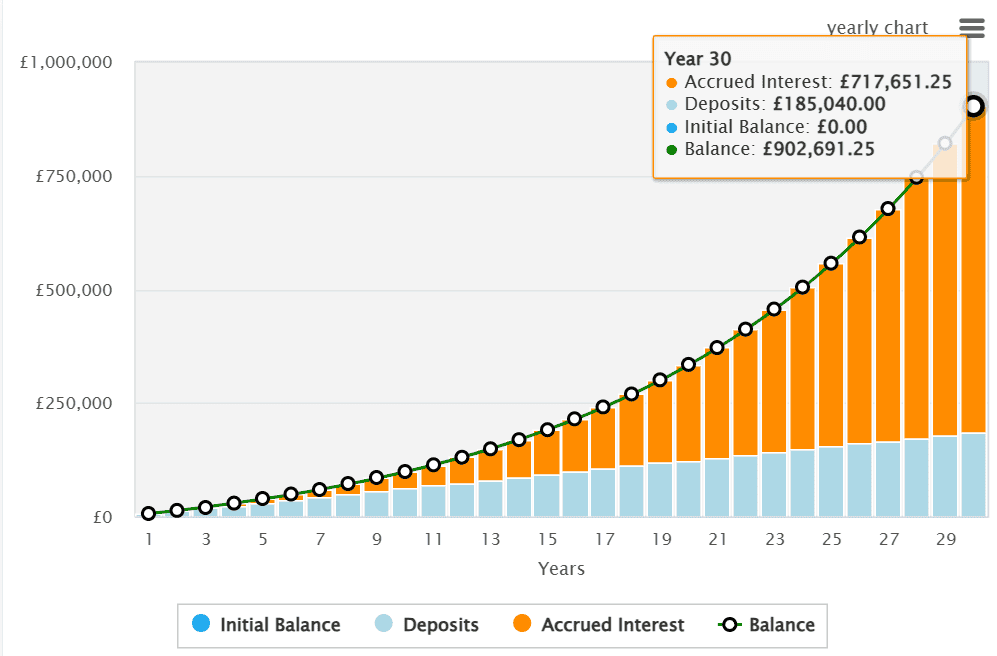
This could be achieved by investing in shares that provide an average annual return of 8.8% in a Stocks and Shares ISA.

Eventual returns based on an 8.8% annual return. Source: thecalculatorsite.com

Investing in funds

That 8.8% return is achievable, in my opinion, based on the proven long-term rates of return of UK and US shares.

The FTSE 100 and S&P 500 have delivered annual average returns of 7% and 11%, respectively. If this continues — which unlike a Cash ISA is not guaranteed — that £514 invested equally across a tracker fund for each index would net an investor that magic £3k monthly second income.

The iShares Core S&P 500 ETF (LSE:CSPX) is one such fund that investors can consider today.

With an ongoing charge of 0.07%, it’s the cheapest S&P-based ETF currently available in the UK. When combined with a Stocks and Shares ISA, it could save investors a huge wad of cash by eliminating unnecessary fees and taxes.

Investing in any fund is riskier than holding cash. However, by investing in 500 different companies, products like this can help investors spread risk effectively while also chasing those superior returns.

In this case, individuals reduce risk with hundreds of different companies spanning many geographies and industries. This doesn’t mean the fund can’t decline during economic downturns. But it can minimise volatility and produce a smooth and solid return over the longer term.

It’s why I hold an S&P 500 fund in my own ISA.

If a 40-year-old invested in top FTSE 100 growth stocks, here’s what they could have by retirement

It’s true that the performance of the FTSE 100 has lagged behind the S&P 500 over the past few years. Yet over the long term, the index has provided some exceptional returns from growth stocks. If a 40-year-old was looking to build a portfolio from scratch based around growth ideas, here’s some indication of what things could look like at 65.

Running it back

To begin with, let’s consider how things could have gone in the past. If we rewind to 25 years ago (the investment time horizon for a 40-year-old to retirement, based on the retirement age back then), the FTSE 100 was at 6,658 points. It’s now at 8,220 points. This is just under a 24% return, or less than 1% a year.

This might not seem impressive, but remember this is the entire index, not specifically the growth stocks. For example, over this period technology stocks have done very well. RELX is a good example. The global provider of information-based analytics and decision tools has grown substantially over the past decade as take up of the product from businesses has grown. As a result, the share price is up 577% since 2000, an average of almost 8% a year.

Over the same period, there has been huge growth in the private equity sector. Investing in companies that aren’t currently public has been a source of large profits for firms in this area. For example, 3i Group is one of the largest private equity powerhouses. The boom in this segment has been one factor in the 299% share price rally since 2000, averaging just under 6% a year.

Looking to the future

Although the past doesn’t predict the future, an investor could look at more examples like this and conclude that over the next 25 years, achieving a 6%-8% annual growth rate is a reasonable assumption to make.

Looking ahead, an investor could consider picking an idea that’s in a hot sector now for long-term future gains. Balfour Beatty (LSE:BBY) is a stock I hold that I think fits the bill, with it rallying 26% over the last year.

The global infrastructure group specialises in construction and support services, with strong growth recently in the US and UK. It has the potential to win more contracts in the coming years as new administrations in both countries look to deliver on their pledge to increase infrastructure spending.

This could provide a multi-year boost for revenue. There’s also large potential for growth in Asia, where it has a joint venture with Gammon but hasn’t really got things moving yet.

One risk is that new projects are partially financed using debt. Given that interest rates in the US and UK are staying higher for longer, this can make new borrowing more expensive.

Potential numbers

If an investor could put away £400 a month in FTSE 100 growth stocks and achieve a 7% average return for a 25 years through, the investment pot could be worth a juicy £326k. Of course, trying to forecast this far into the future is very difficult. The final figure could be significantly higher or lower than £326k. But it does provide a good idea of what could be achieved.

Can Scottish Mortgage shares lead the next bull market charge?

I was gearing up to sell my Scottish Mortgage (LSE: SMT) shares when they suddenly took off like a rocket in the final weeks of 2024.

The tech-focused FTSE 100 investment trust famously endured a terrible 2022, its shares halving as the technology sector fell out of favour. But tech’s roared back, and so have Scottish Mortgage shares. They’re up 28% over one year. Over five years – even accounting for 2022 – they’re up an impressive 66%.

This demonstrates the value of staying invested through market cycles. So why did I consider selling?

Can this FTSE 100 investment trust fly in 2025?

Typically, I prefer direct equities over funds. I’d rather make my own mistakes than delegate them to an investment manager. Aside from Scottish Mortgage, the only funds I hold are US-focused trackers Vanguard S&P 500 UCITS and the L&G Global Technology Index.

Research shows most fund managers underperform the market, so I take a risk when I pick active funds. Another concern is that around a quarter of Scottish Mortgage’s portfolio consists of unquoted companies, whose valuations are opaque. That said, this can be an advantage. For example, it holds Elon Musk’s privately-quoted SpaceX, which I couldn’t access otherwise.

If SpaceX’s Starlink division floats at some point this could boost Scottish Mortgage’s net asset value. Of course, not every IPO’s a success.

The trust also gives me exposure to stocks I wouldn’t normally consider, like the Taiwan Semiconductor Manufacturing Company, or Chinese tech firms such as PDD Holdings and Meituan.

The recent rally has firmed my resolve to stick with Scottish Mortgage through thick and thin. But what can I expect this year?

Its focus on high-growth, innovative companies means it thrives when confidence is high, but struggles when it falters. It did well from the post-Presidential election ‘Trump Bump’ but that may reverse. Investors fear Trump’s mooted tax cuts and trade tariffs could drive inflation and interest rates higher.

It’s an exciting growth stock

This will heap pain on growth stocks as it will increase borrowing costs and squeeze valuations. After the S&P 500’s strong gains over the last two years, a repeat performance seems unlikely, while Scottish Mortgage’s Chinese holdings are at the mercy of geopolitical tensions and regulatory risks.

Another challenge is the potential overhype of artificial intelligence (AI). If it fails to meet lofty expectations, tech stocks – including Scottish Mortgage – could take a hit.

One small advantage is that recent sterling weakness could boost the value of the trust’s overseas holdings. However, predicting currency movements is as tricky as guessing market trends.

Scottish Mortgage shares trade at an 11.8% discount to net asset value, but investment trust discounts have been persistently wide in recent years. A discount alone isn’t enough reason to buy or sell.

If markets rally, Scottish Mortgage could outperform. If they slump, it won’t escape unscathed. That’s why I hold shares like this for the long term. Over that horizon, I think the trust will power on.

I’m glad I still hold it. Now I need to hold my nerve.

I asked ChatGPT to name 5 growth shares that could make me a ton of money between now and 2030. Here are the results

Investing in growth shares can be a great way to build wealth. Just ask anyone who has been invested in Apple over the last 10 years (it’s soared).

Recently, I asked ChatGPT to list five growth shares that could make me a lot of money between now and 2030. Here’s a look at the names it gave me.

ChatGPT’s growth picks

ChatGPT told me that identifying high-growth stocks involves looking for companies with strong fundamentals, growth potential, and innovation. That’s a fair statement.

It added that before making any investment decisions, it’s crucial to conduct thorough research and consider financial goals and risk tolerance. That also makes sense.

As for the five growth stocks it gave me, they were:

  • Nvidia – ChatGPT expects the stock to keep performing due to the high level of demand for its AI chips
  • Amazon (NASDAQ: AMZN) – It’s relentless innovation and diversified business model position it for continued growth, according to ChatGPT
  • Shopify – ChatGPT believes it will benefit from the growth of the e-commerce industry
  • Airbnb – With its scalable platform, Airbnb’s well-positioned for long-term growth
  • First Solar – It sees this solar power company as a good play on the renewable energy industry

I already own three!

It’s an interesting list of stocks. What’s funny is that I already own three of them. Currently, Amazon is my largest individual stock holding. This is a company I’m really excited about.

Today, Amazon operates in a wide range of growth industries including e-commerce, cloud computing, AI, semiconductors, video streaming, digital advertising, digital healthcare, and self-driving cars. So I’d be very surprised if it didn’t make me money over the next half-decade.

There are no guarantees it will, of course. If we see a major economic collapse in the next five years, Amazon’s growth could stall and its share price could fall. I’m optimistic that its revenues and earnings (and share price) will be significantly higher by 2030 however. That’s why I’ve gone all in on it.

The other two stocks I currently own are Nvidia and Shopify. Nvidia’s one of my largest holdings because it has recently shot up. I continue to believe it has substantial growth potential due to the fact it’s the leader in the AI chip space. Shopify’s a smaller position for me as I view it as more speculative. I expect this company to do well on the back of the e-commerce boom but I see it as higher risk due to the fact its profits are still quite small.

I’ll point out that I used to own Airbnb stock. I sold it recently after deciding that government regulation could be a challenge for the company in the years ahead.

As for First Solar, which specialises in solar technology, it’s an interesting idea. However, the outlook for renewable energy companies looks a bit murky to me now that Donald Trump’s going to be US President.

I was hoping for more

Overall, I think ChatGPT’s investment ideas were reasonable. I believe three out of the five stocks have a lot of potential.

I’m a little disappointed that the app didn’t list some really exciting new ideas for me though. I was hoping to learn about some obscure growth company capable of generating huge wealth for me over the next five years.

Financial News

Daily News on Investing, Personal Finance, Markets, and more!

Financial News

Policy(Required)