£11,000 in savings? Here’s how investors could consider aiming for £3,975 a year of passive income!


Passive income is money made from minimal effort. And by far the best way I have found of doing this is investing in shares that pay dividends.

This only involves selecting high-quality stocks that pay high dividends and occasionally monitoring their progress.

The dividends are generated regardless of whatever else I do, including sleeping. And if they are reinvested back into whichever stock paid them, they can make for a much better life and retirement.

This process is called ‘dividend compounding’ and is similar to allowing interest to grow in a bank account.

A case in point

One of the stocks I bought precisely for this purpose is Imperial Brands (LSE: IMB). In 2024, it paid a dividend of 153.42p, which yields 6% on the current £25.73 share price.

So, investors considering an investment of £11,000 (the average UK savings amount) would make £660 in first-year dividends. Over 10 years on the same average yield, this would rise to £6,600 and over 30 years to £19,800.

However, using the dividend compounding method would turbocharge these dividend payouts. Doing this on the same 6% average yield would make £9,013 after 10 years, not £6,600. And after 30 years on the same basis, the dividend payments would be £55,248, rather than £19,800.

With the £11,000 initial investment added in, the Imperial Brands holding would be worth £66,248 by then. And this would be generating £3,975 in annual passive income from dividends by that stage.

That said, the yield can go up or down. Analysts forecast that Imperial Brand’s dividend will rise to 164p in 2025, 171.4p in 2026, and 176.2p in 2027. This would generate respective yields of 6.4%, 6.7% and 6.8%.

A profit to be had on the share price too?

I do not intend to sell any of the shares I own that are geared to generating passive income. However, it is good to know if I ever did they would not make a loss from the price at which I bought them.

Therefore, I only ever buy shares that look very undervalued to me and this applies to Imperial Brands. Right now, a discounted cash flow analysis shows the shares are 63% undervalued at their current price of £25.73. So, a fair value for them is £69.54, although market unpredictability could push them lower.

Such an undervaluation reduces the chance of a loss being made on the share price, in my experience.

How does the business look?

A key risk to Imperial Brands’ profit margins in my view is the high degree of competition in its sector.

Nonetheless, its full-year 2024 results released on 19 November saw adjusted operating profit rising 4.6% year on year to £3.9bn. This beat consensus analysts’ forecasts of a 4.3% increase.

Net revenue from its next-generation products (including nicotine replacements and vapes) soared 26%. And adjusted earnings per share rose 10.9%, driven by profit growth and share count reduction from buybacks.

Looking ahead, the firm forecasts operating profit growth next year in the mid-single-digit percentage area.

If I did not already have a sizeable holding in the firm, I would buy the shares today for their excellent passive income potential.

Is it worth me buying National Grid shares for around £9 after a 14% drop?

National Grid (LSE: NG) shares are down 14% from their 18 September post-rights issue high of £10.61.

The offer involved the right to buy seven shares for every 24 held and ended on 10 June. By that point, the multinational electricity and gas utility giant had secured £7bn in new funding.

As it stands, such a price fall might signal a bargain to be had by me.

The valuation

I only buy stocks that look undervalued to me on two broad measures. First, compared to similar stocks on key measures I have used and trusted over 35 years of private investment. Second, compared to where it should be, based on the future cash flow forecasts for the firm.

To begin with the first measures, National Grid trades at a price-to-earnings ratio of 26.6. This is overpriced compared to its competitor group, which averages 12.6.

The same applies to its price-to-sales ratio of 2.4 against a competitor average of 0.9.

However, it is underpriced on the price-to-book ratio – at 1.3 against a 1.7 average for its peers.

To get to the bottom of its valuation, I used the second measure and ran a discounted cash flow analysis. Using other analysts’ numbers and my own, this shows National Grid shares are 26% undervalued at their current £9.16 price.

So, a fair value for them is £12.38, although market unpredictability may push them lower or higher.

Other reward factors

In 2024, National Grid paid a total dividend of 58.52p. This generates a yield of 6.4%, which compares very favourably to the current average FTSE 100 return of 3.6%.

That said, the firm cut the first interim dividend for 2025 by 18%, to 15.84p. If this were applied to 2024’s entire dividend, then 2025 would pay a total of 48p. This would give a yield on the current share price of 5.2%.

Analysts forecast this will fall again in 2026 to 47.4p, before recovering to 48.6p (yielding 5.3%) in 2027.

How does the core business look?

Analysts forecast the firm’s earnings will grow 16.1% a year to the end of 2027. This is a major positive for me, as it is such growth that ultimately drives a stock’s price and dividend higher.

Its 7 November 2024/25 H1 results also looked good, with underlying profit rising 14% year on year to £2.046bn.

This was partly driven by higher revenues in its UK Electricity Transmission business. The other part came from increased rates in its New York and Massachusetts operations, where it has over 20m customers.

Will I buy the stock?

I own other stocks that are much more undervalued than National Grid, in my view, and which pay a higher yield.

Additionally negative for me is the risk attached to National Grid’s huge government-directed infrastructure spending.

It has a debt-to-EBITDA ratio of 5.9, compared to the 3 or less considered healthy. Although it is presently able to cover the interest on this debt by over 3.5 times, it is a sizeable burden for a firm to keep carrying, I think.

Overall, I do not think it is worth my buying National Grid shares right now. However, it is on my watchlist as a possible buy. This depends on it reducing its debt-to-EBITDA ratio to around 3 and on its valuations at that time.

As the Diageo share price falls another 6% in 2025, what should investors do?

The Diageo (LSE:DGE) share price just keeps going lower at the moment. It’s as if someone has told it the story of Jules Verne’s Journey to the Centre of the Earth and the stock thought “sounds like a plan…”.

One of the biggest concerns is Glucagon-like Peptide-1 (GLP-1) drugs that help reverse the effects of diabetes and help combat obesity. And unlike a number of purported innovations – they actually work. 

It turns out though, that GLP-1 drugs aren’t just good for helping people lose weight. They’re also doing a decent job of knocking pounds off the FTSE 100 drinks company’s market cap

As a result, Terry Smith has been selling his stake in Diageo, citing concerns about the impact of GLP-1 drugs on the drinks industry as a whole. But is this all just a big overreaction?

How big is the problem?

Gauging the scale of the threat precisely is impossible, but investors can give themselves a rough idea. In 2024, Diageo generated 30% of its sales from the US, where the obesity rate is around 40%. 

GLP-1 drugs are expensive and it looks as though only 50% of the people that might be eligible for them will be able to access them. And there’s a further unknown about how many will stick with it.

The effects wear off if the drugs aren’t taken every day. And with potential side-effects including nausea, sickness, and dizziness, there might well be some who find it difficult to keep taking them.

Lastly, there’s an important issue of demographics. While Diageo doesn’t publish demographic data explicitly, market studies indicate that around two-thirds of its customers are male.

That matters because around men only account for around a third of the people currently using GLP-1 drugs for weight loss. Given all this, I think rumours of this company’s demise are greatly exaggerated.

Risks and uncertainties

Based on these numbers, the impact on Diageo’s top line might be fairly limited. In a pretty optimistic scenario, the impact on revenues could be as low as 1.2% – or 4% of US sales. 

There’s a lot behind these numbers for investors to think about. For example, the firm typically earns strong margins in the US so a 1.2% hit to sales might translate into a bigger reduction in profits.

Another issue is whether people on GLP-1s are those who spend more on Diageo’s products. If they do, then losing that part of the customer base might result in a disproportionate reduction in revenues.

All this is to say that no investor should be dismissing the risk of weight-loss drugs entirely when it comes to Diageo shares. And they should absolutely not be counting on the above numbers as accurate.

I think a precise picture of the threat is impossible to construct at the moment. But I don’t think this justifies the sell-off in the stock, which is why I’m still looking to buy Diageo shares right now.

Here’s what £10,000 invested in Greggs shares on 2 January is worth now…

Greggs‘ (LSE: GRG) shares have had a rough start to the year. Markets have punished the UK’s favourite high street bakery chain after it posted a sharp slowdown in sales. It’s a blow for investors who sunk their teeth into the FTSE 250 stock expecting a tasty treat.

Greggs has transformed itself into a national treasure through clever marketing and a carefully executed expansion strategy.

It seemed unstoppable, with plans to expand its 2,500-strong store estate towards 3,500, while targeting new locations including railway stations, airports, supermarkets, and retail parks. Greggs is also testing evening openings and enhancing delivery services, which could boost revenue per store and overall profitability.

This FTSE 250 star’s struggled in 2025

The sausage roll and sandwich maker enjoys strong brand recognition, customer loyalty and consistent sales. In 2021, revenues stood at £1.23bn. Last year, they topped £2bn and the board’s targeting £2.44bn by 2026.

Greggs has another advantage. It owns its production and distribution channels. This helps ease supply chain issues, ensure quality control and enhance margins. Investors fell for the growth story, perhaps a little too hard. Eventually, Greggs shares became pricey.

Last year, the stock traded at around 23 times earnings, well above the FTSE 250 average of 15 times. And that’s the main reason why I didn’t buy them.

Lucky me. Last October’s trading update (1 October) highlighted a slowdown in Q3 sales. An update on 9 January bought more bad news. Like-for-like Q4 sales growth in company-managed shops slowed to 2.5%, down from 5% in the previous quarter. The board cited “subdued high street footfall”.

The autumn Budget, which lifted both employer National Insurance contributions and the Minimum Wage, could add £45m to Greggs’ costs this year. That will rise to £50m in 2026.

The stock’s beginning to look decent value again

Worse, the economy’s slowing and inflation’s rising. This will squeeze disposable incomes, drive up costs and test Greggs’ reputation as an affordable treat.

These pressures have battered the Greggs share price, which has now crashed 27% since the start of the year. An investor who put £10,000 into Greggs on 2 January would have just £7,300 today. That’s a loss of £2,700. Over 12 months, the stock’s down 20%.

For those (like me) who avoided Greggs due to its high valuation, today’s price offers a more attractive entry point. The shares now trade at 16.66 times earnings, while the dividend yield‘s crept above 3%.

This could be a good time to consider investing, but patience is required. While Greggs’ long-term prospects remain solid, the recovery may take a while. So even though the shares are cheaper, I’m not going to buy them.

Call me glum, but I suspect the UK economy could get worse before it gets better.

Could former penny share Filtronic be a millionaire-maker at 101p?

Filtronic (LSE: FTC) is a small-cap stock that I wish had been on my radar early in 2024. Just one year ago, it was a penny share trading for 22p. But after a meteoric 359% rise in 12 months, the share price has jumped to 101p.

Over five years, shares of the electronic components specialist are up a mind-boggling 839%! And they rose 12% yesterday (13 January).

Clearly, I’ve already missed out on some juicy gains. But the AIM-listed firm still has a modest £218m market cap and is growing strongly due to a lucrative relationship with rocket pioneer SpaceX.

So, could this one be a millionaire-maker at today’s price? Here are my thoughts.

What does Filtronic do?

The company designs and manufactures radio frequency communications products for the aerospace, defence, space, and telecommunications markets. Its FTSE 350 defence customers include BAE Systems and QinetiQ.

However, it’s the SpaceX partnership I find eye-catching here. Elon Musk’s privately held business runs satellite constellation Starlink, the world’s most advanced internet system. It provides high-speed, low-latency access even in the world’s most remote locations and now has over 4.6m subscribers.

In April 2024, Filtronic announced a five-year commercial agreement to supply E-band solid state power amplifiers for Starlink. These boost the power of weak signals. Then in August, it bagged a sizeable follow-on order from SpaceX.

As one of the world’s most innovative and mission-driven companies, SpaceX is notoriously picky about the suppliers it deals with. I recommend Elon Musk, the authorised biography by Walter Isaacson, to get a sense of the company’s relentless cost controls. It’s very vertically integrated.

So I see these deals as a very strong endorsement of the firm’s specialist products. They reinforce Filtronic’s position as a trusted supplier of best-in-class technology.

Rapid growth

Yesterday, the firm said that order intake in the current financial year (ending in May) is at “a higher rate than anticipated“. Consequently, trading was ahead of expectations, the second such announcement inside a month.

We won’t get the half-year results until 4 February. But analysts have been busily revising their figures, with most now forecasting £48m in revenue this year. If correct, that would represent a substantial 89% rise over last year’s £25.4m.

But what about profits? Well, broker Edison sees pre-tax profits skyrocketing from £3.4m to £11.5m — 238% year-on-year growth! So Filtronic is currently a fast-growing company.

Booming space sector

Yesterday, Blue Origin delayed the launch of its 320-foot-tall New Glenn rocket. The Jeff Bezos-owned company is helping Amazon build out its own internet service, Project Kuiper, to compete with Starlink.

In future, Starlink plans to have as many as 42,000 satellites in its mega-constellation, up from around 6,874 working ones today. This all shows the high-growth potential of the space sector.

I’m tempted

As for risks, the big one would be a deterioration in the SpaceX relationship. That would likely hurt the firm’s growth — and share price — very negatively.

Also, the forward price-to-sales (P/S) multiple is approximately 4.5, which is high. It tells me the stock probably isn’t going to generate millionaire-making gains, at least not within a £20,000 ISA.

Nevertheless, I’m tempted to take a small starter position here. Filtronic offers an interesting way to indirectly gain exposure to SpaceX’s growth.

Just opened an ISA? Here’s a 9% yield dividend share to consider!

The Stocks and Shares ISA is an excellent product investors can use to target long-term wealth. These tax-efficient products allow investors to grow their money free from capital gains and dividend taxes, boosting their overall returns.

ISAs are gaining rapidly in popularity as capital gains rates rise and dividend tax allowances head the other way. According to CACI, the amount of money held in adult Cash ISAs rose 12% year on year between January and October 2024, to £38.5bn.

That compares with £9.5bn for adult non-ISA savings accounts.

But while Cash ISAs are basically risk-free, the returns they generate tend to be far lower than what Stocks and Shares investors enjoy. Allocating money to both — using a ratio that balances one’s risk tolerance and financial goals — can help investors build wealth without the worry.

Please note that tax treatment depends on the individual circumstances of each client and may be subject to change in future. The content in this article is provided for information purposes only. It is not intended to be, neither does it constitute, any form of tax advice. Readers are responsible for carrying out their own due diligence and for obtaining professional advice before making any investment decisions.

But how does one get started given the wide selection of shares, funds and trusts listed on the London Stock Exchange and overseas?

Here’s one top stock I think new (and existing) ISA investors should seriously consider.

A share I hold

Housebuilder Taylor Wimpey (LSE:TW.) continues to face huge uncertainty in the New Year.

This mainly reflects the future direction of interest rates, a key factor in homebuyer affordability. The Bank of England may be tempted to slash its benchmark to support the ailing economy. But its appetite may be tempered if inflationary pressures remain stubbornly high.

Yet I still think Taylor Wimpey could potentially be a top pick for long-term investors. This is why I hold the FTSE 100 share in my own Stocks and Shares ISA.

Looking good

Demand for new homes should continue its inexorable rise as Britain’s population rapidly grows. Homebuilders will get a better chance to capitalise on this too. If government reforms to development planning are signed off, it will allow 1.5m new homes in the five years to 2029.

And regardless of the aforementioned uncertainty, Taylor Wimpey looks in good shape to keep paying the big dividends it’s known for.

Firstly, the estimated dividend for 2025 is covered 1.9 times by expected earnings. This is just below the widely regarded safety benchmark of 2 times and above.

Taylor Wimpey has a strong balance sheet it can use to keep paying large dividends as well. That’s the case even if earnings disappoint. Net cash was a whopping £584m as of June.

9% dividend yields

While risks remain, a swathe of strong data from the housing market market also supports the Footsie firm’s dividend outlook for this year. This includes fresh research from Propertymark this week.

According to the trade body, the average number of sales per member branch rose to nine in November. That’s the highest number for more than three years. It also said the number of new registered buyers per branch reached two-year peaks.

Against this backdrop, City analysts believe Taylor Wimpey’s earnings will steadily rise in 2025 and 2026 after last year’s expected fall, leading to fresh dividend growth. So the yields on the housebuilder stand at a mighty 9% and 9.2% for this year and next, respectively.

I think Taylor Wimpey is a great dividend stock to consider for a starter portfolio.

How much would a Stocks & Shares ISA investor need for a £500 weekly passive income?

The Stocks and Shares ISA, along with the Cash ISA, can significantly bolster a person’s chances of enjoying a large passive income in retirement.

Why? They give people a chance to save and invest up to £20,000 a year without having to pay capital gains tax (CGT) or dividend tax. Over time, this can save even the average investor tens of thousands of pounds.

But here’s the thing: if not invested sensibly, these tax savings might not be enough to create a sufficient pot for retirement.

Please note that tax treatment depends on the individual circumstances of each client and may be subject to change in future. The content in this article is provided for information purposes only. It is not intended to be, neither does it constitute, any form of tax advice. Readers are responsible for carrying out their own due diligence and for obtaining professional advice before making any investment decisions.

Here’s my plan

My own plan is to invest most of my spare cash at the end of the month in shares, trusts, and funds. I use my Stocks and Shares ISA and Self-Invested Personal Pension (SIPP) to do this.

Only a relatively small percentage is held in cash with products like my Cash ISA. This is because of the higher returns I can expect to make with stocks and other exchange-traded products.

On the plus side, my balance in a Cash ISA doesn’t go up and down according to the performance of financial markets. But I know that holding too much in cash could scupper my chances of a healthy income in retirement.

Let me show you how.

Targeting £500 a week

In this example, let’s say an investor is targeting a weekly passive income of £500 in retirement from their ISAs and other investments. That works out at £26,000 a year.

They plan to retire after 25 years, at which point they’ll draw down 4% of their retirement fund a year, ensuring that said fund lasts for around three decades.

To do this, the person would need to invest £525 a month to build a portfolio worth £650,000.

I’ve based this figure on the 9.6% average annual return that Stocks and Shares ISA investors have enjoyed over the past decade.

By comparison, the monthly investment someone would need to achieve that £650k retirement fund would likely be far higher if they used only a Cash ISA instead. Based on a 4% interest rate, they’d need to invest a whopping £1,265 in their savings account each month. It’s a figure that would be unachievable for many people.

A top ETF

As I say, Cash ISAs are great products for minimising risk. But Stocks and Shares ISA holders can reduce the danger to their capital by purchasing a trust or a fund.

The iShares Core MSCI World ETF (LSE:IWDG) is one such product that could help investors chase large returns with less risk than buying individual shares. In total, it spreads investors’ capital across 1,397 companies.

Around 73% of the fund is devoted to US equities, though the rest is invested pretty evenly elsewhere, providing added diversification by geography. These businesses straddle multiple sectors including information technology, financials, consumer discretionary, and healthcare.

I’m especially attracted by its high concentration of fast-growing technology shares. Major names here include Apple, Nvidia, and Microsoft.

Since 2020, this iShares global ETF has delivered an average annual return of 11.2%. Returns may disappoint during economic downturns. But on balance, I think it’s still an attractive option for long-term investors to consider.

Just released: January’s higher-risk, high-reward stock recommendation [PREMIUM PICKS]

Premium content from Motley Fool Share Advisor UK

Investors following the Fire style are accepting higher risk with the goal of attaining higher returns over time. So this approach requires a higher risk tolerance, and the willingness to accept significant volatility in share prices. In October 2019, we also expanded the range of our Fire shares to also include potential recommendations from the US stock market, which tends to include a better variety of “growth” stocks.

We suggest that investors that primarily buy Fire shares should be particularly mindful of diversification in their portfolios. With sufficient diversification investors should still be able benefit from any upside, while limiting the damage to their portfolio when situations don’t turn out as we hoped.

We don’t consider Fire investing to be gambling or a get-rich-quick scheme, though. We aim to be long-term owners of these businesses and reap the rewards from their success. Our investing time horizon for these shares is measured in years and decades, not weeks and months.

“Under the leadership of prudent management, the firm has built a pretty long track record of defying expectations.”

Zaven Boyrazian, Share Advisor

January’s Fire recommendation:

Redacted

Want The Full Recommendation? Enter Your Email Address!

Here’s why I’m waiting for a lower Rolls-Royce share price to buy

I like a lot about Rolls-Royce (LSE: RR) and have owned the shares before now. But while I would be happy to become a shareholder again if the right opportunity arose, I have no immediate plans. Instead, I am waiting for a lower Rolls-Royce share price before buying – much lower, in fact.

Remarkable performance in recent years

To start, I ought to acknowledge that the past couple of years have been nothing short of remarkable for shareholders in the blue-chip FTSE 100 company.

In 2023, it was the best performer of any FTSE 100 share. Last year it came close to taking that title again (though IAG beat it).

Over the past five years, the share is up 144%. Five years ago, though, it had not yet been rocked by the pandemic-era travel restrictions and their effect on civil aviation demand.

Since October 2020, by contrast, the Rolls-Royce share price has soared by 1,322%.

However, past performance is not necessarily an indication of what to expect in future. That is where my concern about adding the share to my portfolio at the current price comes in.

Solid fundamentals but a challenging business space

Part of the investor optimism about Rolls reflects the company’s strengths.

It operates in a business area that benefits from high barriers to entry: few firms have Rolls’ technical know how.

Its large installed customer base is another commercial advantage. Buying an engine that may run for decades is only the start of an aircraft owner’s expenditure. It will also need to be serviced repeatedly and in many cases, owners prefer the servicing to be done by the company that made the engine in the first place.

So far, so good. On top of that, Rolls is benefiting from booming demand in the defence sector and could also see growth in its power business over years to come.

But I see a big challenge with the core civil aviation space and it is one that is largely outside the company’s control.

Consider the reason for that 2020 slide in the share price – and others before it, such as following the 2001 US terrorist attacks. Demand for civil aviation can plunge overnight for reasons largely or wholly outside an airline’s control, let alone an engine maker.

Why I don’t like the price

So while in principle I would be happy to buy Rolls-Royce shares again, I want to buy at a price that gives me a margin of safety I feel is big enough to reflect that risk of suddenly plummeting civil aviation demand.

After the surge in recent years, the current Rolls-Royce share price-to-earnings ratio of 21 does not give me what I think is a big enough margin of safety for comfort.

The price could go even higher from here, I reckon, especially if management delivers on its ambitious financial performance targets.

If it does not, however, the share could crash – and I fear that could also happen if civil aviation demand suffers another big external shock.

Could this FTSE 100 stalwart turn my Stocks and Shares ISA into a passive income machine?

Despite being founded before anyone can remember, Tesco (LSE:TSCO) continues to dominate the UK grocery market. And I’m wondering whether I should add it to my Stocks and Shares ISA. 

A 3.5% dividend yield is above what I’m currently getting from my portfolio. Furthermore, the firm has just reported an impressive Christmas trading period, giving investors plenty to be positive about.

Dividends

Genuine customer loyalty in the supermarket industry is about as realistic as a world where everyone agrees on something. And this makes the emergence of Aldi and Lidl a risk for Tesco shareholders.

It’s worth noting, though, that the UK’s largest supermarket company has been defending its territory very well. According to data from Kantar, Tesco’s market share in the last quarter of 2024 was 28.5%. 

That’s up from 27.7% the year before. And with the market as a whole expanding as Brits spent more on Christmas groceries than ever before, investors have a lot to feel positive about.

Importantly, Tesco also has some long-term advantages that make it difficult to compete with. Most obviously, its scale puts it in a powerful position when it comes to negotiating prices with suppliers.

In a world where retailers across the board are being forced to compete on price, having lower costs than the competition is a huge advantage. And it’s hard for other supermarkets to replicate this. 

In other words, while barriers to entry might be low, barriers to scale are high. And it’s the size of Tesco’s operation that makes its market position harder to shift than a rusted-out tank.

Growth

Tesco’s strong competitive position makes it look like a great passive income investment. But I’m a bit wary – when I’m looking for stocks to buy, dividends aren’t the only thing I think about.

I also pay close attention to a company’s future growth prospects. Specifically, I’m interested in what opportunities a business has to reinvest its profits to increase its income in the future. 

This comes down to two things. The first is how much Tesco is going to be able to increase its revenues and profits by and the second is how much it’s going to have to invest in order to do that.

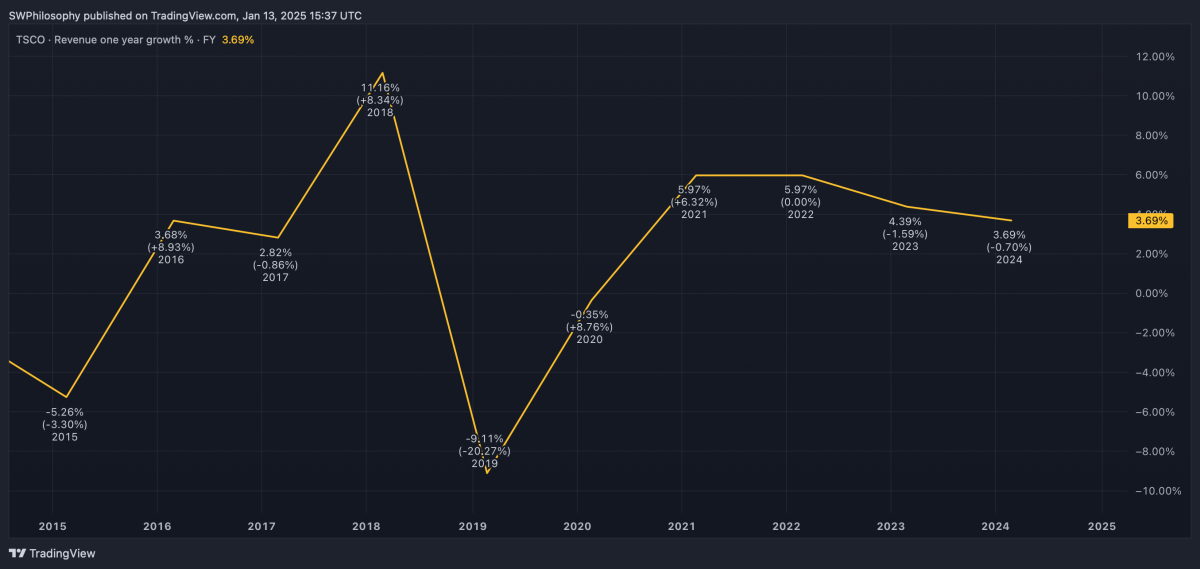
In terms of revenue growth, the last 10 years have been about as explosive as a walking tour of a library. Leaving aside the Covid-19 pandemic, sales have generally increased by more than the rate of inflation – but not by much. 

Tesco revenue growth 2015-2024

Created at TradingView

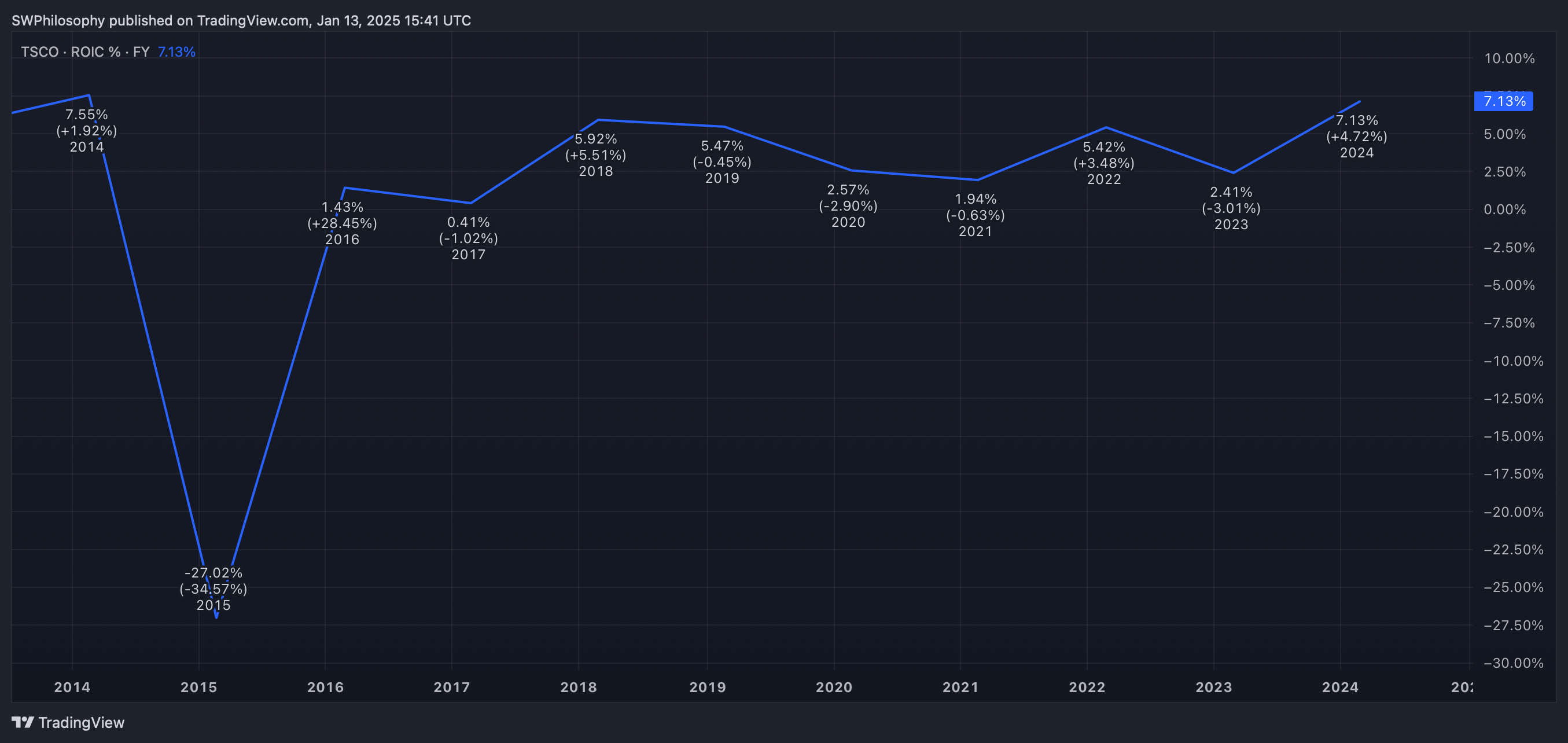
It’s also worth noting that this growth has been fairly expensive. Over the last decade, Tesco’s return on invested capital (ROIC) has consistently been below 10%, which isn’t particularly impressive.

Tesco ROIC 2014-2024


Created at TradingView

This indicates that the company has to commit quite a lot of its capital into things like inventory and equipment to achieve this growth. And this isn’t a particularly good sign for investors.

An opportunity?

Tesco has been part of the FTSE 100 since 1996 and its scale gives it a big advantage over the rest of the UK grocery industry. From a dividend perspective, I think the stock looks attractive. 

The thing is, there’s more to investing than just dividends. And with growth looking both modest and capital-intensive, I think I can find better opportunities right now.

Financial News

Daily News on Investing, Personal Finance, Markets, and more!

Financial News

Policy(Required)