Is there any growth potential left in Tesla stock?

Owning shares in Tesla (NASDAQ: TSLA) has been a veritable goldmine for some investors. If I had bought Tesla stock at the right point in October, for example, I would now be showing a paper gain of 85% — in under three months.

I am a long-term investor though. But here too I could have done well. Very well, in fact. Over the past five years, the Tesla price has soared 1,085%.

Unfortunately, I did not hold Tesla during that period. So should I buy now — or has the investment case run out of growth potential?

The business environment has changed a lot

Last year saw Tesla’s annual number of vehicle sales fall, for the first time.

Now, to keep things in perspective, the drop was small. Tesla is still shifting tens of thousands of vehicles each week.

Nonetheless, a reversal in sales growth can be a sign that a company is moving from one stage of development to another, where the focus is less on growing sales volumes and more on increasing profitability, for example by raising prices and cutting costs.

But here I see some real risks for Tesla. The weaker sales last year were not because electric vehicles are declining in popularity. The total market size is growing – and I expect it to keep moving up.

Rather, Tesla is in a much more competitive market now than it was a few years ago, as multiple rivals have built scale to threaten its leading position.

That could lead to more price competition, hurting Tesla’s profit margins. On top of that, changes in tax credits in key markets could also eat into the US giant’s earnings.

Lots to love about the firm

Still, while any savvy investor takes a clear-eyed view of potential risks, Tesla is not exactly in a bad spot.

The vehicle business is substantial and the company has proved it has what it takes to succeed in it. Even before potential game-changers like self-driving taxi fleets, Tesla has carved out a strong and defensible niche for itself thanks to its innovative technology and well-known brand.

On top of that, the company is not a one-trick pony. It has a large and fast-growing energy storage business.

This strikes me as a smart way to capitalise on some of the expertise it is developing in its electric vehicle business. Over time, I expect energy storage to become a much more important part of the Tesla investment case.

The share price looks overvalued to me

On balance then, I think there could well be growth left in the Tesla business.

But what about the stock price?

The firm already commands a price-to-earnings ratio of 110. In other words, if someone bought the firm at its current valuation, it would take over a century’s worth of earnings at today’s level to pay back the cost of that acquisition, even before interest.

That looks heavily overvalued to me, even allowing for Tesla’s growth prospects, so I have no plans to buy.

Market momentum could yet drive the Tesla price higher. But based on business fundamentals, I see no rational reason for any such increase at this time.

By contrast, a sharp fall would strike me as more understandable in bringing the valuation closer to what I see as justifiable.

Can Taylor Wimpey rocket like the IAG share price?

The share price of IAG — or International Consolidated Airlines Group (LSE: IAG) as it should be called — doubled last year, making it the FTSE 100‘s standout performer.

Shares in the British Airways owner soared as global travel rebounded post-pandemic. Sadly, I don’t hold IAG, so could only watch from the sidelines.

At the same time, my stake in FTSE 100 housebuilder Taylor Wimpey (LSE: TW) tumbled 25%. Rising interest rates and a sluggish housing market were the culprits here. Sadly, I do own Taylor Wimpey.

It’s not uncommon for one year’s winners to become next year’s losers — and vice versa. So, could their fortunes reverse in 2025?

Has the IAG share price hit a ceiling?

IAG benefitted from pent-up travel demand, with passengers keen to fly and happy to pay more for the privilege fares. Yet the scars of Covid remain. Airlines seem perpetually vulnerable to global challenges, including wars, climate change, recessions and even volcanoes.

I think IAG shares could still climb higher. They look cheap, with a price-to-earnings (P/E) ratio of just 7.2. That’s less than half the FTSE 100 average. 

The board plans to modernise fleets, expand long-haul routes and enhance the customer experience, all of which could boost profitability.

But those ambitions come with costs and IAG already has net debt exceeding €6bn. Budget airlines also pose stiff competition. Do passengers really want to pay extra for better service?

Falling fuel prices helped IAG last year, but today’s rising oil price could squeeze margins if it continues. Inflation and higher interest rates may also discourage travel. While the dividend is back, I think the real excitement around IAG has passed.

For a while last year, my Taylor Wimpey shares were flying. Better still, I was getting a fantastic 7% yield. Then things went south.

Inflation and interest rate hikes struck have nudged up mortgage rates and cooled (but not killed) the property market. 

The Taylor Wimpey share price has dropped another 10% in the last week as rising UK bond yields signal economic trouble.

Taylor Wimpey has a stunning yield

The company’s latest trading update reflected these challenges, noting a drop in sales and persistent uncertainties. Still, I see reasons for optimism.

The UK’s chronic housing shortage isn’t going away. Taylor Wimpey boasts a strong land bank and a solid balance sheet. Its P/E ratio of 10.94 might not be as low as IAG’s, but it still looks like a bargain to me.

Even better, the dividend yield now stands at a staggering 8.58%. As far as I can tell, the payout is secure. There’s no chance I’m selling my shares.

The 16 analysts following Taylor Wimpey predict a median share price increase of over 42% in the next year, which, combined with the yield, suggests a potential total return of around 50%. Not quite IAG levels but still pretty handsome.

Personally, I think that might take longer than a year to play out, but the potential is there.

Last year, I wish I’d owned IAG. Today, I’m backing Taylor Wimpey. While I wait for the recovery, I’m happy collecting and reinvesting its bumper dividend.

Here’s how a stock market beginner could get going in 2025 with £260!

Could 2025 be the year to start investing in the stock market, even if only on a limited budget? I expect many people will be asking themselves that this month – and, as happens every year, some of them will end up doing nothing between now and the end of December!

But it need not take a lot of money to become a stock market investor. Here is how someone could start buying shares with a spare £260 this week.

Starting now versus procrastinating

There is always a reason (or excuse) to put off starting, even if it can be done with a fairly small amount of money. Maybe waiting for more knowledge, a better looking market, or even fear of the market crashing.

I think knowledge is helpful, so it definitely makes sense for someone to get to grips with how the stock market works before they begin to invest.

But I think there are good reasons to start sooner rather than later. After all, I take a long-term approach to investing and think many investors would benefit from having a longer not shorter timeframe available to them.

Don’t try timing the market

But what about the other potential concern I mentioned, that there may be a stock market crash around the corner? That may always be true, in the sense that the market will crash again sooner or later, although none of us knows when.

But I think it would be more worrying if an investor sought to ‘buy the market‘. As my own approach focuses on buying a diversified selection of individual shares to buy, it bothers me less.

Even in a broadly overvalued market there can be some bargains – and actually I think the UK market currently offers quite a few such bargain opportunities.

With £260, diversification may seem tricky – but it is still possible to invest in, say, a couple of different shares.

Getting ready to invest

Before actually buying any shares, an investor needs a way to do so. With just £260, minimum fees and commissions could quickly eat into the money when buying and holding shares.

So I think it makes sense to take time to compare different share-dealing accounts and Stocks and Shares ISAs. Different investors each have their own financial situation and objectives.

Looking for shares to buy

When looking for shares to buy, I think most new investors could do worse than to try and keep it simple. By that, I mean sticking to large companies with proven business models they understand.

But finding the right company is not enough for successful investing. It is also important to find it at the right share price. One share I think investors should consider is Aviva (LSE: AV).

The FTSE 100 insurer has a strong business thanks to high, resilient demand for insurance services. It has strong brands and a very large customer base that can help it capitalise on that.

The company has been raising its annual dividend per share since a cut in 2020 (no dividend is ever guaranteed to last). It yields 7.3%. So half the £260 put into Aviva shares would hopefully earn around £9 a year of passive income.

One risk I see is the proposed merger with Direct Line leading competitors to target customers by cutting prices. That could hurt profits for Aviva.

Games Workshop share price falters on half-year results as fears of US tariffs loom

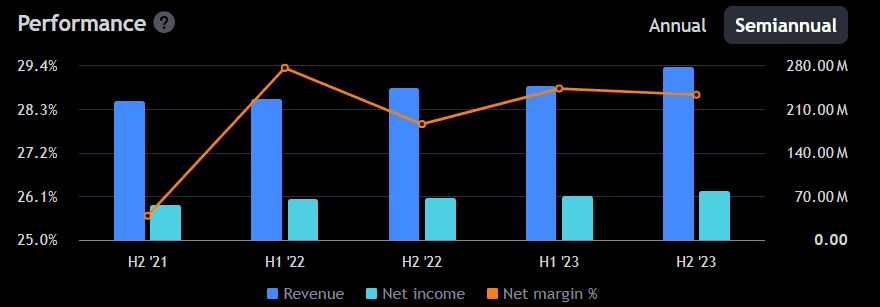
Despite a strong performance, Games Workshop‘s (LSE: GAW) share price slipped almost 4% today (14 January) after the company published its first-half 2024/2025 results.

These revealed a pre-tax profit of £126.8m, marking a 25% rise compared to £95.2m in the prior year. Core revenue reached £269.4m, a 10% increase from £235.6m in the same period last year. 

Income from licensing surged to £30.1m, more than doubling from £12.1m previously. However, its net increase in cash was lower, at £79.1m, compared to £85.3m in the second half of 2023.

Screenshot from TradingView.com

A dividend of £1.55 per share was also announced, bringing the full amount up to £4.20 for the financial year. The ex-dividend date is 23 January.

The company isn’t planning any share buybacks or acquisitions.

Growth drivers

Renowned for its Warhammer series, Games Workshop’s gone from strength to strength. The share price rose 15% in 2023 and a further 34% in 2024, following consistent revenue growth in the past five years.

With a view to continue expanding, the company’s initiated several key developments. Most notably, a planned partnership with Amazon to adapt Warhammer 40,000 into a television series could be a huge boost for the brand.

With a dedicated global fanbase and website that attracts 2.8m monthly visitors, the deal stands in good stead to benefit both parties.

On the video gaming side, the release of Warhammer 40k: Space Marine 2 in September helped boost its digital footprint. Although there were some critical reviews from online gaming sites, the overall reception was generally favourable.

Fundamentals and forecasts

The soaring share price means Games Workshop looks slightly overvalued. It has a trailing price-to-earnings (P/E) of 28.9, well above the industry average. However, with earnings forecast to grow, this is expected to come down.

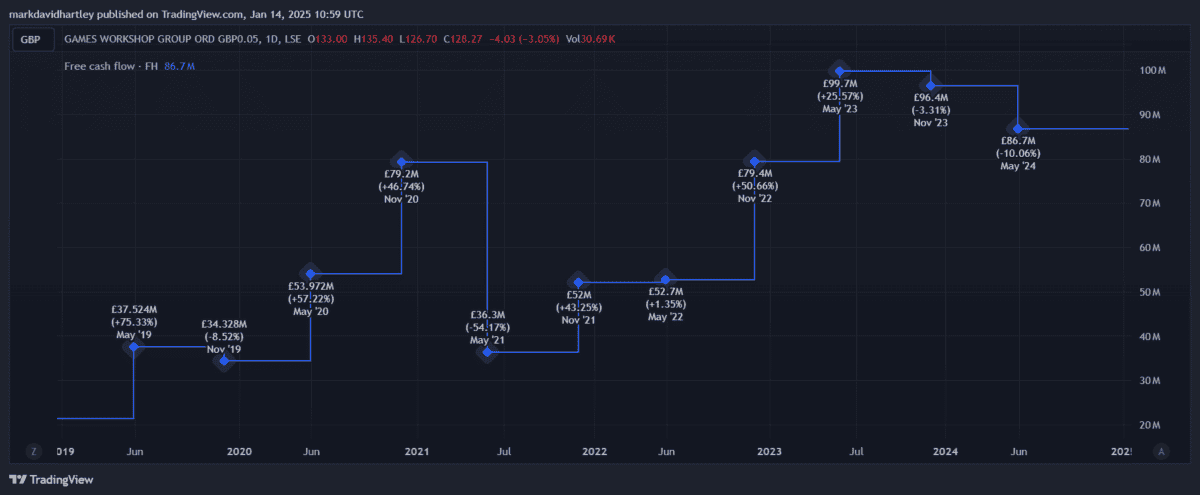
Games Workshop free cash flow
Screenshot from TradingView.com

Despite a slight dip in 2024, free cash flow has been steadily increasing overall. And with no debt, the risk of further interest rate hikes shouldn’t be a cause for concern.

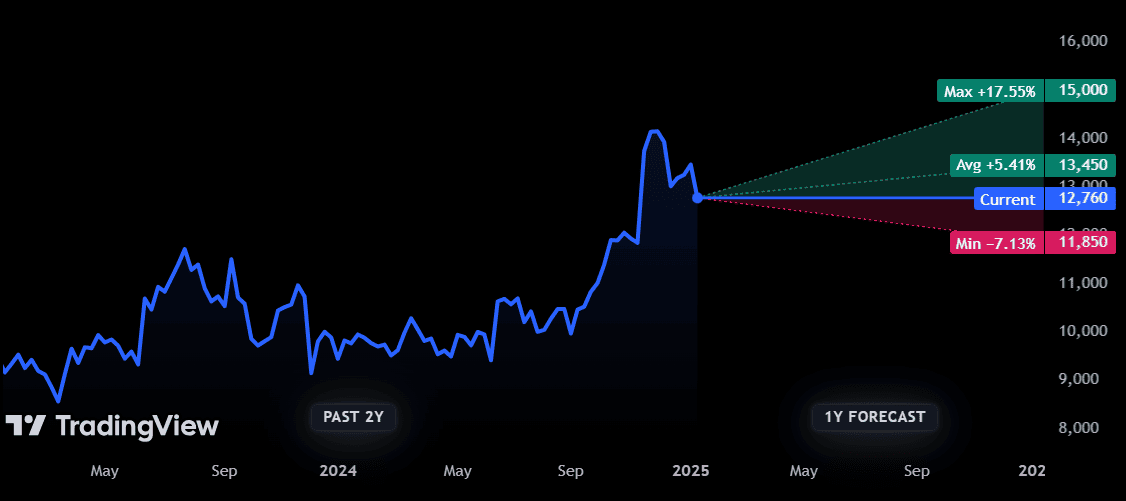
Still, it may be difficult for the share price to see further gains from here. Analysts watching the stock don’t expect much above 5.4% growth in the coming 12 months.

Games Workshop analyst ratings
Screenshot from TradingView.com

Risk to consider

Whether the company can continue to find new customers is the question. As a non-essential retailer, rising inflation could lead to a drop in sales as consumers prioritise their spending. Although it recently joined the FTSE 100, it remains a comparatively small outfit.

With the economy looking uncertain in 2025, investors may opt for the safety of larger and more well-established companies.

In today’s results, it also warned of potential third-party cost inflation related to US trade tariffs. This may be one reason the share price dipped after the news came out. High tariffs could limit profits from the US, its largest market by revenue.

Final thoughts

Overall, Games Workshop appears to be in a good position, both regarding finances and business developments. The partnership with Amazon represents a particularly compelling value proposition.

I’ve been considering the stock for some time as I think it shows great promise. However, considering the current economic climate, I’ll wait for more info about US tariffs before deciding to buy.

How much would an investor need in an ISA to make £650 a month in second income?

Making a second income from stocks isn’t a pipe dream. I do, and I know of plenty of other investors that do the same. However, for an investor that’s starting from scratch with an empty Stocks and Shares ISA, there’s some work that needs to be done in order to try and build the dividends to the point of making £650 a month.

Making use of the ISA

To begin with, the ISA needs to be set up. It’s possible to build a second income without one, but holding the stocks within this investment account is more tax efficient. When an investor receives a dividend or sells a stock for a profit, the proceeds aren’t subject to tax in the ISA. This means that more of the money can be retained, thus accelerating the process of building the portfolio.

In terms of funding the account, there’s a limit of £20k a year that can be invested in an ISA. Some might find it easier on cash flow to invest an amount each month, rather than adding £20k once a year. Of course, no one’s forced to invest £20k. But the closer an investor can get to this figure helps to speed up the process.

Please note that tax treatment depends on the individual circumstances of each client and may be subject to change in future. The content in this article is provided for information purposes only. It is not intended to be, neither does it constitute, any form of tax advice. Readers are responsible for carrying out their own due diligence and for obtaining professional advice before making any investment decisions.

Dividend stock picks

With the money ready to be deployed, the focus now turns to picking good dividend stocks. As a note, picking the stock with the highest yield isn’t always the best one. A high yield could be due to the share price falling, meaning that the dividend might not be sustainable.

Rather, considering a slightly lower-yielding option can be more realistic. For example, the abrdn Equity Income Trust (LSE:AEI). The investment trust has a dividend yield of 7.25%, with the share price up 5% over the last year.

The investment manager (abrdn) aims to provide a high income level by selecting a host of different stocks that pay dividends. It’s a nice option to consider as it takes a lot of the legwork out of researching individual ideas, as well as reducing hassle and transaction costs from buying all the stocks individually.

At the moment, the company has most of the exposure to UK shares. The largest weighting is to financial services with 43%, followed by energy at 18%. The biggest individual holding is Imperial Brands.

One risk here is that it’s an all-or-nothing-style trust. If an investor doesn’t like some of the holdings, they can’t pick and choose what the investment manager includes in the trust.

Reaching the goal

To make £650 a month, it’s not something that will happen overnight. Assuming that an investor can invest £20k a year with a portfolio of stocks that have an average yield of 7%, I can work out some forecasts.

After four years, the investment pot could be worth £115.5k. This could mean in the following year, it could generate a second income of £674 a month.

If an investor put in less per month, the time frame would become longer to hit the goal. Of course, these are just forecasts and should be taken with a pinch of salt, but it shows the potential!

The JD Sports share price is down 10% today! Time to consider getting involved?

The worst-performing FTSE 100 stock so far today (14 January) is JD Sports Fashion (LSE:JD). The JD Sports share price is down almost 10%, hitting its lowest level since 2020. Even though there’s a clear negative catalyst for this move, some investors might see this as a potential for a long-term value buy. Here are the details.

Flagging up profit issues

The business issued a trading update this morning, stating that “we now expect the full-year profit before tax and adjusting items to be between £915m and £935m”. This is down from the previous estimate of £955m to £1.04bn that was last referred to. So in short, this is what people refer to as a profit warning.

The last couple of months of 2024 weren’t as good as expected with like-for-like revenue versus 2023 down by 1.5%. In terms of factors influencing this, the update cited “a challenging and volatile market”. That meant rivals were very promotional, but while maintaining full price supported JD’s margins, it also dented potential sales.

It wasn’t all bad news, with sales growing in Europe and Asia Pacific, doing some of the work to offset the slowdown in the UK and North America. Further, in terms of segment performance, the Sporting Goods and Outdoor area was a standout worthy of note.

Looking at the bigger picture

The sharp share price reaction to the profit warning shows how sensitive investors are to any signs of weakness at the company.

Part of this does seem to be an overreaction. It’s true that this knocks around 10% off full-year profit before tax. But it’s still a very healthy profit to make. Put another way, there’s no danger of the business becoming loss-making any time soon.

In terms of revenue, it expects it to be flat to the previous year. Yet the revenue from last year was a good performance. For perspective, in 2020 revenue was £6.11bn. The forecast for this year is around £10.5bn. By taking a bit of a step back, investors can have a much clearer picture.

Of course, the profit warning might not be the end of the bad news for the moment. The update said “we are taking a cautious view of the new financial year.” So the risk is that we get more of a spiral downwards before management flip to being more optimistic.

Finding value

I think the stock is worth considering for an investor, based on the potential overreaction to the news today. With a price-to-earnings ratio of 7.93, it’s below the fair value metric of 10 that I use to benchmark. It’s not without risks, but it does appear to be an undervalued stock based on the 26% fall in the price over the past year.

The only FTSE 100 shares I own at the start of 2025

As the name suggests, the FTSE 100 comprises 100 shares at any given time. Many UK investors will probably own at least a couple of them, if not all of them through a Footsie index tracker.

When Warhammer maker Games Workshop joined the FTSE 100 just before Christmas, it became the 14th Footsie name in my 41-stock portfolio. In no particular order, here are the other 13.

Dividends shares

One great strength of the UK’s blue-chip index is the dividend income on offer. It yields a very respectable 3.6%, but you don’t have to rummage too long to unearth dividend stocks yielding far higher than the average.

My portfolio has four of these high-yielders in the shape of Legal & General, British American Tobacco, Aviva, and HSBC. Respectively, they yield 9.2%, 8.2%, 7.2%, and 6%.

Beyond the income potential, I like HSBC’s positioning in Asia, the world’s fastest-growing region. And I want my portfolio to have long-term exposure to the UK’s ageing population, which Aviva and Legal & General offer in spades. Meanwhile, British American Tobacco stock appears undervalued to me.

Naturally, dividends aren’t assured, and financial services stocks are exposed to the fluctuations of markets. British American Tobacco’s having to manage a decline in the number of smokers worldwide while building up its non-cigarette business (vapes, pouches, heated tobacco, etc).

Nevertheless, I think this little basket of FTSE 100 high-yielders offers my portfolio solid dividend prospects and decent diversification.

Growthier names

I also hold other dividend-paying stocks where, over time, I hope for a decent bit of share price growth on top. These include bottler Coca Cola HBC and Diageo, which yield 2.9% and 3.3% respectively.

Between them, they sell a number of timeless brands, including Coca-Cola, Sprite, Fanta, Johnnie Walker, Smirnoff, and Guinness.

I’d put 2.6%-yielding defence giant BAE Systems in this bucket too. As EU Commission president Ursula von der Leyen said in 2024: “The world is as dangerous as it has been for generations.”

BAE’s helping European countries re-arm in an age of rising external threats. While an unpredictable Donald Trump administration adds uncertainty, I think BAE will do well moving forward.

Two turnaround stocks I hold are JD Sports Fashion and Rolls-Royce. But the former has just tanked after Christmas profits underwhelmed, so the turnaround may take a while. I’ll remain patient.

Rounding out this category are diversified pharma giant AstraZeneca and plant hire firm Ashtead Group.

Investment trusts

Finally, I hold a pair of FTSE 100 investment trusts in my portfolio. One is Pershing Square Holdings, which offers exposure to Bill Ackman’s hedge fund. He has a tremendous record of beating the market.

The other is Scottish Mortgage Investment Trust (LSE: SMT). The fund invests in innovative firms with high growth potential, including Amazon, Nvidia, and Instagram owner Meta Platforms.

But Scottish Mortgage also gives exposure to exciting private companies that I can’t invest in myself. One is SpaceX, Elon Musk’s extraordinary rocket company whose valuation has swelled to $350bn. Its Starlink internet service now has over 4.6m subscribers.

Due to the trust’s sole focus on growth companies, it can underperform badly during bear markets. But the portfolio’s packed with innovators that I expect to be much larger in future, which should boost Scottish Mortgage’s value over time.

This FTSE 250 stock’s jumped 12% after today’s results! Will it finally make me rich?

FTSE 250 grocery and tech specialist Ocado Group (LSE: OCDO) has been the bane of my portfolio since I bought it last year hoping I was getting a bargain. As of last night, I was down 38% on my trade. But today brought a welcome surprise. Ocado shares jumped 12% in early trading after posting bumper Christmas results.

Long-term investors will still be suffering from indigestion though. The Ocado share price is down 58% over one year and 79% over five.

This morning we learned that Ocado Retail, its joint venture with Marks and Spencer Group, ended the financial year on a high.

Can Ocado shares grow from here?

Q4 retail revenues surged 17.5% year-on-year to £715.8m, building on the 15.5% growth seen in Q3. Average weekly orders increased 16.9% to 476,000, hitting a milestone of 500,000 in late November. Active customers rose 12.1% to 1.12m, with modest gains in average basket value and order volumes.

Demand’s robust as wages rise continue to faster than inflation. So what’s fuelling this growth? CEO Hannah Gibson attributes the success to Ocado Retail’s “unbeatable choice, unrivalled service and reassuringly good value.

There’s an early whiff of spring in the air, with Ocado Retail expecting to sustain its market-leading sales growth and improve efficiency during 2025. It’s targeting a high mid-single-digit adjusted EBITDA margin in the medium term. That’s a critical goal given its long-term struggles with profitability. Scaling operations while enhancing margins could finally address one of the company’s key weaknesses.

I’m not getting too excited though. Last September, Ocado Retail upgraded revenue guidance after a 15.5% Q3 revenue jump, prompting a share price spike that quickly fizzled. Similar patterns emerged over the summer, as a handful of new CFC openings for overseas partners failed to sustain investor enthusiasm.

Ocado still faces major hurdles. While its robot warehouse technology is groundbreaking, international partners have been slow to adopt it. That’s delayed the global roll-out needed to justify the massive investment. Until the group achieves consistent profitability, the share price is likely to remain volatile.

Another bumpy year in store

Rising interest rates add another hurdle. Higher rates drive up financing costs for growth-focused companies and diminish the value of potential future earnings. The fiercely competitive grocery sector and rising operational costs threaten to squeeze margins further.

Today’s results, buoyed by record-breaking Christmas trading, have handed me a glimmer of much-needed hope. Yet the road ahead is challenging. Ocado must expand its customer base, improve efficiency and fully leverage its innovative technology to achieve sustained success. None of that will be easy, especially given today’s economic uncertainties.

So will Ocado finally make me rich? While its trajectory shows promise, the path’s far from certain. The company’s blend of technological innovation and retail expertise is great, in theory. The reality has been tough. External pressures like inflation and interest rate concerns remain daunting obstacles.

I’ve made my bet on Ocado and plan to stick with it, but I expect today’s spike to fade just like the last few did. Its day could come, but only when inflation and interest rates are finally heading in the right direction.

Here’s why Oxford Nanopore Technologies stock is up 15% in the FTSE 250

Oxford Nanopore Technologies (LSE: ONT) stock was the biggest riser in the FTSE 250 index yesterday (13 January). Shares of the gene-sequencing firm rose 10% then another 5% today to reach 149p.

However, the stock is still down more than 75% since listing in late 2021. Here, I’ll take a look at what has caused the recent jump and assess whether it’s a good fit for my portfolio.

Encouraging update

For those unfamiliar, Oxford Nanopore makes cutting-edge DNA/RNA sequencing devices that enable real-time analysis of genetic material. They’re used for scientific research across the healthcare and life sciences industries.

Yesterday, the firm released a full-year trading update. In this, we learnt that underlying revenue growth in the second half was approximately 34% at constant currency. This was an acceleration over the first half, enabling the company to achieve £183m in revenue, in line with market expectations.

That would represent year-on-year growth of 11% on a constant currency basis. That’s not bad considering the overall life sciences sector faced challenging conditions in 2024.

CEO Gordon Sanghera commented: “Looking beyond 2025, our highly differentiated platform and deep innovation pipeline coupled with strengthened commercial and operational capabilities combined with a strong balance sheet, position us well to deliver long-term, sustainable, above-market growth.”

Encouragingly, the gross margin is set to be slightly above the previously expected 57%. And management anticipates the gross margin reaching 62% by 2027, with revenue growing at a compound annual growth rate of more than 30% between 2024 and that date. It also reaffirmed a target of adjusted EBITDA breakeven in 2027.

No profits yet

Of course, an ambition to reach adjusted EBITDA breakeven in two years indicates that the firm is still deeply unprofitable. Indeed, it doesn’t expect to become cash flow positive until at least 2028.

Clearly, the losses add risk to the investment case. And they almost certainly explain why the share price has struggled since late 2021 when the era of near-0% interest rates came to an end.

We won’t get the full-year earnings until 4 March. Looking at the forecasts though, I’m seeing losses above £100m for both last year and this one.

On the plus side, the firm ended 2024 with £403m in cash, so remains well-capitalised. It should be capable of becoming cash flow positive with the resources at hand. If it can do so, while hitting its revenue growth targets, the share price could end up much higher than today’s 149p.

Should I invest?

Oxford Nanopore’s products are based on innovative technology and it appears to be taking market share during a challenging time. The more devices it sells, the more recurring revenue it gets from consumables and software services.

With a modest market cap of £1.4bn, the firm could become a takeover target. However, it can be dangerous to invest on the basis that a business might be acquired at a higher price.

Recently, I’ve made a hash of picking stocks in the healthcare sector. My holding in Moderna continues to take a battering (down another 16% yesterday), while medical device firm Creo Medical has unperformed too. Even Novo Nordisk is struggling lately.

With Oxford Nanopore stock trading at a premium 7.6 times sales, I’m going to give this one a miss for now.

Where’s the stock market heading in 2025? Here’s what the experts say

There have already been many stock market predictions as we hit the middle of 2025’s first month, but uncertainty remains.

Last year, the FTSE 100 delivered returns of 7.1%, supported by sectors like finance, aerospace and defence. The FTSE 250 lagged at only 5.9% due to limited international reach. In the US, the Nasdaq Composite returned 32.7% with the S&P 500 returning 26.9%. 

Several major events shaped the markets last year, including geopolitical tensions and falling interest rates. Initially, the high interest rate environment drove UK property and finance stocks up while retail and fashion suffered.

But as the year came to an end, growth tapered off. 

So where’s the FTSE heading now?

With equities trading at a 40% valuation discount, projections suggest the UK could be the third fastest-growing economy in 2025. Pension reforms and higher inflation could help drive growth.

The Bank of England expects moderate economic growth of 1.5% but not everyone agrees. Economists at Goldman Sachs project growth of 1.2%, slightly below the 1.3% average of those surveyed by Bloomberg.

Major Swiss bank UBS expects the FTSE 100 could end the year around 8,200 points. That’s barely any change from current levels. Others are more positive, with Capital Economics eyeing a year-end rise to 9,000 points — a 10% increase.

Looking around, 8,500 points seems to be the average from most analysts.

In contrast, Wall Street analysts expect the S&P 500 to rise by 14.8% on average in 2025.

UK stocks to watch

After ending 2024 down, both BP and Vodafone are two major stocks tipped for a recovery in 2025. As demand for premium spirits improves, Diageo may also return to growth. 

Legal & General has been noted as an option to consider for risk-averse investors. ITV has been tipped as a potential takeover target and major construction firm Ashtead may move its listing to the US.

With interest rates looking stubborn, bank stocks are also getting attention. Shore Capital recently reiterated Buy ratings for Barclays and HSBC (LSE: HSBA). With a broad international reach, the latter is in an interesting position but it must play its cards right to keep everyone happy.

A beneficial split

Last year, HSBC announced a split between its East and West divisions to cut costs and reduce administrative issues. But with tensions rising between the US and China, there could be more to the strategy. If Trump’s planned trade tariffs create further division, an administrative divide may be beneficial.

It also announced a $3bn share buyback programme to reaffirm its commitment to shareholders (and possibly quash any jitters about the split). There’s still a risk the plan will backfire or fail to serve its purpose. If so, HSBC could find itself torn between major powers if relations between the East and West erode further.

But for now, it looks to be on the right track. Despite solid growth in the past year, it maintains a low price-to-earnings (P/E) ratio and an attractive 6% dividend yield. To my mind, that’s make it worth considering as part of an income portfolio in 2025.

As always, interest rate policies, inflation trends and global events will be key areas to watch as the year progresses.

Financial News

Daily News on Investing, Personal Finance, Markets, and more!

Financial News

Policy(Required)