Here’s how investors could aim for a £6,531 annual passive income from £11,000 of Aviva shares

I have reconciled myself to the possibility that Aviva (LSE: AV) shares may never again decisively break the £5 price barrier. The last time it did so was in the second half of 2018.

However, I am reassured in continuing to hold my stake in the insurance, savings and investment firm by two key factors.

The first is that I bought it primarily as a stock to generate passive income. This is money made with minimal effort, most appositely in my view from dividends paid by shares. Such income can make life a lot better in the short term and can allow for an early retirement. Crucially in this context, the yield that generates passive income rises if a stock’s price falls.

The second is there is every reason for me to think Aviva’s share price might also rise at some point. A risk here is the intense competition in its sector that may squeeze its profits. However, it remains technically very undervalued, and its planned acquisition of Direct Line should add value. Anyway, hope is a wonderful thing.

Passive income generation

In 2023, Aviva paid a total dividend of 33.4p, yielding 7.1% on the current £4.68 share price.

£11,000 is the average UK savings amount and investors considering taking such a stake in Aviva would make £781 in first year dividends.

Provided the yield averaged the same, this would increase to £7,810 after 10 years and to £23,430 after 30 years.

Yields change frequently along with a firm’s share price and annual dividend payments, as mentioned. For Aviva, analysts forecast its dividend will increase to 34.2p in 2024, 37.5p in 2025, 40.1p in 2026 and 41.9p in 2027.

These would give respective yields of 7.2%, 7.9%, 8.5% and 8.9%.

Turbocharging that passive income

I always use the dividends paid by a stock to buy more of it – a standard investment practice known as ‘dividend compounding’.

Doing this on the current 7.1% yield, would generate £11,327 in dividends over 10 years, not £7,810. And after 30 years on the same basis, the dividends would be £80,984 rather than £23,430.

Including the £11,000 initial investment and the Aviva holding would be paying £6,531 a year in passive income from dividends!

Making something from nothing in the bank

I find a common misconception is that a lot of money is needed before any big returns can be made. This is simply not true.

For example, just foregoing that extra fancy coffee or pint of lager nowadays can save someone £5 a day.

Continuing to invest only that saving (£150 a month) in Aviva shares can generate £8,415 in dividends after 10 years. This is on the same twin bases as before – a 7.1% average yield and using dividend compounding.

After 30 years on the same basis, the dividends paid would have swelled to £134,856. By that point, this would be paying £9,575 a year in passive income from dividends.

None of that is guaranteed, and anyway, inflation would diminish the buying power of that money somewhat by then, of course. However, it underlines that big returns can be made from much smaller initial investments, especially using dividend compounding.

Indeed, the Aviva holding could be paying for a lot of coffees and lagers – both icy cold – on a beach somewhere beautiful by 2055.

3 million reasons why earning a second income is more important than ever

With artificial intelligence (AI) putting jobs at risk, earning a second income’s more important than ever.

In November, the British Safety Council highlighted a study revealing how AI could cost the UK workforce up to three million jobs by 2050.

However, the rise of AI presents both challenges and opportunities. The study notes how new roles could emerge from the transition. Until then, some workers may find their primary source of income cut off. For those facing potential unemployment, a second source of income could be a lifetime.

Ironically, investing in AI-focused companies could be a strategic way to work towards that goal. After all, if you can’t beat ‘em, join ‘em, right?

Here are some UK-based companies worth considering as an investment in AI.

Data’s king

British data analytics firm RELX (LSE: REL) was an early adopter of AI. With a vast collection of proprietary databases, it’s the go-to provider of decision tools for business in medicine, risk, legal and scientific fields.

What’s more, it’s established Responsible AI Principles to ensure its related applications are ethical and effective.

Revenue growth’s been steady and consistent since Covid, climbing from £7.1bn in 2020 to £9.16bn in 2023. Results for 2024 are expected to report revenue of £9.5bn and earnings per share (EPS) up from £1.12 to £1.21.

For a data-centric company like RELX, the threat of a cyber attack’s ever-present. Data leaks can be devastating for large businesses tasked with securing private data, often resulting in significant financial and reputational damage. I’m sure the £71.4bn company has excellent cybersecurity but it’s a risk to consider.

Digital transformation

Kainos Group‘s (LSE: KNOS) a FTSE 250 digital technology company. It specialises in IT services and software solutions, with a strong focus on the provision and support of the business software Workday.

It assists organisations in accelerating the shift to a fully digital workplace. In recent years it’s begun to leverage AI and machine learning to solve complex operational challenges. Some of its key services include predictive analytics, natural language processing and real-time business intelligence dashboards.

Worryingly, the stock’s been in decline for several years. In December, the firm announced the surprise reappointment of CEO Brenden Mooney who stood down in 2023. Whether this will help revive its fortunes remains to be seen. There’s a risk the upheaval could extend losses.

Yet analysts remain bullish, with the average 12-month forecast eyeing a 40% price rise. This is reinforced by the company’s commitment to shareholders, with consistent dividend growth from 6p a share to 27.3p over the past eight years.

US exposure

Naturally, the best AI opportunities are often found in the US. That’s where Manchester & London Investment Trust comes along. This UK-listed technology fund provides exposure to top US tech firms like Nvidia, Microsoft and AMD.

Currently, it’s trading at a large discount to net asset value (NAV). While that presents a potential buying opportunity, there’s a risk it doesn’t narrow, resulting in subpar returns. Promisingly, the portfolio only includes 10 stocks, suggesting a careful selection process.

Over the past two years, it has delivered returns of 124.4%. Comparatively, popular tech-focused trust Polar Capital Technology Trust has returned only 91%.

With an 8% yield, is the second-largest FTSE 250 stock worth considering?

Harbour Energy (LSE: HBR) is a FTSE 250 oil and gas company based in London. With a £4bn market cap, it’s not only the second-largest on the index but also currently larger than the 10 smallest on the FTSE 100. Consequently, it main rejoin the main index in the next reshuffle.

It got demoted from the FTSE 100 in late 2022 after its market cap collapsed below £3bn. However, it catapulted back above £4bn again in early September last year after finalising the acquisition of the upstream assets of German oil and gas producer Wintershall Dea.

The acquisition represents a significant expansion for the company, pushing production up to 475,000 barrels of oil equivalent per day (boepd). According to a press release, it’s now “one of the world’s largest and most geographically diverse independent oil and gas companies.”

Assessing viability

Harbour certainly seems to be enthusiastically expanding its business but oil and gas is a tough industry. Prospecting for new wells can be expensive and at times, can yield no returns. Many independent companies experience long periods of losses and mounting debt with no guarantee of a recovery.

When assessing oil and gas companies, it’s important to consider how many years of reserves they hold. The potential value of an as-yet untapped reserve depends on its commercial viability.

Successful explorations amount to assets on the balance sheet and then slowly decrease as they are depleted. As incoming cash is used to fund new explorations, the company can quickly fall back into a low valuation.

Thus, accurately assessing the investment viability of an oil and gas company can prove difficult. This is often made most evident by a wildly fluctuating price-to-earnings (P/E) ratio.

Value and dividends

TradingView.com

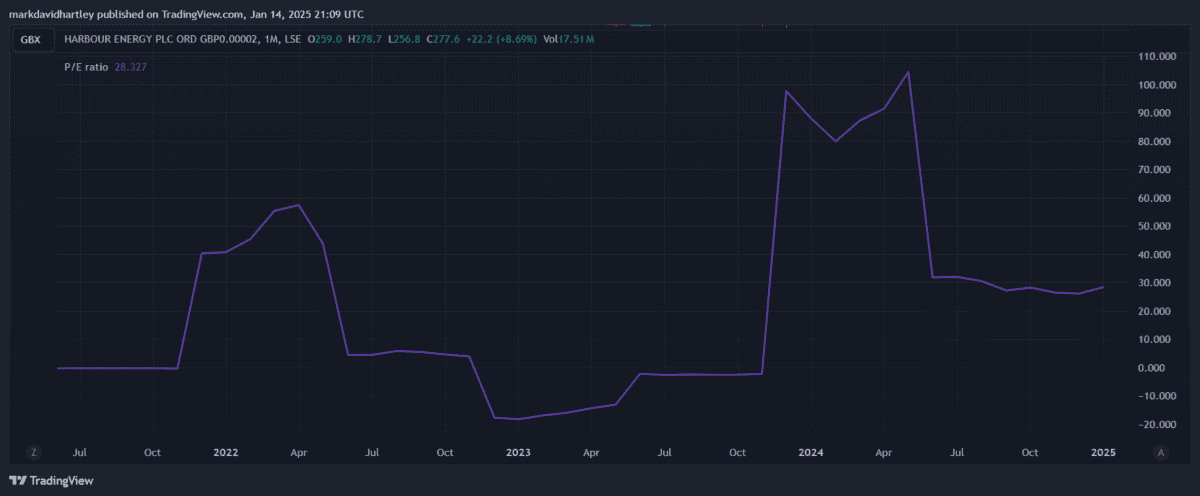
In the graph above, we can see how Harbour’s trailing P/E ratio has moved in a range between -18 and +105 over the past few years.

Currently, it’s positive and sits around 28, which looks expensive for investors considering it now. But the recent boost in production means earnings are forecast to improve significantly, so it has a forward P/E ratio of only 10.

That means the current share price of 277p could be very cheap, prompting analysts to forecast an average 12-month price target of 370p — a 33% increase!

An extra 8% in dividends on top of that would be the cherry on top. But with almost no track record of payments, it’s impossible to say whether its dividends are reliable.

With no steady or consistent cash flow, energy companies can be unreliable when it comes to dividends. Last year, for instance, Diversified Energy Company slashed its dividend and the yield fell from 15% to 7.2%.

Subsequently, I wouldn’t factor in the dividend when assessing the long-term value of Harbour.

Further advancements

But in December 2024, Harbour enjoyed further good news. In cooperation with partner Ithaca Energy, it discovered hydrocarbons in the Jocelyn South prospect in the North Sea. Of course, while the discovery is promising, the commercial viability of it still needs to be evaluated. As ever, there’s a risk it could cost a lot and amount to little.

While Harbour’s developments seem promising, I don’t plan to buy it today. However, it may be worth considering for risk-tolerant investors keen on emerging energy stocks.

10%+ dividend yields! 3 top dividend shares to consider in 2025!

Looking for the best dividend shares to buy? Here are three whose sky-high dividend yields make them worth serious consideration right now.

Phoenix Group

At 11.1%, financial services provider Phoenix Group (LSE:PHNX) currently offers the FTSE 100‘s largest dividend yield for 2025.

This is a share that — if not for my considerable stakes in industry peers Legal & General and Aviva — I’d consider adding to my own portfolio for passive income.

Like those other Footsie shares, it has substantial financial resources it can use to keep paying large and growing dividends. As of June, its shareholder capital ratio was 168%, towards the upper end of its 140%-180% target range.

A strong cash base gives Phoenix the scope to leverage its considerable structural opportunities too. Like those other Footsie shares I’ve described, providers of retirement and wealth products could enjoy sparkling sales growth as the global population ages.

The marketplace is incredibly competitive. But as Phoenix ramps up investment in heavyweight brands like Standard Life, the company still looks in good shape to grow earnings.

NextEnergy Solar Fund

At 13.6%, renewable energy stock NextEnergy Solar Fund (LSE:NESF) has the second-biggest forward dividend yield on the FTSE 250 right now.

Electricity producers like this can offer a healthy level of security to dividend chasers. As energy demand remains unchanged over time, NextEnergy has the earnings stability and the confidence to pay large dividends at all points of the economic cycle.

Indeed, the company has raised annual payouts each year since it listed on the London Stock Exchange in 2014. Its dividend yield during that time has consistently ranged between 5% and 7.5%, too, comfortably beating the FTSE 100 average of 3%-4%.

That’s not to say renewable energy stocks are without risk. Profits at this particular business suffer when solar radiation is low and its ability to generate power decreases.

However, NextEnergy’s wide geographic footprint helps to lessen this threat on group profits. It directly owns more than 100 solar projects spanning the whole of Europe.

Henderson Far East Income

Operated by Janus Henderson, the Henderson Far East Income (LSE:HFEL) investment trust aims to generate both growth and income by investing in far-flung Asian companies.

Major holdings here include Taiwan Semiconductor Manufacturing Company, China Construction Bank, and Macquarie Group. In total, it holds shares in more than 70 companies across regional hubs including China, Hong Kong, Singapore, and South Korea.

This gives it excellent growth potential as Asia Pacific’s middle class rapidly grows, though this is not the only advantage of its diversified approach. Spreading investors’ capital across dozens of businesses helps provide earnings, and thus dividends, with added protection.

Indeed, shareholder dividends have continued growing despite recent problems in China’s economy. Though this remains a threat, City analysts don’t expect this to disrupt the trust’s dividend growth record.

Therefore the dividend yield here for 2025 is a stunning 10.7%.

Greggs’ share price tanked last week. So I bought more!

Disappointing trading releases can sometimes be like London buses. There’s not a single one in sight, but then suddenly two come along at once. This been the case over at Greggs (LSE:GRG), whose share price slumped again following another weak trading statement.

It’s disappointing to me as someone who only opened a position in the baker in November. But I didn’t get down in the dumps and rue my bad fortune.

Not at all. A calm head prevailed, and I increased my stake in the FTSE 250 company instead. Here’s why.

Sales slowdown

Troubles persist across the retail sector as the cost-of-living crisis endures. Not even Greggs, with its famously low-cost menu, has been immune to the pressure.

Full-year financials last week (9 January) showed revenues rise 11.3% to all-time highs of £2bn. Like-for-like sales growth in 2024, meanwhile, was 5.5%.

While these are respectable numbers, revenues missed estimates thanks to a sharp slowdown in the final quarter. Sales were up a more modest 7.7% and 2.5% on a reported and like-for-like basis due to what the firm described as “more subdued high street footfall“.

It’s perhaps no surprise that the market was spooked. As I say, Greggs released disappointing trading numbers before last week’s update, too, when — two months ago — it advised of a sales slowdown in quarter three.

However, I feel the scale of Greggs’ share price plunge is hard to justify.

Setting a high bar

I’d argue that Greggs is currently a victim of its own success. In recent years, investors have got used to the firm setting a high standard with impressive trading releases. So anything other than sparkling trading numbers are met with glum faces.

While 2024’s numbers were disappointing, the significant decline in Greggs’ share price, reaching its lowest since November 2022, seems excessive in my view.

Yet this comes as little consolation to me as an investor. As they say, the market is always right, and I’m still left nursing big losses last week regardless of why the baker sold off.

What matters is how I react. And I think Greggs’ shares are too cheap to ignore following their plunge. So I bought more.

Following last week’s price collapse, Greggs shares now trade on a price-to-earnings (P/E) ratio of 15.3 times. This pulls it even further below its five-year average of 23.4 times (excluding pandemic-hit 2020, when profits were smacked).

Growth hero

I believe this is an attractive valuation for a company that still has exceptional growth potential.

For one, the firm’s long-running and highly successful store rollout programme has plenty more to deliver in the coming years.

The firm had 2,618 stores in operation at the end of 2024, which is still well below its target 3,500. And the business plans to build its presence in potentially lucrative locations like train stations and airports.

Aside from this, the chain also has plenty of room to grow as it expands its click and collect and delivery services, and doubles down on evening trading. The latter alone has considerable growth potential: today, only half of the firm’s stores remain open beyond 7pm.

Like Warren Buffett, I love buying quality stocks when they fall in price. I’ll consider buying more Greggs shares soon if they remain at current levels.

Crypto ETFs have big innovation opportunity in 2025, but demand may be weak

foreground of header

Watch Daily: Monday – Friday, 3 PM ET

Omer Taha Cetin | Anadolu | Getty Images

Crypto ETFs may be entering a year of innovation, with new funds and new approaches, but don’t expect demand to match what was seen in the first year of bitcoin ETFs.

Bitcoin exchange-traded funds debuted a year ago and have been hailed as one of the most successful ETF launches in history, drawing $36 billion in net new assets in their first year, led by BlackRock’s iShares Bitcoin Trust. The ETFs were a catalyst spurring institutional adoption and helped double the total market value of cryptocurrencies in 2024.

The next crypto ETFs could see weaker demand, however. Already, applications for new funds that would track Solana, XRP, Hedera (HBAR) and litecoin have been submitted but, even if approved this year, they may attract a fraction of the assets that flowed in to bitcoin ETFs, according to JPMorgan. There has also been an application for a hybrid bitcoin and ether fund.

“We don’t see a next wave of cryptocurrency [exchange-traded product] launches as being meaningful for the crypto ecosystem given much smaller market capitalization of other tokens and far lower investor interest,” JPMorgan analyst Kenneth Worthington wrote in a note Monday.

Worthington noted that assets of $108 billion in bitcoin ETFs make up 6% of total bitcoin market capitalization after the first year of trading. For ether ETFs, which launched in July with less fanfare, that percentage narrows to just 3% ($12 billion) of the coin’s market cap after six months.

Applying those “adoption rates” to Solana, which has a total $91 billion market cap, JPMorgan projects ETFs tied to the token will attract between $3 billion and $6 billion of net new assets. A fund tracking XRP, which has a market cap of $146 billion, would attract an estimated $4 billion and $8 billion in net new assets.

Worthington added that the regulatory environment – specifically, the promise of a pro-crypto Congress and White House in 2025 that the industry hopes will boost growth in crypto businesses – could shape the outlook for innovation in crypto ETFs.

“The regulatory and legislative guardrails in the U.S. … will determine the type, quantity and focus of new products and services launched,” the analyst said. “The new administration and a new SEC chairman opens the door for new opportunity in cryptocurrency innovation.”

Tyron Ross, founder and president of registered investment advisor 401 Financial, expects demand for bitcoin ETFs this year won’t live up to what was seen in 2024 but will remain “healthy.” That’s largely due to investor education and growing confidence in the 16-year-old digital asset class.

Adoption could accelerate, however, if bitcoin ETFs get added Wall Street’s to model portfolios, he said.

“None of those portfolios have crypto in them, so until crypto is in there, you’re not going to see that next leg of growth this year that you saw last year,” Ross told CNBC. “The majority of advisors buy their their models off the shelf, and those models don’t have bitcoin or crypto [exposure] in them… when that’s addressed, I think you’ll start to see that parabolic [growth] like you saw last year.”

“You can feel it across the space that some of the regulatory clouds are clearing and there’s blue skies ahead, but there needs to be tempered expectations of the ETFs in the coming year,” he added.

Don’t miss these cryptocurrency insights from CNBC Pro:

£10,000 invested in Games Workshop shares 5 years ago is now worth…

A £10,000 investment in Games Workshop (LSE:GAW) shares made five years ago has a market value of £18,285. Add in £2,307 worth of dividends and the total return is over 100%. 

That’s an outstanding return. And I think investors looking for shares to buy can learn a lot from what the stock – and the underlying business – has done since 2020.

Lesson 1: valuation

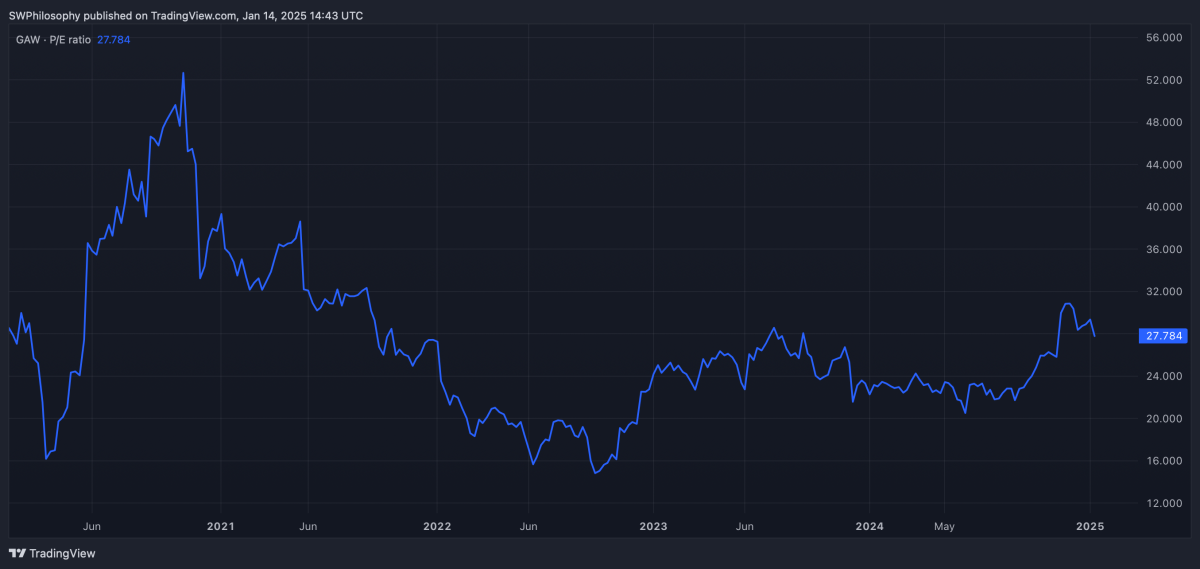
Games Workshop shares might look expensive at a price-to-earnings (P/E) ratio of around 28. That’s well above the FTSE 100 average and investors would be brave to bet on the multiple expanding further in the future.

Importantly, though, the stock was trading at a similar level in 2020 – and investors have done very well with it since. The reason is the company’s sales and profits have grown impressively since then.

Games Workshop P/E ratio 2020-2025

Created at TradingView

Revenues have more than doubled and earnings per share are up 143%. This is why the share price has climbed substantially despite trading at a high multiple five years ago. 

The lesson for investors is that a high P/E ratio doesn’t automatically mean a stock is overvalued. If the business can keep growing, its shares might be a bargain even at a high earnings multiple.

Lesson 2: dividends

With dividends, it’s natural for investors to look for two things. One is a long record of increasing returns and the other is a wide gap between the amount a firm makes and the amount it pays out.

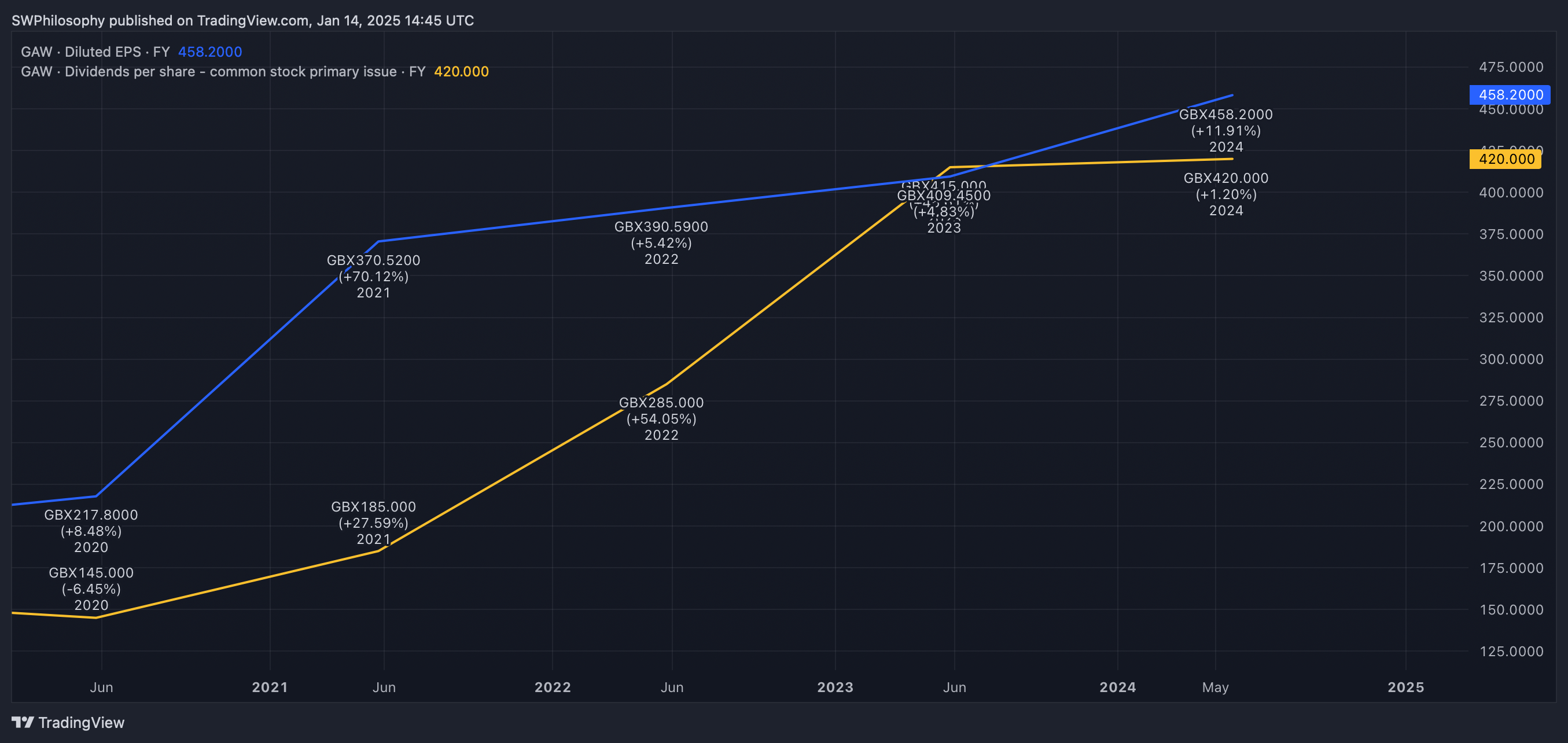
Games Workshop has neither – over the last five years its distributions have fluctuated and it has returned almost all of its net income to shareholders. But it has still been a great dividend stock. 

Games Workshop’s EPS vs. dividends per share 2020-2025


Created at TradingView

Since 2020, the company’s dividends have totaled around 23% of its market cap. And while the growth hasn’t been steady and consistent, it has been substantial over time.

The lesson for investors is that there’s more to dividend stocks than track records and payout ratios. What matters most is the quality of the business, which is where Games Workshop stands out.

Outlook

Games Workshop’s latest trading update reports strong growth across the board. Despite exchange rates weighing on reported figures, things are moving in the right direction. 

The company doesn’t expect direct cost increases as a result of the National Living Wage increases, but it did warn that suppliers might raise prices as a result. This is potential risk going forward.

There’s also uncertainty around tariffs from the US as the new administration takes over later this month. As a result, management has held off giving guidance for the next six months. 

Even if costs rise, I’m not expecting inflation to reach its 2022-2023 levels. And having seen Games Workshop cope admirably during that period, I expect something similar if costs rise in 2025.

A model business

I own shares in Games Workshop in my portfolio. And while I have my eye on a number of stocks from a buying perspective, few businesses are as strong as this one.

It’s not unreasonable for the share price to fall as a result of uncertainty about the prospect of higher costs. But next time I’m looking to invest, this will be on the list of stocks I’ll be considering.

How much in a Stocks and Shares ISA could earn me £500 of passive income each month?

An ISA can be a good way to generate passive income. Thanks to dividends paid by the companies in my Stocks and Shares ISA, I can earn passive income.

I have scoured the market to try and find what seems like the best Stocks and Shares ISA for me. After all, I do not want to earn passive income in the form of dividends only to end up using a lot of it to pay fees on my ISA!

Setting a target

How much passive income I can earn from my ISA depends on two things: how much I invest and the average dividend yield I earn.

The average dividend yield is not fixed. After all, a company can cut or increase its dividend. So, even if I buy a share today that yields 9.2% — such as Legal & General (LSE: LGEN) — that does not mean that it will keep yielding 9.2%.

Indeed, Legal & General aims to grow its dividend per share by 2% annually in coming years. But it has also cut its dividend before, as happened after the 2008 financial crisis.

At 9.2%, Legal & General’s dividend yield is far above the FTSE 100 average of 3.6%. But I reckon that by investing in a mixed portfolio of blue-chip shares like Legal & General, I could realistically target a 7% average dividend yield right now without moving outside the FTSE 100 when hunting for shares to buy.

At that level, earning £500 per month (£6,000 annually) would require almost £86,000 invested in my Stocks and Shares ISA. Not only is that a lot, it is well above my annual ISA contribution allowance.

Investing for the long term

So, I take a multi-year viewpoint on setting up passive income streams. As well as contributing to my ISA regularly over time, I also try to increase its value by compounding dividends.

Even with a £20k lump sum, if I compound that at 7% annually, after 21 years I ought to have the amount I need in my ISA for a 7% yield to equate to over £500 per month in dividends.

If I keep adding to my ISA over time, I could speed that process up. That is what I am doing.

Finding shares to buy

What attracts me to a share like Legal & General for such a plan?

After all, its profits over the past couple of years have been smaller than in the years before that – and the share price is down by a quarter in the past five years.

The weaker profits do concern me and one risk I see is a weak economy hurting investment returns, potentially leading some policy-holders to switch providers. That could hurt profits.

But Legal & General has a lot of what I look for when hunting for shares to buy for my ISA.

It operates in an area I expect to benefit from strong long-term customer demand. The firm has competitive advantages, from its well-known brand to an entrenched customer base. I feel I understand the business and so can assess it.

Plus, crucially, it has proven its ability to generate excess cash – and willingness to use some of that cash to fund dividends.

Prediction: 2 UK shares that could outperform Rolls-Royce between now and 2030

Rolls-Royce (LSE:RR) has been a terrific stock for investors over the last few years. But going forward, I think other UK shares could be better choices for investors with a long-term outlook to consider.

Beyond the FTSE 100 and the FTSE 250, there are some companies with very strong growth prospects. And they’re currently trading at what I see as attractive valuations at the moment.

Rolls-Royce

The Rolls-Royce share price has gone from 93p to £5.79 since the start of 2023. That’s a 521% gain, which is enough to turn £10,000 into more than £62,250. 

A lot of this has been driven by factors that I expect to normalise. Recovering travel demand is one – while this surged following the pandemic, I think it’s unlikely to keep growing at the same rate.

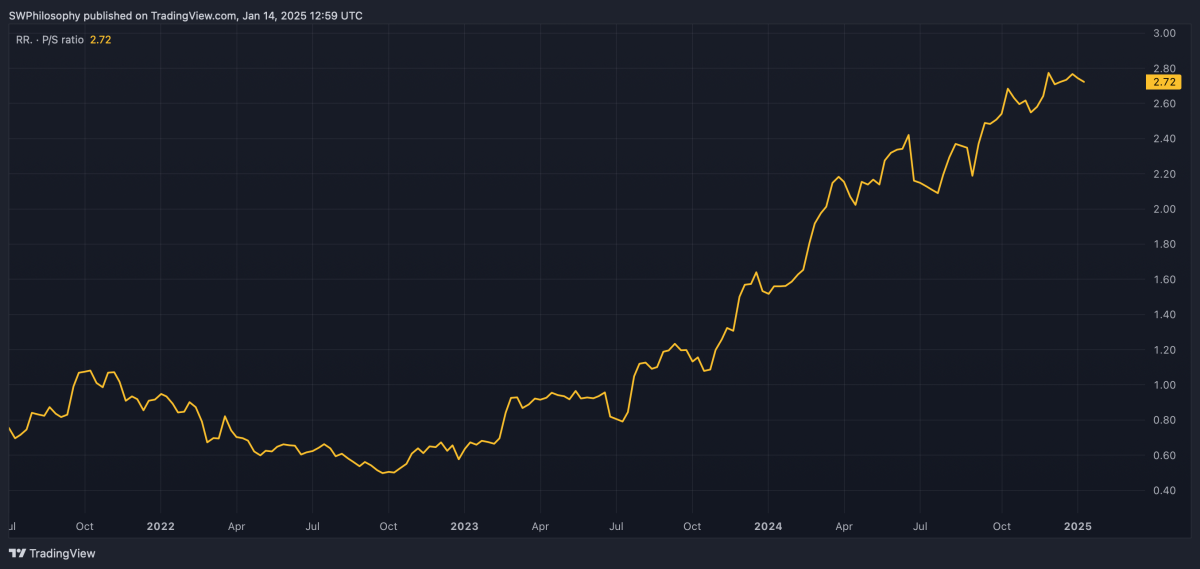
Another is multiple expansion. Since the start of 2023, the price-to-sales (P/S) multiple that Rolls-Royce shares trade at has gone from 0.63 to 2.74, but I’m not expecting this to keep increasing indefinitely.

Rolls-Royce P/S ratio 2021-2025

Created at TradingView

It’s hard to see either of these forces continuing to push Rolls-Royce shares higher at the rate they have been. That’s not to say it won’t be a good investment, but it could be time to look elsewhere. 

Macfarlane

Macfarlane (LSE:MACF) is a stock I’ve been buying recently. It designs and manufactures protective packaging for a variety of different industries. 

The risk with the business is it operates in an industry with some bigger competitors. But the firm has close relationships with its customers and provides bespoke products that aren’t easy to disrupt.

The stock is trading at an unusually low price-to-earnings (P/E) multiple, but I’m anticipating growth on the way. The recent acquisitions of Polyformes and Pitreavie should boost earnings from this year.

This makes Macfarlane a growing business with shares trading at an attractive price. I think investors should consider the stock as a potential outperformer over the next few years. 

Wise

Shares in money transfer service Wise (LSE:WISE) are only slightly above where they were when the company went public in 2021. But I think it’s a terrific business with a lot of scope for growth ahead.

The stock trades at a price-to-earnings (P/E) multiple of 20, which doesn’t look too bad. But investors should note that around 75% of its income comes from interest on the cash it holds in its accounts.

This is important, because this makes the prospect of lower interest rates a risk for shareholders to consider. Wise is unlikely to be able to generate the same return if rates come down.

Ultimately, though, Wise’s core product is cheaper and faster than its rivals. And with a huge market to expand into, I think the next five years could be very bright for the company and the stock.

The next Rolls-Royce

Rolls-Royce is a quality business and I’m not saying it’s a bad stock to own. But it’s hard to see how the things that have caused the share price to rise over the last few years are going to continue from here.

With that in mind, I’m looking at other UK shares at the moment. And both Macfarlane and Wise are ones that I think have a lot of room to grow beyond their current valuations.

Can easyJet soar like the Rolls-Royce share price?

Rolls-Royce (LSE: RR) shares have grown wings lately, flying an eye-watering 98% in 2024 and an astonishing 350% over three years. 

At the same time, easyJet (LSE: EZJ) has struggled to get off the runway. The budget airline’s share price has slipped 2% over the last 12 months and 23% over three years. Over five years it’s down 60%.

I’m baffled by struggling easyJet shares

That dismal showing surprises me for two reasons. First, both FTSE 100 companies have been subject to the same sectoral forces. 

As an aircraft engine maker, Rolls-Royce has benefited from the explosion in pent-up demand for flights as Covid lockdowns pandemic receded into memory. As did British Airways owner IAG, the only FTSE 100 stock to outpace Rolls last year. So can easyJet’s shares soar while Rolls-Royce steadily level off?

The Rolls-Royce recovery was driven by the resurgence in long-haul travel, with increased engine flying hours translating into higher revenues for its civil aerospace division. Investors have also been wowed by its successful restructuring efforts under transformative CEO Tufan Erginbilgiç.

Better still, its defence and power systems segments have also provided steady growth, offering diversification and resilience.

Yet the engineer’s meteoric rise has now priced in a lot of good news and the shares look pricey trading at 41 times trailing earnings. The group has worked down its debt pile but still has to invest heavily in new technologies like sustainable aviation fuel and hybrid-electric engines.

We’re also waiting to see whether new ventures such as its mini-nuclear reactors will cook up a new line of revenue. While Rolls-Royce shares risk flying too close to the sun, easyJet has gone a little cold.

It’s struggled with rising fuel costs, operational disruptions, and stiff competition in the European short-haul market. Passenger demand has been rising steadily and its fast-growing easyJet holidays division is doing well, but as inflation returns customers may feel the squeeze.

This looks like a top FTSE 100 value stock

The shares have slumped 15% in the last month, primarily due to higher inflation expectations and the hullabaloo over UK gilt yields.

With the easyJet share price now trading at just 8.1 times earnings, it surely offers much better value than Rolls-Royce.

easyJet has a solid balance sheet, decent brand and has built a strong position at key European airports. I think its shares could take off again when the economy does. But when exactly will that be?

I hold Rolls-Royce shares and won’t buy more. It’s no longer a rocket ship, more like an ocean liner. But I don’t hold easyJet. Following the recent dip, I’m tempted to buy.

The 20 analysts offering one-year share price forecasts have produced a median target of just over 718p. If correct, that’s an increase of almost 45% from today. That’s a stellar potential return. I think it’s a little of the optimistic side.

2025 looks like a bumpy year for the UK and Europe. I think the easyJet rebound will take some time, but today, the share potentially offers a brilliant entry point for patient long-term investors. Any signs of a turnaround could drive a significant re-rating. One day, easyJet could do a Rolls-Royce. Or IAG for that matter. I’ll buy the moment I’m feeling brave enough.

Financial News

Daily News on Investing, Personal Finance, Markets, and more!

Financial News

Policy(Required)