Searching for passive income? Here are 2 top dividend growth shares to consider!

Searching for top dividend shares to buy? Here are two that are worth a look — their shareholder payouts are tipped to grow steadily in the coming years.

BAE Systems

Defence spending has risen sharply in recent times, hitting repeated record peaks in the process. This is a trend that looks set to continue as, unfortunately, the world becomes increasingly dangerous.

According to a World Economic Forum (WEF) survey, “state-based armed conflict” is — with 23% of the vote –the biggest threat facing the planet in 2025. This is according to a panel of 900 experts in politics, business, and academia.

These views are hardly surprising amid rising tensions between global superpowers on trade and foreign policy. Regardless of whether new conflicts emerge or current hostilities escalate, demand for weaponry is likely to keep rising.

Just yesterday (14 January), BAE Systems (LSE:BA.) announced a new $85m contract with the US Navy to supply Network Tactical Common Data Link (NTCDL) systems. As a critical supplier of defence hardware to NATO members including the US, UK, and Australia, orders tend to rise strongly during times like this.

At £74.1bn, its order backlog rose to record peaks as of June last year. It also recorded sales growth of 11% in the first six months of 2024.

City analysts are expecting revenues and earnings to continue rising in the next couple of years at least, leading to predictions of further dividend growth. BAE Systems has raised the annual payout every year since 2012.

Source: Digital Look

As a consequence, the FTSE 100 company’s dividend yield is a healthy 3% and 3.3% for 2025 and 2026 respectively.

This is not to say that robust earnings growth is guaranteed, however. Supply chain problems could derail project delivery in the short term and beyond, while new spending efficiency programmes under the returning President Trump could impact future profits.

But on balance, I think BAE Systems could produce strong profits and dividend growth over the forecasted period.

The PRS REIT

Residential landlord The PRS REIT (LSE:PRSR) has kept annual dividends unchanged so far this decade. But City analysts think this could be about to change as earnings rise and interest rates (likely) continue to fall.

The PRS REIT' forecasts.
Source: Digital Look

As a result, the dividend yields on the company’s shares rise to 3.8% for this year, and 4% and 4.1% for fiscal 2026 and 2027.

It’s understandable to me that analysts are so bullish on PRS REIT’s growth and dividend prospects. Private rents in the UK continue to soar as the country’s chronic housing shortage continues. Rents increased 9% in the year to November, according to the Office for National Statistics (ONS).

Real estate investment trusts (REITs) can be excellent picks for passive income. This is because they pay a minimum of 90% of rental profits out in dividends in exchange for tax benefits.

It’s not certain that interest rates will continue to fall in 2025. If this happens, the pressure on PRS REIT’s borrowing costs will remain above recent norms, impacting profits in the process.

That said, I think the FTSE 250 business still looks in good shape to keep growing earnings and delivering market-beating dividends.

Please note that tax treatment depends on the individual circumstances of each client and may be subject to change in future. The content in this article is provided for information purposes only. It is not intended to be, neither does it constitute, any form of tax advice.


Should I buy 29,761 shares in this FTSE 250 dividend REIT for £1,000 a year in passive income?

High bond yields make this a good time to consider buying dividend shares. And there are a few on my list at the moment. 

One is Assura (LSE:AGR), the FTSE 250 real estate investment trust (REIT) with a lot of features that could make it a reliable source of passive income for investors.

Please note that tax treatment depends on the individual circumstances of each client and may be subject to change in future. The content in this article is provided for information purposes only. It is not intended to be, neither does it constitute, any form of tax advice.
The equation

Over the last 12 months, Assura shares have fallen by around 23% and the share price has hit 36.26p as a result. With the firm set to distribute 3.36p per share this year, the implied dividend yield‘s 9.26%.

That means the amount someone would need to invest in order to generate £1,000 a year in dividends is £11,025. That’s £10,791 for 29,761 shares, plus £234 in stamp duty.

A falling share price and a high yield can be a sign investors are concerned about the firm’s ability to keep paying dividends. But if they’re wrong, this could be a great passive income opportunity.

A 9.26% yield is eye-catching with government bonds offering above 5%. So I think it’s well worth looking at the stock to see whether the returns actually might be more durable than the market realises. 

The business

Assura owns and leases a portfolio of 608 GP surgeries and healthcare properties, the vast majority located in the UK. As a result, the firm gets almost all of its rental income from the NHS. 

From a passive income perspective, this could be a very good thing. An organisation backed by the UK government is unlikely to run out of money, making the risk of rent defaults relatively low. 

It does however, mean the risk of a change in government policy is quite significant. But for the time being, things seem to be moving in the right direction in terms of UK healthcare policy. 

Growth typically comes from developing and expanding existing properties rather than acquiring new ones. But the company did acquire a portfolio of hospitals last year at a cost of £500m.

Risks and rewards

As is often the case with REITs, the biggest risks with Assura come from its balance sheet. It has a lot of debt and the average time to expiry is less than five years. 

REITs have limited options when it comes to managing their debts. Being required to return 90% of their taxable income to shareholders means they can’t use it to repay outstanding loans. 

But Assura’s making moves to bring down its debt levels by selling off some of the properties in its portfolio. However, this obviously means less in the way of rental income.

A company with reliable rental income should be able to manage a higher debt load than one with more volatile tenants. But I think this is the biggest risk for investors to pay attention to. 

Should I buy?

I currently own shares in Primary Health Properties in my portfolio, which is a very similar business. Adding Assura could help maintain a similar income stream while reducing company-specific risks.

On that basis, buying 29,761 shares to look for a £1,000 a year second income doesn’t seem like a bad idea. It’s definitely one I’m considering for my Stocks and Shares ISA.

A 12.65% yield? Here’s the dividend forecast for this FTSE income share

We might have only just inched into 2025, but looking ahead to 2026 and 2027 provides the opportunity for investors to weigh up dividend forecasts for potential shares worth purchasing.

One company with a high-yield looks like it could increase even more in the next couple of years. Here are the details for consideration.

Renewable energy gains

The firm in focus is the Foresight Solar Fund (LSE:FSFL), a member of the FTSE 250. Its management team’s focused on generating income for investors by owning and managing a portfolio of solar energy assets. More specifically, it makes money from the sale of electricity generated by its solar farms, mostly via power purchase agreements (PPA) with suppliers.

Over the past year, the share price is down 30%, with the dividend yield at 11.2%. The current yield makes it one of the highest income options in the entire index.

It typically pays out a dividend each quarter, and increases the amount per share once a year. For example, in 2022 it was 1.74p, in 2023 it rose to 1.78p, and for the past few quarters it’s been 2.0p.

This trajectory’s appealing for income investors, as there’s a track record of increasing payments, which in turn helps to increase the dividend yield (assuming no wild movements in the share price). The dividend cover’s currently around 1.0. This means that the earnings fully cover the dividend payment. This is a good sign.

Looking forward

According to analyst expectations, the upcoming June declared dividend could rise to 2.1p per share. In June 2026, this is expected to rise to 2.19p, with June 2027 at 2.27p.

So if I assume the share price stays at 70.5p, this could mean the yield for calendar year 2026 would rise to 12.17%. For 2027, this could rise to 12.65%.

Of course, I do need to be careful when looking out for the next two years. It’s unlikely the share price is going to stay at the same level. If the stock falls, the yield will increase further. But if the share price jumps, then the yield could be lower than my forecasts. So investors need to take things with a pinch of salt!

Noting down concerns

There are risks associated with this stock to be aware of. For example, the drop in the share price over the past year has been attributed to lower power prices. This cuts the revenue potential for the company. Further, these large-scale solar projects are partly financed with debt. The fact that interest rates have stayed higher for longer in the UK means future borrowing will be more expensive than previously planned.

Even with these risks, the yield’s very attractive. If investors are aware of the potential concerns, I think it would be a good income stock to consider for the coming few years.

Down 23% last year, here’s a FTSE 100 share that could rebound (and then some) in 2025!

Looking for the best FTSE 100 recovery shares to consider in the New Year? Here’s one I think has the potential to surge in value following recent troubles.

Grim business

The problems in Britain’s housing market have been well documented. Higher interest rates than we became accustomed to during the 2010s has ended the era of cheap borrowing and has dented demand for expensive assets like homes.

Housebuilder Barratt Redrow (LSE:BTRW) has been one of many casualties of the downturn. Its share price has slumped 23% in the past year as difficulties have endured. Over five years, the FTSE firm is down a whopping 48%.

To rub salt into the wounds, reduced build levels — combined with higher costs — have caused margins to fall sharply. Barratt’s own adjusted gross margin slumped 4.7% in the 12 months to June 2024, to 16.5%.

Potential drivers

There are still big risks here as the labour market weakens, potentially impacting new-build demand. Rising staff and materials costs could also weigh on profits. But I believe there’s good reason to expect the builder to bounce back.

Perhaps most crucially, the Bank of England (BoE) looks on course to cut interest rates several times in 2025 as inflationary pressures moderate. December’s surprise fall in CPI confirms things continue to (roughly) go in the right direction.

The impact of recent BoE rate-cutting has already been keenly felt in the market. Data from the Office for National Statistics (ONS) today (15 January) showed average residential property values rising at their fastest pace for two years in November.

Source: ONS via X

Cause for cheer

Recent trading updates from the sector are also encouraging. FTSE 100 rival Persimmon said on Tuesday that forward sales are currently up 8% year on year. Its completion numbers also rose 7% to 10,664 units in 2024 as buyer affordability improved.

This followed Barratt’s own positive update on 23 October in which it praised “solid trading” in recent weeks. Then it said that “whilst customer demand continues to be sensitive to the wider economy, we are beginning to see more stable market conditions with increased mortgage availability and affordability.”

Signs of sustained momentum when Barratt reports interim results on 12 February could send its share price — along with those of other sector participants — sharply upwards.

A FTSE bargain?

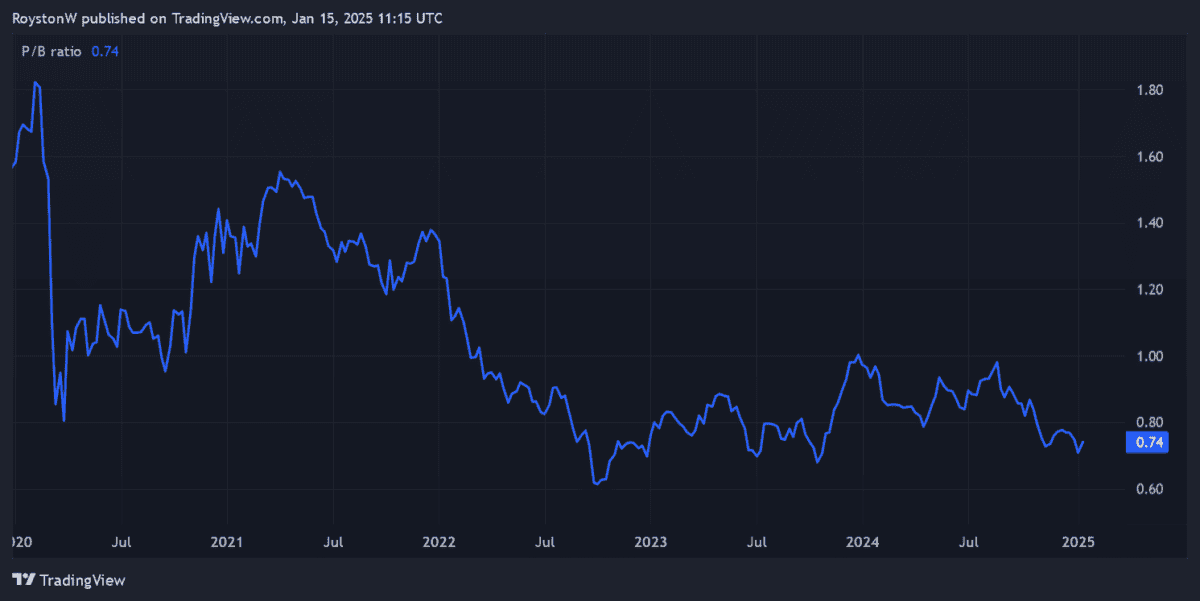
The chances of Barratt’s share price rebounding in 2025 are improved by the company’s ultra-low valuation too.

At 0.7, its price-to-book (P/B) ratio is well inside value territory of 1 and below. In layman’s terms, it means Barratt shares are undervalued compared to the worth of the firm’s assets.

Source: TradingView

The builder also looks attractive based on predicted profits. A forward price-to-earnings (P/E) ratio for this financial year ending June 2025 is an uninspiring 17.7 times.

However, this reading topples to 11.6 times for next year, reflecting broker expectations of a jump in annual earnings.

On balance, I think Barratt shares are worth serious consideration from investors seeking recovery stocks. Even if the builder doesn’t bounce back this year, I think it’s a matter of time before it does as the UK’s soaring population drives homes demand steadily higher.

2 beaten-down shares to consider for a Stocks and Shares ISA in 2025

When looking for shares to buy for their Stocks and Shares ISAs, many investors are understandably attracted to those with all the momentum. However, investing in high-quality stocks that are going through a rough spell is also a proven strategy for creating wealth.

Here are a pair that have sold off aggressively recently. From their current levels, I think both could outperform the market over the next few years.

Novo Nordisk at $81

Novo Nordisk (NYSE: NVO) stock suffered its worst single-day drop ever last month, tanking by more than 20%. It’s now fallen 45% since June, and I reckon investors should consider taking advantage of this massive dip.

The pharmaceutical company’s a dominant player in diabetes care, commanding roughly 33% of the global market. In recent years however, it’s been its GLP-1 drugs, Ozempic and Wegovy, that have supercharged both sales and its share price.

So why did the stock bomb recently? Well, it was the age-old bane of pharma firms, namely disappointing late-stage clinical trial results.

In this case, the culprit was CagriSema, the company’s potential next-generation weight-loss treatment. Novo had set a target for patients to lose 25% of their body weight on average over 68 weeks. The end result was 22.7%, triggering the stock’s huge sell-off.

But that result was marginally better than rival Eli Lilly‘s Zepbound accomplished in a similar trial (22.5%). And around 40% of patients did in fact reach a weight loss of 25% or more. With a bit more tinkering, Novo could still reach the 25% target.

Of course, the risk here is that a rival comes up with an even better treatment. This could happen as there are dozens of firms hoping to break into this lucrative high-growth space.

Zooming out though, I think the CagriSema results show how difficult it is to come up with something much more effective than the current crop of GLP-1 drugs. And Novo still boasts a 55% share of the global market, which is tipped to reach $100bn+ by 2030, up from $24bn in 2023.

After its recent plunge, the stock is trading at a discounted forward price-to-earnings (P/E) multiple of 21. I think that’s attractive and took the opportunity to add to my holding earlier this month.

Greggs at £21

The second stock worthy of consideration is Greggs (LSE: GRG). Shares of the well-known bakery chain have plunged 23% in January alone!

This followed the firm’s disappointing fourth quarter. Total sales growth was 7.7% year on year, while like-for-like growth came in at just 2.5%, instead of the forecast 5.4%.

Greggs blamed lower footfall on high streets and weak consumer confidence. These issues haven’t gone away, so this year could also be challenging.

Plus, in response to higher costs following the Budget, it has increased the price of a sausage roll to £1.30. Loyal punters aren’t happy with this second rise inside a year, according to the tabloids.

Following this dip though, I like the long-term risk/reward setup. Greggs still intends to increase the shop count to 3,000+, while also going after the massive evening food-to-go market.

The stock’s now trading on a forward P/E ratio of 15, noticeably lower than its 10-year average of 18. And there’s a forward dividend yield of 3.4%.

This billionaire is copying Warren Buffett. Should I do the same?

Bill Ackman, the billionaire founder of Pershing Square, made headlines earlier this week by making an offer to buy Howard Hughes, an American real-estate business. He actually said that the aim of the deal is to make a “modern-day Berkshire Hathaway, referring to the business grown by legendary investor Warren Buffett. Should I be aiming to try and follow this strategy too?

How it all works

First let’s run through the concept. Pershing Square Capital Management is the entity that’s trying to buy Howard Hughes for $85 a share. Ackman would form a subsidiary that would merge with the real-estate developer, which would allow him to benefit from the strong cash flow and operating profit from the company. He could then use this funds to go and pursue new investments and dealmaking for Pershing Square.

For clarity, there’s a slight difference between Pershing Square Capital Management and the listed stock Pershing Square. The Capital Management business provides the investment expertise and decision-making for the listed company, with it being a way to offer a publicly accessible vehicle for investors to benefit from Pershing Square Capital Management’s strategies. Both are overseen by Ackman, ensuring alignment in philosophy and objectives.

Ackman openly admits his idea is a nod to Buffett. The Oracle of Omaha famously bought Berkshire Hathaway when it was a textile company. Buffett used the cash generated by Berkshire’s textile operations to invest in other businesses. This has proved to be a very profitable strategy.

How I can do the same

To be clear, I’m not in a position to buy an entire business to benefit from the cash flow benefits for my personal portfolio. But I can copy Buffett and Ackman in the thinking behind this.

For example, part of my existing portfolio is built around owning stocks that pay me dividends. As a result, I get income from these shares, which I can use to fund more stock purchases. This is on a much smaller scale to what Buffett and Ackman do. Yet the principle of using my cash flow to help fund more investments is the same.

For example, I recently bought Balfour Beatty (LSE:BBY) stock. The share price is up 25% over the past year. At the same time, the dividend yield is 2.77%. Even though this isn’t super-high, it should still provide me with income going forward from a mature and stable sector. Buffett went for textiles, Ackman for property, Smith has gone for construction!

I like the stock particularly due to the potential for higher government spending on infrastructure both in the US and UK. These are two main markets for the global firm, with a long history of winning public sector contracts. Therefore, I feel this could provide a sharp boost for revenue in the coming years. I’d expect part of this to filter down to higher dividend per share payments, increasing the dividend yield.

Of course, I’m aware that government promises can be broken and this is a risk going forward. Yet this is just one example of a new stock in my portfolio that should allow me to copy the same concept that helped Buffett to build his empire.

I expect these 3 FTSE 100 shares to fly when inflation really starts to fall

A heap of FTSE 100 shares are climbing this morning after the UK’s December consumer price inflation figure came in slightly lower than expected at 2.5%.

It’s instructive to see which ones are on the up. It suggests they’re the ones to benefit from lower inflation and interest rates – when we finally get them. Should investors consider buying them?

Housebuilder Barratt Redrow (LSE: BTRW) has jumped 3.67% today (15 January) as investors digest the positive inflation surprise. It’s about time they saw some share price growth. The stock’s still down 25% over 12 months, and 40% over three years.

Can the share price build on this?

Falling inflation and interest rates make mortgages more affordable for prospective homebuyers. This should boost demand and house prices, driving up sales and revenues. Lower inflation will also cut the cost of materials such as timber, steel and cement, and put a lid on wages too. All would boost profit margins.

Barratt Redrow shares look decent value, with a price-to-earnings (P/E) ratio of 14.2. The dividend yield is a solid 3.88%. I won’t get too excited though. Inflation’s expected to hit 3.2% by spring, as Budget tax hikes and minimum wage increases kick in, along with Donald Trump’s mooted tax cuts and trade tariffs. Investors may have to be patient.

The same principle applies to another share that’s flying this morning, commercial real estate investment trust (REIT) Land Securities (LSE: LAND). Its shares are up 3.65% as I write, as lower inflation and borrowing costs would ease the pressure on a company that had net debt of £3.6bn in September.

They would also make it easier to fund new developments and refurbish its existing estate, as well as supporting rental yields and minimising defaults.

Please note that tax treatment depends on the individual circumstances of each client and may be subject to change in future. The content in this article is provided for information purposes only. It is not intended to be, neither does it constitute, any form of tax advice.

Landsec offers a brilliant yield

Until we get there, volatility’s likely to continue. The Landsec share price is down 22% over one year and 32% over three.

Yet it looks good value with a P/E of just 10.6, while yielding a blockbuster 7.2%. Again, investors have to be patient as inflation remains sticky. Working from home is also hitting demand for office space while struggling consumers spend less at retail centres. The group’s diversification into mixed-use developments could mitigate some of the risks.

It’s hardly a surprise that my third stock in recovery mode is also in the property sector, student housing specialist Unite Group (LSE: UTG). Lower borrowing costs would make expanding its portfolio of properties cheaper and easier, while stable inflation would support predictable rent growth.

The Unite share price has also taken a beating, falling 24% over the last 12 months. It’s not super cheap though, with a P/E of 17.8. The yield’s 4.4%.

Unite could take a hit if Labour tries to reduce immigration by tightening student visas, hitting demand for accommodation.

Today, occupancy levels for the 2025/26 academic year expected to be 97-98%. CEO Joe Lister reckons that “the outlook for student numbers remains positive with a growing UK 18-year-old population and improving trends in international student recruitment”.

I expect all three to spark into life once inflation really starts falling and central banks get cutting. The problem is, that could take time. All three are worth considering, but with a long-term view as I expect further ups and downs.

After a positive Q4 update, is the Vistry share price set to bounce back?

After falling 57% in the last three months of 2024, the Vistry (LSE:VTY) share price is up 5% after the company’s first trading update of 2025 on 15 January. And the news is generally positive.

Management is confident last year’s issues are in the past and the outlook for sales is relatively positive. But there was something missing from the report that caught my attention. 

Results and outlook

Vistry’s share price has been falling recently because of cost issues in its South Division. Partly – though not entirely – as a result of this, the firm’s pre-tax profits in 2024 fell from £419m to £250m.

Elsewhere, the business looks to be in decent shape. The company completed 7% more units in 2024 than the previous year, with adjusted revenues up 9% and it’s expectign further growth in 2025.

Inflation is set to increase build costs and Employer National Insurance Contributions are set to increase by £5m. But both look relatively modest in the context of the overall business.

That’s why the stock is climbing. But I think Vistry’s real strength is its business model, which is what differentiates it from the rest of the FTSE 100 and FTSE 250 housebuilders. That could boost the share price.

Partnerships

Vistry has less exposure to the open market than other UK housebuilders. Instead, it prefers to partner with investment firms and local authorities to build directly to order. 

This has two big benefits for the business. The first is that it reduces the amount of cash the company requires, with partners financing some of the up-front build costs. 

The second is that it provides guaranteed offtake for completed projects. With sales already agreed, Vistry doesn’t have to worry in the same way about weak demand in the housing market.

The company’s top priority for 2025 is continuing to invest in this – and I think it’s a really attractive business model. But there was something else in the latest update that caught my attention. 

Capital allocation

In its update from 8 November (which was essentially a profit warning), Vistry said the following:

[The firm] remains committed to its medium-term targets including the distribution of £1bn of capital to its shareholders. In light of the recent issues in the South  Division, the group is reviewing the timeframe in which these are expected to be achieved.

With the company’s market cap currently £1.8bn, the prospect of getting over 50% of that back over the medium term looks attractive to me. But the latest update was quiet on this. 

Also in its report, Vistry stated its intention to return £130m to investors through share buybacks. That’s part of the story, but it’s not all of it and this is an important part of why the stock is attractive to me. 

I’m waiting

Like the other major UK housebuilders, Vistry is being investigated by the Competition and Markets Authority. That makes the stock risky, but I think a £1bn capital return might be enough to offset this.

As a result, I’ll be looking carefully for details about this when the company’s full results come out in March. The latest update looks very encouraging, but I’m just waiting for the last piece of the jigsaw before I decide whether or not to buy.

Is it game over for the Diageo share price?

I’ve been thinking a lot about the Diageo (LSE: DGE) share price lately. That’s what happens when I buy a recovery stock that doesn’t recover.

I piled into the FTSE 100 stalwart last January, hoping to take advantage of a dip in its share price after a sales slump in its Latin American and Caribbean markets triggered a profit warning.

As a value investor, I like snapping up out-of-favour companies to benefit when their fortunes recover. Hard experience has taught me this requires patience though, and that means a lot longer than 12 months. So why am I getting itchy?

Can this ailing FTSE 100 stock get its bite back?

In my darker moments, I think it could be game over for Diageo shares. Obviously, that’s ridiculous. This is a £52bn company with iconic brands like Johnnie Walker, Baileys, and Smirnoff. It also happens to be the proud owner of the world’s most fashionable drink, good old Guinness.

That hasn’t stopped its shares falling 15% over the past year and 36% over three. Can it get its fizz back?

The Latin American problems are dragging on. The slump was partly down to local drinkers downgrading to cheaper brands than the premium ones Diageo now specialises in. But it also suffered inventory issues. Has management lost its edge since the glory days under inspirational CEO Ivan Menezes?

Drinkers in the US, Europe, and China are feeling the pinch. Normally, I’d brush that off as a cyclical issue, saying they’ll feel thirsty soon enough when they have a bit more cash in their pockets.

My concern is that younger people are drinking less alcohol amid wellness trends and health concerns. If this generational shift is a more than a passing trend, Diageo could suffer.

If young people drink less, even us oldies may start to become self-conscious about our own refuelling habits. While Diageo has a great opportunity in its alcohol-free Guinness 0,0, I don’t see this as transferable across its spirits catalogue.

The drinks sector needs a little pick-me-up

President-elect Donald Trump has mooted 25% tariffs on imports from Mexico. That’s a worry for Diageo, as its subsidiaries shipped more than 25m litres of tequila to the US last year, including brands Don Julio and Casamigos.

Given these worries, I’ve even considered selling my Diageo shares, which are worth 12% less than I paid. So what stopped me?

Well, people have been drinking booze for millennia. What are the chances of them stopping on my watch? Also, as the tobacco giants showed, there’s a lot of money to be made in a declining sector. Diageo is a global company, and middle classes in emerging markets are upgrading to premium spirits.

While the yield is a relatively modest 3.36% today, Diageo has a robust policy of hiking shareholder payouts. Let’s see what the chart says.

Chart by TradingView

While I dither, Diageo shares continue to stumble. They look shockingly cheap trading at just 16.9 times earnings. I remember when they traded at 24 or 25 times.

The 20 analysts offering one-year share price forecasts have produced a median target of just over 2,705p. If correct, that’s up around 15% from today. Even that doesn’t excite me. I’m clearly feeling glass half-empty towards the stock. I’ll hold, but I won’t buy more.

3 key reasons why AstraZeneca’s share price looks a steal to me right now

Only around five months ago, AstraZeneca’s (LSE: AZN) share price hit a point that made the firm the UK’s first £200bn listing.

Now, it is down 20% from its 3 September 12-month traded high of £133.38.

I think three key reasons will propel it much higher again over time.

Enormous earnings growth potential

Ultimately, it is earnings growth that powers a firm’s share price (and dividend) higher. Analysts forecast that AstraZeneca’s earnings will grow by 16.9% each year to the end of 2027.

Its nine-month results saw its 2024 earnings per share (EPS) growth forecast increase to a high-teens percentage from the mid-teens. This came after an 11% jump in EPS over the period to $6.12 (£4.97).

And both followed a 19% increase in total revenue, to $39.182bn. Revenue is the total income a company generates, while earnings are what remains after expenses are subtracted. In the long term, AstraZeneca forecasts $80bn+ in revenues by 2030, against $45.8bn at the end of 2023.

Positioned for a major demographic shift

According to the World Health Organization, 1.4bn people will be aged 60+ by 2030 compared to 1bn now. By 2050, that number will be 2.1bn. At that point, the number of people aged 80+ will triple to 426m.

As older age brings declining health, the demand for medical assistance, including drugs, increases.

AstraZeneca currently has 189 new drugs at various stages of development in its pipeline. By comparison, its leading UK peer GSK has 71.

Moreover, the firm announced at its 15 November ‘Health Equity Event’ that it is working on multiple game-changing new medicines. These focus on cutting-edge areas such as smart chemotherapy, gene therapy and editing, and next-generation immunotherapy.

Extreme current undervaluation

On the key price-to-book ratio of stock valuation, AstraZeneca trades at only 5.1. This is bottom of its competitor group, which averages 32.9. So, it looks very undervalued on this basis.

The same is true on the price-to-sales and price-to-earnings ratios. On the former, it trades at just 4 compared to its competitors’ average of 11. And on the latter, it is at 31.7 against a 53.9 average for its peers.

A discounted cash flow analysis shows the shares are currently 60% undervalued. Therefore, technically a fair price is £266.18 rather than the present £106.47.

They may go lower or higher than that, given market vagaries. But it underlines to me that they look a steal at the current price.

Will I buy more?

Against all this are two main risks in my view. The first is the possibility of penalties being imposed when Chinese authorities conclude their investigations of its China operations.

The second is legal action for damages from AstraZeneca’s alleged failure to inform investors early enough of these investigations.

That said, AstraZeneca raised its key performance guidance after China launched its investigations. Additionally, I see legal action against pharmaceutical firms as already largely costed into that business and the share price.

Consequently, I will be buying more AstraZeneca shares very soon.

Financial News

Daily News on Investing, Personal Finance, Markets, and more!

Financial News

Policy(Required)