AI thinks these could be the best FTSE 100 stocks to consider buying now

Artificial intelligence (AI) has come a long way since the early days but can it effectively analyse market data? I put that theory to the test by asking three AI chatbots what are the best FTSE 100 stocks?

The results were compelling but I question how they were chosen.

Surprisingly, each bot I asked provided different answers. Claude claimed it was unable to provide specific answers due to a lack of access to real-time data. However, it provided some useful information on how to pick stocks.

Gemini was more compliant, although I had to trick it into pretending it was an investor before it chose to play ball! That makes me question whether its answers are accurate or part of the pretence.

It chose three stocks it felt had performed well recently, Shell (up 9% in the past month), AstraZeneca (up 1%) and HSBC (up 5.6%). Yet it didn’t explain why they would be good to buy now.

In the end, ChatGPT provided the most detailed answer. Rather than base its options solely on past performance, it focused on price-to-earnings (P/E) ratios, P/E growth (PEG) ratios and cash generation.

ChatGPTs five picks

It chose Legal & General, with its strong track record of cash generation, a forward P/E ratio of 10 and a dividend yield of 7.86%. The yield seems a bit low but otherwise accurate.

It noted insurance company Phoenix Group, with a PEG ratio of 0.5 and a 9.6% yield, could benefit from an ageing population. I believe the company’s currently unprofitable so I question that PEG ratio.

GSK, with upcoming RSV vaccine developments and a forward P/E ratio of 10 — the lowest in five years, looks accurate.

Vodafone comes with a P/E ratio of 11 and yield of 10.2%, but It failed to mention that the yield drops closer to 5% this year.

Not as accurate data as I’d have hoped but a good selection, nonetheless. I know those four options well but was surprised by its fifth pick, Associated British Foods (LSE: ABF). As a stock I haven’t given much attention to, I decided to investigate.

Resilience and diversification

ABF’s the world’s second-largest producer of both sugar and baker’s yeast, with several subsidiaries around the world. It produces famous brands like Ovaltine, Ryvita, Kingsmill and Twinings. It’s also the parent company of popular international fashion/lifestyle chain Primark, stores of which can be found on most British high streets. Over in the US, it also operates ACH Food Companies.

This makes it a highly defensive stock as it’s likely to bring in revenue even during economic downturns. Considering the current state of global markets, I’d say that’s a big plus.

However, most of its products are neither unique nor premium. Consumers have many options and could easily be swayed to pick alternatives. It also faces supply chain risks and exchange rate fluctuations, both of which could hurt profits.

While I appreciate its defensive value, it wouldn’t rank in a list of my best FTSE 100 stocks and I don’t plan to buy it right now.

It’s clear AI can aggregate data faster than a human. However, I don’t think its powers of prediction go much beyond predictive text.

So while it may have a use, it’ll be some time before I trust it over the advice of experts.

The Greggs share price is down 20% this year! Is it time to consider buying?

Greggs (LSE: GRG) is known for its low prices. But until recently the FTSE 250 company’s share price has bucked this trend, earnings a premium valuation for the food-to-go operator.

That’s changed. Shares in the sausage roll specialist have fallen by more than 20% so far this year. The stock’s now 30% below the 52-week high of 3,250p seen in September 2024.

What should investors do? Is this fall an opportunity to consider buying – or a warning of worse to come?

2025 looks uncertain

Sudden share price dips like we saw last week are usually caused by a profit warning. That’s when a company tells the stock market its profits are expected to be lower than previously expected.

Has Greggs issued a profit warning? Not quite. But I think it came close last week. In a trading update on 9 January, the company said its 2024 results would be “in line with the Board’s previous expectations”.

However, management sounded less certain about the outlook for 2025. CEO Roisin Currie warned that “lower consumer confidence” was affecting high street footfall and customer spending.

Currie also warned that rising National Insurance and higher wage costs would add to Greggs’ cost base. The company employs over 30,000 people in the UK, most on lower wages.

If Greggs is forced to put up prices to protect its profits, hard-pressed consumers could cut back even further. I don’t know how likely this is – perhaps demand will recover when the increase to the Minimum Wage kicks in from April.

Growth opportunity?

Currie remains confident that Greggs has a significant growth opportunity in the UK. She’s planning to add 140-150 shops to the company’s store estate next year. That could take the total number to over 2,750 – similar to Coca-Cola-owned Costa Coffee, which has over 2,700.

City analysts are still bullish on the Greggs story. Broker forecasts for 2025 have fallen slightly but still suggest profits will rise by 5.5% to 142p per share this year. Looking further ahead, earnings are expected to rise 8% to 153p in 2026.

These estimates price Greggs shares on 15 times 2025 earnings, with a 3.4% dividend yield. My research suggests that’s cheaper than they’ve been for most of the last decade.

What I’m doing

I still think this is a quality business, with above-average profitability, a great brand and a popular product. But I’m worried that Greggs may be getting closer to maturity, as it keeps opening new stores. How many more are really needed?

I think there’s a chance that Greggs’ slower growth could become the new normal. That might make it harder to justify a premium price for the shares.

Given the uncertain outlook for the year ahead, I’m going to stay on the sidelines for a little longer and await further news.

ChatGPT thinks these are the best FTSE 100 dividend stocks to consider buying now

Buying FTSE 100 dividend shares can be a great way to generate a reliable passive income. The index has some of the highest yields on offer anywhere, with plenty of reliable payers.

As a keen income investor, I wondered whether ChatGPT could help me pick dividend shares to consider buying. As a simple test, I asked the AI to recommend the best FTSE 100 dividend stock to buy today.

10 shares it suggested

Overall, the response was probably a bit better than I expected. First of all, ChatGPT avoided the obvious trap of suggesting just one stock. A diversified portfolio always makes more sense for income.

Instead, AI provided me with a list of 10 shares. They certainly aren’t original suggestions, but I think they’re sensible enough.

Here’s the full list. I’ve also included the 2025 forecast dividend yield for each stock:

  • Shell (4.7%)
  • HSBC (6.7%)
  • Unilever (3.6%)
  • GSK (4.9%)
  • Diageo (3.7%)
  • National Grid (5.0%)
  • Legal & General (LSE: LGEN) (9.8%)
  • British American Tobacco (8.4%)
  • AstraZeneca (2.5%)
  • BT Group (5.7%)

This list includes most of the largest companies in the FTSE 100. I would guess that that if I owned just these 10, my portfolio would probably come close to tracking the index.

How reliable are these dividends?

With an average dividend yield of 5.5%, ChatGPT’s selection has the potential to generate a decent income.

However, dividends are never guaranteed and may be cut. For example, National Grid recently cut its payout (ChatGPT didn’t tell me that).

Indeed, over the last five years, Shell, GSK, HSBC and BT have also all cut their payouts for various reasons. They’re all paying out decent dividends now, but they aren’t the most reliable payers I could find on the UK market.

The stock I’d choose…

There are a few stocks on this list I think are worth considering. But my top choices today would probably be the two I already hold – Unilever and Legal & General.

Of these two, Legal & General would probably be my pick. The life insurance and investment giant is one of the biggest players in the UK market, with more than £1trn of assets under management.

Over the last decade, L&G has become a market leader in the bulk annuity business, taking over final salary pension schemes from large companies. This business has the potential to generate reliable cash flows for many years to come.

One possible risk is that newish CEO António Simões has only been in the role since 2023. The changes he’s made so far seem sensible to me, but this is a business where it takes a while for changes to deliver results.

It could be a few years before we know whether Simões has the right plans for long-term growth.

However, Legal & General has been in business for 188 years. It has a long record of profitable operations and has not cut its dividend since 2009. I believe the company’s long-term future is probably safe.

City analysts expect profits to bounce back in 2025. That puts Legal & General shares on a forecast price-to-earnings ratio of 9.5, with a 9.8% dividend yield.

I think the shares are worth considering as an income buy at this level.

Hindenburg Research founder says he’s closing short-seller research shop

  • Hindenburg founder Nate Anderson said the firm has “finished the pipeline of ideas we were working on.”
  • One of Hindenburg’s first high-profile reports came in 2020 and was focused on vehicle startup Nikola.
  • The firm has also gone after the companies of major financial figures, including Carl Icahn’s Icahn Enterprises LP and the business empire of Indian billionaire Gautam Adani.
Nate Anderson on January 6, 2023 in New York. Anderson exposes corporate fraud and ponzi schemes through his company Hindenburg Research.
The Washington Post | The Washington Post | Getty Images

Hindenburg Research, an upstart research and investment firm that made a name for itself with several successful short bets, is closing, founder Nate Anderson announced Wednesday.

“As I’ve shared with family, friends and our team since late last year, I have made the decision to disband Hindenburg Research. The plan has been to wind up after we finished the pipeline of ideas we were working on. And as of the last Ponzi cases we just completed and are sharing with regulators, that day is today,” Anderson wrote in a note posted to the firm’s website.

Anderson founded Hindenburg in 2017, and the company has published negative research reports about dozens of companies in the years since. One of Hindenburg’s first high-profile reports came in 2020 and was focused on vehicle startup Nikola. Part of the report included an allegation that Nikola had faked the autonomous capabilities of a semi-truck in a video, which the company later admitted. Nikola founder Trevor Milton was later sentenced to four years in prison.

Many of the targets of Hindenburg’s reports were smaller companies. The firm has also gone after the companies of major financial figures, including Carl Icahn’s Icahn Enterprises LP and the business empire of Indian billionaire Gautam Adani.

The most recent report filed by the company was on Jan. 2 about car retailer Carvana, which it called a “father-son accounting grift for the ages.” In a statement, Carvana called the firm’s report “intentionally misleading and inaccurate.” The stock fell more than 11% the day after Hindenburg published its report but has since recovered.

Hindenburg was a short-seller as well as a research house. This means that the firm was placing bets against the companies it was researching, putting it in position to profit if the stock declined. As Hindenburg’s reputation grew, some stocks saw immediate negative reactions after the reports were published.

It is not clear how much money Hindenburg made from its short bets.

The rise of Hindenburg came at a time when the controversial practice of short-selling was falling out of favor elsewhere. The meme-stock craze of 2021 pitted retailer investors against hedge funds, causing some professional investors to back away from short selling. Federal officials have also been investigating other short-sellers in recent years, including the Department of Justice hitting Citron’s Andrew Left with securities fraud charges last year.

Here’s how I’m trying to build up my ISA to earn £10,000 passive income each year

I’m convinced I know my best chance of building passive income from long-term investments. I reckon it has to be a Stocks and Shares ISA.

It does open me up to more risk than a Cash ISA, as they offer guaranteed interest rates. Well, for as long as the latest contract, at least. But when the Bank of England (BoE) gets inflation down to its target 2%, I think we’ll be lucky to see Cash ISA rates much above 1%.

I don’t see much point trying to save the tax on that level of income, not when total FTSE 100 returns have averaged something like 6.9% per year over the long term. It’s not guaranteed, of course, but history is behind it.

Please note that tax treatment depends on the individual circumstances of each client and may be subject to change in future. The content in this article is provided for information purposes only. It is not intended to be, neither does it constitute, any form of tax advice. Readers are responsible for carrying out their own due diligence and for obtaining professional advice before making any investment decisions.

Bad spells

To take home £10,000 a year from my ISA, I’d like to be able to not run down my capital too much. If the BoE meets its inflation target, I’d want to leave enough in my ISA to match.

That suggests I could take 4.9% of the average 6.9% per year, and leave the other 2% to keep up with rising prices. So how much might I need?

My sums suggest a pot of around £204,000. If the UK stock market keeps on going the way it has for the past century or so, I should be able to take my £10,000 from that and leave enough to keep up with inflation.

What’s the best way to actually take the cash? For me, that’s where dividends come in. Let’s pick a FTSE 100 stock to use as an example.

Bank dividends

I’ll go for Lloyds Banking Group (LSE: LLOY), because it has the closest dividend among my holdings to that target 4.9% income.

In fact, Lloyds is currently on a forecast dividend yield of 5.4%, so I could even leave a little behind to build up for next year and beyond.

But this does bring me to my first serious need for caution. Dividends are never guaranteed, and Lloyds is a good example of that. The bank had to suspend its dividend when the pandemic hit and the stock market crashed in 2020.

In fact, most of my dividends fell that year. So if I’d been drawing passive income I’d have needed to sell some shares to meet my goal.

Financial crash

Looking back further to the 2008 financial crash, Lloyds suffered a lot more pain back then and it took some time to get back to progressive dividends.

What’s the way to minimise risks like that? In a word, diversification. I particularly like investment trusts for that and I hold several. And I always aim to keep a variety of stocks from different sectors.

Oh, and I’m basing these figures on historic returns, which we might not get in future. Better to aim a bit higher, I think, rather than fall short.

For most of us, building a pot of £200,000 or more could take a few decades. Fortunately, I started investing in ISAs a long time ago. And I think my goals are realistic.

Could this 5.8%-yielding FTSE 250 share storm back in 2025?

It has been a tough few years for FTSE 250 firm Victrex (LSE: VCT).

The polymers specialist has seen its share price fall by 27% in one year. Over five years, the decline has been 58%.

The thing is, I think Victrex has a lot to like about it as a business.

If that becomes clearer again this year, allaying some City fears about risks the business faces, I think the FTSE 250 share could merit a higher price.

To start, I will explain what I like about Victrex (and why I am a shareholder in it).

A Warren Buffett-like moat

The main reason I like Victrex is that it has the sort of business “moat” billionaire Warren Buffett often enthuses about.

It makes high performance polymers that are used in all sorts of applications where safety is crucial, from aerospace to automobiles. That means that quality is a paramount consideration for customers, giving suppliers pricing power.

On top of that, Victrex makes a number of proprietary polymer products that effectively mean it is the only choice for customers with certain specific needs. Again, that gives it pricing power.

In turn, that has helped the company generate sizeable excess cash to pay dividends. The current dividend yield is 5.8%.

An increasingly tough trading environment

So far, so good.

For a long time, that business model was akin to a license to print money.

Victrex has had a difficult few years that have called into question whether it can sustain its past success (and profit margins). Post-tax profit last year was 77% lower than two years before. Revenues in the same period slid by 12%.

As industrial applications evolve, a key risk facing Victrex – and it is one I continue to see – is whether demand for the sorts of polymers it makes will stay strong, or decline.

Signs of a potential turnaround

So it is understandable that investors were cheered by some elements of the company’s full-year results, published last month. Yes, revenues before tax were down and pre-tax profit was down badly.

But there was, at least, volume growth.

Some of the recent earnings drops can be pinned on the startup costs of new manufacturing facilities in China. Now they are operational, hopefully they can turn from a loss centre to a profit centre for the FTSE 250 firm (though one risk I see is intellectual property leakage).

What about the volume story?

Higher volumes but lower revenues typically point to either a change in the mix of products sold, or declining pricing power. The company pinned this on exchange rates and weaker performance in its higher margin medical division, affecting its overall sales mix.

So, if the product mix gets back to a more normal one (with stronger contribution from medical products) and volumes continue to grow, 2025 could see both revenues and profits grow at Victrex.

If that happens, I think it could be good news for the Victrex share price. Having taken some profits following last month’s announcement, I continue to hold my long-term Victrex stake for now.

Kier Starmer aims to make the UK an AI superpower! 2 FTSE stocks are poised to benefit

Two days ago, Prime Minister Kier Starmer announced plans to “mainline” artificial intelligence (AI) “into the veins” of the UK to boost productivity in public services and fuel future economic growth. Looking at the details, I reckon two FTSE stocks could benefit from this ambition to make the UK an “AI superpower“.

FTSE 250

The first share is Kainos Group (LSE: KNOS). This is a medium-sized FTSE 250 technology firm that helps private and public sector organisations transform digitally. It specialises in the deployment of products from Workday, the cloud-based platform for HR and finance.

Kainos stock has performed well over the long term, but has more recently fallen on hard times. It’s now trading for 768p, which is 62% lower than the 2,052p price it was at in November 2021.

So how will Kainos benefit from the government’s AI proposals? Well, the IT provider has a strong track record of working with public sector clients, including the NHS and Department for Transport. So it’s already a trusted partner.

Plus, Kainos is already leveraging AI to benefit its customers. In the six months to September, it won nearly 40 AI & Data projects across the public, healthcare, and commercial sectors, taking the total so far to over 140. I expect that to motor much higher in future after the latest AI plans were announced.

Naturally, the firm faces a lot of competition to win contracts in this area, while public finances remain stretched. And it’s struggling for revenue growth right now in a challenging trading environment.

These issues are worth bearing in mind, as AI benefits aren’t going to happen overnight. Longer term, however, Kainos looks incredibly well positioned to benefit from these AI-driven public sector productivity plans.

With the stock trading at a fairly reasonable 19 times earnings for FY25 (which ends in March), and yielding 3.7%, I think it’s worth considering.

FTSE 100

Besides being powerful, AI is also notoriously power-hungry. Indeed, Big Tech’s energy consumption right now is outpacing entire countries!

To power his plans, Starmer also announced the establishment of an AI Energy Council to explore innovative energy solutions, including small modular reactors (SMRs). These are mini-nuclear reactors built in factories that offer scalable, low-carbon energy.

One of the frontrunners in developing SMRs is Rolls-Royce (LSE: RR). The FTSE 100 firm has a dedicated subsidiary and this venture remains in pole position to win a competition to deploy SMRs across the UK.

In September, Rolls-Royce SMR was selected by the Czech Republic as its preferred supplier for mini reactors. It said this “strengthens Rolls-Royce SMR’s position as Europe’s leading SMR technology”.

Unfortunately, it will be the early 2030s before this technology begins to be deployed widely. And despite the outcry it would cause in the UK, it’s possible Rolls-Royce isn’t chosen this year as one of the two winners from four contenders.

Meanwhile, the FTSE 100 stock isn’t cheap after surging 86% in a year. It’s trading at 26.5 times this year’s forecast earnings, which is quite pricey.

Nevertheless, the long-term opportunity appears massive. According to estimates, the global SMR market could top $295bn inside 20 years. This will be driven by European nations aiming to reach net-zero targets and rising energy demand from AI data centres.

DoubleLine’s Gundlach says the Fed looks like Mr. Magoo, focuses too much on ‘short-termism’

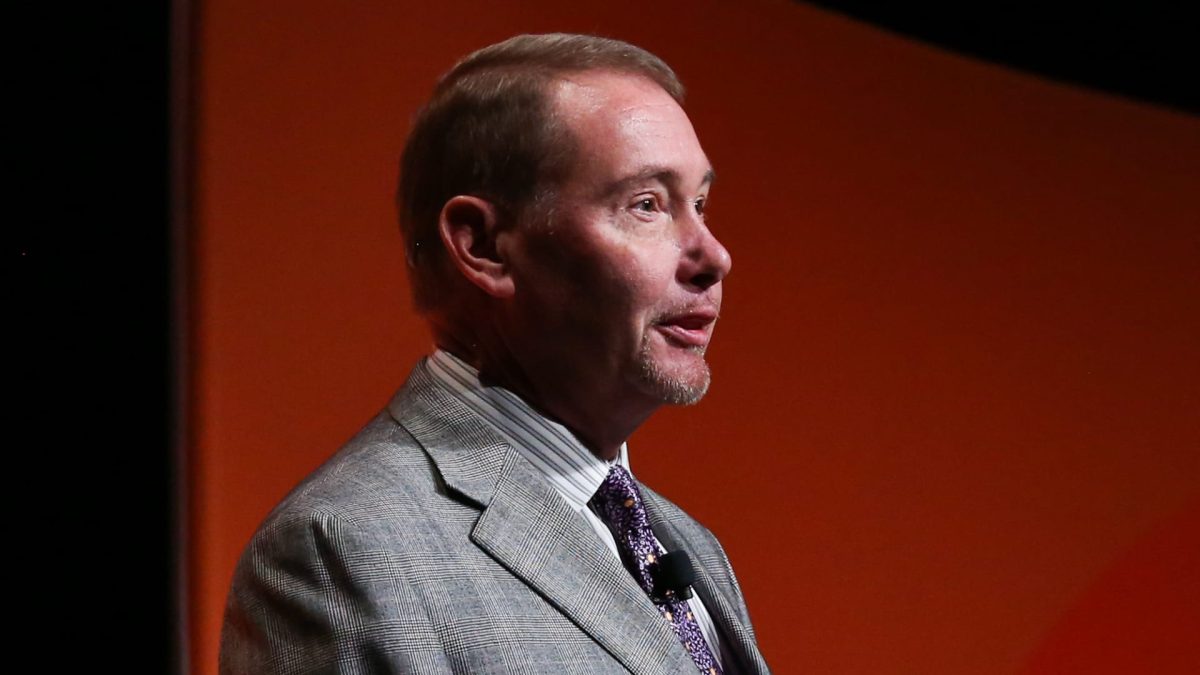
Jeffrey Gundlach speaking at the 2019 SOHN Conference in New York on May 5, 2019.
Adam Jeffery | CNBC

DoubleLine Capital CEO Jeffrey Gundlach believes the Federal Reserve is missing the bigger picture again.

“The Fed looks like Mr. Magoo, driving around, bumping into things. Then became systematic, got inflation to come down,” Gundlach said in an investor webcast Tuesday evening. “But for the past five months we’ve had another rising trend. This has got the Fed back into short-termism, reacting too much to short-term data, not being strategic.”

Gundlach, a noted fixed-income investor whose firm manages $95 billion, made the comments before the latest reading of the consumer price index on Wednesday. The CPI increased a seasonally adjusted 0.4% on the month, putting the 12-month inflation rate at 2.9%

Excluding food and energy, the core CPI rate came in slightly lighter than expected both on a monthly basis and an annual basis. While the numbers compared favorably to forecasts, they still show that the Fed has work to do to reach its 2% inflation target.

“CPI month-over-month change has got the Fed zig-zagging,” Gundlach said. “The market has gone from an aggressive assumption of Fed cuts to just one cut in 2025.”

The Fed has cut benchmark rates by a full percentage point since September, a month during which it took the unusual step of lowering by a half point. In December, the central bank projected only two quarter-point rate cuts in 2025, fewer than the four cuts it previously forecast.

“The Fed is now in sync with the market, and the market is not given further signals for a change,” Gundlach said. “That is consistent with the Fed slowing down its change of monetary policy.”

Futures pricing continued to imply a near certainty that the Fed would stay on hold at its Jan. 28-29 meeting but leaned more toward two quarter-point rate cuts through the year, assuming quarter percentage point increments, according to CME Group.

Was this penny stock a silly purchase?

I own a few penny stocks in my Stocks and Shares ISA. Of them, one is now worth substantially less than I paid for it. On top of that, 2025 could potentially see things get worse not better.

So, was this a mistake for me to buy – and ought I to sell?

A challenging 2024 for a longstanding business

The share in question is Topps Tiles (LSE: TPT).

It is down in value by 23% over the past year and over half on a five-year timeframe. Ouch.

There are good reasons for the fall in the past year, in my opinion. Last year saw like-for-like revenues fall 9%. A £7m profit before tax the prior year turned into a £16m pre-tax loss.

The dividend per share was cut by a third. I think it is one of the reasons some investors hang onto the stock, so it is understandable that the board was loathe to axe it altogether.

Still, given the loss last year, I see a risk that the dividend could yet go to zero.

Might 2025 be any better?

Some of the reasons for last year’s poor performance could be just as bad – or worse – this year.

Weak demand in the tile market is a critical one. On top of that, the company’s acquisition of assets from bankrupt rival CTD last year (currently under investigation by competition authorities) divides investor opinion. Some see it as ill-planned and potentially not the most cost-effective way for Topps to build further scale.

I am more positive about that, seeing it as an opportunistic move that helps the business build credibility in areas adjacent to its main business, such as selling to architects.

Topps has a strong market position, selling one in five tiles bought across the nation. That came about as part of a concerted strategic push and it has another plan to grow its sales to around £1m per day on average.

Lots still to prove

But while sales are one thing, profits are what matter to investors.

Last week, Topps announced that in its most recent quarter, it had returned to sales growth. In the last 12 weeks of last year, like-for-like sales grew 5% year on year.

The chief executive has announced plans to stand down and any hiccoughs in succession and handover could add further risks to the company’s financial performance.

While I am happy about the return to sales growth, I will be keeping a close eye on the company’s interim results a few months from now to see whether it has also moved back into the black after last year’s losses.

Clearly there are multiple risks here. But I do not think buying Topps was silly. It remains a solid business in an area I expect to benefit from strong demand over the long run. So I have no plans to get rid of this penny stock from my portfolio.

After a stunning 2024, could IAG shares still go higher from here?

Last year was an excellent one for shareholders in International Consolidated Airlines Group (LSE: IAG). In fact, IAG shares performed better than any other in the FTSE 100.

Yet despite that outstanding performance, the current share price-to-earnings (P/E) ratio is seven. That sounds fairly cheap at first glance.

The general principle is that the lower a P/E ratio, the cheaper the share seems, although in practice that also depends on whether earnings are likely to stay at the same level and also how much debt the company is carrying.

So, with that sort of P/E ratio and strong commercial performance, could IAG shares move higher in 2025 – and ought I to consider adding the airline owner to my portfolio?

2025 could be a great year commercially

Looking to the year ahead, I think things could go well for IAG. Civil aviation demand is high and it could stay that way into the summer. At the third-quarter point last year, IAG said it expected its strong performance to continue for the rest of 2024.

It did not get into detail about the 2025 outlook at that point, but did say that, “Longer term we see positive, sustainable demand for travel”. I do not really know what that means: is “positive” a synonym for growing, or not? But while the language is not helpful, the mood seems to be one of optimism.

Set against that, however, I also see some risks this year. Multiple large economies are either performing weakly or have recently been in a recession. More may follow.

That, combined with constrained consumer spending, could mean weaker demand for leisure travel. On top of that, business travel demand continues to be weak compared to before the pandemic.

IAG’s strategic choices are a concern for me

On top of those broader risks, I feel IAG has long been making some strategic choices that could also hurt demand at some of its airlines, such as British Airways.

It has been trying to improve aspects of the passenger experience. But after years of cost cutting ate into passenger loyalty, I think IAG has lost the power of some of its brands – perhaps forever.

On top of that, recent changes announced to BA’s loyalty programme seem to have gone down like a lead balloon with a lot of frequent flyers. That could hurt demand further.

Here’s why I’m not investing

On top of more foreseeable external demand risks like a weak economy, I am also concerned about ones that are less easy to spot. For example, another pandemic or terrorist attack could badly hurt civil aviation demand overnight.

That puts me off investing in airlines generally. I have made exceptions before (including owning IAG shares).

But while I see further space for IAG shares to move up in value in coming months, the risks here do not sit comfortably with me. So I have no plans to invest.

Financial News

Daily News on Investing, Personal Finance, Markets, and more!

Financial News

Policy(Required)