P/E ratios under 5? Are these undervalued UK shares an opportunity to build wealth?

When evaluating stocks, value investors are typically attracted to UK shares that appear cheap compared to earnings. Naturally, it makes sense to grab something when it’s selling at a bargain.

The price-to-earnings (P/E) ratio reveals what it costs to buy shares compared to what each share earns the company. It’s considered a quick way to gauge whether a company is performing better than it share price suggests.

The right reasons

There are different reasons why a company may have a low P/E ratio so it’s important to assess the reason. Imagine a company’s making good earnings but behind the scenes, it’s headed for disaster. If shareholders are aware of the underlying issue, it could prompt them to sell.

But there are times when great companies with solid earnings still appear cheap. Recently, investors have been increasingly drawn to the US market, driving capital away from the UK. And falling interest rates have shifted attention to other asset classes.

Rather than lose hope, savvy investors see the long-term value in such an opportunity. Those who have been in the game long enough know that the situation can change quickly. Any major shift in global economic policy could bring capital flooding back into the local market, sending prices soaring.

How to identify value stocks

Figuring out which shares might recover in such a situation can be highly lucrative. As mentioned, a low P/E ratio can indicate good value but not necessarily long-term potential.

But when a well-established company with solid financials appears cheap for no reason, that’s a good sign. And right now, the UK market’s brimming with such opportunities.

Stocks to consider

Look at International Consolidated Airlines Group, the company that owns and operates British Airways along with several other EU airlines. For a year before November 2024, it was trading at less than five times earnings – a surprisingly low ratio for such a large firm.

Investors who recognised the value and bought the shares early benefited from the 80% price rise in the past six months. NatWest Group was also trading with a P/E ratio below five for the last quarter of 2023. The price has since recovered over 90%.

Currently, I see another major FTSE 100 stock that’s been trading below a P/E of five: insurance giant Beazley Group (LSE: BEZ).

Despite the stock climbing 61% in the past year, it still has a low P/E ratio. With earnings more than doubling between 2022 and 2023, the ratio’s levelled out. That’s a strong sign that there’s more room for price growth.

The risk is that it’s heavily exposed to growing costs from climate-related disasters. Last year, it wrote off expenses of $175m due to claims from hurricanes Helene and Milton. Another major disaster could leave it sitting with hefty bills to cover.

Analysts seem unfazed, forecasting revenue upwards of £5bn by 2026, along with a 30% earnings increase. The average 12-month price estimate of 973p is around 18.6% higher than today’s price.

Right now, I don’t have spare capital to put into the stock. But I think it’s worth considering for value investors seeking out discounted UK shares.


If an investor put £1k in the S&P 500, here’s what they could have in 2026

Over the past month or so, the top Wall Street analysts released their forecasts for where the S&P 500 could go this year. Of course, nothing can be predicted precisely, and the difference in forecast views highlight this fact. Yet based on the consensus view, here’s what an investor could end up with if they invested now and the predictions turn out to be correct.

Looking at the numbers

According to Bloomberg, the average forecast from the list of contributors is 6,614 points. At the moment the index stands at 5,842 points. So this would be a 13.2% rally for 2025. As a result, a £1k investment could be worth £1,132 by year-end.

Some forecasters are looking for greater gains, with others predicting much less. For example, the team at Oppenheimer are top of the tree with its view of 7,100 points! From the data I can see, the lowest target for 2025’s 6,000 points from Cantor Fitzgerald.

It’s true that there’s a wide range of views here. But what strikes me as interesting is that all of these analysts are looking for the index to gain in value this year.

This isn’t to say the index can’t fall. There are several reasons that could cause these forecasts to be upended. For example, US inflation could materially rise. This could cause interest rate cuts to evaporate and investors to get worried about the broader economy.

Where the gains could come from

If the S&P 500 does hit the 6,614-point mark, it’ll likely be partly down to the mega-cap firms continuing to do well. The index is up 23% over the last year, helped by US shares such as Vistra (NYSE:VST).

Vistra’s a US-based energy company engaged in the production and distribution of electricity and related services. It’s a significant provider of energy, but some might look at the 333% jump in the share price over the past year and be a bit confused.

It’s true that normally energy companies of this size don’t see such large stock movements. Yet the driver for Vistra was the fact that the infrastructure is seen as a critical driver behind the energy demand of artificial intelligence (AI). The increasing need to power energy-hungry computers and processors mean that Vistra could see better financial performances in coming years.

Vistra could also help to lead the charge this year for the index and so may be worth considering. However, one risk is that some of the stock’s rally is built on speculation. AI hype could mean the stock’s in a bit of a bubble. If investors don’t see some tangible proof of demand filtering down to higher profits soon, the share price could fall.

Overall, sentiment towards the US stock market’s positive for the year ahead. Investors do need to be careful and do their own research, but the professionals are clearly expecting a good 2025.

Prediction: these FTSE 250 stocks could be among 2025’s big winners

I’m hoping for a return to growth for the FTSE 250 in 2025 after a disappointing few years. But which stocks do I think might lead the mid-cap index? My eyes have fallen on these three.

Healthcare income

I think 2025 could be the year when some of the FTSE 250’s undervalued real estate investment trusts (REITs) could make a comeback. Primary Health Properties (LSE: PHP) is one, after its share price ended 2024 on a bit of a slide.

Please note that tax treatment depends on the individual circumstances of each client and may be subject to change in future. The content in this article is provided for information purposes only. It is not intended to be, neither does it constitute, any form of tax advice.

The company owns healthcare facilities that it rents out largely to GPs, many in the NHS. With relatively reliable rental income, success doesn’t depend on property valuations.

Uncertain valuation

I think its assets look good anyway. At the 2024 interim, adjusted net tangible assets per share stood at 105p. The share price is just 89p at the time of writing.

That’s a non-standard accounting measure, and property valuations have been volatile, so there’s risk there.

But with strong earnings growth forecast for 2025, and a forward dividend yield of 8.2%, I think this trust could deserve a higher rating in 2025.

Cheap TV

The first half of 2024 made it seem like an ITV (LSE: ITV) recovery was on, though it cooled off. We’re looking at a decent 12-month gain of 17%, but I still think the shares could be too cheap.

The tough economy is putting the squeeze on advertising spend. But we just heard that December inflation was down, which hopefully bodes well.

The firm’s Q3 update spoke of revenue being impacted by the phasing of deliveries and the 2023 writers’ and actors’ strike in the US. And that gave the share price a hit on the day.

Forward, not back

ITV still said “We remain on track to deliver at least £750 million of digital revenues in 2026“. And it sees only a small fall in 2024 ITVX streaming revenue.

We have a forward dividend yield of 7%, with an expected FY 2024 price-to-earnings (P/E) ratio of just nine.

There’s an earnings fall forecast for 2025, which could keep the shares down. But if we see early signs of the growth predicted for 2026, I think ITV could beat the FTSE 250 this year.

Plastic, fantastic

At polymer specialist Victrex (LSE: VCT), seeing a five-year share price fall of 57% and a trailing P/E of 50 made me pause for breath.

Looking closer though, I see things I like, including a forecast 6.8% dividend yield.

After a few years of falling earnings, forecasts show a return to growth starting with a boost in 2025. They put the forward P/E at 17, dropping as low as 11 by 2027.

Protective moat

On these valuation measures, I think we could have solid growth characteristics. But I want to see a competitive advantage to back that up.

Victrex makes high-performance polymers for safety-critical uses, and a number of them are patented products. That looks like a safety moat.

The biggest risk for me personally is that I haven’t researched the company properly yet. But I think investors looking for 2025 winners should consider doing so.

I asked ChatGPT to name 2 cheap shares to beat the FTSE in 2025. Its first pick astonished me

I’m on the hunt for cheap shares and happy to get help wherever I can, even if that means calling in the robots. So I asked AI chatbot ChatGPT for its views.

Of course, I know it doesn’t really have a view. It just culls information from the internet. Although in that respect it isn’t so different from the rest of us.

I didn’t see its first stock pick coming. I thought it would choose a couple of FTSE 100 companies whose shares had plunged in 2024 and were dirt cheap as a result. Instead, it came up with Barclays (LSE: BARC). It’s been one of the best performers of all, with the shares up 80% over the last year.

The shares aren’t as cheap as the bot thinks

This highlights a risk of relying on ChatGPT. It based its recommendation on Barclays’ price-to-earnings (P/E) ratio for 2023, which was a lowly 5.1. After the recent surge, it’s now up to 9.5. Investors beware.

However, that’s still comfortably below the FTSE 100 average P/E of around 15 times. And Barclays currently has a modest price-to-book ratio of just 0.5. That’s half the figure of 1 seen as fair value.

It also boasts a diversified revenue stream across retail and investment banking, which includes exposure to the thriving US market. “This provides some resilience against sector-specific downturns”, ChatGPT tells me. 

It’s actually quoting a Motley Fool article there. An old one. ChatGPT’s other ‘insights’ are just blether about the financial services sector being regulated and competitive. So what do I think?

Barclays is a brilliant long-term buy and hold. But after its strong run I don’t think this is the time to buy. The yield’s now down to 3%. I hold Lloyds Banking Group whose shares rose ‘just’ 20% last year. But with a P/E of 7.1 and forward yield of 6%, I think it’s the better pick. I’m only human though, and could be wrong.

ChatGPT’s second stock pick is cheap by anybody standards, oil giant BP (LSE:BP). So cheap in fact that I bought its shares on 14 January at a P/E of just 5.9 times.

I decided BP was an unmissable bargain

The BP share price has been highly volatile in recent years, mostly down to oil price movements. It rocketed after Vladimir Putin invaded Ukraine in 2022, triggering the energy shock, then fell as the West secured other supplies of energy.

Today, Brent crude’s back above $80 a barrel following the Biden administration’s 11th-hour sanctions on Russia, chilly temperatures across the Atlantic and inflation fears.

Markets are watching President-elect Donald Trump closely. He wants the US to get drilling, which should increase supply. Yet Goldman Sachs has warned strict sanctions on Iran could send Brent towards $90. Plus we’re all wondering what OPEC+ might do next.

I’m looking beyond the short-term noise – particularly voluble in the energy sector – and treating BP as a long-term stock to buy and forget. Now looks like a great entry point. Especially with that bumper 5.3% trailing yield and potential share buybacks.

ChatGPT also informs me that “BP must navigate the complexities of the energy sector’s transition and commodity market volatility”, and that’s a fair point. 

Should I prepare for a stock market crash in 2025?

As I write, a stock market crash feels quite unlikely. British and American inflation data for December was better than expected, providing embattled chancellor Rachel Reeves with a little bit of breathing space.

Why’s that important? Well, I’d suggest that a stock market crash, in the UK at least, needs a real catalyst. That could be rising inflation, a surge in oil prices, or even a new regional conflict.

However, there’s one thing that’s unlikely to cause UK stocks to rout, and that’s a lack of confidence in the valuation of British stocks. UK-listed firms already trade with significant discounts to their American peers.

So should I prepare for a stock market crash? Well, on evidence, I’d say ‘no’.

The omens are good

While past performance doesn’t guarantee future returns, there’s a well-defined relationship between FTSE 100 shares and interest rate cycles. Historically, UK stocks have risen in the 12 months following the initiation of rate cuts, and this is particularly relevant as the Bank of England’s currently six months into a rate-cutting cycle.

In fact, UK stocks have typically posted above-average returns in rate-cutting cycles, notably when recessions are avoided. During the 1990-1991 recession, the FTSE 100 climbed over 22% in the year following the first rate reduction. Moreover, returns averaged an impressive 31.5% during the 1996-1997 and 1998-1999 rate-cutting cycles.

Perhaps unsurprisingly, this trend isn’t limited to the UK market. Across major economies, stocks have typically shown strong performance during periods of monetary easing. However, the current scenario presents unique challenges, including increased dependence on China’s growth and persistent equity outflows from the UK market.

Despite these factors, many analysts remain optimistic about the potential for FTSE 100 shares to deliver positive returns in the coming year. That’s particularly so in sectors such as banking, technology and consumer discretionary. As such, I don’t think there’s much need to prepare for a stock market crash by holding back on investments.

One to consider

In a falling interest rate environment, housebuilders are an obvious area of interest. Vistry Group (LSE:VTY) has been catching the attention of analysts in recent months, with some suggesting that it may have been oversold.

Notably, I was one of the investors who sold their Vistry shares last year after the company issued multiple profit warnings and said they had underestimated costs. I actually reached out to Vistry’s investor relations team to ask whether they had misled the market on costs. They haven’t responded to either of my emails.

However, we’re now looking at a stock that trades at 11.6 times forward earnings, 8.2 times projected earnings for 2025, and 6.2 times expected earnings for 2026. This actually puts it at a discount to the likes of Persimmon, which is arguably less diversified than Vistry.

Vistry has an affordable housing division that reduces some of its exposure to volatility of the private market. Personally, I’m not investing in it — my trust’s been eroded. But I appreciate that some analysts will see this slump as an opportunity.

Warren Buffett strikes again

Berkshire Hathaway (NYSE:BRK.B) literally has more cash than it knows what to do with. And investors are looking at what Warren Buffett – or any of the other managers – are going to do with it. 

But investing in the stock market isn’t the only thing that Berkshire does well. A big part of the firm is its insurance division, which has yet again been making impressive moves.

Wildfires

California is currently suffering its worst wildfires in over 40 years. As I write this, 25 lives have been lost and 23 people are still missing – and to some extent, that’s the only thing that really matters. 

On top of that, over 12,000 homes and businesses have been damaged. And it might be some time until the full extent of the damage is known.

While this is significant, it’s relatively minor compared to the loss of life. One reason for this is that insurance companies exist to put right at least some of the damage that has been caused. 

Berkshire’s balance sheet protects it from a lot of potential problems. That means the possibility of a huge insurance loss is the biggest risk with the stock – and this has been the case for some time. 

Insurance

In the context of the latest wildfires, Berkshire Hathaway has done a good job of protecting itself. Since 2023, the company has stopped writing home insurance policies in California. 

While the causes of the fires aren’t yet clear, climate change is being cited as a key reason and Buffett has been aware of this for some time. The Berkshire CEO has cited this in the firm’s annual meetings.

This highlights the strength of the company’s insurance operations. With policies that are renewed – and repriced – each year, Berkshire has the chance to back away from risks if they become too great.

The decision to stop writing policies in California has proved to be a smart one. While it might have reduced insurance premiums in the short term, it has also avoided some big losses for the firm. 

Buffett’s first rule

According to Buffett, the first rule of investing is not to lose money and the second rule is to never forget rule number one. In the insurance industry – where risk is inevitable – this can be hard to do.

Being able to walk away from business when it isn’t priced attractively is crucial. However, it’s much easier for a company like Berkshire that already has $325bn in cash. 

That’s the unique advantage Buffett’s operation has over other insurers. It isn’t under any pressure to write contracts to grow its premium volume, unless it expects to make a decent return in doing so.

I doubt it’s Buffett personally looking after Berkshire’s decisions around California underwriting. But I have no doubt that the culture of the organisation comes from the top. 

Investing like Warren Buffett

Every three months, investors pay attention to what Berkshire Hathaway is doing with its cash. But job number one is – and always will be – looking after it. 

This is key to how Buffett thinks about investments. It runs through Berkshire’s subsidiaries and is one of the key reasons I expect the stock to continue working out well for shareholders.

Here’s how much an investor would need in an ISA to earn £3,000 of passive income monthly

Generating passive income from investments is a worthwhile financial goal, and an Individual Savings Account (ISA) is an excellent vehicle for achieving it. For UK investors seeking to earn £3,000 in monthly passive income determining the required ISA balance, and how to get there, involves some shrewd planning.

Hitting the target

A widely-used benchmark is the 4% rule. This suggests an investor can withdraw 4% of their portfolio annually without significantly depleting their capital long term — this could be achieved by investing in dividend-paying stocks with an average yield of 4%. Based on this, an investor would need £900,000 in their ISA to generate £3,000 a month.

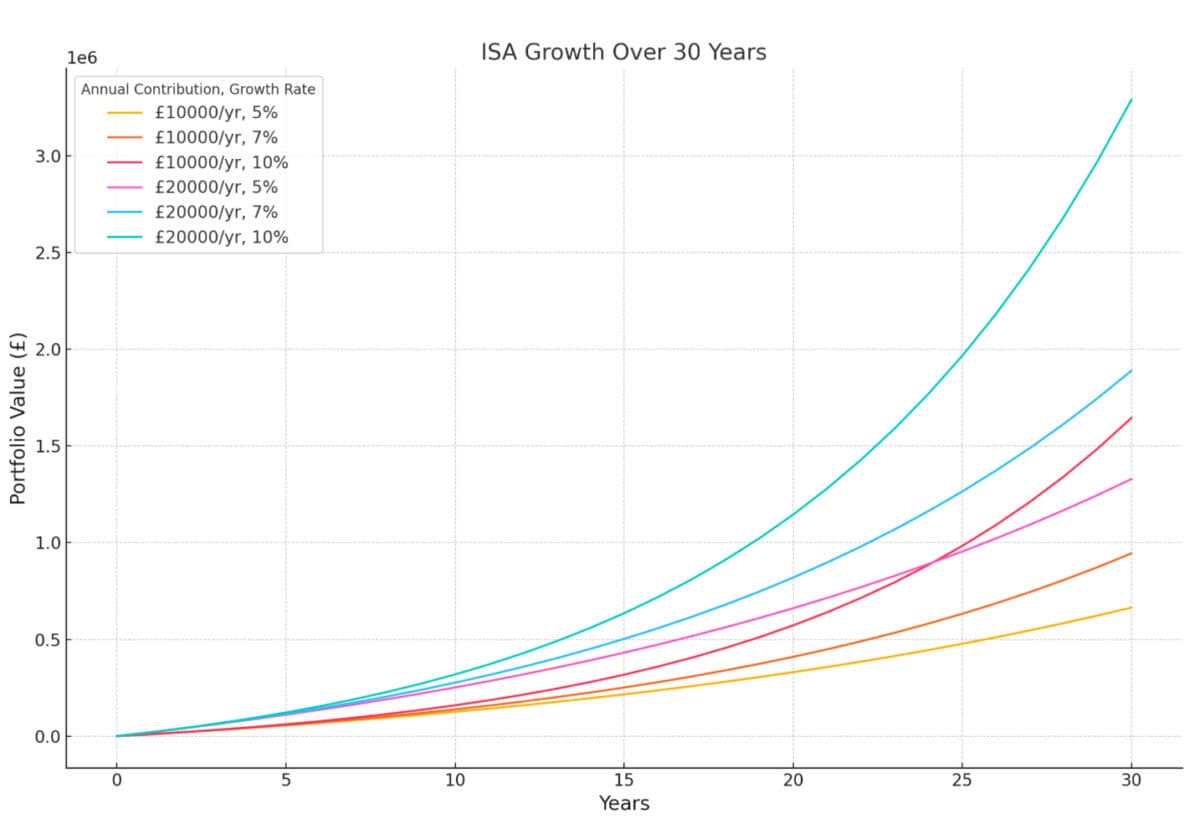
Achieving this balance depends on several factors, including initial contributions, the time horizon, and investment returns. ISA allowances permit up to £20,000 a tax year to be contributed. By doing this and investing in assets with an average annual return of 7% (a typical expectation for shares), an investor starting from £0 could potentially accumulate around £900,000 in 25 years. Of course, that’s not guaranteed and said investor could lose money as well as making it.

There are other ways to aim for the target. One could invest in higher dividend-paying stocks in an effort to generate a larger yield from a smaller balance. The required balance could also be achieved sooner or with less capital if the investor’s shrewd. This is highlighted in the below graph.

The art of the possible

Many novices will buy into index-tracking funds. These aim to track the performance of major indexes. For example, the FTSE 100 averaged 6.3% annually over 20 years, while FTSE 250 outperformed it. America’s S&P 500 returned about 10.5% annually since 1957, averaging 13.3% in the decade to 2024. The Nasdaq achieved 19.8% over the past decade.

But some people, those buying into individual shares and funds, achieve stronger growth. While I’ve averaged strong double-digit returns over the last five years, brain-boxes like analyst J Mintzmyer have averaged over 40%. However, as great as this sounds, investors need to remember that poor investment decisions can result in losing money.

Consider this for the growth phase

I typically invest in individual shares, but in my daughter’s Self-Invested Personal Pension (SIPP), which involves smaller investments, I prefer funds or trusts that offer me diversification while only paying one platform trading fee.

One trust she recently bought and I think is worth considering is Edinburgh Worldwide Investment Trust (LSE:EWI). It’s operated by Baillie Gifford, which also runs the popular Scottish Mortgage Investment Trust.

Like Scottish Mortgage, Edinburgh Worldwide invests in growth-oriented companies but focused on making an initial investment in companies when they are younger — originally companies with a market-cap smaller than $5bn, but this was recently upped to $25bn to broaden the field of play.

Its largest investment is SpaceX which represents a massive 12.3% of the portfolio. This is followed by PsiQuantum at 7.5% and Alnylam Pharmaceuticals. In short, it’s a very interesting portfolio, representing some of the most sought-after growth investments worldwide.

However, SpaceX and quantum computing go some way to highlighting the risky nature of the trust’s holdings. Not only are these early-stage companies — albeit one worth $350bn in the case of SpaceX — but there’s limited available data about their finances — only listed companies need to issue earnings reports.

2 growth stocks that are ONLY for long-term investors

Warren Buffett attributes the success of his Coca-Cola and American Express investments to the fact the companies have grown, not the dividends they’ve paid. In other words: growth stocks can be great.

The trouble is, a lot of businesses need time to increase their earnings. And I think some of the best growth stocks should only be considered by investors with a long-term focus. 

Halma

Over the last 12 months, Halma (LSE:HLMA) shares have climbed 27%. That’s a great return, but I don’t think investors should bet on something similar happening again in 2025. 

The stock currently trades at a price-to-earnings (P/E) ratio of 36 (or 31 based on the firm’s adjusted figures). And the company isn’t Nvidia – it’s not likely to double its profits in the next year.

I think, however, that its long-term prospects are enough to justify the current share price. Halma’s strategy involves buying other businesses and integrating them into its network. 

Typical acquisition targets occupy dominant positions in niche markets, making them difficult to disrupt. But it can also mean their scope for growth is limited and this is a risk given the high share price. 

Halma can generate some growth by integrating subsidiaries into its ecosystem. Ultimately, though, the success of the business is going to come down to the firm finding enough companies to buy. 

Management reported a strong acquisition pipeline in the firm’s latest trading update. I think the stock could turn out to be a great investment, but it’s not going to happen overnight. 

Palantir

Palantir (NASDAQ:PLTR) is a very different case. I think there’s a decent chance the firm’s profits may double in the next 12 months, but at a P/E ratio of 345, the stock will look expensive even if they do.

Historically, the company has relied heavily on government contracts. And with these continue to make up a big part of revenues, there’s an ongoing risk of policy changes and budget shifts. 

Recently, though, Palantir has shifted to targeting businesses to sell to, and the early signs are encouraging. It seems as though companies can’t sign up fast enough when they see what Palantir can do.

Whether it’s bottled water or agricultural software, the firm’s analytics products appear to be able to generate impressive insights for their clients. And I think this is very promising. 

There’s a lot of optimism about what artificial intelligence (AI) might mean for various businesses. But Palantir is one of the few companies that actually has a working AI product that produces real results.

It’s going to be a long time before the firm is in a position to return cash to shareholders in a way that amounts to a good return on the current share price. I think, though, that patience could pay off here.

Long-term investing

Unless they fall sharply, neither Halma nor Palantir stock is going to look cheap in the next couple of years. And while anything can happen, I don’t think investors should look for a return in that time.

Over the long term, however, both companies have outstanding growth prospects. There are risks in both cases, but I think either stock could turn out to be a great investment at today’s prices.

Trading platform Dub will pay some retail investors to share portfolios through TikTok-like ‘creator program’

  • Select retail investors will be able to earn royalties as users of trading platform Dub duplicate their portfolios.
  • It’s part of a new creator program launched by the investing app.
Manusapon Kasosod | Moment | Getty Images

Dub, a platform that allows retail traders to mimic the investments of notable people in business and government, debuted a service Thursday that pays select everyday investors to share their portfolios.

Retail traders accepted into Dub’s so-called top creator program will be paid royalties for users to access their model portfolio. The creator program marks the latest push from Dub to sway mom-and-pop investors to its platform, which encourages users to forgo traditional stock picking and instead duplicate other traders’ portfolios.

“Fundamentally, we are rethinking the distribution of how capital flows to investing talent,” said Steven Wang, Dub’s founder and chief executive. “We are really at the very early innings of another retail investing revolution.”

Since its launch nearly a year ago, Dub has offered users the opportunity to track and copy the investment portfolios of people ranging from Federal Reserve Chair Jerome Powell and Rep. Nancy Pelosi, D-Calif., to billionaire hedge fund manager Bill Ackman. Users, who pay $9.99 a month or $89.99 a year, can essentially make replicas of these portfolios using their own money held in Dub’s broker dealer.

These portfolios are tracked for changes over time, with any trades automatically mirrored to others who copied them. In other words, Wang said traders can go on “auto pilot” once holding a copy of someone’s portfolio and eliminate the human error of missing any trades.

Previously, users could opt to make their portfolios available for copy by others if they met a personal investment minimum of $1,000. Now, the creator program adds a financial incentive for accepted users.

The program’s name can draw comparisons to influencer payment structures from social media platforms such as TikTok. Accepted traders get paid a scaling fee that takes into consideration several social metrics. The rate isn’t based entirely on the number of portfolio copies per creator, but that number may be a factor.

The amount of royalties received is determined individually between Dub and each creator in the program, Wang said.

Multiple traders were already signed onto the program at the time of launch, according to Dub. Their roster includes Andrew Ver Planck, an alumnus of MacKay Shields and Putnam Investments, and Lawrence Fuller, a SeekingAlpha analyst.

Dub has a $100 minimum deposit, though some portfolios require larger investments to make a copy. The company’s broker dealer is registered with the Securities and Exchange Commission.

The ‘next generation’ of investing influencers

Dub’s program comes amid a booming period for both retail trading and the influencer economy.

Data shows that net inflows from average Joe traders to popular stocks and funds remain elevated compared with pre-pandemic levels. That’s despite the boom-and-bust cycle of day trading and meme stocks that captured America’s interest during the Covid pandemic.

At the same time, the pandemic lockdowns catalyzed a surge of interest around people with large followings on online platforms. That’s bolstered the sub-economy tied to digital creators, which Goldman Sachs estimated can swell to a $480 billion revenue opportunity by 2027. Goldman reported in 2023 that around 50 million people work as content creators around the globe.

Dub’s app has been downloaded more than 700,000 times, according to Wang. The company expects to reach 1 million before the end of the first quarter.

Looking ahead, Wang said he hopes to see the best individual traders gain followings and fortunes through the creator program and Dub’s platform. One of the benefits of Dub, he said, is the ability to see verified returns of each portfolio that can be copied before a user chooses to throw their own money behind it.

“I want the next five Warren Buffetts to be surfaced and famous on Dub,” he said. “If we’re really successful with the top creator program, the next generation of the best fund managers, the best traders in the world that people follow will rise from Dub.”

Are Lloyds shares the best no-brainer buy for a 2025 Stocks and Shares ISA?

Looking for ideas for a Stocks and Shares ISA, surely it’s best to buy shares in great companies when they’re cheap, isn’t it?

I’d say a definite yes to that, but with two very big caveats. One, we really need to be sure we’ve found a genuinely great company. And two, we have to be able to distinguish the good ones from those that deserve to be down.

One thing that means is that I almost never see any investment possibility as a no-brainer. But I think it’s entirely possible to weigh up the chances for Lloyds Banking Group (LSE: LLOY) without needing brains like billionaire investor Warren Buffett.

Up, but still cheap?

The Lloyds share price is actually up 30% in the past 12 months. And it’s almost back in positive territory over five years. But that’s still an underperformance against the FTSE 100 since the early days of 2020.

And Lloyds is a mere shadow of its former self from before the 2008 banking crisis. But it’s no use harking back to those old days. No, we need to look at today’s very different Lloyds.

So how do I go about rating the bank’s value as a Stocks and Shares ISA candidate for 2025 and beyond?

I’m going to come back to Warren Buffett again.

Rule number 1

Buffett’s first rule of investing is “never lose money.” And his second rule, famously, is “never forget Rule 1.

So what things could cause Lloyds shareholders to lose money in 2025? I think the main fear is the car loan mis-selling issue. So far, Lloyds has set aside £450m to potentially cover its obligations, but other than that it’s being tight-lipped about it.

Some observers think it could ultimately cost Lloyds up to £1.5bn. It looks like we’ll have to wait for the annual results due on 20 February to hear the Lloyds board’s updated take.

The other thing that investors seem worried about is interest rates. Falling rates should mean tighter margins for mortgage lenders. But the other side of that should be more borrowers and fewer defaults.

A Lloyds price jump today (16 January), when news broke of December’s lower-than-expected inflation figures, seems to show the markets are positive about the possible effects.

Against the crowds

The Lloyds share price rise might make it look like the crowds are behind it. But it’s way behind the progress that Barclays and NatWest Group have made in the past 12 months. And I’d say that has to be due to the fears I’ve looked at here.

So I think that the best time to consider adding a company to a Stocks and Shares ISA might just be when it faces its greatest short-term uncertainty. Providing we’re convinced it can overcome it and has a positive long-term future. Oh, and the price is right.

It’s nowhere near being a no-brainer rule, and it’s not for the faint-hearted. It’s for investors who don’t mind going against the crowds. Does sounds like Warren Buffett yet again? I rate Lloyds as one to consider for a 2025 ISA.

Financial News

Daily News on Investing, Personal Finance, Markets, and more!

Financial News

Policy(Required)