£15k to invest? 2 high-yield stocks to consider that could deliver a £1,565 passive income

Some passive income strategies can take years to deliver a meaningful level of income. But today I’m looking at two high-yield FTSE 250 shares with the potential to provide an average dividend yield of over 10% in 2025.

My sums suggest that an investment of £15k split equally across these two shares could generate a passive income of £1,565 this year.

Of course, I’d never invest all of my portfolio in just two shares. I’d want more diversification in case of dividend cuts. But I think both of these shares could be worth considering for an income portfolio.

An 11.9% yield!

My first choice is specialist insurer Lancashire Holdings (LSE: LRE). This company provides insurance and reinsurance in sectors including property, shipping, energy and aviation. It’s a niche business with experienced management. Profit margins can be high when market conditions are favourable.

I’ve followed Lancashire for a number of years and its results tend to go through cycles. Recent years have seen some big claims and high inflation, putting profits under pressure for a period.

However, these events allowed the company to push through strong price increases on its insurance. Lancashire now appears to be reaping the rewards of this more difficult period.

City brokers are forecasting near-record profits for 2024 and 2025. Cash generation’s strong, and the company’s paying out some big special dividends in addition to its ordinary payout.

Perhaps the biggest risk here is that Lancashire will suffer a major claims event – probably a natural disaster – that will upset its calculations.

The company’s expected to have exposure to the recent California wildfires, for example, although City estimates I’ve seen suggest the costs will be manageable.

So far, broker forecasts are unchanged. Analysts’ estimates suggest a total dividend of $0.96 per share in 2025, giving a potential dividend yield of 11.9%, at the time of writing.

A reliable income from property

My second choice is FTSE 250 healthcare property REIT Assura (LSE: AGR). This investment trust has a £3.2bn portfolio of hospitals, GP surgeries and other healthcare properties in the UK and Ireland.

Assura shares currently offer a forecast dividend yield of almost 9% for the 2024/25 financial year.

Please note that tax treatment depends on the individual circumstances of each client and may be subject to change in future. The content in this article is provided for information purposes only. It is not intended to be, neither does it constitute, any form of tax advice.

One attractive feature of the healthcare sector is that lease lengths are generally longer than for other types of commercial property. Assura’s average unexpired lease length was 13 years at the end of September 2024, providing a predictable income stream.

Another attraction is that the shares currently trade at a 25% discount to their last reported book value of 49p per share. If interest rates fall, I’d expect the share price to rise to trade closer to book value.

The main risk I can see now is that Assura’s dividend could come under pressure from higher debt costs. Assura’s loan-to-value ratio’s currently over 45% — quite high for a REIT.

However, a programme of asset sales is underway to reduce borrowings. This appears to be making good progress. Most of Assura’s debt’s also at fixed rates with several years remaining, so management do have some time.

On balance, I think Assura’s dividend’s likely to remain safe. I certainly think the shares are worth considering as a possible income investment.


£10k invested in BP shares 10 years ago is now worth…

The oil industry’s known for its boom-and-bust cycles. The long-term performance of BP (LSE: BP) shares reflects this. Since 2015, this FTSE 100 stalwart has hit highs of almost 600p – and dropped as low as 200p.

Some investors try to time the cycle, buying at the bottom and selling at the top. A few even manage it. But it’s not easy.

The low points tend to be accompanied by scary news, making it hard to buy. When oil shares are high, I often find investors explaining to me why it will be different this time – and arguing that the shares are still cheap.

The good news is that there’s a second way to target a profit from BP shares that doesn’t rely on market timing. The energy stock’s one of the London market’s biggest dividend payers. The current dividend gives a 5.9% yield and is equivalent to a payout of about £4bn a year.

Impressively, that’s less than half the £10bn in surplus cash BP’s expected to have generated in 2024. This suggests to me the payout’s likely to be safe, even if oil prices do slump.

Lacklustre returns

Does it make sense to buy BP shares just for their dividend yield? I decided to crunch the numbers. On 16 January, BP shares closed at 413p. As I write today – 10 years later – the share price is 430p.

Clearly, that’s not a great result. But over the same 10-year period, BP’s paid a total of 254p per share in dividends. This means that £10,000 invested in BP shares 10 years ago would be worth £16,560 today, including dividends.

That’s equivalent to a 65% return over the last decade, or an annualised return of 5.2% a year. This isn’t a disaster. But over the same period, the FTSE 100 Total Return index (which includes all FTSE 100 dividends) has risen 86%, or 6.4% annualised. Investors could have done better simply buying an index tracker.

Is BP worth considering today?

These numbers confirm my view that the best time to buy shares in BP is when the energy sector’s in a slump and the shares are cheap on a cyclical view.

I don’t think that’s true at the moment. Although it’s true that BP shares have underperformed some rivals over the last year or so, the group’s profits remain at the upper end of their historic range. This is thanks to strong oil and gas prices and an improved balance sheet.

To consider buying BP, I’d want a dividend yield of 6.5%, or more. That way, I wouldn’t be dependent on strong share price growth to hit my target annual return of at least 8%.

Based on the 2024 forecast dividend, I’d need a price of 385p for a 6.5% yield. That’s only a fall of 10% from the current share price. I reckon it’s quite possible we’ll see that at some point in 2025. After all, over the last 12 months, BP shares have hit a low of 365p and a high of 542p.

I’m sitting tight for now. But BP will stay on my watch list of stocks to consider buying in a market slump.

The FTSE 100 hits new record highs — what do I do now?

Bond yields are rising, US tariffs are coming, and UK businesses are facing higher costs in the form of taxes and National Insurance. But either nobody’s told the FTSE 100, or it doesn’t care. 

The UK’s largest index has just hit record highs, which is impressive considering what’s happened to the JD Sports share price in the last three months. So should investors plough on regardless or look elsewhere?

Keep buying?

Different investors have different strategies and that’s a good thing – as with clothes, there’s no style that suits everyone. But I think investors right now should consider sticking to whatever their plan is.

For some, that will involve investing a fixed amount regularly into a diversified index, such as the FTSE 100. It’s as exciting as magnolia paint, but it does come with some big advantages. 

One is that it takes away the difficulty of working out when shares are cheap and when they’re not. Buying regularly will eventually generate a good result as long as stocks do well over the long term. 

The other is that it removes the need to work out which stocks have the brightest prospects. Investing across an index means investors will benefit whether BP outperforms BT or the other way around.

This is a good plan, but the point is investors are meant to keep buying regardless of whether prices are low or high. So the FTSE 100 being near its highs isn’t a reason for anyone doing this to avoid it.

Stock picking

Not all investors do this – some are so horrified at the idea of owning things they don’t want or buying stocks at high prices that they prefer to focus on individual companies. I’m one of these investors.

There are definitely some bits of the FTSE 100 I’m staying away from right now, but this isn’t the case across the board. Earlier this week, shares in Rentokil Initial (LSE:RTO), which I already hold, once again hit my target buy price.

The company has had some difficulties lately. It acquired Terminix – a big US competitor – in 2022 and seeing it try to integrate the business has been a lot like watching a python trying to eat an antelope.

One difference between the two is that nobody’s trying to organise a class-action lawsuit against a snake. There’s one against Rentokil though, and that’s why the share price has been falling this week. 

That’s something investors should consider as a genuine risk. It’s hard to know exactly what it might amount to, but it’s well worth keeping an eye on for anyone interested in the stock.

My money however’s (quite literally) on the FTSE 100 firm. I think the pest control industry’s likely to grow steadily over time and a strong position in this industry could well turn out to be very valuable.

Opportunities

The FTSE 100’s showing impressive resilience in a difficult economic environment. But whether it’s regular investing or looking for specific opportunities, I don’t think investors should be staying away.

For my own portfolio, I’ve got an eye on Rentokil, plus a couple of other shares. I’m paying close attention to what the bond market’s telling me, but stocks still look attractive to me right now. I may buy more.

£5,000 invested in Tesla stock 12 months ago is now worth…

Over the last 12 months, Tesla (NASDAQ:TSLA) stock’s been more volatile than a toddler who’s accidentally been fed an espresso brownie. As someone who’s seen both, I can attest to this. 

Shares in Elon Musk’s company-that-makes-cars-despite-not-being-a-car-company are up 95%. That’s enough to turn a £5,000 investment into something worth £10,055 after factoring in exchange rates.

Cars

For the first time, Tesla recorded a year-on-year decline in deliveries. And this happened despite Tesla offering incentives to boost volumes and maintain revenues at the expense of its margins.

While the market for cars in general might have been weak at the start of the year, the entire decline can’t be put down to a difficult environment. US light vehicle sales eventually grew 2% in 2024. 

Despite the enduring popularity of the Model Y, Tesla lost market share to every US manufacturer with the exception of Stellantis. And the less said about its robotaxi event in October, the better.

None of this is a reason for the share price to almost double over the last 12 months. But there was a lot for shareholders to be positive about along the way. 

Outlook

Car sales may have been underwhelming, but Tesla’s shown itself to be robust. Instead of cars, the company’s managed to prop up its bottom line by selling regulatory credits.

Some people might be critical of this, but I think that’s a mistake. Ultimately, money’s money and the firm’s shown it has a mechanism for getting through a weak period in electric vehicle (EV) demand.

Furthermore, the downturn might be temporary. The launch of the new Model Y Juniper could boost demand and the anticipation of this might be part of the reason for the weak recent sales.

Lastly, the firm announced plans to launch a car with a price tag below $30,000. This could also help increase sales and it uses Tesla’s biggest advantage when it comes to manufacturing – its scale.

Risks

Tesla shareholders have a lot to be optimistic about. But to say the company still has challenges ahead is an understatement along the lines of saying Everest is ‘a bit of a climb’.

A change in US government might take away the regulatory credits that have been propping up the company’s bottom line. That would put increased pressure on other revenue sources.

The new administration might make Tesla getting the necessary approval for its robotaxi network easier. But it’s unclear exactly how much influence the federal government has over state regulators.

Whether people buying an affordable vehicle for $30,000 are going to spend an extra $8,000 for FSD software is also uncertain. If they don’t, the new cars might come at the cost of Tesla’s overall margins.

The lesson for investors

Tesla’s share price has been through more ups and downs in the last year than most stocks do in a decade. But investors who have sat tight and held on have been handsomely rewarded. 

Anyone wanting to buy the stock has had plenty of opportunities when the share price has been falling. And I think there will be plenty more in future, but I don’t think right now’s one of them.

Here’s how Warren Buffett’s No.1 lesson can help investors as they try to turn £1 into £1m

Warren Buffett has amassed a net worth in excess of $140bn. However, his number-one lesson is as useful to you and me as it is to him. So what’s this great piece of advice? Well, it’s simple: “Don’t lose money”.

It’s hard to recover from a loss

I’m one of those weird people who works with Bloomberg TV on in the background all day. It’s certainly useful, but I always remember a clip from an old advertorial — which was shown probably every 30 minutes — in which, I believe, Bill Ackman says “If you lose 50%, you’ve got to go 100% to get back to where you started”.

It’s very obvious, but it’s something I think many novice investors overlook. Recovering from a loss on an investment, notably one as large as 50%, is very challenging and, for some investors, they may find it impossible.

Putting this lesson into practice

Putting these lessons into practice is, in part, straightforward. Diversification’s necessary to avoid losses having an existential impact on an investor’s portfolio. This doesn’t mean we can’t invest in high-reward stocks, but it means we hedge our bets by spreading risk.

The next step is investing in stocks with a margin of safety or a really strong value proposition — this is actually another Buffett lesson. For me, this tends to revolve around the price-to-earnings-to-growth (PEG) ratio as my focus is growth stocks. If the stock in question trades with a significant PEG discount to the wider sector, then it’s something I’ll consider.

Incremental gains

As such, the objective isn’t to invest all our money into one stock and hope for a multibagger. Instead, it’s about investing in a range of stocks with strong prospects with the objective of significantly beating the market.

So how can £1 turn into £1m? The answer’s with £500 of monthly contributions, 26 years, and an average return of 12% — that’s above average for novice investors, but many achieve much stronger growth.

One stock to consider

I keep banging on about a stock called Celestica (NYSE:CLS), but I think it’s a good example of how people can think about investing with a margin of safety. The Canadian company designs, manufactures and provides supply chain solutions for the electronics industry. And the stock’s recent surge has been driven by demand for its switches and routers — and other items — which are vital for data communications and information infrastructure, especially in artificial intelligence (AI).

Now trading for $110 a share, I first bought Celestica at $26, but I still think the stock offers good value. That’s simply because the company’s performance gets better and better while medium-term forecasts have improved. Even now, the stock trades with a PEG ratio of 0.91 — a 51% discount to the information technology sector average.

The company could definitely have stronger margins and there are reports that sales are quite concentrated among a handful of top customers. However, I still think this is a great stock and worthy of further research. I’d buy more but it already exceeds my own rules for concentration risk.

2 cheap shares that could be takeover targets in 2025

Cheap shares often make great takeover targets. That’s because undervalued companies, particularly those with strong underlying assets, established market positions, or untapped potential, can offer significant opportunities for buyers.

These companies also present opportunities for retail investors, as shareholders can benefit from the rapid appreciation of share prices when takeover offers are made. Just look at Hargreaves Lansdown stock, which jumped 51% last year after the board agreed to a takeover in August.

So, here are two companies that I think could be takeover targets in 2025.

This gene-editing leader looks cheap

CRISPR Therapeutics (NASDAQ:CRSP) could be an attractive takeover target due to its low valuation and strong balance sheet. It’s also a world leader in gene therapies, with an approved gene-editing treatment, Casgevy, which could generate up to $3.9bn in annual revenue. In addition to Casgevy — the world’s first approved gene therapy — the company has a strong pipeline of treatments in development, including those targeting cancers and diabetes.

The above certainly suggests that CRISPR Therapeutics is undervalued, with a market cap only around $3.3bn. This relatively low valuation makes it an appealing acquisition target for larger healthcare companies looking to enter the gene-editing market. Moreover, with $1.9bn in cash and $200m in debt, this stock’s enterprise value is just $1.6bn.

What’s more, some analysts suggest there is a ready-made buyer in CRISPR’s partner on Casgevy, Vertex Pharmaceuticals. Now Vertex is a massive company with a market cap of $106bn and more than $6bn in cash. With Vertex responsible for 60% of Casgevy costs and set to take 60% of earnings, it may be something of a no-brainer to consolidate control over the programme — and the pipeline — through a takeover.

CRISPR is a stock I own, and while I’m tempted to buy more, my holding already represents significant exposure to the gene editing sector.

Discounted stock, full-price fashion

Most investors will be familiar with Burberry’s (LSE:BRBY) challenges over the past 12 months. The stock slumped on falling sales and challenges in China, where the economy appears to be missing its target.

With the share price significantly down from its highs — albeit up from recent lows — the stock is still being touted as a takeover target. In fact, in November 2024, there were rumours that the Italian skiwear company Moncler was interested in acquiring the British luxury brand Burberry.

In addition to its brand strength and unique positioning in British luxury, a takeover sounds feasible given the consolidation that already exists within the industry. Fashion houses like LVMH and Kering have acquired a host of luxury brands over the years, delivering economies of scale and synergies between things like skincare brands and high-end Belmond hotels.

Having rode Burberry shares to the peak, sold, and then bought again at a much lower price only to see them fall further (I sold again), I’m staying away from this iconic brand. However, I’m sure some investors will see an opportunity.

I asked ChatGPT to rate my FTSE 100 stocks and here’s what it said

Currently, I hold four FTSE 100 shares in my Stocks and Shares ISA. I’m pretty happy with them, and believe they’re some of the best long-term investment opportunities on the index. However, with artificial intelligence (AI) already trumping my IQ, I decide to ask ChatGPT for its opinion on my humble UK portfolio.

So, here’s what ChatGPT said.

Mixed take on banking stocks

ChatGPT noted that my holdings in Barclays and Lloyds are both seen as proxies for the UK economy and the financial sector. The AI platform rated Barclays at 7.5/10, noting that it was a “solid pick in the financial sector, but macroeconomic risks warrant caution”. It only gave Lloyds a 6.5/10 rating, suggesting it was overly dependent on the UK economy.

Focusing on Barclays, ChatGPT said the bank had a strong capital position, noting the CET1 ratio, supportive trends in interest rates, and diversified revenues steams. Unlike Lloyds, Barclays has an investment arm. However, risks include exposure to the slow-growing UK economy, regulatory scrutiny, and volatility in investment banking revenues.

Turning to Lloyds, the AI platform hailed the bank’s leadership in the mortgage market, cost discipline, and digital transformation, while noting the generous dividend yield. However, ChatGPT doesn’t like Lloyds’s industry-topping exposure to the UK economy — notably through mortgages — and its limited diversification.

While ChatGPT makes some valid points, it’s worth noting that investing in banks often requires a deep dive to thoroughly understand the risk/reward payoff. The platform’s analysis is very surface level. My optimism relates to their price-to-earnings (P/E) ratios relative to their US peers, and under-appreciated hedging incomes. In future, I’ll stick to John Choong’s analysis of banking stocks.

ChatGPT is bullish on air travel

Onto my next two stocks, IAG and Rolls-Royce (LSE:RR), which were rated 7/10 and 8/10, respectively. ChatGPT said the British Airways owner was experiencing strong post-Covid booking trends, noting cost-saving initiatives and rebounding long-haul travel. However, it wasn’t a fan of its exposure to fuel price volatility and its debt burden.

The AI bot also suggested that Rolls-Royce’s debt burden was too high, and that it was heavily exposed to geopolitical events. However, the engineering firm was its top pick. This was thanks to the aforementioned recovery in air travel, strong defence budget, and restructuring efforts.

Personally, I’d argue that Rolls-Royce’s £800m debt burden is more than manageable. I’m sure many analysts would agree,  given the stock’s whopping £50bn market cap and increasingly strong cash flows. This does suggest to me that some of the data ChatGPT is using may be outdated. That’s a concern, especially in industries that are moving very quickly.

Instead, I note that a key risk with Rolls-Royce lies in the rising production costs driven by inflation. In addition, the aviation sector is vulnerable to severe downturns, as evidenced during the pandemic.

However, despite Rolls-Royce being rated the best of my holdings by ChatGPT, I feel that I have significant exposure. I probably won’t top up any time soon.

My £3-a-day plan to build a second income in 2025

There are different ways to build a second income and taking on another job is only one of them. Like a lot of people, I prefer simply to buy blue-chip income shares that pay dividends.

Dividends are never guaranteed to last, which is why savvy investors keep their portfolio diversified. But by carefully choosing a few high-quality shares, it is possible to build a second income from the hard work of proven companies, even on a limited budget.

Here is how I plan to do that this year with £3 a day.

Small steps add up over time

£3 a day might not sound like much. But in one year, saving that much every day would give me over £1,000 to invest. If I keep going year after year, the amount will grow.

After five years of saving, if I invest in a portfolio of shares yielding 7% on average, I ought to be earning a second income of £383 annually.

But my approach is actually to reinvest the dividends, meaning I have more to invest. Doing that, £3 a day compounded at 7% annually ought to have grown to around £6,499 five years from now. Invested at a 7% yield, that should result in around £455 a year in dividends.

It might not seem like a massive second income, but for three quid a day over five years I think it is pretty decent.

Bear in mind that I would own those shares and so would receive any dividends they paid out for as long as I own them, even if at some point I decided to stop putting £3 a day aside.

Some practical steps to get going

On a practical level, how can I put aside this money and then invest it? Simple. I use a Stocks and Shares ISA (though I could also use a share-dealing account).

Although I already have one, costs and fees can change (and eat into my income) so I try to make sure I have chosen one that works well for me – and that it continues to be a good choice.

If not, I would consider transferring my ISA to a different provider.

Finding blue-chip income shares to buy

In my example above I used an example yield of 7%. That is an average, so I could hit it with some shares that earn less and some that earn more.

One share I own in part for its passive income potential is Diageo (LSE: DGE). At the moment it is well below my 7% target, as it yields 3.4%. But it has grown the payout per share annually for decades and I am hopeful that it can keep doing so.

It might not. It has been facing weaker demand than hoped in Latin America, while recent reported supply problems with Guinness in England have made me wonder whether the company’s supply chain is as robust as it should be.

But with Guinness and spirits brands like Johnnie Walker, the company is able to command premium prices for products with a large target market.

As I look for a large market and sustainable competitive advantage when investing, Diageo strikes me as a natural fit for my portfolio.

If a 40-year-old invested in FTSE 250 growth stocks, here’s what they could have by retirement

Since its creation in 1992, the FTSE 250 index of stocks has delivered an total average annual return of around 9%. That solid return is thanks to its large weighting of mid-cap growth shares that often exhibit superior profits — and, by extension, share price growth — potential.

That said, the returns on FTSE 250 stocks have significantly cooled in more recent years. If a 40-year-old wanted to build a portfolio based around the index, here’s some indication of how much they could make by retirement.

Tough times ahead?

Past performance is not always a reliable guide of what to expect. But the mid-cap index’s cooling returns is worth studying to get an idea of future returns.

Since early 2015, the FTSE 250’s average yearly return has dropped to roughly 5%, reflecting enduring weakness in the UK economy and political turbulence at home. Just over half of the index’s earnings come from these shores, so its underperformance perhaps isn’t all that surprising.

Looking on the bright side, now could well prove a great time to invest in the index, as its poorer performance leaves scope for it to catch up with more strongly performing overseas indexes like the S&P 500.

However, the fragile condition of Britain’s economy means investors should be braced for further disappointment. In recent weeks, key data has shown:

  • Enduring economic stagnation, with GDP rising just 0.1% in November.
  • A deteriorating jobs market and rising unemployment, the latter hitting 4.3% in October.
  • Continued pressure on consumer spending, with retail sales dropping 0.3% in December.

Chasing better returns

This is why I think individuals should consider avoiding an index tracker fund like the iShares FTSE 250 ETF. Instead, I think buying individual FTSE 250 growth stocks could be a better route to to think about, although, of course, the best investment for each investor will be according to their own individual goals and circumstances.

Kainos (LSE:KNOS) is a stock I’m considering for my own portfolio. Like US tech giants Nvidia and Microsoft, it has considerable growth potential as artificial intelligence (AI) usage becomes mainstream.

Kainos — which helps private and public sector organisations automate and digitalise operations — booked 40 new AI & Data project contracts between April and September, taking the total to 140. The firm’s huge investment in AI could continue to reap strong rewards, though investors should remember that competition in this sector remains fierce and that development setbacks could hamper growth.

With a forward price-to-earnings (P/E) ratio of 19.8 times, Kainos shares look cheap compared to many other US and UK tech shares. This could leave scope for further share price gains.

Since early 2015, it’s provided an impressive average annual return of 15.2%.

An £840k+ portfolio

If Kainos’ returns of the past decade remain unchanged, a 40-year-old investing £250 a month would have a portfolio worth £841,717 after 25 years. That excludes broker fees, but also doesn’t take into account potential dividend income. Prices could also go up and down in that time.

By comparison, a 5%-yielding FTSE 250 index tracker would make just £148,877.

Predicting the future is impossible, but this example gives a good idea of what could be achieved by buying specific FTSE 250 growth stocks in a well diversified portfolio.

£20k to invest? 2 dividend stocks to consider for a £1,860 passive income this year!

The London Stock Exchange is home to a wide range of top dividend stocks. Considering a lump sum investment in some of the UK’s high-yielding companies could lead to an enormous passive income now and in the future.

Here are two great dividend shares that have caught my attention today. I think they might prove lucrative and are worthy of further research.

Let’s say an investor has £20,000 to invest in these income shares today. If broker projections are right, spreading that money equally across them would yield £1,860 in passive income this year alone.

Dividends are never guaranteed. But here’s why I’m optimistic these dividend stocks could deliver a large and growing passive income in 2025 and beyond.

Healthy dividends

As a real estate investment trust (REIT), Primary Health Properties is set up to deliver dividends to investors. Sector rules demand that 90% of annual rental profits are paid out, if not more.

This doesn’t mean shareholders are guaranteed a decent passive income, of course. Dividends remain correlated to the level of earnings these businesses produce.

But I’m confident in this trust’s ability to pay a solid dividend year after year. This is because of its focus on the ultra-defensive medical property market, where its rents are also effectively guaranteed by government bodies such as the NHS.

Please note that tax treatment depends on the individual circumstances of each client and may be subject to change in future. The content in this article is provided for information purposes only. It is not intended to be, neither does it constitute, any form of tax advice.

Primary Health’s future earnings could be at risk depending on future changes to healthcare policy. But at the moment things are looking rosy. Investment in primary healthcare facilities is, in fact, rising as the Department of Health and Social Care tries to take the pressure off of packed hospitals.

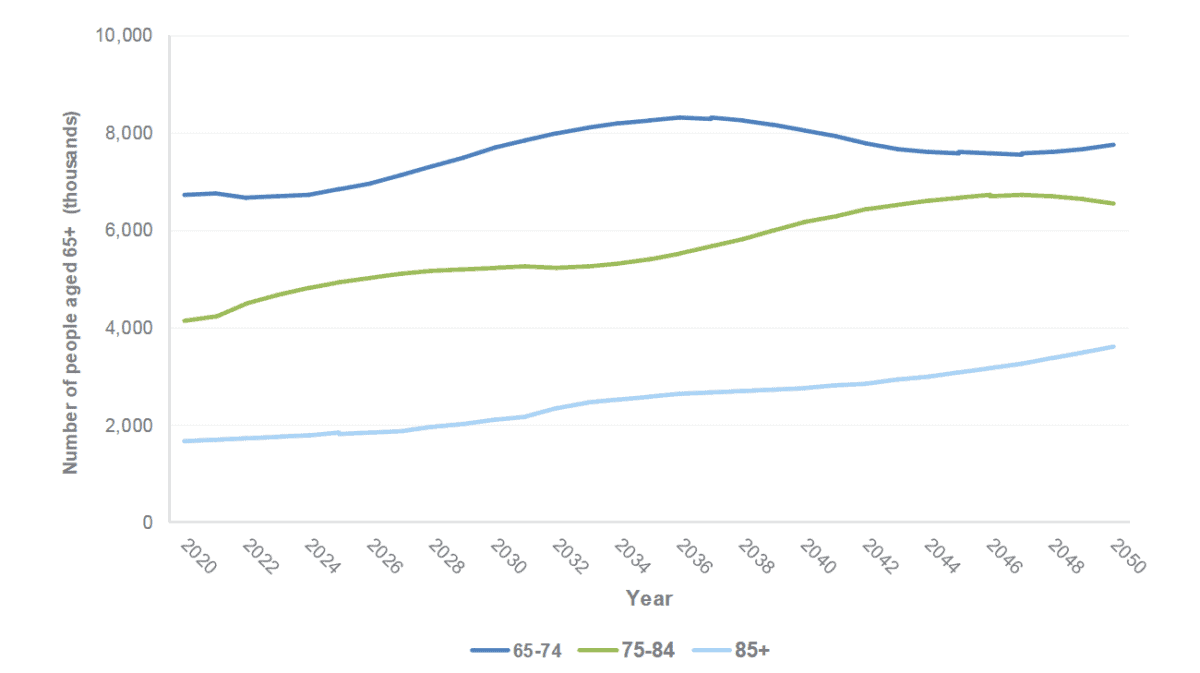
This is a sector with significant long-term growth potential too, driven by the rapid pace at which the UK population’s ageing. The same demographic changes are happening too in Ireland where the FTSE 250 company also operates.

Source: Age UK

Primary Health Properties has raised annual dividends every year since the mid-1990s. I think it’s in good shape to keep this proud record going for a long time to come.

M&G

Financial services provider M&G’s also in one of the box seats to profit from an ageing population. As people live longer, demand for savings, wealth, and retirement products is expected to rise significantly. And especially so as worries over the level of future state benefits, and pensioners’ eligibility for them, grows.

This could underpin long-term earnings growth. What I like particularly about M&G is its broad geographic footprint spanning the UK, Europe and Asia. This gives it abundant growth opportunities along with a chance to offset trouble in one or two countries at group level.

But what makes the company such a brilliant dividend stock? After all, its operations are highly cyclical and profits can fall during downturns, hurting shareholder payouts.

Despite that clear risk, M&G’s a cash machine, giving it the means and the confidence to pay large and growing dividends even during tough times. With a Solvency II capital ratio of 210% as of June, it certainly looks in great shape to remain an impressive dividend payer for a long time to come.

Financial News

Daily News on Investing, Personal Finance, Markets, and more!

Financial News

Policy(Required)