Is it downhill from here for Tesla stock?

It has been an incredible few months for investors in Tesla (NASDAQ: TSLA). Since October, Tesla stock has doubled (yes, doubled). That is even after taking into account a fall of 11% over the past month, or so.

But with the company’s car sales falling last year for the first time, might the share price now follow?

Tough market getting tougher

In its car business, Tesla has build an incredible operation thanks to a few strengths that include its powerful brand, first mover advantage, proprietary technology and large customer base.

I continue to see those as advantages, though I think the benefit of the company being a first mover in key parts of the electric vehicle (EV) industry is of declining importance.

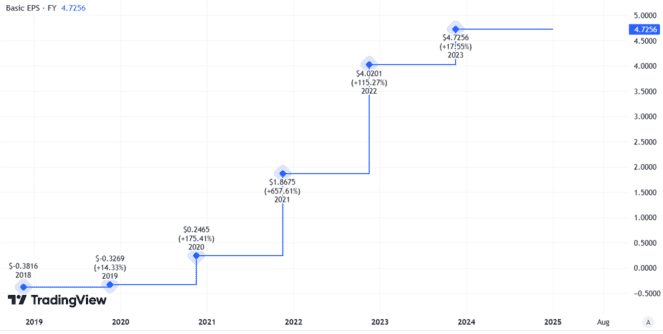
After years of losses, the company has been profitable for the past few years and earnings per share (EPS) have been moving upwards.

Created using TradingView

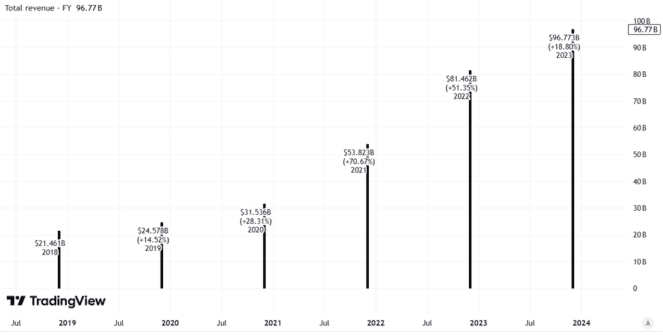
Not only have profits been marching upwards, but so too have revenues, in a big way.
Created using TradingView

The growing revenues and profit, plus Tesla’s long-term advantages, help explain why investors have been so enthusiastic about the stock.

But the carmaker is not alone in its field. A host of competitors have emerged and some are serious rivals. BYD, for example, trounced Tesla’s sales numbers last year, shifting more than twice as many cars – and also selling more TVs in Japan than local giant Toyota.

With large, successful competitors vying for customer spend, there is a risk that pricing in the EV sector will go down, making it harder for Tesla’s car division to maintain its profit margins.

More than one iron in the fire

I say ‘car division’ because Tesla is more than just a motor company. It has been applying its expertise in renewable energy to a wider set of challenges, and has a fast-growing energy storage division.

I think that could be a key growth driver and may mean (time will tell) that Tesla ends up being able to report revenue growth last year even though vehicle sales fell.

Over the long term, I think the Tesla investment case has a lot to like. The EV market getting tougher may squeeze profit margins, but it may also thin out the field, helping strong players like Tesla in years to come. Meanwhile I believe energy storage alone could end up being a massive business for the firm.

No plans to buy at this price!

But while I like the investment case, I do not like the current share price. In fact, I think Tesla stock looks wildly overvalued. That does not mean it could not go even higher. Clearly, the stock has a lot of momentum and some investors are wildly enthusiastic about it.

But I think the valuation – 117 times earnings – is too high (by a long shot) to justify on the fundamentals. Sure, it may look look cheap (!) by Tesla’s historical standards.

Created using TradingView

But that in itself does not make the share cheap. Instead, to me, it looks unjustifiably high, based on a realistic assessment of the current business prospects.

So at anything like the current price, I will not be adding Tesla stock to my portfolio.

At a record high, is it time to buy or sell FTSE 100 stocks?

Last Friday (17 January), the FTSE 100 index closed at a new all-time high, beating the record set last May. At 8,505 points, it’s gained over 400 points in just the past month.

Yet some might be confused, given the bleak economic outlook and the potential for higher inflation. So I weighed up what the best course of action could be.

The case for buying

Late last year, I wrote about how the FTSE 100 was very undervalued by comparison to the S&P 500. In fact, the average price-to-earnings (P/E) ratio for the UK stock market at that point was half that of the US. Therefore, it doesn’t surprise me that much that UK stocks are doing well to start the year. For value investors, I imagine some have booked some profits on US shares and used that money to invest in the UK at better valuations.

Even with the push to record highs last week, the average P/E ratio for the index is 15.5x. Even though this isn’t what I’d call undervalued, it’s still lower than the US and some other developed markets. So from that angle, there could be further scope for FTSE 100 stocks to keep rallying in the months to come.

Targeting specific sectors

Investors should remember that they don’t have to simply buy a FTSE 100 index tracker. Rather, they can be selective in the sectors to target. For example, on Friday a host of the top performers were from the commodity space. So an investor could look to buy a stock from this sector for further potential gains.

Anglo American (LSE:AAL) jumped 3.6% on Friday and is up 46% over the last year. The business is involved in the exploration and processing of a wide range of metals and minerals. This includes diamonds, copper, iron ore and coal. As a result, even though the share price is influenced by commodity prices, it’s diversified enough not to be incredibly volatile due to a swing in the raw material price.

Commodity prices have started 2025 off well, with some forecasting a strong year ahead. If the Chinese manufacturing sector picks up, demand for iron ore and coal will increase. Copper’s continuing to experience higher demand due to the wide range of commercial uses. Anglo American could benefit from these factors, causing the share price to rise.

A risk is that the firm operates in some politically unstable areas, such as South Africa and South America. Changes in regulation or operational activities can be common, threatening to disrupt production.

Broader caution

I do understand that as humans we struggle to justify buying something when the price is high. Not only this, there are valid concerns that the UK economy could underperform this year if interest rates don’t fall that much and inflation picks up again.

Yet that’s why I think investors can find selective pockets of opportunity in the index. Anglo American’s a company well worth considering alongside other commodity sector ideas.

This FTSE 100 stock’s down 45% in 4 months and the CEO just bought £99k worth of shares

In late September, I bought some shares in FTSE 100 stock JD Sports Fashion (LSE: JD.). At the time, I thought they offered value. It’s fair to say the trade didn’t go as planned. Since I bought, the retailer’s share price has fallen by more than 40%!

I continue to believe in the long-term growth story here however. And I’m encouraged by the fact that week CEO Régis Schultz invested £99,000 of his own money in the company.

Lots of bad news

Since I bought the shares, there’s been quite a bit of bad news here. For a start, there was the UK budget and the National Insurance (NI) changes for employers. These changes are going to result in higher costs for retailers like JD Sports Fashion.

Then, the company came out in November and said that profit for this financial year (ending 31 January) would be at the lower end of guidance. It blamed volatile trading for the weak forecast.

More recently, the company advised on 14 January that full-year profit would be even lower. “Market headwinds were higher than we anticipated,” said Schultz.

Finally, rising bond yields are also worth highlighting. These won’t have helped the stock as the company has some debt on its balance sheet.

Short-term challenges

Given all this bad news, the outlook for the stock doesn’t look great in the short term. Right now, the company’s facing many headwinds (I really underestimated the consumer demand problems).

However, taking a longer term (three to five years) view, I continue to believe this stock can do well. That’s because this company has ambitious growth plans.

Long-term growth story

One of the reasons I bought the stock in the first place was that the retailer – which has around 4,500 stores globally – is expanding rapidly. This financial year, it’s expecting to open around 200 new stores globally. As it grows over time, its revenue and earnings should rise. This should push its share price up.

Another reason I bought was that the company’s making big moves in North America (which offers more growth potential than the UK). Recently, it’s made some major acquisitions there. In the US, it’s launching slick new stores that are appealing to consumers.

We come with new space, new merchandising, a much more modern way of looking at it, and that’s what is winning,” Schultz said last year.

Insider buying

Now, the CEO clearly believes in this long-term growth too. Last Wednesday (15 January), he snapped up 109,933 shares in JD Sports Fashion himself at a price of 90p per share. This trade cost him around £99,000, a significant amount of money. This suggests he sees a rebound in the share price at some stage. I don’t think the CEO would have spent nearly £100k of his own money on company stock if he thought the stock was going significantly lower.

I’m holding

Looking at this insider buy, I’m happy to hold on to my shares in JD Sports Fashion for now. I’m not expecting a near-term rebound. But I do think there’s potential for share price gains over the next three to five years. Especially, with the stock now trading at less than seven times the FY2026 earnings forecast.

Tesco’s share price is down 3% from its one-year high despite a strong Christmas. Should I buy on the dip?

Tesco’s (LSE: TSCO) share price is down 3% from its 18 December 12-month traded high of £3.75. That said, the stock is still up 33% from its 13 February low of £2.72 over the same period.

So, is this a rare opportunity to buy Tesco shares on the dip or were they overvalued already?

How does the valuation look now?

My starting point in assessing a stock’s true worth is to look at its key valuations against its peers.

On the price-to-earnings ratio benchmark to begin with, Tesco currently trades at just 12.7 compared to its competitors’ 18.5 average. So, it is very undervalued on this basis.

Meanwhile, on the price-to-book ratio, it is overvalued, trading at 2.1 against a 1.5 peer average. And on the price-to-sales ratio, it is fairly valued at 0.3 – the same as the average of its competitors.

So, I ran a discounted cash flow analysis to get a clearer take on Tesco’s value. This shows the stock is 46% undervalued at its price of £3.63.

So technically, the fair value for the shares is £6.72.

They may go lower or higher than this, given market uncertainties. However, it confirms to me how much value remains in the stock.

Do recent results support this bullish view?

Tesco was a big winner over the Christmas period covering the six weeks to 4 January, according to industry figures.

Like-for-like (LFL) year-on-year sales rose 4.1% in the UK, 4.8% in the Republic of Ireland, and 4.7% in Central Europe. LFL sales measure a retail business’s growth from its existing stores and space, excluding new store openings or closures.

Over the Q3 period running to 23 November, LFL sales in these respective regions increased 3.9%, 4.4%, and 3.5%.

Given these numbers, Tesco reaffirmed its 2024/25 financial year retail adjusted operating profit forecast of “around £2.9bn”. In 2023/24, the figure was £2.76bn. It also maintains its forecast that it will generate £1.4bn-£1.8bn of retail free cash flow over the medium term.

Analysts forecast that its return on equity will be 16.9% by end-2027.

Will I buy the shares?

I am tempted by a 46% undervaluation in a growth stock. However, at my late point in the investment cycle (aged over 50), I am deterred by its short- and medium-term risks.

The main short-term one in my view is the impact of the October Budget’s 1.2% increase in employers’ National Insurance. CEO Ken Murphy said Tesco will face additional costs of about £250m a year from this.

The main medium-term risk is further similar tax increases. These would increase firms’ costs more widely, fuelling inflation and increasing the cost of living. This could see customers significantly cutting back on their supermarket spending.

On the other side of the returns equation, Tesco’s current 3.4% yield is much lower than the 7%+ return I demand from my dividend stocks. So, it is not for me on this basis either.

That said, if I were even 10 years younger, I would buy Tesco for its long-term prospects. I think it will remain a leader in the UK supermarket space, which should drive the share price (and yield) higher over time.

Aiming for passive income in 2025? Consider these 3 simple strategies

Creating a passive income stream is a common way to safeguard against unexpected financial troubles. Many UK residents are constantly on the look out for new ways to bring in extra cash.

Fortunately, it’s now easier than ever to build towards this goal. The average British citizen has greater access to the stock market than ever before. 

With that in mind, here are three ways to harness this power in 2025.

Dividend stocks

One of the most popular methods of earning income from stocks is via dividends. These are regular payments companies deliver to shareholders as a reward for their loyalty. The yield is the percentage paid out per share. 

The amount varies and can be altered at any time depending on how well the business is performing. So it’s important to look for reliable companies with a long dividend track record.

For example, Vodafone recently cut its annual dividend from 9 cents to 4.5 cents per share. Whereas British American Tobacco has been increasing its dividend consistently for over 20 years.

Exchange-traded funds (ETF)

Recently, earning extra income by investing in ETFs has become more popular. These products provide a quick and easy way to get exposure to a wide range of stocks — often, an entire index.

While the funds typically provide stable income, it’s seldom in the double digits. Most ETFs return between 4% and 8% per year but there are some outliers.

For example, the iShares Core S&P 500 ETF has delivered annualised returns of 12.66% over the past 10 years. The fund attempts to beat the overall performance of the S&P 500 by weighting each stock based on market cap.

Investment trusts

Like an ETF, an investment trust provides exposure to a range of stocks. However, it’s usually a much smaller and more focused selection based on a goal like income or growth.

The advantage of an investment trust is that the hard work is taken care of. Rather than try to analyse stocks and balance a portfolio themselves, investors can leave that up to the fund manager.

However, this service incurs an ongoing fee, typically between 0.5% and 1%. This needs to be factored into the expected return. 

A good income-focused fund could return a yield of 5%. While it may be less than some individual stock yields, its often more stable and reliable. 

For example, the City of London Investment Trust (LSE: CTY) maintains an average yield of around 6%. It’s been paying and increasing its dividend consecutively for over 50 years. While past performance doesn’t indicate future results, it provides some peace of mind.

The trust is focused on British income stocks like HSBC, Shell, and RELX. Its ongoing charge is 0.37%.

While the fund is worth considering for dividend income, it isn’t highly diversified. Consequently, if the UK market dips, the trust falls with it. The share price is down 0.9% in the past five years because high inflation has hurt the UK economy. As such, it’s returned no more than the dividend payments. This is an ongoing risk that could hurt the fund’s performance if inflation rises again.

When picking stocks, investors should always consider the company-specific risks. Fortunately, companies typically provide guidance along with their interim results, helping investors to make informed decisions.

Is there any growth potential left in NIO stock?

NIO (NYSE:NIO) stock’s been on a downward spiral since the start of 2021. The electric vehicle (EV) manufacturer was once lauded to be the next big thing but has experienced struggles along the way, causing some investors to throw in the towel on this share. So is there any growth potential left that makes it worthy of consideration?

Why the battery’s low

First, it’s important to understand why the share price has performed poorly despite operating in a growth sector. The 28% fall over the past year can be put down to three main reasons. To begin with, competition in the EV space has ramped up. On top of other specialist EV firms like Tesla, NIO’s been competing with more traditional car makers pivoting to offer customers a hybrid of full EV options.

Another influence has been a poor financial performance. Back in November, the quarterly results showed a net loss of $710m, up from the loss of $639m from the year prior. This was also worse than analysts’ expectations. If a business can’t make a profit for a continued period of time, it doesn’t bode well.

Finally, NIO’s a Chinese company, headquartered out of Shanghai. The broader problems with the Chinese economy has hindered progress, with some investors steering clear of the stock as they saw it as a bellwether for the economy.

Optimistic outlook

But there could be significant growth potential left in NIO shares. For a start, production numbers are increasing. At the start of this month, the company released more information on delivery numbers for last year.

For December, 31,138 vehicles were delivered, a jump of 72.9% versus the same month in 2023. When we consider the year in total, 221,970 vehicles were delivered, an increase of 38.7% from 2023. This shows demand’s increasing, pushing revenue higher.

This could indicate that if the firm can keep a lid on costs going forward, making an annual profit might not be too far away.

Another factor’s the low share price. At $4.36, it’s close to the 52-week lows of $3.61. Below that and I have to look back to 2020 to find it at a similar level! On the other hand, it traded at $67 in 2021. So based on past performance, there’s an argument to be made that there’s certainly growth potential there.

The bottom line

Of course, past performance doesn’t indicate future returns. But when I consider that the company’s growing, I think it’s only a matter of time before financial results improve. It’s true that the EV space is competitive, but based on the potential market size, there’s plenty of money to go around. As a result, I think NIO could be a smart buy for investors to consider at the moment.

Is it time for me to buy more shares around £4 in this FTSE 100 banking giant after the government reduced its stake?

In all the pre-Christmas excitement, some investors may have missed the reduction in the government’s stake in this FTSE 100 bank.

December saw the state’s holding in NatWest (LSE: NWG) fall to 9.99% from 10.99%. This is down from 84% after the bank was rescued along with others during the 2008 financial crisis.

The government is still the bank’s biggest single shareholder. However, Chancellor Rachel Reeves recently reaffirmed its plan to fully exit its investment by 2026.

So, is it now a good time for me to buy more?

How does the core business look?

I see the principal risk for NatWest as being a sustained drop in its net interest income (NII). This is the difference between the income from interest it receives on loans and pays out on deposits.

It tends to drop for banking operations in countries where headline interest rates are trending down. This usually occurs as inflation is on a falling trajectory and looks to stay on the low side.

That said, it is far from clear to me that this will continue for too much longer in the UK. Many UK businesses have warned of the inflationary effects of the October Budget’s 1.2% increase in employers’ National Insurance.

Even without such a rise, I know as a former investment banker that banks can hedge much of their interest rate exposure.

Another risk to NatWest is the high degree of competition in the sector which may reduce its overall profit margins.

How has the bank been doing recently?

That said, last year’s Bank of England interest rate cuts did hit NatWest’s NII. It dropped 1.2% to £8.3bn over the first nine months of the year.

However, interesting for me was that by Q3 the bank had managed to more than compensate for this by simply lending more. Net loans increased by £8.4bn, while deposits increased by £2.2bn.

So ultimately over Q3, its year-on-year NII increased once again — by 8% to £2.9bn. This drove its Q3 operating profit before tax up 25.7%, to £1.67bn, ahead of analysts’ £1.5bn consensus forecast.

As a result, it upgraded its profit guidance for full-year 2024 from £14bn to £14.4bn.

Are the shares undervalued?

The first part of my assessment of stock prices is comparing their key valuations with those of their competitors.

NatWest currently trades at a price-to-earnings (P/E) ratio of just 7.5 against a competitor average of 8.4 So, it looks cheap on this basis. Even Russian Commercial Roads Bank presently trades at a P/E of 8.1 and it is under international sanctions!

The second part of my assessment involves looking at whether a stock is undervalued to where it should be, based on future cash flow forecasts. A discounted cash flow analysis shows NatWest shares to be 57% undervalued at their current £4.14 level.

Therefore technically, their fair value is £9.63, although the vagaries of the market might move them lower or higher.

Will I buy more of the shares?

I believe NatWest will continue to perform strongly in the coming years. This should drive its share price – and dividend – higher.

In fact, analysts forecast its dividend yield will rise to 5.5% in 2025, 6.4% in 2026, and 7% in 2027.

Given this, I will be buying more of the shares very shortly.

3 FTSE 250 shares to consider for a brand new Stocks & Shares ISA!

Building a diversified portfolio of FTSE 250 shares is a great way to consider building long-term wealth. Spreading capital across a variety of mid-cap UK shares spreads out risk. It also allows an individual the chance to capitalise on multiple investment opportunities.

One way investors can diversify is by buying a selection of value, growth and dividend shares. The first two categories can provide significant capital appreciation over time. The final one can provide a stable income over longer periods that can be reinvested to amplify compound gains.

With this in mind, here are three top FTSE 250 shares for new ISA investors to consider today.

Value

A rapid rise in weapons spending bodes well for defence businesses like Babcock International Group. But unlike fellow industry heavyweights such as BAE Systems, this particular share still looks dirt cheap, on paper.

For this financial year ending March, Babcock trades on a price-to-earnings (P/E) ratio of 11 times. This makes it one of the cheapest defence stocks currently listed on the London Stock Exchange.

On top of this, the firm’s price-to-earnings growth (PEG) ratio’s just 0.3 for this fiscal period. This is below the widely accepted value benchmark of 1 and below.

Babcock, which provides engineering and training services to armed forces in the UK and overseas, saw revenues soar 11% year on year In the six months to September.

Supply chain issues remain a threat to this defence stock. But I think this is more than baked into Babcock’s rock-bottom valuation.

Growth

Building materials suppliers aren’t out of the woods just yet. Brickmaker Ibstock (LSE:IBST) remains vulnerable to the Bank of England keeping interest rates in or around current higher-than-normal levels, denting the housing market recovery.

However, I’m optimistic the FTSE 250 company can cast off its troubles of recent years. Home sales data”s strengthening and may continue to if (as expected) rates are cut and competition among mortgage providers heats up.

In this landscape, construction could rise substantially from recent levels. Several major UK housebuilders have already pledged to kickstart building activity from 2025 onwards. This is why City analysts expect Ibstock’s earnings to soar 37% and 34% in 2025 and 2026 respectively.

Given the advanced age of Britain’s housing stock, the firm can also expect robust demand from the repair, maintenance and improvement (RMI) sector.

Dividends

The FTSE 250’s packed with great real estate investment trusts (REIT) to buy. These firms are designed for income investors, as sector rules state at least 90% of rental profits must be distributed in the form of dividends.

Supermarket Income REIT‘s (LSE:SUPR) one of my current favourites. And it isn’t just because its dividend yield of 9.2% for this financial year (to June) is a sector high.

Please note that tax treatment depends on the individual circumstances of each client and may be subject to change in future. The content in this article is provided for information purposes only. It is not intended to be, neither does it constitute, any form of tax advice.

It’s also because the company’s consistently raised dividends in spite of weak economic growth and inflationary pressures in the UK. This reflects the trust’s focus on the ultra-defensive food retail market, allied with its blue-chip tenant list that includes FTSE 100 grocers Tesco and Sainsbury’s.

Supermarket Income’s share price may struggle to grow if interest rates remain around current levels. But the prospect of more large and dependable dividends still makes it worth considering, in my book.

£30k to invest? Here’s one way to target a near-£65k second income in retirement

There are many ways that individuals can target a large second income when they retire.

Here’s my three-point strategy that could turn a £30,000 lump sum investment today into an annual passive income of nearly £55k.

1. Use a SIPP

Firstly, it’s worth considering opening an investment account that reduces or eliminates wealth-reducing tax liabilities. This can save individuals thousands of pounds each year they can invest to make even greater compound returns.

In the UK, both the Individual Savings Account (ISA) and the Self-Invested Personal Pension (SIPP) serve this purpose. Users of these products don’t pay a penny in capital gains tax or dividend tax.

For someone looking to invest a big amount like £30k, they might want to think about parking that in a SIPP.* As well as providing big tax savings, these pension products give users extra money to invest thanks to tax relief.

Let’s say this investor is a basic-rate taxpayer. After depositing £30k, they’d receive a 20% government ‘top-up’ which would be paid into their account within 10 weeks.

So in effect, they’d have £36,000 to start growing their retirement pot.

* The annual SIPP allowance is £60,000 or a sum equivalent to annual earnings, whichever is lower.

Please note that tax treatment depends on the individual circumstances of each client and may be subject to change in future. The content in this article is provided for information purposes only. It is not intended to be, neither does it constitute, any form of tax advice. Readers are responsible for carrying out their own due diligence and for obtaining professional advice before making any investment decisions.

2. Balance risk and reward

Investing in exchange-traded assets is riskier than holding one’s money in cash. However, for many people, the pull of substantially higher rewards makes this extra risk a worthwhile endeavour.

Individuals can still effectively tailor the amount of risk they’re prepared to take on, too, according to how they fill and structure their portfolio.

A SIPP user can hold a certain proportion of their investment in cash if they choose. They can also purchase a diversified selection of shares and other assets to balance their exposure.

Trusts like the Xtrackers MSCI World Momentum ETF (LSE:XDEM) can be an effective way to achieve this. This particular exchange-traded fund (ETF) has holdings in approximately 360 companies across the world and spanning multiple sectors.

Major holdings range from Nvidia and Walmart, through to Berkshire Hathaway and JP Morgan Chase.

With a focus on momentum shares, it has the potential to deliver market-beating capital gains. However, a high weighting of US shares (approximately 76% of the ETF) also means it may carry more risk than a more globally diverse fund.

Encouragingly the fund has an excellent long-term track record, delivering an average annual return of 12% since early 2015. If this continues, a £36k investment today would — after 30 years — become a terrific £1,294,187.

3. Buy high-yield dividend shares

There are multiple ways that investors can then try and turn this into a passive income in retirement.

They could purchase an annuity with it. Alternatively, they could draw down 4% of it a year, which would provide a second income for around three decades.

Another option to consider would be to purchase high-yielding dividend stocks. For example, investing that £1m portfolio in high-yield dividend stocks with an average yield of 5% could generate an annual passive income of approximately £64,709.

And with this method, an investor gives their portfolio further scope to grow over time.

£20k ISA? Here’s how that could generate £574 a month of passive income!

Using a Stocks and Shares ISA to earn passive income in the form of dividends is something hordes of investors do. I am one of them.

With a £20k ISA, I think an investor could target a passive income of £574 per month.

It will take time, though: this is a long-term plan.

Building big income streams

Let me start with some maths, by way of explanation.

Investing £20k at an average yield of, say, 6% could generate £1,200 annually in passive income.

But an alternative approach would be to invest that amount and then reinvest dividends along the way.

That is known as compounding.

At some point of their own choosing, an investor could stop reinvesting the dividends and start taking them as passive income.

Sticking to the example above, compounding £20k at 6% annually for a decade would mean the ISA would be worth around £35,817. At a 6% yield, that could generate £2,149 of dividends, or around £179 per month.

Rolling a snowball downhill

But with longer time horizons, things get even better.   

Investor Warren Buffett compares compounding to a snowball going downhill. The longer the hill, the more snow it can pick up.

So in my example above, after 20 years, the monthly passive income would be around £320 per month. After 30 years, it would be £574 on average every month.

Getting the basics in place

Before doing any of that, though, comes the matter of what Stocks and Shares ISA to use.

There are plenty of choices available and I think it makes sense for an investor to consider what one seems most suitable for them. No two investors are identical.

Hunting for high-quality shares to buy

Although I think a 6% yield is achievable even while sticking to blue-chip FTSE 100 shares, it is substantially higher than the average FTSE 100 yield right now.

An example of one FTSE 100 share with an above-average yield I think passive income-hunting investors should consider is Legal & General (LSE: LGEN).

The insurer has a yield of 8.9%. It has grown its dividend per share annually over the past several years and plans to keep doing so, though in practice what happens to a company’s payout ultimately always depends on its financial performance. Nothing is ever guaranteed to last.

Legal & General did cut its dividend following the 2008 financial crisis and I see a risk that that could happen again if financial markets turbulence leads a lot of policyholders to redeem their policies earlier than expected.

But I also see a lot to like here.

The insurance market is huge and Legal & General’s retirement focus gives it a clear strategic direction. It has a proven business model, powerful brand, large client base, and has been consistently profitable in recent years.

I myself own this passive income powerhouse in my portfolio for just those reasons.

Financial News

Daily News on Investing, Personal Finance, Markets, and more!

Financial News

Policy(Required)