2 FTSE 100 growth shares that could be about to soar!

Looking for the best FTSE 100 growth shares to buy? Here are two I think could rebound this year after a tough 2024, and are worth consideration.

Persimmon

Housebuilder Persimmon (LSE:PSN) started the New Year on the back foot. But it’s picking up momentum thanks to a stream of positive data from the housing market.

I think this could continue if a (likely) fall in interest rates ignites strong pent-up demand in the UK.

Fresh commentary today (20 January) from Rightmove affirmed the underlying strength of the housing market right now. It showed property prices up 1.7% in January, representing the biggest jump in prices at the start of the year since 2020.

For the full year, Rightmove predicts a 4% increase in property prices, and an increase in total sales, to 1.15m.

This follows a perky trading update from Persimmon itself last month. Then, the builder said that “customer enquiries and sales rates have been consistently ahead of the prior year since the spring selling season“. It also said forward sales were up 8% year on year, at £1.1bn.

The housebuilders aren’t completely out of the woods. There’s no guarantee that interest rates will drop, hampering an ongoing recovery in homebuyer affordability. Cost inflation is also a danger to these companies’ profits.

But on balance, I think Persimmon, for one, is in good shape to recovery strongly from this year on. City analysts agree with me, and are tipping earnings growth of 16% in 2025 and 20% in 2026.

I don’t think the FTSE firm’s low valuation reflects this bright outlook. Its price-to-earnings growth (PEG) ratio, at 0.8, sits below the benchmark of one that implies a stock is undervalued. This leaves further scope for a share price rebound, in my view.

Ashtead Group

Like Persimmon, Ashtead (LSE:AHT) is highly sensitive to interest rates and their impact on property markets. In fact, the impact has been worse than anticipated, with the business publishing another profit warning in December.

Back then it slashed its full-year sales growth target, to between 3% and 5%, from 5%-8% previously.

The rental equipment supplier also faces uncertainty as US President Trump flouts the idea of new trade tariffs that could cool the domestic economy. Ashtead makes almost nine-tenths of sales from the US.

Yet, as for the housebuilder, I believe things are generally looking up for Ashtead as central banks respond to falling inflation. It’s why City analysts are tipping earnings growth of 14% for both the financial years to April 2026 and 2027. A 5% drop is predicted for the current fiscal period.

There are also significant growth opportunities for the FTSE 100 company to exploit in the coming years. One of these is a substantial jump in the number of so-called mega infrastructure projects slated for the next few years.

Ashtead puts the total value of these at $974bn between financial 2025 and 2027. That’s up significantly from the $509bn between 2022 and 2024.

Through its ambitious expansion strategy, Ashtead is positioning itself to better take advantage of this upswing, too, as well as the eventual recovery in local construction markets. I expect its share price to rebound strongly over the next couple of years.


Stanley Druckenmiller says ‘animal spirits’ are back in markets because of Trump with CEOs ‘giddy’

Billionaire investor Stanley Druckenmiller believes Donald Trump’s re-election renewed a jolt of speculative enthusiasm in the markets and surging optimism within businesses.

“I’ve been doing this for 49 years, and we’re probably going from the most anti-business administration to the opposite,” Druckenmiller said on CNBC Monday. “We do a lot of talking to CEOs and companies on the ground. And I’d say CEOs are somewhere between relieved and giddy. So we’re a believer in animal spirits.”

While the notable investor, who now runs Duquesne Family Office, is bullish on the economy in the near-term, he remains somewhat cautious on the stock market because of elevated bond yields. He revealed that he is holding onto his short against Treasurys, effectively betting that bond prices will fall and yields will rise.

“In terms of the markets, I would say it’s complicated,” Druckenmiller said. “You’re going to have this push of a strong economy versus bond yields rising in response to that strong economy, and that kind of makes me not have a strong opinion one way or the other.”

The S&P 500 surged nearly 6% in November on Trump’s victory, bringing the benchmark’s 2024 gains to 23.3%. Trump’s promised tax cuts and deregulation have boosted risk assets dramatically, especially bank and energy stocks, as well as bitcoin, which just hit another record high Monday.

Druckenmiller, 71, said he would focus on individual stocks, not worrying about the broader market. The investor noted he’s bullish on companies where artificial intelligence is going to lower their costs and drive productivity. He didn’t reveal which AI stocks he’s betting on after selling out of Nvidia and Microsoft.

‘Risks are overblown’

As for concerns that Trump’s punitive tariffs would spoil the market rally and spike inflation, Druckenmiller believes that the revenue generated by duties could lessen the pressing fiscal problem in the country.

“We have a fiscal problem, we need revenues,” Druckenmiller said. “To me, tariffs are simply a consumption tax that foreigners pay for some of it. Now the risk is retaliation, but as long as we stay in the 10% range, …I think the risks are overblown relative to the rewards, the rewards on high.”

Stanley Druckenmiller: Tariffs are simply a consumption tax that foreigners pay for some of it

Trump’s trade memorandum to be issued Monday would not impose tariffs yet. His camp has been reportedly discussing a schedule of graduated tariffs increasing by about 2% to 5% a month on trading partners.

Druckenmiller once managed George Soros’ Quantum Fund and shot to fame after helping make a $10 billion bet against the British pound in 1992. He later oversaw $12 billion as president of Duquesne Capital Management before closing his firm in 2010. 

As Trump enters the White House, this UK share looks at least 19% undervalued to me!

If President Trump carries through his threat to impose tariffs on all imports into the US, many UK shares will suffer. His promise to “put America first” resonated with the majority of voters. But it could spell trouble for a number of companies on this side of the Atlantic.

However, there’s one stock that I think will do particularly well from Trump 2.0, regardless of whether he introduces import taxes targeted at the UK. That’s because of his wish to make NATO members increase the proportion of their national incomes spent on defence.

Presently, the 32 members have pledged to spend at least 2% of gross domestic product on military hardware and personnel. However, Trump wants them to go further.

On 7 January, he told a press conference: “I think NATO should have 5% … They can all afford it, but they should be at 5%, not 2%.

Given that the US ‘only’ spends 3.4%, this might sound a bit unfair. However, the point that Trump’s clearly making is that he expects others to spend more so that America can spend less.

This means defence stocks with major US contracts could see a fall in their revenues.

One possible beneficiary

However, a company like Babcock International Group (LSE:BAB) could prosper.

During the year ended 31 March 2024 (FY24), the group earned 70% of its revenue from the UK. It also generated a further 6% from France and Canada, both NATO members.

The group’s exposure to the US is very small and comes primarily from the supply of components to its submarine fleet.

Encouragingly for the group, the UK government has started a Strategic Defence Review and has promised to “set out the path to spending 2.5% of GDP on defence”.

Although this is a long way short of Trump’s 5%, it’s likely to benefit Babcock as governments generally like to keep defence spending local. The group is currently the second largest supplier to the Ministry of Defence.

And now could be a good time for me to invest.

Based on its FY24 earnings, Babcock currently trades on 16.3 times its historical profit. However, this is lower than, for example, BAE Systems (19.5).

If it could attract the same multiple as its larger rival, its market cap would be 19% higher. And with Trump back — and the UK government committed to spending more on defence — I see no reason why this couldn’t happen.

My plan

But I have concerns. The group recently reported £90m of “cost overruns” on the building of five ships for the Royal Navy.

And its dividend is miserly.

Also, I know that investing in the sector isn’t everyone’s cup of tea. But it’s over 4,000 years since the first army was established which, unfortunately, tells me that global conflicts are here to stay. And I believe the first act of government is to protect its people.

That’s why I’ve put Babcock on my watchlist for when I next have some spare cash.

With its impressive 26% return on capital employed (FY24), £9.5bn contract backlog (30 September 2024), and relatively low level of gearing, I think Babcock’s well placed to benefit from Trump’s second term and the UK government’s commitment to spend more on defence.

Is the stock market broken?

David Einhorn — a top US fund manager — thinks the stock market is broken. And that means investors thinking about buying shares need to be extra careful.

It’s not that they need to stay away from stocks. But there’s more to consider than just finding shares that are trading below their intrinsic value.

What’s going on?

Traditionally value investing is about buying stocks for less than they’re worth. Over the long term, investors make money when the share price comes to reflect the intrinsic value of the company.

The trouble is, this relies on enough other investors looking for undervalued opportunities, which just doesn’t seem to be the case right now. And without it, undervalued stocks stay cheap indefinitely.

For instance, right now, I think DCC (LSE:DCC) shares look much better value than AstraZeneca. But Einhorn points out that it’s hard for share price movements to reflect this any time soon.

This is because the vast majority of cash entering the market right now is in funds that track things like the FTSE 100. As a result, the stocks getting bought are the ones that make up these indexes.

If someone invests £10,000 in a fund tracking the FTSE 100, £770 goes on AstraZeneca stock, but only £25 on DCC shares. If this is what mostly happens in the stock market, the gap can only widen.

I think Einhorn is dead right – and it gives value investors (like me) a problem. If buying undervalued stocks and waiting for the market to realise doesn’t work, how are we supposed to make money?

What to do

If value investors can’t rely on the stock market for returns, Einhorn thinks there are two places left to look. One is the world of private equity and the other is a company itself.

Private equity has been a powerful force for UK stocks, with the likes of Hargreaves Lansdown and Britvic being acquired. But buying a stock in the hope that the business will be taken over is extremely risky. 

That’s why I like DCC and think it’s worth considering. I think the company’s component parts are worth more than the current market cap – but the key thing is that management is actively looking to do something about this. 

The firm’s healthcare and technology subsidiaries contribute around 25% of overall operating income. But analysts think these are worth £1.3bn and £800m, respectively – around £2.1bn in total. 

If they’re right, those two divisions are worth around half of DCC’s market cap despite only generating 25% of the operating income. In that situation, management might well be wise to try and sell them.

That would leave DCC shareholders with a more concentrated business, which can be riskier. The question is whether getting almost half the share price back as a cash dividend makes this worth it. 

How to make money in the stock market

David Einhorn is a very sophisticated investor, who was once rumoured to be under consideration as a long-term successor to Warren Buffett at Berkshire Hathaway. What he says is worth listening to.

The stock market’s mechanism for getting shares to trade at the value of the underlying business might be broken. But stocks like DCC show there are still opportunities that are worth considering.

Up 23% today! Has the death of this FTSE stock been greatly exaggerated?

By lunchtime today (20 January), Reach (LSE:RCH) was the third-best-performing stock on the FTSE.

Its rise of 23% followed the release of a positive (but brief) trading update, which said that the news publisher now expects to “deliver results ahead of current market expectations for the full year”.

A better headline

This is welcome news for longstanding shareholders who’ve seen the company’s share price decline by 27% since January 2020.

Worse, the stock market valuation of the publisher of the Daily Mirror, Daily Express and Daily Star has fallen 77%, since its September 2021 peak.

So perhaps today’s announcement is evidence that reports of the death of the newspaper industry are something of an exaggeration.

But Piers Morgan, who used to edit the Daily Mirror, doesn’t think so.

He recently bought his ‘Uncensored’ YouTube channel from Rupert Murdoch and says the future of news is going to be online. Morgan believes print and traditional broadcast media are in terminal decline. He recently told the Financial Times: “Linear network stuff is just dead now. It’ll take a while to die, but it’s dead … in 10 years’ time none of them will exist.”

An apparently attractive valuation

However, on paper, the shares of Reach do look cheap.

Prior to today’s market update, analysts were expecting 2024 earnings per share of 22.3p, meaning the stock was trading on a forward multiple of 3.2. Following today’s update, its price-to-earnings (P/E) ratio has crept above four. But this is still remarkably cheap by historical standards.

The stock also appears to offer good value using an assets-based approach. Its market cap is 55% lower than its book value. Having said that, over two-thirds of its assets are accounted for by an internal valuation of its 120 newspaper titles. Without approaching potential buyers, it’s difficult to know whether this is accurate or not.

Even so, income investors might be tempted to consider taking a position.

Since June 2022, Reach has kept its interim and final dividends unchanged. If this continues, it’ll pay 7.34p a share in respect of its 2024 financial year. This implies an attractive forward yield of 8.1%.

Not for me

However, despite these positives, I don’t want to invest.

The group’s improved financial performance only came in the last quarter of 2024. As the saying goes, one swallow doesn’t make a summer.

I also agree with Piers Morgan about the long-term decline of newspapers, which can be seen in Reach’s results. During the six months ended 30 June 2024, print revenues fell by 6.1%, compared to the same period in 2023.

However, digital sales were also lower (1.3%). And the latter only contributed 22% to total revenue — the group’s still heavily reliant on traditional news consumption.

In my opinion, despite the group doing well during its last quarter, I think it faces some challenges that it’ll struggle to overcome. I don’t think younger people place as high a value on traditional news as the newspaper-reading generations before them, which means putting journalism behind a paywall isn’t going to be as profitable.

And this probably explains why the shares appear cheap. Instead of seeing this as a buying opportunity, I believe this is a warning sign that other investors don’t see a ‘good news’ growth story. Therefore, I don’t want to buy.

SpaceX is booming! Here are other space stocks to consider buying for an ISA

Space Exploration Technologies Corp, or SpaceX, is one of the most exciting growth companies in the world. Unfortunately, everyday investors can’t buy shares in it inside our Stocks and Shares ISA portfolios.

That’s because founder Elon Musk is keeping the business private due to its underlying mission to colonise Mars and make humans a multi-planetary species. This isn’t going to happen in the next few quarters, making the mission-driven firm unsuitable to the shorter-term investing horizons on Wall Street.

An artist’s impression of SpaceX’s Starship rockets on Mars. Source: SpaceX

Last year, SpaceX’s Falcon rockets made up more than half of the world’s 259 orbital launches. And recently, it tested its giant reusable rocket, Starship, for the seventh time. The second stage blew up, which highlights how challenging rocket science can be.

Still, its high-speed Starlink internet business now has nearly 7,000 satellites in its fast-growing constellation. The firm is aiming for 42,000, while boasting nearly 5m subscribers back on Earth. One of these is a friend of mine who recently installed a Starlink dish on his family’s camper van. It’s impressive stuff.

SpaceX’s valuation has ballooned to $350bn, making it the world’s most valuable private company. Investors can gain indirect exposure through Scottish Mortgage Investment Trust and Baillie Gifford US Growth Trust. Both now have SpaceX as their top holding.

Options to consider

According to McKinsey, the global space economy will be worth a massive $1.8trn by 2035, up from $630bn in 2023. How can investors grab a slice of this growing cosmic pie? There are a few options to consider.

One is Planet Labs, which is an Earth-imaging firm. There’s also Seraphim Space Investment Trust, a UK venture capital trust that invests in innovative start-ups that are leveraging space technology. Naturally, some of these young enterprises could fail.

Across the pond, there is space tourism firm Virgin Galactic, which was founded by Sir Richard Branson. This one is dicey as it’s currently building its next generation of spacecraft and generating no revenue. Looking ahead, it will have a hell of a job on its hands competing with SpaceX and Jeff Bezos’s Blue Origin.

Another stock is Rocket Lab. In contrast to SpaceX, this firm specialises in small satellite launches. Rocket Lab is still loss-making, which adds risk, but it is growing rapidly. In 2024, revenue is forecast to have grown 77% year on year to $434m.

More risk-averse investors might consider established defence companies that have growing space businesses. Examples include BAE Systems, Lockheed Martin, and L3Harris Technologies.

An intriguing candidate

One fascinating space stock to consider that has appeared on my radar is Intuitive Machines (NASDAQ: LUNR). This is a company with a $2.8bn market cap that makes lunar exploration and landing vehicles for NASA.

The stock is up 560% in one year!

The event that put rocket boosters under the share price happened in February when Intuitive Machines became the first private company to successfully land a spacecraft on the Moon. This achievement convinced NASA to award it a mega-contract worth up to $4.8bn to build a communications system between Earth and the Moon.

It’s worth pointing out that this is currently another loss-making business, so arguably carries higher-than-average risk. But it’s growing fast, with revenue tipped to hit $497m in 2026, up 525% from 2023.

Here’s how I’m trying to build up my ISA to earn £5,000 in passive income each month

For me, the very best way to earn a second income is by putting money in an ISA and following a well-trodden investment strategy in order build wealth. Of course, the more money an investor has, the easier it is to generate a large passive income.

Sadly, most Britons still elect to build wealth through savings accounts, which with annualised returns typically below 3%, that money isn’t growing very quickly.

Stock markets typically perform better than savings

Investing in stock markets typically yields significantly higher returns compared to traditional savings accounts. Many individuals, particularly beginners, opt for index-tracking funds, which aim to replicate the performance of major market indexes. Historical data underscores the long-term growth potential of such investments.

For instance, the FTSE 100 has delivered an average annual return of 6.3% over the past 20 years, with the FTSE 250 outperforming its large-cap counterpart. In the US, the S&P 500‘s averaged an impressive 10.5% annually since its inception in 1957, climbing to an even higher average of 13.3% in the decade leading up to 2024. Similarly, the Nasdaq posted an exceptional 19.8% average return over the past decade.

These figures starkly contrast with the comparatively modest interest rates offered by savings accounts, emphasising the advantage of stock market investments for building wealth over the long term.

Doing the maths

Personally, I prefer to pick individual stocks, trusts and specific funds, over index-tracking funds. That’s because I believe I can beat the market — after all, researching stocks is essentially what I do.

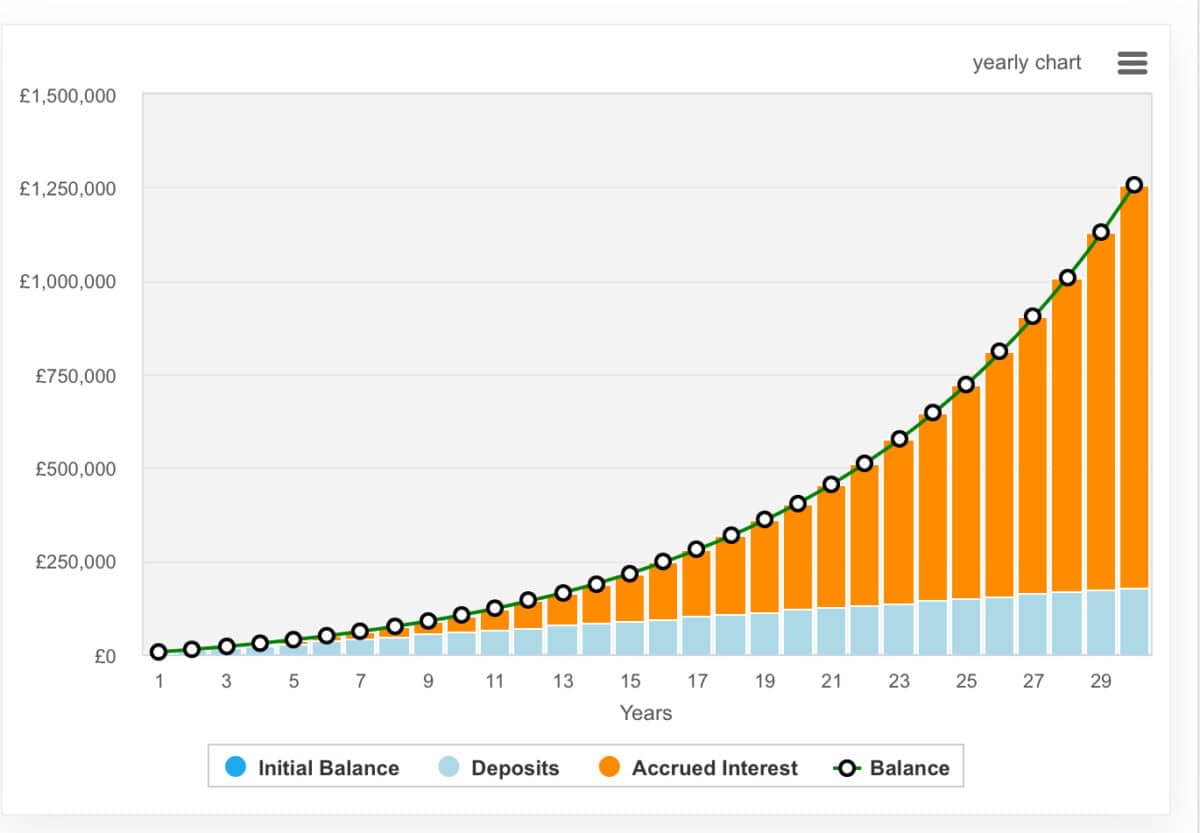
However, if an investor had chosen a tracker of any of the above major indexes over the last decade, they would have vastly surpassed the returns they could have achieved in a savings account. Let’s assume an investor puts £500 a month into an index tracker. Here’s how that money could perform in an S&P 500 tracker, based on the previously noted historical growth rates (but note, past performance is no guarantee of future success).

Thecalculatorsite.com

Why did I use the S&P 500 data? Well, because it quite conveniently works out to just over £1.2m over 30 years. Putting that money in stocks with an average dividend yield of 5% would generate £5,000 of monthly passive income — and tax-free. This is what I’m aiming to do, but by cherry-picking stocks, I’m hoping to grow my money faster.

Please note that tax treatment depends on the individual circumstances of each client and may be subject to change in future. The content in this article is provided for information purposes only. It is not intended to be, neither does it constitute, any form of tax advice. Readers are responsible for carrying out their own due diligence and for obtaining professional advice before making any investment decisions.

One to consider for the growth phase

While index trackers are a great way to start investing, investors may want to consider an exciting growth-oriented trust like Edinburgh Worldwide Investment Trust (LSE:EWI). It’s a Baillie Gifford-run fund — like the well-known Scottish Mortgage Investment Trust — and it’s a really interesting, albeit risky proposition. The fund aims to invest initially in entrepreneurial companies when they’re still nascent.

The trust’s largest investment is SpaceX, which represents a significant 12.3% of the portfolio. This is followed by PsiQuantum at 7.5% and Alnylam Pharmaceuticals. These are fairly high-risk investments, but given supportive trends in artificial intelligence (AI), space exploration, and even quantum computing, this could be the right time to take a diversified approach to emerging technologies.

However, some of its holdings aren’t publicly listed, and only listed companies are required to disclose earnings reports, which means crucial data on these private entities is scarce, heightening uncertainty for investors.

2 things that could sink the Lloyds share price in 2025

Lloyds (LSE: LLOY), I think it is fair to say, had a good run in 2024. The share price is now 35% higher than it was just one year ago, with a 5% dividend yield to boot.

Yet the Black Horse bank trades on a price-to-earnings (P/E) ratio of 8. That may make it look cheap, but I see a number of risks I fear could bring the Lloyds share price crashing down this year – and put me off investing in it.

Weak uncertain economic outlook could be bad news for banks

First is the obvious one. The economy. For now, it may not exactly be humming, but it is at least moving along without spluttering too much.

I reckon that could change, though. There is a high level of geopolitical uncertainty that I fear could hurt both corporate investment and consumer spending, both factors that could lead to a weaker economy. That matters – lots – for Lloyds as it is the nation’s leading mortgage lender.

While I see that as a strength if the economy does well, the reverse is true too. If mortgage defaults go up, profits could fall dramatically We’ve been there before – and we could get there again.

The first nine months of last year saw post-tax profits decline 12% year-on-year.

Car finance scandal could hurt profits

Somewhere else we’ve been before is British banks having to pay out billions of pounds in compensation for mis-selling payment protection insurance (PPI).

Seemingly, they did not learn the lesson fully and another consumer mis-selling scandal has arisen, this time in the car finance field. The impact of this could be huge for the likes of car dealerships struggling to arrange finance under an environment of tighter scrutiny.

But the banks will not get off scot-free. Last year, Lloyds set aside hundreds of millions of pounds for fines and compensation payments. It also scrapped commissions in its large car finance arm, which could have long-term implications for the profitability of that business.

As with PPI though, we do not yet know how much fines and compensation may finally add up to once the dust settles on all historical claims.

Here’s why I’m not investing

Still, even after setting aside that money last year, Lloyds managed to make huge (albeit reduced) profits in the first nine months, as I mentioned above.

It has deep strengths including well-known brands, a vast customer base and a proven business model. The 35% rise in the past year could indicate that many investors have scented a potential bargain.

But is the Lloyds share price as cheap as it looks? That low P/E ratio could change at a stroke if earnings fell badly – a scenario I think could happen if either of the above risks comes to pass.

In the current economic environment, I am not investing in any bank shares – and that includes Lloyds, for sure.

Is it time to boot underperforming Fundsmith Equity out of my Stocks and Shares ISA?

I’ve held Fundsmith Equity in my Stocks and Shares ISA for many years now. And it’s generated strong returns for me over the long term. Recently however, its performance has been disappointing on a relative basis. For example, in 2024, the fund returned 8.9% versus 20.8% for the MSCI World index.

Is it time to boot the fund out of my ISA and reinvest my capital elsewhere? Let’s discuss.

Quality investing works

I continue to like the investment strategy here. Fundsmith portfolio manager Terry Smith is a quality investor (he likes to buy ‘good companies’ and hold them for the long term) and quality investing tends to work well over the long run.

However, I do think Smith has made some mistakes in recent years.

Not enough tech

One’s been his weighting to technology. The world’s going through a major tech revolution and Fundsmith hasn’t had enough exposure (especially to mega-cap tech).

He was very slow to buy Apple, meaning that he missed out on some big gains. And when he did buy shares in the iPhone maker, he only took a small position (which he recently sold).

It was a similar story with Alphabet (Google). This now has a top 10 position in the fund but he was slow to buy this stock and missed out on some large gains.

As for Amazon, he really made a mess of this stock. Here, he bought high and then sold low which led to him missing out on the recent rise to new all-time highs.

I think he could have had larger positions in all three of these stocks as they all have a lot of quality.

Where’s Nvidia?

Turning to Nvidia (NASDAQ: NVDA), Fundsmith’s never held this stock. But that doesn’t surprise me, to be honest.

Personally, I’m bullish on the stock. Right now, all the major tech companies are scrambling to buy Nvidia’s artificial intelligence (AI) chips. As a result, the company’s generating spectacular growth. For the year ending 31 January 2026, analysts expect revenue and earnings per share growth of 53% and 50% respectively.

But history shows that the semiconductor industry can be highly cyclical. It also shows that Nvidia’s share price can be very volatile at times. This is a stock that can fall 10% or more in the blink of an eye. It’s already had one 10%+ pullback this year and we’re still in January!

That’s not the kind of stock Smith goes for. He prefers companies/stocks that are more stable and I’m fine with that.

There are plenty of other tech stocks he could look at though to position Fundsmith for the tech revolution. An example, there’s Synopsys, which makes software for chip designers and has plenty of quality.

Hopefully, we will see more high quality tech stocks in the portfolio in the future.

My move now

As for my move now, I’m going to continue to hold Fundsmith in my ISA. I’m looking at it as a portfolio diversifier – if mainstream indexes take a hit, I’m hoping the fund will outperform.

It’s only a relatively small position in my portfolio though. I have plenty of other funds (both active and passive) and lots of high-quality individual stocks for growth and diversification.

Greggs shares have slumped 21% in 2025. Time to consider buying?

It has not been a good year so far for Greggs (LSE: GRG). Greggs shares have crashed  21% this year. Yes, this year. Less than three weeks into 2025, the baker has had over a fifth wiped off its share price.

But as a long-term investor, I have had my eyes on the sausage roll supplier. So could this share price tumble represent a buying opportunity for my portfolio?

Concerns about future customer demand

What explains that fall? This month, the FTSE 250 business updated the market on its performance last year. Total sales grew 11% year-on-year. The fourth quarter saw sales growth slow, but it still came in at a pretty impressive 8%.

The company opened a record number of new shops, it expects strong ongoing opening momentum and the year should come in line with the board’s expectations.

All of that raised the question, why the price crash? After all, that news sounds upbeat.

One clue was a decline in net cash from £195m to £125m. Still, fitting out new shops – as well as planning a new distribution centre – eats up cash. But as a long-term investor I see that as potentially positive for the business.

But the bigger concern, in my opinion, was Greggs’ take on what might happen next. It pointed to lower consumer confidence as a key risk to expenditure. That, it seems, has given the market fright.

Lots to like about the long-term outlook

I think that is a valid concern. The company said it had carefully managed costs in the fourth quarter, so while it ought to be able to meet expectations for 2024 performance, I see a risk that higher costs could be more problematic for profits at the full-year level in 2025.

But Greggs has been here before, many times. It has honed its business model through recessions, weak consumer spending, shop shutdowns and more. I have confidence that management will continue to move it forward positively.

Greggs has a unique brand and has done a good job developing strong products in what many thought was basically a commodified space. Its large shop estate gives it economies of scale and it has also been harnessing digital technology to help drive sales (although in my case I find its screen-based pricing displays a step backwards from when I could just look at a product and see a price tag beside it).

Not yet a bargain, but may be heading there

Still, Greggs trades on a price-to-earnings ratio of 17. So even with those strengths, I would not describe it as a bargain especially taking into account the potential for a profit squeeze this year, due to weaker consumer spending and also higher costs via higher employment costs.

But Greggs shares are 7% cheaper than they were five years ago. The business is now bigger and, in my opinion, more battle-tested than it was then.

At this price, I am still not ready to buy. But I am keeping a close eye to see whether further share price falls could make this seem like an attractive long-term buying opportunity.

Financial News

Daily News on Investing, Personal Finance, Markets, and more!

Financial News

Policy(Required)