Anywhere under £45.27, GSK’s share price looks cheap to me

GSK’s (LSE: GSK) share price has traded in an unusually wide range for it over the past year. It recorded a 12-month high of £18.19 on 15 May. And since then hit a one-year low of £13.05 on 18 November. Currently, it is much nearer that low than the high, at just £13.58.

This scale of the loss – 25% at present – flags the possibility to me of a bargain buying opportunity. New shares at such a low price could add value to my existing holding in GSK.

But I need to check that there is value in the stock. Such a fall could also indicate that the company is simply worth less than it was before or that the market is catching up to the true value of the shares.

Are the shares undervalued right now or not?

The first part of my pricing assessment compares GSK’s key valuations with those of its competitors.

On the price-to-earnings ratio, it trades at just 21.6 – bottom of its peer group, which averages 29.1. This comprises Merck KGaA at 22.8, both Zoetis and AstraZeneca at 31, and CSL at 31.4. So, GSK looks very undervalued on that basis.

The same is true on the key price-to-book and price-to-sales ratios. On the former, GSK currently trades at 3.9 against a competitor average of 6.6. And on the latter, it is presently at 1.7 compared to a 5.2 average for its peers.

The second part of my pricing assessment examines where GSK shares should be, based on future cash flow forecasts. This discounted cash flow analysis  shows the stock is 70% undervalued at its current £13.58 price.

Therefore, the fair value of the stock is technically £45.27. Market unpredictability may move it lower or higher than this. But it underlines to me that the stock is absolutely packed with value right now.

How does the core business look?

A steady trickle of bad news has weighed on GSK’s share price over the past 12 months.

Ongoing litigation over its Zantac drug’s link to cancer is one. And this remains a primary risk for the firm, in my view.

The 23 December US Food and Drug Administration’s de-authorisation of for four Covid antibody-based drugs for emergency use is another. This includes GSK’s Sotrovimab.

That said, there have been several positive developments as well. The major one in my view is the $1.15bn acquisition of US biotech firm IDRx announced on 13 January.

It is part of the firm’s strategic shift towards gastrointestinal cancers to compensate for a declining vaccines business.

Factoring in all positive and negative factors to date, analysts forecast GSK’s earnings will increase 20.7% each year to end-2027. And it is this growth that ultimately drives a firm’s share price (and dividend) higher.

Will I buy more shares?

Currently, the yield on GSK shares is 4.3%. But analysts’ forecast it will rise in 2025 to 4.8% and in 2026 to 5.2%. These return rates compare favourably to the FTSE 100 average of 3.6%.

And the stellar earnings growth projections should also drive the share price much higher, in my view.

As such, I will be buying more GSK stock very soon.

Worried about UK stagflation? Consider buying dividend shares

Earning passive income from dividend shares is nearly never a bad idea. But with the UK at risk of stagflation, now might be an especially good idea for investors to take a look at what’s on offer.

A combination of low economic growth, high inflation, and high unemployment might not be great for share prices. But I think dividend stocks might prove more resilient than most. 

Beating stagflation?

Like the witches in Macbeth, or the ghosts of A Christmas Carol, bad things often come in threes. So it is with stagflation, with the aforementioned mix of sluggish growth, inflation, and elevated unemployment.

The latest fear for the UK is that this might be an unwelcome consequence of the Budget. A big part of this was increases to the National Living Wage and National Insurance contributions for employers.

The worry is this might deter investors (leading to low growth). At the same time, businesses could respond by raising prices (leading to inflation) and cutting jobs (leading to unemployment).

That’s not great, but investors can’t do much about this. What they can do however, is figure out which stocks to consider buying to protect themselves in such an environment. 

Dividends

Shares in companies that can distribute cash to investors in the form of dividends can be attractive in a stagflationary environment. Especially if they can do so consistently. 

I think real estate investment trusts (REITs) are a good example. These are firms that own properties and generate rental income by leasing them to tenants and distributing the cash to investors.

In general, REITs don’t participate much in a growing economy. That’s because tenants don’t suddenly decide to start paying more on their rent just because profits are rising. 

The other side of that coin though, is that they don’t pay less when growth falters. And that can make REITs more resilient than other stocks when things are tougher. 

Please note that tax treatment depends on the individual circumstances of each client and may be subject to change in future. The content in this article is provided for information purposes only. It is not intended to be, neither does it constitute, any form of tax advice.

Supermarket Income REIT

One example is Supermarket Income REIT (LSE:SUPR). Right now, the stock has a dividend yield of almost 9%, so there’s a real return on offer for investors even if inflation does start to move higher.

On top of this, the firm’s leases include future increases linked to inflation, the vast majority of which are based on the Retail Price Index (RPI). So rising prices should result in higher rents – and dividends.

Around 75% of the company’s rent comes from Tesco and J Sainsbury. That’s a risk, since it means the business might not have the strongest hand when it comes to negotiating new leases.

It’s worth noting though, that less than 1% of the current leases expire in the next five years. So Supermarket Income REIT should have a decent way to run before it has to get into this issue. 

Long-term investing

I’m not going to buy Supermarket Income REIT – or any stock – just because of what the economy might do in the next few months or years. But I do think it’s an important consideration. 

One of the benefits of a diversified portfolio is it limits the effect of specific risks. Stagflation is one of these, so I think long-term investors can legitimately look for stocks that offer protection from this.

2 growth stocks that could surge under the Donald Trump presidency

Growth stocks can take our portfolios to the next level, just like Donald Trump wants to send the US economy into overdrive. But which companies might benefit from the returning President? Well, proposed tax cuts should benefit most US enterprises in some ways, while tariffs will help some firms up to a point. However, here are two companies with very specific reasons to benefit.

SpaceX’s competition

SpaceX may have made a lot of headline in recent months given Elon Musk’s alliance with Trump, with the company likely to gain from the new US government’s space ambitions. However, Rocket Lab (NASDAQ:RKLB) is a listed and much cheaper alternative to SpaceX and should also benefit from increased activity in the space realm.

Rocket Lab might not be Mars-ready, but it has some distinct advantages over SpaceX. This includes cost-effectiveness for dedicated launches in payload class up to 13 tons with its upcoming Neutron ‘launch vehicle’. Its dedicated launch capabilities and reputation for precise orbital insertions also suggest it doesn’t deserve the massive discount to SpaceX (that unlisted company recently bought shares back from employees suggesting a value of $350bn compared to Rocket Lab’s $13.7bn).

As trading opened on Tuesday (21 January), Rocket Lab stock surged 30%. This followed Trump’s most recent remarks about prioritising space exploration at his inauguration. This is actually rather gutting for me as I touted the stock on Friday, noting its $1.8trn addressable market by 2035, but wasn’t able to purchase the stock before the market opened on Tuesday.

Are there any risks? Well, some are related to SpaceX. While there’s probably room for multiple players in this sector, there’s the risk that SpaceX, given its likely strong balance sheet, fast-paced innovation, and links to Trump, could hoover up a large proportion of government contracts. I’m not convinced by this argument, but time will tell.

Obviously, I wish I’d bought this stock last week. But I could also say that for other companies in my watchlist, including Opfi and Innovative Solutions and Support. At this higher price, I’ll have to re-evaluate my interest in Rocket Lab.

AI offers efficiencies

I’m not particularly bullish on Palantir Technologies (NASDAQ:PLTR) but I know a lot of people think this software company will go far. That’s because this firm, which embeds AI into its platforms to assist with data integration, decision-making, and operations at scale, was founded by Peter Thiel — a Trump backer and co-founder of PayPal (with which Elon Musk was also involved).

However, it would be wrong of me to suggest Thiel’s closeness to Trump is the only reason this business could succeed. The company has a long track record of working with US defence and intelligence agencies and its Starlab consortium for a commercial space station aligns with Trump’s ambition in space. Moreover, its platforms also deliver the all-important efficiency that could help reduce government bloat.

The risks of investing in Palantir lie in the valuation. It’s extraordinarily expensive At 173 times forward earnings — very similar to Musk’s Tesla valuation. While the expected growth rate is very strong, the price-to-earnings-to-growth (PEG) ratio stands around seven times. As such, I don’t expect to add this stock to my portfolio.

Here’s why I think Scottish Mortgage Investment Trust shares could keep beating the FTSE 100!

Taking a diversified approach to investing doesn’t have to mean disappointing returns. The performance of Scottish Mortgage Investment Trust (LSE:SMT) shares over the past decade provides a perfect illustration of this.

Since around the start of the Millennium, this investment trust has been focused on high-growth technology (and tech affiliated) stocks. And since 2015, the FTSE 100 share has delivered an average annual return of 15.2%.

By comparison, the broader Footsie has delivered a yearly average of 6.2%.

Past performance isn’t a guarantee of future returns, however. And there are challenges facing the tech sector that could impact the trust’s future earnings.

So what are Scottish Mortgage’s profits and share price prospects for the next couple of years? And should I buy it for my own portfolio today?

Growth opportunities

Obtaining earnings forecasts for investment trusts is challenging. This is because their earnings depend on the performance of the underlying investments, which can be extremely volatile and difficult to predict.

In total, Scottish Mortgage has holdings in 95 different tech shares and trusts. Some of its biggest holdings are microchip manufacturer Nvidia, e-retailers Amazon and MercadoLibre and social media giant Meta.

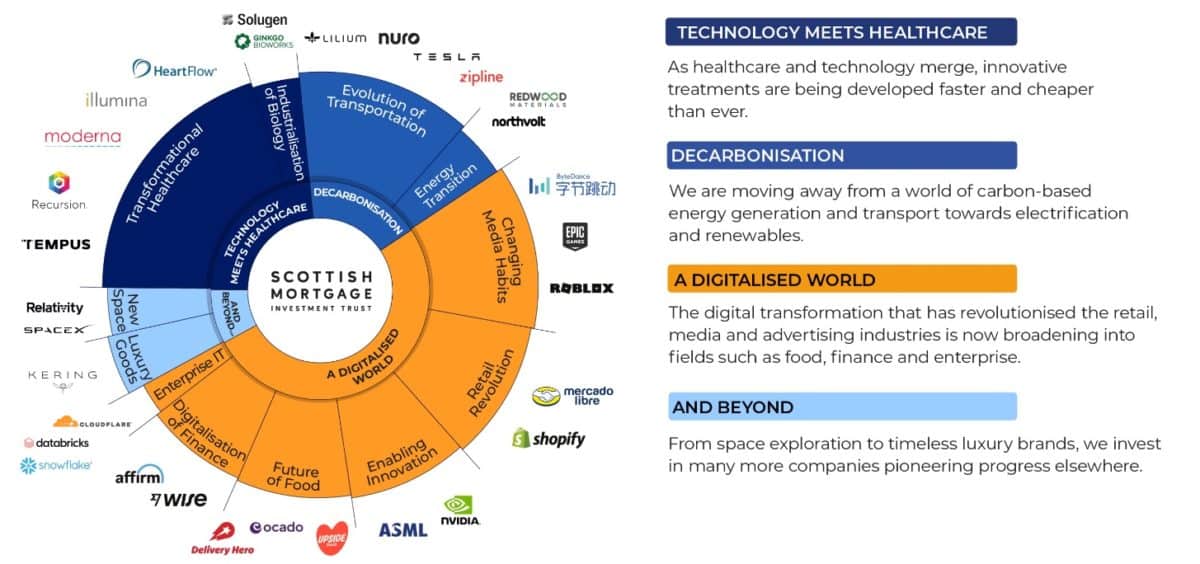
While near-term earnings are tough to nail down, the trust has significant growth potential over a longer horizon. As the graphic below shows, it provides a multitude of ways for investors to capitalise on the growing digital economy.

Source: Scottish Mortgage Investment Trust

Another benefit of this particular trust is that it gives investors exposure to non-listed companies they can’t invest in directly. These include Elon Musk’s space transportation company SpaceX, whose value has roughly doubled in a year to around $350bn.

Around 7.5% of the trust is dedicated to this specific company.

Danger ahead?

But like any investment, there are risks to Scottish Mortgage’s earnings and share price performance in the near term and beyond.

One is a potential slowdown in the global economy that damages corporate and consumer spending. Technology shares are some of the most cyclical out there, and they often sink sharply in value during downturns.

Fresh trade tariffs across key regions are another danger that could affect the tech sector especially severely. Possible consequences include weaker sales, supply chain disruptions, greater production costs and reduced innovation, all of which could significantly dent the trust’s performance.

Here’s what I’m doing

Yet I believe these threats may be baked into the trust’s low valuation. At £10.54 per share, it trades at a near-8% discount to its net asset value (NAV) per share of £11.40. This leaves a healthy margin of error that could protect against severe share price volatility.

I already have significant exposure to the tech sector through a couple of funds I hold. Alongside an S&P 500-tracking exchange-traded fund (ETF) from HSBC, I’ve also invested in the more targeted iShares S&P 500 Information Technology Sector ETF.

Without my existing tech exposure, I’d seriously consider adding Scottish Mortgage shares to my portfolio. I think its diversified approach is a great way to capture growth opportunities while simultaneously spreading risk.

For investors seeking exposure to the booming tech sector, I believe the trust is worth serious consideration.

Just released: our 3 top income-focused stocks to buy in January [PREMIUM PICKS]

Premium content from Motley Fool Share Advisor UK

Our monthly Ice Best Buys Now are designed to highlight our team’s three favourite, most timely Buys from our growing list of income-focused Ice recommendations, to help Fools build out their portfolios.

“Best Buys Now” Pick #1:

BAE Systems (LSE: BA.)

  • The geo-political conflicts in Ukraine and the Middle East have prompted NATO members to fulfil their commitments to invest 2% of their GDP in their own defence, and BAE Systems is set to benefit from a long-term increase in defence spending in Europe over the next few years.
  • Defence manufacturers primarily serve government clients, ensuring steady sales and stable revenues. Contractual provisions that account for cost increases offer these companies protection against inflation. This resilience to rising prices has played a significant role in the industry’s exceptional performance compared to the overall stock market in the long run.
  • Currently, Britain is spending 2.25% of its GDP on defence, which is set to increase to 2.5% by 2025, following Parliament’s approval of an additional £5 billion for the armed forces.
  • In H1 2024, the combined revenue from the UK and Europe accounted for 40% of BAE’s total revenue, up from 33% in 2022. Analysts expect that the combined defence budgets of European NATO members will increase by 25%, amounting to around $400 billion annually.
  • Under AUKUS partnership, the UK will co-design and build eight next-generation, nuclear-powered (but not nuclear-armed) submarines with Australia. BAE Systems, with its expertise in submarine design and construction, could play a significant role in providing support or technical assistance.

“Best Buys Now” Pick #2:

Redacted

Want All 3 “Best Buys Now” Picks? Enter Your Email Address!

A Trump meme coin ETF is already in the works

A cartoon image of US President-elect Donald Trump with cryptocurrency tokens, depicted in front of the White House to mark his inauguration, displayed at a Coinhero store in Hong Kong, China, on Monday, Jan. 20, 2025.
Paul Yeung | Bloomberg | Getty Images

A new securities filing Tuesday revealed that an ETF issuer is already rushing to launch a fund to track the new Trump crypto token.

The proposed fund is called the Rex-Osprey Trump ETF. The fund could gain exposure to the Trump token at least in part through a Cayman Islands subsidiary, according to the document. The filing does not have a ticker or fee listed.

The type of filing and the preliminary details included suggest that the fund would be legally different from how the popular bitcoin ETFs operate. That could help the fund launch more quickly, but it could also increase the likelihood that regulators reject the proposal.

The filing Tuesday comes on the first business day after last Friday’s launch of Trump coin, which is built on the Solana platform. The token has been highly volatile but appears to be worth billions of dollars of notional value to the Trump family.

The website for the token, shared by Trump himself on social media, said that Trump coin is intended to be “an express of support” and not “an investment opportunity.”

The proposed Rex-Osprey Trump ETF is one of a flurry of new crypto ETF filings in recent days. The same fund series documents for the Trump ETF also listed proposals for funds following the two majors crypto coins — bitcoin and ether — and secondary coins solana and XRP, as well as meme coins bonk and doge.

Proposals for several other funds came late Friday, including the multi-token CoinShares Digital Asset ETF and a series of leveraged and inverse XRP funds from ProShares.

The crypto ETFs currently market in the U.S. track just bitcoin and ether or the futures contracts for those tokens. Crypto products were viewed skeptically by former Securities and Exchange Commission Chair Gary Gensler, but both the ETF and crypto industry expect that a wider scope of funds could launch under the Trump administration.

Acting SEC Chair Mark Uyeda announced Tuesday that the SEC has launched a “crypto task force” to help develop a clearer regulatory framework around digital assets.

Down 30% in 3 months, is the Taylor Wimpey share price too cheap for me to ignore?

Since 19 September, housebuilder Taylor Wimpey (LSE: TW) has seen its share price fall by over 30%.

Why have the shares slumped? One obvious explanation might be that the FTSE 100 company’s trading has disappointed investors. But this hasn’t happened.

Trading as expected

Taylor Wimpey’s recent 2024 trading update confirmed that profits for last year should be “in line with previous guidance”. And 2025 seems to have got off to a reasonable start too. Taylor Wimpey’s order book stood at £1,995m at the end of December, 12.5% higher than the £1,772m reported at the end of 2023.

The company expects to report an increase in completions this year – although weaker pricing in the South of England does mean that the average house price in the order book is 0.5% lower than last year.

This might be one reason for the recent weakness, but this update was only issued on 16 January 2025. It doesn’t explain last year’s slump.

Market headwinds?

My guess is that investors were hoping the government would include some kind of cash bung to boost housing activity with the autumn Budget. Investors may remember how the Help to Buy scheme turbocharged house prices for several years. As it happens, the only promise we’ve got from the government so far is that it will try to unclog the planning system.

One other potential headwind is that interest rates aren’t falling as fast as expected. This has a direct impact on mortgage rates and affordability. That raises the risk of further pressure on house prices.

Is the 8% dividend yield safe?

I think this is a good example of the old stock market adage “buy the rumour, sell the news”.

Shares in Taylor Wimpey and other housebuilders performed very well ahead of October’s Budget. But when the actual news emerged (there wasn’t any), investors took profits. This sell off has left Taylor Wimpey shares trading slightly below their June 2024 book value of 125p. That’s a traditional sign of value for a housebuilders.

I’m also tempted by the 8% forecast dividend yield. However, I’m a little concerned that the forecast payout of 9.4p isn’t fully covered by expected 2024 earnings of 8.2p.

Taylor Wimpey ended last year with net cash of £565m and could probably afford to maintain the dividend. However, management won’t necessarily want to do this. It may want to preserve cash so that it can expand its build rate if market conditions improve.

What’s more, CEO Jennie Daly already has a get-out-of-jail-free card for a dividend cut. Her previous guidance on dividends implied that the payout could fall to a minimum of 7.1p per share, if needed. That would give the stock a more normal 6.1% yield.

My verdict

Right now, I’m on the fence about Taylor Wimpey. I think there’s a chance the stock’s become attractively valued. But I don’t feel it’s definitely too cheap to ignore. I’m also slightly worried about the safety of the dividend.

For these reasons, I’m going to wait until the company’s results are published in February before revisiting this situation.

Is the S&P 500 heading for a correction in 2025?

The S&P 500 jumped 23.3% last year, the second consecutive annual rise above 20%. And it’s already around 2% higher in 2025.

But is the surging index heading towards a correction (that is, a 10% fall)? Here are my thoughts.

Arguments for

Incredibly, the S&P 500 has delivered a return above 20% in four out of the past six years. On a total return basis (including dividends), it has been above 25% for four of those years, with a Covid-struck 2020 producing ‘just’ 18.4%.

Year Price return Total return
2019 28.88% 31.49%
2020 16.26% 18.40%
2021 26.89% 28.71%
2022 −19.44% −18.11%
2023 24.23% 26.29%
2024 23.31% 25.02%

Historically though, these returns are far higher than usual for the index. Indeed, the last period there were such monster returns clumped together was in the late 1990s. And we know what followed that boom…

Year Price return Total return
1995 34.11% 37.58%
1996 20.26% 22.96%
1997 31.01% 33.36%
1998 26.67% 28.58%
1999 19.53% 21.04%
2000 −10.14% −9.10%
2001 −13.04% −11.89%
2002 −23.37% −22.10%

Of course, this doesn’t guarantee that something similar will happen this time around. But both then and now, there was the dawn of a revolutionary new technology that was getting investors excited (the internet and artificial intelligence (AI), respectively). Might history be rhyming here? It’s possible.

Moreover, Donald Trump has promised/threatened widespread tariffs, which many economists predict will be inflationary. If so, this would be a hindrance to interest rate cuts.

Finally, the index is extremely richly valued, with a forward price-to-earnings (P/E) ratio of 21.6. This high starting point makes it more difficult for corporate earnings to grow at a rate that justifies the valuation.

The index performed very strongly the last time Trump was in charge of the US economy. However, the multiple is currently around 27% higher than it was when he took office in early 2017. Therefore, a correction could be on the cards.

Arguments against

Yesterday (20 January), the new President was sworn in. In his speech, he promised to boost consumer spending power by lowering energy bills, taxes, and inflation, thereby making the economy stronger in the process. He even mentioned putting the American flag on Mars.

Given this optimism, it could be argued 2025 will be yet another positive year for the S&P 5OO. Talk about a US recession has faded, animal spirits are strong, and interest rates still look set to move lower.

How I’m responding

The mood in the US right now is incredibly bullish. My hunch then is that the index will chug higher this year, but that it won’t deliver a third straight double-digit return. Naturally, I could be totally wrong.

What I’m more certain about though is that specific S&P 500 stocks appear grossly overvalued. One is Palantir Technologies (NASDAQ: PLTR), whose share price has exploded 1,017% since the start of 2023.

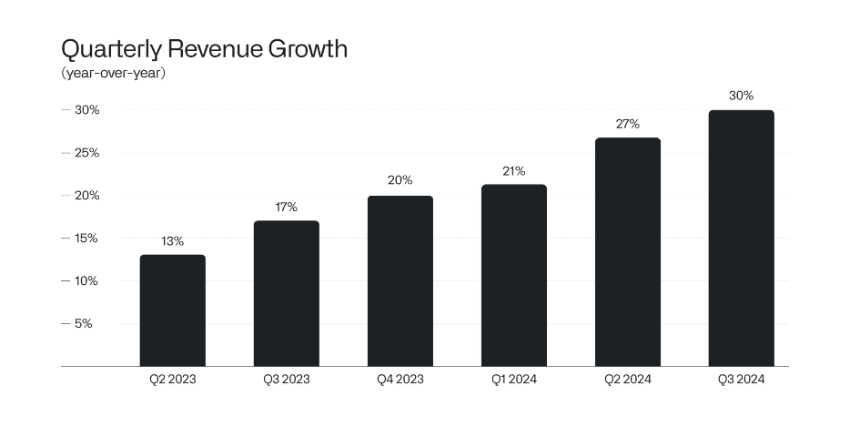
Palantir provides AI solutions to both government organisations and companies. It has been growing like wildfire, with third-quarter revenue up 30% year on year to $725m.

Revenue has actually accelerated for six straight quarters!

Source: Palantir Technologies Q3 2024 shareholder letter

Palantir also generated a record $144m in net profit. And CEO Alex Karp struck an incredibly bullish tone: “A juggernaut is emerging. This is the software century, and we intend to take the entire market.”

Clearly then, there’s a lot to like about this AI company. However, the stock is trading at an eye-watering price-to-sales (P/S) multiple of 66. The forward P/E ratio is above 150. If growth normalises, these valuations are likely unsustainable.

Palantir is the type of overvalued S&P 500 stock that I’m avoiding right now.

£15,000 invested in Tesco shares at the start of 2024 is now worth…

Tesco (LSE: TSCO) shares haven’t really set the world on fire over the past couple of decades. The group’s ambitious international expansion plans didn’t pan out as hoped while an accounting scandal in 2014 led to a dividend suspension and rocked investor confidence.

More recently though, there seems to have been a reassessment of the investment case. The FTSE 100 stock is up 81% from a low in October 2022.

Indeed, the share price is up 26.2% since just the beginning of 2024. This means anyone who invested £15,000 in the UK’s leading supermarket back then would now be sitting on £18,925. And they’d also have received around £635 in dividends, taking the total return to approximately £19,500.

That’s a very solid result in a relatively short space of time.

Still dominant

Every month, industry insights and trends are released from data provider Kantar. We got these earlier in January, just before Tesco released a Christmas trading update.

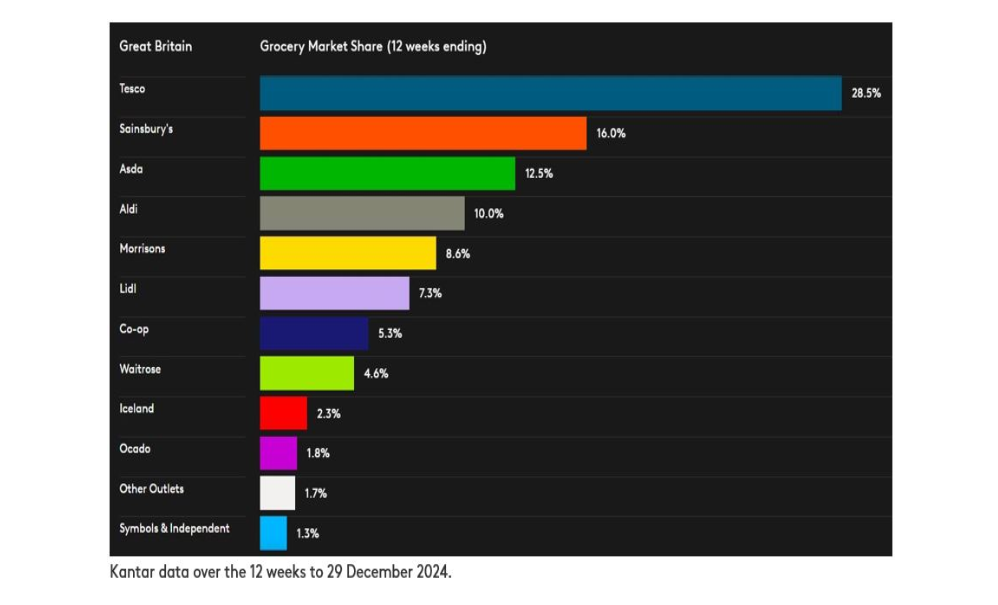
Together, they painted the same picture, which is that Tesco is performing very well. Over the 12 weeks to 29 December, it enjoyed 5% growth in sales across its convenience, superstore and online channels.

This saw its market share increase by 0.8%, the largest gain of any supermarket, taking its hold to 28.5%. That’s Tesco’s highest market share since 2016!

CEO Ken Murphy commented: “We delivered our biggest-ever Christmas, with continued market share growth and switching gains.”

Source: Kantar

Online opportunity and challenge

One potential risk for Tesco is online, where spending for December reached a record £1.6bn. According to Kantar, Ocado boosted its sales by 9.6% over the 12 weeks to 29 December, taking its overall market share to 1.8%.

Of course, Tesco has its own online business. This channel saw 10.8% growth in UK sales over the Christmas period, including over 1.2m orders placed through Tesco Whoosh, its rapid delivery service.

Meanwhile, the company leverages its extensive store network for click-and-collect services, which pureplay online grocers do not offer.

Unlike online-only Ocado though, Tesco must balance this opportunity with maintaining its physical operations. True, its massive scale gives it advantages when it comes to negotiating prices with suppliers. But Ocado uses robots to pick and pack orders efficiently, reducing costs and improving order accuracy.

The long-term aim is to translate these operational efficiencies into more competitive pricing for customers in order to take market share and (possibly) boost profit margins. If that happens, Tesco might one day feel compelled to invest heavily in automation technologies to remain competitive. And that could weigh on margins and investor sentiment for the stock.

Will I invest?

The forward-looking dividend yield is 4%, with the payout expected to be covered two times by forecast earnings. While no dividend is guaranteed, this reassuring coverage suggests to me that the payout should be met. Looking ahead, I do like the dividend growth prospects here.

However, a more immediate concern for me is the increase in costs related to the recent Budget. Due to Tesco’s massive workforce, this will add an extra £250m to its costs each year, according to management. Passing this on to customers through higher prices could result in lower overall basket sizes.

Therefore, I have no plans to invest in the stock right now.

3 passive income ideas for Stocks & Shares ISA investors to consider!

The Stocks and Shares ISA can be a powerful tool in helping investors to substantially boost their passive income. As well as saving individuals a fortune in tax, investors can purchase a wide range of dividend-paying shares, funds and trusts from the UK as well as overseas.

Here are three strategies for ISA investors to consider for building passive income over time.

1. Consider high yielders

Assets that have large dividend yields can substantially boost one’s passive income. In a nutshell, these securities should provide an individual (if broker forecasts are correct) with a greater dividend income than if that person invested the same capital elsewhere.

High-yielding companies can be risky, as some inflate dividends to mask underlying business issues. But the good news is that investors also have a wide selection of top stocks with generous yields to think about.

Legal & General is one such company. Earnings may disappoint if tough economic conditions persist and consumers cut back further. But the FTSE 100 firm’s strong balance sheet means it should (in my opinion) continue to deliver market-beating dividends.

City analysts agree. Its dividend for 2025 is a gigantic 9.4%.

2. Look for dividend growers

Shrewd dividend investing isn’t just down to searching for the biggest yielders. It also involves locating companies that can grow shareholder payouts over time.

Sustainable dividend growth usually implies robust financial health, consistent earnings growth, and a commitment to rewarding investors with cash. A company with a rising dividend can also help investors offset inflationary damage.

FTSE-listed Bunzl (LSE:BNZL) is one such stock worth a close look. It’s consistently raised dividends for more than three decades, and is tipped to have grown them the 32nd straight year in 2024.

This is thanks in part to the broad range of essential products it supplies, including medical gloves, food packaging and cleaning equipment. It also sells them across a multitude of sectors in North America, Europe and Asia, providing it with excellent earnings stability and growth opportunities.

Bunzl’s appetite for acquisitions could impact future dividends if the balance sheet becomes stretched. But so far this hasn’t proved an obstacle to dividend growth. The firm’s dividend yield for 2025 is a handy 2.3%.

3. Diversify for safety

Holding a multitude of stocks offers a margin of safety for passive income investors. Dividends are never guaranteed, and companies can reduce, postpone or cancel cash rewards at a moment’s notice. Owning a portfolio of, say, 10 to 15 shares can help investors better absorb dividend shocks from one or two holdings.

Alternatively, an investor can consider buying an investment trust or an exchange-traded fund (ETF). This can offer even better diversification by spreading risk across an even larger basket of assets.

The iShares MSCI Target UK Real Estate is such ETF to consider. It holds shares in 35 property stocks across multiple sectors, giving it strength across all points of the economic cycle.

A focus on real estate shares means performance may lag when interest rates are higher. But over the long term the fund — which today carries a 7.6% forward dividend yield — could be a great way to generate passive income.

Financial News

Daily News on Investing, Personal Finance, Markets, and more!

Financial News

Policy(Required)