Down 37% despite hitting £2bn+ in sales, does this FTSE 250 firm look an unmissable buy to me?

FTSE 250 fast-food retailer Greggs (LSE: GRG) passed the milestone of £2bn in sales in 2024.

Aside from this 11.3% year-on-year sales increase (to precisely £2.014bn), its 9 January Q4 results saw a record 226 new shops opened. Another 140-150 net new store openings are planned for 2025 to add to the total of 2,618 currently trading.

The purveyor of several of the UK’s most moreish culinary treats, in my opinion, added that supply chain capacity development is on track. This supports these ongoing plans for growth.

A risk to these is intense competition in the food retail sector.

That said, analysts forecast Greggs’ earnings will grow by 4.5% each year to the end of 2027. And it is ultimately these that drive a firm’s share price and dividend higher.

So why are the shares down?

The stock fell 15% after the Q4 figures as they missed forecasts for a 2024 year-on-year sales rise of 12.2%.

As a former investment bank trader, I understand that part of the share price reflects such forecasts. However, my approach as a private investor over many years has been to take a long-term view.

In my experience, the longer an investment is held, the greater the chance it has to recover from short-term market shocks.

Consequently, when I look at Greggs’ performance numbers I think there is a bargain to be had.

Are the shares now significantly undervalued?

The first part of my assessment of Greggs’ pricing is to compare its key valuations to those of its competitors.

On the price-to-earnings ratio, the shares currently trade at 16.5 against a peer group average of 20.2. This comprises J D Wetherspoon at 14.7, Whitbread at 21.4, and McDonald’s at 24.4. So, it looks very undervalued on that basis.

I think it apposite to note here that Greggs overtook McDonald’s as the UK’s top takeaway for breakfast in 2023. And it retains that number one position.

Greggs also looks very undervalued on the key price-to-sales ratio, trading at 1.2 compared to a competitor average of 3.3.

However, on the price-to-sales ratio, Greggs looks slightly overvalued at 4.6 against its 3.8 peer average.

To get to the bottom of its valuation, I used the second part of my pricing assessment methodology. This involves examining where a stock should be, based on its future cash flow forecasts.

The resulting discounted cash flow analysis shows Greggs’ shares are technically 62% undervalued at their present £20.47.

So a fair value for them is £53.87, although market vagaries might push them lower or higher.

Will I buy the stock?

I am at the later stage of my investment cycle, aged over 50 now. This means that the length of my market view has contracted to around 10 years from the previous 40.

My focus now is on shares that will generate for me a very high passive income from dividends.

Analysts forecast Greggs’ yield will be 3.2% in 2025 and 3.9% in 2026. By comparison, the average yield of the FTSE 250 is presently 3.3%.

However, the average yield of my passive income stocks is nearly 9%. So, Greggs is not an unmissable buy for me.

That said, if I were in the early stages of my investment cycle, I would buy it for its growth potential and major undervaluation.


Has a 2025 Tesla stock crash already started?

Anyone who bought Tesla (NASDAQ: TSLA) stock five years ago would be sitting on a gain of more than 1,100% today. But they’d have been on a bit of an up-and-down ride between then and now.

The price climbed sharply higher when CEO Elon Musk got his foot in with the new US adminstration. Investors seemingly assumed his relationship with President Trump should help give his companies a boost.

But even now, Tesla stock is still only a little above the highs it reached in late 2021. Anyone who happened to buy at the peak back then would have had to wait three years just to break even.

Electric vehicles

The future for vehicles is surely electric. But a few things make me suspect Tesla shareholders might be in for a disappointing ride in 2025.

One of them comes from Donald Trump himself. In his inaugural address, he said “We will end the Green New Deal, and we will revoke the electric-vehicle mandate, saving our auto industry“.

On top of his oil pledge to “drill baby, drill,” that doesn’t read like good news for the electric vehicle (EV) industry to me. Or, specifically, for Tesla.

Another thing is Tesla’s super high valuation. We all expect high-tech Nasdaq growth stocks to be on high valuations, for sure. The kind of growth we could see from them has to be worth a handsome premium.

But Tesla’s valuation makes the rest of the so-called Magnificent Seven Nasdaq stocks look like bargain-basement buys.

Nvidia, cheap?

Six of the seven are on forward price-to-earnings (P/E) ratios that range from 25 (Alphabet) to 50 (Nvidia). And then we have Tesla’s P/E up at 201. Nvidia might have a market capitalisation of a whopping $3.6trn. But on a per-share basis, Tesla’s valuation is four times as high.

Admittedly, forecasts for earnings growth suggest that ratio of 201 should come down to 113 by 2026. But that’s still high compared to the others.

Consensus price targets for Tesla right now range from a low of $125 to a high of $528 (omitting the $2,600 target that Cathie Wood of Ark Invest put on the stock last year)

So, brokers think Tesla could fall 70%, or gain 26%, from the price at the time of writing. Know what I think? I think it means these clever analysts haven’t really got a clue. And to be honest, neither have I. But I do know Tesla has already fallen 14% from last month’s high.

Tesla bull

I’m bullish about the long-term future for Tesla. I’m just unsure about the current valuation. Investors need to be able to handle short-term swings, perhaps even some big ones. But at my age, I don’t have what it takes to grit my teeth and buy something when I think it looks toppy.

Still, I could change my mind and buy some if it really does crash in 2025. In fact, I think I might find it hard not to.

Here’s what I’d need in an ISA to earn £1,000 of passive income a month

We’d all love to earn some monthly passive income to top up our pensions when we retire, wouldn’t we?

If it’s tax-free, even better. There’s no tax to pay on interest from a Cash ISA, for example. But as Bank of England rates fall, I expect we’ll soon be back down to interest of 1% or less. I’d rather pay tax on a better return than save the tax on such a pittance.

Fortunately, there’s a way we can aim for the best of both worlds, using a Stocks and Shares ISA.

Please note that tax treatment depends on the individual circumstances of each client and may be subject to change in future. The content in this article is provided for information purposes only. It is not intended to be, neither does it constitute, any form of tax advice. Readers are responsible for carrying out their own due diligence and for obtaining professional advice before making any investment decisions.

Top returns

For more than a century, the UK stock market has beaten other forms of investment hands down. Over the past 20 years, total annual FTSE 100 returns have averaged 6.9%. That includes share price gains and dividends.

It’s been volatile though. In the 2019-2020 financial year, the average Stocks and Shares ISA made a 13.3% loss. And I thought it was going to be a lot worse, seeing how the early days of the pandemic were going.

Investing in shares really needs a long-term outlook. For investors who aren’t comfortable taking short-term losses, well, maybe they should stash their cash elsewhere. There’s nothing wrong with being cautious. Those of us who do go for shares can help reduce our risk by seeking diversification.

How much would we need in an ISA to make a 6.9% annual return worth £1,000 a month? I reckon it should take a pot of about £174,000. And if we wanted to take the cash only from dividends (of, say, 4% a year on average), we could need £300,000.

Dividends

I see four key parts to a strategy to achieve our passive income goals. Start early, invest as much as we can each year, keep going as long as we can, and reinvest all our dividends.

But what makes a good dividend? A high yield’s nice, but only if it can be sustained. I’d prefer a lower current yield, but based on a long track record of rises. Look at Murray Income Trust (LSE: MUT), for example.

It’s an investment trust that aims for a mix of rising dividend income and capital growth. It does it by investing in stocks such as RELX, AstraZeneca, National Grid, and a range of others. So there’s some diversification from just one buy.

Currently, the trust has a forecast dividend yield of 4.6%, I’d need around £261,000 to earn £1,000 a month passive income at that rate. More importantly, it’s raised its dividend for 51 years in a row.

Cover the risk

The 10-year share price performance hasn’t been brilliant, sadly. It does put the shares on a 12% discount to underlying assets, which might make them look good value — but it will reflect investor uncertainty.

Maybe the market’s put off by the trust being managed by abrdn, whose own share price performance has been poor?

There’s clearly risk here. But I do think investors with a long-term outlook who want to build passive income could do well to consider holding some investment trusts like this in their ISAs.

Nuclear energy is on-trend: are Rolls-Royce shares my best option?

Rolls-Royce (LSE:RR.) shares are the best-performing on the FTSE 100 in recent years. The stock’s rise has been driven by an incredible turnaround in the company’s financial performance.

In turn, this is thanks to an impressive cost-cutting drive and strong demand across all its main business units — civil aerospace, defence, and power systems.

Where does nuclear fit in?

Rolls-Royce has been developing small modular reactors (SMRs) that use nuclear fission to create energy on a relatively cost-efficient basis and with a greater degree of flexibility than their predecessors.

While this technology isn’t solely being developed by Rolls-Royce, it’s widely considered a world leader, with CEO Tufan Erginbilgiç repeatedly calling on the UK government to help protect its lead and commit to a future with SMRs.

However, this SMR development doesn’t fit into any of the above business units. It’s part of Rolls-Royce’s new ventures and it’s arguably the most promising programme in development.

Nuclear power’s the thing

Over the past two years there’s been a revolution in artificial intelligence (AI). AI workloads are extremely demanding and require substantial infrastructure to operate effectively. In particular, they rely heavily on power-intensive data centres. These require a significant proportion of global energy.

So with the Western world making some movement away from fossil fuels, and with renewable energy still somewhat unreliable, there’s been a renewed interest in nuclear energy. Private investment’s been soaring and governments are once again making nuclear a priority after a period in the dark.

And if you haven’t been following, nuclear stocks have surged. For example, Range Nuclear Renaissance ETF — an exchange-traded fund with nuclear holdings — has soared 92% over 12 months.

Investing in Rolls for a nuclear future

Nuclear energy isn’t a major part of most analysts’ investment thesis for Rolls-Royce. And I think that’s possibly wise given the time horizons for the engineering giant’s nuclear programme. It plans to have its first SMR operational in the UK in 2030, and despite being selected for SMR development in Czechia, the first one there won’t be operational until the early 2030s.

That’s not to say further catalysts with regards to Rolls-Royce nuclear programme won’t boost the share price. However, it may be the case that investors won’t be willing to assign value to a programme that won’t become cash flow positive this decade.

As such, for exposure to nuclear power, I’d suggest Rolls-Royce isn’t the best option. Instead, there’s a handful of interesting US-listed companies that are at the forefront of existing nuclear technology.

The bottom line

Rolls-Royce is a booming company, but that doesn’t mean there aren’t risks. An uptick in inflation could harm demand for air travel — engine flying hours represent a major proportion of revenues — while the pandemic suggested this business is vulnerable to demand shocks. Moreover, as a UK-based business, changes to employer National Insurance contributions could hurt earnings.

However, I’d suggest it’s hard to bet against this great business. All three segments are booming and the nuclear programme offers an additional opportunity for long-term growth. I keep changing my mind here, but with a substantial holding in Rolls-Royce, I probably won’t buy more despite its strong prospects and its discount versus its US peers.

£10k in Tesla shares would have returned $100 per day since the US election!

Tesla (NASDAQ: TSLA) shares were having a rough year in 2024 until the US election on 5 November. For the first three quarters, it looked like the world’s most famous electric vehicle (EV) company would end the year down.

Now, the stock is up over 100% since this time last year. A committed investor who held throughout the year would have doubled their money. Even shares bought on the day of the election result would be up 69%.

That’s a profit of £6,900 on a £10k investment, equating to over $100 (£82) per day!

The rapid rise means Tesla’s market cap has dwarfed that of competitors Toyota, Ford, and BYD. Now at around $1.33trn, the ballooning stock has also helped push CEO Elon Musk’s net worth close to half a trillion dollars.

Challenges ahead

Despite appearances, the road ahead may not be smooth for either Tesla or Musk. The US government advisory body he was picked to lead has already attracted several legal challenges. Not to mention the potential conflict of interest that such a position would bring about.

This could matter for Tesla because the company’s sky-high share price is not representative of earnings. Despite bringing in significantly less revenue than all the top 10 car companies in the US, the stock is now worth more than all 10 combined.

It doesn’t take much imagination to realise why that could be problematic. The EV giant’s price-to-earnings (P/E) ratio has skyrocketed above 100, suggesting the price is in highly speculative territory. 

How long can it ride on the coattails of Musk’s political aspirations?

Growth for growth’s sake

Despite the fervour and fanfare around Tesla, there have been no notable developments in the past three months — nor any significant boost in sales. Last October’s much-anticipated ‘robotaxi’ event failed to impress, with a vague “before 2027” being the only timescale provided for launch.

With nothing to back the rapid growth, some analysts fear Tesla could have a “$1trn gap to fill.” If it fails to deliver results worthy of the valuation, brokers could turn on the stock with a dreaded Sell rating.

Then again, this is Musk we’re talking about. If history is anything to go by, he’ll likely find a way to keep the overweight ship on a steady keel.

Screenshot from TradingView.com

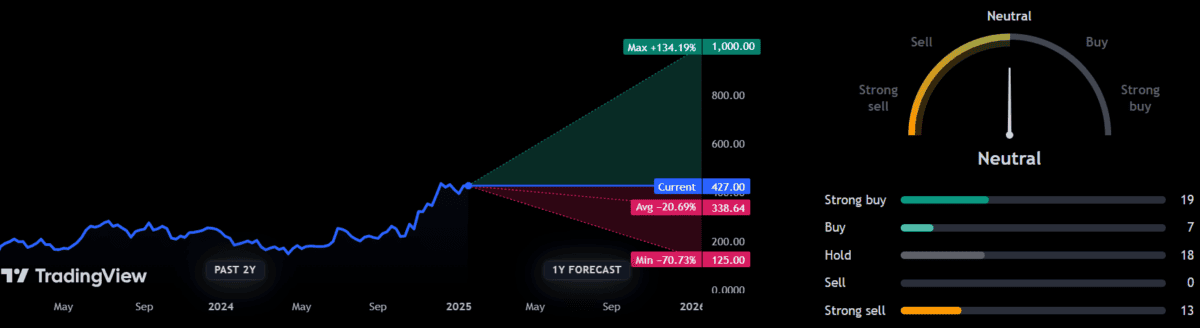
Analysis of the stock is almost as divided as US political opinion. Out of 57 analysts, 13 give a strong Sell, 18 a Hold and 19, a strong Buy. The remaining seven are a moderate Buy. The most optimistic give it a 12-month price of $1,000, a massive 135% increase. The most bearish expect a 70% decline in the coming 12 months.

Personally, I wouldn’t be surprised with either outcome. Trying to understand the current US economic situation is headache enough without Musk’s political forays throwing a spanner in the works.

So, as an investor with a strong inclination toward predictable returns, I will be giving Tesla stock a wide berth for the foreseeable future. However, for investors with a strong risk appetite, the potentially sky-high gains might make it worth considering.

Here’s a cheap UK stock that could soar while Donald Trump’s US President

UK stocks are soaring again as confidence returns to global financial markets. Both the FTSE 100 and FTSE 250 have printed strong gains in recent days following Donald Trump’s return to the White House.

In fact, London’s home to a multitude of shares that could benefit substantially from the Republican’s second run as US President. Here’s one I feel could pay off during the next four years and is worth considering.

Bouncing bullion

Precious metals prices are on the front foot again in the days following Trump’s inauguration. This reflects huge macroeconomic uncertainty that the New York native’s unconventional approach to governing creates.

That’s not all though. A series of statements, from talk over the US absorbing Greenland and Canada to proposed trade tariffs, have the potential to fuel inflation and exacerbate existing geopolitical tensions. These are natural drivers for safe-haven assets like gold and silver.

If Trump’s last stint in Washington is anything to go by, bold policies on the economy and world order could dominate his second term, in turn supporting demand for flight-to-safety assets.

Gold star

This bodes well for gold miners like Pan African Resources (LSE:PAF). As you can see, this FTSE 250 share has risen again recently thanks to resurgent bullion prices.

Investing in mining stocks can be riskier than, say, purchasing an exchange-traded fund (ETF) that simply tracks the metal price. This is because company earnings can be crushed by exploration and production issues or problems with mine development.

But on the other hand, owning metal producers can deliver superior returns if operational performance impresses the market. With Pan African Resources, production at its Mogale Tailings Retreatment (MTR) plant continues to ramp up following commissioning in October. It has also recently acquired low-cost operator Tennant Consolidated Mining to give group output a significant shot in the arm.

Another thing to consider is the cheapness of the South African miner’s shares. At 39p per share, it trades on a forward price-to-earnings (P/E) ratio of 6.3 times.

Furthermore, its price-to-earnings growth (PEG) multiple sits comfortably below the value watermark of 1, at 0.1.

Low valuations like these can lead to strong share price gains if market conditions remain supportive and operational newsflow impresses.

An attractive value share

There’s no guarantee that gold prices will continue rising, of course. And this could severely impact Pan African Resources, regardless of how well it’s run or the cheapness of its stock.

A less unpredictable approach from the returning President could sap some of the tension surrounding financial markets. Other factors like a rising US dollar could also harm the performance of buck-denominated assets like precious metals.

Yet on balance, I think the outlook for gold prices remains highly encouraging. And I’m not alone. Analysts at Saxo Bank, for instance, think the yellow metal will strike fresh record peaks of $2,900 per ounce by the end of the year. Others are even more bullish.

Against this backdrop, I think Pan African shares are worth serious consideration.

5 UK shares to consider buying for a £36k+ passive income in retirement!

There are plenty of ways the modern investor can target long-term wealth with UK shares. Diversification is one of the most popular strategies for helping individuals attain a large passive income in retirement.

This be achieved with a selection of stocks spanning a range of industries, sub-sectors and territories. It can also be enhanced with a mix of value, growth and dividend shares.

Going for growth

Buying growth stocks can supercharge the size of an investor’s portfolio. As earnings take off, the value of these stocks often rises significantly, providing substantial capital gains.

The US stock market’s a popular destination for growth investors. But London also has its fair share of growth heroes to consider.

Information technology stock Softcat’s one. Market competition’s fierce, but its expertise across cybersecurity, digital infrastructure and cloud computing gives it multiple ways to capitalise on the booming digital economy.

I also like the look of Bank of Georgia, a major player in the country’s rapidly expanding banking sector. Returns could be bumpy however if geopolitical turbulence in the region persists.

Targeting value

The benefit of owning value shares is twofold. Like growth shares, they can provide significant scope for capital appreciation. But their low valuations can also limit share price falls if shocks come along that impact earnings potential.

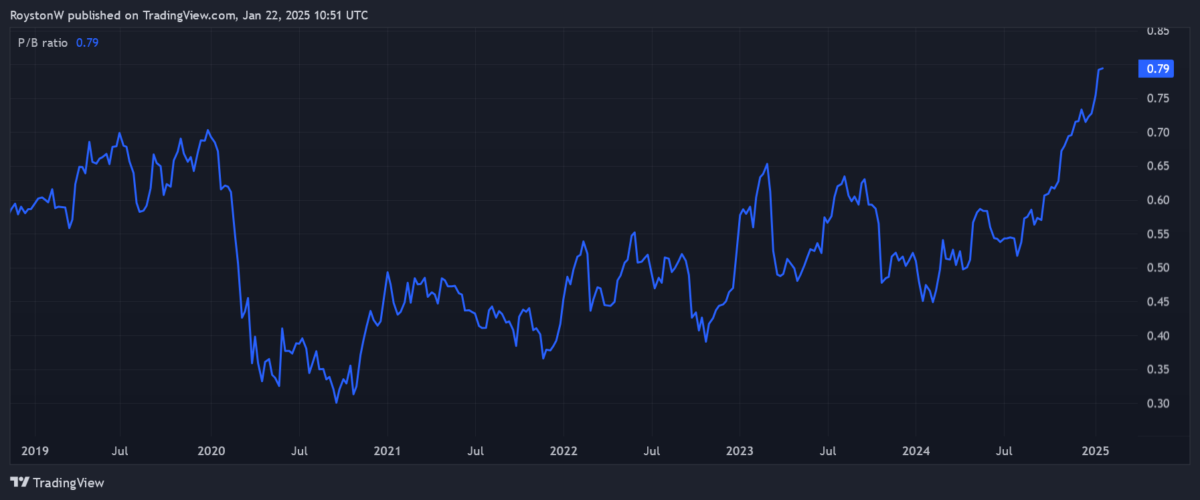
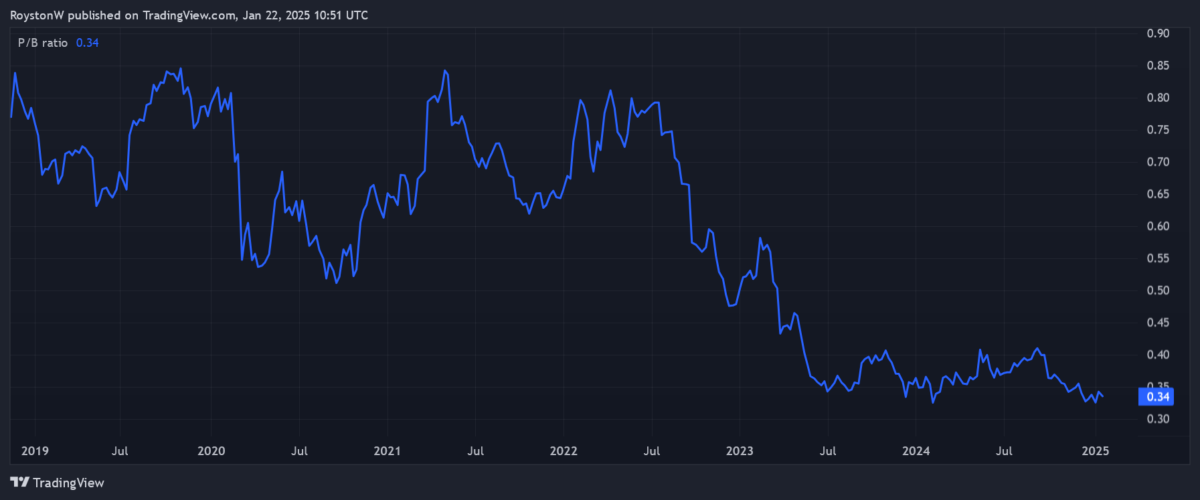
Standard Chartered and Vodafone are two great value shares on my own radar today. Both trade on a price-to-book (P/B) value of below 1, indicating their shares deal at a discount to the value of the companies’ assets.

StanChart’s P/B ratio. Source: TradingView
Vodafone's P/B ratio
Vodafone’s P/B ratio. Source: TradingView

StanChart’s profitability could disappoint if China’s economy keeps struggling. Yet I still expect its emerging market focus to deliver excellent long-term gains. I’m similarly optimistic about Vodafone and its African operations, although it faces challenges in its core German market in the near term.

Generating income

Dividend stocks can help investors still grow their portfolios during economic downturns when growth shares often struggle. In this type of landscape I think The PRS REIT (LSE:PRSR) could be a stock to consider.

As a real estate investment trust (REIT), it’s obliged to pay at least 90% of rental profits out to shareholders.

Please note that tax treatment depends on the individual circumstances of each client and may be subject to change in future. The content in this article is provided for information purposes only. It is not intended to be, neither does it constitute, any form of tax advice.

This itself doesn’t guarantee a dividend every year. But despite interest-rate-related pressure on profits, PRS REIT’s position in the ultra-defensive residential rentals market still makes it a largely dependable passive income stock.

In fact, profits here are rising sharply as rents in the UK balloon. Its like-for-like rents on stabilised sites leapt 11% between July and December, data this week showed.

Next steps

With this portfolio of UK shares, I believe an investor could realistically target an average annual return of 9%. At this rate, a £400 monthly investment in a tax-eliminating Stocks and Shares ISA would — after 30 years — provide a retirement pot of £732,297 (excluding broker fees).

If they then parked this cash in 5%-yielding dividend shares, they could enjoy an annual passive income of £36,615 in retirement. While dividends are never guaranteed, continuing to invest in a diversified range of stocks can protect against individual shocks and provide a healthy dividend income.

This is the route I plan to take with my own portfolio.

How much an investor would need in a Stocks and Shares ISA to earn a £16,000 yearly income 

A Stocks and Shares ISA allowance is a brilliant way to build a large pot of money for retirement. And it’s an even better method of generating passive income to fund our final years.

Money invested inside the tax-free allowance rolls up free of all capital gains tax (CGT) and income tax.

That means we don’t have to pay a penny in CGT to HMRC when our stock picks rise in value. Even better, we can reinvest all of the company dividends received straight back into the portfolio without paying a penny in tax on them.

FTSE 100 shares are top income stocks

When an investor retires, they can draw one-off lump sums or regular dividends entirely tax free. This makes managing overall tax liability easier. By juggling pension and ISA withdrawals, an investor can avoid getting pushed into a higher tax bracket. These tax benefits last for life.

Please note that tax treatment depends on the individual circumstances of each client and may be subject to change in future. The content in this article is provided for information purposes only. It is not intended to be, neither does it constitute, any form of tax advice. Readers are responsible for carrying out their own due diligence and for obtaining professional advice before making any investment decisions.

Let’s say an investor’s target retirement income is £40,000 a year. If they get £12,000 from the state pension, and another £12,000 from a company pension, they’d still be £16,000 short. So how much would they need in a Stocks and Shares ISA to generate that?

The answer partly depends on the type of shares they buy. Let’s say they start with FTSE 100 bank HSBC Holdings (LSE: HSBA).

Today, the bank has a trailing dividend yield of 5.99%. That’s a brilliant rate of income, comfortably above the FTSE 100 average of 3.5%. Although dividends aren’t guaranteed, companies need to generate sufficient profits to fund them.

HSBC has actually been on my own Buy list for months. The Asia-focused bank looks terrific value, trading at just 8.9 times trailings earnings. That’s cheap for a bank that increased profits by 10% to $8.5bn in Q3, smashing analysts’ expectations of $7.6bn.

The board has been further rewarding shareholders to the tune of $3bn per quarter, in the form of share buybacks.

No stock is without risk. New CEO Georges Elhedery has to navigate US-China tensions, manage the planned split between its Eastern and Western divisions, and sustain growth as falling interest rates squeeze margins. Yet, I’m still keen to buy.

The HSBC share price could rise too

Investing in a dozen different FTSE 100 shares would spread risk. If an average yield of 6% could be generated from those shares, an investor would need £266,667 in their Stocks and Shares ISA to generate £16,000 a year.

That looks like a tall order but it’s doable, given time. With £300 invested every month and with an average total return of 8% a year, it would take just under 25 years. If that monthly sum is increased every year to keep pace with inflation, the goal could be achieved sooner.

Better still, the dividend income should rise over time as most companies aim to increase their shareholder profits every year if they can. There are no guarantees. A portfolio can make or less than expected. But having a target to aim for is a great start.

How much would someone need to invest in UK shares to earn a £2,000 monthly passive income?

Last year, banking giant HSBC doled out £8.4bn in dividends. Some of that went to institutional shareholders. Some went to strategic investors. And a fair bit went to people who own HSBC – and other UK shares — primarily because of their passive income potential.

In fact, a lot of investors focus their passive income efforts on buying shares in proven blue-chip companies that typically pay out dividends to shareholders.

That can be lucrative, though, like any investment, it comes with some risks.

Below I outline how an investor could target a £2,000 per month average income either now or down the line by buying UK dividend shares.

Doing the dividend maths

To begin, I will explain the maths.

A monthly £2k equates to £24k per year. How much someone needs to spend on shares to earn that will depend on the average dividend yield of the shares they buy. Dividend yield is basically  the dividends earned annually as a percentage of the cost.

So, for example, at a 5% yield, it would be necessary to spend £480k on shares to hit the passive income target.

That is a lot of money. But one good thing about the current valuation of many blue-chip UK shares is that it means the yield can be quite attractive.

While the FTSE 100 average yield is 3.6%, in today’s market I think it is realistically possible to target 7% while sticking to quality companies.

Why a long-term approach can help

Still, even at 7%, the upfront investment needed would be substantial, at around £343,000.

But for those serious about setting up passive income streams and willing to take a long-term approach, there is another way, even starting from zero.    

For example, say that an investor puts £860 per month into the stock market and it compounds at 7% (by reinvesting dividends initially).

After 18 years, the portfolio will be big enough so that, at a 7% yield, it can generate over £2k each month on average as passive income.

Finding shares to buy

I said I think a 7% yield is realistic in the current market.

One of the UK shares I had in mind in that context, that I think investors should consider, is British American Tobacco (LSE: BATS).

There is clearly a big risk here: the company makes most of its money selling cigarettes and demand for those is declining in most markets.

Still, although in decline, it remains huge – British American sells billions every week. Thanks to its portfolio of premium brands, it has pricing power that enables it to fund a big dividend.

The yield currently stands at 7.9%. British American also has a track record of raising its dividend per share annually for decades, although that does not necessarily mean it will keep doing so.

Although cigarettes are a declining market, non-cigarette sales are growing fast. I think British American’s well-established brands can help it do well in that space.

Getting ready to invest

One thing I have not mentioned above is the practical side of getting started.

That would take a way to buy UK shares, such as a dealing account or Stocks and Shares ISA.

With lots of choices available, it can pay for an investor to take time and research what looks best for them.

Here’s how £300 could set a stock market beginner on the path to riches in 2025!

A lot of people dream of making money in the stock market but do not even make the first step of buying shares.

There may be reasons for that, such as thinking they need more expertise about money before they start investing. But, as the saying goes, you’ve got to be in it to win it.

In fact, it’s not necessary to have a lot of money before getting into the stock market.

On the other hand, I do think understanding how it works is important. But in this day and age, it’s easier than ever to learn about important concepts like valuation and building a diversified portfolio even on a limited budget.

With just £300 to start, here’s how a stock market beginner could start to build serious wealth.

Living in the real world — not the fantasy one

Let me clear. I’m not suggesting that a few hundred pounds can miraculously turn into millions.

But there are, as I see it, four key variables that determine how much wealth someone builds in the stock market. Let’s look at each in turn.

Variable one: how much you invest

First is the amount of capital invested. All other things being equal, you’ll make (or lose) twice as much money investing £600 as with £300 and twice as much again with £1,200, not £600.

Everyone’s financial situation is different. But while it’s possible to start investing with, say, £300, building wealth would likely happen quicker if an investor continued to contribute regularly.

Variable two: investing over the long term

Time can be the smart investor’s friend.

For example, £300 compounded at 8% annually would be £648 after one decade, nearly £1,400 after two decades, and over £3k after three decades.

Variable three: minimising fees and costs

A sometimes overlooked factor when investing is how small-seeming fees and charges can chip away at a portfolio over time.

With £300 to invest initially, that could be especially true if an investor gets stung by minimum charges.

So it makes sense to compare different share-dealing accounts and Stocks and Shares ISA to find what suits one’s own needs best.

Variable four: buying great shares at attractive prices

Of course, a critical factor in all this is what shares an investor buys.

To illustrate my approach let’s discuss one share I think stock market beginners should consider: Legal & General (LSE: LGEN).

It has a lot of what I look for when investing.

Large target market? Tick. Competitive advantage due to things like a strong brand, proven model, and large customer base? Tick. Recent history of profitability? Yes.

It is also a generous dividend payer, with a yield of 8.9%. That means that for every £100 invested today, hopefully an investor would receive around £8.90 in dividends annually.

In fact, it could be more, as the FTSE 100 firm plans to keep raising its dividend per share annually. But one common mistake stock market novices make is not taking risks seriously enough – and dividends are never guaranteed.

If a stock market crash leads policyholders to cash in, Legal & General could cut its dividend, as it did during the 2008 financial crisis.

Still, I plan to keep holding my shares in the firm.

Financial News

Daily News on Investing, Personal Finance, Markets, and more!

Financial News

Policy(Required)