Up 20% in a month, will this FTSE 100 stock continue to soar?

2025 is off to a strong start for UK investors. The FTSE 100 index is sitting just shy of a new all-time high, beating the record set last May.

At face value, this is puzzling. Many experts are forecasting sluggish growth for the UK economy and borrowing costs are at a 10-year high. Government spending is under the microscope with concerns it will keep inflation higher for longer.

However, the weaker British currency benefits multinationals that earn much of their money in the US, and investors continue to pile money into equities. This has helped keep UK stocks buoyant despite the general doom and gloom.

Amid this turbulent start to the year, the UK large-cap index has climbed 5.4% in the past month to 8,542 points as I write on Thursday (23 January). And among the many high performers, there’s one FTSE 100 banking stock that has really caught my eye.

Strong start to the year

The Barclays (LSE: BARC) share price has gone from strength to strength in recent times. It has more than doubled in the past year to £2.94 per share as of today. This is seriously impressive growth in a short space of time and it has propelled the company’s market cap to over £40bn.

Chief executive CS Venkatakrishnan has proven popular with investors since taking the reins in late 2021, with a promise to return £10bn to shareholders via share buybacks and dividends over the next three years.

An 18% increase in third-quarter 2024 pre-tax profits to £2.2bn exceeded analysts expectations with strong investment banking performance providing a boost. All of that as Venkatakrishnan aims to deliver on his promise to reduce the relative size of the more volatile trading and investment banking division.

Higher borrowing costs could also potentially help the bank as it looks to boost its net interest income(NII). This is essentially the difference between the bank’s interest earned on assets and interest paid to customers. Resilience in bank loan books alongside higher interest rates has helped boost Barclays and other bank’s valuations in 2025.

Valuation

So, it’s clear that the Barclays share price has been on a run lately. How does that compare to its UK banking peers?

The NatWest share price has climbed 95.7% in the last 12 months to £4.18, while HSBC shares are up 37% to £8.22 over the same period.

That leads me to relative value. Barclays looks good value at first glance with a price-to-book (P/B) ratio of 0.6. That compares favourably to both NatWest and HSBC at 0.9 and 1.0, respectively.

However, P/B ratios aren’t the only metric to consider. The bank’s 2% dividend yield lags behind NatWest’s figure of 2.9%, while a price-to-earnings (P/E) ratio of 11.8 is well above the 8.7 that both NatWest and HSBC are trading at right now.

Will I consider buying?

Barclays isn’t a stock that I’m looking to buy right now. The bank’s relative value to peers is mixed and there’s a strategic transformation under way to turn around its profitability.

There’s no doubt the recent share price run has been impressive but I’m not sure it will continue. I’ll be focusing my attention on more defensive sectors within the Footsie, like pharmaceuticals, for the time being.


The Rolls-Royce share price could get a major boost from this one area

A lot of the conversation about the Rolls-Royce (LSE:RR) share price in recent months has been based around valuation. More specifically, some are starting to think that the stock is overvalued, given the 99% rally in the past year to levels not seen in over a decade. Despite this, I think some investors have missed one key growing area, which could give a further injection of life to the stock in the future.

Going nuclear

I’m talking about the rise of nuclear energy usage. The sector is rapidly emerging as the leader in the global energy transformation, with cleaner sources being demanded more. A big part of this is coming from the tech space. AI processors and models need an incredible amount of power. In the past few months, major companies such as Amazon and Microsoft have signed power purchase agreements, with many more likely to follow suit.

Given that I view AI adoption and usage as still in its early stages, the scope of nuclear power demand could grow significantly from here in coming years. Now let’s tie this view to Rolls-Royce. The business is at the forefront of developing Small Modular Reactors (SMRs). These are an innovative and cost-effective solution for nuclear power generation.

As countries move to adopt SMRs for power generation, Rolls-Royce could capture significant market share. Further, it’s worth noting that the company has already secured government funding for some nuclear projects. Over time, I’d expect more investment from the public sector, which could further help to boost overall revenue from this division.

Show me the money

Investors might like the sound of things so far, but there’s a big consideration not yet spoken about. Namely, what financial benefit could this area contribute to the overall business?

This is where things get a bit tricky. The public company owns Rolls-Royce SMR Limited and has the majority stake in it. However, the half-year results stated that “planned cost increases in SMR to meet development milestones resulted in an increased operating loss of £91m versus £78m in the prior period.”

Put another way, this area is still under development and is currently loss-making. I can’t find any information as to when it expects to flip to posting a profit, or even revenue projections. The full-year results are due out in just over a month, when I expect more information will be given. This should also include more detailed commentary on the outlook going forward for nuclear.

Share price implications

Investors might see the lack of financial results for nuclear so far as a risk right now. I accept this, but stocks can often trade based on future expectations, not just past results. Therefore, I think there’s potential for the share price to rally over the coming year based on increased awareness of nuclear as a theme and the foundations that Rolls-Royce has in this area. In fact, I wouldn’t be surprised if the stock got a major boost from excitement about nuclear power.

I’m going to wait and see what gets revealed in the annual results and make a decision from there.

2 dividend shares that could yield 7%+ between now and 2027

Trying to predict dividend income isn’t easy. However, when trying to plan for the next couple of years, an investor could consider dividend forecasts and use this as part of their overall decision-making process. When looking for dividend shares with potential, here are two to think about that could offer generous yields in the years to come.

Public sector cash flow

The first one is International Public Partnerships (LSE:INPP). The UK-listed infrastructure investment company focuses on acquiring and managing a portfolio of assets. This mainly revolves around public-private partnership projects, such as renewable energy initaitives.

The reason why investors might like this as a company is because the assets are typically backed by long-term, government-supported contracts. This means that the revenue generated by the company can be seen as stable and predictable. It therefore translates to good cash flow, which in turn allows the dividend to be paid.

For the past decade, the dividend has been ticking higher each year, being paid semi-annually. It has a policy of increasing it by 2.5% each year. At the moment the yield is 7.22%. Assuming that the 2.5% increase keeps occurring and we don’t see any crazy share price movements, the yield should remain above this level.

The share price is down by 11% over the last year. One reason for this is the “volatile macroeconomic environment” that was spoken about in the interim financial report. With inflation starting to rise again and uncertainty about interest rate movements, this is a risk going forward.

The future of energy

Another income stock is the Foresight Solar Fund (LSE:FSFL). I wrote about the company earlier in the month, flagging up the potential for a bumper yield going forward.

At the moment the dividend yield is 10.84%. Usually investors get paid a dividend each quarter, with the amount increasing once a year. According to analyst expectations, the upcoming June declared dividend could rise to 2.1p per share (from the current 2p level). In June 2026, this is expected to rise to 2.19p, with June 2027 at 2.27p.

The factor that fuels this increase is similar to International Public Partnerships. It makes money from owning and managing a portfolio of solar energy assets. It has power purchase agreements (PPA) with suppliers, which mean the revenue is quite certain based on the contracts. Further, being in the renewable energy sector should mean long-term success, given that this is seen by many as the future of fuelling the globe.

However, operating in the energy space does have risk. The 26% fall in the share price over the past year can partly be attributed to lower power prices. This has a direct negative impact on revenue.

Both shares could offer an investor income in the coming few years. Of course, this isn’t a guarantee, but is something to consider.

The Associated British Foods (ABF) share price dips after guidance cut. Time to buy?

Associated British Foods (LSE: ABF) just lowered its Primark growth forecasts, and the share price dropped a few percentage points in early trading. In its 23 January update, the company posted a 0.5% rise in revenue for the 16 weeks to 4 January, at constant currency. At actual currency rates, it fell 2.2%.

Revenue in the period was split 50/50 between the firm’s Primark fashion/lifestyle retail arm and its food-related businesses.

Eyes on Primark

Primark saw a 2% total sales rise in the period. Like-for-like sales, however, fell by 1.9%. Sales were backed by “good growth across our key growth markets, Spain, Portugal, France, Italy, Central and Eastern Europe and the US.” Though like-for-like sales in the UK and Ireland grew over Christmas, the full period saw a decline.

According to Kantar data, Primark’s market share dipped a little to 6.8%, which still seems healthy.

The update added: “Trading activity within elements of our shopper base was weak as a result of cautious consumer sentiment and a lack of seasonal purchasing catalyst given the mild autumn weather“.

That led the board to downgrade its full-year guidance for Primark, now expecting “low-single digit sales growth in 2025“. Adjusted operating profit margins should remain about the same.

Sentiment

The Associated British Foods share price is down 13% in 12 months, and 27% over five years, which doesn’t surprise me. I’d expect retail stocks like this to follow the general economy, though with ABF I see defensive strength. Doesn’t that mean this could be a good time to consider buying?

Morgan Stanley and Citigroup have both cut their ratings on the stock in the past week. So the share price is down, the company has lowered its full-year guidance, and we have analysts turning bearish. That combination makes me think this could be a stock for contrarian investors to consider. At least, those who look past the short term, as I think the short term could remain sticky.

Valuation

Forecasts suggest an earnings fall this year, for a forward price-to-earnings (P/E) ratio of 10.5. Net debt of over £2bn complicates things a bit. But the City expects it to stay fairly constant. And with its market-cap of £14bn, I just don’t see the company struggling with debt.

If the forecasts are right, earnings should start to climb again from 2026 — hopefully in line with an economic recovery. That means we could see the P/E drop as low as 8.5 by 2027. The economy’s the biggest unknown and I see it as the main threat to the ABF share price.

Brokers expect the dividend to climb 25% between 2024 and 2027, with a current forward yield of 3.3%.

Food (and clothing) for thought

Agriculture, sugar production and the other food businesses really aren’t my kind of things. So I’m unlikely to buy Associated British Foods, even though I think I see good long-term value.

But for investors who like the safety of essentials like food, and also want to get into into cut-price clothing and homewares, ABS is surely one to consider.

Interim results are due on 29 April.

I asked ChatGPT to name 3 cheap shares with massive recovery potential – I own two of them!

I’m always on the lookout for cheap shares to add to my portfolio of FTSE stocks, as I can’t resist a bargain. I prefer buying top companies when they’ve fallen out of favour, as this typically means a lower entry price and higher yield. Betting against the market takes patience and strong nerves though. Troubled companies can take years to turn around.

When I asked artificial intelligence chatbot ChatGPT to name three FTSE shares with low valuations but high recovery prospects, I was pleased to find I already hold two of them.

Not that I treat ChatGPT as infallible – far from it. Still, I couldn’t fault the chatbot’s logic: “Investing in undervalued FTSE 100 shares that have underperformed recently can offer substantial growth potential as they rebound”.

JD Sports Fashion’s been a losing bet so far

Unfortunately, its first pick, JD Sports Fashion (LSE: JD), has yet to prove the point. The trainer and sportswear retailer has had a volatile 12 months, with the shares down 28% after repeated profit warnings. Over three years, they’re down 57%.

I’ve been averaging down, tempted by its strong UK presence and expanding international operations, particularly in the US. As ChatGPT notes: “The company’s extensive store network and growing online platform position it well to capitalise on consumer demand for athletic and leisure apparel”.

JD Sports also looks great value, trading at just 6.8 times earnings. Yet it operates in a tough retail environment that demands constant investment in marketing and innovation. Fashion’s vulnerable to changing trends. Has athleisurewear finally had its day?

I think not. I’m backing JD Sports to recover as interest rates fall and the economy improves, even though the shares continue to head south.

Retail’s a challenging sector, so it’s no surprise ChatGPT’s second pick is also in this space – albeit at the luxury end: Burberry Group (LSE: BRBY).

Burberry has also issued profit warnings, due to falling demand from both China and the West. Its brand suffered after marketing missteps, prompting new CEO Joshua Schulman to admit the group’s “niche aesthetic” had “skewed to a narrow base of luxury customers”.

Investors have bought into his plans to refocus on Burberry’s heritage, with shares up almost 50% in the last three months. They’re still down 17% over one year and 46% over three. The valuation’s climbed to almost 14 times earnings.

The recovery has begun, but delivery’s crucial. Full-year results, due tomorrow (24 January), will tell us more.

Can Prudential shares finally fight back?

ChatGPT’s final pick is insurer Prudential (LSE: PRU), which is focused on Asia and Africa. I don’t own this one, which is perhaps fortunate, given the shares are down 80% over 12 months and 50% over three years.

Still, the stock looks attractive, trading at just nine times earnings. As ChatGPT notes, Asia and Africa are “high-growth markets with increasing demand for insurance and financial services”.

Prudential’s strong brand and extensive distribution network provide a solid foundation for long-term growth. Like Burberry, it would benefit massively from a Chinese recovery, but that remains a distant prospect, in my view. The shares are cheap, valued at nine times earnings.

I’ve been tempted by Prudential before, but I’m already heavily invested in financials. For now, I’ll stick to my other picks and hope patience pays off.

Should I add this S&P 500 growth machine to my Stocks and Shares ISA?

Netflix (NASDAQ:NFLX) looks like it just keeps going from strength to strength. So should I be snapping it up in my Stocks and Shares ISA

The latest earnings update shows impressive growth in revenues, profits, and subscribers. And there’s reason to think there could be more to come. 

Returns

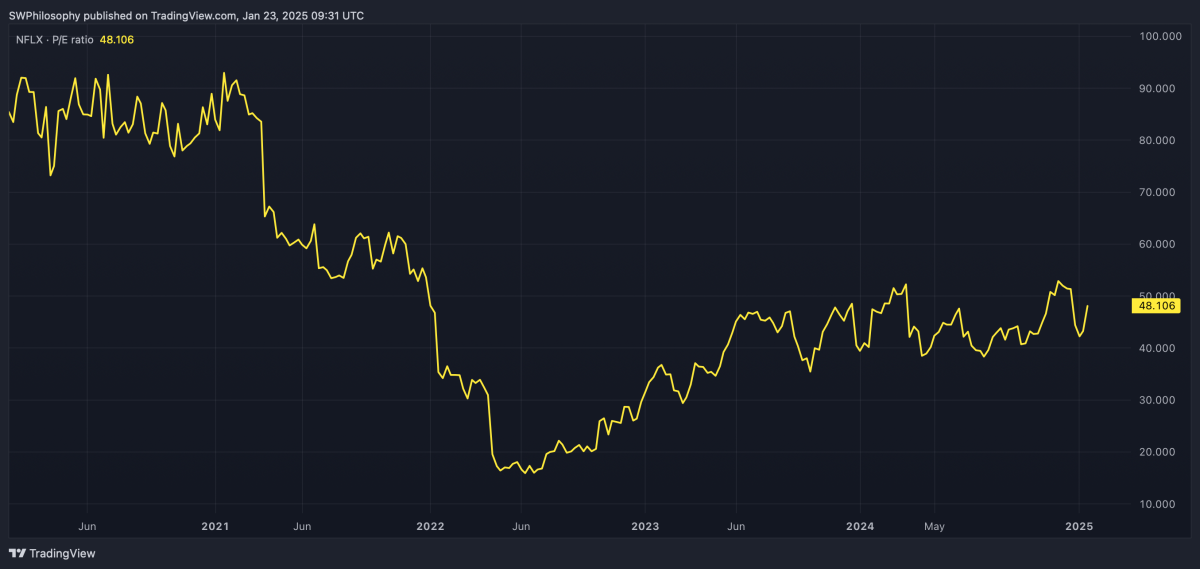
Netflix shares trade at a price-to-earnings (P/E) ratio of around 48. That’s high, but it doesn’t mean the stock is a bad investment – it was at 85 times earnings five years ago and it’s up 171% since then.

Netflix P/E ratio 2020-25

Created at TradingView

The reason it’s worked out so well is straightforward – the business makes a lot more money now than it did back then. Earnings per share have gone from $4.13 to $17.69, which is a 328% increase. 

Even with the P/E ratio coming down, profit growth has pushed the stock higher. This has been driven by a combination of increasing revenues and widening margins.

The big question is whether it can sustain this going forward. And while the business is clearly in a strong position, there are a couple of charts I’m looking at that give me reason to hesitate.

Revenues

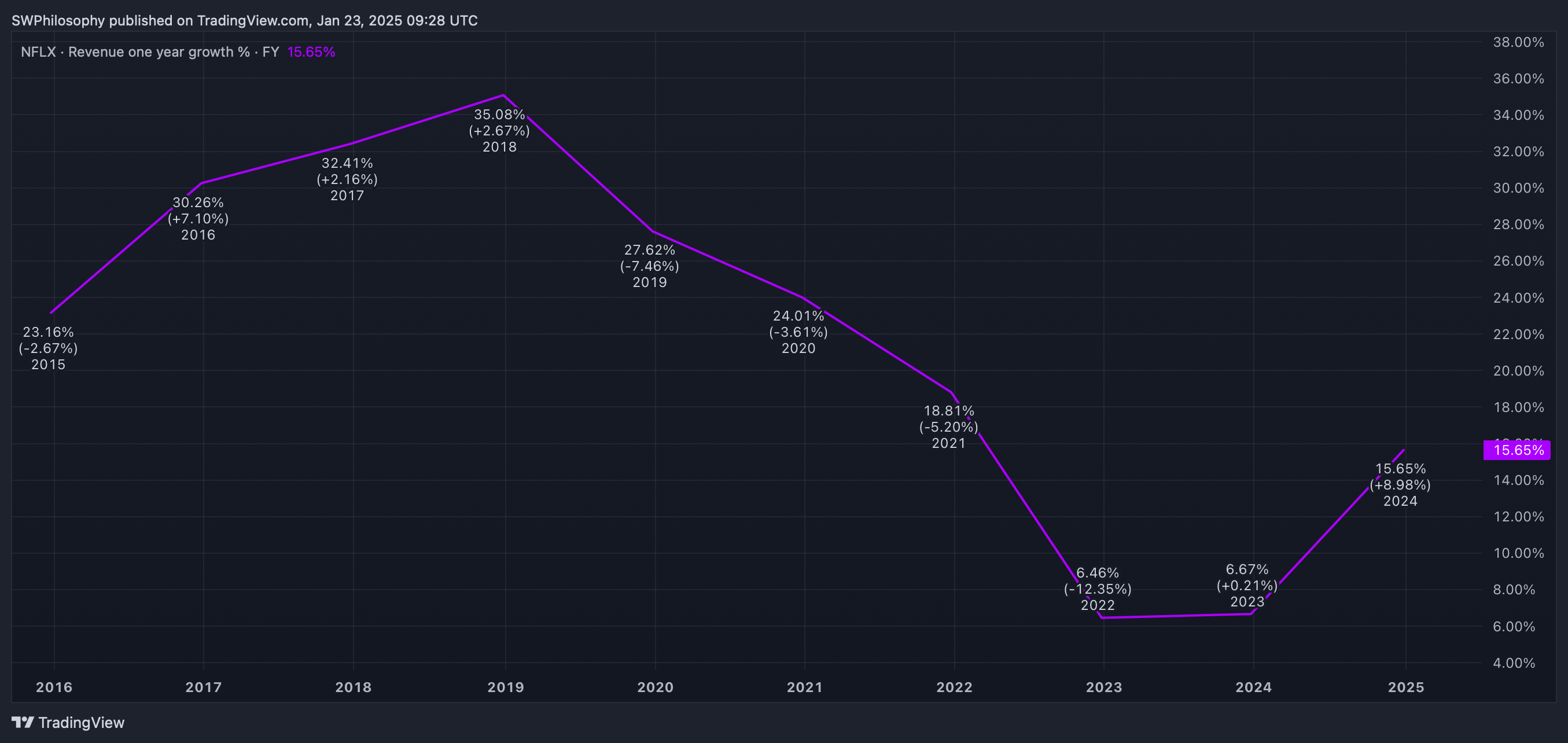
Revenues were up 16% in the fourth quarter of 2024. That’s a good result, but it’s worth noting that before last year, the rate of sales growth had been slowing quite considerably over the last 10 years.

Netflix revenue growth 2015-24


Created at TradingView

Netflix has recently made a couple of big moves to boost revenues. This has included introducing an ad-supported tier and clamping down on password sharing between different households. 

I think both of these are excellent moves. But they aren’t things that can be repeated – having stopped password sharing, there isn’t anything else to do on that front. 

In its latest update, Netflix announced it’s going to increase prices. That should result in higher revenues, but whether that’s enough to justify the current share price is a more difficult question.

Profits

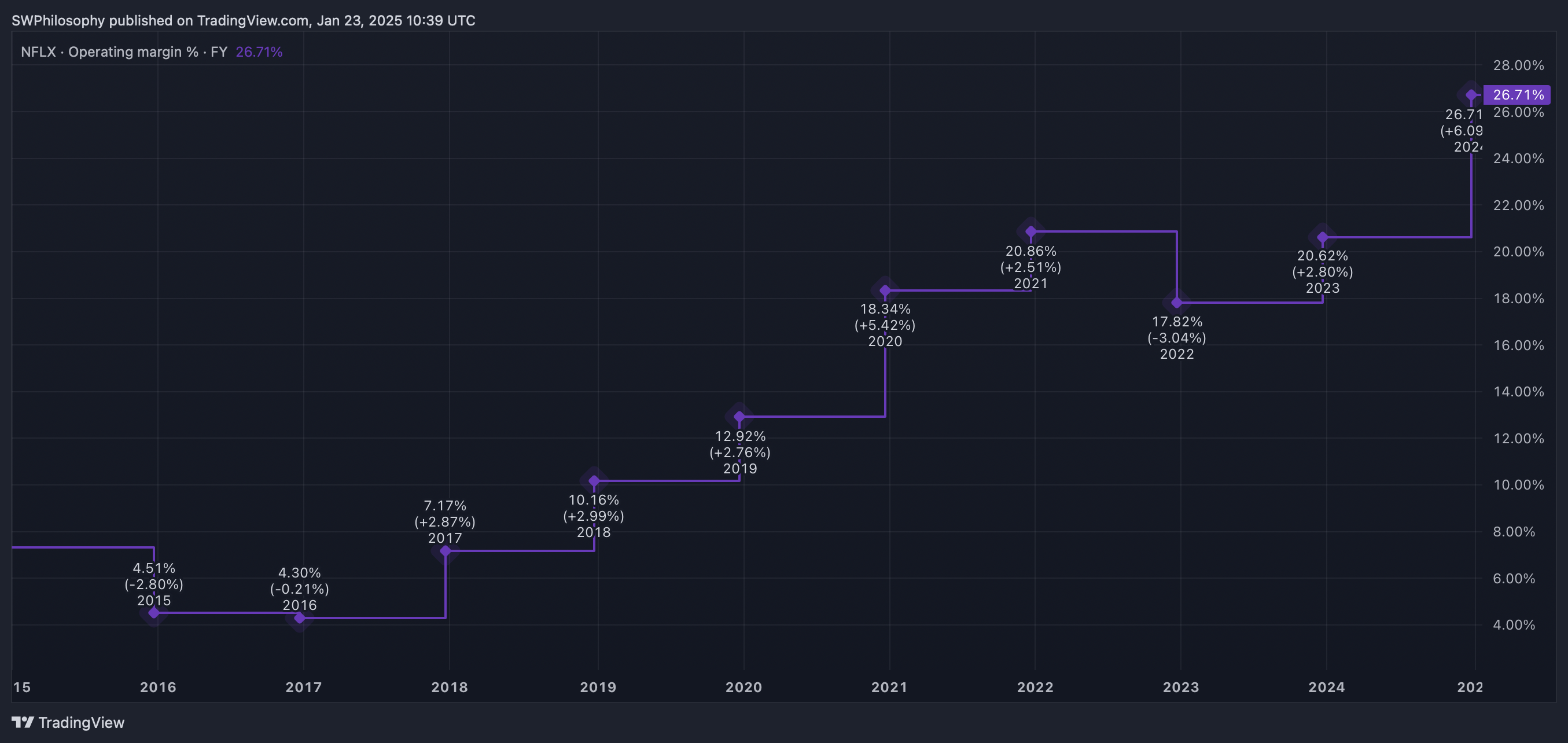
Operating margins have also increased significantly over the last 10 years. To some extent, this is to be expected as the business achieves greater scale, but the question is how much further they can go. 

Netflix operating margins 2015-24


Created at TradingView

Netflix still has – and probably always will have – significant costs associated with creating and acquiring content. I don’t see a way around that over the long term. 

The recent initiatives that have been boosting revenue, however, show how the firm can earn a very strong return on those investments. The associated costs are minimal, so margins have been widening. 

It also doesn’t cost Netflix anything to raise prices, so there’s a chance margins could increase further. Once again, though, the question is how far and whether the stock is worth it at today’s prices.

Tough one

A couple of years ago, Netflix was in a position where the business didn’t need much to go right for the stock to be a bargain. That’s the kind of margin of safety I look for when I’m looking for shares to buy.

I don’t see that right now with the stock. So while I find it very tempting to just go for it and hope the company can grow enough to make that decision pay off, that’s just not my style as an investor.

A boohoo director just bought £99k worth of shares! Time to buy this UK stock?

If boohoo (LSE: BOO) isn’t the worst UK stock to have owned over the past few years, it’s certainly up there. Or down there, as the case may be.

Since June 2020, the boohoo share price has lost 93% of its value and now trades for 29p! ‘Ouch’ almost doesn’t quite cut it.

However, a couple of notable insiders have been buying the fast fashion stock recently. Should I follow suit? Let’s discuss.

Insiders are bullish

Earlier this month, boohoo co-founder Carol Kane upped her stake in the company, snapping up 320,943 shares at a price of 31p. That purchase cost just under £100k.

Then yesterday (22 January), filings revealed that she’d splashed out another £99k on a further 330,295 shares at 30p each.

Back in December, new CEO Dan Finley bought 294,350 worth of stock. The price for those? Also £99,000.

As legendary Wall Street investor Peter Lynch once observed: “Insiders might sell their shares for any number of reasons, but they buy them for only one: they think the price will rise.”

Clearly then, insiders see value on offer here, and the stock does look cheap on paper trading at just 0.3 times sales.

Why does boohoo now trade for pennies?

Now, I wouldn’t rush out to buy a struggling share just because executives have been doing so. I want to know the reasons why it has fallen so much.

In the case of boohoo, it has faced many challenges. The main ones include weakened consumer demand, high inflation, supply chain scandals, and increasing product returns from customers.

Arguably the biggest problem though has been intense competition from fast fashion giant Shein. Quite simply, it is beating boohoo at its own game, offering much more choice at cheaper prices.

Turnaround potential

In the six months to the end of August, boohoo’s revenue fell 15% year on year to £620m, while the underlying operating loss widened to £18.3m from £4m. It cited “ongoing headwinds” at its youth brands (boohoo, boohooMAN, PrettyLittleThing, and NastyGal).

I find that worrying because these labels — once individually trumpeted but now bundled together as “youth brands” — are supposed to be the growth drivers. Or were. Unfortunately they’re the ones that compete directly with Shein.

The key brand that is performing well is Debenhams, where net revenue jumped 68% in H1. Indeed, this bright performance landed the head of Debenhams, Dan Finley, the CEO job. The hope is that he will work his magic across some of the group’s embattled brands.

In November, boohoo did manage to strengthen its balance sheet by raising £39.3m from shareholders. So a return to top-line growth in FY26 (starting in March) could spark a big turnaround in the share price. That said, analysts don’t currently hold out much hope for this.

Alternatively, perhaps the labels will be sold off to the highest bidder and the group broken up. Those parts might be worth more than the current sum.

Should I invest?

Operating costs are falling, but the company isn’t expected to return to profitability any time soon. And while I’d like to see boohoo stage a comeback, I lack confidence in its mixed bag of brands.

Weighing things up, I think there are less risky growth stocks for my portfolio today.

Growth potential? These FTSE 100 shares are trading below their intrinsic value

Value investors are always on the lookout for shares trading below their intrinsic value. Despite the FTSE 100 hitting a new high this week, I’ve still found several such stocks on the index.

However, a low price doesn’t tell the whole story. Not all stocks are cheap for the same reasons as some might be in financial trouble. To avoid falling into a value trap, it’s important to assess why the price is low and if a recovery’s likely.

How to identify value

The following ratios are used to identify value stocks: 

  • Price-to-earnings (P/E) ratio compares the stock price to the company’s earnings per share (EPS). Undervalued stocks typically have lower P/E ratios
  • Price-to-book (P/B) ratio compares the stock price to the company’s total asset value. A value of 1 indicates a fair price, anything below suggests it’s undervalued
  • The debt-to-equity (D/E) ratio compares the company’s debt to the total value of all issued shares. Ideally, this metric should be below 1 (100%)

With that in mind, here are two undervalued FTSE 100 shares to consider.

Kingfisher 

Kingfisher’s (LSE:KGF) a leading home improvement retailer operating brands such as B&Q and Screwfix. It has a P/E ratio of 13.7 and a P/B ratio of 0.7, suggesting the price could be undervalued.

The company’s gross profit margin’s exhibited volatility in the past, peaking at 29.54% in October 2022 before declining to 21.99% this month.

Analysts have mixed opinions about where the stock might be headed, with some estimating a 53% rise and others, a 10% loss. It’s also one of the most shorted stocks in the UK, likely due to a profit warning issued last November expecting earnings to decline.

There’s no denying that Kingfisher’s current low valuation looks attractive. However, the UK property market’s struggling at the moment, limiting the level of home improvements required. 

It may recover eventually but, for now, I’ll put the stock on the back burner.

Standard Chartered

Despite being the UK’s fifth largest bank, Standard Chartered (LSE: STAN) doesn’t have much presence in this country. It operates mainly in emerging markets including Africa, Asia and the Middle East.

With a P/E ratio of 9 and a P/B ratio of 0.8, the value proposition’s clear. But does it have growth potential?

Over the past four quarters, the stock’s beaten analysts’ expectations for earnings. In Q1 2024, it did particularly well, posting an EPS of 42p — way ahead of the expected 29p. EPS is now forecast to reach £1.49 in 2025.

However, the bank’s net margin fell in 2023 to 8.2% from 10.5% in 2022. This is despite a 30% revenue increase. During the same period, deposits dipped slightly from £383bn to £368bn. Looking ahead, there’s a risk that interest rate cuts could eat into the bank’s profits from loans.

It’s a complex situation to assess, as reflected by the lack of agreement between analysts. Approximately half of analysts viewing the stock have put in a Buy rating, with the other half leaning towards Hold or Sell. This may be partly due to fears that new US tariffs could prompt an economic downturn in the East.

While the undervalued price is attractive, I’ll keep an eye on US tariff developments before deciding on whether to buy.

At £1.42 now, BT’s share price looks cheap to me anywhere under £3.64

BT’s (LSE: BT.A) share price looks cheap on the surface. But is it? My starting point for assessing it is comparing it to its competitors on key valuation measures I trust.

On the price-to-sales ratio, BT trades at just 0.7 compared to a peer average of 1.2. So it looks very undervalued on this basis. The same is true on the price-to-book ratio, on which it trades at 1.1 against a 1.5 competitor average.

However, on the price-to-earnings ratio it is presently at 18.2 versus the average 16.4 of its peers.

To gain more clarity on the potential undervaluation I ran a discounted cash flow analysis. This shows BT’s shares are technically 61% undervalued at their present price of £1.42. Therefore, a fair value for them would be £3.64.

Market unpredictability may push them lower or higher than this, of course. However, it underlines to me just how much value potentially remains in the stock.

The bonus of a good yield as well

BT shares currently yield 5.6%, which compares very favourably to the FTSE 100’s present 3.6% average.

Investors considering a £10,000 holding in the firm – the same as mine – would make £7,484 in dividends on this basis after 10 years. After 30 years this would rise to £43,446.

These returns depend on two provisos. First, the dividends are reinvested back into the stock (known as ‘dividend compounding’). And second, the annual yield over the periods averages 5.6% — it may be lower or higher.

That said, BT’s interim dividend for 2024/25 increased 3.9% from 2.31p in the previous year to 2.4p. If applied to this year’s entire dividend, the total would be 8.312p. This would yield 5.9% on the present share price.

Analysts project this average 5.9% level will remain in place in 2025/26 and 2026/27.

In the long term, a company’s share price and dividend are driven by its earnings growth. A principal risk for BT in this context in my view is any fundamental problem in its infrastructure build-out. This could be costly to remedy and damage its reputation.

However, analysts forecast its earnings will increase by 16.5% each year to the end of 2027.

How does the core business look?

Fo its full fiscal year 2023/24 results, CEO Allison Kirkby said BT achieved its £3bn cost and service transformation programme a year early. She added that it had reached the inflection point in its long-term strategy.

Shortly afterwards, I bought the shares for the first time. And on a somewhat grander level, legendary investor Carlos Slim bought an initial 3.16% stake in the firm as well. My guess is that he sees the same exceptional value in the stock as I do.

BT’s H1 2024/25 results saw year-on-year revenue drop 3% to £10.1bn. However, earnings rose 1%, to £4.1bn. The difference came principally from ongoing cost-cutting. Anyhow, it highlights to me that BT can increase earnings even if revenue declines.

Revenue is the total income generated from sales, while earnings are what remains after operating costs are subtracted.

Will I buy more of the shares?

I am happy with my current weighting of BT shares.

However, without these I would buy the shares now based on their earnings growth potential. This should drive the share price and dividend higher over time, in my view.

Is the Lloyds share price recovery finally kicking off thanks to the Treasury?

There’s no doubt that the Lloyds Banking Group (LSE: LLOY) share price has so far disappointed those who were expecting a bank stock recovery.

Over the course of 2024, Lloyds shares did climb 14%. But at the same time Barclays posted a whopping 70% gain. And NatWest Group managed an even bigger 80%. Lloyds really did look like the lame duck of the home-grown high street banks last year.

Easing fears

A few things have held back the performance of Lloyds shares. It’s the UK’s biggest mortgage lender. And the slow building sector coupled with high interest rates doesn’t help when the economy’s barely limping along.

But it’s also been blighted by the current mis-selling scandal facing car finance providers. It comes after previous mis-selling cases from big finance firms, and it has me shaking my head wondering whether they’ll ever learn.

Lloyds is heavily exposed to this one, and it’s already set aside £450m to cover any potential refunds and penalties. But some analysts watching the case have suggested the bank could be in it for up to £1.5bn. Some even think the total cost to the industry could be as high as £30bn.

Now things suddenly look a little bit brighter, and it’s all down to the UK treasury.

Reduce liabilities

In a submission to the Supreme Court ahead of a hearing on the case, chancellor Rachel Reeves has apparently urged leniency in terms of potential liabilities.

The letter says the outcome could “cause considerable economic harm and could impact the availability and cost of motor finance for consumers“. And it warned that “any remedy should be proportionate to the loss actually suffered by the consumer and avoid conferring a windfall“.

So just cover the costs and don’t impose anything punitive or excessive. I don’t think Lloyds shareholders could really have asked for more.

Since the news broke, the Lloyds share price has gained 5%, and it’s up 13% so far in 2025. That’s by market close on 22 January.

Close Brothers Group will also face the Supreme Court over the affair. And it did even better with a 25% jump in the same two days.

Not over yet

Lloyds isn’t out of the woods yet, and we have no idea how the court will respond to these Treasury missives. And we don’t even know how Lloyds’ board thinks it will go down, as it hasn’t said anything much about the whole thing.

Results for the 2024 full year are due on 20 February, and there’ll surely be something then — even if it’s only an updated figure for funds set aside. And the company hasn’t yet said anything in response to these latest moves.

What does it mean for investors? Well, I don’t think it should affect our long-term view of the bank. That surely will depend far more on economic developments in the next few years.

But it should perhaps ease the uncertainty we face this year. And it boosts my confidence a little in the future of the forecast 4.8% dividend yield. But there’s still some way to go.

Financial News

Daily News on Investing, Personal Finance, Markets, and more!

Financial News

Policy(Required)