Is it game over for the Legal & General share price?

The last year brought more disappointment for the Legal & General (LSE: LGEN) share price. Despite the occasional flash of excitement, it’s slumped more than 6% in the past 12 months. Sadly, this isn’t a one-off.

Shares in the FTSE 100 insurer and asset manager are down 25% over five years. It’s not alone in this. Other FTSE financials have struggled amid higher inflation, rising interest rates and wider stock market volatility.

Yet I still see Legal & General as a brilliant investment, thanks to its blockbuster dividend. The shares currently yield 8.6%, more than double the return from a best-buy savings account or average bond fund.

But am I fooling myself? Those tumbling shares will have wiped out much of the dividend income investors have received.

Is the dividend worth it?

A yield this high also signals trouble. It suggests the share price has struggled – and it has. It also raises questions about sustainability. 

The forecast yield for 2024 is an eye-catching 9.8%, but cover is expected to be just 1.1 times earnings. Investors typically prefer dividends to be covered at least twice by earnings to allow for mishaps.

Even so, the board remains bullish. It’s forecast cumulative Solvency II capital generation of £5bn-£6bn by 2027, which should support payouts. It’s also hinted at returning more capital to shareholders through a potential share buyback in March.

Of course, neither dividends nor buybacks are guaranteed, but both currently seem secure. What about that share price though?

Legal & General’s a financial powerhouse, a big name in pensions, insurance, investment management, annuities and equity release. On 4 December, the company flexed its muscles with a solid trading update, demonstrating resilience in a wobbly market. Operating profits were up, and the group confirmed it was on track to meet ambitious five-year targets.

The shares jumped 5% on the day but failed to sustain momentum. This is partly due to concerns over the UK economy. However, the biggest shadow is the outlook for interest rates.

I’d like some growth with my income please

Markets remain uncertain about how many base rate cuts the Bank of England will deliver this year. Predictions vary from one to four, depending on any given day’s news.

This is critical for Legal & General for two reasons. First, lower rates reduce borrowing costs for businesses and consumers, potentially boosting economic activity. Second, they lower yields on cash and bonds, making dividend-paying stocks like Legal & General more attractive by comparison.

I believe a few cuts are likely over the next 18 months, which could breathe life into Legal & General’s share price. However, I don’t expect a return to near-zero rates.

I’m cautious about the stock’s valuation. It’s no longer cheap, trading at more than 32 times. That’s roughly double the FTSE 100 average price-to-earnings ratio of around 15. That means the shares aren’t a sure-fire winner.

So is it game over for Legal & General’s share price? Given its strong fundamentals, diversified business model and generous dividend, I think it remains a compelling long-term buy-and-hold for me. 

Yet I have to accept that 2025 may still bring disappointment for the share price. If it does, at least the dividends should soften the blow.


£5,000 invested in National Grid shares 5 years ago is now worth…

Including dividends, a £5,000 investment in National Grid (LSE:NG.) shares made in January 2020 is now worth £6,631. That’s an average return of 5.8% a year – almost exactly in line with the FTSE 100

Considering the stock’s often thought to be relatively safe compared to other UK shares, that looks more than respectable. And I think the outlook for the company might be reasonably positive. 

Regulation

National Grid operates a regulated utilities business. And like most things in life, there are good and bad aspects to this. The obvious benefit is a lack of competition. Investors don’t have to try and stay ahead of disruptive trends – the company’s status as a legal monopoly’s protected.

The obvious downside is that the firm isn’t allowed to set its own prices. These are also regulated – by Ofgem in the UK and by a combination of State and Federal organisations in the US. 

National Grid’s allowed to earn a specified return on its asset base. In the UK, that’s currently 4.25% (after inflation) and in the US it’s around 9% (before inflation). 

Growth

So far, so unexciting. But I think there’s a good reason to be optimistic about the company going forward, starting with the UK review of its current allowed rate for 2026. 

At the last review, National Grid’s allowed rate of return was cut from around 6% to the current 4.25%. But this was due to lower financing costs, which are part of Ofgem’s calculations.

Investors might remember though, that interest rates were 0.1% in 2021. And they’re much higher now, which might mean the company’s allowed rate could be set to increase from next year.

Nothing’s guaranteed, which is a risk with the business. But even if interest rates fall from their current levels I think shareholders might have grounds to be optimistic about the rate review in 2026. 

More growth

A higher rate on its current asset base would be a welcome boost for National Grid. But it’s also worth noting that the company has plans to expand this base by making investments. Between 2026 and 2031, the firm plans to spend £35bn on UK transmission infrastructure. And it updates its asset base each year, meaning it can start earning a return on these investments quickly. 

There is however, a complication. While National Grid updates its asset base annually, Ofgem reviews this each time it sets rates. So there’s a risk of the allowed return falling due to lower asset values.

Investors need to factor this into their thinking. But if the company’s careful with its capital expenditures, shareholders should benefit from the investments it makes. 

Looks can be deceiving

On the face of it, National Grid looks like a business with low risk and limited growth prospects. I think that appearance might be misleading on both counts. While regulation brings risk, I think the possibility of a higher allowed rate of return from 2026 could be a big boost for the stock.

Investors should consider this carefully as a possible boost going forward.

£5,000 invested in Barclays shares 1 year ago is now worth…

Barclays (LSE:BARC) shares have doubled in value over the past 12 months. In fact, and as a personal triumph with the banking stock now up 102%, all of my UK investments have doubled in value over the past year with the exception of Lloyds.

I think this goes to show that the UK, and the FTSE 100, can be a great place to find multibaggers.

So £5,000 invested one year ago is now worth £10,000. That’s a great return in anyone’s book. And in addition, an investor would have received a fairly juicy dividend during the period, around 5% of that original investment.

It was a no-brainer

A year ago, I was optimistic about Barclays despite the poor sentiment towards the stock. It was very much unloved. The stock had underperformed its peers, grappling with net interest margin (NIM) downgrades and SEC fines over securities errors.

Yet I believed these challenges presented a compelling buying opportunity. At just 6.9 times forward earnings, Barclays traded at a 35.8% discount to the sector average. Its price-to-earnings-to-growth (PEG) ratio of 1.39, typically a sign of overvaluation, looked appealing when factoring in a near-5% dividend yield.

For me, it was a rare blend of value, growth potential, and income, making it an attractive long-term play.

A management-propelled turnaround

Sentiment change — as it always is — has been a pivotal factor in the impressive recovery of the share price over the past year. In early 2024, the UK’s improving economic outlook and prospects of interest rate cuts began to lift investor confidence.

February also marked a turning point when CEO CS Venkatakrishnan announced a strategic overhaul, including reallocating £30bn in risk-weighted assets (RWA) to the bank’s high-performing UK retail division by 2026. This unit, which averaged a 19% return on tangible equity (RoTE) between 2021-2023, has become central to Barclays’ strategy.

The plan was further bolstered by a £600m acquisition of Tesco’s banking arm and a £2bn efficiency drive, targeting £700m in cost cuts across divisions. These bold moves rejuvenated investor sentiment, propelling the share price upward.

The rate environment conundrum

Higher interest rates are good for banks, until they’re not. I’ve heard this saying used a number of times, and it means that banks benefit from higher interest rates — allowing them to raise NIMs — until their customers start struggling and default. At which point, higher rates can become disastrous.

However, the way things have played out over the past year probably represents the best-case scenario. Interest rates have fallen slowly, allowing banks to also slowly unwind their interest rate hedging, while the UK economy has avoided — albeit narrowly — a recession.

This however, does lead me to an investment risk. Barclays‘ performance, like other UK-focused banks, typically reflects the health of the UK economy. And, informally speaking, I can’t help but feel the chancellor has well and truly screwed things up. A stagnating economy and higher National Insurance contributions could put Barclays’ customers under increasing pressure.

Personally, I’m holding my Barclays shares for the long run. I’d be tempted to add to my position, based on long-term optimism, but concentration risk is an issue given my exposure to Barclays and another UK-focused bank, Lloyds.

Here’s the reason my 1-year old has a SIPP

A Self-Invested Personal Pension (SIPP) can be started at any stage of life — even for a baby. For the 2024/25 tax year, the Junior SIPP allowance is £3,600, which includes government tax relief. As such, contributions of up to £2,880 annually can be made, with the government adding £720 in pension tax relief. This makes it an attractive option for long-term savings.

Why start so young?

Starting a pension early harnesses the power of compounding, where investments grow exponentially over time as returns generate further returns. The earlier contributions begin, the more time there is for this effect to amplify savings. This means even modest early investments become highly valuable later. Additionally, the minimum age to access a pension will rise to 57 in 2028. Younger savers will have an extraordinarily long period of time to build wealth. By starting early, individuals can build a more substantial pot, ensuring a comfortable retirement and taking full advantage of the extended investment period before accessing their pension.

Let’s do the maths

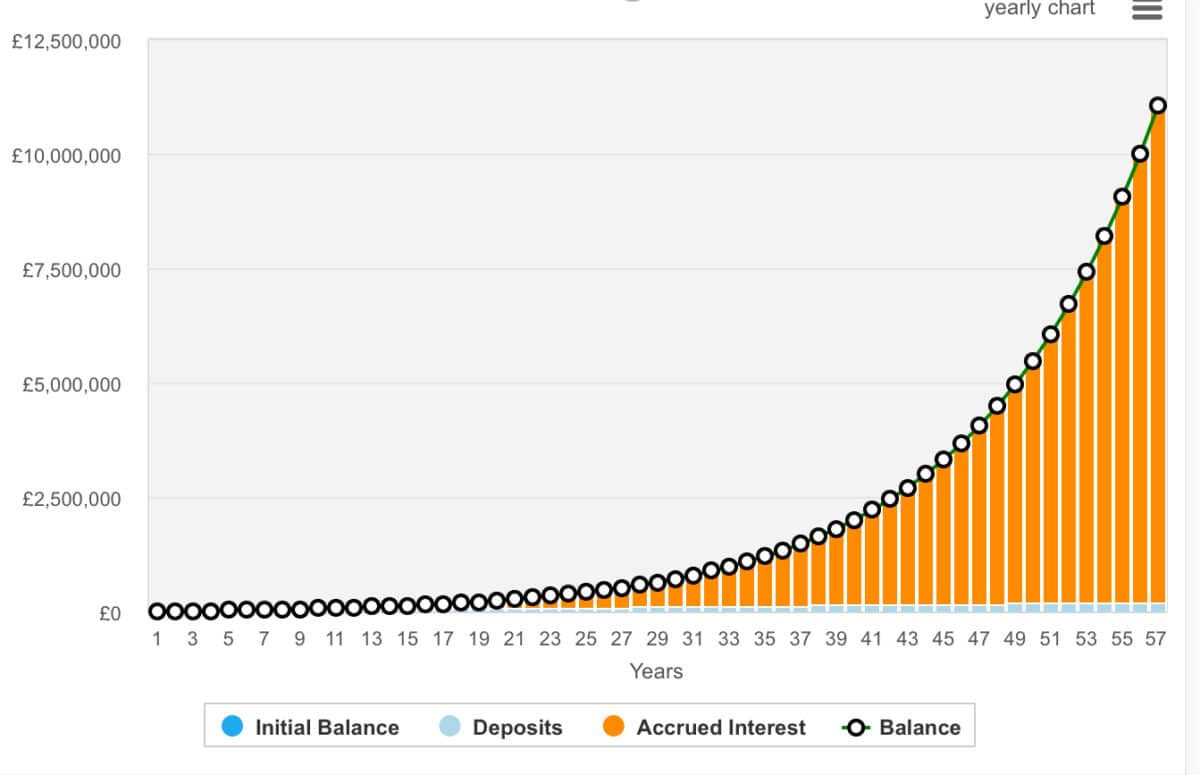
With a possible 57 years of growth — or maybe longer given the direction of retirement ages — a SIPP could become a massive pot of money. In fact, £3,600 a year would compound to £1.2m with 5% annualised growth, £11m at 10%, and £127.3m at 15%. It goes without saying but there’s a huge disparity in end figures based on the annualised growth rate. That’s simply the way compounding works and it’s a reminder as to how investing, even in simple index-trackers, can help build wealth faster than with savings accounts.

Moreover, we need to recognise that the portfolio growth appears to accelerate in the later years. This can be seen in the below graph where we see the growth of £3,600 at 10% annualised.

Thecalculatorsite.com

Fuel for thought

My daughter’s SIPP hasn’t grown as fast as her ISA — which has seen about 60% growth over 12 months. One reason for that is that Hargreaves Lansdown offers fee-free trading on Junior ISAs, but not on SIPPs. In turn, given the relatively small figures involved in the SIPP, I have typically preferred investing in trusts and funds rather than individual stocks to gain diversification.

One of those stocks is growth-focused trust Edinburgh Worldwide Investment Trust (LSE:EWI), operated by Baillie Gifford — which also runs the better known Scottish Mortgage Investment Trust.

While this fund offers diversification, its investment strategy is inherently rather risky. That’s because it aims to invest in entrepreneurial companies before they’re anywhere near maturity. In fact, the trust’s policy was to make the first investment in companies only with a market cap below $5bn. That was actually raised last month to $25bn.

Interestingly, SpaceX represents a whopping 12.3% of the portfolio, which may actually present some concentration risk. That’s followed by another unlisted company, PsiQuantum, at 7.5%. With almost 20% of invested assets wrapped up in these two unlisted pre-profit companies, I appreciate why some investors will be hesitant.

However, Baillie Gifford has a great reputation for picking the next big winners and I’m personally very bullish on SpaceX and quantum stocks in the long run. I believe it will be a bumpy ride, but that’s fine when you’ve got 57 years for maturation.

£5,000 invested in IAG shares 6 months ago is now worth…

International Consolidated Airlines Group’s (LSE:IAG) stock has doubled in value over the past six months. And boy, does that kind of move for IAG shares make me happy.

It’s been my number-one pick in the sector for some time and I’m delighted to see the stock outperform the market. So £5,000 invested in IAG six months ago would now be worth a little over £10,000.

What’s behind the rise?

The IAG share price has surged 100.7% over six months due to a combination of strong operational performance and strategic decisions. Management’s focus on transatlantic routes is part of the reasons the company has yielded record profits, capitalising on rebounding global travel demand.

IAG’s success in repaying debts, reinstating dividends, and announcing a €350m shareholder buyback programme has also demonstrated financial stability — which was questioned during the pandemic — and boosted investor confidence.

Moreover, the FTSE 100 stock was significantly undervalued, trading at just 4 times forward earnings. That made it very cheap compared with the likes of Ryanair, which was around 13 times. In short, improving sentiment, with investors buoyed by strong results and forecasts, has allowed IAG to start making up this valuation gap.

Still room for growth

Analysts still see room for growth in the IAG share price. The stock’s currently trading with a 10% discount to the average share price target, but the consensus target’s risen continually with the share price. That’s a good sign that analysts believe the company’s fortunes will continue to improve.

In fact, there are currently nine Buy ratings, four Outperform, and four Hold ratings. And this reflects a very positive outlook from the analyst community. This is reinforced by many institutions, including JP Morgan, suggesting IAG was indeed the best pick in the sector.

What’s more, and it’s something I believe is often overlooked, IAG offers a fairly unique degree of diversification, thanks to its business model. The British Airways, Aer Lingus, and Iberia operator has a variety of class offerings, catering to leisure and business travel as well as long- and short-haul. This means it’s hedged, to some degree, against falling demand in one of its categories.

Staying diversified

While I’m still bullish on IAG, noting among other things that the stock remains down 23% over five years despite earnings broadly recovering, airlines can be a tricky market segment. For one, it’s typically quite cyclical with historical data suggesting demand suffers during periods of economic decline. Moreover, we’ve also seen that disease outbreaks, be they epidemics or pandemics, can place airlines in existential crises. A slower UK economy, combined with additional National Insurance contributions, may also hurt earnings.

With this in mind, investors should try to remain diversified even if one stock looks like a clear multibagger. Over-concentration in a single asset can amplify risk, particularly in the face of market volatility or unforeseen company-specific challenges.

As such, with my IAG stock up close to 150%, I‘ve been thinking hard about buying more. But concentration risk within my own portfolio may prevent me from doing so.

Here’s the dividend forecast for Shell shares for 2025 and 2026!

As with other major oil producers, demand for FTSE-listed Shell (LSE:SHEL) shares have taken off at the start of 2025. Up 6.1% since 1 January, the business has been driven higher by an mid-single-digit rise in Brent crude prices.

In the last seven days, Shell’s been the fourth-most-purchased share, trust or fund among investors using Hargreaves Lansdown‘s platform. One reason is the potential boost that resurgent oil prices could give to the company’s dividends.

Dividends here have more or less doubled since the depths of the Covid-19 pandemic. And City analysts expect this proud record to continue, as can be seen in the table below:

Year Dividend per share Dividend growth Dividend yield
2024 139.30 US cents 8% 4.4%
2025  146.60 US cents 5% 4.7%
2026 154.20 US cents 5% 4.9%

You’ll also notice that dividend yields for this year and next sail above the FTSE 100 average of 3.6%.

It’s important to remember

though, that dividends are never, ever guaranteed, and that Shell faces threats that may put these forecasts in jeopardy. So how robust do these payout estimates look? And should investors consider buying the oil major for passive income?

Strong numbers

The first thing to consider is how well these expected dividends are covered by anticipated earnings. As an investor, I’ll be looking for a reading of 2 times and above. At these levels, businesses typically have enough room to pay dividends while continuing to invest in their operations.

On this metric Shell scores incredibly highly. For both 2025 and 2026, dividend cover is 2.6 times.

The next thing to look at is the strength of the company’s balance sheet. This is especially important for oil explorers and producers, whose operations require large amounts of capital expenditure.

Shell’s made strong cash generation one of its prioritises, and it continues to make good progress on this front. Free cash flow was $10.8bn in the third quarter, a result that helped pull net debt more than $5bn lower year on year to $35.2bn.

Net debt to adjusted EBITDA consequently fell to 2.2 times, which is reasonable, in my opinion.

However…

Based on all the above, Shell looks in good shape to meet those sunny dividend forecasts. Yet I still have reservations about the oil major’s ability to provide a large and sustained passive income.

Fossil fuel producers are highly cyclical, and a sharp fall in oil prices can cause dividends to fall short despite solid numbers like those above. This is what happened in 2020, when Shell sliced the dividend for the first time since 1945.

While oil prices are rising today, significant supply-and-demand-side threats persist at the start of 2025 that could see them weaken significantly again, hammering Shell’s profits and cash flows. These include soaring output from the US, Canada and Brazil, and poor Chinese demand as the Asia’s largest economy splutters.

As someone who invests for the long term, I’m also concerned about Shell’s ability to consistently pay market-beating dividends as cleaner energy sources become increasingly popular. The firm’s decision to slash renewables-related spending (including to below 10% in 2024) could leave future profits and earnings even more vulnerable in this landscape.

Despite its high yields, I think passive income-chasers should consider passing on Shell shares today.

£1 coins for 70p? 2 FTSE 100 stocks trading at big discounts

The two FTSE 100 stocks I’m looking at today both trade below book value. They also offer generous dividend yields.

These metrics are classic signs of a value stock that could be too cheap. And yet investors seem reluctant to invest, despite the tempting valuations on offer.

I’ve been taking a closer look to see why this might be. Are these shares potential bargains too consider – or are there problems on the horizon?

DIY slowdown

Homeowners in the UK and France aren’t spending as much on home improvements as they were. That’s bad for FTSE 100 member Kingfisher (LSE: KGF), which owns the B&Q and Screwfix businesses in the UK and DIY chains in France.

Management says that consumer uncertainty and unfavourable weather have contributed to a slowdown in DIY sales over the last year.

Fortunately, the do-it-for-me trend means that tradespeople in the UK, at least, have remained busy. Many of them shop at Screwfix and use B&Q’s TradePoint service.

While B&Q sales fell by 1.1% during the third quarter, Screwfix sales were up nearly 5%.

CEO Thierry Garnier says he’s seeing “early signs of improvement” and is working hard to turn around the group’s underperforming French business.

In the meantime, Kingfisher’s share price slump means the stock is trading at a 30% discount to its book value of 358p per share.

The main risks I can see are Kingfisher’s exposure to cyclical pressures and the UK housing market. Sales could remain weak for a while, but I think a cautious outlook is already priced in.

With Kingfisher shares currently offering a dividend yield of 5%, I think they’re worth considering for income and value.

Property at a big discount

There’s a property theme to my selections today. My second stock is commercial property REIT Land Securities (LSE: LAND).

LandSec – as it’s known – owns some prime London office towers and a number of so-called destination shopping centres around the UK. These are super-sized locations (like Bluewater in Kent and now Liverpool One) that draw shoppers from a fairly wide area.

Please note that tax treatment depends on the individual circumstances of each client and may be subject to change in future. The content in this article is provided for information purposes only. It is not intended to be, neither does it constitute, any form of tax advice.

Higher interest rates have had a painful impact on commercial property, putting pressure on prices. Alongside this, the impact of the pandemic created additional uncertainty about future demand for big offices and shopping centres.

As a result, the shares currently trade at a 35% discount to their last-reported book value of 871p per share.

Investors are still cautious. But the evidence so far suggests to me the owners of high-quality, well-located commercial property will continue to see strong demand.

In its latest update, LandSec reported 97.9% occupancy of its central London offices at the end of September 2024. Occupancy of the company’s major retail sites was 96%.

Right now, the stock offer a 7% dividend yield. This payout looks well supported by rental income.

If UK interest rates do start to fall, I think the shares could rise to trade closer to their book value.

What could go wrong? The UK economy could slow down, hitting retail activity. If interest rates stay higher for longer, that could also hold back the shares.

However, this REIT has been in business for 80 years. I see it as a quality choice, and believe the shares are worth considering for their high yield.

£2k in savings? Here’s how an investor could use it to build a £24,126-a-year second income

Building a sustainable and growing second income through investing doesn’t require extraordinary skills or insider knowledge. Private investors have one powerful ally: time. With a long-term approach, even modest sums can grow into a significant passive income stream. 

Here’s how an investor could get started with as little as £2,000 (or even less).

Harness the power of FTSE 100 stocks

The FTSE 100 index is a fabulous source of income. Over the long run, investing in a diversified selection of UK blue-chip stocks can build wealth from a combination of dividends and share price growth.

While even big UK companies can be volatile in the short term, history shows that equities outperform most other asset classes over time. A well-constructed portfolio of 15-20 FTSE 100 stocks is a good starting point. Targeting reliable, established companies with strong customer bases and consistent dividend growth is key. 

These companies are often better equipped to weather economic turbulence while rewarding shareholders with regular payouts.

Cigarette maker Imperial Brands (LSE: IMB) is a good example for investors to consider. Despite the controversies surrounding tobacco, and constant regulatory challenges, it has shown the strength to adapt and survive. The board has worked hard to build strong brands, retain market share and shift into next-generation products such as heated tobacco and vaping devices.

Investors tend to favour Imperial Brands for its reliable dividend income stream. Today, the trailing yield’s an impressive 5.8%. That’s comfortably above the FTSE 100 average of 3.5%. It’s not guaranteed though. No dividend is.

Lately, Imperial Brands share price has been climbing too. It’s up 38% in the last year.

The shares are on fire!

After a strong run, there’s a fair chance the shares could idle. There are long-term threats. A vaping clampdown could wreak havoc, while smoking rates may continue to decline. Yet Imperial Brand has shown bags of resilience over the years. I personally don’t buy tobacco stocks but for those investors who do, I think they might wish to consider this for a brilliant source of dividends and maybe some share price growth too.

Long-term investing is all about patience and harnessing the power of compounding. Over the past 20 years, the FTSE 100 has delivered an average annual return of 6.9%, including reinvested dividends.

Let’s say an investor tucks away £2,000 at age 25 and leaves it in the market for 40 years. With that average return, their investment would grow to £28,850 by age 65. A yield of 5.8% would provide a second income of £1,673 a year. Not bad from a £2k investment.

Investing isn’t a once-and-done process though. Let’s say the same investor put away £2,000 every year for 40 years, under the same growth assumptions. Their portfolio would grow to £415,973 by age 65. Withdrawing 5.8% annually would generate £24,126 in yearly income. That’s a brilliant return, although inflation will have eroded its spending power in real terms.

While the stock market offers compelling growth potential, no investment’s without risk. Market returns may fall short of expectations, and individual companies may face challenges. Diversification’s crucial to reduce the impact of any single underperforming stock.

While £2,000 a year is a solid sum, by gradually increasing that over time our investor could generate even more impressive rewards.

3 investment trusts to consider in 2025 for growth and passive income!

Looking for the best investment trusts to buy for long-term growth and dividend income? Here are three I think investors should consider giving a close look.

JPMorgan Global Growth & Income

The JPMorgan Global Growth & Income (LSE:JGGI) trust does exactly what it says on the label. It invests in a variety of global stocks — typically in a range of 50 to 90 — to drive capital appreciation and generate a decent dividend income.

Last year, the trust raised the annual dividend 23.6%, a rise helped by its large distributable cash reserves.

As with many pooled investments, it has significant holdings in US tech stocks to attain growth. Microsoft, Amazon, Nvidia, and Meta are (in order) its four largest holdings. In total, just over a quarter of its capital is spread across semiconductor manufacturers, software developers, and hardware makers.

But unlike some trusts, this JP Morgan one uses borrowed funds to strive for superior gains. While the presence of gearing like this can amplify investor earnings, it can also exacerbate losses if the trust underperforms.

BlackRock World Mining Trust

The BlackRock World Mining Trust (LSE:BRWM) provides investors with a more targeted approach. In this case, it’s designed to generate a profit as commodities demand steadily grows.

That said, the trust’s exposure to the mining sector is spread far and wide. Approximately 60% is invested in mining companies with global operations, a quality that helps it absorb upheaval (like political instability and conflict) in certain regions. Multinational operators BHP, Rio Tinto, and Glencore are some of the largest of its 60-plus holdings.

In addition, this BlackRock product provides exposure to a range of industrial and precious metals including copper, iron ore, and gold. As a consequence, investors can enjoy a multitude of growth opportunities as well as a stable return across the economic cycle.

The trust could be a great way to capitalise on long-term themes like rising digitalisation, the growth of clean energy, and ongoing urbanisation. However, volatility on commodity markets could impact investor returns from year to year.

Alliance Witan

Alliance Witan (LSE:ALW) is one of the world’s oldest investment trusts. And for dividend hunters, it might be one of the best to consider.

It’s raised the annual dividend for 57 years on the spin.

This is another pooled vehicle with significant holdings in tech giants like Alphabet and Nvidia. But with weighty exposure to other sectors like financials, consumer goods, healthcare, and telecoms, it also holds a number of companies known for paying large and growing dividends.

Famous dividend payers in its portfolio include Unilever, Philip Morris, and Coca-Cola.

In total, the trust has holdings in around 200 companies from across the world. And so it provides superior diversification than many other investment products. But be aware that its high exposure to cyclical industries could still result in poor returns during economic downturns.

I asked ChatGPT if I should buy Nvidia stock in 2025 and it said this…

Nvidia (NASDAQ: NVDA) just became the world’s most valuable company again after a quick burst from its stock price saw it leapfrog Apple.

With its market cap now at a staggering $3.6trn, it’s valued more highly than the entire London Stock Exchange!

But a sad anniversary is approaching in March. That will mark a year since I sold my shares in Nvidia. Since then, the stock is up 60% (cue Homer Simpson’s famous catchphrase)!

To be fair, I assumed I was probably giving up further gains in the near term, hopefully to avoid a massive pullback in the medium term. However, I failed to factor in the likelihood of a Trump return, tax cuts, deregulation, and the rest of it. In short, the unrestrained unleashing of animal spirits on Wall Street.

So infectious have these spirits been that even Europe is interested in harnessing artificial intelligence (AI) rather than merely regulating it. The Labour government said it wants to “mainline AI into the veins” of the UK, though some of the use cases (like spotting potholes) are admittedly less heart-stopping.

Anyway, AI chip king Nvidia’s growth trajectory seems unstoppable once again. So, should I re-buy the stock in 2025?

Calling in the bot

Given that I seemingly sold Nvidia far too early, my human brain is clearly flawed and fallible. So I asked ChatGPT’s silicon AI brain for help.

It informed me that Nvidia’s data centre segment is growing rapidly due to increased cloud computing and AI adoption. The bot assured me that the “ongoing AI revolution is in its early stages“.

However, it cautioned that high interest rates, inflation, and a potential recession in 2025 could hurt tech stocks. I’d go along with the first couple of risks, though the probability of a recession seems low. Indeed, Torsten Sløk, the chief economist at Apollo Global Management, recently said he thought that the probability of a US recession this year is now 0%.

ChatGPT mentioned that the stock is often highly valued. That’s true, as the trailing price-to-earnings (P/E) ratio is 58.

On the other hand, it assured me that Nvidia has consistently delivered strong revenue and earnings growth. That’s less true because in late 2022 (just before ChatGPT was released and when I last bought shares) the company’s Q3 2023 revenue declined 17% year on year. Earnings fell 72%!

This highlights the cyclical nature of the semiconductor industry (which the AI assistant did highlight, to be fair).

Now, I had to push ChatGPT to get off the fence and give me an ‘opinion’. It did, sort of, saying that if I “believe in the long-term secular growth trends in AI, machine learning, and cloud computing, Nvidia could be a great addition to [my] portfolio in 2025.”

None of this has helped me much.

To buy?

Tech companies are apparently increasingly relying on synthetic data (i.e. made up by algorithms) to train AI after exhausting all human-generated data. But the challenges to overcome now include more hallucinations and even model collapses. 

Will large language models ever prove profitable and justify the mind-boggling expenditure? Or are companies massively overspending? I’m still left with the nagging feeling that Nvidia’s sales, pricing power, and ultimately fat margins are unsustainable.

Due to these doubts, I’m not going to reinvest.

Financial News

Daily News on Investing, Personal Finance, Markets, and more!

Financial News

Policy(Required)