Investing a lump sum? 3 ETFs to consider in 2025 to target a near-£25k passive income!

Looking for the best exchange-traded funds (ETFs) to buy for a large retirement income? Here are three to consider for a diversified and high-returning shares portfolio.

Bargain hunt

Owning a selection of value shares can deliver substantial capital appreciation over time. The theory is that these companies’ share prices will eventually correct higher as the market wises up to their earnings potential.

The iShares Edge MSCI World Value Factor ETF‘s (LSE:IWVL) a fund that provides investors with this opportunity. It holds positions in 398 businesses across the globe, with a particular focus on US and Japanese shares (these comprise roughly 40% and 22% of the fund respectively).

A large weighting of tech stocks (25% of the fund) also means large positions in the likes of Cisco Systems, Qualcomm and IBM.

Annual returns haven’t been especially high over the past decade, averaging 5.5%. If this continues, an investor could endure worse returns than if they purchased other funds.

Yet I still think it’s a good stock to consider to create a balanced portfolio.

Gunning for growth

Investors could offset the weaker returns here by also purchasing the Invesco EQQQ Nasdaq 100 ETF (LSE:EQQQ). The average yearly return here stands at an impressive 18%.

As with value stocks, investing in growth shares provides scope for substantial capital gains. This is because these companies typically experience above-average profit increases that drive share prices through the roof.

The fund’s focus on the Nasdaq means investors here also have high exposure to technology companies. This can mean poorer returns during economic downturns.

That said, it can — as we’ve already seen — provide significant returns as the digital economy explodes. Looking ahead, phenomena such as artificial intelligence (AI), quantum computing and robotics could deliver stunning investor profits.

Significant holdings here include Nvidia, Apple and Microsoft.

Targeting dividends

The final ETF to consider is the Xtrackers FTSE 100 ETF (LSE:XDUK). Investing in Footsie-focused funds has a range of advantages, including diversification across market-leading companies and exposure to a stable and mature market.

Another notable perk is that, as an asset class, British blue-chip shares have a strong culture of paying dividends, underpinned by some robust, cash-rich balance sheets. Some of the index’s largest companies include dividend darlings Shell, Unilever and HSBC.

Investing in dividend shares can help provide a healthy return across the economic cycle. Since early 2015, this fund’s delivered an average annual return of 6.4%.

UK shares have underperformed overseas equities in recent years, and this may continue as the domestic economy struggles. But I still expect the FTSE 100 to be a great place to target dividends.

A passive income of almost £25k

Past performance isn’t always a reliable guide to future returns. But if the long-term returns on these ETFs remains unchanged, a £25,000 lump sum investment spread equally across them would lead to an £495,935 (excluding trading fees) after 30 years.

Investing this in 5%-paying dividend shares could then — if broker forecasts are correct — provide a £24,796 passive income for life.


4 UK stocks Fools believe are wonderful companies at fair prices

One of Warren Buffett’s most famous quotes reads “It’s far better to buy a wonderful company at a fair price than a fair company at a wonderful price”. So what stocks listed on UK markets do our contract writers believe match this description right now?

Compass Group

What it does: Compass provides food catering services to schools, offices, hospitals and military facilities in the UK and abroad.

By Mark David Hartley. Compass Group (LSE: CPG) provides catering and food services on an international scale, employing half a million people across Europe. Growth over the past four years has been strong and consistent, with the 147% growth between October 2020 and November 2024. That’s an annualised return of over 25% per year! It’s also a solid dividend payer, with over 20 years of consecutive growth (barring a brief cut during Covid).

Sure, the share price isn’t on the cheap side. But considering the recent growth, I believe they’re fairly valued. Similar growth stocks typically have a high price-to-earnings (P/E) ratio. 33 at the time of writing, Compass’ is relatively low and with earnings forecast to grow, it will probably decrease. The risk is that, when trading so high, any slip in earnings or an economic downturn could send the shares spiralling. Plus, by operating across 50 countries, it’s exposed to political, regulatory and foreign exchange risks.

Mark David Hartley owns shares in Compass Group.

Greggs

What it does: Greggs is a food-on-the-go retailer known for baked pasties and sausage rolls with over 2,500 stores across the UK.

By Zaven Boyrazian. Despite appearances, the UK’s favourite bakery chain, Greggs (LSE:GRG) has long been a cash-generating machine! Demand for pasties and sausage rolls has propelled the business to become the industry leader by market share when it comes to breakfast takeaway. 

Total revenue over the first nine months of 2024 is up 12.7%, with like-for-like sales increasing by 6.5%. Yet shares have taken a double-digit tumble in recent weeks following the reveal of the UK government budget.

With around 30,000 workers on Gregg’s payroll, the incoming hikes to minimum and living wages are a hefty blow. Deutsche Bank has subsequently predicted £97m in increased labour costs over the next two years.

That’s a big hit on margins if Greggs is unable to pass on the higher costs to customers. But this isn’t the first time Greggs has had to raise prices. And while its pricing power does have limits, the bakery chain has so far defied pricing expectations.

With the shares now trading lower, a buying opportunity has emerged, in my opinion.

Zaven Boyrazian does not own shares in Greggs.

IG Group

What it does: IG Group is a global financial technology company, providing online trading platforms for clients.

By Paul SummersIG Group (LSE: IGG) shares have long traded at a valuation far below the average among UK stocks. That looks attractive to me considering this business consistently posts great operating margins and returns on capital employed – two ‘quality’ metrics I pay a lot of attention to.

In addition to this, it’s worth noting that IG makes money in both good and bad times. For example, revenue rose 15% to almost £279m in the three months to the end of August as fears grew about a US recession. 

There are risks, of course. Not unreasonably, this part of the market is often a target for regulators. IG also faces an ongoing battle to keep clients from switching to rivals.

As things stand, however, it remains the market leader in what it does and boasts a robust balance sheet. There’s a chunky dividend as well. 

Half-year results are due on 23 January.

Paul Summers has no position in IG Group

J D Wetherspoon

What it does: J D Wetherspoon is a leading operator of pubs throughout the UK and also has a hotels business

By Christopher Ruane. With a price-to-earnings ratio of 16 at the time of writing, J D Wetherspoon (LSE: JDW) may not be cheap — but it looks fairly priced to me.

It is easy to focus on the downside. Pubs continue to decline in numbers nationally. Spoons reckons that taxes and business costs could rise £60m following the recent Budget. That is above the £49m in post-tax profit the firm posted last year. Clearly, there are risks.

But I think Spoons’ reputation for cheap drinks works to its advantage in this regard. The whole sector will likely need to raise prices following the Budget. So while Spoons may charge its customers more than before, its relative position as the cheapest boozer in many places could become attractive to even more punters.

It has a proven business model, loyal and large customer base and long, deep experience in operating hundreds of pubs. A move into franchises in student unions offers a new avenue for growth.

Christopher Ruane owns shares in J D Wetherspoon.

3 things investors should consider when building a £10k passive income

I’m a big fan of the financial independence, retire early (FIRE) movement. The idea of building a sustainable passive income to supplement and hopefully replace my nine-to-five gig sounds ideal.

Of course, there is a lot of hard work, discipline, and good luck needed to achieve another earnings stream. I think investing in high-quality UK stocks is one of the most achievable ways for me to do this.

Here are three things that investors should be considering when building a passive income for the future.

Investing in the right stocks

Picking the right investments is key. Personally, I prefer stocks with high dividend yields as payout levels tend to be relatively ‘sticky’. Company boards tend to avoid reducing dividends substantially, when they can, to avoid sending the wrong signal to investors.

There are many high-yield stocks on the Footsie. One example is Legal & General (LSE: LGEN), which is currently yielding an impressive 8.7%.

That is well above the Footsie average of around 3.5% and one of the highest within the UK large-cap index. The company is a major player in the UK asset management industry and could benefit from pension consolidations as it seeks to grow assets under management and associated fees.

While high yielding, Legal & General isn’t one for me at the moment. The company’s dividend coverage ratio of 0.9 indicates its earnings aren’t covering its dividends and that creates question marks over future payouts. The price-to-earnings (P/E) ratio being north of 40 is another concern for me.

To that end, it’s important to be aware of the dividend value trap. This happens when investors buy a stock for its high yield but in reality the share price is falling due to poor performance, making the yield look artificially high.

While I’m all for dividend payers that can boost my future portfolio value, Legal & General isn’t one for me. There are several other Footsie stocks with strong yields including GSK, which I am considering.

Building sustainable savings habits

Investing in the likes of Legal & General and other dividend stocks is only possible with cash to invest. Investors that can build healthy savings habits for the long run are really in the box seat to build a sizeable passive income.

These habits are also helpful when hunting for bargains. Investors that have the cash available to buy when others are selling could potentially invest in some cheap stocks and propel their returns in the long run.

Having a rainy day fund

The above is all well and good, but investors can be easily caught out by market movements. The stock market tends to be cyclical, so a recession could impact the value of a portfolio at the same time as people need the cash most.

Clearly, it’s best to avoid selling at the bottom. One of the best ways for investors to protect themselves is by building a ‘rainy day’ or emergency fund to cover a reasonable amount of expenses.

That amount will vary for everyone, but I tend to keep three to six months’ worth of expenses tucked away. By doing this, while picking the right investments and steady savings habits, I can hopefully avoid forced selling and build a long-term passive income.

Here’s how much I need in a Stocks and Shares ISA to earn £50,000 of passive income a year

Every month I invest in my Stocks and Shares ISA to help build wealth. The ultimate goal is to generate passive income from my portfolio.

Here, I’m looking at how large it needs to be to start throwing off my target figure of £50k in tax-free dividends each year. And how long it could take to reach starting from scratch.

Please note that tax treatment depends on the individual circumstances of each client and may be subject to change in future. The content in this article is provided for information purposes only. It is not intended to be, neither does it constitute, any form of tax advice. Readers are responsible for carrying out their own due diligence and for obtaining professional advice before making any investment decisions.

Maths

Stripping things back, I think there are two key ingredients. How much money I invest every month and what my ultimate rate of return is over the long run. The first I hope will be broadly consistent, while the other is harder to know in advance.

For example, the ISA contribution limit is £20k a year and the annual average return from the stock market is around 10% with dividends reinvested. Using those figures, it’s going to take me roughly 17 years to build an £833,000 portfolio. This will be large enough to generate £50,000 a year in passive income, with a 6% dividend yield.

But life can throw curveballs and nearly everything is getting more expensive in the UK. So the reality is that some years I might not be able to max out the ISA limit. However, investing £15,000 a year — or £1,250 a month — would only extend the timeline by just over two years. So thankfully, it won’t change things too much.

Getting there

Now, there are variables here because dividends aren’t guaranteed and I won’t generate 10% every year. These are just averages. But to offset the risk of dividend cuts and underperforming shares, I am keeping my portfolio diversified.

Specifically, I’ve decided to invest in a mixture of growth stocks, dividend shares, and a smattering of investment trusts. I hope these can drive the returns I need to get me to my long-term target.

Some stocks I class as hybrids, delivering both share price and dividend growth. My favourite is probably new FTSE 100 entrant Games Workshop (LSE: GAW). Shares of the Warhammer owner have returned well over 100% in the past five years, including rising dividends. Its policy is to distribute nearly all net income to shareholders.

In the first half of its 2024/25 period, the company’s sales at constant currency jumped 16.4% year on year to £274.2m. Core operating profit increased 17.6% to £98.1m, while income from licensing more than doubled to £28m.

The company warned that higher costs stemming from the Budget may lead to increased input costs from suppliers this year and next. So this is worth monitoring, as is a return of inflation, which could pressurise its customers.

However, I intend to hold my shares longer than 2026. Warhammer has barely scratched the surface of its long-term opportunity in Asia, where tens of millions are deeply invested in gaming, animé, fantasy, and sci-fi genres.

The deal signed with Amazon to adapt its Warhammer 40,000 universe into films and television series should also give the brand a boost. I expect this stock to continue doing well for my portfolio over the long run.

Up 124% in a year! But could the IAG share price still soar from here?

Listening to passengers talking about British Airways, there is no shortage of complaints. Listening to shareholders in BA’s parent company International Consolidated Airlines Group (LSE: IAG) however, I would be surprised to hear many complaints about recent performance. It was the best performer in the FTSE 100 index last year – and the IAG share price has doubled over the past year.

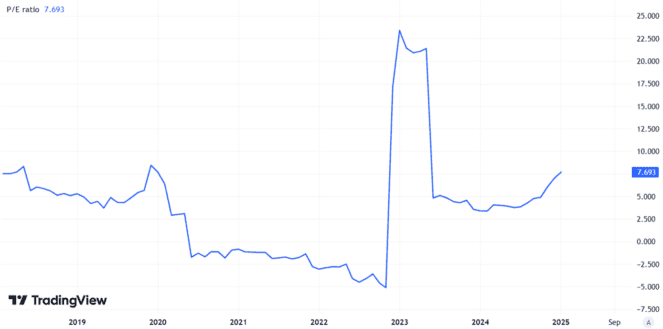
Despite that, the price-to-earnings (P/E) ratio continues to look relatively cheap. At 8, not only does it look pretty modest in absolute terms, it is also well off its highs over the past several years.

Created using TradingView

So, is there room for further share price growth at IAG – and ought I to invest?

Things could get better from here

I reckon there could be space for the stock to move up even more.

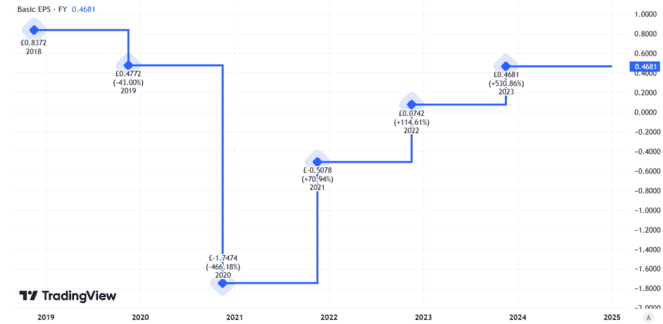
A key reason for the positive mood among investors over the past year is that IAG’s business performance has been improving. A look at the earnings per share demonstrates this.

Created using TradingView

Things are not yet back to where they were in say, 2018, but the direction of travel has been consistent and positive.

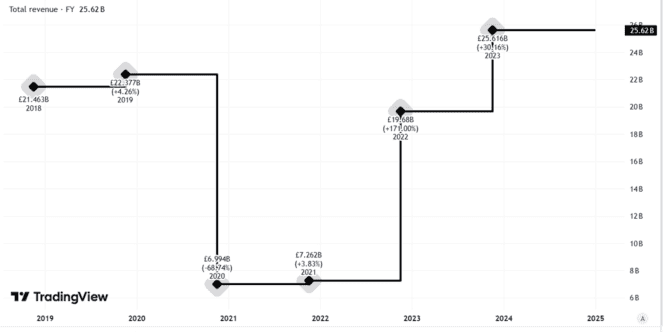
Revenue meanwhile, is ahead of where it stood in 2018. So, if the company keeps a tight rein on costs, that ought to provide an opportunity for profits to move even higher.

Created using TradingView

In the first nine months of last year, net debt fell by around a third. In November the company launched a share buyback, which I take as a sign of financial confidence on the part of the board (though personally I would be more attracted by the money being used to pay down debt or boost the dividend).

Civil aviation demand has been high and the company has struck a positive note about the outlook for this year without yet getting into detailed forecasts.

Am I ready to invest?

However, I have some concerns.

One is what IAG’s years of relentless cost-cutting and testing passengers’ loyalty mean for the business over the long term Yes, lately it has been trying to elevate elements of the passenger experience. But I think that is a reflection of its realisation that it had increasingly lost key competitive advantages as customers questioned why they should shell out big money for airlines with little in the way of service on many routes.

I also see a risk that, when the next big demand shock comes for civil aviation, it could once again hurt revenues, profits – and the share price.

From pandemics to terrorist attacks and recessions, such external shocks tend to pop up from time to time and sit outside IAG’s control to a large extent (or completely).

So while I think the share price could keep moving up, I do not like the risk profile at the current price and so have no plans to invest.

The genie’s out the bottle! After the US invests $500bn, are Warren Buffett’s AI fears warranted?

Speaking at the annual meeting of Berkshire Hathaway shareholders last May, billionaire investor Warren Buffett relayed his fears about artificial intelligence (AI). Comparing the technology to a genie in a bottle, he said: “It’s partway out of the bottle. We may wish we’d never seen that genie, or it may do wonderful things.”

In a few short years, AI has rapidly transformed from a futuristic concept to an integral part of our daily lives. Likening its development to that of nuclear weapons, Buffett is not the only one to express significant concerns about AI’s potential dangers. 

In an open letter penned in 2023, Elon Musk, along with over 1,000 other tech leaders, urged restraint in the development of large AI experiments. The letter noted the “profound risks to society and humanity” that the technology poses.

But over the past week, it seems those fears have all but been forgotten.

A shift in AI policy under Trump

Regulations around AI have already taken a sharp turn under Trump’s new administration. After taking power on January 21, he revoked a 2023 executive order by former President Biden that mandated stricter oversight of AI technologies. 

The move signals a clear shift towards a more innovation-driven approach, with the administration emphasising the importance of maintaining US leadership in AI development. The rationale seems to be that AI will advance either way so it’s better to be ahead of the game.

While that does little to address the potential risks, it makes sense in terms of national security. Risks aside, the move is likely to provide opportunities for investors. As the saying goes, “If you can’t beat ’em, join ’em”.

AI stocks in focus

Trump has brought together three main companies to form Project Stargate, a $500bn AI infrastructure initiative. One of them is ChatGPT-developer OpenAI and the other two are the NYSE-listed tech giant Oracle (NYSE: ORCL) and Japanese conglomerate SoftBank.

The project aims to accelerate the development of AI in the US, starting with a data centre in Texas. Leading US semiconductor giant Nvidia has already seen its stock jump 5% since the news, making it once again the world’s most valuable company by market value, at $3.6trn.

Oracle

Oracle was likely chosen due to its extensive cloud infrastructure expertise and data centre management. Notable growth in this area highlights its capacity to support large-scale AI initiatives, making it a stock worth considering for investors keen on AI exposure.

But its massive debt load poses a risk. At $94.47bn, it exceeds equity by six times and cash tenfold. This could strain its ability to finance interest payments, limiting funds available for expansion. It’s not the AI risk Buffett was referring to but it’s certainly one to watch.

Revenue from cloud infrastructure increased 52% to $2.4bn for the Q2 fiscal quarter ended 9 December. Non-GAAP operating income grew 10% to $6.1bn with a margin of 43%.

“Record level AI demand drove Oracle Cloud Infrastructure revenue up 52% in Q2, a much higher growth rate than any of our hyperscale cloud infrastructure competitors”, said Oracle CEO Safra Catz.

Despite the positive results, the share price fell 8% in December but recovered 16% in the past week. At $185, it is now close to breaching the all-time high of $192 it hit in November 2024.

The Burberry share price soars 15% after today’s results – is there more to come?

The Burberry (LSE: BRBY) share price has been through hell in recent years. Now it’s back with a vengeance.

I pored over this morning’s (24 January) Q3 results, which include the crucial Christmas trading period, wondering how investors would respond. 

Would they take flight at the 7% year-on-year drop in retail revenues to £659m? Or view that as progress following a 22% sales first-half slump?

Comparable store sales fell by just 4% in Q3, compared with a 20% drop in the first half. That’s progress of sorts but they’re still falling.

Can the FTSE 250 stock carry on with its recovery?

I also wondered whether markets would swallow CEO Joshua Schulman’s claim today that his strategic plan “will improve our performance and drive long-term value creation”.

In the group’s last set of results, published on 14 November, investors swung behind the new broom. Burberry shares jumped 17% as Schulman unveiled his ‘Burberry forward’ plan by targeting £40m in savings and “reconnecting our brand with its original purpose”.

The more I looked at today’s report, the more optimistic I felt. Especially with Schulman stating that “it is now more likely our second-half results will broadly offset the first-half adjusted operating loss”.

In November, Burberry said it was too early to tell whether the second half would fully offset the first half on a bottom-line basis. So that’s progress too. I anticipated another jump in the stock and boy, did we get it.

As I write, it’s up 15% and I’m a happy chap because Burberry was my biggest loser last year, leaving me with a 40% paper loss at one point. That’s despite buying the shares after the first of several profit warnings, and averaging down with each subsequent slice of bad news.

The rally began in November and the shares are now up 50% in the last three months. Although they’re still down around 14% over one year (and 55% over two).

As well as celebrating the recovery, I’m kicking myself for not buying even more when Burberry was down. Although I’ve learned that it’s almost impossible to call the very bottom of the market, or an individual stock.

This growth stock is back in play

So today, I’ll take the win and look forward to a brighter 2025. I already have a big stake in Burberry, so won’t buy more. I can see why other investors would consider doing so. But I’d take my time, personally, and beware profit takers. Stocks have a habit of retreating after a big early morning jump like this one. Also, the stock isn’t as cheap as it was, trading at 14.5 times earnings.

Also with the global economy still struggling, we can’t assume the consumers have got their taste for luxury back. China is a particular worry as its economy resists attempts to get it moving again.

The US is in a more optimistic mood, but then we have Donald Trump’s trade tariffs to worry about. Burberry would be right in the firing line, should we get them.

Also, markets are putting a lot of faith in Shulman’s words, but as he admits himself, “it is still very early in our transformation and there remains much to do”. Enough of that. Let’s enjoy today. Burberry is back on track and these things can be infectious. Bring it on!

With £5,000 in UK shares, how much passive income could an investor expect?

UK shares are the go-to choice for many income investors because of their strong focus on dividends. The regular returns that dividends provide equate to a steady cash flow, making income easier to calculate.

Without dividends, investors must rely on selling stocks to gain access to funds. If the market is down, this could mean having to wait until a more opportune time.

Identifying dividend stocks

Consider the long-running and well-established British insurance company Legal & General (LSE: LGEN). It has been paying a dividend for over 25 years, with 16 consecutive years of growth at a rate of 13.3% a year. 

Even during tough economic periods, it has maintained a solid commitment to its shareholders. This is why it is one of the most popular dividend stocks in the UK.

But the past few years have proven particularly difficult for the company. A big earnings drop in 2023 meant its dividend payout ratio reached 276% — a worryingly high level. This metric compares the amount paid out in dividends to earnings coming in, with 100% meaning they are equal.

That means it paid out almost three times its income in dividends in 2023. Clearly, that is unsustainable. Track record or not, if earnings do not improve, it risks having to cut dividends.

Fortunately, things may be looking up. In a trading update last month, the company said it’s on track to achieve its 2024 full-year targeted profit growth of 6-9%. The following day, Goldman Sachs upgraded its rating on the stock to a Buy. 

Growth vs income stocks

Growth stocks also have their place when aiming for passive income. Employees with a steady income may prefer to grow their investment first before shifting it to dividend stocks later in life. In the same vein, early investors may choose to reinvest their dividends, thereby compounding the gains until retirement.

Both options have their benefits depending on the individual investor’s strategy. When considering the benefits of a well-diversified portfolio, it makes sense to include a mix of growth and income stocks. This can easily be rebalanced over time as priorities change.

Calculating returns

Consider £5,000 invested in a portfolio of UK dividend shares with an average yield of 6%. Since dividend stocks tend to have low growth, an investor might expect an average price appreciation of around 3% a year.

The table below outlines an example portfolio with those current averages.

Stock Yield Annualised growth (10 years)
Legal & General 9.0% -0.7%
Aviva 7.0% 0.5%
Rio Tinto 7.0% 5.6%
London Metric Property 6.1% 1.8%
HSBC 6.0% 3.3%
BP 6.0% 0.7%
Segro 4.0% 6.4%
Admiral Group 3.2% 7.0%
AVERAGE 6.0% 3.1%

Within 10 years, a £5k investment in such a portfolio could reach £28,700. A yield of 6% on that would return only £1,615 a year in dividends.

To achieve meaningful dividend income, regular contributions are necessary to build up the portfolio. With just £100 added each month, the pot could balloon to £91,000 in 20 years, paying dividends of £5,000 a year. After 30 years, the annual dividends could equate to over £1,000 a month.

The above example uses averages based on past performance which is not indicative of future results. However, it provides a rough estimate of what a beginner investor should consider in terms of time and contributions required.

Greggs shares have tanked over the last 6 months and a broker says it’s time to sell

Greggs (LSE: GRG) shares have been a lousy investment recently. Over the last six months, the company’s share price has fallen nearly 30%.

To make matters worse for investors, a well-known broker has recently come out with a Sell rating. This particular broker believes the shares are set to continue falling.

Downgraded to Sell

The broker I’m referring to is Panmure Liberum. On Tuesday (21 January), it downgraded the popular FTSE 250 stock from Hold to Sell and cut its price target from 3,300p to 1,733p. That’s roughly 17% below the current share price. This implies that the broker expects the shares to experience further weakness.

Given Greggs’ recent struggles, Panmure Liberum has downgraded its 2025 and 2026 profit before tax forecasts by 6% and 10%, respectively. And it has said that a dividend cut could be on the cards if sales are weak this year.

Its analysts believe that Greggs’ period of ‘supernormal’ growth may be over and they reckon the rollout of evening trade (a strategy designed to boost growth) may actually hurt the high street chain. “We query whether it is resonating with customers in a highly competitive market,” they wrote in a research note.

My view on Greggs

Personally, I’m not as bearish on Greggs shares as Panmure Liberum’s analysts are. After the recent share price fall, I actually think there could be an opportunity here for long-term investors to consider.

It’s not the first stock I’d buy today if I was looking to put some capital to work in the market (I see lots of companies with more growth potential). But I do think it has potential in the long run.

This is a company with a strong brand and a high level of profitability. And it’s rolling out new stores all the time (226 new shops were opened in 2024).

Meanwhile, the valuation has come right down recently. Currently, the forward-looking price-to-earnings (P/E) ratio here is under 15 looking at the 2025 earnings per share (EPS) forecast, although this EPS forecast could fall in the months ahead.

So, I think the stock could be worth considering as a long-term investment. Taking a five-year view, it could potentially deliver attractive returns.

Several risks

Having said all that, there are quite a few risks to consider here.

The weak UK economy is one. This could lead consumers to cut back on food on the go.

The National Insurance changes announced in the 2024 Budget are another. These are likely to hit Greggs’ profits.

Finally, theft – and the associated hit to profits – can’t be ignored. Recently, I read that some Greggs stores have had to put padlocks on their beverage cabinets to stop people stealing bottles of Coke.

Given these issues, risk management is crucial. If one is looking to buy Greggs shares, I think it’s smart to consider taking a relatively small position (and having plenty of other stocks for diversification).

Have I called the BP share price completely wrong?

The BP (LSE: BP) share price has been rising lately, and that’s good news for me because I’ve been busily loading up on its shares.

I decided they were too cheap to ignore, with a price-to-earnings (P/E) ratio of around six. That’s a fraction of the average FTSE 100 P/E of just over 15 times.

At the same time, BP shares offered an unmissable 6% yield coupled with plentiful share buybacks. Typically $3bn a quarter.

The clincher is that the oil price was down in the dumps at around $70 a barrel. If it rose from that reduced base, BP shares would surely follow, and that’s largely what’s happened.

Can this FTSE 100 dividend king fight back?

As I write, Brent crude trades at just over $78 a barrel, although that has slipped slightly from $80 in recent days.

On the face of it, I’ve locked into a top UK blue-chip at a bargain price, and can look forward to years of high and rising dividends. Plus more buybacks and with luck bags of share price growth too.

Sadly, investing isn’t that simple. As with every stock, BP faces a world of risk, only more so.

First, the oil price could drop. If that happens, BP shares are likely to drop too. Anything from worries over peak Chinese demand to oversupply triggered by US President Donald Trump’s “drill, baby drill” energy policy could hit revenues and profitability. As could disappointing global economic growth. Or a shift in Saudi policy. Threats everywhere.

I’m also concerned by reports that big oil producers are borrowing money to fund those share buybacks, as they battle to keep investors happy. That doesn’t seem a sustainable strategy.

BP is still struggling to navigate the energy transition, and has come under fire for cleaving too closely to its fossil fuels heritage. There’s no easy answer here. Pouring money into renewables is costly and uncertain. Sticking to oil and gas is risky too. I’ve no idea what the answer is, but there’s a risk of BP choosing the wrong path.

Stop worrying and reinvest the income

There are broader ‘Black Swan’ risks, such as potential oil spills, Middle Eastern unrest or a breakthrough in alternative energy technologies, such as hydrogen or nuclear fusion.

None of this is easy to predict, in a world that swung from worrying about ‘peak oil’ then ‘peak demand’ and back again, in a matter of years.

Despite these concerns, and the nagging feeling that I’m doing wrong by the planet, I’m sticking with my decision to invest in BP shares.

The risks I’ve listed are reflected in that low valuation. Some of my share price worries are offset by that high yield.

Also, I didn’t have any direct exposure to the energy sector. Since I believe in diversification, that felt like a serious omission. 

I have no idea what will happen to BP next. Nobody does. But I do believe that buying and holding a diversified spread of dividend-paying blue-chips should help me build my wealth in the longer run, so long as I can stand the short-term volatility. And it makes sense to buy when they’re cheap. At today’s low price, I couldn’t resist BP.

Financial News

Daily News on Investing, Personal Finance, Markets, and more!

Financial News

Policy(Required)