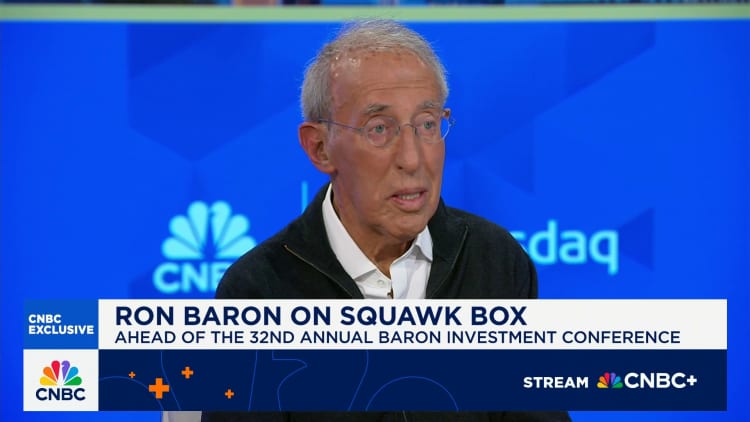
Billionaire investor Ron Baron isn’t flinching during the latest tech selloff, and he’s certainly not touching his own Tesla shares, he said.
The longtime growth investor said he sees the pullback as a chance to spot bargains, even as volatility has rattled the biggest names in tech recently.
“Not very much,” Baron said Friday on CNBC’s “Squawk Box” when asked what he’s doing amid the drawdown. “Just looking and trying to understand where opportunities are and try to take advantage of them.”
His conviction is especially intense when it comes to Tesla, one of his signature bets. He recalled selling a third of Baron Funds’ Tesla holding a few years ago due to criticism from his clients and the media about the significant concentration in a single stock. Baron emphasized that his personal position remains entirely intact.
“We sold 30% for clients. I did not sell personally a single share,” he said.
Roughly 40% of his personal net worth is invested in the electric-vehicle maker, alongside 25% in SpaceX and about 35% in Baron mutual funds.
Tesla shares are down 18% from their 52-week high and were on track to open 5% lower on Friday as investors this week rethink the AI-related shares that have led the bull market.
Baron said he’s already made about $8 billion from Tesla over the years, and he believes he could make five times that over the next decade.
Baron recounted a promise he made to the board of his mutual funds when he sought approval decades ago to invest in public stocks, a pledge that effectively binds him to Tesla and SpaceX for life.
“I told the board, ‘If you let me invest a certain amount of money, then I will promise that I won’t sell any of my stock. I will be the last person out of the stock,'” he said. “I will not sell a single share of my shares until my clients sold 100% of their shares. … And I don’t expect to sell in my lifetime Tesla or SpaceX.”
Ripple Labs has become one of the world’s largest cryptocurrency companies, but executives aren’t stopping there, CEO Brad Garlinghouse told CNBC. Over the past year, the firm has ramped up efforts to bridge the Web3 world and an industry that has long been viewed as its foil — traditional finance.
In an interview with CNBC’s “Crypto World” at the Ripple Swell 2025 conference in New York, Garlinghouse said his firm aims to offer a wide range of traditional financial services built on blockchain infrastructure, capitalizing on growing institutional adoption of digital assets.
A blockchain is a decentralized digital ledger that logs transactions across a network of computers.
“I want to see Ripple invest in [the] future and get ahead of where that market’s going,” Garlinghouse said Tuesday. “The assets we have been buying have been on the traditional finance side, so we can bring crypto-enabled solutions to that traditional financial world.”
Aiming at finance-focused firms
Ripple has been on a nearly $4 billion acquisition spree in hopes of building a financial services powerhouse, in 2025 alone buying prime brokerage Hidden Road for nearly $1.3 billion in April and software firm GTreasury for more than $1 billion this fall. Last week, it launched an offering through its brokerage that will provide U.S.-based institutions access to over-the-counter spot market trading across several tokens, raised $500 million in fresh funding and lifted its market value to $40 billion.
Ripple’s bid to deepen its push into traditional finance comes as institutional demand for digital assets grows the Securities and Exchange Commission and Commodities Futures Trading Commission dialing back digital assets regulations this year under President Donald Trump, a self-styled crypto champion.
Bank of America and Citigroup have begun actively exploring stablecoins, with Citi recently unveiling plans to launch a crypto custody service for clients in 2026. JPMorgan in June said it plans to introduce a stablecoin-like “deposit token” on Coinbase’s public blockchain Base. Beyond dollar-pegged tokens, institutional investors have poured billions of dollars into spot Bitcoin ETFs since their U.S. debut in January 2024.
“ The United States used to lean out on crypto, and now we’re leaning in, and I think people underestimate how big a shift that is,” and the likely impact on the entire crypto market, Garlinghouse said.
Institutional integration
On top of building out its own services, Ripple also aims to sign deals to lend its XRP Ledger technology to larger institutions’ crypto pushes, according to Garlinghouse.
Such partnerships could prove a boon to XRP, the native token of the XRP Ledger, a decentralized blockchain aimed to service fast and low-cost transactions.
“ The more we can build utility and really scale solutions that take advantage of XRP at the core, the more that will be uniquely good for the XRP ecosystem,” Garlinghouse said.
XRP has traded sideways for much of 2025, even as ether and bitcoin sailed to record highs of about $3,900 and $126,000, respectively.
But while high-profile partnerships might push up the price of XRP, dealmaking with traditional institutions is likely to remain difficult due to stalled efforts to create guardrails for cryptocurrency companies and holders in the U.S., Garlinghouse said.
The crypto industry lobby was once hopeful that lawmakers would pass a sweeping digital assets market structure bill called the Clarity Act before the end of the year.
But with the U.S. government shutdown set to enter its sixth week, efforts to establish legislative guidelines for the industry have come to a halt.
“Until we have that [legal go-ahead], it’s gonna be hard,” Garlinghouse said. “Banks are looking for and need that clarity for them to really lean in.”
Michael Burry attends the New York premiere of “The Big Short” at the Ziegfeld Theater in New York City on Nov. 23, 2015.
Jim Spellman | WireImage | Getty Images
Michael Burry, the investor made famous by “The Big Short” who recently roiled the market with a tech short bet, is accusing some of America’s largest technology companies of using aggressive accounting to pad their profits from the artificial intelligence boom.
In a post Monday on X, the Scion Asset Management founder alleged that “hyperscalers” — the major cloud and AI infrastructure providers — are understating depreciation expenses by estimating that chips will have a longer life cycle than is realistic.
“Understating depreciation by extending useful life of assets artificially boosts earnings – one of the more common frauds of the modern era,” Burry wrote. “Massively ramping capex through purchase of Nvidia chips/servers on a 2-3 yr product cycle should not result in the extension of useful lives of compute equipment. Yet this is exactly what all the hyperscalers have done.”
Burry estimated that from 2026 through 2028, the accounting maneuver would understate depreciation by about $176 billion, inflating reported earnings across the industry. He singled out Oracle and Meta Platforms, saying their profits could be overstated by roughly 27% and 21%, respectively, by 2028.
CNBC has reached out to Oracle and Meta for comments. Nvidia declined to comment. Burry’s accusation is a serious one, but could be hard to prove because of the leeway companies are given in estimating depreciation. CNBC was not independently able to confirm this practice was being done by the companies.
When paying for a large asset upfront — like semiconductors, servers, etc — a company is then allowed under generally accepted accounting principles, or GAAP, to spread out the cost of that asset as a yearly expense that is based on the company’s estimate of how rapidly that asset depreciates in value. If companies estimate a longer life cycle for the asset, they can then lower the yearly depreciation expense that hits the bottom line.
Burry, who famously bet against subprime mortgages before the 2008 financial crisis, has warned this year that AI enthusiasm resembles the late-1990s tech bubble.
Burry last week revealed seemingly fresh wagers against AI favorites Nvidia and Palantir Technologies. He disclosed put options with a notional value of about $187 million against Nvidia and $912 million against Palantir as of Sept. 30, according to a regulatory filing. The filing didn’t specify the strike prices or expiration dates of the contracts.
Shares of Nvidia rebounded nearly 6% on Monday after dropping 7% last week. Palantir saw its shares pop almost 9% on Monday following a 11% sell-off last week. Nvidia was lower again on Tuesday.
Burry said in his X post that “more detail” was coming on Nov. 25 and that readers should “stay tuned.”
In another attempt to make homebuying more affordable, President Donald Trump floated the idea of a 50-year mortgage in a social media post. In response, Federal Housing Finance Agency director Bill Pulte, who oversees Fannie Mae and Freddie Mac, posted that they are “working on it,” and that it would be, “a complete game-changer.”
The purpose of a longer-term mortgage would be to lower the monthly payment for homeowners. The longer the term of the loan, the smaller the principal needed each month to pay it off in full. But such a plan has other trade-offs.
Using the latest median sale price of a home from September, $415,200, according to the National Association of Realtors, and the current interest rate of about 6.3%, according to Mortgage News Daily, on a 30-year fixed loan with a 20% down payment, the monthly payment of just principal and interest would be $2,056. If you raise the length to 50 years, at the same interest rate, that payment would be $1,823, a savings of $233 per month.
Homeowners, however, would not build equity as quickly because their principal payments would be smaller. The amount of interest paid to lenders would be 40% higher.
How it might work
The real question is can Fannie and Freddie do this. Analysts say it is possible, but a 50-year mortgage does not currently meet the definition of a qualified mortgage under the Dodd-Frank Act, which provides investors with a backup from Fannie and Freddie if a loan goes bad. But regulators were given the authority to change that in order to insure mortgage affordability. That, however, could take up to a year, given the need for congressional approval, according to Jaret Seiberg, a financial services and housing policy analyst at TD Cowen.
“Fannie and Freddie could establish a secondary market for 50-year mortgages in advance of policy changes. They even could buy mortgages for their retained portfolios. Yet this would not alter the legal liability for lenders. It is why we believe lenders will not originate 50-year mortgages absent QM [qualified mortgage] policy changes,” wrote Seiberg in a note to clients.
Get Property Play directly to your inbox
CNBC’s Property Play with Diana Olick covers new and evolving opportunities for the real estate investor, delivered weekly to your inbox.
Then there is the question of the mortgage rate. The average rate on the 15-year fixed mortgage is currently 66 basis points lower than the rate on the 30-year fixed, according to the Mortgage Bankers Association. This would imply that the rate on the 50-year fixed would be higher. It all depends on investor demand for the product.
“There is not currently a secondary market for such loans, nor would a robust secondary market be cultivated any time soon,” said Matthew Graham, chief operating officer at Mortgage News Daily. “That means that, in addition to the extremely low amount of principal paid down in earlier years of the loan, the interest rates would also be quite a bit higher than 30-year loans — a double whammy for those with any hope of building equity.”
Graham said that for all practical purposes, the loan would be more akin to an interest-only loan, because very few people would keep a home for 50 years. Homeowners could still gain equity through home price appreciation, but prices have been softening swiftly across the nation this year, with nowhere near the appreciation seen in the years previous.
How it impacts affordability
Even realtors agree that the savings to homeowners would be minimal.
“This is not the best way to solve housing affordability. The administration would do better to reverse tariff-induced inflation, which is keeping the rates on existing mortgages high,” wrote Joel Berner, senior economist at Realtor.com in a release.
Others note that this new mortgage product would likely depend on Fannie Mae and Freddie Mac remaining under government conservatorship. The Trump administration has said that the two will be taken private and then have an initial public offering sometime in the near future.
“Adoption of a 50-year mortgage product might complicate the path to privatization for Fannie Mae and Freddie Mac,” analysts at Evercore ISI wrote in a note to clients. “That said, we understand that the Administration is expecting the GSEs to remain under conservatorship after it sells roughly a 5% stake to the public. This would allow the Administration to maintain control of the GSEs for the foreseeable future.”
Home affordability has been a major pressure point for the Trump administration. Historically low interest rates resulting from pandemic-driven economic policy caused an historic run on housing that catapulted home prices more than 50% higher in just five years. As a result, home sales have weakened dramatically, as has mortgage demand.
The average age of a typical first-time buyer in 1991 was 28. By 2024, it had reached 38, according to a report from the National Association of Realtors, whose deputy chief economist called the number, “shocking.”
The Trump administration has been pressuring builders to put up more homes in order to ease prices, claiming they are sitting on an oversupply of empty lots. Builders contest that claim and continue to cite high costs for land, labor and materials.
On the company’s latest earnings call, PulteGroup CEO Ryan Marshall said he agreed with the president’s perspectives as it pertains to an undersupply of roughly 4 million homes for sale, but added, “While this supply deficit certainly has an impact on affordability generally, the complexities of the new home construction industry dictate that tackling a problem of this scale requires a coordinated and comprehensive approach that brings together federal, state, and local leaders working in partnership with the new home construction industry.”
Valar Atomics raised $130 million with participation from Anduril Industries founder Palmer Luckey and Palantir Chief Technology Officer Shyam Sankar.
Valar is developing reactor technology that uses helium as a coolant and operates at higher temperatures than traditional plants.
Valar is suing the Nuclear Regulatory Commission over its licensing process for small reactor designs.
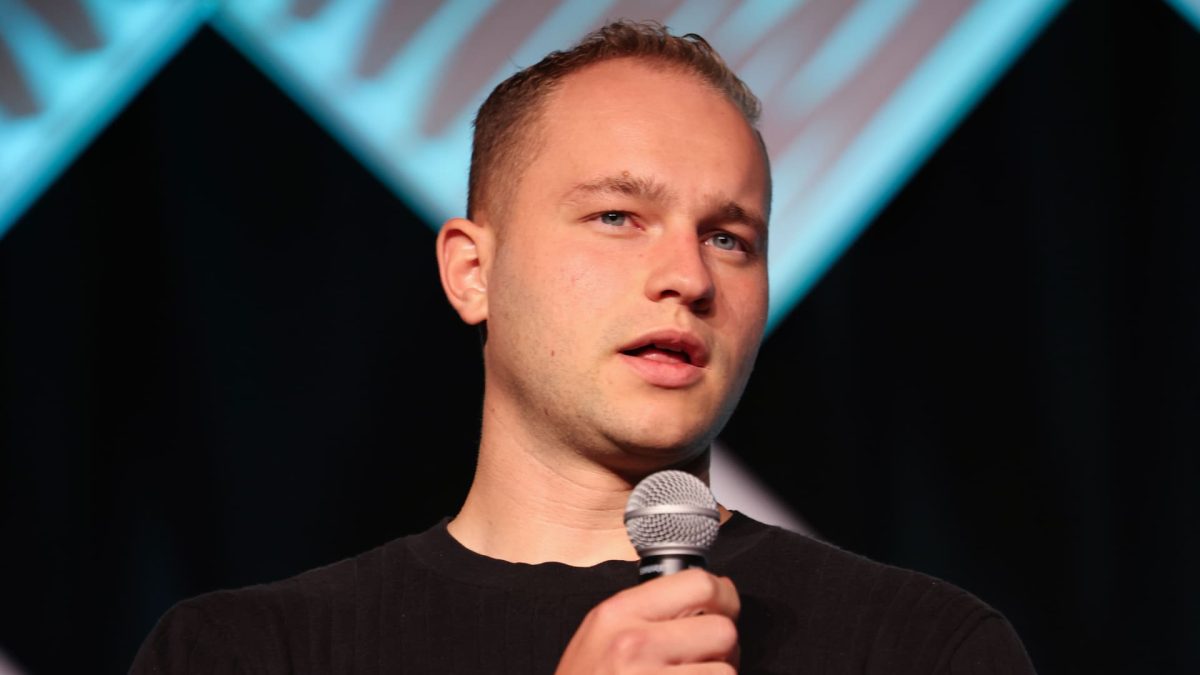
Isaiah Taylor, CEO, Valar Atomics speaks onstage during the Reindustrialize Conference 2025 on July 16, 2025 in Detroit, Michigan.
Tasos Katopodis | Getty Images Entertainment | Getty Images
Advanced nuclear reactor developer Valar Atomics raised $130 million in its latest funding round with backing from Anduril Industries founder Palmer Luckey and Palantir Chief Technology Officer Shyam Sankar, the startup said Monday.
The fundraising was led by venture capital firms Snowpoint Ventures, Day One Ventures and Dream Ventures. Lockheed Martin board member and former AT&T executive John Donovan also participated. Valar’s total fundraising now totals more than $150 million, according to the company.
Doug Philippone, co-founder of Snowpoint and former head of global defense at Palantir, will also join Valar’s board of directors.
Valar is one of several nuclear startups that hopes to benefit from President Trump’s push to deploy new reactor technology in the U.S. by cutting regulations and accelerating approvals.
Based outside Los Angeles, Valar is one of several reactor developers and states that are suing the Nuclear Regulatory Commission over its licensing process for small reactor designs. The parties to the suit are seeking a resolution with the NRC in the wake of Trump’s executive order that would overhaul the regulator. The case has been temporarily paused due to the government shutdown.
Pilot program
The Department of Energy in August selected Valar and other developers to participate in a pilot program that aims to deploy at least three advanced test reactors by July 2026.
Valar is developing reactor technology that would use helium as a coolant and operate at much higher temperatures than traditional plants, according to the company. Its business plan calls for the deployment of hundreds of small reactors at a single site.
Valar broke ground on a site for a test reactor in September at the Utah San Rafael Energy Lab, a unit of the Utah Office of Energy Development.
High valuations for artificial intelligence (AI) stocks were the focus of the market this week, with fears of a potential AI bubble capping investor sentiment. But the view on Wall Street is still that several tech stocks offer strong fundamentals and are delivering rapid, AI-induced growth, justifying their sky-high valuations.
The recommendations of top Wall Street analysts can help investors find attractive AI stocks displaying robust long-term growth outlooks.
Here are three stocks favored by the Street’s top pros, according to TipRanks, a platform that ranks analysts based on their past performance.
Amazon
E-commerce and cloud computing giant Amazon (AMZN) recently impressed investors with its upbeat Q3 results. Accelerating growth in the Amazon Web Services (AWS) cloud unit confirmed the Street’s faith in Amazon’s expansion into artificial intelligence.
In reaction to the solid Q3 print and the recently-announced deal with OpenAI, Mizuho analyst Lloyd Walmsley increased his price forecast for Amazon to $315 from $300 and reiterated a buy rating. TipRanks’ AI Analyst is also bullish on AMZN stock, with an “outperform” rating and a price target of $276.
Walmsley said that the Q3 performance, OpenAI deal and positive outlook for Amazon’s Trainium chips made him more optimistic toward AWS’s long-term growth. In fact, the 5-star analyst expects acceleration in AWS revenue growth from 20% in Q3 to 21% in Q4 2025 and 22% in the first quarter of 2026. He expects AWS revenue to rise by 23% to $157 billion in the full year 2026, followed by a 22% increase to $192 billion in 2027 — above the Street’s expectations of $154 billion and $185 billion for 2026 and 2027, respectively.
“We believe investors continue to rotate into AMZN shares given a valuation well below its historic ranges and positive news likely to continue into the AWS ReInvent Conference in early December,” said Walmsley.
The analyst’s bullish investment thesis is also based on the cost-to-serve improvements in Amazon’s retail business, driven by automation in fulfillment centers and an enhanced logistics network.
Walmsley ranks No. 103 among more than 10,100 analysts tracked by TipRanks. His ratings have been successful 64% of the time, delivering an average return of 27.5%. See Amazon Insider Trading Activity on TipRanks.
Alphabet
This second stock pick is Google- and YouTube owner Alphabet (GOOGL). The company reported better-than-expected third-quarter results, with AI driving solid momentum in its cloud business.
Impressed by the Q3 performance, JPMorgan analyst Doug Anmuth raised his price target for Alphabet to $340 from $300 and reaffirmed a buy rating. In comparison, TipRanks’ AI Analyst has a price target of $316 with an “outperform” rating on GOOGL.
Anmuth highlighted that Q3 marked the first time that Alphabet’s quarterly revenue crossed the $100 billion mark. The top-rated analyst noted Alphabet’s robust performance in the third quarter, with double-digit growth across every major business.
Interestingly, Anmuth believes that Q3 results and favorable insights on AI search formats could change investors’ views toward Google’s AI search transition. Alphabet noted AI-induced acceleration in query growth and paid clicks, while Anmuth noted that industry conversations indicate that paid clicks using Google’s AI Overviews (AIO) and AI Mode (AIM) features are driving higher conversion rates.
“Overall, the AI search transition has been viewed as the greatest risk to Google, but additional signs that AI search is more opportunity than threat will continue to flip the narrative,” said Anmuth.
The analyst is also encouraged by the surge in Google Cloud’s backlog to $155 billion. He contends that the figure doesn’t include all the gains from the recently announced expansion of GOOGL’s partnership with Anthropic, implying a further increase in the backlog at the end of the fourth quarter. Overall, Anmuth is confident about Alphabet’s prospects and said it remains JPMorgan’s Top 2 idea, behind only Amazon.
Anmuth ranks No. 113 among more than 10,100 analysts tracked by TipRanks. His ratings have been profitable 63% of the time, delivering an average return of 22%. See Alphabet Ownership Structure on TipRanks.
Advanced Micro Devices
The third tech giant this week is chipmaker Advanced Micro Devices (AMD), which delivered strong results in the third quarter of Fiscal 2025. AMD attributed stronger earnings and revenue to its expanding compute business and fast-growing AI data center segment.
In reaction, Stifel analyst Ruben Roy increased his price target for AMD to $280 from $240 and reiterated a buy rating. With a price target of $285, TipRanks’ AI Analyst has an “outperform” rating on AMD stock.
Roy noted that AMD’s Q3 top line was driven by strength across the company’s data center, AI, server and PC businesses. The 5-star analyst highlighted management’s optimism toward continued momentum in Q4 FY25, with revenue expected to grow 25% year-over-year to $9.6 billion. AMD expects Q4 revenue growth will be supported by strong performances in its data center, client and embedded businesses, partially offset by a double-digit decline in the gaming segment.
Interestingly, Roy believes that AMD’s performance in the near-term is being fueled more by increasing demand for server central processing units and continued share gains in client CPUs rather than data center AI graphics processing units. The analyst expects AMD’s data center AI GPU business to increase to a range of $6 billion to $6.5 billion in FY25, versus a prior estimate of $5 billion.
“Looking ahead, we continue to believe that AMD is executing well as the company nears production shipments of the MI400/450 series GPUs and the Helios rack next year,” Roy said.
The analyst is also optimistic on AMD’s recently-announced deals with OpenAI and Oracle Cloud Infrastructure, saying they provide clarity on the longer-term growth outlook in its data center AI business. Roy awaits further insights from AMD about its technology roadmap and total addressable market (TAM) at an upcoming Analyst Day event on November 11.
Roy ranks No. 20 among more than 10,100 analysts tracked by TipRanks. His ratings have been profitable 71% of the time, delivering an average return of 34.4%. See AMD Statistics on TipRanks.
(This is the Warren Buffett Watch newsletter, news and analysis on all things Warren Buffett and Berkshire Hathaway. You can sign uphereto receive it every Friday evening in your inbox.)
Berkshire’s stock gains as AI worries depress Wall Street
The upturn for Berkshire shares has cut its underperformance versus the benchmark S&P 500 to 4.3 percentage points from 12.2 percentage points on October 29.
Operating profits for Berkshire’s wholly owned companies were up 34% to almost $13.5 billion in the third quarter, with a 200% increase for insurance underwriting income.
There were again no stock buybacks, a sign Buffett does not think Berkshire shares are significantly undervalued despite their weakness since May.
With no money spent on buying back Berkshire shares and equity sales outpacing purchases, the company’s September 30 cash hit $381.7 billion, up 10.9% since the end of June.
If you subtract BNSF’s cash and account for the timing of some Treasury bill purchases, the total is $354.3 billion, up 4.3% from June.
Buffett’s farewell message?
Warren Buffett may be delivering his final message as Berkshire’s CEO next Monday.
“On Monday, November 10th, Berkshire will be issuing a press release which will contain a message from Mr. Buffett regarding philanthropy, Berkshire and other matters that Berkshire shareholders and others may find to be of interest.”
Warren Buffett walks the floor ahead of the Berkshire Hathaway Annual Shareholders Meeting in Omaha, Nebraska on May 3, 2024.
The “Berkshire and other matters” portion could be something of a farewell message as he prepares to step down as CEO at the end of the year.
While he will remain chairman of the board, he will not be on stage at next May’s meeting and new CEO Greg Abel will be writing the annual letter to shareholders.
Since he appears to be intentionally limiting his future opportunities to speak to shareholders and the rest of the world, Buffett may be ready to have his final say now.
10-Q clues point to more sales of Apple and Bank of America
We won’t know for sure until next Friday’s release of Berkshire’s Q3 equity portfolio snapshot, but it looks like there were more sales of Apple shares during the three months ending September 30.
She also points out that Apple’s 24% gain during the quarter would have provided an opportunity for Buffett to lock in more profits.
Apple remains Berkshire’s largest equity holding, currently valued at $75.2 billion, but it has cut the position by 69% over the past two years.
Barron’sdivides that $1.2 billion cost basis drop by $35, Apple’s per-share basis, to estimate Berkshire may have sold 35 million shares for around $8 billion, based on Apple’s average price of $230 per share during the quarter.
With Apple reporting in its 10-Q that it had $12.4 billion in Q3 equity sales, Barron’s suggests a lot of the remaining $4.4 billion may be Bank of America sales, another big position that Berkshire has been sharply reducing.
That stake has been cut by around 40% since the beginning of last year.
At $32.2 billion, it is Berkshire’s third largest equity holding.
Borrowing more yen is expected to fuel more buying in Japan
All five of the stocks are at or near all-time highs.
The combined value of Berkshire’s reported holdings is approaching $33 billion, up from $31 billion just one month ago.
The figure could be even higher assuming some of Berkshire’s continued buying has not yet been publicly revealed.
‘It’s not me’
Berkshire Hathaway has a new warning about YouTube videos with “images or AI created images impersonating” Warren Buffett.
A news release Thursday said, “Generally, such video images of Mr. Buffett may appear to look like him but the sound of the impersonator speaking in a very flat monotone voice is clearly not the voice of Mr. Buffett.”
It added, “Mr. Buffett is concerned that these types of fraudulent videos are becoming a spreading virus. Individuals who are less familiar with Mr. Buffett may believe these videos are real and be misled by the contents of these videos.”
In April, a Berkshire release cited unspecified “reports currently circulating on social media” about “comments allegedly made” by Buffett and said, “All such reports are false.”
Buffett also warned shareholders at the 2024 Berkshire annual meeting that AI’s ability to create fake audio and video could make scamming “the growth industry of all time.”
BUFFETT AROUND THE INTERNET
Some links may require a subscription:
HIGHLIGHTS FROM THE ARCHIVE
In investing, you can’t be scared when others are scared (2010)
Warren Buffett explains why investors should look at their stocks the same way they would look at owning a farm or an apartment.
WARREN BUFFETT: If you have a temperament that when others are fearful, you’re going to get scared yourself, you know, you are not going to make a lot of money in securities over time, in all probability.
You know, people really — if they didn’t look at quotations — but of course, the whole world is urging them to look at quotations, and more than that, do something based on small changes in quotations.
But think how much more rational — we’ve talked about it before — but think how much more rational investing in a farm is than the way many people buy stocks.
If you buy a farm, do you get a quote next week, do you get a quote next month? If you buy an apartment house, do you get a quote next week or month?
No, you look at the apartment house or the farm, and you say, “I expect it to produce so many bushels of soybeans and corn, and if it does that, it meets my expectations.”
If they buy a stock and they think if it goes up it’s wonderful, and if it goes down it’s bad.
We think just the opposite. When it goes down, we love it, because we’ll buy more. And if it goes up, it kills us to buy more.
And I — you know — all kinds — you know, Ben Graham wrote about it. It’s been explained. But if you can’t get yourself in that mental attitude, you’re going to be scared whenever everybody else is scared.
And to expect somebody else to tell you when to buy and therefore get your courage back up or something, you know —
I could get this fellow’s courage up substantially by saying this is a wonderful time to buy, and then a week from now he’d run into somebody else that tells him the world is coming to an end and he’d sell.
I mean, he’s a broker’s friend, but he’s not going to make a lot of money.
BERKSHIRE STOCK WATCH
Four weeks
Twelve months
BERKSHIRE’S TOP STOCK HOLDINGS – Nov. 7, 2025
Berkshire’s top holdings of disclosed publicly traded stocks in the U.S., Japan, and Hong Kong, by market value, based on today’s closing prices.
Please send any questions or comments about the newsletter to me at alex.crippen@nbcuni.com. (Sorry, but we don’t forward questions or comments to Buffett himself.)
If you aren’t already subscribed to this newsletter, you can sign up here.
Also, Buffett’s annual letters to shareholders are highly recommended reading. There are collected here on Berkshire’s website.
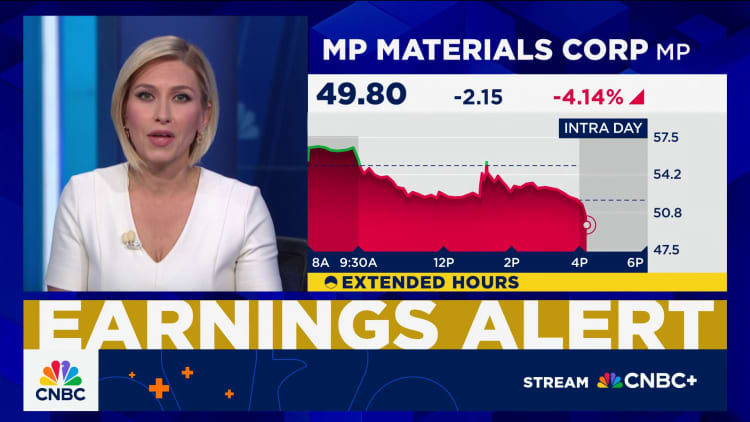
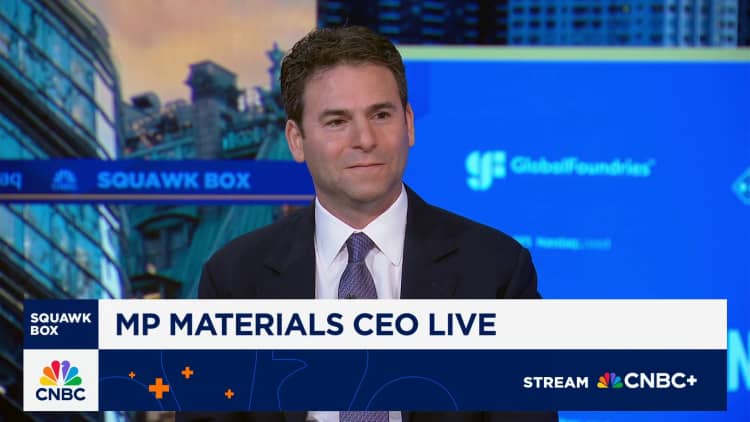
MP Materials CEO James Litinsky cautioned investors to approach other rare earth projects with caution as the market speculates about future government deals.
The Defense Department struck a landmark agreement with MP in July that includes an equity stake, price floor, and offtake agreement.
“The vast majority of projects being promoted today simply will not work at virtually any price,” Litinksy said on MP’s earnings call.
Pentagon-backed MP Materials warned investors this week to approach other rare earths projects with caution, pointing to the industry’s difficult economics.
Stocks of U.S. rare earth companies have had wild swings in recent months as investors have speculated that the Trump administration might strike more deals along the lines of its landmark agreement with MP. Smaller retail traders have gotten involved in the stocks with the VanEck Rare Earth and Strategic Metals ETF up 60% this year.
The Defense Department in July took an equity stake in MP, set a price floor for the company, and inked an offtake agreement with the rare earth miner and magnet maker in an effort to roll back China’s dominance of the industry.
CEO James Litinsky said he didn’t want “people to get burned” amid the speculation. Litinsky cautioned investors “to just be very clear-eyed about what the actual structural economics are amidst all the excitement.”
“The vast majority of projects being promoted today simply will not work at virtually any price,” Litinksy said on the company’s third-quarter earnings call Thursday evening.
Stock chart icon
VanEck Rare Earth and Strategic Metals ETF, YTD
MP views itself as “America’s national champion,” Litinsky said. MP is the only active rare earth miner in the U.S. and has offtake agreements with Apple and General Motors in addition to the Pentagon.
“We have structural advantage because we’re fully vertically integrated,” the CEO said. “We’re years and billions ahead of others.”
It takes years for the best rare earth producers to ramp up and stabilize their output and economics “despite what some promoters might suggest,” Litinksy said. Australia’s Lynas took about a decade and MP will reach normalized production in about three years from the start of commissioning, he said.
The White House is “not ruling out other deals with equity stakes or price floors as we did with MP Materials, but that doesn’t mean every initiative we take would be in the shape of the MP deal,” a Trump administration official told CNBC in September.
Litinsky described the rare earth industry as close to a “structural oligopoly,” a system where there are just a few major players. The government investing in a dozens of sites and businesses wouldn’t necessarily set up a supply chain, he said.
The Trump administration should continue to encourage private capital to flow into the industry through loans, grants and other support, Litinsky said. There is room for “a lot of other players and supply” but the market will require “materially higher prices” for the industry’s structural challenges to change, he said.
“If X dollars of capital can stimulate two or three X in private capital, they should be doing that as much as possible,” Litinsky said.
The CEO indicated that he views MP as a forerunner that will help create the conditions for a broader market that is not dependent on China over time.
“In the very short term the administration has made sure that we have a successful national champion in MP,” Litinsky said. “We are going to sort of pave the path if you will to then figure out how there’s much broader supply coming online.”
Rare earths are crucial for making magnets that are key inputs in U.S. weapons platforms, semiconductor manufacturing, electric vehicles, clean energy technology and consumer electronics. Beijing dominates the global supply chain and the U.S. is dependent on China for imports.
A protester with the Main Street Alliance holds a sign outside the U.S. Supreme Court, as its justices are set to hear oral arguments on U.S. President Donald Trump’s bid to preserve sweeping tariffs after lower courts ruled that Trump overstepped his authority, in Washington, D.C., U.S., November 5, 2025.
Nathan Howard | Reuters
Traders slashed odds that the Supreme Court will uphold President Donald Trump’s aggressive tariffs after justices on Wednesday signaled doubts about the legality of the administration’s sweeping trade powers.
On Kalshi, contracts tied to whether the court would rule in favor of Trump’s tariffs slipped to around 30% from nearly 50% before Wednesday’s hearing.
A similar contract on platform Polymarket dropped to about 30% from more than 40% earlier in the week, reflecting traders’ growing belief that the justices may strike down the policy.
The moves came after several conservative justices joined their liberal colleagues in expressing unease about the broad authority Trump claimed under the International Emergency Economic Powers Act to impose tariffs on imports. They sharply questioned Solicitor General D. John Sauer on the Trump administration’s legal justification of the tariffs, which critics say infringes on the power of Congress to tax.
Lower federal courts have ruled that Trump lacked the legal authority to impose the so-called reciprocal tariffs on imports from many U.S. trading partners, and fentanyl tariffs on products from Canada, China and Mexico.
Prediction markets, which allow traders to bet on real-world events, often react swiftly to perceived signals during high-profile court hearings. Wednesday’s shift suggested that traders viewed the justices’ tone as an indicator of headwinds for the president’s trade agenda.
The Supreme Court will not issue a decision in the case on Wednesday. It is not clear when the court will release its ruling.
Sam Altman, chief executive officer of OpenAI Inc., during a media tour of the Stargate AI data center in Abilene, Texas, US, on Tuesday, Sept. 23, 2025.
Kyle Grillot | Bloomberg | Getty Images
With OpenAI’s recent release of its AI browser, the historic level of capital expenditures being made in the current AI arms race may accelerate even further, if that is possible.
From the reciprocal, and some have said circular, nature of hundreds of billions in commitments in investment, tied to future chip purchases, to the extent to which GDP growth is reliant on this boom, some have said this is a bubble. A Harvard economist estimates 92% of US GDP growth in the first half of 2025 was due to investment in AI.
But much more needs to be understood about the connection between the breakneck investment in AI and the business models that underpins the entire economy: the advertising technology (Ad Tech) industrial complex.
For the past 25 years the infrastructure of the internet has been engineered to extract advertising revenue. Search Engine Marketing, the advertising business model at the core of Google, is perhaps the greatest business model of all time. Meta’s advertising business, based on engagement and attribution, is a close second. And right behind both of these is Amazon’s advertising business, powered by its position as the largest online retailer. While a smaller portion of Amazon‘s topline, its highly profitable advertising business makes up a disproportionate percentage of Amazon’s profits. So much so that nearly every major retailer has spun up their own version of retail media networks, all driving significantly to the bottom lines and market capitalization of massive companies like Walmart, Kroger, Uber (and UberEats), Doordash and many more.
In fact, these platforms have been using AI to refine their advertising business models for years, in the form of algorithmic models that powered their search and recommendation engines, and to increase engagement and better predict purchase decision, seeking an ever-greater share of all commerce, not just what is typically thought of as “advertising.” These three multi-trillion-dollar market cap companies either wholly, or substantially, derive their profits from advertising. And now they are using some portion of those historically profitable advertising revenues to fuel infrastructure investments at a level the world has not seen outside of War Time spending by governments.
But at the same time, the latest wave of AI has the potential to disrupt the very same trillions in market cap that is fueling it. AI will, without question, change how people search (Google), shop (Amazon) and are entertained (Meta). Answers delivered without clicking around the web. AI-assisted shopping. Infinite personalized content creation.
If AI represents such a potential existential risk, why are Google, Meta and Amazon such a huge part of the current arms race to invest in AI? The “moonshot” outcome of would be that achieving Artificial General Intelligence, or Super Intelligence, AI that can do anything a human can, but better, would unlock so much value that it would dwarf any investment.
But there is more immediate urgency to protect, or disrupt, the advertising business model fueling the trillions in market cap and hundreds of billions of current investment, before someone else does. While the seminal paper that launched this phase of AI, “Attention is All You Need” was written by mostly Google researchers, it was OpenAI and Microsoft, and now Grok as well, that launched the current AI arms race. And they are not remotely as dependent on the current advertising industrial complex. In fact, Sam Altman has called the feeds of the major platforms using AI to maximize advertising dollars, “the first at-scale misaligned AIs.” He is clearly stating which businesses he believes OpenAI is trying to disrupt.
What comes next?
This time is different, but it also comes with different risks. The major difference with the current fever in infrastructure investment vs the dotcom bubble of 2000, is that in large part the companies funding it are among the most profitable companies in the world. And so far, there has not been indications of cracks in the business model of advertising that is both funding their investments, and their market capitalizations (along with so many massive companies people wouldn’t think about being in the advertising business).
But if AI does disrupt, or even break, the current advertising model, the shock to the economy and markets would be far greater than most could imagine.
Google, Meta and Amazon are still best positioned to create new business models, and as mentioned, have been using AI for far longer to support their advertising business models with great success.
However, fundamentally changing the way people interface with search, commerce and content online will require just that, entirely new revenue models, maybe, hopefully, some that are aligned, that are not advertising based. But whatever the model, perhaps it is helpful to consider that the justification in AI infrastructure spending may not be to just unlock new revenue, but to protect the business models that make up a much more significant portion of the market capitalization of public companies than most people are aware.
Financial News
Daily News on Investing, Personal Finance, Markets, and more!