5% from a Cash ISA? Scottish Mortgage shares are already up 11% this year!

Cash ISAs continue to be a popular financial product. And with interest rates of around 5% on offer today, I can understand why. Personally though, I think there are better ways to build my wealth. Take Scottish Mortgage (LSE: SMT) shares for example – they’re already up about 11% this year.

A growth-focused investment trust

Scottish Mortgage is an investment trust with a growth focus. Designed for long-term investors with a higher risk tolerance (like myself), it offers exposure to companies operating in high-growth industries such as artificial intelligence (AI), cloud computing, self-driving vehicles, computer chips, space technology, and online shopping.

Given that it’s an investment trust (and not a regular investment fund), it trades on the stock market like company shares do. As I write this, its share price is 1,060p.

Strong gains

The thing is, at the start of the year, the share price was 955p. So already, the shares are up 11% for the year and we’re not even through January yet.

And this strength comes after a great 2024. Last year, the share price rose from 808p to 955p – a gain of 18%.

Personally, I’m loving the recent share price strength here. I have held this investment trust in my SIPP (pension) for many years now but at the start of last year, I put another £4k or so into it. That capital is now up more than 30% (i.e. a gain of £1,200+). Not bad in a little over a year.

I remain bullish

Looking ahead, I remain very bullish on Scottish Mortgage shares (and believe they are worth considering as a long-term investment). There are several reasons why.

First, industries like AI and cloud computing aren’t likely to stop growing any time soon. Realistically, these industries are still in their infancy today.

Zooming in on the AI industry, it is forecast to grow by around 30-40% per year between now and 2030 (AI is the fastest-growing technology in history). So, there could be huge growth ahead for companies operating in it.

Second, the trust is invested in some amazing businesses. At the end of 2024, top holdings included Amazon, Nvidia, Taiwan Semiconductor Manufacturing Company (TSMC), and Mercadolibre.

All of these companies have great long-term track records and substantial growth potential looking ahead. All are set to be beneficiaries of the technology revolution we are experiencing today.

Third, the trust offers exposure to some exciting unlisted businesses. An example here is SpaceX – one of the leading players in the fast-growing space industry.

Not for everybody

Now, I’ll point out that this investment trust isn’t suitable for everybody. As I said earlier, it’s designed for those who are comfortable taking on some risk.

History shows that its share price can be volatile at times. We could potentially see a wobble in 2025, especially if there are concerns about the strength of the economy or corporate spending on technology.

Taking a five-year view, however, I’m excited about the investment potential here. I believe this trust will generate significantly higher returns than savings products such as Cash ISAs in the years ahead.


This FTSE 250 share is up 95% in 3 months! Can it keep rising?

The FTSE 250 stock I’m looking at today has almost doubled in price over the last three months.

Sadly, I missed out on this incredible gain. But as a potential investor, I’m interested to understand whether this strong momentum could continue. Should I consider this stock for my portfolio?

A year of progress

I think Ukrainian iron ore pellet producer Ferrexpo (LSE: FXPO) is best described as a risky investment. The company’s operations have been disrupted by the war with Russia. Among the problems it’s faced are higher costs, power shortages and lower iron ore prices.

However, 2024 was a year of major progress. Production rose by 66% to 6.89m tonnes and access to Black Sea ports improved for exports. Ferrexpo loaded 37 ships last year, up from just 19 in 2023.

The company is expected to report a 44% increase in revenue to $941m for 2024, together with a net profit of $43m. After two years of losses, it’s good to see the business returning to profit.

The company’s improved financial performance was reported with its half-year result in October, just ahead of Donald Trump’s win in the US presidential election. Since then, Ferrexpo’s share price has taken off, doubling in three months.

There seems to be a strong feeling in the market that the Trump presidency has increased the likelihood of a settlement between Ukraine and Russia. That would be likely to benefit Ferrexpo.

Are the shares still cheap?

Despite recent gains, the share price is still around 60% below the levels seen prior to the Russian invasion in February 2022.

One way to interpret this is that it reflects Ferrexpo’s production, which is running at around half pre-war levels of 11m tonnes per year. The main reason for this is that the company has only been able to run one or two of its four pelletising production lines over the last year.

If Ferrexpo could return to full operating capacity, production could potentially double. Revenue and profits would be significantly higher.

More normal operating conditions could see a return to the high profit margins and generous dividends that were the norm prior to the war. In my view, an outcome like this could make the shares look cheap at current levels.

However, Ukraine’s infrastructure has been badly damaged and there’s no way to know if or when the war will end. It’s not clear how easily Ferrexpo would be able to return to pre-war levels of production quickly.

Iron ore prices may also have further to fall.

My approach is to look at Ferrexpo as things stand today. And on that view, the shares don’t look cheap to me.

Broker forecasts for 2025 suggest earnings could fall to around three cents per share this year, due to lower iron ore prices. That puts the stock on a lofty price-to-earnings ratio (P/E) of 46. At this level, Ferrexpo shares are too expensive for me to consider buying.

Could a return to private ownership make NatWest shares a passive income goldmine?

With NatWest (LSE:NWG) shares up almost 100% over the last 12 months, it’s natural for investors to wonder whether that ship has sailed. But analysts at JP Morgan think there’s still an opportunity.

Their expectation is for market share gains, net interest income growth, and the UK government selling its stake to result in higher dividends. If they’re right, this could be a big opportunity.

Investment thesis

First and foremost, the outlook for NatWest – as well as the other UK banks – is positive. Net interest income is expected to grow by around 4.4% in 2025 (and JP Morgan thinks this might be conservative).

UK banks net interest income

Barclays Lloyds Banking Group NatWest
2023 £12.71bn £13.77bn £11.05bn
2024 (est.) £12.7bn £12.94bn £11.15bn
2025 (est.) £13.28bn £13.44bn £11.64bn

Source: S&P Global Intelligence

In a better lending market, NatWest could also be in a stronger position than its peers. The firm has less exposure to car loans than Lloyds Banking Group or Barclays, giving it a stronger balance sheet.

Lastly, the bank is set to go back to being fully privatised later this year, for the first time since 2008. The UK government has reduced its stake to below 10% and is expected to divest this in 2025. 

Once this happens, a change in dividend policy could be on the cards. Instead of returning 40% of its attributable profits to shareholders, this is expected to increase to 50%. 

Putting all this together, JP Morgan is anticipating a dividend yield of around 7% per year from 2026, based on today’s prices. That’s something passive income investors should pay attention to.

I don’t think the NatWest share price is going to stay where it is if this happens. But investors who buy today could find themselves in a very nice position a couple of years in the future.

Risks

For the first time in a decade, NatWest shares are trading above the firm’s book value. That indicates investors are more positive about the outlook for the business than they have been over the last 10 years. 

There is good reason for this – the UK government divesting its remaining stake puts the company in a position it hasn’t been in more than a decade. And that strength should – hopefully – be permanent.

Some of the other issues, though, are less certain. With the car loans investigation, the latest news indicates that the impact on Lloyds and Barclays might be less significant than anticipated.

In that situation, NatWest’s position compared to its rivals might not be strengthened in the way JP Morgan’s analysts are anticipating. So its growth could come in lower than expected. 

Furthermore, lending margins across the board are likely to depend on what happens with interest rates over time. And the outlook for this is far from clear at the moment.

The Bank of England is facing a dilemma between keeping rates high and risking a recession or lowering them at the cost of inflation. In either situation, there could be challenges for NatWest.

Too cheap to ignore?

JP Morgan has a price target of £5 for NatWest shares – around 18% above the current level. And the UK government selling the last of its stake is clearly a long-term positive for the bank. 

Even if the economic outlook is uncertain, a change in dividend policy could make the stock a very good source of passive income. So I think it’s definitely one for investors to consider.

£10,000 invested in easyJet shares 5 years ago is now worth…

Five years ago, easyJet (LSE:EZJ) shares were about to fall out of the sky as Covid-19 brought travel restrictions and disruption. Travel demand has recovered well since then, but the stock has not. 

The share price is still 60% below its pre-pandemic levels, meaning a £10,000 investment made five years ago has a market value of £3,958. But with the business making progress, is the stock a bargain?

Recovery

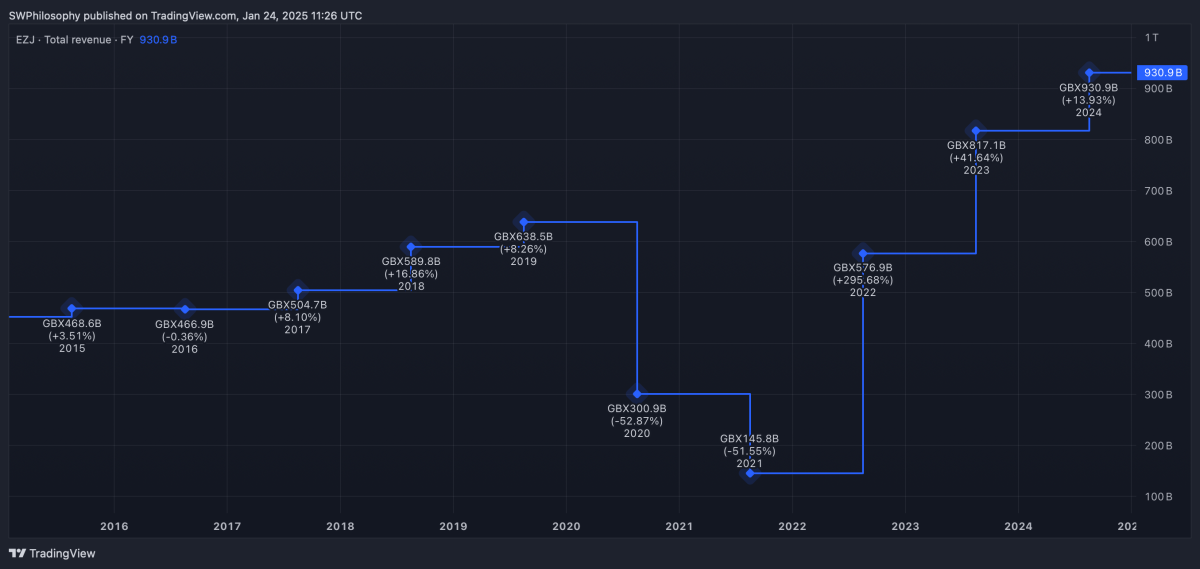
The recovery in easyJet’s business is clear from its income statement. With the return of travel demand, the company’s revenues have bounced back and are now well above pre-Covid levels.

easyJet revenues 2015-25

Created at TradingView

The balance sheet, however, is still an ongoing project. The company’s total debt stands at £3.9bn, which is three times where it was in 2020 and limits the firm’s flexibility if demand drops.

It’s also a lot in the context of a business that generates £597m in operating income each year. And £130m of that gets spent on making interest payments on its outstanding loans. 

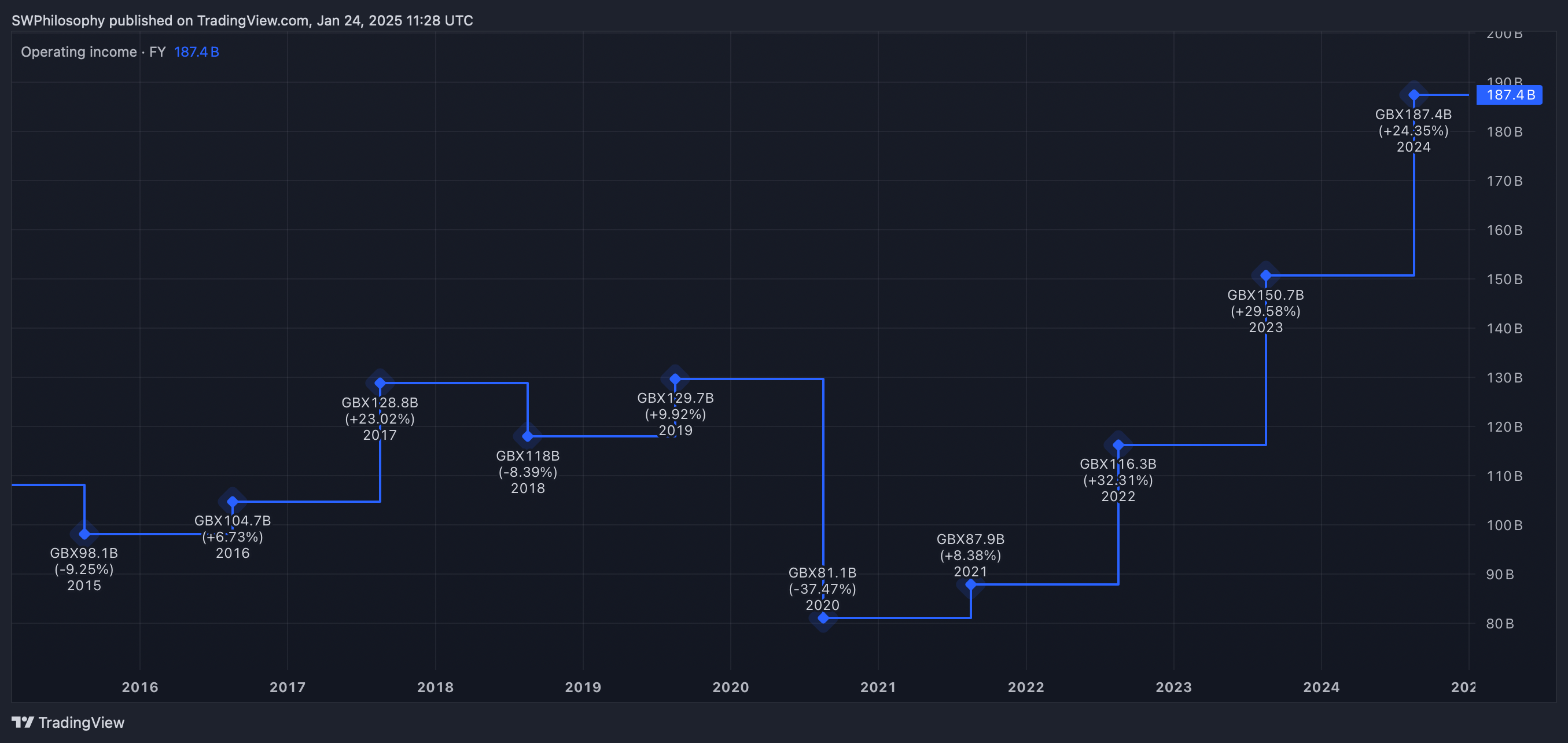
Despite this, easyJet’s operating income has actually recovered quite impressively. While this is being weighed down to some extent by higher borrowing costs, it’s roughly back to 2020 levels.

easyJet operating income 2015-25


Created at TradingView

The trouble is, the company’s share count is also a lot higher than it was in 2020. Instead of 397m shares outstanding, there are now 759m – an increase of around 91%. 

That means the impressive operating profit has to be divided by almost twice as many shares. And this – along with a weaker financial position – is why the stock is well below where it was five years ago.

Outlook

In order to reduce its outstanding shares, easyJet is going to have to buy them back. But having issued them at low prices, repurchasing them could look quite ugly. 

As a result, the firm has moved to reinstate its dividend as an alternative way of returning cash to investors. I think this is a good move – and there’s more for investors to be positive about. 

The company has made some progress in bringing its debt level down. And if it can keep doing this, interest payments should be lower and profits should rise over time. 

This formula has worked for Rolls-Royce over the last couple of years and it doesn’t take much imagination to think it could work for easyJet as well. But the longer it takes, the riskier it becomes.

Outside shocks – such as pandemics or Icelandic ash clouds – can be impossible to predict. But they do happen and it’s important for airlines to be in a strong position to meet them when they do.

At the moment, easyJet is still working its way through a significant amount of debt. And until it manages to do this, I think it’s unusually vulnerable in the event of a downturn. 

Long-term investing

Investors buying easyJet shares during the pandemic might have expected things to go back to normal pretty quickly. But while revenues and operating profits have recovered, the share price hasn’t. 

The reason is the firm’s balance sheet and share count are still a long way from where they once were. And these long-term concerns are enough to put me off the stock at the moment.

2 high-yield passive income shares to consider for 2025 and beyond!

I’m searching for the best passive income stocks to buy and hold for the long term. Here are two on my radar today.

Global X SuperDividend ETF

Largely speaking, share investing remains a great way to generate a large and growing second income. But exchange-traded funds (ETFs) are rapidly growing in popularity with investors seeking dividends. It’s not difficult to see why.

These investment vehicles help to spread risk, as they can still pay decent dividends even if one or two income stocks disappoint. In many cases, they also offer truly stunning dividend yields.

Take the Global X SuperDividend ETF (LSE:SDIP), for example. With investments in 105 global companies across different sectors, it offers exceptional diversification to limit risk. Holdings include Phoenix Group, Brandywine Realty Trust, and British American Tobacco.

As a consequence, I think the fund can be relied upon to provide a stable passive income across the entire economic cycle.

On top of this, SuperDividend’s focus on high-yield stocks means its trailing 12-month dividend yield is a whopping 11.1%. To put that in context, the FTSE 100‘s trailing yield is way back at around 3.5%.

Since the ETF invests in global equities, adverse changes in in foreign exchange rates could impact overall returns. But on balance, I think it’s a great way to target dividend income with risk in mind.

Bano Santander

I’ve not been tempted to buy popular dividend shares Lloyds and NatWest for my portfolio. While they’re tipped to pay large dividends in the short term, their capacity to deliver a huge and growing payout could be impacted by weak growth in the UK economy.

Spanish bank Banco Santander (LSE:BNC) isn’t immune to such pressures. It has significant operations on these shores, as well as across the eurozone where the economic outlook is also gloomy. In total, the bank sources 45% of earnings from Europe.

But its sprawling emerging markets operations could make it a better buy for overall shareholder returns. This could be boosted still further if — as reported — the business exits Britain as part of a wider pivot towards Latin America.

Today, Santander sources around a quarter of profits from this far-flung region. And business is growing rapidly, such as in Brazil where loans and deposits grew 9% and 7%, respectively, between July and September.

With a strong brand name and large presence in heavyweight regional economies including Chile, Mexico, and Argentina, it’s well placed to capitalise on soaring demand for financial products from a growing middle class. Research house Horizon believes Latin America’s banking sector will expand at a compound annual growth rate of 28.3% between 2024 and 2030.

I think this could lead to sustained profits and dividend growth at the bank. For 2025, the total dividend is tipped to increase 7% per year to 20.5 euro cents per share. And so the dividend yield stands at a healthy 4.3%.

While dividends are never guaranteed, Santander’s robust balance sheet means it looks in great shape to hit this target. Its common equity tier 1 (CET1) capital ratio was 12.5% as of September. Dividend cover meanwhile is a rock-solid 3.8 times.

I think 2025 could be the year these low-P/E FTSE 100 shares come good

I see quite a few FTSE 100 stocks on low valuations that I reckon stand a good chance of climbing in 2025.

Centrica (LSE: CNA) is the one that immediately strikes me, with its low forward price-to-earnings (P/E) ratio of seven. That’s only about half the FTSE 100 long-term average P/E.

Centrica shares are actually up 46% in the past five years, which might seem surprising. But in this case, it just means we’re looking at a longer-term decline. Way back in summer 2013, the price was around three times where it is today.

Why so cheap?

A share price doesn’t fall like that unless something goes wrong. And plenty has gone wrong for Centrica, the owner of British Gas. That operation has lost a lot of customers in the past decade or so, while gas demand overall has been in decline. Still, just as renewed investor interest in BP and Shell suggests, I think oil and gas could still see many years of demand ahead.

Oh, remember that P/E of seven? At the 2024 interim stage, Centrica had net cash of £3.2bn on its balance sheet. If we strip that out, it suggests an adjusted P/E of under four for the business itself.

Yes, investing in gas today means taking a risk, with energy price uncertainty added to the mix. But of 15 analysts I can find who are making recommendations, 11 have Centrica as a Buy (with the remaing four suggesting we Hold).

I think Centrica has to be worth considering for investors looking for a recovery.

Retail renewal

I can’t think about low-P/E stocks without JD Sports Fashion (LSE: JD.) coming to mind. On 14 January, the company downgraded its full-year profit guidance after seeing revenue dip in November and December. It’s those old “challenging markets” again. The board reckons profits should be “at the lower end of our original guidance range of £955-1035m.”

It suggests a significant drop in earnings per share (EPS) compared to the previous year, and a P/E of close to 11. Against current retail sector difficulties and fearing a sluggish economic recovery, I’d usually consider that about right for a company like this.

But JD is another forecasters’ darling, with strong earnings growth on their cards starting in 2026. If it comes off, we could be looking at the P/E dropping to just seven in the 2025-26 year. Even with the retail stock risk, JD is another consideration for me for 2025.

Another cheapie?

The International Consolidated Airlines share price has climbed 125% in the past 12 months. But we’re still looking at a five-year fall of 48%. And there’s a forecast P/E of only 6.5 for 2025. Is it going to soar like Rolls-Royce Holdings in 2025?

Airlines can be among the most volatile of stocks and not for those who can’t handle the risk. But for those who can, and who understand how to value growth stock opportunities, I think this is another FTSE 100 recovery candidate worth considering in 2025.

2 dirt cheap growth shares to consider in February!

Buying growth shares provides investors with a chance to book significant capital gains as profits take off.

Snapping them up at low prices can provide even greater share price growth too. The theory is that quality cheap shares can soar in value as the market wises up to their solid fundamentals and rerates them.

Investing in lowly valued growth stocks could be a particularly good idea in these uncertain times. Worsening economic conditions and falling profits could, in theory, limit the scale of any temporary share price reversals.

With this in mind, here are two of my favourite cheap growth shares to consider for next month.

Topps Tiles

Penny stocks such as Topps Tiles (LSE:TPT) can be prone to high bouts of price volatility. But I believe the long-term earnings potential still makes it worth a closer look.

This particular small-cap share has a chance to grow profits as the UK housing market stabilises. As a major supplier of building materials, it can expect demand to rise strongly as homebuilders ramp up construction levels.

I also like Topps’ ambition to capitalise on this through its ‘Mission 365’ growth strategy. It hopes measures like expansion into new products, improving its trade channel, and boosting its online marketplace will increase revenues by around £100m from 2023 levels over the medium term.

Today, the business trades on a price-to-earnings (P/E) ratio of 9.2 times for the financial year to this September, based on City forecasts that annual earnings will soar 58%.

This combination also means the company boasts a price-to-earnings growth (PEG) ratio of 0.2. Any reading below 1 indicates that a share is undervalued.

Topps Tiles faces competitive pressures from retail giants like B&Q and Wickes. Labour costs are also set to rise following the recent Budget. Yet I believe these risks are baked into the company’s low valuation.

Polar Capital Technology Trust

Growth shares can be risky investments due to the elevated valuations they often command. One lukewarm trading statement or signs of sector weakness can cause a firm’s share price to collapse.

Funds like the Polar Capital Technology Trust (LSE:PCT) don’t eliminate this risk. But investment across more than 100 companies helps to balance out this risk.

By investing across various sectors, this particular fund also provides exposure to an array of growth opportunities. Chipmaker Nvidia and software developer Microsoft, for instance, give investors a way to capitalise on the artificial intelligence (AI) boom. The same with carmaker Tesla and self-driving vehicles, and retailer Amazon with e-commerce.

At 367p per share, I think this tech trust offers especially good value today. It trades at a near-9% discount to its net asset value (NAV) per share of 402.6p.

Past performance isn’t a guarantee of future returns. And this growth-focused trust could suffer if economic conditions deteriorate and the broader performance of growth shares follow suit.

But a 19.4% average annual return since early 2015 suggests Polar’s technology trust could be a great way to consider balancing risk and potential profit.

3 SIPP mistakes I’m avoiding like the plague!

A self-invested personal pension (SIPP) can be an excellent way to build more wealth to support my retirement.

However, there are a few common mistakes that I’m very keen to avoid. Here are three of them.

Overtrading

The first is buying and selling shares too often in this account (i.e. overtrading). This can quickly lead to spiralling charges, which would likely erode my long-term returns.

I invest every month in my Stocks and Shares ISA, but I rarely make large purchases for my SIPP portfolio. My holding period for a stock is at least five years, ideally longer. Therefore, buying and selling a lot in my SIPP makes no sense.

My aim is to find some big winners and compound my returns over many years. Interrupting this process by overtrading is counter-productive.

As the late Charlie Munger famously said: “The first rule of compounding: Never interrupt it unnecessarily“.

Selling far too soon

Next, imagine an investor back in early 2010 thought that streaming content online was the future. So they bought shares in an up-and-coming streaming leader called Netflix.

However, after just one year, the value of their holding had more than trebled (a true story!). The stock’s price-to-earnings (P/E) ratio was 70 (also true). According to mainstream financial media, that made the stock ‘overvalued’.

So, while still thinking that streaming was the future and that Netflix was pioneering it, our investor dumped the stock. Let’s assume they invested £1,000 and sold the shares for £3,100. A great return.

However, as is probably obvious, this investor would have left huge gains on the table. Since early 2010, Netflix stock is up 13,450%! By selling far too early, they missed out on more than £130,000 (discounting currency moves).

Obsessing about valuation

The final related mistake I’m keen to avoid is worrying about overvaluation, specifically the P/E multiple.

This ratio is almost entirely useless when evaluating fast-growing businesses in the process of disrupting large established industries (television, in Netflix’s case). It is more appropriate for mature companies optimised for bottom-line profits (earnings).

I’ve never owned Netflix shares, meaning this cherry-picked example is entirely hypothetical. But it still applies to my own SIPP portfolio because I have a handful of growth stocks that have gone up a lot and appear to be conventionally overvalued.

For example, I invested in The Trade Desk (NASDAQ: TTD) at a much lower share price in 2018. The company’s data-powered platform enables major brands and ad agencies to plan, manage, and optimise digital ad campaigns across multiple channels. The fastest-growing areas are connected TV and ad-driven streaming.

The share price is up 325% in the past five years.

This puts the stock on a forward P/E ratio of 89. The main risk with this high valuation is a downturn in the digital ad space, as happened in 2022 when the stock dropped 50%.

However, I’m willing to ride out such downturns and overlook the high valuation because I think the company’s best days are still ahead of it. Net income more than doubled over the first nine months of 2024.

In future, I fully expect data-driven digital advertising to become the norm. As a global ad-tech leader with a smart founder at the helm, I see The Trade Desk’s platform becoming even larger.

1 stock market strategy to target the next millionaire-maker like Nvidia

It’s every stock market investor’s dream to find the next monster success story like Nvidia (NASDAQ: NVDA). Its share price is up by an otherworldly 27,850% in 10 years, turning every £3,600 invested into a cool £1m over that period (excluding currency moves).

Of course, Nvidia is special and the speed and scale at which the artificial intelligence (AI) revolution took off has caught everyone by surprise. Or has it? Perhaps not for some savvy shareholders who were following what CEO Jensen Huang was saying before the AI boom took hold.

But besides being a fly on the wall in the AI chipmaker’s boardroom, how could everyday investors have followed Nvidia’s plans? Well, most companies host earnings calls with analysts to discuss the most recent quarter (or half for many UK companies). Crucially, management often discusses what it expects to happen in future.

The transcripts of many of these Q&A conference calls can be found in several places online, including The Motley Fool. The app I use is Quartr, which contains live earnings calls, transcripts, presentations, conferences, and analyst forecasts — all for free!

Here’s how an investor could use these communications to spot potential timely buying opportunities.

Looking back

As strange as it might seem now, Nvidia hasn’t always blown away Wall Street expectations every single quarter.

For example, if we time-travel back to the third quarter of fiscal 2023 (late 2022), the firm’s revenue dropped 17% year on year. It was suffering from weak chip demand and restrictions on exports to China. Both remain potential risks today.

But within that weakness, data centre revenue still surged 31%. And during the call, management repeatedly stressed how generative AI was really taking off.

CFO Colette Kress said: “Earlier today, we announced a multiyear collaboration with Microsoft to build an advanced cloud-based AI supercomputer to help enterprises train, deploy and scale AI including large state-of-the-art models.”

Later, she added: “Despite near-term challenges, we believe our long-term opportunity remains intact, fuelled by AI…we’re seeing surging demand in some very important sectors of AI and important breakthroughs in AI.

CEO Jensen Huang later reiterated this: “We’re seeing…surging demand for AI.”

For tuned-in investors willing to look past the weak quarter, there were huge gains on offer. The stock is up 855% since that earnings call in 2022!

Looking forward

Recently, one comment in the earnings call of a company I follow — Latin American digital bank Nu Holdings (NYSE: NU) — made my ears prick up.

Mexico is an opportunity that net-net, I think, could be another Brazil for us.

David Valez, founder and CEO of Nu Holdings, Q3 2024.

Nubank, as it’s known, has 100m customers in Brazil, an incredible 57% of the adult population. But only 10m customers today in Mexico (around 12% of the adult population). Interesting.

As a lender, this neobank is inherently exposed to economic volatility and rising defaults. But if Mexico becomes another Brazil for the company, the growth opportunity is immense. I plan to buy more shares.

Foolish takeaway

Reading a company’s earnings call transcripts can help an investor make more informed decisions on when to buy a stock, and vice versa.

In my experience, they often contain insights and breadcrumbs. Following these opportunities can be very lucrative.

If a 40-year-old invested in FTSE 100 and FTSE 250 growth stocks, here’s what they could have by retirement

The performance of both the FTSE 100 and FTSE 250 has been hugely disappointing since 2015. And the outlook for the next decade remains highly uncertain, meaning investors may want to consider individual shares to generate a healthy return.

In the shade

Someone who bought a Footsie-tracking exchange-traded fund (ETF) in 2015 would have recorded an average annual return of just 6.2%. A FTSE 250-tracking fund, meanwhile, would have delivered an even worse 5.3%.

By comparison, an S&P 500-tracking ETF offered an average annual return of around 12.5%. Even a fund that tracks Germany’s DAX index would have supplied a better return over that timeframe (6.8%).

The dominance of high-performing tech stocks within the S&P 500’s one reason for this outperformance. However, the FTSE 100’s and FTSE 200’s poorer returns on a global basis also reflect recent weak economic growth and volatile political landscape over the past decade.

Talking growth stocks

Falling interest rates could support a recovery over the next 10 years. However, tough economic conditions mean that any upturn is far from certain.

In this landscape, investors may want to consider searching for individual large- and mid-cap UK shares to buy instead of holding an index fund. Bear in mind of course, that the best investment for each investor will vary based on their personal goals and financial circumstances.

Purchasing specific shares isn’t always a successful strategy. This carries much more risk than buying an ETF that contains a diversified basket of companies.

However, this tactic can also deliver thumping gains, as the following selection of FTSE 100 and FTSE 250 growth stocks shows. Their average annual return since early 2015 can be seen on the right.

Company Return
FTSE 100
Games Workshop 15.6%
JD Sports Fashion 15.5%
Ashtead (LSE:AHT) 17.7%
3i 23.7%
London Stock Exchange 17.5%
FTSE 250
Plus500 15.9%
Greggs 10.2%
Volution 13.9%
Kainos Group 15.2%
Allianz Technology Trust 23.9%

When also factoring in dividends during the period, the returns are even more impressive.

A top FTSE 100 share

Ashtead’s one of several of these top growth shares I hold in my own portfolio. Earnings have boomed since 2015 as it’s rapidly expanded organically and through acquisitions.

Over the past decade, the rental equipment supplier has almost doubled its market share in the US to around 12%. With a strong balance sheet and the market remaining highly fragmented, the firm has a chance for further substantial profits-boosting acquisitions.

Looking ahead, Ashtead also has significant structural opportunities as infrastructure spending ramps up in the States. Though be aware that revenues could come under pressure if the US experiences a fresh downturn (around 86% of revenues came from across the Atlantic last year).

If the company keeps delivering those knockout returns of the past decade, a 40-year-old investing £200 each month would have made a stunning £1.08m after 25 years, excluding broker fees. Their returns could be even higher, depending on future dividends too.

To put this in context, a 6.2%-yielding FTSE 100 index tracker would generate just £142,943 over the same period.

Past performance isn’t always an accurate guide to future returns. But here you can see what an investor can achieve by buying specific growth stocks as part of a diversified portfolio.

Financial News

Daily News on Investing, Personal Finance, Markets, and more!

Financial News

Policy(Required)