Here’s how much an investor would need in an ISA to earn a £10,000 second income this year (and every year!)


One straightforward way to earn a second income is to build a portfolio of dividend shares.

Not only does that involve little real work, it can also be lucrative. Step by step, here is how an investor could use that strategy to target £10K in passive income each year.

A lump sum is one way – but it’s not necessary

The dividend income will depend on how much is invested and what the average dividend yield is.

For example, using a 5% dividend yield, £10K in second income annually would require a £200K investment.

But an alternative method (and the one I use) is to try and build up to the income target over time by making regular contributions to an ISA.

Even £200 per week compounded at 5% annually could lead to a £200k portfolio. Sure, it would take 14 years. But as a long-term investor, that is music to my ears.

Finding shares to buy

An investor could also speed things up if the compound annual growth rate (i.e. share price movement plus any dividends) was higher than 5%. But dividends are never guaranteed – and share prices can go down as well as up.

So I never choose a share just because of its yield.

Rather, I try and find great companies I think have excellent long-term commercial prospects that in my opinion are not properly reflected in their current share price.

A short case study

That sounds well in theory, but what about the practice?

Let me illustrate with a share I own: footwear specialist Crocs (NASDAQ: CROX). Over the past five years, the Crocs share price has soared 149%: far, far above my 5% per year example.

I have missed that gain, as I am a fairly new shareholder. Fine. The thing is, even now, the company trades on a price-to-earnings ratio of just 7.

That seems almost absurdly cheap to me given the iconic brand and product, huge customer base, manufacturing management expertise and patented designs. I do not like Crocs — but I recognise a great business model when I see one.

Still, if the business is so good, why is it selling at that price – and why is it down 36% since June?

Its acquisition of the Hey Dude footwear brand has brought a host of problems and looks like increasingly bad value.

That is a risk to earnings. But I still think Crocs is a great business at a great price and plan to hold the shares.

Getting ready to invest

But wait. Crocs does not pay a dividend. So where would a second income come from in such a scenario?

Recall above I talked about a £200K portfolio invested at a 5% yield. If not starting with a lump sum, the investor does not need to invest in dividend shares immediately.

They can use a mixture of dividend and growth shares to build their portfolio value. Then, at the £200K mark, they could switch to just dividend shares.

If the investor diversifies and chooses the right shares, hopefully that £10K second income will keep coming (and maybe even growing) each year.

But they need a good way to buy and hold those shares, such as a Stocks and Shares ISA.

The FTSE 100 hit an all-time high this week — but I still loaded up on this share!

What a week it has been for the FTSE 100!

The blue-chip index of leading British shares broke through to a new all-time high.

That might make it sound like top London shares are expensive – and some of them certainly look that way to me.

But I reckon there are some real potential bargains on offer too, despite the overall index’s strong performance.

In fact, I bought more of a FTSE 100 share I already own this week after its price plumbed depths last seen five years ago, during the early stages of the pandemic lockdowns.

Step (or run) forward… JD Sports

The share in question, JD Sports (LSE: JD) has not been falling for no reason.

This month it issued its second profit warning in short order (the prior one was in November).

Geopolitical tensions pose a risk to its supply chain costs and therefore profit margins.

Sportswear brand Puma missed its profit target during the week, further alarming investors about the health of the sector. Also, credit agency Moody’s downgraded Nike debt, which did not help investor sentiment.

Are things as bad as they look?

From the share price chart, it is hard as a shareholder not to feel alarmed about what may be going on with JD Sports.

Still, just as the FTSE 100 hit a new high this week so too did its German counterpart the DAX – thanks to a strong performance from Adidas.

There are other signs that the sportswear and shoes sector might not be as battered as suggested by JD’s share price. In its latest profit warning, the company reported organic revenue growth of 3.4% for the nine weeks under review.

It expects full-year like-for-like revenue to be flat. While that is nothing to write home about, I do not think it is bad either.

That is especially true given that JD Sports has apparently maintained like-for-like sales without matching heavy competitive price promotions in the last couple of months of 2024.

Why I think JD Sports is a great company — and at a great valuation too

Clearly there are risks, especially if a weak economy leads consumers to rein in their discretionary spending.

But while the retailer this month lowered its full-year outlook for profit before tax and adjusting items, it still expects that to come in at £915-£935m.

Compare that to the current market capitalisation (£4.2bn) and I think the share is deep in value territory.

I may be wrong. Its near-relentless fall since September makes me wonder if I have missed something. Clearly a lot of investors are bearish about the stock, even though it has been selling for pennies.

Still, I think its strong brand, global reach, proven business model, and large customer base are significant strengths.

As a long-term investor, I expect the share price to bounce back over coming years and think the current valuation offers me a margin of safety.

So I loaded up more of this FTSE 100 share into my portfolio.

Here’s how an investor could find shares to buy for an early retirement

Buying shares and letting dividends or capital gains pile up can be a lucrative way to get ready to retire early. But that plan requires an investor to decide what shares to buy.

Here is one approach an investor could consider.

Starting with the end in mind

To boost the value of the portfolio in the decades leading up to retirement, so that it can produce an income through dividends, an investor could choose growth shares, income shares, or a combination of both.

The long timeframe involved here could allow for a growth share to show its real potential, as a young business blooms into something much larger.

But that timeframe could also allow the power of compounding to demonstrate itself. For example, compounding a portfolio of income shares at an annual rate of 7% would mean it should grow by 661% in total over a period of 30 years.

On the hunt for long-term value compounders

In that context, it could make sense for an investor to buy either growth or income shares along the way. Either could compound in value over time.

But I think a key point to ask is: what does the future look like?

In other words, investing for decades ahead is not necessarily the same as when someone with a short-term mindset looks for shares to buy.

So it can be helpful to think about what industries could be thriving decades down the road.

That could be an old one: for example, I expect insurance to remain big business. But it could be a new one too: three decades ago, search engines and social media were in their infancy but both are now huge revenue generators.

Still, in any large or potentially large industry, how could an investor decide from the different shares available what ones to buy?

Why a proven business model can aid investment decisions

One approach is to look for businesses that have a proven commercial model.

That could mean ruling out some real disruptors that go on to be massive successes. But it could hopefully also mean avoiding lots of early-stage companies whose number one skill is burning through cash.

A proven business model not only suggests that a firm has what it takes to make money. It can also suggest that a company is being run by real business managers, not people who confuse having a great idea with having a great business.

An example in practice

To illustrate, let’s look at one share I think investors should consider: drinks giant Diageo (LSE: DGE).

There are risks to long-term market demand, such as lower enthusiasm for alcoholic drinks among young people, compared to older generations.

But I still think the drinks market is likely to stay massive.

Diageo has some competitive advantages that allow it to compete and make profits. I think they could endure for a long time. Its portfolio of premium brands is a huge asset, but so too is its network of unique production sites (such as famous Scottish distilleries) and vast global distribution network.

It has grown its dividend per share annually for decades.

After a 24% share price fall in five years, I think the price-to-earnings ratio of 18 now looks reasonable for such an excellent, proven business.

8 pros and cons of buying shares as a passive income idea

Passive income ideas come in all shapes and sizes. One I use myself, along with millions of other people, is buying shares I hope will pay me dividends in future.

As an approach, I reckon this has both pros and cons. Here are eight.

Pro: it’s genuinely passive

What I see as a massive pro is that as a passive income idea it really is passive.

I bought shares in BP — and now earn regular dividends from the oil major without ever lifting a finger.

I think that compares favourably to supposedly passive ideas that can actually involve a lot of work, like setting up an online shop.

Con: it takes capital…

Buying shares requires money, even though the amount can be little.

That can be seen as a con compared to some passive income ideas that require no capital. But I think the catch there, for me at least, is that an idea that requires zero financial capital is likely to require some human capital such as labour and/or time.

Pro: …it doesn’t take much capital

When I said above the amount can be little I meant it!

If you have enough to buy a coffee each day, you already have enough to start building up in a share-dealing account or Stocks and Shares ISA to earn passive income.

Pro and con: the income’s not guaranteed

Dividends are never guaranteed, even if a company has paid them before.

That can be a con, as when Shell shareholders in 2020 saw the dividend cut for the first time since the Second World War.

But it can also be a pro.

Why? Well, a company that has not paid dividends before can suddenly start (like Google parent Alphabet did last year), a business can announce a special dividend on top of the ordinary payout (as Dunelm has done on multiple occasions) and a firm can raise its dividend per share (as Guinness brewer Diageo (LSE: DGE) has done every year for decades).

Con: it can take effort to find great shares

What sort of share could be a good choice for future passive income streams?

It can take some effort to find out. After all, a company can axe its juicy dividend suddenly (as Direct Line did a couple of years ago).

But taking time to dig into a share can also reveal a potential bargain that looks set to generate a lot of future income.

I bought Diageo shares because I know the alcoholic drinks market is huge and the firm’s brands, such as Johnnie Walker, give it pricing power that can translate into chunky free cash flows and dividends.

Pro and con: share prices matter too, not just dividends

Still, while I am upbeat about the demand outlook, there is a risk that fewer drinkers in younger generations will mean Diageo’s sales shrink.

That helps explain why the FTSE 100 firm’s share price has fallen 26% in five years.

I pounced on that as a buying opportunity as I felt it was a bargain.

But it points to the fact that, when buying shares for dividends, it is important to remember that they can later lose value.

On the other hand, an increasing share price could ultimately mean (if sold) extra passive income on top of any dividends.

Is £280 enough to start buying shares for the first time? Yes – and here’s why!

Getting into the stock market is something many people think about without actually doing. One reason some would-be investors do not start buying shares is a perception that it requires a lot of money.

In fact, though, it is possible to begin one’s stock market journey with a relatively small sum. I also see some potential advantages in doing so.

Why starting small can be better than going large

One reason I think an investor might want to begin on a smaller scale is speed. Saving up lots of money can take a long time, so beginning with a few hundred pounds could provide a quicker entry point to the market.

As a believer in long-term investing, I think that could be useful as it potentially extends the timeframe of one’s investing career.

While people start buying shares with the hope of making money, sometimes there are some beginner’s mistakes along the way that cost money. At least with a smaller amount at stake, such mistakes will hopefully be less financially painful!

Investing with under £300

So, clearly I see some potential advantages to an investor beginning on a small scale. I also think it is possible to do.

That said, there can be some challenges.

For example, diversification is a useful, simple risk management strategy. Diversifying with just a few hundred pounds can be harder than when investing bigger amounts – but it is still possible.

Another thing for investors to consider is minimum charges or commissions. On a £280 pot of money, they could soon add up to a relatively large expense.

So I reckon a smart first-time investor will weigh up the different share-dealing accounts and Stocks and Shares ISAs available, to see what seems to suit their own circumstances best.

On the hunt for shares to buy!

Having done that, the £280 does not need to burn a hole in the pocket (or ISA).

It can sit until the new investor finds what seems like a great opportunity to start buying shares. Patience is a virtue and that can certainly be the case when it comes to investing.

How might such an investor find the right kinds of shares to start buying?

Everyone has their own objectives and approach. But I think one share new investors should consider is Reckitt (LSE: RKT).

Risk as well as reward is always important to consider and Reckitt does face some risks that could hurt the share price, notably long-term legal disputes about product safety.

But one positive aspect of such woes is that it means Reckitt shares can now be bought more cheaply than they could a few years back.

This is a company with a massive market. As people will keep cleaning their homes, for example, I expect that to continue to be the case.

While it faces strong rivals, Reckitt can lean on competitive advantages such as its well-established portfolio of premium brands that span the globe. That helps it reward shareholders with dividends. At the moment the dividend yield is 3.8%.

How an investor could use a Stocks and Shares ISA to target £1,120 in dividends annually

One of the attractions of investing through a Stocks and Shares ISA is the ability to pile up dividend income tax-free. Here is how an investor could use an ISA to target annual dividend income of over a thousand pounds.

Please note that tax treatment depends on the individual circumstances of each client and may be subject to change in future. The content in this article is provided for information purposes only. It is not intended to be, neither does it constitute, any form of tax advice. Readers are responsible for carrying out their own due diligence and for obtaining professional advice before making any investment decisions.

Taking a smart-yet-simple approach to investing

An amount like £20K is enough to diversify comfortably over, say, five to 10 shares. Rather than trying to find little-known growth shares, I generally (not always admittedly) prefer to stick to large, proven, blue-chip shares.

A proven business model and willingness to use free cash flows to pay dividends can be a positive indicator when it comes to setting up passive income streams from an ISA.

So I think the savvy investor could stick to companies they know in industries they understand.

By trying to buy when great shares look cheap then holding them for the long term, they could leave their Stocks and Shares ISA untouched for months and sometimes even years at a time while the income hopefully rolls in.

Time to think about asset allocation

There are different ways to diversify.

One would be to invest no more than, say, a quarter of the ISA in a single industry, even though some (such as tobacco and financial services) may be especially tempting because of their high yields.

Starting with a target yield in mind can be a dangerous game as it can lead the tail to wag the dog.

After all, no dividend is ever guaranteed and sometimes a high yield is a sign that the City expects a dividend cut — Vodafone (LSE: VOD) is a prominent example from the past year.

Rather, I think it makes sense to look at the likely long-term value of a share, versus its current valuation.

Lots of possible choices in the current market

Right now, I think there are quite a few strong, proven blue-chip companies in the London market selling for attractive valuations and with yields of 5%, 6%, 7% and even as high as 10% in some cases.

One example I think investors should consider for their Stocks and Shares ISA is, in fact,… Vodafone!

Why? The dividend cut may seem like bad news. But even after it, the telecoms share would still currently offer a prospective yield of around 5.6%.

Reducing the dividend also eases some cash flow pressures on the company. That could allow it to pay down more debt, something it has been making good progress on in recent years, although I still see its net debt of around £27bn as a risk — servicing, let alone repaying it, eats into profits.

The market for telecoms is huge and likely to stay that way — and mobile money is an additional growth driver.

Vodafone has a massive customer base and powerful brand. It is the market leader in multiple European and African markets and recently became the largest fibre provider in Germany.

Setting realistic expectations

As I said, I see quite a few shares to consider in the FTSE 100 with yields around that of Vodafone’s, or higher.

Sticking to that 5.6% as an average yield across the portfolio though, a £20K Stocks and Shares ISA could produce £1,120 of dividends each year.

5 pieces of Warren Buffett wisdom for new investors – and very old ones!

Billionaire investor Warren Buffett started investing in the stock market as a schoolboy and is still at it decades later.

Over that time, he has accumulated a lot of investing wisdom.

Here are five pieces of that Warren Buffett approach that I try to follow and think could help investors both old and new!

1. Think in terms of buying a slice of a business

Many investors obsess about numbers.

Numbers are important, but they are only a representation of what a business is and how it is performing.

Buffett thinks of a share as a stake in a business. So, while he certainly does look at the numbers, he also asks what I think can be a very useful question: “Is this a business I would like to own?

If not, why own even a small piece of it?

2. Simple and proven can be a lucrative strategy

Many of Buffett’s big investments are in companies that have proved themselves over decades and have easy-to-understand business models, such as Coca-Cola (NYSE: KO).

Some new investors believe that the way to make money is investing in emerging, complex businesses. Buffett’s more simple approach appeals to me as I like to be able to assess what I am investing in to judge whether I am getting what seems like good value.

Coca-Cola, incidentally, has been a goldmine for Buffett. Not only is the stake now worth far more than he paid for it, but it also generates hundreds of millions of pounds annually in dividends – a key form of passive income

3. Watching without buying can be a smart move

It can be tempting, when excited about a company’s business case, to buy immediately without paying too much attention to valuation.

That can be a costly mistake. A good business does not always make for a good investment.

So Warren Buffett sometimes follows companies for years, or even decades, before deciding to invest. In the stock market, timing is not everything – but it is a very important thing.

4. Too much of a good thing can be a bad thing

Although Coca-Cola is a sizeable shareholding of Buffett’s, he has quite a few others too.

He could have put all of his money into Coca-Cola shares and done very well. But while we know that now, that is with the benefit of hindsight.

Any company faces risks that can sink its share price. Maybe changing diets will lead consumers to move away from sugary drinks, for example, or ingredient inflation will squeeze Coca-Cola’s profit margins. That is still a risk, in my view.

By spreading his portfolio, Buffett ensures that a problem for Coca-Cola (or any other investment) ought to have a limited impact overall.

5. Reinvesting gains to invest more

So far though, Coca-Cola has created a lot of wealth for Buffett.

It has a large target market, a strong competitive advantage thanks to things like its branding, proprietary formula and extensive distribution network and has raised its dividend annually for decades.

What has Warren Buffett done with those billions of pounds in dividends?

He has reinvested them. Putting profits to work like that can lead to higher profits in future. That is a simple but powerful technique known as compounding, that can be used by investors at any level.

The 8% yield looks good but the Vodafone share price is still fighting for a recovery

The Vodafone (LSE: VOD) share price has been on a steady decline since September last year (2024), after what seemed like a promising recovery earlier in the year. Things were looking quite good in the first three quarters, with the share price up 10% year-to-date.

Then it all turned south, now down 13.5% since the 52-week high of 80p. The decline, partly the result of a weakening UK economy, was exacerbated by a dividend cut announced for 2025.

It’s all part of CEO Margherita Della Valle’s plans to cut costs and revive the company’s fortunes. She also instigated efforts for streamlining operations to focus on key markets by selling off non-core assets, including its Italian and Spanish businesses.

The price stands at around 69p per share as I write on 24 January, approximately 12% above its 52-week low of 62.59p in early February 2024.

Earnings and dividends

During 2023, earnings per share (EPS) fell below expectations by 135% and 25%, respectively, in H1 and H2. The first half of 2024 has already shown promise, with EPS beating estimates by almost 100%. Analysts expect EPS to remain steady at 3p per share in the second half.

Operating profit jumped 28.3% to £1.84bn in the first half of last year. This was primarily due to £269m in proceeds from the disposal of its stake in Indus Towers.

The share price rollercoaster has sent the dividend yield on an odd trajectory, initially dropping from 11% to 5.5% before edging back up to 8.3%. That might look attractive right now but is likely to fall back to around 5.5% when the final-year dividend for 2025 is announced.

Risks and recovery potential

The question any investor should be asking is, how did Vodafone manage to fall to a 25-year-low in 2023? Its problems seem to have started way back in 2018, so blaming the pandemic is not an option.

If it’s going to make a recovery, the underlying issue — and its resolution — need to be identified. The likely reason is a combination of factors: failure to make headway in India, a drop in revenue from roaming charges during the pandemic and a suffocating debt load.

It also faces significant risks, including stiff competition in the telecoms industry, regulatory pressures and foreign exchange losses in emerging markets.

India and the pandemic are now out of the equation and debt has dropped from $66bn to £48bn over the past five years. 

It’s certainly a good start but it’s yet to fully sway the opinion of analysts.

Looking ahead

The average 12-month price target looks to be around 89p, with estimates ranging from 65p to 142p. The overall trend seems to be one of uncertainty. Brokers seem equally undecided, with UBS putting in a neutral rating on the stock earlier in the week.

Revenue and earnings dropped sharply in 2023, shaking investor confidence and prompting the turnaround plan.

But despite the struggling price, things are already starting to look better. Since the share price tends to trail earnings, there’s a strong chance of a recovery this year. It all hinges on the 2024 full-year results due in May this year.

Vodafone may be worth considering for value investors aiming for long-term growth. But I fear the share price could still fall further before it makes a decisive recovery.

Here’s how an investor could aim for an ISA that generates £10,000 each month

The ISA is an excellent vehicle for building wealth and then generating a tax-free passive income. And this is something I plan to use to the fullest extent.

But using an ISA to generate £10,000 per month or £120,000 a year sounds hard, right? In the current market — given that an average 5% dividend yield is very achievable — this passive income target could be reached with £2.4m invested in stocks and shares.

That’s a lot of money. But it may surprise many investors to know that it’s also achievable. In fact, with 4,850 ISA millionaires in the UK in 2023, thousands of Britons could already be generating the type of passive income we’re talking about.

Please note that tax treatment depends on the individual circumstances of each client and may be subject to change in future. The content in this article is provided for information purposes only. It is not intended to be, neither does it constitute, any form of tax advice. Readers are responsible for carrying out their own due diligence and for obtaining professional advice before making any investment decisions.

Stock markets beat savings accounts time after time

Stock markets have consistently outperformed savings accounts over the long term, with several major indexes demonstrating this trend. The S&P 500, a benchmark for the US stock market, has delivered an average annual return of 10.13% since 1957. Even when adjusted for inflation, the real return remains impressive at 6.37%. This significant difference in returns can lead to substantial wealth accumulation over time.

Even though the FTSE 100 hasn’t performed that well over the past decade, long-term total returns are rather encouraging. In the 20 years from 2003 to 2023, FTSE 100 total shareholder returns came in at 241%, while the FTSE 250 has outperformed that — almost 600%.

In short, even when investing in relatively unexciting index-tracking funds, stocks and shares vastly outperform savings over the long run (although savings accounts are safer). And while past performance is no guarantee of future success, the track record of stock markets in developed economies — especially the US and UK — is very strong.

How the maths adds up

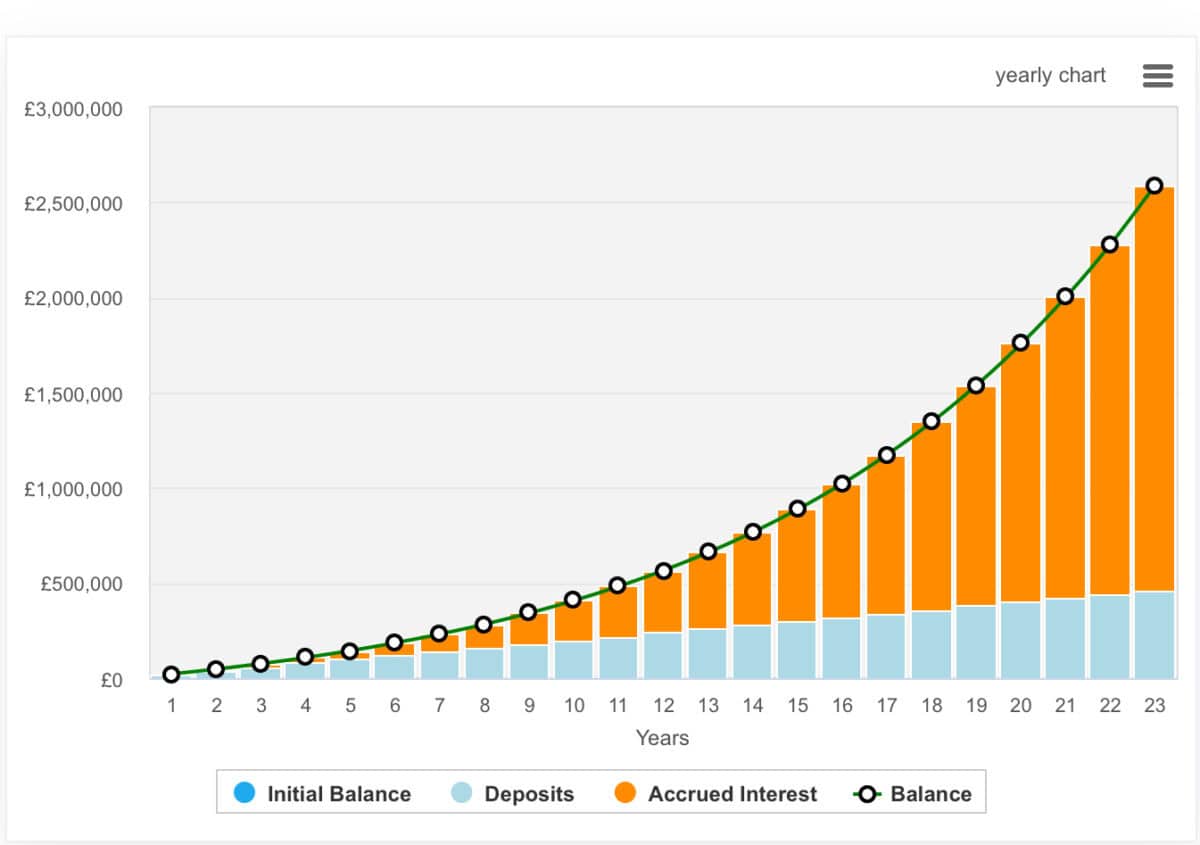
There are various ways to make the maths work and hit £2.4m. One way, as shown below, would be to max out the ISA contribution — £20,000 per year — for 23 years, and average 12% annualised returns. Some people may say 12% is ambitious and they’re right. But it’s still far below the Nasdaq’s total returns for the last decade — around 20%.

thecalculatorsite.com

One stock for the growth phase

Investors may want to look at some of my favourite stocks, including Celestica, Credo, and DXP Enterprise. However, novice investors may prefer to consider funds or trusts like Scottish Mortgage Investment Trust (LSE:SMT) for easy diversification.

The FTSE 100-listed investment trust typically invests in growth-oriented companies with Elon Musk’s SpaceX now representing the largest holding at 7.5%. This is followed by Amazon and MercadoLibre, among other big tech companies.

What’s more, the Baillie Gifford-managed fund has a reputation for picking these tech winners before they become household names. It’s a great track record and it’s one that has seen them deliver approximately 333% share price growth over the past decade.

Things to worry about? Well, some of its biggest holdings are Magnificent Seven stocks, which may underperform the market this year and beyond following terrific growth in previous years. That could, however, be mitigated by stronger performing mid-caps lower down in the portfolio. It’s a stock I hold, and I recently bought more for my daughter’s SIPP.

The time is ripe for the FTSE 100 to outperform the S&P 500

Since the launch of ChatGPT at the end of 2022, the S&P 500 has been on a tear. With every other stock market, including the FTSE 100, left behind, Wall Street analysts expect 2025 to be another stellar year for the US. I, though, believe 2025 is likely to be a much tougher year for US index investors.

Concentration of stocks

One of the biggest risks for the S&P 500 in 2025 and beyond is extreme concentration. A few years ago, it was the FAANG stocks that were the darlings of the market. Today, it’s been rebranded as the Magnificent 7.

Call it what you like, but a stock market that is being propped up by just a handful of stocks makes no sense to me.

On top of the concentration risk, is the fact that virtually everyone is on one side of the boat. Not only US investors have piled into the S&P 500 but so has the rest of the world.

Smart money is out

When individuals like Warren Buffett and Stan Druckenmiller start paring back or selling out completely from their mega-cap holdings, I simply can’t ignore that fact.

Buffett once famously described Apple as “probably the best business I know in the world”. But even a great company can become ridiculously overvalued.

Today, the earnings yield (the inverse of the price-to-earnings ratio) of the S&P 500 is lower than a risk-free 10-year treasury bond. The last time this happened was back in 2000, just before the dot.com bubble popped. To me, this fact pretty much sums up the level of complacency that is out there today.

FTSE 100 comeback

If the gloss starts to come off the Magnificent 7 in 2025, I don’t believe the index will go sideways. That is certainly not what happened in 2022.

I don’t doubt that if the S&P 500 falters that the contagion would likely initially spread to the FTSE 100. But I don’t think it will last.

If 2022 taught me anything it is that once investors have clambered for the exit, they then start hunting for cheap, safer plays. Packed with blue-chip companies at ridiculously low P/E multiples, many dishing out inflation-busting dividend yields, the FTSE 100 will be a natural choice.

One sector that is doing really well at the moment is financial services. The Barclays share price has doubled over the past 12 months. Despite this, it trades at forward P/E of just seven.

Insurance businesses also look cheap to me. Aviva’s 6.8% dividend yield, supported by long-term structural growth trends, make it a compelling investment to consider.

Then there are the oil stocks. The BP and Shell share prices have been weighed down by weak oil and gas prices throughout 2024. But this is beginning to reverse. And with a US president who supports the industry, I believe the upward trend will continue.

I don’t want to forget about the miners. As demand for electricity soars from the likes of data centres, EVs, and heat pumps, huge investments in grid infrastructure will be needed. Glencore and Anglo American have some of the best large-scale copper mines across the globe. Both of these stocks’ valuations don’t reflect their intrinsic value, in my opinion.

Financial News

Daily News on Investing, Personal Finance, Markets, and more!

Financial News

Policy(Required)