£11,000 in savings? Here’s how investors could use that to target £2,991 in annual passive income!


Money made from minimal effort is often referred to as ‘passive income’. And by far the best way I have found of generating it is from dividends paid by shares.

The only significant effort involved is picking the right stocks in the first place. After that, it is just a case of monitoring their progress every now and again.

Despite the negligible labour required, the level of passive income generated can be life-changing. It can make for a much more comfortable daily existence and can allow for an early retirement.

So what are ‘the right stocks’?

I look for three qualities in the shares I choose for passive income purposes.

The first is a good yield. This can change as it is based on a stock’s share price and dividend. However, my minimum starting requirement is around 7% a year.

This is because I can usually get around 4% from the 10-year UK government bond – the ‘risk-free rate’ – and shares are not risk free.

The second facet I look for is an undervaluation in the share price. This reduces the chance of my making a loss on the stock if I want to sell it. Conversely, of course, it increases the possibility that I will make a profit on the share price in that event.

I generally look for an undervaluation of at least 20% from its fair value, based on a discounted cash flow (DCF) analysis. This assesses a stock’s price relative to where it should be, based on future cash flow forecasts.

And the final thing I want is a business strong enough to support the current dividend and to raise it over time. Consequently, I want a firm with high earnings growth forecasts, as these ultimately power a dividend (and share price) higher.

A case in point

BP (LSE: BP) currently delivers a yield of 5.4%. However, analysts forecast this will increase to 6.2% in 2025, 6.5% in 2026, and 6.8% in 2027.

Its present price of £4.20 looks 60% undervalued to me on a DCF basis. So a fair value for the stock is technically £10.50, although the market might push it lower or higher.

A risk here is that the supply and demand balance of the market tips into a long-term bearish trend.

Nonetheless, consensus analysts’ forecasts are that its earnings will grow a stunning 23.8% every year to the end of 2027. I think this should push the dividend and share price much higher.

How much passive income can it make?

Investors considering an £11,000 (the average UK savings amount) holding in BP would make £7,853 in dividend income after 10 years. This is based on the current 5.4% staying the same over the period (which is not guaranteed). It also factors in that the dividends paid out are reinvested into the stock (known as ‘dividend compounding’).

On the same twin provisos, the same investment will make £44,382 in dividend income after 30 years.

Adding in the initial £11,000, the total holding would by then be worth £55,382. This would pay £2,991 a year in passive income.

Given its strong earnings growth potential, and what this might mean for the dividends and share price, I will be adding to my existing BP holding very soon.


Down 15% to just 67p, does Vodafone’s share price look a bargain to me?

Vodafone’s (LSE: VOD) share price is down 15% from its 17 September one-year traded high of 79p.

Such a steep fall might indicate a bargain for those whose portfolios the stock suits. Or it might signal that the firm is just worth less than it was before.

I ran valuation measures and models I have trusted most in 30 years as a private investor to ascertain which it is.

What does the share price mean in value terms?

The first element in my pricing analysis is to compare a firm’s key valuations with its competitors.

On the price-to-earnings (P/E) ratio, Vodafone currently trades at just 8.7. This is bottom of its peer group and way off their average P/E of 18.7.

This group comprises Orange at 13.4, BT Group at 18.1, Telenor at 18.8., and Deutsche Telekom at 24.5. So, Vodafone shares look very undervalued on this measure.

The same applies to its price-to-book ratio of only 0.3 compared to its competitor average of 1.7. And it is also true on the price-to-sales ratio, on which it trades at 0.6 against a 1.2 peer average.

Undervaluations on all three key measures are an extremely promising start in my view. However, the acid test is a discounted cash flow (DCF) analysis. This examines the price a stock should be, based on its future cash flow forecasts.

Using other analysts’ figures and my own shows Vodafone’s share price is 55% undervalued at its current 67p. So the fair value per share is technically £1.49.

It may go lower or higher than this due to market unpredictability, of course. However, the clean sweep on key valuations and the strong DCF under-pricing confirm to me it may be a huge bargain.

Does the core business support this outlook?

H1 fiscal year 2025 results saw total revenue increase 1.6% year on year to €18.3bn (£15.47bn). Analysts forecast Vodafone’s earnings will grow 3.19% a year to end-2027. And it is these that drive a firm’s share price and dividend over time.

I think the main risk to these is any mishandling of the merger with Three. This could negate the potential benefits of the now-approved deal, which could be considerable.

Most notably for me these include the creation of a larger network with faster speeds and better coverage for customers.

Will I buy the stock?

A key factor in stock selection is appreciating one’s position in the investment cycle. The younger one is, the longer the time a stock has to recover from any price shocks.

Aged over 50 now, I am at the later stage of that cycle. This means I cannot afford to take the investment risks I could when I was younger.

And a key risk for me in this context in Vodafone is its sub-£1 price. This means that each penny represents nearly 1.5% of its total value. That is too high a price volatility risk for me to take at my age.

That said, if I were even 10 years younger I would probably buy the stock now, based on its earnings growth potential. If I were of a more cautious disposition, I might wait to see how the merger with Three was progressing.

£10k invested in Lloyds shares one month ago is now worth…

Investors love Lloyds (LSE: LLOY) shares. The FTSE 100 bank regularly features among the UK’s most traded blue-chips. And they’re finally being rewarded for their loyalty, with the Lloyds share price jumping 47% in the last year.

Yet everything’s relative, and Lloyds investors can’t help looking over their shoulders at rival FTSE banks Barclays and NatWest, which have skyrocketed 99% of 93% respectively over the same period.

Lloyds is trailing because it’s been swept up in motor finance mis-selling scandal, which risks turning into the next PPI. That cost Lloyds a whopping £23bn in compensation claims, more than any other bank.

The FTSE 100 bank has started 2025 well

Now it’s on the hook again, thanks to its Black Horse division. Some reckon it could have to pay £4.2bn in compensation for hidden commission payments on car loans. The final bill could be even higher. Barclays and NatWest have mostly avoided the hit. Why always Lloyds?

Yet suddenly investors aren’t quite as worried, thanks to chancellor Rachel Reeves. She’s working to block car loan firms from having to shell out huge sums in compensation, fearing it could bankrupt smaller lenders and undermine wider UK competitiveness. That would send worrying signals to the international investors she’s now desperate to cultivate.

It’s a controversial step, but with the economy under pressure Reeves doesn’t want another compensation free-for-all. There’s contagion risk too, as the commission principle, once established, could spread to other sectors, such as insurance. The total bill could be astronomical, as industry lobbyists have no doubt been warning.

Reeves has given Lloyds a further potential lift by supporting Financial Conduct Authority proposals to relax mortgage lending rules, in a bid to boost home ownership and get Britain moving. This includes simplifying lending criteria and reassessing affordability tests, which could boost Lloyds as the UK’s biggest lender.

Reeves may also ease bank ring-fencing rules, which protect consumer deposits by separating lenders’ retail and investment banking operations.

We don’t know whether any of this will happen, or whether it’ll make a difference. But it’s lifted the mood, especially on Lloyds. Since I hold the stock, I’m delighted.

I’m buying mostly for the dividends

An investor who put £10,000 in Lloyds just a month ago would have seen the value of their stake rise 15%. Today, they’d have £11,500. They can also look forward to some dividends too, with Lloyds shares forecast to yield 5.25% in 2025.

Yet there’s still plenty to worry about, as the UK potentially slips towards recession, interest rates remain high, and consumer sentiment low.

Even if the Bank of England does cut base rates, it could prove a mixed blessing. That would squeeze net interest margins, the difference between what banks pay saves and charge borrowers.

So much for the news flow. Ultimately, I treat it as background music. Unless something dramatically changes, there will always be a place for Lloyds shares in my portfolio. I plan to hold them through thick and thin, and re-invest every dividend I get until I reach retirement, when I’ll draw them as income. With luck, I’ll be holding Lloyds for life.

£5,000 invested in Tesla stock 6 months ago is now worth…

Tesla (NASDAQ:TSLA) stock doesn’t look overly appealing at first glance. The stock trades at ridiculously high earnings multiples having risen 88% over the past six months. Looking back, the stock’s meteoric rise may have seem unlikely given the industry-topping valuation it possessed half a year ago. However, everything changed when Elon Musk’s ally Donald Trump was re-elected to the presidency.

So £5,000 invested six months ago would now be worth £9,400, plus a little extra given the depreciation of the pound over the period. That’s an incredibly strong investment in anybody’s book.

Why did Tesla gain on a Trump win?

Tesla’s stock surged following Trump’s election victory, with shares soaring more than 14% on the day after. This rally was driven by several factors. Investors anticipate that Tesla and Musk will benefit from Trump’s return to the White House, given his vocal support for the candidate during the campaign.

The removal of electric vehicle (EV) subsidies could be one advantage for Tesla due to its dominant market position, while smaller competitors might struggle. However, it’s not clear how else Tesla will benefit from Musk’s ties and position within the new administration. Tesla’s Chinese peers already face hefty tariffs and Musk’s company produces its vehicles around the world.

Crazy valuation

As always, sentiment’s key. And seemingly a Trump presidency has heightened optimism around Tesla’s future as an artificial intelligence (AI) powerhouse. With a forward price-to-earnings ratio of 163.9 times, Tesla trades at an 828.9% premium to the consumer discretionary sector median, indicating extremely high growth expectations.

Meanwhile, the forward price-to-earnings-to-growth (PEG) ratio of 18 times is 982.9% higher than the sector median, suggesting that investors are pricing in extraordinary growth potential beyond traditional automotive metrics.

This valuation discrepancy highlights the market’s focus on Tesla’s technological ambitions rather than its current automotive business. Investors are essentially paying a premium for Tesla’s potential to dominate in AI-driven transportation and robotics, despite the inherent risks and uncertainties in these emerging fields.

The significant deviation from both sector averages and Tesla’s own historical valuations underscores the speculative nature of these bets on future technological breakthroughs. However, many investors simply don’t want to bet against the world’s richest person and his ally in The White House.

Outsized gains aren’t an impossibility

Tesla’s Trump-driven rally has started to lose momentum. This has been compounded by moderating sales and the DeepSeek-induced pullback. Despite promises to improve sales in 2025 and a revamp of the Model Y, the stock is down around 11% since the turn of the year.

However, as I mentioned, Musk’s a very hard man to bet against. The company’s technologically is reportedly ahead of its peers when it comes to computable automation and has the capacity to scale its humanoid robotics venture arguably faster than any other company. Personally, I’m not buying the stock. My exposure’s purely through investment trusts.

Is £500 enough for a stock market beginner to start investing in 2025?

Many people still think stock market investing is reserved for the wealthy or well-connected in society. In truth, there’s never been a lower barrier of entry for investors from all walks of life.

Getting started no longer requires a large lump sum of savings to open an account. Nor does it require the expensive services of an advisor or broker. Anybody with internet access and a bank account can start investing with just a few pounds if they wish.

But one of the biggest limitations that keep the average person from investing is fear. 

People tend to fear things they don’t understand — especially when it comes to money. Trust in financial institutions has eroded since the 2008 financial crisis. Now, people are far less willing to part with their hard-earned savings.

Fortunately, another change has been the rapid rise of freely available information. Sorting through this information can be challenging but it’s there for those willing to learn.

What matters the most when investing is not so much the amount of capital available but deciding how to allocate it. The sooner one starts investing, the greater the eventual returns are likely to be.

Whether it be £50, £500 or £5,000, the most important thing is taking the first step.

Steps to getting started

  • Think long-term: ideally, it’s best to consider an investment strategy with a long-term view. Be it for retirement or buying a house, it should be approached in terms of decades, not months. This gives the investment time to compound and grow exponentially.
  • Assess risk tolerance: each person’s risk tolerance depends on their financial situation and how much they can afford to lose. High-risk investments are best left to those who can afford the loss.
  • Define a budget: making regular contributions is the best way to build an investment. The more the better, but be realistic. Decide on a weekly or monthly amount and stick to it.

Picking stocks

With a solid plan in place, it’s time to pick stocks. When starting, it’s best to stick to well-established companies with a long history of stable growth. These are usually low-risk-but-low-reward stocks like Unilever or Diageo.

Consider the insurance firm Admiral Group (LSE: ADM). It operates across Europe and the US, offering motor, household travel and pet insurance along with personal loans. This diversity helps protect it against a downturn in any single country or area of insurance. It pays a reliable dividend with a yield of around 4%.

The stock dipped through 2022 and hasn’t fully recovered, up only 17.5% in the past five years. Rising inflation has subdued the UK insurance sector and continues to pose a risk to the stock, along with stiff competition and regulatory concerns.

But before Covid, it made solid and steady gains, growing at an annualised rate of 8.5%. 

It’s now up 53% since its five-year low of £17.35 in July 2022. While the growth is promising, it’s pushed up the company’s price-to-earnings (P/E) ratio to 20.3, which could limit room for further growth. 

Still, future cash flow estimates indicate it’s trading at 51.3% below fair value. Overall, I think it’s worth considering as a beginner stock due to its solid earnings, long-term potential and established nature.

Here’s how I’m trying to build my ISA to earn a £5,000 second income each month

The Stocks and Shares ISA is simply an excellent vehicle for building wealth and earning a second income. And that’s because it’s shielded from taxation. So if I double my money on a stock, there no capital gains tax. And if I want to take dividends from my holdings, there’s no income tax.

While millions of Britons use a Stocks and Shares ISA to invest, sadly a much greater proportion keep their money in savings accounts or simply have very little savings at all. And with savings accounts offering around 3% annualised growth on average, many Britons will struggle to build wealth.

Please note that tax treatment depends on the individual circumstances of each client and may be subject to change in future. The content in this article is provided for information purposes only. It is not intended to be, neither does it constitute, any form of tax advice. Readers are responsible for carrying out their own due diligence and for obtaining professional advice before making any investment decisions.

Even index-tracking investments beat savings

Index-tracking investments consistently outperform savings accounts, offering superior long-term returns. While savings accounts are safer and guaranteed, they provide minimal interest, often failing to keep pace with inflation, the MSCI World index delivered average annual returns of around 11.1% between 1978 and 2024.

This stark difference becomes evident over time. For instance, a £10,000 investment in the MSCI World index in 1979 would have grown to £960,000 in 2024. Index funds achieve this through broad market exposure, low fees, and passive management. They also provide an easy, diversified investment option that allows investors to benefit from overall market growth.

As such, and despite short-term market fluctuations, index funds have proven to be a more effective wealth-building tool than traditional savings accounts.

The maths add up

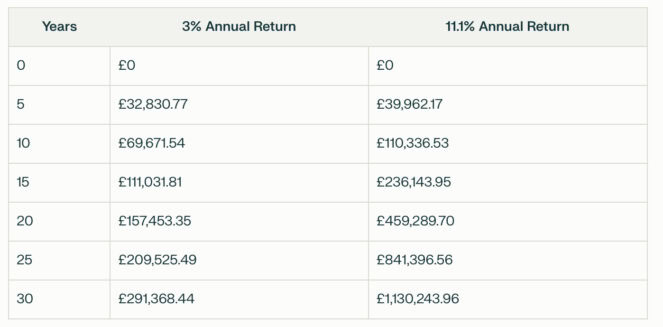
In the chart below, I’ve shown how my money (£500 of monthly contributions) would grow at 3% — representing a savings accounts — and 11.1% — reflecting the annualised growth of the MSCI World Index over the past 45 years. As we can see, the difference is relatively modest at first, but eventually the 11.1% pulls away over time. That’s simply because of compounding.

By the end of the 30 years, the index tracker’s growing by more than £100,000 a year (although that’s not guaranteed, of course). This is why it pays to start early, and also why my one-year-old has an ISA and a Self-Invested Personal Pension (SIPP)!

Moreover, with £1.1m, I could attempt to earn £60,000 annually in dividends by investing in stocks with an average yield just above 5%.

An investment to consider

Index trackers can be a great way to start investing, but something a little more exciting could be an exchange traded fund (ETF) or trust. And one of the most popular to consider in the UK is Baillie Gifford’s Scottish Mortgage Investment Trust (LSE:SMT).

It invests in growth-oriented stocks with SpaceX now representing the largest holding. It’s also the largest holding in Baillie Gifford’s Edinburgh Worldwide Investment Trust portfolio, indicating a lot of faith from the fund’s management. Scottish Mortgage’s tech-focused investments are also complemented by holdings in luxury stocks, including Ferrari.

The stock’s discounted by around 7.1% versus the estimated value of the fund’s assets. In other words, investors are buying SpaceX and Ferrari shares on the cheap. However, I know some investors will be put off by the valuations of some of the stocks held — like Tesla at 170 times forward earnings — and SpaceX, which isn’t listed and has no stock market-derived value.

Nonetheless, it’s a stock I’ll incrementally buy more of over the years. The managers have a great track record with the shares up 2,666% since inception in 1993.

£10,000 invested in BT shares 1 year ago would now be worth…

Analysts have long debated on how much BT (LSE:BT.A) shares should be worth. The company has invested billions in the roll-out of fibre-to-the-premise, sacrificing near-term earnings for long-term profitability. In turn, this has resulted in a fair degree of volatility.

Over the past 12 months, the BT share price is up 20%. As such, a £10,000 investment a year ago would be worth £12,000 today, plus around £600 in dividends. That’s a market-beating return, although the stock did surge more than 50% from its lows in April to its highs in November.

What’s behind the growth?

BT gains over the past 12 months have been driven by several key factors. The company’s new(ish) CEO, Allison Kirkby, has implemented aggressive cost-cutting measures, targeting £3bn in annual savings by 2029. This follows the successful achievement of a previous £3bn cost-saving goal a year ahead of schedule.

BT has also reached peak capital expenditure on its full-fibre broadband rollout, signalling a shift towards increased cash flow generation. The company expects to reduce capital expenditure by around £1bn post-peak build, leading to a projected doubling of normalised free cash flow over the next five years.

These initiatives, arguably coupled with the valuation, have attracted significant investor interest, notably from Mexican billionaire Carlos Slim. Through his family business Inbursa, Slim has increased his stake in BT to 4.3%, investing approximately £550m in total. This move is seen as a vote of confidence in Kirkby’s strategy and BT’s future prospects.

The FTTP promise

FTTP could be a game-changer for BT, offering significant advantages over traditional broadband technologies. With speeds up to 1gbps, FTTP provides faster and more reliable connectivity, meeting the growing demand for high-bandwidth services. This technology enables BT to future-proof its network, supporting the transition to an all-IP future.

Moreover, FTTP offers superior performance and reliability than traditional wiring. This can lead to increased customer satisfaction and reduced churn. The increased reliability will also allow the company to reduce its maintenance workforce, leading to considerable operational expenditure savings.

In short, this investment could drive long-term revenue growth and strengthen BT’s competitive position in the broadband market. However, the debate concerns whether the huge investment will truly be worth it. Clearly the company thinks so, but some analysts are less convinced.

BT’s consensus

The consensus among 17 analysts for BT Group is Outperform with an average target price of 190.6p, representing a 36.7% premium from the last close of 139.4p (27 January). The highest target is 290p, while the lowest is 110p. This wide range of targets reflects varying opinions on BT’s future performance, with a generally positive outlook.

It’s an interesting stock that has been on my watchlist for almost a year. At 10.1 times forward earnings — falling to 8.6 times for 2026 — and a 5.6% dividend yield, it could be an attractive opportunity. However, I’m keeping my powder dry for now.

What does DeepSeek mean for the stock market?

Parts of the stock market, notably those with exposure to artificial intelligence (AI), experienced considerable downward pressure on Monday (27 January). The reason behind this is DeepSeek, a Chinese lab, shocked the tech world after producing a large-language model (LLM) or advanced reasoning model, called DeepSeek R1.

This model delivered comparable performance to the world’s best chatbots at seemingly a fraction of the cost. And over the weekend it was downloaded more than ChatGPT.

How DeepSeek shocked tech

DeepSeek-R1’s an open-source model with comparable performance to Western AI systems like ChatGPT. The model’s success has sparked concerns about the future dominance of US tech giants, causing a sell-off of US tech stocks. This development’s seen as a potential equaliser in the AI field, particularly benefiting researchers and developers with limited resources.

Diving deeper, DeepSeek-R1 impresses because of its cost effectiveness. Trained for just $5.6m, it operates at 95.3% less cost than Anthropic’s Claude 3.5 Sonnet and charges users only 2% of OpenAI’s O1 model rates. Its four-stage training process, including large-scale reinforcement learning on reasoning problems, has achieved O1-level performance at a fraction of the cost of its peers.

However, there’s another angle. DeepSeek R1’s claimed to be built on “less advanced” or “last generation” Nvidia GPUs (Graphics Processing Units), in line with export controls on the most advanced chipsets.

Some analysts are questioning whether this is possible and it may be a matter of time before we find out more. DeepSeek published its methodology, meaning it can be copied and evaluated. Some analysts suggest that China has evaded export restrictions and R1 could have been built on higher-end chips.

What does this mean for tech?

This development challenges the assumption that cutting-edge AI requires massive investments in advanced hardware and infrastructure. In addition to companies like Nvidia, stocks in the data centre segment have taken the biggest hit. These are the firms responsible for building the AI infrastructure that the sector has been clamouring for over the past year. This includes rack-scale providers, cooling companies and those in networking.

As I write, Celestica‘s (NYSE:CLS) among the hardest hit stocks. Sadly, it’s one of my favourites with a price-to-earnings-to-growth (PEG) ratio consistently under one. Celestica’s a leading provider of electronic manufacturing services (EMS) and operates multiple manufacturing facilities worldwide. The company specialises in producing complex electronic components and systems for various industries.

Celestica’s business model heavily relies on serving large technology companies, particularly hyperscalers like Amazon and Google who are investing heavily in AI and data centres. In Q3 2024, hyperscaler revenue increased 54% to $761m, accounting for 30% of total revenue. Thus, if we’re seeing a massive breakthrough in AI cost-efficiency, Celestica may see a slowdown in sales growth.

However, there’s certainly a possibility all of this is being overplayed. After all, greater LLM efficiency combined with the rapid expansion of data centres could represent another quantum leap forward for AI, making it more accessible and compounding performance gains. Moreover, cheaper AI should hasten its adoption, particularly among SMEs and the broader market. This could become apparent in the coming months.

I may have considered buying more Celestica, but it’s already my largest holding by some distance. I don’t want to become over-concentrated.

2 investments that could send my Stocks & Shares ISA surging in February

The stock market typically shows more volatility during earnings season. This is when we really get to see how well a company is performing and if a stock outperforms analysts’s expectations, it can make quick gains. As such, my Stocks and Shares ISA can see disproportionately strong returns during the season — and that season has just got started. So, here are two companies that are reporting in February that could send my portfolio surging.

This bank looks cheap

Standard Chartered (LSE:STAN) stock looks cheap. The FTSE 100 stock trades with a forward price-to-earnings (P/E) ratio of 8.1 times, indicating a 35% discount compared to its global financial peers. Current forecasts suggests that annual earnings growth will average 12.1% over the next three to five years. This results in a compelling price-to-earnings-to-growth (PEG) ratio of 0.67. No wonder CEO Bill Winters was questioned on the stock’s valuation at Davos last week.

Moreover, banking stocks have delivered very strong earnings reports so far this season. And with Winters noting that they operate in the same global market as its peers, the upcoming Q4 and full-year results may be an opportunity to rectify this valuation gap. Standard Chartered is due to report on 21 February with analysts pointing to earnings around $1.49 per share.

A key risk for investing in Standard Chartered is its exposure to emerging markets, particularly in Asia, Africa, and the Middle East. While these regions offer growth opportunities, they also expose the bank to heightened geopolitical tensions, regulatory uncertainties, and currency fluctuations. In some respects, the unique selling point is also the biggest risk.

This is a stock I’m following closely and may add to my portfolio.

An undervalued tech stock

Many US-listed technology stocks are starting to look a little expensive, but Zeta Global Holdings (NYSE:ZETA) looks attractively priced at 32 times forward earnings and a PEG ratio of 0.87. This PEG ratio is a considerable 54% discount to the information technology sector average.

This data-driven marketing technology company, which helps businesses optimise customer engagement through advanced analytics and artificial intelligence is also reporting Q4 results on 21 February. The firm has forecasted a huge 39%-41% increase in sales for the quarter, and full-year revenue of $984.1-$988.1m. Positively, all analysts covering the stock have increased their expectations over the past 90 days. Positive ‘revisions’ to analysts’s forecasts are often a great sign.

However, some analysts have highlighted that there may be a downturn in political spending — an important revenue driver — following the US election. That’s something to keep an eye on. Nonetheless, I’m buoyed by the longer-term forecast, with the P/E ratio falling to 14.3 times for 2027. This is based on current estimates, with earnings growing by around 38% annually over the medium term.

I already own this stock, but I’m currently down 10%. I may consider buying more.

A word of caution

While earnings season can be a period where outsized returns are realised, if a company missed expectations, the stock can move in the other direction. Even a beat on earnings but an underwhelming forecast from management can spook the market.

Looking for dividend growth? 3 top passive income shares to consider today

The UK stock market is a favourite destination for investors seeking top-quality passive income shares. London’s packed with companies in mature industries that have strong balance sheets. This is a winning formula for consistently large and growing dividends.

But how did British dividend stocks perform in 2024? And what can investors expect in the current year?

Dividend growth to slow?

According to financial services provider Computershare, total dividends rose 2.3% year on year in 2024, to £92.1bn, thanks to a high proportion of special dividends.

But it wasn’t all good news. Excluding special dividends and currency movements, shareholder payouts dropped 0.4% over the period, to £86.5bn. This reflected dividend cuts from the mining sector.

Encouragingly, the number crunchers at Computershare expect headline dividends to increase again in 2025. But growth is tipped to slow to a crawl as special dividends return to more ‘normal’ levels.

In the current year, analysts think dividends will reach £92.7bn at a headline level, up 0.7% from 2024. This is expected to be driven by a 1% rise in underlying payouts (at constant exchange rates), to £88.2bn.

Median dividend growth is tipped to be in the 4%-4.5% range, roughly matching 2024’s 4.5% increase. Yet Computershare reckons that large payout cuts (like the upcoming one from Vodafone/Three) will weigh on the market total.

Funds or individual stocks?

Investing in a FTSE 100 tracker fund is a popular way for investors to generate dividends. But I think there are better methods of targeting a passive income, given the prospect of weak payout growth in 2025 (and potentially beyond) across the broader market.

For instance, I think buying shares in real estate investment trust (REIT) Tritax Big Box is worth serious consideration. Dividends here are expected to rise by a market-beating 6% this year. This results in a large 5.7% dividend yield.

I expect the warehouse operator to deliver a large passive income despite the threat of interest rate pressures continuing this year. Under REIT rules, it must pay 90% or more of annual rental earnings out in dividends.

I also think Persimmon merits close attention. Total dividends here are also tipped to increase 6% in 2025. And so the dividend yield is a chunky 5.1%.

Encouraged by recent strong housing data, analysts think earnings (and therefore dividends) will rise strongly in 2025. That’s even though Stamp Duty changes in April could impact new-build demand.

Renewable energy

Octopus Renewables Infrastructure Trust (LSE:ORIT) is another top income share to consider. City analysts predict dividend growth for 2025 to be a more modest 3%. However, in my view this is more than offset by the company’s mighty 9.3% dividend yield.

Please note that tax treatment depends on the individual circumstances of each client and may be subject to change in future. The content in this article is provided for information purposes only. It is not intended to be, neither does it constitute, any form of tax advice.

Investing in renewable energy stocks can be a rough ride when unfavourable weather conditions damage power generation. But Octopus’s diversified model helps reduce this risk. It owns solar, wind, battery storage and hydrogen assets across six European countries (including the UK).

Trading at a 37.9% to its net asset value (NAV) per share, I think it’s worth serious attention from fans of big-paying value shares.

Financial News

Daily News on Investing, Personal Finance, Markets, and more!

Financial News

Policy(Required)