£20,000 invested in Amazon shares just 3 months ago would now be worth…

It’s almost surreal that Amazon (NASDAQ: AMZN) shares lost 54% of their value between mid-2021 and late 2022. Or perhaps recency bias makes me think it surreal as they’ve since bounced back in style, surging 180% to take the company’s market cap to a record $2.48trn.

Indeed, the stock is up by a market-thrashing 25.4% in just the past three months! That means an investor who was brave enough to plonk down £20,000 in late October would now be sitting on around £25,080. That’s a fantastic return in just under 14 weeks.

But are Amazon shares still worth considering today after this strong showing? Let’s take a look.

Diversified business

One of the things I like about Amazon from an investing point of view is its optionality. In other words, it has different ways to win beyond online retail. It operates the world’s leading cloud computing platform, Amazon Web Services (AWS), and generates revenue by selling warehouse capacity and logistics services.

It also has a fast-growing digital advertising business on its e-commerce app. Sellers can pay to have their items appear at the top of search results or on product pages. Amazon charges them a fee whenever someone clicks on their sponsored listing. This is a very profitable revenue stream, while the Prime subscription service keeps customers coming back. 

The company is also investing in delivery robots and drones, self-driving vehicles, various artificial intelligence (AI) initiatives, and more. While these can weigh on near-term profitability, they also have the power to boost efficiency and margins over the long run.

Despite being 30 years old and therefore no spring chicken, Amazon is still one of the most exciting companies around, in my opinion.

Surging profits

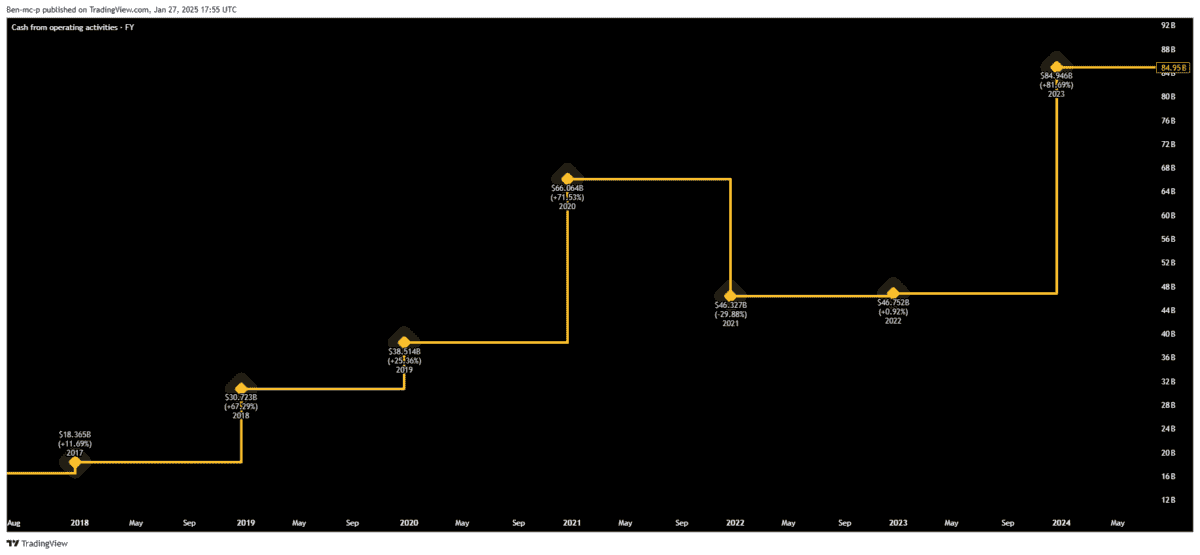
In recent years, the company has turned itself into a leaner beast. Consequently, its operating cash flow is absolutely surging, as we can see below.

Created at TradingView

Plus, Wall Street analysts forecast double-digit revenue growth over the next few years. In fact, the company remains on track to generate a mind-boggling $1trn in annual revenue by 2030! This assumes Amazon grows its top line by approximately 8% annually, which I think is more than realistic.

That said, nearing such a symbolic figure could bring negative headlines and more regulatory scrutiny in future. Last year, the US Federal Trade Commission advanced an antitrust lawsuit accusing Amazon of operating an unlawful monopoly. So potential regulation presents future risks here, I’d argue.

Is there any value left?

Unsurprisingly, the stock isn’t cheap after its monster run. It’s trading at four times sales, while the forward price-to-earnings (P/E) ratio is 37.

Yet I think this is reasonable value, considering the company’s profit margins are expected to continue expanding. The P/E ratio for 2026 drops to 31, based on consensus forecasts.

However, as we saw in 2022, Amazon stock can also go down as well as up. It has lost 50%+ of its value on multiple occasions over the past three decades. Therefore, it’s best-suited to long-term investors with a stomach for volatility.

Looking ahead over the next few years, I can only see Amazon getting larger as areas like e-commerce, digital advertising, and cloud computing expand worldwide.

Despite being at a record high, I think the stock is well worth considering.

2 cheap FTSE 100 shares to consider for an ISA in February

Just because something’s cheap doesn’t necessarily mean it’s low quality. Here are two FTSE 100 shares I think are trading at bargain valuations, at least from a long-term investing perspective. Both are worth considering for an ISA.

The King of Trainers

First up is JD Sports Fashion (LSE: JD). The sportswear retail giant has tripped over its own laces multiple times in the past 12 months, issuing warning after warning on profits.

It originally projected an underlying pre-tax profit in the £955m-£1.03bn range for its current fiscal year, ending February. Now, after a soft Christmas trading period, JD expects £915m-£935m. 

Obviously that’s not ideal, but equally not disastrous, I’d argue. For context, it was £917m the year before.

That said, there’s a risk that weak consumer spending and elevated levels of discounting persist for a while. JD rarely gets involved in grubby discounting, preferring to remain disciplined on pricing to maintain its premium image. While that helps maintain margins, it’s not great for top-line growth.

Weak sales at major partner Nike remains a problem. Nimble rivals like Hoka and Roger Federer-backed On are all the rage, eating into Nike’s market share. JD sells them all as part of its multi-brand strategy, but Nike still accounts for around 45% of sales.

If the company was just a UK retailer, I’d be less interested. However, JD has over 4,500 stores globally. Its opportunity to take share in the US, where consumer spending is tipped to improve under Donald Trump’s administration, still appears strong to me.

Meanwhile, Nike’s new CEO is refocusing on its wholesale channels, a shift that should ultimately benefit JD. Things at Adidas, its other major partner, are going much better. Actually, I’m after a new pair of Samba trainers for the summer and might pop into my local JD store.

The share price has fallen 63% in just over three years. Now at 84p, the stock’s trading for 6.4 times next year’s prospective earnings. Even if that forecast proves slightly optimistic, the valuation still looks dirt cheap to me.

I bought shares in November at 97p and may get more. If I do, I won’t be the only one, as CEO Régis Schultz recently invested £99,000 of his own money in the company.

Wall Street hedge fund

My second pick is Pershing Square Holdings (LSE: PSH). This investment trust gives investors a stake in Bill Ackman’s top-performing hedge fund.

The share price is up an impressive 186% over five years.

Ackman has a knack for investing in top-tier brands that have hit a rough patch. Examples include Chipotle Mexican Grill in 2016 after food safety issues, and Alphabet in early 2023 when ChatGPT’s release raised concerns about Google’s search empire. Both stocks have since rebounded very strongly.

His latest potential rabbit from a hat? None other than Nike! Time will tell if this is another well-timed turnaround play.

One risk here is that Pershing runs an incredibly small portfolio of eight-to-12 stocks. This adds concentration risk. But the shares are currently trading at a 29% discount to the fund’s net asset value. While there is no guarantee this discount will narrow, I reckon it offers a chance to consider investing in a high-quality portfolio at a bargain price.

Here’s why the Scottish Mortgage share price is back above £10!

The Scottish Mortgage Investment Trust (LSE: SMT) share price seems to have rediscovered its mojo. It’s up 30% in a year and 64% since bottoming out in May 2023.

This ongoing recovery’s seen it break through the 1,000p barrier for the first time in nearly three years.

Why?

There seem to be a few reasons why this has happened. First, the growth-focused trust reported its interim results back in November, which covered the six-month period to the end of September. Here, we learned that its net asset value (NAV) per share had increased by 1.9%, compared to a rise of 3.6% for the FTSE All-World index. 

However, the longer-term performance was much stronger. Over five years, the NAV had gained 88.9%, outpacing the index’s 66.9%. And over a decade, it had grown 347.8%, compared with 211.3% for the benchmark. As a shareholder, I’m pleased by this outperformance.  

Before yesterday (27 January), when semiconductor stocks took a shellacking, many top holdings had also reached new highs. These included TeslaAmazon, Nvidia, Taiwan Semiconductor Manufacturing, Spotify, and Meta Platforms. Most have been boosted by ongoing bullishness around all things artificial intelligence (AI).

On the private side of the portfolio, SpaceX’s valuation has nearly doubled in a year. Scandinavian Airlines is the latest company to announce a partnership with its satellite internet service Starlink, intended to introduce free high-speed Wi-Fi across its aircraft. Meanwhile, Starlink’s begun beta-testing a direct-to-mobile service, which could transform the global telecoms landscape. 

Also, there are reports that another unlisted holding, data analytics platform Databricks, might be eyeing an IPO. It has just carried out a successful financing round at a much higher $62bn valuation.

These are two very exciting growth companies building value for Scottish Mortgage shareholders outside of public markets.

Elsewhere, TikTok’s back on phones in the US, with reports saying that owner ByteDance will retain a stake in the business once it’s sold. That’s probably the best outcome for Scottish Mortgage’s large holding in the social media giant.

Finally, the FTSE 100 trust continues to buy back its own shares, which can help boost the share price.

Achieving its objectives

However, there are also reasons to be a bit cautious. The main one is that most of the portfolio’s companies are listed across the pond, where valuations look stretched. If Big Tech earnings come in light this year, that could cause volatility and knock the trust’s valuation.

Nevertheless, I’m excited about the potential here. Scottish Mortgage’s aim is to invest in the world’s greatest growth companies. It won’t get every pick right, but it doesn’t need to when it can make 100 times its money on a stock, as it did with Nvidia.

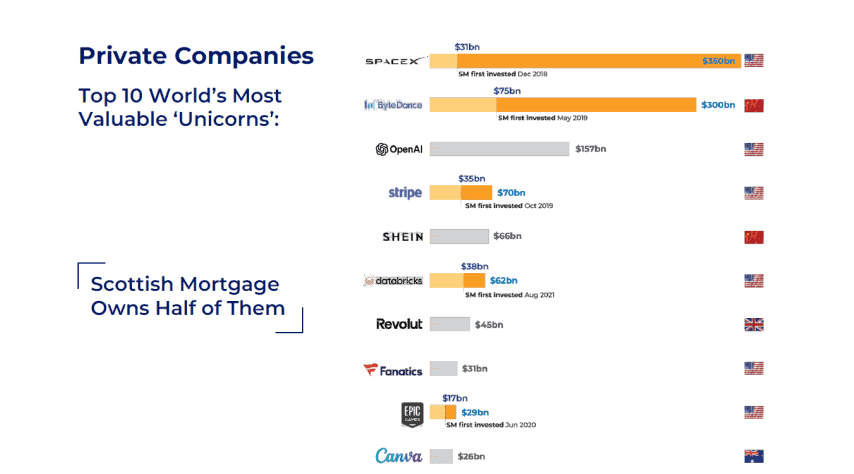
To give another example, it first invested in SpaceX in 2018 when it was worth $31bn. Now the rocket pioneer’s valued at $350bn, meaning the investment is more than a 10-bagger in just over seven years!

Indeed, it holds half of the world’s most valuable private companies, and they’re becoming more valuable.

Source: Scottish Mortgage Investment Trust

All this tells me the trust’s doing what it says on the tin. And I believe it’s set up for strong returns over the long run — the only timeframe that matters.

Is this as good as it gets for the red-hot Tesco share price? 

The Tesco (LSE: TSCO) share price surge caught me off guard. I just didn’t see it coming.

If Hollywood turned the UK grocery sector into a gangster movie, Tesco would be Mr Big, with young guns Aldi and Lidl eyeing up its territory. Yet somehow, Mr Big stood his ground.

Today, Tesco’s position looks pretty impregnable, with market share of 28.5% the highest since 2016. That’s a satisfactory ending for Tesco investors. Especially with the shares up 24% over the last year, and 48% over five years. Dividends are on top, of course.

Sadly, I missed out on all of that. I just didn’t think Tesco could do it. So can the shares climb from here?

This is a top FTSE 100 dividend growth stock

Let’s look at the fundamentals. Tesco’s current price-to-earnings ratio’s just over 15, squarely in line with the FTSE 100 average. 

While this isn’t alarming, it isn’t particularly cheap. And when it comes to dividends, the yield’s dipped to 3.28%, just below the FTSE 100 average of 3.5%. For income-focused investors, that might be a touch underwhelming.

I suspect I won’t be the only investor looking at those numbers and thinking the fun’s over. That may explain the lukewarm market response to a positive Christmas trading period. Tesco reported a 3.7% sales increase across the UK and Republic of Ireland, covering the six weeks to 4 January. This marked an improvement from 2.8% in Q3. Sales grew even faster at its Central Europe’s operations, up 4.7%. 

The board now expects full-year retail adjusted operating profit of £2.9bn, in line with guidance upgraded in October.

CEO Ken Murphy hailed “our biggest ever Christmas, with continued market share growth and switching gains”. He pinned this on Tesco’s strategy of being the UK’s cheapest full-line grocer for over two years, as well as introducing new or improved products across its ranges.

The supermarket war isn’t won yet

Yet Tesco shares slipped 1.5% on the day and have idled since. This may simply be profit taking. Investors have done well out of Tesco. But it may also suggest they see better opportunities elsewhere.

If I held Tesco shares, I’d stick with them. It would be rude not to frankly, given how well they’ve done. But would I buy? That’s a tricky one. Firstly, it feels like I’ve missed my best moment. Second, all the other grocers are still gunning for Mr Big.

Tesco employs more than 300,000 and will take a hit from the government’s £25bn raid on employers’ National Insurance, plus its inflation-busting Minimum Wage increase. It already operates on wafer-thin margins.

If inflation falls, that may soften the blow. Plus of course, its rival grocers have to face the same issue. 

I won’t buy Tesco shares today. They look fully valued while the UK economy remains bumpy, making shoppers feel poorer. It has a lot to live up to. I’ll go shopping for shares elsewhere.

2 high-growth AI stocks I’d love to buy in 2025

Artificial intelligence (AI) stocks have been volatile this week. This is due to the fact that the emergence of Chinese AI app DeepSeek has shaken up the market. As a long-term investor, however, I remain very bullish on the artificial intelligence theme as the technology is likely to have a profound impact on the world over the next decade. With that in mind, here’s a look at two top AI stocks I’d love to buy for my portfolio in 2025.

Rolling out AI agents

One company that I think has huge potential on the AI front is ServiceNow (NYSE: NOW). It’s a software company that enables businesses to automate processes and deliver better experiences to employees and customers.

ServiceNow’s software is already embedded within the corporate world. Currently, the company serves 85% of the Fortune 500.

However, it’s now rolling out some really exciting AI products. An example here is its AI agents. Designed to boost efficiency, these can autonomously perform tasks (across a range of departments). So, they have the potential to significantly reduce costs for firms.

I wouldn’t be surprised if, in a decade’s time, these AI agents are doing a lot of work that is done by humans today (e.g. customer service). Taking a long-term view, I reckon this company has the potential to be a genuine winner in the AI space.

Now, the issue with this stock for me right now is the valuation. Currently, the forward-looking price-to-earnings (P/E) ratio is about 68. That’s a little too high for me. Because it doesn’t leave any room for error (like a short-term slowdown in revenue growth).

I am prepared to pay a high valuation here as the company is growing quickly. This year, analysts expect revenue to climb 20%.

But I’m not prepared to invest at the current valuation. So, I’m going to wait patiently for a pullback in the hope that I can snap up some shares at a lower earnings multiple.

Helping businesses get an edge

Another tech company that appears to have a ton of potential in the AI space is Palantir (NASDAQ: PLTR). It specialises in software that helps organisations use their data to get an edge.

In the past, Palantir has had a lot of success working with government organisations. From the FBI and the CIA to the UK’s NHS, it has won a lot of major contracts.

Now however, the company is moving into the corporate world and it’s having success here too. In Q3 2024, commercial revenues were up 54% year on year.

One product that is driving this success is Palantir’s AIP (Artificial Intelligence Platform) product. This is a powerful platform that enables businesses to rapidly deploy AI.

Now again, it’s the valuation that is the deal-breaker for me here. Currently, Palantir sports a P/E ratio of 159.

I just can’t bring myself to pull the trigger and invest at that price. If the company was to experience some kind of setback like a slowdown in contract wins or a cyberattack, the shares could fall significantly.

I am keen to get a few Palantir shares into my portfolio at some stage, however. I’m hoping an opportunity presents itself in 2025.

Here’s what the rise of DeepSeek could mean for Nvidia stock

Over the past few days, there’s been a huge amount of chatter about what DeepSeek means for the AI sector. More specifically, some are concerned about the implications for Nvidia (NASDAQ:NVDA) stock. Yesterday, (27 January) the share price fell by almost 17%, wiping off close to $600bn in market-cap. Here’s my take and what I’m doing about it.

Breaking down the news

Let’s first address DeepSeek. It’s a Chinese AI company that develops open-source large language models (LLM). It’s comparable to ChatGPT, where you can ask DeepSeek questions and get answers.

The main difference is that ChatGPT cost billions in order to produce, causing the industry to set a high benchmark in terms of the costs to develop AI models further. However, DeepSeek reportedly only cost a fractional $6m to train. This is the main reason why some investors are spooked. If a company can develop a model for such a low cost and with relatively few components, the sector might be heading for a large reset.

Now, let‘s turn to Nvidia. The share price drop yesterday was because DeepSeek used fewer advanced Nvidia chips. This is partly due to the ban on the export of advanced chips to China from the US. Clearly, the ban isn’t watertight, but that’s a different conversation!

The fact that a model could be trained using fewer Nvidia chips than normal could indicate that the revenue projections for Nvidia are overestimated. The whole premise of Nvidia dominance in this area has been thrown out of the window.

Negative views misplaced

I think the market’s reaction yesterday was overdone. To start with, this isn’t a story about Nvidia but rather about more LLMs coming online. I believe we’re entering a phase where more and more AI models will start to pop up. But I don’t see this as a huge threat to Nvidia. After all, the business provides the hardware to support and train these models.

Sure, some might need fewer chips than previously thought. But if more and more are being developed, more chips will be demanded. Selling fewer chips at a higher price or more chips at a lower price should ultimately mean revenue isn’t impacted by much.

If anything, I see the DeepSeek story as a positive for the AI sector in general. It pushes the boundaries and shows what’s possible. Of course, there will be winners and losers in this process. However, the constant progress and greater adoption worldwide are long-term positives for Nvidia’s share price.

Waiting for the dust to settle

The main risk, in my view, is that in the coming weeks investors might keep panicing and sell Nvidia stock. This could cause a sharper fall. Yet, if this happens I’ll use it as an opportunity to buy. I’ve been waiting for over a year for a correction in the share price and it looks like it’s finally happening.

Finally, let’s put things into perspective. Even with the drop, the stock’s still up 94% over the last year. Although I think some will be worried, from a long-term investment perspective, I don’t believe this is game over for Nvidia.

Is it game over for the Taylor Wimpey share price?

If the Taylor Wimpey (LSE: TW) share price was a house, I wouldn’t buy it. It’s got a severe case of subsidence right now, having fallen 45% over the past five years, with a 20% slide in the last year alone.

Plenty of investors have parted with their money though, me included. They thought the FTSE 100 housebuilder was a bargain, but every time the stock appeared to stabilise, it was hit by another earth tremor. So is it time to move on?

Writing for The Motley Fool, I’ve learned not to abandon a share just because it’s out of favour with the wider market. In fact, that’s often a trigger for me to buy. Troubled companies often bounce back stronger, but it can take time. That’s certainly the case here.

Can this FTSE 100 straggler fight back?

Taylor Wimpey’s share price struggles reflects a challenging environment for UK housebuilders. 

Rising mortgage rates have hit affordability, while broader economic uncertainty cools demand. The cost-of-living crisis has driven up the cost of materials, and post-pandemic supply chain challenges linger. 

On 16 January, Taylor Wimpey confirmed the impact. UK completions fell to 9,972 last year, down from 10,356 in 2023. The overall average selling price slipped to £319,000, from £324,000.

On paper, Taylor Wimpey shares look like a bargain. With a price-to-earnings (P/E) ratio below 12, the stock is cheaper than the average FTSE 100 P/E of around 15 times. Its trailing dividend yield of 8.1% is eye-catching, offering a significantly higher income than cash, bonds and most FTSE 100 stocks.

Dividend payouts hinge on profitability, and Taylor Wimpey risks margin compression as sales shrink and costs rise. Upcoming national insurance hikes for employers won’t help, nor will the increased minimum wage. 

The group does boast a robust balance sheet and ended 2024 with a £2bn order book, but maintaining such a generous yield might become challenging if market conditions deteriorate further. The forecast yield of 8.6% is covered just once by earnings, worryingly. Taylor Wimpey has a good track record of dividend increases, but nothing is guaranteed.

Can the dividend compensate for lost growth?

So can the share price recover? The 16 analysts offering one-year share price forecasts have produced a median target of just over 148p. If correct, that’s an increase of around 25% from today. Combined with that yield, it would give investors a total return of 33% if true. Seems optimistic to me, but we’ll see.

The UK does face a chronic under supply of housing. This should support demand while that fat order book brings visibility.

What Taylor Wimpey shares really need is a string of interest rate cuts. That would shrink mortgage rates, revive the economy and ease cost pressures too. It would also make that dividend look even better, relative to yields on cash and bonds.

In my view, this isn’t game over for Taylor Wimpey. But investors tempted by that yield must realise this is a volatile sector on the front line of every economic issue. The share price is actually lower than it was 10 years ago. Even the brilliant dividend cannot totally compensate for that. Despite my concerns, I’ll play on. I still think it’s a winner over time.

Here’s the forecast for the two highest-yielding dividend stocks on the FTSE 100

The FTSE 100 is home to some of the UK’s largest companies and a treasure trove of high-yielding dividend stocks. These stocks promise a consistent and reliable cash flow from regular dividend payments, making them attractive to income-focused investors.

Two leading FTSE firms, Phoenix Group (LSE: PHNX) and M&G (LSE: MNG), are currently offering the highest yields. That suggests they could be top choices to consider for those seeking passive income. But the yield alone can be deceiving as it doesn’t tell the full story.

Recent developments, earnings and forecasts may help build a better picture of where they’re headed.

Phoenix Group

Phoenix is a life insurance and pensions provider, with subsidiaries including SunLife and Standard Life.

It currently boasts the highest yield on the FTSE 100 at 10.4%. Having remained around 10% for over two years, it isn’t the result of a sudden price dip. It’s grown at an annual rate of 2.8% for the past decade.

Like many insurance companies still struggling to recover from the pandemic, it’s unprofitable and the price is down 32.4%. However, the past year has seen some growth.

Value investors may consider an opportunity there but recovery could be slow. Analysts are cautious, with the average 12-month price target expecting only a 12.4% gain. Dividend-wise, mild growth is expected this year, for a yield of 10.9% that could climb further to 11.2% in 2026. 

Falling inflation has helped the company regain a foothold but there’s a risk inflation could rise again. That could be problematic as the firm is already struggling with £5.41bn in debt — more than its entire market cap.

As a shareholder, I hope it recovers but it may be a long road ahead. If I were considering the stock now, I’d wait until the next earnings call before making a decision.

M&G

M&G is an investment management firm that was formed when it demerged from Prudential in 2019. However, it has existed in one shape or another since 1931.

It has the second-highest yield on the FTSE 100 at 9.9%, which has held steady between 8% and 10% for the past five years. During that time, the annual dividend has risen from 12p per share to almost 20p.

The share price is still down since pre-Covid but has recovered almost 90% from its all-time low in late 2020. Weak results in March last year (2024) stalled growth, sending the price tumbling 16%.

Things may have improved since but only the next full-year results will tell. If they also fail to impress, the share price could take another dip.

As such, analysts are cautious. Their average 12-month price target is a meagre 11.55% increase from today’s price. Still, dividends are expected to grow to 20.6p this year and 21.3p in 2026. That could push the yield above 10%.

With less debt and a more promising outlook, M&G appears to be in a slightly better position than Phoenix. Investors aiming for dividend income may want to consider it as the better option of the two.

However, no investment decision should ever be based on a single metric. Many stocks on the FTSE 100 could offer better long-term returns when taking all factors into consideration.

Can NIO stock ever move up again?

Once riding high, NIO (NYSE: NIO) has been a disappointment for many investors more recently. NIO stock is now 30% lower than it was a year ago. It is 93% below its 2021 highs, which must now seem like a distant dream for some long-term shareholders.

What has gone wrong – and ought I even to think about adding NIO to my portfolio in hope of possible future gains?

2021 versus 2025

Looking back, that previous price looks pretty ridiculous to me. It was based on a very high degree of optimism about how fast the electric vehicle market could grow and what market share NIO might be able to gain. From today’s perspective, it looks wildly optimistic.

However, given the massive fall in NIO stock, the company now commands a market capitalisation of under $9bn.

As of the end of September, the company had a balance of cash and cash equivalents, restricted cash, short-term investment and long-term time deposits standing at around $6bn. That suggests the market is currently assigning the firm an enterprise value of roughly $3bn to $4bn.

NIO does have some real strengths

That is a substantial number. Still, could there be value here?

NIO has established a brand and high-end positioning I think could help insulate it from some of the downwards pricing pressure rivals may face thanks to the number of competitors in the space. Another potential game-changer the firm has is its proprietary battery swapping technology, which helps allay a key concern of many electric vehicle users: range.

Last year saw vehicle deliveries of 221,000, or well over 4,000 each week on average. That represented growth of 39% year on year. December saw 73% year-on-year growth.

Yes, those numbers are a fraction of rival Tesla’s. But they are substantial nonetheless.

Plus, Tesla’s deliveries last year actually contracted slightly. Compared to that, NIO’s sales are on fire.

Can the finances ever be made to work?

But what Tesla does have, unlike NIO, is a business model that it has proven can be consistently profitable (albeit it took many years of losses to reach that point).

By contrast, just in the third quarter of last year, NIO saw year-on-year net losses grow 11% to $721m.

The quarterly statement was not so vulgar as to use the phrase “cash burn”, but  carmaking is a very costly business and at close to three-quarters of a billion dollars in three months, even that $6bn cash pile could be gone in little over a couple of years.

That raises the risk that the company could need to boost liquidity over the next several years, potentially diluting existing shareholders in the process.

All is not lost!

As a potential shareholder shareholder, that concerns me.

But my main concern is the lack of a profitable business model.

However, rivals have shown it can be done. Positively, NIO’s sales are now substantial and growing. If sales keep going up and a credible pathway to profitability becomes clearer let alone established, I think NIO stock could move higher from its current level – perhaps substantially.

But while the losses remain large, for now I am not ready to invest.

Is this my chance to buy Nvidia shares?

When it comes to buying shares, I aim to be greedy when others are fearful. And I don’t recall investors being as fearful about certain artificial intelligence (AI) stocks as they are right now.

Nvidia (NASDAQ:NVDA) is one example. The company’s position as the world’s leading GPU firm is under no obvious threat, so the stock falling almost 17% in a day is catching my eye.

What’s the problem?

Identifying the big winners in the AI revolution isn’t straightforward – especially for those of us who aren’t tech engineers. But Nvidia has been an obvious candidate even for the likes of me.

The idea is that large language models (LLMs) need the best chips in order to compete. And that has meant Nvidia’s GPUs, which has resulted in the firm’s sales growing 420% over the last five years.

The issue isn’t that another company has managed to start generating more powerful chips. It’s that LLMs might not actually need the latest and greatest hardware to reach the top. 

DeepSeek – an AI lab in China – just launched its own model that outperforms OpenAI from Microsoft and Gemini from Alphabet. And its AI Assistant is the most popular download on Apple’s App Store.

The details are complicated, but the bottom line is DeepSeek has found a way to achieve this without the most powerful GPUs. That could be trouble for Nvidia – and the stock is responding accordingly. 

If the most powerful hardware isn’t necessary for the best AI models, Nvidia’s pricing power is likely to be limited. And in that situation, the stock looks badly overpriced.

Fearful… but not that worried?

It’s worth keeping the falling share price in context. A drop of nearly 17% puts the Nvidia share price within 89% of where it was a week ago – and 95% above its 52-week low. 

In other words, the latest news might have made investors more fearful about the stock than they have been in a long time. But I don’t think the market is in panic mode by any means.

Based on estimates for 2025, the stock is trading at a forward price-to-earnings (P/E) ratio of 28. That’s not only its lowest level since 2020, it’s in line with the S&P 500 average.

There is, however, a catch. Earnings estimates for the next 12 months aren’t yet pricing in weaker demand based on the idea that LLMs might not need Nvidia’s most advanced GPUs.

I’m therefore viewing that P/E ratio with suspicion right now. If profit forecasts get cut, analyst price targets could come down, causing the Nvidia share price to fall further.

So I’m not in a rush to buy Nvidia shares for my portfolio at the moment. Despite the sudden drop, I think the current share price still represents positive expectations from investors.

What’s next?

My suspicion is the US views AI as a matter of national security. So I’m very alert to the possibility the next development is going to come sooner, rather than later.

Nvidia’s GPUs might be a key part of this, but DeepSeek’s revelation means nothing is guaranteed. So despite falling almost 17% in a day, the share price doesn’t yet offer me enough of a margin of safety.

Financial News

Daily News on Investing, Personal Finance, Markets, and more!

Financial News

Policy(Required)