At £2.57, is now the time for me to buy shares in this major FTSE retailer after a 15% drop?

Shares in FTSE 100 supermarket J Sainsbury (LSE: SBRY) have fallen 15% from their 10 September 12-month traded high of £3.01.

A sizeable drop for such a leading firm signals to me that a major bargain might be had. Alternatively, it might indicate that the company is essentially worth less than it was previously. I took a closer look at its performance numbers and share price valuation measures to ascertain which it is.

Why is the stock down?

I think the primary driver for the share price tumble is the potential impact of the October Budget on the retail sector.

The 1.2% increase in employers’ National Insurance threatens a massive increase in costs for big firms like Sainsbury’s. The resulting business decision is to pass these on to customers or to cut costs, or some combination of both.

Indeed, 23 January saw it announce 3,000 jobs would be cut and that all its remaining in-store cafes would close.

The main risk for Sainsbury’s is the continued effect of this tax rise – and any further rises — in my view.

How does the core business look?

Longer term, a firm’s share price (and dividend) is ultimately driven by its earnings growth. In Sainsbury’s case, analysts forecast that these will increase by a stellar 20.26% each year to the end of 2027.

This looks well-supported by its 7 November H1 2024-2025 results showing retail sales up 3.1% year on year, to £16.3bn. Underlying operating profit rose 3.7% to £503m.

Its key Christmas quarter running to 4 January saw a 2.8% rise in underlying sales. It added in the results announcement that it expects full-year underlying operating profit in line with consensus. This is in the midpoint of its £1.01bn-£1.06bn guidance range.

Are the shares undervalued?

My starting point in ascertaining whether a stock is underpriced is to compare its key valuations with its competitors.

On the price-to-earnings ratio, Sainsbury’s is currently at 33.3 against a peer average of 13.2. These comprise Carrefour at 10.5, Tesco at 12.7, Marks and Spencer at 12.9, and Koninklijke Ahold Delhaize at 16.8.

So, Sainsbury’s looks overvalued on this measure.

However, on the price-to-sales ratio, it looks slightly undervalued — at 0.2 compared to a 0.3 competitor average. And it looks even more undervalued on price-to-sales ratio – at 0.9 against a 1.8 average for its peers.

To bring some further clarity to the matter, I ran a discounted cash flow analysis. This assesses where a stock should be, based on future cash flow forecasts. It shows Sainsbury’s shares are 57% undervalued at their current £2.57 price.

Therefore, their fair value is technically £5.98, although market unpredictability may push them lower or higher.

However, it does underline to me that the stock looks a potential bargain right now.

Will I buy the shares?

I focus on dividend stocks that yield over 7%. Aged over 50 now I am to increasingly live off this income while reducing my working commitments. Sainsbury’s yield is currently 5.1%, so it is not for me on this basis.

However, if I was even 10 years younger it would be on my watchlist as a potential growth stock buy. It projected strong earnings growth should power its share price and dividend much higher over time, I think.


Analysts reckon this dirt cheap FTSE growth stock can grow 60%! Are they mad?

So brokers reckon a FTSE 100 growth stock that’s plunged 50% over five years, and 30% in the last 12 months, will turn things around on a massive scale. I hope they’re right because I hold the stock. But I’m sceptical.

I like buying stocks when they’ve fallen out of favour, and that’s why I bought sportswear and trainer specialist JD Sports Fashion (LSE: JD) this time last year. The board had just issued a profit warning after a disappointing Christmas, and I thought this was an opportunity to get in on the cheap. 

All I did got was a heap of worries, as those profit warnings continued to roll in. Yet analysts continue to believe in the former stock market darling.

The share price keeps taking a beating

The 16 brokers offering one-year share price forecasts have produced a median target of just over 131p. If correct, that’s an increase of almost 60% from today. Is this just wishful thinking?

Let’s start with the numbers. JD Sports is currently trading at a rock-bottom price-to-earnings (P/E) ratio of just 6.7, a figure that screams ‘cheap’. The problem is that it was screaming cheap all last year, and only got cheaper.

There’s usually a reason why a stock gets this battered. In JD’s case, it’s clear: falling sales, a declining profit outlook and a nagging concern that trainers and athleisurewear aren’t the fashion force they were.

The company’s recent trading update, released on 14 January, hit confidence again. Revenue for the critical November-December period dropped 1.5%, a big blow during what’s supposed to be the busiest shopping season. 

While JD managed to claw back some momentum in December, with like-for-like sales up 1.5%, it wasn’t enough to offset earlier declines.

Adding to my unease, it downgraded its full-year pre-tax profit forecast to £915m-£935m. That’s down from the already-lowered guidance of £955m-£1.035bn. I’m not the only investor wondering if the company’s golden growth era’s over.

So why are analysts so optimistic? JD’s core strategy of maintaining discipline in a highly promotional retail environment has shielded gross margins. While this approach might hurt short-term sales, it positions the company to rebound when market conditions improve.

Can this former FTSE 100 favourite fight back?

The group’s international operations are providing a glimmer of hope. The Sporting Goods and Outdoor segment’s holding up, while stronger growth in Europe and Asia Pacific has partially offset weakness in the UK and North America. Diversification‘s working in its favour.

Finally, there’s the possibility of a broader market rally if interest rates fall and consumer confidence picks up later in 2025. JD Sports shares could lead the charge if spirits rise. No guarantees though.

While we wait, the vultures are circling chief executive Régis Schultz, whose vision of turning JD into a “global sports-fashion powerhouse” keeps receding. A new broom might do some good.

I’m not going to bank my 30% loss. JD Sports has had a major wake-up call. I still think it has a huge opportunity, particularly in the US. Analysts aren’t completely mad. But they’re a lot more optimistic than I am.

Why’s Spirax Group a top-performing FTSE 100 stock this year?

While US markets shudder in the wake of Chinese artificial intelligence (AI) competitor DeepSeek, the FTSE 100‘s holding up well. The UK’s leading index climbed 70 points as the week began, edging ever closer to a new high above 8572.

An unlikely stock leading the charge on Tuesday (18 January) was steam management company Spirax Group (LSE: SPX). It’s up 16% year-to-date (YTD), making it one of the top Footsie stocks this month.

Formerly Spirax-Sarco Engineering, the British manufacturer designs and builds sustainable industrial solutions used in thermal energy and fluid technology. It’s comprised of three divisions: Steam Thermal Solutions, Electric Thermal Solutions, and Watson-Marlow Fluid Technology Solutions.

I don’t know much about steam and fluid energy but Spirax is far from some antiquated boiler maker. In fact, it’s a UK leader in industrial decarbonisation. According to the company, it’s “positioned to play a critical role in enabling the industrial transition to net zero”.

But that alone’s surely not the reason for this month’s rapid gains. So I decided to take a closer look.

Why the price surge?

Typically when a stock surges I check two things. Did it post a trading update, or has it been tipped by a broker?

Spirax’s most recent results were posted in November so that’s not it. But major broker Jefferies put in a Buy rating on the stock on 20 January. It’s climbed 7% since, but was already up almost 9% year-to-date at the time.

So what prompted the positive rating? Discussing the rating, Jefferies felt negative sentiment regarding the stock was overblown. It said “a number of the group’s recent issues are not yet fully resolved” but it expects a recovery in the next two-to-three years.

Before this year’s recovery, the stock price had slipped 60% from a five-year high of £170.45 in late 2021. It started this year around £68.50 but is now nearing £80. The reasons for the earlier decline aren’t clear but are likely due to a global industrial slowdown and uncertainty regarding the company’s valuation.

Addressing the issues, Spirax updated its name in early 2024 and then brought on a new CFO Louisa Burdett in July. It also launched a sustainability strategy dubbed ‘One Planet: Engineering with Purpose’.

Worth considering?

While the recent gains are impressive, I see little evidence to suggest a definitive turnaround. The stock enjoyed a similar recovery in late 2023, only to dip again just as quickly in the following quarter.

For investors looking for growth stocks on the FTSE 100, I think the following three look more promising to consider.

IT services provider Computacenter jumped 7.2% yesterday (27 January) after releasing record-breaking results for the second half of 2024. Jefferies put in a Buy rating on the stock and analysts expect on average a 25.7% gain in the coming 12 months.

Burberry‘s been blowing up the news lately after the famous luxury fashion house posted higher-than-expected sales for Q3 2024. The stock surged 16% last week, bringing the price to a six-month high. 

Airtel Africa, with results out this week, could make a surprise recovery this year. After selling off non-core assets, it aims to refocus on core markets and reignite growth.

I think this FTSE 100 stock could surge in February

There’s a handful of FTSE 100 stocks that appear undervalued. But these companies often need to provide investors with a catalyst. Something to make the market reconsider the stock’s valuation and attract investment.

Standard Chartered‘s (LSE:STAN) one such company. The stock’s surged over the past 12 months but still appears undervalued and discounted versus its banking sector peers. Adjusted for growth, it may be one of the cheapest banks out there.

The value proposition

Standard Chartered stock’s forward price-to-earnings (P/E) ratio of 8.1 times represents a 36% discount compared to its global financial peers, suggesting potential for price appreciation. This valuation’s particularly attractive considering the bank’s projected earnings growth.

Analysts forecast an average annual earnings growth of 12.1% over the next three-to-five years, resulting in a price-to-earnings-to-growth (PEG) ratio of 0.66. A PEG ratio below 1’s generally considered to indicate an undervalued stock, making Standard Chartered’s 0.66 particularly compelling, given the 2.5% dividend yield.

Comparing it with its peers

Here’s a chart comparing the P/E ratios for Standard Chartered and several international peers. It and Lloyds show the lowest P/Es, potentially indicating they’re undervalued compared to their peers. Goldman Sachs has the highest, suggesting it may be trading at a premium.

Company Name P/E Non-GAAP (FY1) P/E Non-GAAP (FY2)
Standard Chartered 8.11 7.17
DNB Bank 9.07 9.93
Goldman Sachs 15.6 13.6
National Bank of Canada 11.94 10.90
Fifth Third Bancorp 12.38 11.01
First Citizens BancShares 13.04 11.43
JPMorgan Chase 14.56 13.62
Lloyds Banking Group 8.86 8.56

CEO agrees

Speaking at the World Economic Forum in Davos, CEO Bill Winters reiterated his long-held thoughts that the company remains undervalued by the market. “We’re still trading below book value, which doesn’t make any sense to me given the returns that we’re generating”, he told Bloomberg TV.

His note on book value is even more illuminating when we consider that JP Morgan’s price-to-book ratio’s 2.3 (Standard Chartered sits at 0.75).

This view is supported by the bank’s strong performance, as evidenced by its stellar third-quarter results in 2024, where pretax profit nearly tripled to $1.72bn, beating analyst forecasts. Standard Chartered has also upgraded its income guidance for 2024, expecting growth towards 10%, and revised its outlook for 2025 and 2026.

Concerns are potentially overplayed

Standard Chartered’s emerging markets focus exposes investors to significant geopolitical and economic volatility. Developing countries face heightened risks of political instability, currency fluctuations, regulatory unpredictability, and economic turbulence.

Moreover, sudden policy changes, potential civil unrest, and macroeconomic challenges can dramatically impact the bank’s performance and investment returns in these complex markets.

Coupled with an appreciation of the dollar, these factors can hurt the bank’s earnings. However, investors have to take the rough with the smooth here. By operating in developing world economies, Standard Chartered also promises stronger growth than many of its peers.

What’s happening in February? Well, the bank’s set to unveil its full-year results on 21 February. It’s certainly on my radar and it may be a stock for investors to consider.

Small investors bought the dip in Nvidia by a record amount Monday

  • Retail investors put more than $562 million into Nvidia shares on a net basis on Monday amid the chipmaker’s historic sell-off, according to Vanda Research.
  • That marked a record for net inflows into Nvidia, showing everyday investors bought the dip while institutions dumped shares.
CFOTO | Future Publishing | Getty Images

Retail investors rushed into Nvidia on Monday, signaling Main Street support for the chipmaker despite the emergence of an artificial intelligence model from China that battered its shares and caused a historic, $600 billion loss in market value.

Everyday traders bought more than $562 million worth of Nvidia shares on balance Monday, according to data from Vanda Research that subtracts total outflows from inflows. That marked a record for daily net inflows into Nvidia as mom-and-pop investors bucked their institutional counterparts, who dumped the stock en masse.

The buy-in from individuals came as Nvidia suffered its biggest one-day loss, tumbling around 17%, since the onset of the Covid pandemic in March 2020.

Monday’s plunge came in the wake of news that an AI model from Chinese startup DeepSeek scored high performance marks more cheaply and in far less time than Western counterparts.

The development raised doubts about the U.S. strategy of spending huge sums on AI and the data centers they require, just as President Donald Trump last week announced a multi-billion dollar AI project called Stargate. The sudden rise of DeepSeek also rang alarm bells that America may not lead in AI technology, offering chilling reminders of what some described as a “Sputnik moment” at the dawn of the Space Race.

Nvidia told CNBC on Monday that DeepSeek’s model was an “excellent AI advancement.” DeepSeek’s offering reportedly outperformed the best models of OpenAI and other U.S. competitors, further stoking concerns about the status of the U.S. in AI.

For their part, however, individual investors were unfazed. Data from Vanda shows the chipmaker was the most-purchased security by average investors on net in 2024 — surpassing even the SPDR S&P 500 ETF Trust (SPY), which tracks the S&P 500.

The show of support from small-scale traders is the latest example of retail investors diverging from monolithic Wall Street, as happened during the meme stock craze that captivated U.S. markets during the pandemic. The difference now being that individuals can’t swing the price of Nvidia, with a market value Tuesday near $3 trillion, the way they could small-cap stocks such as video game retailer GameStop or movie theater chain AMC four years ago.

Despite the difference in scale, there were similar overtones on Monday, however. Nvidia was the most-mentioned stock on the popular WallStreetBets Reddit forum over the past 24 hours, with mentions surging more than 175% as its shares plunged, according to Quiver Quantitative data as of Tuesday morning.

One Reddit user posted a photo of their Nvidia position on the WallStreetBets forum with the title “in Huang we trust,” a reference to Nvidia CEO Jensen Huang. Another said Monday’s moves were a “classic overreaction” and “missed the bigger picture.”

Prediction: these FTSE 100 and FTSE 250 trusts can beat the market in 5 years

The FTSE 250 is home to a large number of real estate investment trusts. And for a lot of them, their income is not dependent on the value of the real estate they hold.

Today I’m looking at possibly my top FTSE 250 choice, coupled with a FTSE 100 favourite. Let’s check the bigger one first.

Please note that tax treatment depends on the individual circumstances of each client and may be subject to change in future. The content in this article is provided for information purposes only. It is not intended to be, neither does it constitute, any form of tax advice.

Business boom

Land Securities (LSE: LAND) owns offices, shopping centres, and retail parks. Some investors will judge it based on the values of those properties. Others will look at where it gets its income and how its per-earnings figures look.

I see an attractive forward price-to-earnings (P/E) ratio. With the shares down 41% in five years, it’s just 7.7. And it could drop to 6.3 by 2027 if forecasts are close to the mark. We’re looking at a predicted dividend yield for this year of 6.9% too. I think that could be one of the most attractive on the FTSE 250.

Property valuation

Land Securities looks good to me on property valuation too. With November’s interim results, the company put its net asset value (NAV) at 873p per share.

That can be an uncertain measure to estimate, and we don’t know where it might have gone since. But with the shares at 558p at the time of writing (28 January), that’s a 36% discount. It seems a bit like buying £1 coins for 64p. There’s no guarantee of value, but I see it as a bonus attraction.

The economy, interest rates, business outlook, commercial property market… are all very uncertain in 2025. But for investors with at least a five-year horizon, I think this has to be one to consider.

Oh, and Land Securities “acquired a 92% stake in Liverpool ONE, one of the premier shopping centres in the UK” in December. I think the board knows a bargain when they see one.

Cheap as frozen chips?

Supermarket Income REIT (LSE: SUPR) rents out supermarket properties. After a tough 2024, it looks like it faces an uphill battle in 2025 with a projected P/E of around 35. But, expecting a strong recovery, analysts have that falling to only around 8.5 by 2027.

Since 2022, the tight economic squeeze coupled with high inflation has put pressure on supermarkets. And it’s helped push the investment trust’s share price down 37% in five years.

Another discount

There’s another discount to NAV here too. The company put its NAV per share at 90p at 30 June 2024. With a 68p share price as I write, that’s a 24% discount. It’s not as big a buffer, but it helps.

At FY results time, chair Nick Hewson reckoned “the improving interest rate environment should provide positive tailwinds“. And he added: “We are pleased to recommend another increased dividend of 6.12 pence per share for FY25 and remain focused on delivering a progressive dividend for shareholders.”

The same threats largely apply, especially as inflation is annoyingly stubborn. And I reckon the share price could struggle for a while yet. But that’s a 9% dividend yield. It’s got to be another to consider for a five-year buy-and-hold.

A dirt-cheap FTSE 250 growth AND dividend share to consider in February!

Looking for low-cost FTSE 250 growth and income shares to buy? Residential landlord Grainger (LSE:GRI) might be just the ticket.

Here’s why I think it merits serious consideration today.

Strong conditions

A chronic property shortage has driven residential rents skywards in recent years. As Britain’s largest listed rental accommodation provider, Grainger has been a huge beneficiary of this upswing.

It’s rapidly grown its property portfolio to capitalise on this, and now has more than 11,000 homes on its books. That compares with around 5,600 homes five years ago.

The big question for investors today is whether this trend can continue. Falling demand more recently has caused some room for doubt: according to Rightmove, average advertised UK rents outside London dropped 0.2% in the last quarter of 2024.

With elevated rental costs squeezing the number of prospective tenants, advertised rents (excluding the capital) dropped for the first time since 2019.

This could be the beginning of a trend that threatens profits at Grainger and its peers. The government’s plans to build 1.5m new homes during the five years to 2029 might also dent profits growth.

But I’m not so sure. First and foremost, this is because Britain’s population is booming and tipped to continue doing so, driving demand for residential space significantly higher.

The Office for National Statistics (ONS), for instance, predicts the UK population will grow by around 5m between 2022 and 2032, to 72.5m.

At the same time, the number of buy-to-let investors is falling due to rising costs and regulatory hoops. Estate agent Hamptons has predicted 113,630 new buy-to-let purchases across the UK in 2024, down a whopping 40% in less than a decade.

Growth to accelerate?

Grainger isn’t without risk, especially given the threat of interest rate pressures persisting that crimp asset values.

But on balance, I think the earnings picture here is largely very bright. This is backed up by current broker forecasts: City analysts think earnings will rise 2% during the financial year to September 2025 before growth accelerates to 10% in fiscal 2026.

Now, Grainger shares don’t look cheap based on these figures. For this financial year, they trade on a price-to-earnings (P/E) ratio of 22.1 times.

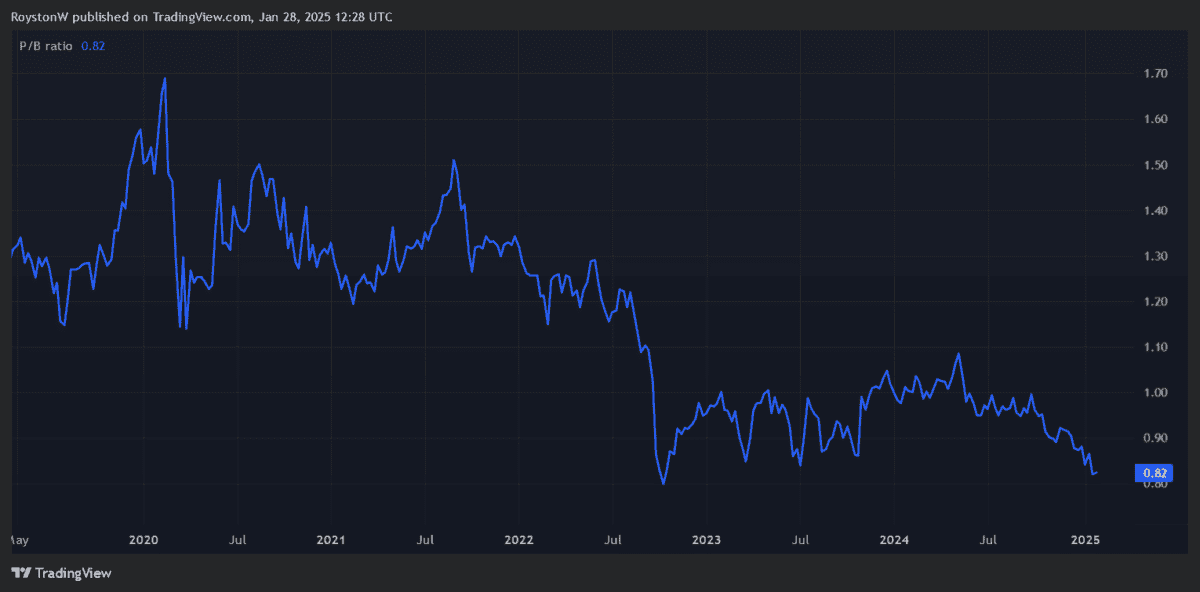
However, based on another popular value metric — the price-to-book (P/B) ratio — the FTSE 250 share actually looks exceptionally cheap.

With a reading below 1, at 0.8, the landlord trades at a discount to the value of its assets.

Source: TradingView

Rising dividends

Pleasingly for Grainger investors, the prospect of solid profits growth means City analysts expect dividends to continue rising sharply over the forecasted period.

For financial 2025 and 2026, total dividends are tipped to soar 12% and 9%, respectively. To put that in context, shareholder payouts across the broader stock market are expected to grow between 4% and 4.5%.

What’s more, these predictions push Grainger’s dividend yields to 4% for 2025 and 4.4% for 2026. Both figures comfortably beat the 3.3% average for FTSE 250 shares.

For investors seeking a blend of growth, income, and value, I think Grainger shares are worth a close look.

I asked DeepSeek for 3 top S&P 500 growth shares and its last pick made me laugh

DeepSeek is currently the most popular free app in the UK on the Apple (NASDAQ: AAPL) app store. So I thought I’d join the crowd and take the Chinese chatbot for a test drive. After first being told I couldn’t register — it turned out it had been hit by a cyberattack — I was finally able to open an account. So I asked it for its top three S&P 500 growth shares to consider buying.

Here’s what the artificial intelligence (AI) bot said…

The top pick

The first stock it churned out was Apple. It highlighted the firm’s strong balance sheet and large ecosystem of products and services.

I wouldn’t disagree with that. The iPhone maker had cash and liquid assets of $65.2bn at the end of September, and has over 2.2bn active devices worldwide. However, I would challenge DeepSeek’s assertion that revenue growth is “strong” and it has shown “consistent innovation“.

Apple’s revenue dipped 2.8% in 2023 and grew just 2% in its most recent financial year. Meanwhile, it has fallen behind competitors in China and has reportedly stopped production of Apple Vision Pro headsets temporarily due to lack of demand. It also spent a decade working on an electric vehicle that it never brought to market, before cancelling the project last year.

Having already built out its massive user base, Apple is focused more on incremental improvements. This isn’t to criticise the company, just to question some of DeepSeek’s points.

With the stock’s price-to-earnings (P/E) ratio at a high 34, Apple wouldn’t be my top S&P 500 choice.

The other two

The bot’s second pick was Microsoft. Hmm…I’m detecting a pattern here. That’s because Apple just reclaimed the tile of the world’s most valuable company, with Microsoft at number two. In third place is AI chipmaker Nvidia, after its share price slumped nearly 17% yesterday (27 January).

But surely DeepSeek didn’t give me Nvidia as its third pick? Laughably, it did, spitting out the S&P 500’s top three in nearly the exact same pecking order as of its training cut-off date (July 2024).

Ironically, of course, it was DeepSeek that was responsible for Nvidia’s epic one-day drop yesterday. Investors were spooked by its purportedly dirt-cheap development cost compared to Western rivals like ChatGPT.

I also asked the AI assistant whether it was a threat to Nvidia’s share price. Interestingly, it ended with, “I’m not a direct danger, but I’m part of a broader trend that Nvidia will need to navigate as the AI landscape evolves“.

Final thoughts

I asked ChatGPT Plus for three S&P 500 stocks at the beginning of the year and it also gave me Microsoft and Nvidia. But it broke with index orthodoxy and went with Visa as its third pick.

Is DeepSeek any good? Not for picking stocks, though I only used the free version. My hunch is the US will ban it on security grounds.

More broadly, it’s becoming clear that generative AI models are commodities. This means margins will probably be low, unlike the traditional Silicon Valley software model.

That’s not to say AI in general won’t revolutionise industries. I reckon it eventually will, like electricity has.

But the key for investors is to figure out whether an AI-based company actually has a durable competitive advantage (or not).

Why the easyJet share price could take off in 2025

The easyJet (LSE: EZJ) share price has had a volatile few years. Despite a recovery in post-pandemic travel volumes, the airline’s stock has fallen 8.9% in the last 12 months, to £4.99 per share as I write on 28 January. Investors would be hoping for more after a 10.5% share price slide to start the year.

I don’t think many will be expecting the airline’s value to soar to the pre-pandemic heights of £15-16 per share. However, I do think there is potential to grow the current £3.8bn market cap if things go right.

Stock price under pressure

The easyJet share price has continued to be volatile. That’s despite a strong first-quarter result, with higher passenger numbers and revenues, as load factors (a measure of how full planes are) hit an impressive 92%.

CEO Kenton Jarvis expects second-quarter available seat kilometres (ASK) to exceed 14% growth. However, revenue per available seat kilometre (RASK) is expected to drop by 4% due to new and longer routes.

Overall though, I think the quarterly update shows the airline is in decent shape for FY25. Total seats are forecast to grow by 3% to 103m while ASK is forecast to climb 8% higher.

Factors for growth

Clearly, exceeding expectations is the key to boosting the airline’s valuation. Management has shown an ability to drive operational efficiency, and a continued focus on costs could boost margins and profitability. Similarly, an ability to pass on higher costs like jet fuel to consumers would be another bonus.

Any positive surprises in travel trends would also be a positive. That includes a better-than-expected winter travel period and good uptake on routes of strategic focus.

Of course, I’m looking at the stock with a 3- to 5-year time horizon. Investors would be hoping to see evidence of a step-change in behaviour rather than just a flash in the pan.

Strong demand is the key. Resilient budget travel spending despite reduced broad consumer spending could really drive the easyJet share price. This type of counter-cyclical earnings profile may entice investors that would otherwise avoid the stock.

Management raising dividends feels unlikely given the focus on growth, but that might also boost investor sentiment.

Potential risks

While investors will be hoping for more gains, there are risks to the stock. It has proven to be volatile in recent times and the travel industry is heavily reliant on leisure spending.

Economic challenges like higher interest rates, as well as volatile oil prices amid heightened geopolitical tensions, are other things that would be weighing on my mind before buying.

Then there’s the competition. Budget travel is a fiercely competitive industry with Wizz Air (LSE: WIZZ) and Jet2 (LSE: JET2) among others snapping at easyJet’s heels.

My verdict

While I believe the airline’s focus on operational efficiency and expanding its route network could propel the share price higher in 2025, I’m not convinced it’s the best place for my money right now.

I think the potential risks outweigh the potential benefits, so I’ll be looking to deploy any spare money into more defensive sectors like pharmaceuticals for the time being.

The Eurasia Mining (EUA) share price has jumped 43%. Time to buy this penny share?

Over the past year, penny share Eurasia Mining (LSE: EUA) has jumped 43% in price. But it still sells for less than 3p apiece.

Past price action is not necessarily an indication of what may come in future.

Still, it has me wondering: should I add the share to my portfolio?

Taking the long-term view

As a long-term investor, my reaction on seeing that impressive one-year performance is to wonder how typical it is of the longer trend – and what if anything may change that trend.

Over five years, the share price has sunk 27%.

Even that number does not capture the full story, as during that period the price actually touched 40p. So some investors today could be sitting on a much higher paper (or actual) loss than 27%.

The catalyst for the rising price over the past 12 months — including an 82% increase since the end of May — has been the ongoing question of whether lossmaking Eurasia will be able to offload its Russian assets and if so whether it could get a good price for them.

Along the way last year, it issued new shares as part of a trade finance agreement. Given the company’s financial position (net cash outflows in the first half were £1.2m), I see a risk of further shareholder dilution in future if Eurasia needs to bolster liquidity further.

So, what is the latest news of a possible sale?

It remains a wait and see, with the company repeatedly emphasising last year that there is no guarantee of any sale in future.

Investing, not speculating

Here, I think, is where being an investor not a speculator helps me make a clear decision, quickly.

Warren Buffett asks (in general, not specific to Eurasia) why someone might want to buy a share if they are not attracted by the idea of owning the whole company.

Eurasia has a market capitalisation of £72m. But the company had no turnover in the first half of last year, is consistently lossmaking and its key assets (in Russia) are basically stranded in a geopolitical quagmire over which it has limited, if any, control.

Would I want to buy that company in general, let alone for £72m? No. Absolutely not.

So, do I want to buy a share in EUA at today’s price, or almost any price? Again, no.

That does not mean that this could not be a very lucrative opportunity. If Eurasia can offload its assets at a good price, I reckon the share price could shoot up even from where it currently stands. Bear in mind that 40p price – just a few years ago, enough buyers and shareholders felt that was justifiable to make it happen.

But buying today in the uncertain prospect of an asset sale is far too speculative for me.

Trade financiers and speculators with a radically different risk appetite to me might do very well here (or very badly) at some point. As an investor, though, I will not be joining them.  

Financial News

Daily News on Investing, Personal Finance, Markets, and more!

Financial News

Policy(Required)