Could worries about DeepSeek crash the S&P 500 and AI stocks?

The S&P 500 has rebounded from the heavy losses experienced on Monday (27 January). But the world’s most widely followed share index isn’t out of the woods just yet.

While volatility has calmed as the week’s rolled on, concern over tech stocks’ profitability — and more specifically those in the artificial intelligence (AI) space — remains at the front of investors’ minds.

Could the S&P 500 be about to crash?

Deep trouble?

To recap, the S&P 500 nosedived on Monday following fresh news on DeepSeek, a Chinese startup that’s developing its own AI system to rival those developed in the US.

DeepSeek’s been around for a while, but performance data from its R1 model has just blown industry experts’ socks off. Testing data shows performance comparable to that of existing AI systems like OpenAI’s o1. However, DeepSeek has achieved this at significantly lower cost.

If these findings hold, there may be significant implications for the global AI landscape. From providing direct competition to established system operators like OpenAI and Google, to impacting demand for high-power computer chips, DeepSeek’s advancements could drive major changes in market dynamics, and with it expectations of soaring profits across the US tech sector.

What next?

Given the S&P 500’s large weighting of technology stocks, it’s easy to see why the index slumped. At the start of 2025, tech giants like Nvidia, Microsoft, Apple, Meta, and Alphabet made up just over 30% of the S&P’s entire market capitalisation.

Their share price gains last year, which were built on hopes of booming AI-related profits, have come under serious scrutiny. Even after Monday’s washout, many tech names still command sky-high valuations.

Yet despite this, the chances of a full-blown market crash look (for the moment at least) pretty low. Disruption has long been a common theme across the tech sector. In addition, R1 has so far has not reached the artificial general intelligence (AGI) level, and can only be used for narrow tasks. It’s possible that disruption to current AI assumptions will not be as severe as thought.

It’s also important to remember that DeepSeek’s model could boost earnings and cash flows across the S&P 500 if it revolutionises AI development.

For system developers, the expense of developing and running these systems may be lower moving ahead. Meanwhile, large swathes of the S&P 500 could benefit from more affordable AI solutions that substantially bring down costs.

Here’s what I’m doing

I continue to remain optimistic over the US tech sector and, by extension, the S&P 500. As well as AI, other tech phenomena like cloud and quantum computing, autonomous vehicles, and cybersecurity offer significant growth opportunities.

But rather than putting all my eggs in the same basket, I think a diversified approach is the best way to invest. The iShares S&P 500 Information Technology Sector ETF (LSE:IUIT) is a top exchange-traded fund (ETF) I hold in my own portfolio and think investors should consider.

With cash spread across 69 companies, it gives me exposure to all of the growth opportunities mentioned above. These include semiconductor manufacturers, software developers, IT consultants, and communications equipment suppliers.

These are early days in the AI revolution, so a crash that pulls this fund (and the broader S&P 500) lower can’t be ruled out. But on balance, I think the outlook for the US tech industry remains extremely bright.


How much passive income can an investor make from the stock market?

It’s never been easier to generate passive income from the stock market. There are dozens of trading apps about nowadays, many of them offering a wide range of investing choices. Better still, some don’t charge any stock trading fees.

So, how much passive income could an investor starting out realistically expect to generate from a portfolio? Let’s find out.

A £10k portfolio

The first thing to point out is that a Stocks and Shares ISA account shields any dividends received from income tax. While the annual limit is £20,000, even investing half that amount is enough to build up sizeable passive income, as we’ll see.

Please note that tax treatment depends on the individual circumstances of each client and may be subject to change in future. The content in this article is provided for information purposes only. It is not intended to be, neither does it constitute, any form of tax advice. Readers are responsible for carrying out their own due diligence and for obtaining professional advice before making any investment decisions.

The average dividend yield from FTSE 100 stocks right now is around 3.5%. This means an investor could invest £10,000 in an index tracker than holds all 100 stocks and hope to achieve annual dividend income of £350.

An alternative route would be to build a bespoke portfolio of individual shares. This approach carries higher potential risk, as individual companies face unique challenges that require consideration, and their dividends are not guaranteed.

However, the risk might be worth it due to the potential for higher income. In other words, it is possible to earn a far higher rate of passive income by investing in individual dividend stocks offering far higher yields.

A stock to consider

I currently have four ultra-high-yield FTSE 100 stocks in my income portfolio. The table below lists their forecast dividend yields for 2025.

Forward yield
Legal & General 9.3%
British American Tobacco 7.8%
Aviva 7.3%
HSBC 6.3%

The average yield here is 7.7%, meaning an investor who puts £2,500 into each stock should receive £770 a year in dividends. That’s more than double the FTSE 100 average!

Of course, I’m simplifying things, as dividend payments rarely stay the same every year. Ideally, they should increase, but that isn’t certain. Aviva, for example, cut its payout in 2019 (though it’s paid a rising dividend every year since).

Global bank HSBC and insurers Legal & General and Aviva are all financial stocks. Therefore, the other may stick out like a sore thumb. Why do I own the tobacco stock? Well, when I first invested in it back in March, the stock was yielding above 10% on a forward-looking basis. That proved far too tempting, despite the genuine risk of falling cigarette sales.

Since then though, the share price has increased by 33%, lowering the yield in the process. Nevertheless, l think the stock still offers me solid value, trading at a low price-to-earnings multiple of around 7.9.

British American Tobacco is the world’s second-largest tobacco company by volume, operating in more than 180 countries. It owns cigarette labels Lucky Strike and Camel, as well as next-generation brands like Vuse (e-cigarettes), Glo (heated tobacco), and Velo (nicotine pouches). I don’t expect these nicotine products to disappear worldwide for some time.

Indeed, the Trump administration recently withdrew a plan to ban menthol cigarettes in the US. The company owns Newport, the leading menthol brand in America. Meanwhile, its Velo-branded nicotine pouch products are growing strongly.

Regular investing

To build up sizeable passive income, it’s going to take time. However, if someone invested £500 a month on top of a £10k sum, and reinvested dividends along the way, they’d end up with £319,077 after 20 years.

That portfolio would then be generating £24,568 in dividends each year, assuming the same 7.7% yield.

Forget about DeepSeek! Here are 2 AI stocks that I’m considering buying

Chinese artificial intelligence (AI) startup DeepSeek has taken the world by storm. For those living under a rock this week, the company claims to have developed an innovative AI model for a fraction of the cost of other industry leaders, including OpenAI.

That sparked a sell-off in the tech-heavy Nasdaq and among technology stocks more broadly. Chip manufacturer Nvidia experienced an historic 17% single-day loss that wiped $589bn (£475bn) off its market cap on Tuesday.

While some investors are now questioning valuations and growth expectations, I have two AI-related stocks that I’m considering buying under the microscope.

Enterprise software giant

Sage Group (LSE: SGE) is first cab off the rank. The company is a leader in enterprise software specialising in accounting and payroll services.

Integration of AI into its product suite has increased automation and improved analytics capabilities. This, in turn, has helped boost the company’s share price by 80% in the past five years to £13.35 per share as I write (29 January).

A 21% increase in full-year underlying operating profits to £529m and a margin increase of 220 basis points to 22.7% says to me that the strategy is working. At the forefront of a growing industry, the stock doesn’t come cheap with a price-to-earnings (P/E) ratio of 42.4.

While I’m considering buying, I do think that’s a hefty price to pay in an uber-competitive and continuously evolving space like enterprise software where the next challenger is never far away.

IT infrastructure services

Staying with the technology theme, Softcat (LSE: SCT) is a stock I track closely. The IT infrastructure provider has a range of services including software licensing, hardware procurement, and cloud computing.

The ability to leverage AI’s innovative and efficient solutions is proving a profitable one. The company’s growth trajectory has been impressive, punctuated by a 9.3% increase in its FY24 operating profit to £154.1m.

Softcat shares are trading at a multiple of 26.5 times earnings. That’s significantly lower than Sage, but still more than double the FTSE 250 average of around 12.9.

Much like Sage, Softcat is a fast-growing and recognisable name in a market with huge potential growth. However, the price reflects this, while the need for constant innovation and potential market saturation are just a couple of risks that could rain on the growth parade.

Key takeaway

While DeepSeek has grabbed headlines, the investable AI universe is large. We’ve seen the astronomical growth in Nvidia’s valuation in recent years but there are ways I could get exposure to the AI trend without it being a chip maker or AI developer.

I am considering buying both Sage and Softcat, but I don’t think it will be in the near future. I don’t have the spare funds to invest right now, and I think defensive sectors like pharmaceuticals are better bang for my buck at present.

Could Rolls-Royce shares hit £8 in 2025?

Last year was another great year for shareholders in Rolls-Royce (LSE: RR), just like the year before. Even if Rolls-Royce shares climb by a far lower amount this year – 36% from where they are today – they would hit £8.

Given that the Rolls-Royce share price was in pennies as recently as 2022, that could be an incredible return for some investors.

But how likely might that be to happen (or not) – and ought I to invest?

There is good reason for the share price to be in much better shape now than a few years back, in my opinion.

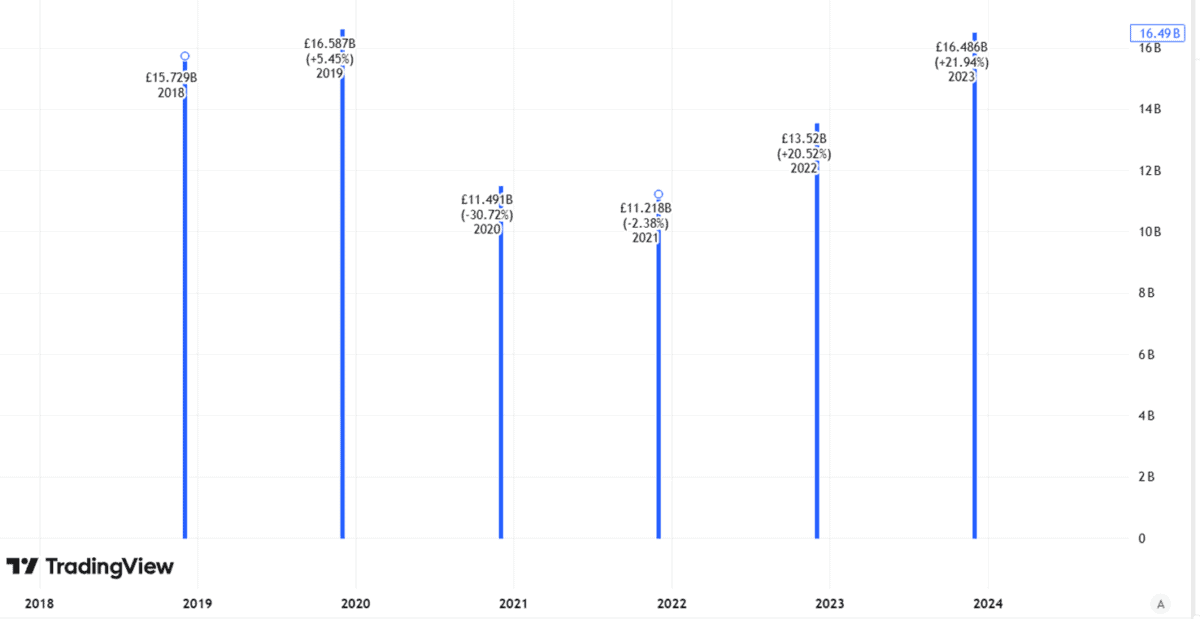
A sharp drop in civil aviation demand during the pandemic was a real test for Rolls. But since then, revenues have come back strongly.

Created using TradingView

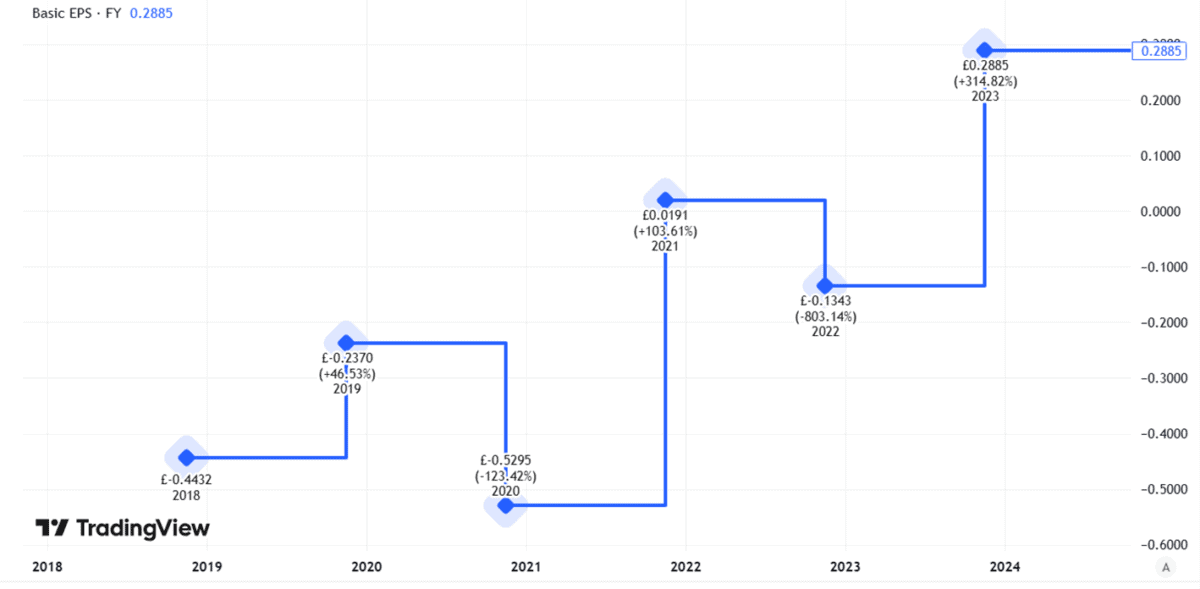
But while revenues were a concern for several years, the bigger one was profits. Making and servicing engines is a business that comes with high fixed costs. So even fairly modest moves in revenue can lead to substantial swings in the profit and loss account.

Looking at Rolls-Royce’s basic earnings per share this is clear.

Created using TradingView

Rolls has made a number of important business moves in the past several years.

It has got rid of some businesses to focus on its strategic core. It has cut costs. It has also implemented an aggressive plan to improve financial performance.

Combined with a boom in demand for civil aviation engine sales and servicing across the industry as a whole and it is a good time for Rolls-Royce.

I’m concerned about the margin of safety

That helps explain why Rolls-Royce shares have soared.

I actually think they could yet go higher from here, including potentially hitting the £8 mark. The price-to-earnings ratio of 21 looks a bit pricy to me but not massively overdone. It has been rising but remains well below its peak of recent years.

Created using TradingView

On top of that, the prospective ratio could well be lower if Rolls can improve earnings per share. I expect it to be able to do that this year and next as part of its financial transformation programme – if things go according to plan.

That, however, is where I see potential problems.

Its ambitious targets mean Rolls already has its hands full delivering on its programme with what it can control.

But what about things that are not in the plan, such as a massive external demand shock pummelling revenues and profits again?

We have seen it in the past with the pandemic but also with terrorist attacks, volcanoes, or a bad recession sending civil aviation demand sharply downwards.

I see such a risk as a matter of ‘when’ not ‘if’, although it may be decades in the future. Then again, it could be tomorrow – and I do not think the current Rolls-Royce share price offers me anything like an adequate margin of safety to account for that risk.

So, although I do think the shares may move higher still, I have no plans to invest.

1 move to avoid at all costs if the S&P 500 crashes in 2025

The S&P 500 has increased by more than 23% in three out of the last four years. While great for investors’ portfolios, it’s also sobering to think that the last time returns were as strong as this was in the lead up to the dot.com market crash.

Consequently, a growing number of commentators are turning bearish on the S&P 500’s prospects in 2025.

This might lead some investors to consider selling in case their stocks take a tumble. I think that would be a mistake though. Here’s why.

Avoiding market timing

A market crash is often defined as a rapid drop of more than 20%. The problem is that nobody really knows for certain when one will happen.

So, if I sell my stocks in anticipation of one, what do I do if stocks continue to go up in 2025? Then again in 2026? I might see the gains I’m missing out on and dive back in, at a premium, just before it actually does crash or starts sliding towards a bear market.

Moreover, I’d have to be right twice for this move to be successful. There would be the exit, getting out just in time to save my portfolio from a painful drop. Then I would have to re-enter the market at the right time before it recovered and started to chug upwards again. But all research on market timing shows that this is almost impossible to get right.

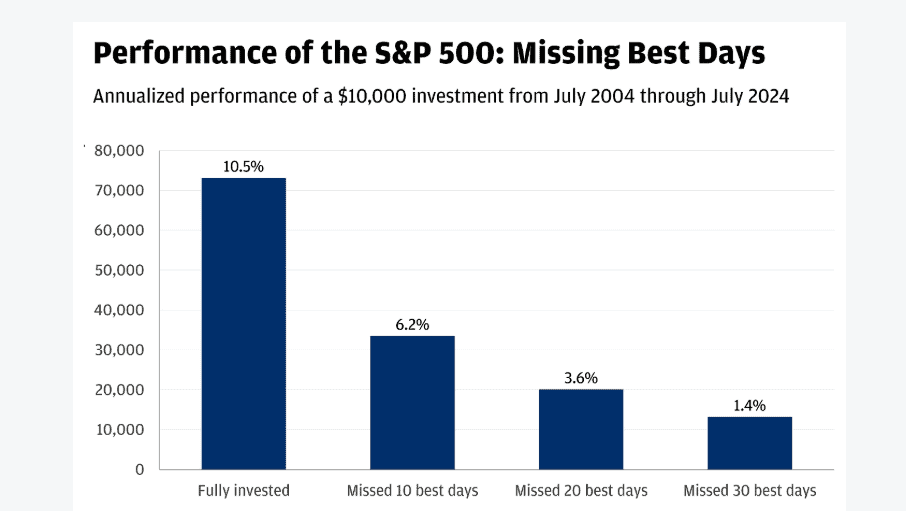
So, what if the market does quickly crash and I’m left with a badly bruised portfolio? Again, the worst thing to do here would be to sell my shares. The reason being that over the past 20 years, 7 of the 10 best market days occurred just a couple of weeks after the worst 10 days, according to JP Morgan.

Staying fully invested, a $10,000 investment in the S&P 500 in 2004 would have grown to over $70,000 by last year. But missing the 10 best days through wrongly timing the market would have cut that to under $35,000!

The key then is for me to avoid panic selling and stay invested.

Source: JP Morgan Asset Management

Seeking a better price

Earlier this week, AI chip stocks plunged after a Chinese start-up unveiled a seemingly cheaper-built version of ChatGPT. This cast doubt on the massive costs related to the ongoing AI buildout.

Were these concerns to snowball and trigger a crash, I’ll be keen to buy more shares of CrowdStrike (NASDAQ: CRWD). This is the AI-powered cybersecurity company whose name came to the public’s attention for all the wrong reasons back in July when a faulty software upgrade caused a global IT outage.

The share price crashed 38% after this incident, but has since bounced back strongly, rising 82%.

While I’m relieved about this, it’s also left the stock looking very pricey at 27 times sales. This lofty valuation leaves little room for error, particularly if another software incident or, worse, cybersecurity breach of its platform takes place.

However, as of the last quarter, 66% of customers were using five or more of its cybersecurity modules, while an impressive 20% were using eight or more. So the software debacle seems to have caused little lasting damage.

Looking ahead, analysts still expect CrowdStrike’s revenue and profits to grow above 20% until at least 2028.

Looking for UK shares to buy? This 19p small-cap down 5% today may be worth considering

Clinical trials firm hVIVO (LSE: HVO) delivered a trading update today (29 January). This is a stock that I own, having built up a position over the past couple of years. However, while I still view it as one of the more promising small-cap shares to consider buying, it’s proving far more volatile than I anticipated.

To give a flavour, the share price today has dropped 5% to 19p, as I write. However, in the two weeks prior, it had surged nearly 30%. Over five years, it’s up 252%, but down 36% since mid-November. Did I mention that it’s volatile?!

Looking through the update though, I think there are a couple of concerns as well as long-term potential.

What happened?

For those unfamiliar, hVIVO is a contract research organisation (CRO) that specialises in human challenge trials (HCTs). These involve recruiting healthy volunteers — signed up through its own FluCamp recruitment platform — and exposing some of them to pathogens to test vaccines and therapeutics.

Today, the company actually delivered two announcements. First, there was the trading update for 2024, which showed 12% year-on-year revenue growth (£62.7m) and a strong EBITDA margin of approximately 26% (up from 23.3% in 2023). It ended the year with £44.2m in cash, up from £37m the year before.

Operationally, hVIVO made solid progress, opening the world’s largest commercial HCT unit. This 50-bedroom facility has also enabled the firm to diversify its offerings to include laboratory services for external clients. Earlier this month, it inked its largest standalone lab contract signed to date (£2.7m).

The second announcement offered guidance and related to the acquisition of a pair of clinical research units from a CRO in Germany. The company said this deal “further diversifies hVIVO’s services to include in-patient Phase I and Phase II trials across a broader range of therapeutic areas“.

The acquisition cost €10m, funded entirely from hVIVO’s existing cash resources. However, while the units recorded unaudited revenue of nearly €20m last year, they also reported an adjusted EBITDA loss of €1.8m.

Why is the stock down?

So, the firm is using cash to buy loss-making businesses abroad. Moreover, it plans to spend another €2.5m on integration costs in 2025. Consequently, management has warned that this will impact EBITDA margins in the short term, guiding for mid-to-high teens (significantly less than last year’s 26%).

However, it also expects the acquisition to contribute positively to earnings by 2026. And it gives hVIVO a “significant footprint” in Europe while offering “considerable cross-selling opportunities” due to a broader client base.

Looking forward, it expects revenue of £73m this year, including this deal. If we assume similar revenue at the acquired business (around £16m), then this suggests core revenue will be flat or declining, hinting at weak organic growth. That’s not ideal.

Then again, the firm has previously stated that it expects acquisitions like this to help get it to £100m in revenue by 2028.

My view

Stepping back, I think the market reaction today is understandable. However, the stock at 19p may still be worth considering for patient investors.

Given this is a business with a modest £129m market cap though, I’m keeping my holding small relative to my overall portfolio. That way, I can benefit if it goes up while minimising damage if it doesn’t.

Nvidia stock: all that glitters is not always gold

They say that a week is a long time in politics. But with Nvidia (NASDAQ: NVDA) stock shedding the largest daily amount of market cap in US stock market history, one day must have felt like a lifetime for its shareholders.

A total loss of $1trn in market cap across the Magnificent 7 highlights the dangers of extreme market concentration in just a handful of stocks. The question I am now asking myself is, are we are at the beginning of the unravelling of the biggest bubble in stock market history?

Large language models

I don’t claim to be an expert in large language models but I have for some time become deeply concerned about the path the tech industry finds itself on.

Although there is no way of knowing for sure how much the hyperscalers have invested in Nvidia chips, the accounts of Alphabet, Meta, and Microsoft point to it being in the tens of billions of dollars. And what have they got to show for it?

Without trying to sound too cynical, my answer is not a lot.

Every time I use ChatGPT, I am less than impressed with its results. I have yet to talk to anyone who would rely on the answers any generative AI model provides without first fact checking. It’s little wonder that all these models come with a disclaimer.

What about the thorny issue of hallucinations? This happens when a model presents a falsehood as categorically true. What business will want to rely on such flawed technology, particularly when it comes to mission-critical apps?

Lessons from history

It’s easy to discount my criticisms. After all, generative AI is a new technology. Surely, a solution to these problems will come with time. Maybe it will, but that fundamentally misses the point.

The entire industry is selling this technology as the future of AI. Whether DeepSeek succeeds is neither here nor there — such a collective mindset across Silicon Valley is inherently dangerous. I would even go as far as to say that such groupthink poses an existential threat.

History is littered with examples of companies that were at the forefront of the advancement of a new technology, and yet when the race was run were pipped at the post.

One of the most instructive was the 20-year long pioneering innovation battle to produce a commercialised home videotape. The winner there didn’t emerge until JVC produced the VHS standard.

Buy the dip?

My point in using the JVC example, is an attempt to highlight that the battle for AI supremacy will not be run over 100 metres but over a marathon. But too many investors today believe that the race has run, and the riches and the spoils are there to be collected.

As I write this article, on 28 January, Nvidia has recovered some of its loses. This is to be expected. Many would-be investors will view its share price weakness as a buying opportunity. I am not so sure.

The stock is almost certainly heading for a period of heightened volatility. But I still think that far too many investors are totally oblivious to the risks here. ‘Buy the dip’ is so ingrained in people’s psyche, that only an all-out crash will change such a mindset. I certainly won’t be touching the stock.

Here’s how £20 a month could put a stock market beginner on the path to wealth in 2025

Getting into the stock market is a goal some people put off because they think it takes much more money than it really does. In fact, with even £20 a month, it is possible to lay the foundations for trying to build long-term wealth in the market. Here’s how.

Is £20 a month really enough?

Let’s start with that £20 a month. Over one year, that would add up to £240. With more money, an investor could try to build their portfolio faster. But it’s possible to start with £20 a month and go from there. If more money’s available to invest in future, that could speed things up.

But I reckon there’s a lot to be said simply for getting going. Doing that on a fairly modest scale should hopefully make any beginner’s mistakes less costly.

How to start investing

On a practical level, the investor would need an account to put the money in and buy shares. There are lots of different options available when it comes to share-dealing accounts and Stocks and Shares ISAs, so I think it makes sense to look at the choices. Every investor is different.

Before even choosing shares to buy, a new investor could consider some important points about how to invest. For example, what is the right balance between risk and reward (again, what works for one person may not work for another)? And what are some of the practices a good investor likely wants to consider from day one in the stock market?

Building a portfolio

An example of such a good practice is not putting all your eggs in one basket. In stock market parlance that’s called diversification and it is possible even when investing with a very limited budget.

One mistake many new investors make is not being realistic about their expectations. That’s understandable as they lack stock market experience, but I think it is an important thing to watch out for. Some shares do brilliantly, but some go sideways and some do terribly.

So long-term wealth creation is helped by building a portfolio of shares in outstanding companies that are bought at attractive prices — and holding them.

Finding the right shares to buy

But how can a new investor (or an experienced one) decide whether a price is attractive?

Take Tesla (NASDAQ: TSLA) as an example. It has a large customer base and could benefit from further growth in the electric vehicle (EV) market. It has a proven, profitable business model. On top of that, the company’s knowledge of power storage has enabled it to grow a large and rapidly expanding energy storage business.

The Tesla share price is close to $400. On its own though, a share price does not necessarily tell us much about a company’s valuation (we also need to know how many shares there are, for example).

As an investor, I would happily consider buying Tesla shares for my portfolio at the right price. But the current valuation puts me off for now.

Its share price is around 109 times annual earnings per share. That seems very high to me, even before considering risks like fierce competition hurting the company’s profit margins.

How to find UK AI shares to consider buying

With the buzz surrounding Nvidia and Meta it can sometimes seem that artificial intelligence (AI) stocks are an American thing. But there are quite a few UK shares that offer investors exposure to AI in one way or another.

Here, I outline a couple of possible approaches an investor could adopt when hunting for shares.

Buying into the US indirectly

One approach would be to buy shares in UK investment trusts that hold stakes in US giants. As an example, Scottish Mortgage Investment Trust holds Nvidia shares.

In fact, the chipmaker was the trust’s fifth biggest holding at the end of last month, accounting for around 4% of its overall valuation. It also owns a sizeable stake in rival chipmaker ASML.

Scottish Mortgage’s tech focus means its holdings are not just limited to chip manufacturers. For example, it also has a stake in Tempus AI. That firm uses AI to help healthcare professionals diagnose and treat diseases including cancer.

I am a bit burnt on that score having had high hopes for a similar investment in a different firm that has turned out to be one of my worst investments in recent years.

If I had invested in Scottish Mortgage instead of buying individual UK shares that I felt had a good AI investment case, I could have benefitted from the trust’s expert managers and also a level of diversification it is hard for me to achieve as a private investor on a small budget.

FTSE 100 member Scottish Mortgage is only one of a number of London-listed investment trusts that own US AI shares. In the FTSE 250, for example, Polar Capital Technology Trust ended last year with Nvidia as its biggest holding.

Looking for individual UK shares

What about individual UK shares not investment trusts? Some may be AI-focused but there are others where the technology potentially offers cost savings as part of an existing business model, from pharma giants like AstraZeneca to digital information providers such as RELX.

The ins and outs of AI feel a bit beyond my own circle of competence as an investor. But I need not rule out any AI-related shares.

Take Computacenter (LSE: CCC) as an example. It provides IT equipment and services to a wide range of commercial clients across multiple markets. That sounds like a business set to benefit from AI spending, in my view.

In a trading update Tuesday (28 January), the company did not focus on AI, but did say: “Order intake during the second half, notably in North America, has been strong”. As it noted at the interim results point last September, “we are increasingly seeing a need for comprehensive advice on the use of AI in general and AI-related infrastructure”.

Computacenter faces some risks too. Yesterday’s statement revealed that sales revenues fell last year once exchange rate movements are taken into account. It also highlighted the risks to this year’s performance posed by “uncertain macroeconomic and political environments in some of the European countries in which we operate”.

Still, with a proven business model, large customer base and deep industry knowledge, I think the investment case has a lot of strengths. The price-to-earnings ratio of 15 looks reasonable. I think UK investors on the hunt for AI shares ought to consider Computacenter.

2 FTSE 100 and FTSE 250 shares to consider for a Stocks & Shares ISA!

Looking for top growth and dividend shares to buy for a Stocks and Shares ISA? Here are two from the FTSE 100 and FTSE 250 I believe merit serious attention.

Berkeley

Investing in housebuilders like Berkeley (LSE:BKG) carries higher-than-usual risk right now. Build cost pressures remain significant, while on the demand side, a tough outlook for the UK economy threatens future sales.

On the bright side however, interest rates still look on course to fall steadily in the months ahead. And if homebuyer demand following recent rate cuts is anything to go by, builders could experience a strong rebound in 2025.

Things are looking particularly exciting in the London market right now. This is good news for Berkeley, which specialises in construction in the capital and surrounding areas.

On Tuesday (28 January), London-focused estate agent Foxtons said it was handling the highest number of homes under offer since the Brexit referendum in 2016. It added that volumes were “substantially” higher than those seen a year ago and reflected “strong under-offer activity in the fourth quarter.

This follows Berkeley’s statement in early December that sales had experienced “a slight uptick in recent weeks“.

Once again, it’s too early to say that the housebuilders are out of trouble just yet. But a more favourable interest rate environment, allied with government plans to build 1.5m new homes in the five years to 2029, means industry earnings could improve significantly.

Berkeley’s plans to capitalise on London’s white-hot rentals market gives it added scope to grow profits, too. In June, the company announced it intends to put up 4,000 build-to-rent properties over the next decade.

Today Berkeley shares trade on a forward price-to-earnings (P/E) ratio of 10.7 times. This is lower than the corresponding readings of fellow FTSE 100 housebuilders Taylor Wimpey, Barratt Redrow and Persimmon.

All things considered, I think Berkeley’s a great recovery stock to consider.

AJ Bell

Retail investment platforms are other UK shares with considerable long-term growth potential. With the UK’s elderly population rapidly growing, and peoples’ engagement in financial planing also rising, sector revenues could enjoy strong and sustained expansion.

FTSE 250-listed AJ Bell (LSE:AJB) is one such company I feel is worthy o close attention. A strong set of financials today (29 January) has once again underlined the firm’s considerable growth potential.

As of December, the financial services giant had 561,000 customers on its books. This represented a 4% quarter-on-quarter increase, and a mammoth 16% rise on an annual basis.

As a consequence, total assets under administration (AUA) leapt 17% year on year to £89.5bn.

While its market has room for substantial growth, fierce competition means AJ Bell is by no means guaranteed to succeed. But ongoing platform investment, growing brand awareness and attractive pricing puts it in a strong position.

Its forward P/E ratio of 19.5 times looks toppy on paper. Still, I believe AJ Bell’s strong momentum in a growing market means its shares are worthy of a premium rating and further research.

Financial News

Daily News on Investing, Personal Finance, Markets, and more!

Financial News

Policy(Required)