I’m considering buying these passive income stocks in 2025

When we think of investing in a Stocks and Shares ISA for passive income, what comes to mind? Stocks paying a steady annual dividend, without year-to-year uncertainty? When we reach the stage of drawing down our income, that might make good sense.

When I get there, I expect I’ll have most of my investment in Dividend Hero investment trusts, like City of London Investment Trust and Murray Income Trust. They’ve raised their payouts for at least 50 years in a row. And they typically pay dividend yields of 4.5% to 5%.

But I’d wager most people reading this are still in the build-up phase. We’re reinvesting our annual dividends in more shares to try to maximise our eventual pot, aren’t we? If we’re at that stage, who cares how the dividends fluctuate? Long-term returns are surely all that matters.

Top sectors

I intend to keep investing in my favourite sectors, even ones that can be cyclical and volatile. Right now, I think the insurance business looks especially good. I have my eye on Aviva, Phoenix Group Holdings, and Legal & General (LSE: LGEN).

Insurance stocks can be tricky to rate on typical valuation measures, like the price-to-earnings (P/E) ratio. At Legal & General, analysts have it at 15, falling to 9.5 based on 2026 forecasts. That seems fine. But I’m more interested in liquidity measures, which can have a greater bearing on an insurance firm’s ability to pay dividends.

At the halfway stage, the company reported a solvency II coverage ratio of 223%, with a capital surplus of £897m. We saw the interim dividend raised 5%, with a forecast full-year yield of 8.8%. We also have a £200m share buyback.

Cyclical stocks are especially tricky to predict. And dividend cover by earnings has been falling for FTSE 100 stocks, which might keep investors away from some of the top yields. But for passive income investors looking forward at least a decade, I think this could be a good one to consider for pot building. It’s on my list.

Off the boil

Housebuilder stocks like Persimmon and Taylor Wimpey (LSE: TW.) have been giving up their earlier 2024 gains. Taylor Wimpey is down 30% from its 52-week high. Is this a new opportunity to buy cheaply, before the sector gets back to a long-term upwards trend?

With interest rates not coming down as quickly as hoped, I can see reasons for the dip. Taylor Wimpey has a forecast 8% dividend yield. But that depends very much on the cash coming in from house completions, and they’re falling. In a full-year update on 16 January, the company reported 9,972 UK completions, down from 10,356 in 2023. And 2023 fell behind 2022.

Until we see serious growth in these figures, I fear the Taylor Wimpey share price could remain low. But at least the firm’s order book was up to £1,995m at 31 December, from £1,772m the previous year.

And CEO Jennie Daly pointed out that completions were actually “towards the upper end of our guidance range.

Despite possible dividend pressure in 2025, I’m seriously considering buying some to add to my housebuilder holdings.


The Rolls-Royce share price could soar to 820p, according to this broker

The Rolls-Royce (LSE: RR.) share price has risen spectacularly over the last two years. Since the start of 2023, it’s surged from 93p to 591p – turning a £5k investment into more than £30k.

One City brokerage firm believes the share price can climb much higher though. It’s highlighted 820p as a medium-term target price.

Lofty share price target

The broker’s Panmure Liberum, and its analyst Nick Cunningham – who currently has a Buy rating on Rolls-Royce – believes the stock can hit 820p in the next three years.

That target’s around 39% higher than the current share price. If it was to come to fruition, a £5,000 investment in the company today could grow to around £6,950.

Cunningham’s bullish on Rolls-Royce for several reasons. One is that he believes the strong civil aviation market will support growth.

Another is that the company has significant exposure to the defence industry. He anticipates that higher defence spending in the years ahead will boost profit revenue and profit margins.

Cunningham has acknowledged however, that the prolific profit growth generated by the FTSE 100 company in the last few years is unlikely to continue. His view is that profit growth’s likely to “continue to be positive, but also less dramatic.”

Not everyone’s as bullish

It’s worth noting that not all brokers are as bullish on Rolls-Royce as Panmure Liberum. Earlier this month, analysts at Citi actually downgraded the stock from Buy to Neutral.

Its view was that the stock’s now approaching ‘fair value’. However, it did raise its target price from 555p to 641p and that new target is 8.5% above the current share price.

Should I buy?

Is it worth buying some Rolls-Royce shares for my portfolio today given Panmure Liberum’s 820p target? It implies share price growth of nearly 12% a year, which would be an excellent return over the medium term.

Well, there’s a lot I like about Rolls-Royce from an investment perspective today. I like the fact that the company has exposure to several different industries including civil aviation, defence, and nuclear energy.

I also like management’s laser focused on efficiency. The earnings growth generated by CEO Tufan Erginbilgiç in recent years has been very impressive.

I just can’t get comfortable with the stock’s valuation today however. With the consensus earnings per share (EPS) forecast for 2025 sitting at 21p, the forward-looking price-to-earnings (P/E) ratio’s 28.

That’s nearly as high as the P/E ratio on tech stock Nvidia! And to my mind, it adds a lot of risk.

If top-line growth was to slow, or costs came in higher than expected, the share price could take a hit. Ultimately, there’s no margin of safety at that earnings multiple.

So I’m not going to chase Rolls-Royce shares here. With the valuation’s so high, I’m going to focus on other investment opportunities.

I asked ChatGPT to rate my worst-performing UK stock – here’s what it told me

I decided to have a bit of fun with ChatGPT and asked what it thought of the worst-performing UK stock in my portfolio.

The company is FTSE 250-listed luxury car maker Aston Martin (LSE: AML). Yes, yes, I know, only an idiot would buy that. But last September, I decided its shares had fallen so far there was surely a chance of making money.

Instead, I’m staring at a 35% paper loss — but I suppose it could be worse. Over 12 months, the Aston Martin share price has plunged 45%. Over five years, it’s collapsed 96%.

So I asked my AI chatbot buddy for its view on what is thankfully my worst share purchase (although Ocado Group might have something to say about that).

The Aston Martin share price is a car crash

My question was: Exactly how stupid was I? Happily, my boon robot companion was programmed to be polite and replied: “You weren’t necessarily stupid to invest in Aston Martin, but you did take on significant risk in a company with a volatile history“.

Personally, I think stupidity does come into it. At least I only invested the scrapings of my cash account, rather than a larger sum.

My assumption that Aston Martin was through the worst wasn’t entirely unreasonable, I was happy to hear. “The problem is that a falling stock doesn’t necessarily mean it’s undervalued. Sometimes, it’s a warning sign of deeper, ongoing issues”, ChatGPT said.

It noted that the stock was floated in 2018 at a wildly optimistic valuation of £19 per share. The reality has been brutal, with the shares down to £1.05.

ChatGPT noted that Aston Martin has a history of high debt and poor cash flow, forcing multiple equity raises that diluted shareholders and made recovery harder. “Even after securing backing from investors like Mercedes-Benz and executive chairman Lawrence Stroll, the company still struggles to turn a consistent profit”, it added.

Aston Martin may have an iconic brand but competes against Ferrari, “which operates with higher margins and a more stable financial model“.

Happily, there are reasons for optimism. “Aston Martin has been refreshing its lineup, and the brand’s Formula 1 presence helps keep it relevant. If its new models sell well, revenue could improve.”

This FTSE 250 stock is driving me to drink

If Aston Martin can drive efficiencies and profitability, it could turn a corner (I see what you did there, ChatGPT). Or it could be acquired by a larger automaker or investor looking for a turnaround project.

But ChatGPT had concerns too, warning the group’s £1.3bn net debt limits growth opportunities, especially with interest rates high. The luxury market also continues to struggle.

Overall, ChatGPT isn’t convinced, concluding: “The stock remains highly speculative, and its future depends on execution and external conditions”.

Personally, I would have been harder on myself. I was dazzled by the brand and, worse, by the shallow notion that the shares could snap back and hand me a quick profit.

Most of my portfolio is in solid FTSE 100 blue chips, so maybe I was due a bit of rash fun. I’ll hold onto the shares but won’t take this kind of punt again. It’s making my portfolio look messy and me feel like a chump. Even if ChatGPT is too polite to say.

Investors considering a £10,000 holding in this FTSE 250 gem could make £17,599 a year in passive income over time!

Shares in the FTSE 250’s abrdn (LSE: ABDN) are down 11% from their 12-month 31 January traded high of £1.70. Given that a stock’s yield rises as its price falls, its annual return is up to 9.7%.

However, analysts forecast its 2023 dividend of 14.6p will remain until the end of 2027. Indeed, it has been at this level since 2020.

To me, this makes it an unmissable passive income gem in my portfolio geared to generating such returns. These are derived from minimal effort on my part, aside from choosing the stocks and monitoring their progress.

How much passive income can be made?

Investors considering a £10,000 stake in abrdn would make £970 in first-year dividends. If the yield averaged the same 9.7% over 10 years, this would rise to £9,700. And on the same basis it would increase to £29,100 after 30 years.

This is much more than could be made from any UK standard savings account. But vastly more could be made using a common investment technique known as ‘dividend compounding’.

The magic of dividend compounding

This process simply involves reinvesting the dividends paid by a stock right back into it. It is similar to leaving interest in a savings account to grow.

By utilising this method on an average 9.7% yield, annual dividends would be £16,277 after 10 years, not £9,700. And after 30 years on the same basis, these would be £171,433, rather than £29,100. 

Adding in the initial £10,000 investment and the abrdn holding would be worth £181,433 by that point. If the 9.7% yield were still in place, the shares would pay £17,599 a year in dividend income.

What about the share valuation?

abrdn currently trades at a price-earnings (P/E) ratio of just 8.3. This is bottom of its group of competitors, which averages 33.8. These comprise RIT Capital Partners at 11.9, M&G at 29, Bridgepoint Group at 45.5, and Legal & General at 48.8.

So, it looks very undervalued on this basis.

The same can be said for its key price-to-book ratio of 0.5 against a peer average of 2.4. And it is also true of its price-to-sales ratio of 1.9 against the 4.9 average of its competitors.

I ran a discounted cash flow analysis to put all this into a share price context. Using other analysts’ figures and my own, this shows the stock is 18% undervalued at its present £1.51 price.

So its fair value is technically £1.84, although market vagaries may push it lower or higher than that.

The major reorganisation

abrdn is on a mission to reduce costs, improve its client offering, and increase profitability.

Its 21 January Q4 trading update showed it has cut £100m+ in costs so far. It is on track to hit its £150m target by the end of 2025.

Additionally positive was that net inflows of client cash jumped £1.2bn in the quarter. This means it now has £511.4bn in assets under management and administration.

I think the principal risk in the stock is if this ambitious reorganisation fails or simply falls short.

However, its H1 2024 results showed an IFRS post-tax profit of £171m compared to a £145m loss in H1 2023.

Consequently, I will be buying more shares of abrdn very soon.

2 super-cheap shares with dazzling dividends I’m considering buying today, and one I’m sadly not

There are loads of incredibly cheap shares on the FTSE 100 today, and many offer fantastic rates of dividend income. I think now may prove a brilliant time to buy them.

At some point, interest rates may fall appreciably. When this happens, yields on lower-risk investments like cash and bonds will decline, making dividend-paying stocks more attractive.

FTSE 100 income stocks have been out of favour for years, as investors throw money at US tech. However, the rise of Chinese AI player DeepSeek could cool enthusiasm for the related US mega-caps, potentially leading investors back to old-school value stocks.

Today’s lower UK share prices mean higher dividend yields for new investors, and reinvesting dividends today can build my stake for the day when income stocks rebound.

With this in mind, here are three high-yield dividend stocks I think look particularly attractive right now.

I’m sorely tempted by Shell

Oil giant Shell (LSE: SHEL) has had a solid year, its share price climbing 6% over the past 12 months. 

Despite this, it remains attractively valued, with a low price-to-earnings (P/E) ratio of just 7.6. Investors are also rewarded with a respectable 4% trailing dividend yield.

Shell’s strong financial position and significant cash flow generation should help fund its dividend and share buybacks. The biggest risk is oil price volatility. It’s just impossible to say where prices will go. The company also faces the challenge of balancing profitability from fossil fuels while investing in renewables and low-carbon energy solutions.

But long-term, I believe Shell remains attractive for investors seeking both dividend income and share price growth. With its commitment to returning capital to shareholders, it’s well-positioned to reward patient investors.

Rio Tinto looks good value

Mining giant Rio Tinto‘s (LSE: RIO) struggled, with the share price dropping 13% over the past year. 

However, this has pushed its dividend up to an impressive 7.3%, making it one of the highest yielders on the FTSE 100. Its low P/E ratio of 8.3 suggests it’s undervalued.

Rio Tinto’s been hit hard by the Chinese economic slowdown, which has dampened demand for metals and minerals. The China growth story may be over for good but Rio Tinto may benefit from the shift towards renewable energy and electric vehicles (EVs), which require industrial metals including copper and aluminium.

Mining’s cyclical, but downturns present buying opportunities. With its strong balance sheet and disciplined approach to capital allocation, Rio Tinto looks well-positioned to benefit when demand recovers.

If only I could buy British American Tobacco

British American Tobacco‘s (LSE: BATS) surged 36% in the past year, yet still offers a high dividend yield of 7.4% and trades at a low P/E of just 8.4.

While smoking’s declining in the West, the company has diversified into next-generation products including vapes and heated tobacco.

Regulatory risks remain, as governments may tighten restrictions on new nicotine products. However, British American Tobacco sells billions of ‘sticks’ every year and continues to generate strong cash flows, supporting its generous dividends.

Despite ethical concerns, investors seeking reliable income may find it attractive. Personally, I don’t invest in tobacco stocks, otherwise I’d have bought this one years ago and might be significantly wealthier. 

But I’m now considering buying Shell to supplement my holding in rival BP, while Rio Tinto’s high on my shopping list.

With a spare £50 a month, here’s how an investor could start a Stocks and Shares ISA

Some people may be put off investing in a Stocks and Shares ISA because they think it’s just for the wealthy.  But at The Motley Fool, we believe anyone with a little extra cash can benefit from setting money aside for the future. Thanks to modern investment platforms, it’s possible to start with as little as £50 a month. 

A Stocks and Shares ISA‘s a fantastic vehicle for this, offering tax-free growth and shielding you from capital gains and dividend taxes.

Please note that tax treatment depends on the individual circumstances of each client and may be subject to change in future. The content in this article is provided for information purposes only. It is not intended to be, neither does it constitute, any form of tax advice. Readers are responsible for carrying out their own due diligence and for obtaining professional advice before making any investment decisions.

Start small, think big

Before investing, it’s crucial to have an emergency fund in an easy-access savings account. Investing in stocks carries risk, and nobody wants to be forced to sell at a loss if an unexpected bill lands. A good rule of thumb is to have at least three months’ worth of essential expenses saved before committing to the stock market.

Many ISA platforms, such as AJ Bell, Hargreaves Lansdown, Interactive Investor and Vanguard, allow low, minimum contributions. 

Some even offer commission-free investing, making it cost-effective to invest small amounts regularly. With £50 a month, it’s now possible to purchase shares in an investment fund or an individual stock.

Buying individual stocks can be exciting and potentially rewarding in the long run but carries more risk. Some newbie investors may prefer to invest in a low-cost FTSE 100 or S&P 500 index fund, which provides instant diversification. 

However, for someone who fancies trying their hand, picking individual stocks can be much more engaging. Starting with a strong, defensive company’s a smart move.

In my view, Unilever‘s (LSE: ULVR) a solid starter stock to consider. I hold it myself. This FTSE 100 giant boasts some of the world’s most recognisable brands, such as Ben & Jerry’s, Dove, Hellmann’s, Dove, Persil and many more.

I reckon Unilever is a great starter stock

Since Unilever sells everyday essentials, demand tends to remain stable even in economic downturns, helping new investors weather stock market volatility.

Unilever also has a long history of paying dividends, currently yielding 3.2%, with the board aiming for 5% annual increases. 

Its global presence and diversified product range provide stability, though the company has faced criticism for spreading itself too thin. The board is addressing these concerns, but change takes time.

Unilever’s share price has risen just 3% in five years, with dividends on top of that. However, over the past 12 months, it’s surged more than 20%. The outlook’s more optimistic but, as always, past performance is no guarantee of future results.

Because every stock carries risk, building a diversified portfolio is essential. I’d aim to increase that initial £50 a month as soon as possible. First to £100, then £150, then £200. Expanding into sectors like technology, healthcare and financial services can further reduce risk.

Reinvesting dividends helps turbo-charge long-term growth. But the most important step? Getting started. With patience and consistency, those small monthly contributions can compound into substantial wealth over time.

Up 700% in a year! Could this be the biggest US growth stock of 2025?

Despite the name, growth stocks don’t always grow. Sometimes they cause a global internet outage and lose half their value in a matter of weeks. In times like these, we’re offered a rare opportunity to see the true meaning of recovery.

After dropping 45% last July, Crowdstrike hit a new all-time high this week. That equates to growth of almost 90% in less than six months. US tech stocks are known for their growth but a recovery like this is a rare thing indeed.

And yet, shockingly, it’s not the fastest-growing stock in the past six months. Both Palantir and Axon Enterprise outpaced it, up 196% and 112% respectively. 

But the absolute winner of the lot is mobile app development and advertising firm AppLovin (NASDAQ: APP). It’s gained 360% since August last year and a mind-blowing 710% in the past 12 months. I don’t know the exact price history of every stock in the world but I’d be surprised if many have achieved anything close.

For context, it took US tech darling Nvidia around 17 months to achieve similar growth. Palantir recently did the same in about 19 months and at one point Tesla climbed 700% in 20 months, between 2020 and 2022.

So what is AppLovin and why’s it not dominating the news like the others?

Mobile gaming and advertising

Launched in 2012, AppLovin releases mobile games and provides tools for developers to monetise their apps. Disappointingly, the name’s not a play on the character ‘McLovin’ from the 2007 movie Superbad. Until last October, it hadn’t done much to grab attention. In early September, the share price was still down 24% from its all-time high of $112 in late 2021.

Then things started happening rapidly. On 7 November, it posted impressive Q3 results that sent its market-cap soaring above $100bn. Revenue increased 39% in the quarter and earnings per share (EPS) reached $1.25 — far ahead of the expected 92c. Over the past two months, Piper Sandler, Wedbush, JP Morgan, Macquarie and Jefferies have all lifted their price targets for the stock, most giving it a Buy or Outperform rating.

Most recently, Goldman Sachs raised its target from $220 to $335. The stock’s currently trading near $360.

The strong performance isn’t unwarranted. Over the past six consecutive quarters, earnings have beat analyst expectations every year — once by as much as 180% (Q2 2023). Revenue’s not far behind, climbing 125% since 2020 and beating expectations each year without fail.

Worth considering?

While much about AppLovin looks impressive, there are risks to consider. Much of its revenue derives from mobile gaming, a relatively new industry that’s highly competitive and lacks a loyal customer base. And a shift in privacy regulations, in particular GDPR in Europe, could derail the company’s ad-driven revenue model.

Looking at ratios, the price is now 100 times higher than earnings, putting it in highly speculative territory. At that level, the chance of a correction increases dramatically. 

So yes, it’s a fairly new high-flying company that could easily be the next big thing. But it could also be the next big failure. For that reason, it doesn’t appeal to a risk-averse investor like me. However, I’m certainly interested to see where it goes.

Should cheap Lloyds shares be on investors’ shopping lists in February?

Lloyds Banking Group (LSE:LLOY) has enjoyed an electrifying start to 2025. At 62.5p per share, the FTSE 100 bank has risen a whopping 13.4% in value in just a handful of weeks.

Yet even accounting for this rise, the Lloyds share price looks dirt cheap. At least on paper, that is.

Its price-to-earnings (P/E) ratio for this year’s a modest 9 times. But the Black Horse Bank doesn’t just look cheap based on predicted profits. With a price-to-book (P/B) ratio of 0.9, it trades at a slight discount to the value of its assets.

Throw a 5.5% forward dividend yield into the mix too, and Lloyds shares seem to offer terrific all-round value.

However, it’s important to remember that a cheap share price is common among high-risk companies and/or those with poor growth prospects. With this in mind, should investors consider cut-price Lloyds shares next month?

Growth issues

Times are tough for the high street banks. And things could get more difficult as subdued economic conditions dampen credit demand among consumers and businesses. On top of this, the traditional lenders’ margins are under threat as the Bank of England (BoE) gears up to make further interest rate cuts and market competition increases.

Lloyds’ net interest margin (NIM) — the difference between what it charges borrowers and the interest it pays savers — dropped to a wafer-thin 2.94% as of September. It could plummet in 2025 if the BoE’s ratesetters (likely) slash interest rates multiple times this year.

Lloyds chief executive Charlie Nunn has tipped three interest rate reductions by the end of December.

Cost-cutting increases

In this environment, retail banks have little room to grow earnings. So in recent days, Lloyds has announced more branch closures to give the bottom line a boost and further its pivot to digital banking. By next March, the bank plans to shutter another 136 branches to reduce its cost base. This will take the number of Lloyds, Halifax and Bank of Scotland branches to 757, down significantly from 2,200 a decade ago.

As I say, the overall loan outlook for the bank’s pretty gloomy. However, signs of recovery in the housing market are a good omen for its mortgage unit. Lloyds is the UK’s most popular residential home loan provider with a market share of around 19%.

Car crash coming?

Based on all the above, I feel investors should think about buying other value shares instead. And especially when I get onto potentially the biggest threat to Lloyds in the short-to-medium term.

As a major car finance provider, Lloyds faces potentially billions of pounds in fines if found guilty of mis-selling motor loans. HSBC thinks the Financial Conduct Authority probe into the non-disclosure of dealer commissions could cost the sector a staggering £44bn.

If so, this could cause shockwaves for Lloyds’ profits, dividends and, as a consequence, share price. The bank might be cheap, but I think this reflects the high degree of risk it poses.

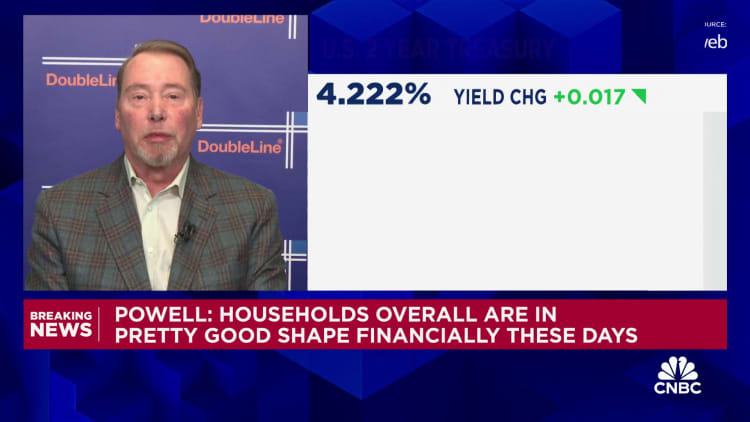
DoubleLine’s Gundlach says his base case is one rate cut this year, two reductions maximum

  • DoubleLine Capital CEO Jeffrey Gundlach said Wednesday he expects only one rate cut for 2025 — two reductions at most — as the Federal Reserve patiently awaits incoming data to assess the state of the labor market and inflation.
  • The central bank kept interest rates unchanged Wednesday after three consecutive cuts to end 2024.
Jeffrey Gundlach speaking at the 2019 SOHN Conference in New York on May 6, 2019.
Adam Jeffery | CNBC

DoubleLine Capital CEO Jeffrey Gundlach said Wednesday he expects only one rate cut for 2025 — two reductions at most — as the Federal Reserve patiently awaits incoming data to assess the state of the labor market and inflation.

“Maximum two cuts this year. And I mean maximum, I’m not predicting two cuts. I just think that’s the most you can possibly think about,” Gundlach said on CNBC’s “Closing Bell.” “At the present moment, if you had made me pick a number, I would say now one cut would be the base case and maximum two.”

The central bank kept interest rates unchanged Wednesday after three consecutive cuts to end 2024. Fed Chair Jerome Powell emphasized that the central bank is in no hurry to adjust its policy stance, particularly as the economy remains strong.

“It’s going to be a slow process to get to a hurdle to cut rates again. … I don’t think you’re going to see a cut at the next Fed meeting,” Gundlach said. “He’s obviously focused on the stability in the unemployment rate right now in terms of not feeling a need to cut rates.”

The notable fixed income investor thinks long-duration Treasury yields have more room to rise. He noted that the benchmark 10-year rate has increased about 85 basis points since the Fed cut rates for the first time last year.

“I think that rates have not peaked on the long end,” he said. “I think rates will have another move up on the long end.”

Gundlach cautioned against owning high-risk assets right now because of his view on long-term interest rates and his observation that valuations are high.

Don’t miss these insights from CNBC PRO

Can Tesla stock grow any more?

This year, it will be 15 years since Tesla (NASDAQ: TSLA) listed on the stock exchange. During those years it seems as if there has been a never-ending battle between bears saying Tesla stock was surely headed for a fall and bulls who reckoned the long-term investment case was not fully reflected in the price.

As ever, that remains the case.

Tesla stock is up 808% in five years and 84% just since late October.

But with a market capitalisation of $1.2trn and a price-to-earnings (P/E) ratio of 108, Tesla’s current valuation seems to factor in a huge amount of growth potential – and even then could still be seen as pricy.

I like the company’s prospects and think its strong brand, proprietary technology, and large customer base set it up well for ongoing commercial success.

But is there any point in me shelling out for Tesla stock at this point given its giddy valuation?

Three possible drivers for a higher valuation

That depends on what I expect to happen to the business in coming years and decades.

I do see several possible drivers to push Tesla stock even higher.

One, which we have seen many times in the past (just look at that gain since October!), is momentum. Stock market participants scared of missing out have often piled into Tesla shares, pushing the price up higher.

But that momentum-based approach does not interest me, as I think it is closer to speculation than investing. I prefer to invest in an enterprise (or not) based on business fundamentals.

Transformational business potential

Could the fundamentals justify a higher price?

Again, I think the answer is potentially yes.

One driver could be much improved earnings. Although the company’s electric sales volumes fell slightly last year, it has a long history of revenue growth and I think it has the tools to keep delivering on that, for example, by introducing new models.

Plus, in carmaking, economies of scale are a big thing (no pun intended).

Tesla’s strong sales mean it could improve profit margins in coming years, by stripping out costs and also selling add-ons with high profit margins. One risk I see there, though, is that the competitive electric vehicle market could mean it increasingly needs to compete on price, hurting margins.

A third driver is growth outside the vehicle business.

Its energy storage business is already going gangbusters. On top of that, Tesla could also launch new product lines from a driverless taxi operation to commercial applications using its vast trove of customer journey data.

If growth from areas beyond vehicle sales boosts earnings, that could propel Tesla stock upwards.

At 108, the P/E ratio tells its own tale

But a lot of that feels fairly speculative for now.

Meanwhile, Tesla’s triple-digit P/E ratio looks far too high for my comfort as a would-be investor.

Given risks ranging from growing competition to a change in tax credit regimes in the US and elsewhere, does Tesla stock merit being priced at over a century’s worth of earnings at the current level?

I do not think so.

Again, that feels like a speculator’s valuation to me, more than a savvy investor’s one. So, I have no plans to buy Tesla for my portfolio.

Financial News

Daily News on Investing, Personal Finance, Markets, and more!

Financial News

Policy(Required)