Is this UK media group a cheap growth share or an ailing dividend payer?

I happily admit I’m not much of a growth share guy. Typically, my focus is on hunting in the UK stock market for consistent dividend payers in sectors that I like.

However, there is the occasional growth share or two that catches my eye. Given the volatility we’re seeing in the stock market at present, I thought I’d do a deep dive into one company that appears cheap compared to the FTSE 250 index. 

Prominent broadcaster

ITV (LSE: ITV) looks cheap to me at face value. The company is a major player in UK television programming and digital streaming services as it looks to adapt to the rapidly-evolving media landscape.

While the media group has been on my radar for a while, what really caught my eye was its latest results. The success of ITVX, the company’s streaming platform, has helped provide a significant financial boost of late.

In fact, the company noted a 15% increase in digital advertising revenues between January and September 2024 as it continues to capture this growing part of the market.

Shares in the company have climbed 20.5% in the past year to £7.82 per share as I write on 30 January. Despite those gains, it still has a high dividend yield of 7% which is well above the FTSE 250 average of 3.4%.

It’s a similar story with the price-to-earnings (P/E) ratio. ITV shares are trading at a multiple of 6.7 times earnings, while the mid-cap Footsie average is around 12.9. That looks like a bargain to me.

So, why are investors seemingly wary of the stock? There are a few key risks that might be looming on the horizon.

Key risks

First of all, digital streaming is a cutthroat industry. The need to be producing or acquiring relevant content for audiences with ever-changing tastes is a difficult one.

Similarly, while its ITVX business is growing, traditional broadcasting revenues are in decline. That puts pressure on the main business and potentially creates a bit of an ‘all the eggs in one basket’ situation.

Without the ITVX growth, there really isn’t a lot for investors to hold onto in terms of growth potential. Throw in the high cost of producing proprietary content, and the economic uncertainty facing the UK, which could impact on consumer spending, and ITV suddenly doesn’t seem like such a bargain.

Verdict

ITV is an interesting prospect. It is a household name with a long history as a major player in UK media. There are certainly some challenges facing the stock in the medium-term which does make it hard to value.

If the ITVX segment can continue to show signs of growth, then I think it could be a bargain at the current price. However, there is too much uncertainty over my 3- to 5-year investment horizon for me to be buying right now.

In the meantime, I’ll focus my efforts on more defensive sectors like pharmaceuticals to see if there are some bargains to be found.


Airtel Africa share price surges 10% on Q3 results but foreign currency remains a key risk

The Airtel Africa (LSE: AAF) share price surged almost 10% this morning after interim results revealed a 171% year-on-year increase in profit after tax. 

The Q3 2025 report highlighted an exceptional gain of $94m in pre-tax profit due to currency appreciations in Tanzania and Nigeria. Net profit came in at $133m. For the nine months ending 31 December 2024, it posted a 21% increase in constant currency revenue. However, due to currency devaluations, reported revenue was down 5.8%.

Much of the growth came from strong performance in its Mobile Money division, which brought in 29.6% more revenue (in constant currency).

Despite the strong results, its profit margin slipped 0.5% and basic earnings per share (EPS) fell to 6.2c from 7.1c. Earnings before interest, tax, depreciation, and amortisation (EBITDA) declined 11.9% in reported currency to $1.68bn, attributed to higher fuel costs and lower revenue from Nigeria.

Overall, the results were well received, bringing the share price up to 147p — a 25% year-to-date (YTD) gain.

Growing customer base

Airtel has been going from strength to strength lately after a period of mixed performance in 2023 and 2024. The relatively new listing enjoyed rapid gains in 2021 but faltered after peaking at around 165p in mid-2022.

Now nearing a 30-month high, it may soon breach that price level again. 

Customer growth has been strong, up almost 8% this quarter, with smartphone penetration up 44.2% and a 32.3% increase in data usage per customer. It operates in 14 African nations with a majority market share in Zambia, Tanzania, Seychelles, Congo, Niger, Malawi, Gabon, and Chad.

With this morning’s results, it launched a second $100m share buyback, extending the programme announced in December last year. The plan is to repurchase approximately 900,000 shares in the coming 12 months. 

Foreign exchange risks

Foreign currency losses remain a key issue for the company, with the devaluation of the Nigeria naira impacting profits in previous years. Over the past two years, the naira has fallen almost 70% against the US dollar.

The decline contributed to an $89m loss reported in its 2024 final year results. In the fourth quarter of 2023, its net margin fell to -9.3% but has since recovered to 1.98%. The potential for further impact from Nigeria remains a risk.

Debt remains another risk affecting the company, having risen a further 7.5% to $5.3bn. The rising cost of fuel has contributed to its debt, as diesel generators power much of its network infrastructure in remote areas. As geopolitical issues continue to drive up the price of crude oil, this may put pressure on the company’s profits going forward.

Challenges ahead

Airtel’s recovery in recent years has been impressive but many challenges remain. Operating in developing countries with volatile currencies is a key risk that needs careful management.

As such, analysts have mixed opinions on the stock, with price targets ranging from a 26.5% loss to a 39.8% gain. On average, a decline of 4.47% is expected in the coming 12 months.

However, with a growing customer base and strong revenue, EPS is expected to reach 22p in 2027 — a nearly fourfold increase. As a shareholder, I have high hopes for the company but remain cautious regarding the economic challenges it faces in Africa.

2 shares smashing all-time highs as the FTSE 100 peaks

The FTSE 100 has had a great start to the year, rising nearly 5% to reach a record level. So it’s hardly surprising to see a few Footsie shares also pushing skywards into uncharted territory.

Here are two that have started 2025 the way they ended 2024 — going up!

On a roll again

First is Rolls-Royce (LSE: RR), which gained over 90% last year and closed at a record 611p earlier this month. It’s pulled back slightly to 592p, as I write, but that’s still higher than where it started the year (568p).

Beyond the recovery in international travel, the company continues to benefit from elevated defence spending. Last week, Rolls bagged its biggest ever deal, a £9bn contract with the Ministry of Defence to make nuclear submarine reactors for the Royal Navy.

There’s also growing excitement about its small modular reactors (SMR) business. Last year, it won a landmark contract to help deploy these mini-nuclear reactors in the Czech Republic. It may land a contract to do the same in the UK too — the long-delayed decision is expected in the spring.

With nations wanting to decarbonise energy systems, and more data centres needed to support power-hungry AI systems, the global SMR market could be huge.

However, it’s also one that is a few years away (2030s). In the meantime, the firm faces supply chain challenges and sky-high expectations from investors. It remains to be seen whether the share price will surge for a third year in a row.

Longer term, however, I’m bullish on this blue-chip. The global fleet of long-haul aircraft is expected to expand significantly in the coming decades, particularly in Asia. The growth opportunities should be plentiful for the FTSE 100 engine maker.

That said, with the stock trading a high price-to-earnings (P/E) ratio of 32 for 2024, I’m not keen on adding to my holding at the moment.

Scaling up rapidly

Next is InterContinental Hotels Group (LSE: IHG). The share price is up 130% over the past five years, leaving it near its all-time high at just under 10,800p.

Like Rolls-Royce, InterContinental is another global company, with a growing hotel presence across Europe, Asia, and the Americas. Its capital-light franchising model is enabling it to scale quickly, especially in high-demand markets across Asia, where it is leveraging local partners’ resources and market knowledge. 

This is a stock I’ve wanted to buy for some time now, but the seemingly high valuation has put me off. Right now, the P/E ratio for 2024 is around 30.

Arguably, that valuation fails to account for the risks of a potential trade war and rising inflation that might be triggered by Donald Trump’s proposed tariffs. That could hit disposable income and therefore demand for travel and hotels.

Again though, I’m optimistic about this stock moving forward. There’s a big pushback on short-term rentals on Airbnb in many major cities, which should ultimately play into the firm’s hands.

The company owns a diverse portfolio of hotel brands, including the luxury InterContinental Hotels & Resorts, the mid-range Holiday Inn, and boutique Kimpton. I see it as one of the highest-quality businesses in the FTSE 100 and expect it to carry on doing very well.

As soon as there’s a significant dip, I plan to invest.

Is it worth me buying BT shares after today’s poorly-received update?

In sharp contrast to last year, BT (LSE: BT-A) shares have had a pretty volatile start to 2025. Today’s (30 January) trading update from the UK’s biggest mobile and broadband operator has done nothing to change that.

So, what’s troubling investors?

Mixed numbers

Well, the figures were hardly pulse-quickening. Adjusted revenues dipped 3% to £5.2bn in Q3 following lower sales at the company’s Consumer and Business units.

On a more upbeat note, revenue at BT’s Openreach division increased by 1% to £1.5bn with 17m Fibre to the Premises (FTTP) connections completed by the end of December. A target of 4.2m premises in the current financial year has been set with the goal of 25m being hit at the end of 2026.

CEO Allison Kirkby was also trying to put a positive spin on things, highlighting that the company’s “cost transformation more than offset lower revenue outside the UK and weak handset sales“. The sale of its data centre business in Ireland — part of BT’s strategy to completely focus on its home market — was also stressed.

Opportunity knocks?

All things considered, it feels like the market has overreacted a touch, especially as BT believes it’s still on course to meet full-year expectations.

Today’s share price fall should be put in perspective too. This company significantly outperformed the index in 2024.

In addition to a rise of almost 17%, investors were treated to dividends of 8p per share. Perhaps some profit-taking — if that’s what we’re seeing — was inevitable.

The question, however, is whether BT can continue to do the business over the long term from here. Well, this is where things get a bit tricky.

Cheap…for a reason?

On the one hand, this still looks to be a very cheap stock. A price-to-earnings (P/E) ratio of just 8 means that BT shares still trade far below the average valuation across the FTSE 100.

Based on the current price, the £15bn cap also boasts a juicy 5.5% dividend yield. That’s more than a fund tracking the return of the UK’s biggest companies will deliver.

However, the prospect of more cash does come with an extra dollop of risk.

One major weakness of the investment case is that BT’s balance sheet still creaks under an enormous amount of debt. This is hardly surprising given that management has committed to throwing billions of pounds into its roll-out of full-fibre broadband. The idea is that this will all pay off with higher profits in the end. Perhaps it will. But shareholders could see quite a bit of volatility along the way if we get any inflationary shocks.

Better buys elsewhere

Considering the above, it’s not surprising that analysts are predicting a negligible rise for dividends in FY26. To me, near-stagnant payouts aren’t particularly attractive. BT doesn’t have the best record of sustaining payouts when the UK economy wobbles either.

Cheap at face value as it may be, I’m still not tempted to buy. Last year’s lovely gain aside, I prefer businesses in robust financial health. While no one truly knows what’s around the corner and no dividend stream is guaranteed, a history of consistently rising payouts with few (if any) interruptions are what I look for.

And there are plenty of those in the UK market right now!

I lost £15k on tech stocks on 1 day: here are my key takeaways

I’ve been investing in tech stocks for some time now, and as the market suggests, my returns have been pretty strong. In fact, since withdrawing some money from my ISA a year ago, my portfolio of circa 25 stocks has almost doubled in value.

However, Monday (27 January) was almost certainly the worst day for my portfolio ever. The £15,000 drop in the value of my investments was not an insubstantial part of my total. However, as always, I should look to learn from these events. Here are my key takeaways.

A grey swan event

We can’t plan for every eventuality. And on Monday, artificial intelligence (AI)-related stocks tanked because a Chinese company’s language model, reportedly produced for just $5.6m, became the most downloaded chatbot on the App Store.

DeepSeek hadn’t been on investors’ bingo list for 2025. But just one month into the year, it’s got people questioning the dominance of US tech and asking how much money is really needed to develop AI. However, although DeepSeek ranked higher than many of its Western chatbot peers, some questions remain about the validity of the development claims.

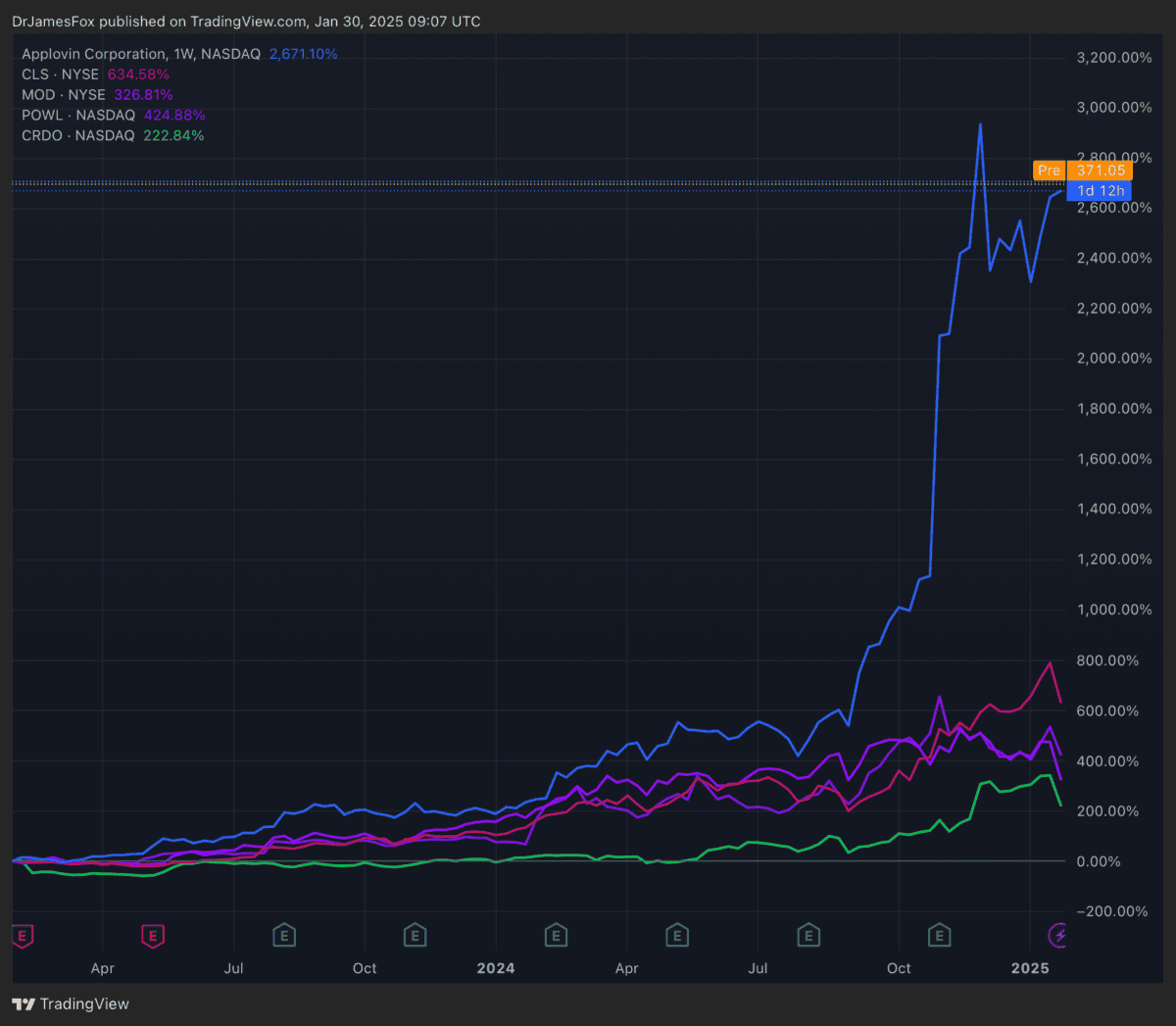
While the headlines focused in on Nvidia, which fell more than 10% in Monday’s trading, some of my AI infrastructure holdings fell further. Celestica and Credo both fell around 30%, while Modine Manufacturing and Powell Industries weren’t far behind.

A lapse in diversification

I have 25 stocks in my portfolio, but my error was that I allowed some to grow too large, creating concentration risk. I recently sold most of my AppLovin shares, which were up 800%, but I didn’t practice the same caution with Celestica, Modine, or Powell. All three were up over 200% in my portfolio, growing faster than most of my other stocks.

TradingView: Performance of AI-stocks over five years

As a result, almost 20% of my portfolio focused on AI infrastructure. It’s an important reminder than diversification requires constant asset adjustment to avoid concentration risk.

Achieving diversification

Celestica stock has surged back from Monday though, and I partially expect the others to do the same. However, in the spirit of diversification, I could consider a stock for the ‘second layer’ of AI. UiPath (NYSE:PATH) is one such company, and it’s been on my watchlist for a while. It’s the second layer of AI because it’s one of the companies that is using technological developments to provide platforms to help business automate and optimise processes.

From a valuation perspective, it’s trading with a price-to-earnings-to-growth (PEG) ratio of 0.99, which represents a 46% discount to the information technology sector average. However, at 32 times forward earnings, there’s a certain degree of risk here and anything less than a stunning performance could be an issue. For now, it’s a stock I plan to keep a close eye on. Maybe I would have been wise to move a little earlier when the stock traded with lower multiples.

However, for even greater diversification, I may wish to consider an ETF or a fund-based approach. This can provide me with exposure to a host of companies typically with lower risk than investing in a singular stock.

Dividend rise and buyback help keep the Shell share price up. Time to buy?

The Shell (LSE: SHEL) share price has risen 22% in the past five years. And the 10% dip in adjusted earnings per share (EPS) for 2024 reported on 30 January didn’t throw it off course.

Most of the drop came in the fourth quarter, which saw EPS down 38% from the previous quarter. It was affected by a number of specific things, including higher exploration well write-offs, lower margins and lower oil prices.

Cash still looks healthy, as Shell lifted its full-year dividend by 7%, and revealed a new $3.5bn share buyback programme. That makes it the 13th consecutive quarter with buybacks of at least $3bn.

Cash flow

CEO Wael Sawan said: “Despite the lower earnings this quarter, cash delivery remained solid and we generated free cash flow of $40bn across the year, higher than 2023, in a lower price environment.”

He added: “Our continued focus on simplification helped to deliver over $3bn in structural cost reductions since 2022, meeting our target ahead of schedule.”

Despite the five-year price rise, we’re still looking at a 4.3% dividend yield for 2024. Does that make it a buy now? If the dividend keeps rising, and future buybacks lift per-share measures further, I’d say it has to be worth considering. But could future dividends suffer under the threat of a price war?

Oil prices

President Trump told the World Economic Forum in Davos that he wants OPEC countries to lower oil prices. Whether he’ll be successful in that is open to question. But even just ramping up US exploration and production could have the effect he desires. And oil has already fallen back from the gains of the final weeks of 2024.

Then there’s the longer-term threat from efforts to wean the planet off fossil fuels. The political will to get carbon emissions down has clearly been weakening. But the rise of record storms and wildfires, attributed in part to human-driven climate change, shows the problem isn’t going away.

There’s a key question for investors to ask here. Are the short-term and long-term threats already accounted for in the Shell share price? I think they just might be.

Valuation

Forecasts suggest a 2025 price-to-earnings (P/E) ratio of about 8.7. Shell recorded a rise in debt to $38.8bn in the fourth quarter, and adjusting for that would push the effective P/E up to 10.4. Is that too much?

The City doesn’t think so. There’s a strong buy consensus among 15 analysts, with a price target of around £32. With Shell shares trading at £26.20 as I write, that could mean a 22% increase.

I think investors considering buying Shell shares need to weigh a number of factors. Higher oil production could mean lower prices. But higher volumes also mean higher revenues. Demand is also a bit weak now, especially from a sluggish China. In the long term, these things tend to even out.

How long the long term really is for oil is a tricky question. But it’s surely not going away soon. Shell is on my buy candidates list.

As Tesla stock rises on more robotaxi claims, what should investors do?

Elon Musk announced Wednesday (29 January) that unsupervised Full Self Driving will be arriving in the US within six months. And Tesla (NASDAQ:TSLA) stock’s up 4% as a result.

Even by Musk’s standards, this is bold. But the Tesla CEO’s been inaccurately forecasting the imminent launch of a robotaxi network for years, so should investors think this time’s any different?

Sales and profits 

For Tesla, keeping investors focused on the prospect of driverless vehicles – and not on its car sales – is probably a good thing. The results for the fourth quarter of 2024 were disappointing.

Expectations were low going into yesterday’s report. But the results still fell short of even those, as record vehicle deliveries resulted in an 8% drop in automotive revenues. Realistically, this probably doesn’t matter. Even if the results had been better than anticipated, car sales aren’t why Tesla’s market-cap‘s almost 14 times that of Ford and General Motors combined.

The reason also isn’t energy storage or affordable vehicles. The current share price is a reflection of investors believing the firm’s going to achieve its robotaxi ambitions – and they have to be right.

Is this really happening?

A lot has to happen for the kind of autonomous vehicles Tesla shareholders are imagining to become a reality. The most obvious thing in the company’s way is regulatory approval. 

This has the potential to be an ongoing issue. The proposal to start in Texas (where regulatory barriers are low) makes a lot of sense, but launching into different states will bring new challenges.

On top of this there’s still the issue of the technology itself. Tesla’s latest footage shows its cars driving themselves from the factory to the loading dock, but this isn’t new.

Showing it can operate in closed environments – as it did last year – is one thing. But there’s a big difference between this and driving around a town or a city. 

What if it doesn’t happen?

Given Musk’s track record and the challenges ahead, investors would have to be extremely brave to bet on Level 5 autonomous vehicles by June. The good news though, is that they don’t have to. 

If – for whatever reason – Tesla falls short of its targets, the stock might go down. But its shareholders will need to work out whether the robotaxi network has been delayed (yet again) or cancelled. Further delays probably don’t matter. Despite its CEO’s announcements, the company achieving its ambitions a year late will still make the stock an excellent investment at today’s prices.

The story’s different however, if Tesla doesn’t get there at all. In that situation, no amount of efficiency in car manufacturing’s going to make the business worth the current share price.

What should investors do?

Investors are doing exactly the right thing (and have been for some time). Rather than looking at the share price, they’re trying to figure out the underlying business, which is what will ultimately matter.

Given its CEO’s track record on robotaxi predictions, I think Tesla is way too hard to forecast – and that ought to make investors at least hesitate. But even if the firm misses its 2025 targets, I think the story still has a way to go.

Up 91% in a year, could NatWest shares head higher still?

Over the past year, NatWest (LSE: NWG) has been an excellent investment for many shareholders. NatWest shares have moved up 91% during those 12 months. On top of that, the FTSE 100 bank offers a dividend yield of 4.1% and has grown its ordinary dividends per share significantly over the past three years.

Despite the massive rise in price, NatWest shares continue to sell for a bit less than nine times earnings. That looks potentially cheap to me. So is it worth adding the bank to my portfolio now in the hope of future gains?

The outlook for banks seems uncertain

Stepping back from NatWest specifically, as an investor I feel the market’s outlook for UK banks must have changed significantly to justify the sort of price action we have seen over the past year.

NatWest’s 91% rise is huge. But during the same period, Lloyds has moved up 45%, Barclays 97% and HSBC 34%. So it seems as if the City reckons that the outlook for UK banks in general now looks markedly stronger than a year ago.

That reflects the economy being a bit more resilient than was feared, economic optimism globally coming in 2025 has been boosted in some regions as shown in strong stock market performance and the potential for central banks’ moves on interest rates to improve growth rates.

Still, is that enough to justify soaring bank share prices? The economy may be wobbling less than feared but it still feels pretty fragile to me, both on a UK and global perspective. The risk of a slowing economy also brings risks of higher loan defaults, hurting profits at banks including NatWest.

This share could keep moving up, but will it?

Another factor specific to NatWest has been the UK government selling down the stake in the bank it had held since bailing it out during the 2008 financial crisis. This week, that fell below the 8% level.

Reducing then eliminating the government shareholding could, over time, lead to a lower number of shares in circulation and so push up earnings per share. That could boost the share price.

The bank’s earnings in the first nine months of last year showed year-on-year growth of 4%. With over 19 million customers, strong brands and a proven business model in a space I expect to keep seeing high demand, I think the well-known bank could keep doing well. That could push NatWest shares up.

On the other hand though, I wonder whether the market has been too quick to dismiss those economic risks. NatWest’s strengths today were true a year ago too. A 91% share price rise feels steep to me in those circumstances.

I think the global economy remains weak and swathes of the British economy are looking distinctly shaky. I remain concerned about the risk that poses to banks’ earnings — and their share prices. NatWest, for now at least, is not on my stock market shopping list.

2 penny stocks I’m avoiding like the plague in February

I’m partial to the odd small-cap share, if it floats my boat. Unfortunately, these two penny stocks don’t, leaving me keen to avoid them.

Beleaguered luxury brand

The first stock’s Mulberry Group (LSE: MUL). Shares of the luxury accessories maker have fallen 76% in just under four years!

This has seen the company’s market-cap slump to just £63m. Part of me thinks that’s too low for a company that posted £153m in FY24 sales (which ended in March). On the other hand, Mulberry’s being hammered by the global slowdown in demand for luxury goods.

In November, the company reported that revenue dropped 19% to £69.7m in the six months to the end of September. Sales fell in every region, with particular weakness in Asia. Gross margin contracted to 66.5% from 70.4% and the loss widened by 23% to £15.7m. Grim stuff.

The company doesn’t see things picking up anytime soon, saying the “wider macro-economic environment, including ongoing inflationary pressures, continues to present uncertainty and challenges“.

Now, Mulberry’s the UK’s largest designer and manufacturer of luxury leather goods. I don’t like to see the British brand suffering like this. So I hope new CEO Andrea Baldo is successful in cutting costs, renewing the brand, and restoring profits.

Perhaps he’ll succeed, or maybe the firm will be acquired at a higher price (though it rejected two bids from Frasers Group last year). Truth is, I haven’t the foggiest what’s going to happen. With the firm posting losses, there’s just far too much uncertainty for me to invest here.

Not ready for lift-off

The next penny stock I’m not touching with a bargepole in February is Virgin Galactic (NYSE: SPCE). This is the space tourism business founded by Sir Richard Branson.

The share price has suffered a supernova collapse, plummeting 99.5% in four years!

The company’s listed in the US, where there’s a slightly different definition of a penny stock. It’s typically defined as one that trades for less than $5 and has a low market-cap. That certainly describes Virgin Galactic, with its share price at $4.50 and a meagre $130m market cap.

What’s gone wrong? Well, the company conducted its final spaceflight last summer before announcing a two-year pause in commercial operations to focus on building its next-generation spacecraft. So there’s almost zero revenue coming in until at least 2026.

In Q3, it burnt through $118m of cash, leaving $744m in cash and equivalents. While that sounds a lot, cash burn’s expected to have risen to between $115m and $125m in Q4. At that rate, it probably won’t have enough to fund itself through to mid-2026.

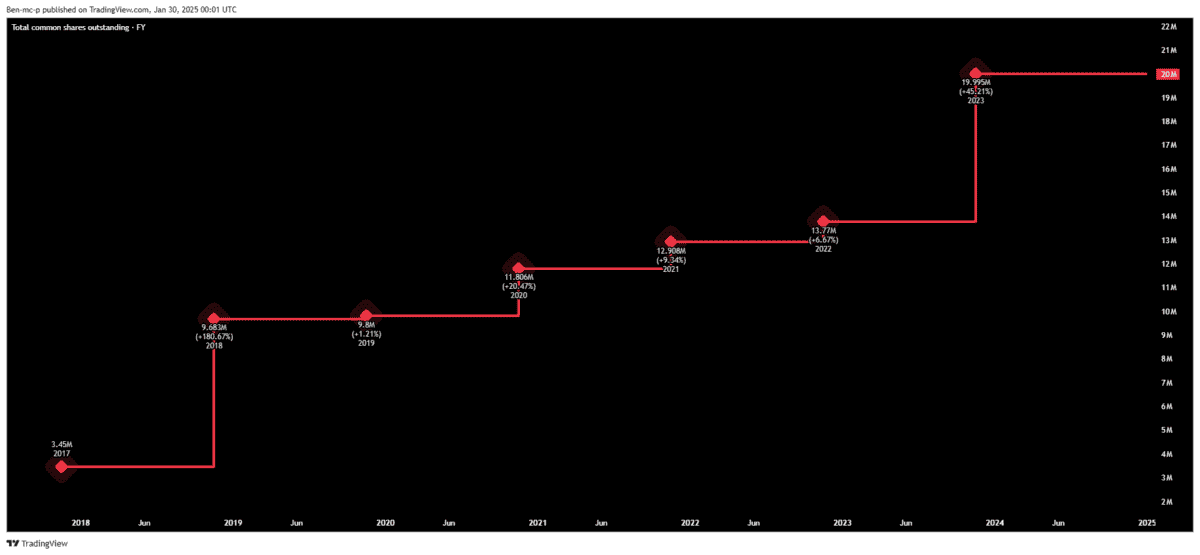
The solution? Keep selling more stock, massively diluting shareholders in the process. This isn’t new, as the share count history shows.

Created at TradingView

Now, I do support Virgin Galactic’s mission to fly thousands of private astronauts to space. Seeing our planet from above famously changes perspectives in a profound way (known as the ‘Overview Effect’). If space travel can bring humanity together, then I’m all for that (its retired spacecraft was called ‘VSS Unity’ for this reason).

However, I doubt such idealism will do much for my portfolio down here on Earth. So I’m sitting this one out.

A £10,000 investment in this UK dividend stock could earn me £2,500 per year in passive income

With a 1.4% dividend yield, Judges Scientific (LSE:JDG) looks as much like a passive income stock as I do Chris Hemsworth. But I think it’s perfect for my portfolio – which is why I’ve been buying it.

The stock might not be the best choice for anyone looking to earn a second income in the next couple of years. But from a long-term perspective, things look quite different. 

Is this a dividend stock?

Judges Scientific is more of a dividend stock than it first looks. The yield might not be much to look at, but the company has a policy of increasing its shareholder distributions by at least 10% each year. 

That’s enough to turn a £10,000 investment today into something that generates £2,443 per year 30 years from now. And the reason that matters to me is because it’s when I reach State Pension age. 

Until then, I’m planning to reinvest whatever dividends I receive. With that in mind, I don’t think it’s at all unreasonable to think the eventual return on a £10,000 investment could be over £2,500.

Obviously, this depends on the company’s ability to keep increasing its dividends. And while this isn’t guaranteed, I think it has some really excellent prospects. 

Growth

Judges Scientific is a collection of scientific instrument businesses. These are established operations with strong positions in highly specialised markets that makes them hard for competitors to disrupt.

For example, Scientifica makes instruments that allow scientists to move electrodes to study individual brain cells. This requires deep technical knowledge, creating a high barrier to entry.

The downside to this type of operation is that it can be hard to grow. And while Judges Scientific can create some opportunities, this isn’t the primary source of growth for the overall company. 

Instead, the main focus is on adding new subsidiaries through acquisitions. The firm aims to identify and bring in new businesses that have the characteristics it looks for in its existing ones. 

Risks

This strategy of growing by acquisitions has been extremely effective, but there’s no denying it’s also risky. The biggest danger is the chance of destroying shareholder value by overpaying for a business. 

Judges Scientific isn’t entirely immune from this threat. But it does have some important principles that it looks to stick to in order to minimise the risk for the company. 

One of these is that it aims to avoid paying more than six times operating income for acquisitions. At that level, new subsidiaries don’t need to have terrific growth prospects to work out well. 

Another is by making part of the deal contingent on future results. These ‘earn out’ structures are a common part of Judges Scientific’s agreements and help reduce the risk for the company.

Long-term investing

Being able to take a long-term approach with investing has a lot of benefits. But one of the biggest is it means I can buy shares in companies that can generate spectacular returns, but need time to grow. 

One of these is Judges Scientific and with the stock close to a 52-week low, I’m looking past the current dividend yield. I see this as a great chance to invest in a business with outstanding future prospects.

Financial News

Daily News on Investing, Personal Finance, Markets, and more!

Financial News

Policy(Required)