ISA millionaires love Legal & General shares – and so do I!

I was surprised to learn that Legal & General (LSE: LGEN) shares were the number one stock purchase among ISA millionaires in 2025.

Shares in the FTSE 100 insurer and asset manager seem an unlikely winner of a popularity contest, having slumped 23% over five years and 8% over 12 months. Yet I’m glad they’re in demand, because I hold them too.

We can assume that Stocks and Shares ISA investors who’ve hit millionaire status know what they’re doing. Kate Marshall, lead investment analyst at Hargreaves Lansdown, which compiled the figures, thinks so.

This FTSE 100 stock is a millionaire maker

She said that while some invest hoping to get rich quick, “the vast majority have built their fortune through the far more reliable approach of getting rich slow”

Marshall said most don’t take enormous risks but “consistently invest as much as possible of their annual allowance, as early as possible in the tax year, in a diverse and balanced portfolio. And they’ve done this every year for decades”.

That’s very much our philosophy at The Motley Fool

When it comes to Legal & General, I know what these investors are up to, because I’ve been doing it myself.

I bought its shares three times over the last 18 months, precisely because they’d fallen. This allowed me to get in at a good valuation and grab a higher yield. Now I plan to hold it for years, ideally decades.

Legal & General operates in a highly competitive corner of the market. It’s also a mature sector, where growth opportunities are limited. I don’t expect the share price to go bananas. There may be periods when it drives me bananas.

However, in the long run, I expect it to deliver a tasty combination of dividend income and share price growth. Mostly, though, it’s about the dividends.

Legal & General now has a blockbuster trailing yield of 8.7%. Analysts forecast it to climb even higher, to 9.1% in the year ahead and 9.3% the year after.

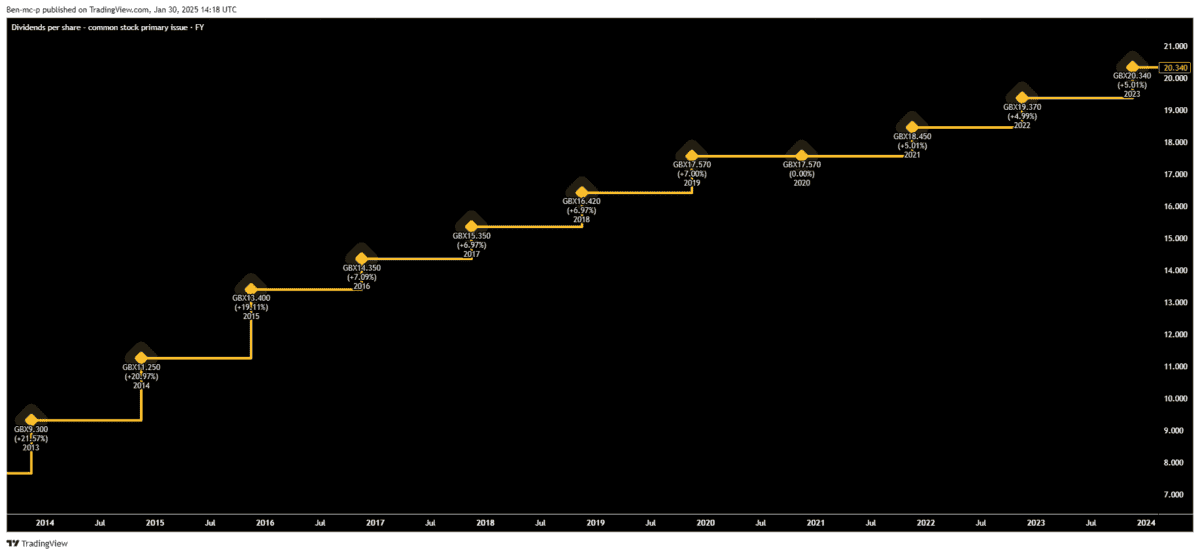
Like most FTSE 100 companies, Legal & General rewards loyal investors by increasing shareholder payouts year after year. To do that, it needs to generate plenty of cash. 

It’s a brilliant income stream

Worryingly, the forward dividend is covered only 1.1 times by earnings, whereas I’d prefer it to be covered twice. The board expects to generate up to £6bn of capital by 2027, which should support payouts, but there are no guarantees.

My shares have climbed a meagre 4.5% since I bought them. Yet, when dividends are included, my total return is almost 17%. And these are still early days.

I received my last payment on 17 September. The next is due on 5 June. I should get another before the year is out. I’ll reinvest every penny, building my stake. That will buy me more shares, which will pay me still more dividends.

If the current yield holds, I could double my money in around eight years, even if the shares don’t rise at all. And if they do, well that’s a bonus.

Sadly, I don’t think I’ll ever achieve ISA millionaire status. But it’s good to know I’m thinking along the right lines.


Can the chancellor’s growth plans send these stocks soaring?

Never mind DeepSeek – we all know what the big news is in the world of growth stocks this week. It’s that the UK’s planning to upgrade the A428 between Cambridge and Milton Keynes. 

More seriously, there’s quite a bit to the chancellor’s latest spending plan for investors to take note of. And this could be big news for a couple of UK shares that investors might ordinarily overlook.

FW Thorpe

FW Thorpe (LSE:TFW) provides industrial lighting systems. And while this sounds about as exciting as a lecture on the history of tax law, there’s actually quite a bit to catch the attention of smart investors.

The firm focuses on areas where requirements are technically complicated or specific. This creates a barrier to entry for competitors and allows the business to maintain some strong operating margins.

Emergency lighting’s one example. Whether it’s an expansion at Heathrow Airport or the building of a new cancer hospital in Cambridge, this is more complicated than screwing in some energy-efficient bulbs.

Emergency systems need to be able to deploy instantly in the event of a power failure and stay on for a certain amount of time. And FW Thorpe has the technical expertise to provide this.

One of the risks with this business is that it depends on continued investment into UK industry. Whether it comes from the government or the private sector doesn’t matter – but it can’t be guaranteed.

Sales growth has stalled in the last year or so and the stock’s fallen almost 20%. But this could pick up as the chancellor’s investments take shape and I think the stock’s well worth a look for investors.

James Halstead

The idea behind James Halstead‘s (LSE:JHD) similar. The company manufactures and distributes commercial flooring, which also sounds as exciting as reading a 500-page photocopier manual. 

Again though, the firm focuses on specialist products that go into environments that have specific requirements. Hospitals, for example, can’t just stick down some bathroom vinyl and be done with it.

James Halstead has a product that can be welded at the seams to create a completely sealed surface. This prevents bacterial growth and meets the demanding hygiene standards hospitals maintain.

Equally, airport floors need something a bit tougher than the average lino. And the company’s developed flooring that can deal with high foot traffic, rolling luggage, and constant cleaning.

Along with shifting construction output, the firm’s reliance on PVC as a raw material makes it vulnerable to rising oil prices pushing up costs. That’s a risk investors need to seriously consider.

Despite this, James Halstead’s closing in on 50 years of consecutive dividend growth. And with a current yield of almost 5%, I think it could be one for passive income investors to consider. 

Boring’s beautiful

On the excitement scale, emergency lighting and non-slip floors are so far behind artificial intelligence (AI) and anti-obesity drugs that it’s not even funny. But investors shouldn’t overlook these boring stocks.

FW Thorpe and James Halstead have strong competitive positions that are difficult to disrupt. And I think the chancellor’s plans for investing in the UK could give them both a boost.

Here are some of my top FTSE 100 dividend stocks to consider buying in 2025

I’ve been looking at the outlook for dividend stocks in 2025, and it has to depend a fair bit on how total 2024 dividends turn out. And that picture looks a bit mixed.

According to the most recent Dividend Dashboard from AJ Bell, analysts expect a total of £78.5bn in FTSE 100 dividends for 2024. And that should be backed by total pre-tax profit for the index coming close to beating the all-time record set in 2022.

But against that, forecasts suggest almost no dividend gain over 2023. And cover by earnings looks likely to drop. There are some big dividend yields on the cards. But there must be fears they could come under pressure.

Optimism ahead

At least the City expects dividends and cover to both rise in 2025, but I’m wary of such an early prognosis. Every year for the past few years, these surveys have shown optimism at the start. But estimates keep being scaled back as each year progresses.

I can’t help thinking our dividend focus could do well to shift towards a bit more safety this year. We need to keep an eye on those earnings. So which dividend stocks do I think we should consider as potentially safer buys in 2025?

I’m leaning towards HSBC Holdings (LSE: HSBA) for one, even though its share price has gained close to 50% in the past five years.

Covered high yield

Despite the rise, we’re still looking at an estimated dividend yield of 5.8% for the year ended December. And, importantly if we think payout pressure might emerge in 2025, forecasts put cover by earnings at 2.1 times.

The bank’s exposure to China looks like the biggest risk, with its economy struggling to grow. And who knows what any international trade war may bring?

But in a Q3 update, CEO Georges Elhedery announced “a further $4.8bn of distributions in respect of the third quarter, which bring the total distributions announced so far in 2024 to $18.4bn.

We’re looking at a forward price-to-earnings (P/E) ratio of only eight. And forecasts suggest dividend growth in the years ahead.

Real estate investor

Looking for other 2024 final dividends expected to be strongly supported, I see Land Securities with predicted cover of 1.7 times. It’s a real estate investment trust (REIT) that operates offices, shopping centres, and retail parks

Weak property sentiment might hold the share price back until we see the next bull market. And we might need the economy to brighten. But the expected 6.9% dividend puts it firmly on my consideration list.

Please note that tax treatment depends on the individual circumstances of each client and may be subject to change in future. The content in this article is provided for information purposes only. It is not intended to be, neither does it constitute, any form of tax advice.

Dependable yield

The British American Tobacco dividend has been one of the FTSE 100’s more reliable ones. It hasn’t been cut in the past decade while so many others have fallen around it.

Regulatory challenges combined with uncertainty over the long-term future for tobacco are the main fears. But I can see the stuff being consumed in one form or another long into the future. And a 7.4% dividend, covered 1.6 times by forecast earnings, has to make this a serious consideration too.

Here’s the up-to-date dividend forecast for Glencore shares to 2026

Dividends from mining shares can flow like a river when the global economy’s booming. Glencore (LSE:GLEN) shares have a rich history of delivering huge cash rewards when broader commodities demand takes off.

But cash rewards can conversely sink sharply when times get tough. This was also the case at Glencore in 2023, as falling earnings saw it slash 2023’s dividend 71% year on year to 13 US cents per share.

Phenomena including China’s cooling economy and possible new trade tariffs pose threats to earnings going forwards. Yet City analysts believe dividends on Glencore shares will rise strongly in 2025 and 2026 after rebounding last year.

Year Predicted dividend per share Dividend growth Dividend yield
2024 14 US cents 8% 3.1%
2025 15 US cents 7% 3.4%
2026 19 US cents 27% 4.3%

How realistic are current payout forecasts though? And should investors consider buying the FTSE 100 mining giant?

Good and bad

Firstly, I’ll look at the company’s dividend cover to assess the strength of these estimates. I’m looking for a reading of 2 times and above, giving payout forecasts a wide margin of error.

On this front Glencore doesn’t score especially high. Dividends for 2025 and 2026 are covered 1.6 times and 1.5 times respectively by anticipated earnings. However, like with any company, I’ll also consider the Footsie firm’s balance sheet before making a judgment. Pleasingly, Glencore looks far healthier on this front.

Robust cash generation meant net debt dropped by $1.3bn between January and June last year, latest financials showed, to $3.6bn. And so the firm’s net debt to adjusted EBITDA ratio dropped to an ultra-low 0.3.

This sort of reading could, in theory, give Glencore the financial headroom to pay those predicted dividends while also investing in its operations, even if earnings drop.

To buy or not to buy?

I have to say however, that I’m not convinced by current payout estimates. While they could disappoint, there’s a good chance they might also surprise to the upside.

Past performance isn’t always a reliable guide to the future. But an uncertain outlook for commodity prices in the near term, combined with the highly-capital-intensive nature of its operations, means that dividends could remain volatile as in previous years.

Yet I still think Glencore could be a great stock to consider for long-term investors. It’s why I own shares in Rio Tinto, another FTSE 100 high-yielder.

Over the next decade, I think Glencore shares could deliver a blend of terrific capital gains and passive income. This is because considerable mining and marketing operations give it significant scope to exploit rising long-term demand for metals and energy products.

I’m especially encouraged by the firm’s large exposure to ‘energy transition’ metals such as aluminium, zinc, cobalt and copper (Glencore’s the world’s sixth largest copper producer). This could deliver vast profits as sectors like renewable energy and electric vehicles (EVs) gobble up vast quantities of material.

Today, Glencore shares trade on a forward price-to-earnings growth (PEG) ratio of just 0.4, well below the value benchmark of 1. Given this cheapness, combined with the possibility that dividends could grow sharply from this point onwards, I think the miner’s worth a very close look today.

With an average 10.2% dividend yield, here are 2 dividend shares to consider for an ISA passive income of £1,530!

The FTSE 100‘s packed with a huge range of cash-rich, market-leading companies boasting great dividend records. But I’m not impressed by the index’s average forward dividend yield of 3.5%. ISA investors can get much better yields today.

Take the following UK dividend stocks, for instance. Their forward dividend yields come to an average 10.2%.

Dividend share Dividend yield
Alternative Income REIT (LSE:AIRE) 9.2%
Global X Nasdaq 100 Covered Call ETF (LSE:QYLD) 11.1%

It’s important to remember that dividend projections can often miss their targets. As we saw during the pandemic, even the most financially robust company can slash, suspend, or cancel shareholder payouts when crises come along.

However, if broker forecasts are correct, a £15,000 lump sum invested equally across these stocks could provide Stocks and Shares ISA investors with a £1,530 passive income this year alone.

Here’s why I think they’re worth serious consideration today.

A favourite fund

Exchange-traded funds (ETFs) can provide terrific returns while also helping investors effectively manage risk. In the case of the Global X Nasdaq 100 Covered Call ETF, individuals spread their cash across a wide range of the largest US tech companies.

The fund generates income by purchasing Nasdaq 100 shares and then selling covered calls on them. It then returns this cash to shareholders by way of dividends.

An added benefit is that the fund provides exposure to the so-called Magnificent Seven technology stocks (albeit with limited upside potential). Businesses like Nvidia, Microsoft and Alphabet have significant earnings opportunities to mine including quantum computing, autonomous vehicles and artificial intelligence (AI).

On a more sombre note, concerns over the disruptive impact of DeepSeek’s AI model could mean further volatility with the firm’s underlying holdings. It could also impact the premiums the fund collects from selling options, and by extension the dividends it distributes.

But on balance I think it’s still an attractive stock to consider, and especially for those with long-term investment strategies. Over extended timeframes, the impact of temporary market choppiness can be smoothed out.

Real estate star

Real estate investment trusts (REITs) can also be great investments for a passive income. These companies don’t pay corporation tax. And in return, they must pay at least 90% of rental profits out in dividends each year.

Please note that tax treatment depends on the individual circumstances of each client and may be subject to change in future. The content in this article is provided for information purposes only. It is not intended to be, neither does it constitute, any form of tax advice.

This doesn’t necessarily guarantee a large and dependable dividend income however. Rent collection and site occupancy can slip during economic downturns, impacting rental earnings.

But well-diversified trusts like Alternative Income REIT can greatly reduce this risk. This particular one’s portfolio spans multiple cyclical and non-cyclical sectors including hotels, residential tower blocks, petrol stations, care homes and retail warehouses.

I also like this particular property share because its tenants are locked into extremely long contracts. As of June, its weighted average unexpired lease term (WAULT) was 16.5 years to the earlier of break and expiry.

What’s more, almost all of its tenants are locked into inflation-linked contracts, which substantially protects group earnings from rising costs. Almost 96% of its leases were linked to the retail price index (RPI) or consumer price index (CPI) as of June.

What does the latest analysts’ take on the Lloyds share price mean for investors?

Over the past year or so I’ve become accustomed to seeing bullish broker forecasts for the Lloyds Banking Group (LSE: LLOY) share price.

But looking at the latest January summary from the London Stock Exchange Group, I’m surprise to see the consensus downgraded to Neutral. Just three months ago we had a solid Buy consenus.

And of five analysts out of 17 who had the stock as a strong Buy three months ago, only two of them still rate Lloyds so highly. What should private investors make of this?

Mixed reaction

Firstly, I think we need to sit back a bit and take this kind of stuff in our stride. After all, contrarians are always looking for the ones the City folk get wrong, right?

Short-term uncertainty weighs on the professionals. And it’s the kind of uncertainty that long-term Foolish investors are better able to overlook. But at the same time, I’d never ignore what the City is saying about any stocks I’m interested in. It’s very much a part of my strategy to consider all opinions before I make up my own mind.

A number of recent events have changed the short-term landscape for Lloyds. Not the least of which is the share price, which has risen 48% in the past 12 months, though not close to the doubling achieved by Barclays. Maybe Lloyds was a screaming buy a year ago, but the shouting seems quieter now.

The consensus price target at the moment is still only around 65p. That’s just a few pennies above the current price, so that alone might be all that lies behind the softening stance.

Threats

Lloyds has been in the news recently for what many might see as a disturbing reason. It’s planning to close another 136 branches. That’s about 10% of the UK total, and it makes the term ‘high street bank’ seem increasingly historical.

It’s not such bad news for shareholders though, as it’s really just part of the growing shift from cash to digital transactions. If anything, it should cut costs and hopefully help maintain profit margins. It doesn’t make the stock any less attractive for me.

The ongoing car loan mis-selling investigation is more worrying. The recent intervention from Chancellor Rachel Reeves has settled my nerves a bit, however. She’s urged the Supreme Court that “any remedy should be proportionate to the loss actually suffered by the consumer and avoid conferring a windfall“.

That could help ease fears that Lloyds could be hit for as much as £1.5bn.

Why buy?

We’re looking at a forecast price-to-earnings (P/E) ratio of 10, on the low side by FTSE 100 standards. But in the current economy, I think that might be about right. There’s a forward dividend yield of 4.6%, which I rate as decent for a bank. It’s not the best though, with HSBC Holdings on a predicted 5.8%.

But considering my optimistic view of the long-term outlook for banks and mortgage lenders, I’m holding my Lloyds shares. And I could see myself topping up in the future.

Here’s the FTSE 100’s top performer in 2025! Can it keep flying?

Airtel Africa (LSE:AAF) isn’t the FTSE 100‘s most famous name. But it’s been making headlines as the blue-chip share index’s greatest riser in the year to date.

At 144.9p, Airtel Africa’s share price has risen an impressive 23.7% since 1 January. It shot up 9% on Thursday (30 January) alone thanks to an upbeat response to its latest financials.

So what’s all the buzz about? And can the FTSE firm continue its northwards march?

A booming market

A blend of low market penetration, rising disposable incomes, and rapid population growth is supercharging telecoms and financial services demand in Africa. And Airtel has shown it has the tools to capitalise on this opportunity.

The company — which provides voice, data, and mobile money services across 14 African nations — saw revenues at constant currencies rise a whopping 20.4% in the nine months to December, to $3.6bn, it announced today.

Customer numbers grew 7.9% between April and December, to 163.1m. And data usage per customer increased by 32.3%, to 6.9 gigabytes, as smartphone adoption continued to rise.

The volume of data and mobile money customers rose 13.8% and 18.3% respectively over the nine months.

Revenues were boosted by Airtel’s sustained investment across its markets. Data capacity rose by just over a fifth between April and December.

Good and bad

It wasn’t all sunshine for Airtel during the period, however. Turnover continues to be impacted by adverse currency movements, and more specifically currency devaluations in Nigeria, Malawi, and Zambia.

At actual currencies, sales dropped 5.8% in the nine months.

But largely speaking this was another rock-solid statement from Airtel. With currency pressure beginning to moderate, and demand for its services still rocketing, the future looks bright for the FTSE firm.

Analyst Neil Shah of Edison Group notes that “with sustained investment in network expansion, a growing customer base, and rising data and mobile money penetration, Airtel Africa remains well-positioned for long-term growth“.

This could pave the way for further significant share price gains. Airtel shares have almost doubled in value over the last five years.

Attractive value

After this year’s stunning gains, Airtel Africa trades on a pumped-up price-to-earnings (P/E) ratio of 31.7 times for this financial year (to March 2025). This could, at first glance, suggest limited price upside, at least in the near term.

But look a little closer and the business actually seems to offer real value. For the new year beginning in April, it’s P/E slumps to 10.6 times, beginning in April. This reflects City expectations of a 198% earnings jump.

What’s more, its price-to-earnings growth (PEG) ratio is just 0.1 for the upcoming fiscal period. Any reading below one implies that a share is undervalued.

It’s important to remember that earnings forecasts are known to miss their mark. If this happens, a share price can fall sharply in value.

While this is a risk, Airtel’s strong momentum and substantial structural drivers suggest it’s in good shape to meet — or potentially even exceed — analyst estimates. I fully expect the FTSE firm’s share price to continue its long-term ascent.

3 simple steps to target a £20,000 second income from stocks

It can be quite daunting when first considering the stock market as a way to generate a second income. There is a lot of jargon to get one’s head around. But it is not quite as complex as it might first seem.

With this in mind, here are a few simple steps a new investor might follow to target sizeable dividend income.

Choose the right account

To start, there obviously needs to be an account to buy stocks in. This will be opened through a brokerage, which is a company that acts as an intermediary to facilitate the buying and selling of stocks.

There are a fair few about. Some legacy platforms like Hargreaves Lansdown still charge customers per trade. However, there are many new apps that allow free trading. To be fair, Hargreaves Lansdown has a wealth of resources for new investors, whereas the no-frills free-trade apps are very much DIY. It depends on preference.

The investing account someone would generally start with in the UK is a Stocks and Shares ISA. This marvellous vehicle enables a portfolio to grow more rapidly because there are no tax liabilities on income and returns (the annual contribution limit is £20,000).

Please note that tax treatment depends on the individual circumstances of each client and may be subject to change in future. The content in this article is provided for information purposes only. It is not intended to be, neither does it constitute, any form of tax advice. Readers are responsible for carrying out their own due diligence and for obtaining professional advice before making any investment decisions.

Consider quality high-yield dividend stocks

As the aim is to start earning a second income, the next focus will be on looking for shares that pay dividends. These are semi-regular payments made by companies to shareholders, usually from profits. They’re mostly paid twice or four times a year.

The stock’s dividend yield will determine how much passive income is on offer. For example, insurance and asset management firm Legal & General (LSE: LGEN) currently carries a mighty 8.9% yield.

In other words, an investor could put £2,000 into this FTSE 100 stock and hope to receive £178 back each year in dividends. However it could be less than this (if the firm cuts the payout, which is always possible) or ideally more.

Personally, I think Legal & General is one of the best income shares around, which is why I own it in my own portfolio. The company has a strong brand, large customer base, and excellent track record of increasing its payout.

Created at TradingView

A well as opportunities though, risks can arise from the group’s massive $1trn+ assets under management. It is exposed to stock market downturns, which can quickly reduce the value of its investment portfolios, as well as shifting interest rates that drive fluctuations in bond prices. Economic downturns can also negatively impact earnings.

However, for investors looking for high-yield income, I think Legal & General is worth considering for inclusion in a diversified portfolio of quality stocks.

Invest regularly

The keys to building up a sizeable passive income portfolio are time and consistency.

Were someone to invest £750 a month, achieving an 8% average return, they’d end up with roughly £275,000 after 15 years. This assumes dividends are reinvested over this time rather than spent.

At this point in the journey, the ISA portfolio would be generating annual income of approximately £20,000. It could then be enjoyed or reinvested for longer to target an even greater figure.

8.01% yield! Is the 3rd largest dividend on the FTSE 100 one to consider snapping up today?

Taylor Wimpey (LSE: TW) shares now pay out the third-largest dividend on the FTSE 100. The yield now sits at 8.01% with projections for the next three years at 6.78%, 7.65%, and 9.03%, too. For investors looking for stocks to put a reliable bit of cash in their pocket, is this an attractive stock to consider snapping up? Let’s answer.

Unusual policy

Part of the appeal of Taylor Wimpey is its somewhat unusual dividend policy. To account for the cyclical nature of house prices and home building in general, management aims to return 7.5% of net assets each year. In other words, the payments are tied to things like the land the company owes rather than the numbers on the income statements. 

This has the effect of a more stable dividend payment as assets move less up and down compared to earnings. That is, of course, only while the company is making the money to pay for it.

The next decade could bring sustained good performance for housebuilders too. One reason is more demand for houses thanks to an increasing population. 

The Office for National Statistics released data on the trend this week. Over the 10-year reporting period, around 10m will flow into the country, with around 5m leaving. Up to 2032, the UK population will grow 7.2% to the 72m mark. That’s a net influx of 500k people a year. 

Are we building 500k houses a year? Not even close. The last year on record came to 220k. The government’s own lofty targets – that many decry as unrealistic and unattainable – come to 300k. It seems inevitable that demand for housing will outpace supply. 

Rising costs

High house prices bring many negative effects too, but it will likely result in more earnings for those building the houses. The consequence might be sustained high dividend payments for years to come. 

More expensive houses aren’t the only thing that seems inevitable, so too do rising costs in the industry. Energy prices are higher on our islands than almost anywhere in the world. Labour costs have just gone up through minimum wage rises and Employer’s NI changes – a hefty bill for Taylor Wimpey with 6,000 employees and 15,000 contractors.

That’s not even to mention the cost of raw materials that started rising during Covid and exploded after the invasion of Ukraine. These surging costs are a huge headache and may be the biggest risk to the future dividends of Taylor Wimpey. 

On the whole, I think there are good prospects here for both income and growth. Given the risks, I don’t think I would call this a slam dunk buy and won’t be buying in myself today. But if worries about costs were to ease then this would likely be a stock to make it into my own portfolio.

£10,000 invested in Sainsbury’s shares 2 years ago is now worth…

Are defensive shares back on the menu? With economic projections looking gloomy and talk of a recession not far from people’s lips, companies with products folk buy through thick and thin might outperform. And even better if they offer a decent dividend along with the main course. Shares that might fit the bill include the nation’s second biggest supermarket, Sainsbury’s (LSE: SAIN). 

A £10k stake

Recent performance from the shares has been mediocre. A stake bought two years ago is only up 2.7% in value. I could have earned more through a savings account. Tesco is up 50% by comparison. It’s not been a great time for existing Sainsbury’s shareholders but it could mean a buying opportunity. 

Then there is the question of dividends. Sainsbury’s pays a 5.11% yield, going from the last 12 months, one of the higher payers on the FTSE 100. It’s no flash in the pan, either. A dividend has been paid every year since 2007. Such a weighty payout can make a static share price less of an issue. 

That 1.7% increase over two years becomes 13.96% when looking at total return (dividends reinvested). A £10,000 stake turns into £11,396, which is the attraction of this kind of dividend stock.

Sainsbury’s is coming off a “best ever Christmas” too. The festive period is a busy one for the big shops and CEO Simon Roberts was happy to announce winning “market share for the fifth consecutive Christmas”. This is great stuff in such a competitive sector. With budget options like Lidl, Aldi, or even Tesco snapping at the heels at one end, and prestige supermarkets like Waitrose and Marks and Spencer at the other, it’s a very good sign that Sainsbury’s is holding its ground in the middle. 

A squeeze

The big news Sainsbury’s is grappling with is, of course, the bump in Employer’s National Insurance. This cost affects almost all companies, but it disproportionately affects supermarkets where the twin issues of wafer-thin margins and a large workforce put the squeeze on at both ends. 

Management has mooted a £148m tax bill against net income of around £1bn. I doubt many other firms will be dealing with such a large slice taken out of their profits. Investors aren’t too pleased either – the shares dropped like a stone after the Budget and are still 13% down as I write.

The response has been to axe 3,000 jobs, including 20% of senior management, along with closing its in-store cafes. That might help the bottom line a bit but cutting services is not what I’m hoping to see, not to mention the human cost of so many people being put out of work. 

That’s probably the key question when it comes to my own decision. I like the defensive properties of the supermarket sector – I have some exposure already – and I suspect it will be a strong performer in a seemingly grim economic period. But I don’t think there’s enough in Sainsbury’s for me to buy in today.

Financial News

Daily News on Investing, Personal Finance, Markets, and more!

Financial News

Policy(Required)