Does the National Grid share price matter, as long as the dividends keep coming?

Over the past year, National Grid (LSE: NG) has moved up 2% on the London stock exchange. The National Grid share price is within 6% of where it stood five years ago.

Things could be worse. At least the share price has moved in the right direction.

For some investors, the share price may be irrelevant. National Grid is popular for its dividend. Its position in the utility industry is perceived to provide stable cash flows that can help a dividend the firm aims to grow in line with inflation.

As an investor though, ought I to take that approach and consider just the dividends?

Why a share price matters

if I invest money in a share and the price falls, I do not lose anything – unless I sell. At that point, a paper loss crystallises into an actual one.

So even if I bought National Grid shares today and the price fell (it is down 13% since May 2022, for example) I would only lose money if I sold at that price.

However, most investors sooner or later will consider selling shares. Even long-term shareholders may change their financial objectives or view of a company, for example.

So a falling share price can be a concern if it looks unlikely to recover. Tying money up for years in shares that have a paper loss can also bring an opportunity cost as those funds cannot be used for other things.

How secure is the dividend?

So I would certainly pay attention to the National Grid share price even if I expected the dividends to keep coming.

But utilities are not as secure as some shareholders believe when it comes to maintaining their dividends, let alone growing them regularly.

Want an example? Look at SSE. Last year’s dividend was 60p per share. Back in 2020, it was 80p. In 2015, it was 88.4p. So much for utilities being reliable long-term dividend payers. No dividend is ever guaranteed.       

Increasingly alarming debt levels

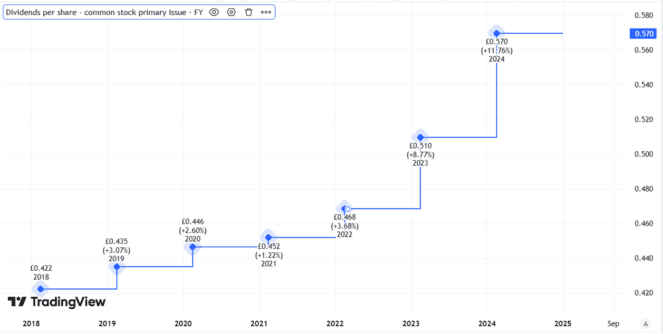
In fairness, National Grid has a good track record when it comes to annual dividend growth.

Created using TradingView

But look at the firm’s basic earnings per share.
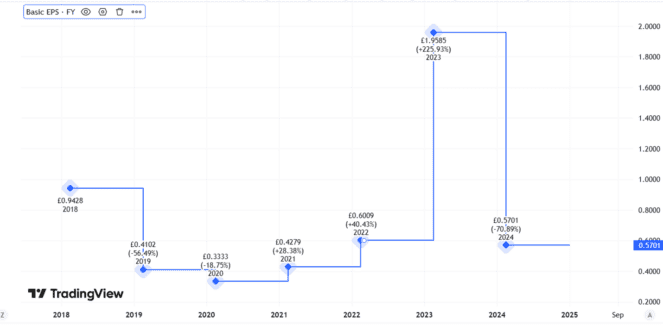
Created using TradingView

They move around a lot – and do not always cover the dividend.

Owning and maintaining an energy network is costly business, especially now at a time when energy is being generated and where it is being consumed are in flux compared to historical norms.

That means National Grid has to spend a lot to keep its business running. So its net debt has grown over time.
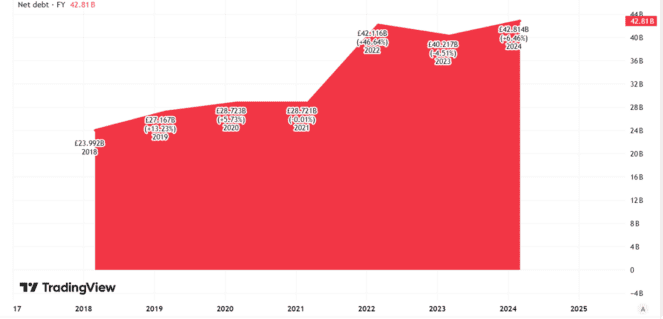
Created using TradingView

Last year saw a rights issue designed to help boost funds available for items including capital expenditure. That diluted shareholders.

I see a risk of a similar move in future if National Grid wants to deliver on its goal of keeping the dividend growing annually in line with inflation. An alternative, at some point, is for the company to reduce the payout like SSE has repeatedly done. If that happened, it could send the share price tumbling.

So although its unique network assets can help generate sizeable cash flows, I have no plans to add National Grid shares to my portfolio.


3 investment trusts from the FTSE 250 to consider in February

Investment trusts offer a great way to achieve portfolio diversification, making them very popular. In fact, they make up over a third of the entire FTSE 250!

Here are three mid-cap options I think are worth considering today.

Dividends and value

First up is BBGI Global Infrastructure (LSE: BBGI). This Luxembourg-based fund offers an appealing government-backed 7.1% dividend yield, based on 2025 forecasts. That’s more than double the FTSE 250 average.

The high yield’s due to two factors. First, the company has an excellent track record of dividend increases (13 years), driven by the stable nature of the underlying assets. These 56 social infrastructure projects across G7 countries include schools, hospitals, roads, and toll bridges. They earn BBGI inflation-linked revenue.

Second, the share price has dropped 32% in two and a half years, pushing the yield skywards. This is due to higher interest rates that have made cash and bonds look like a safer bet than infrastructure shares. Therefore, a higher-for-longer rate environment or a sudden spike in inflation are risks here.

However, I think the shares look very attractive at 121p.This leaves them 18.4% below the portfolio’s net asset value (NAV) of 148p, as at 30 June.

If and when interest rates move lower, I think the share price could recover strongly as investors reassess the high-quality income on offer.

More dividends

The second option to consider is BlackRock World Mining Trust (LSE: BRWM). This trust invests in mining stocks from around the globe. Top holdings include Glencore, BHP Group, and Rio Tinto.

These mega-miners provide indirect exposure to the green revolution through their production of key materials needed for clean energy technologies. That includes copper, essential for electric grids, wind turbines, and solar panels, as well as nickel, lithium, and cobalt, which are needed in many electric vehicle (EV) batteries.

Now, the risk here is that the performance of these stocks is influenced by the price of commodities, many of which are impacted by goings-on in China. And things haven’t been going well in the world’s second largest economy since the pandemic.

This is reflected in the mining trust’s share price, which is down nearly 30% since the start of 2023.

While commodity prices could always take a tumble, threatening mining profits and the trust’s dividend yield, I think the shares are worth considering at 496p. At that price, there’s a respectable 6.7% yield and 8.3% NAV discount.

Going for growth

The final FTSE 250 stock worthy of consideration is Baillie Gifford US Growth Trust (LSE: USA). The focus on US growth shares might be obvious but we’re talking the crème de la crème, including Amazon, Shopify, Netflix, and Instagram owner Meta Platforms.

But what makes this one different from a run-of-the-mill tech fund is its investments in private companies such as rocket pioneer SpaceX and Stripe (internet payments).

One risk here is a sudden slowdown in artificial intelligence (AI) infrastructure spending. That might damage investor sentiment for top holdings like Nvidia, leading to pressure on the trust’s share price.

Longer term though, I see this as a solid option for direct and diversified exposure to the global technological revolution. A 9% discount to NAV adds weight to the investment case, in my opinion.

3 S&P 500 stocks that have returned more than 20% a year over the last decade

Looking for stocks with strong performance track records? The S&P 500‘s a great place to start the search. In this index, there are many companies that have generated incredible long-term returns for investors.

Here, I’m going to highlight three brilliant S&P 500 stocks that have returned more than 20% a year over the last decade (in US dollar terms). Let’s get into it.

Amazon

First up, we have Amazon (NASDAQ: AMZN) and I calculate that over the last 10 years, its share price has risen 1,223%, which translates to about 29% a year.

I first bought this stock for my own portfolio in late 2020 (near $150) and it has done well, rising nearly 60%. I just wish I’d bought it sooner.

Back in 2017, I remember looking at it when it was around $60 and thinking it was too expensive (the price-to-earnings (P/E) ratio was very high). The lesson here – expensive stocks can still generate amazing long-term returns.

Looking ahead, I remain excited about this stock (it’s my largest holding). Given how diversified the company is (e-commerce, cloud computing, digital advertising, etc), I believe it still has substantial long-term growth potential.

That said, if an investor was looking to buy Amazon shares, I’d suggest they consider waiting for a pullback. Since August, the stock’s had a huge run and if upcoming earnings (next week) miss expectations, it could be volatile.

Mastercard

Another US stock that’s done well for me, and has been a brilliant long-term performer, is payments powerhouse Mastercard (NYSE: MA). It’s up about 590% over the last decade which equates to a return of about 21% a year (it’s also paid small dividends).

Like Amazon, I believe Mastercard has a ton of potential. In the years ahead, billions of transitions are set to shift from cash to card. Meanwhile, growth of industries such as e-commerce and travel should also benefit credit card companies. So for me, this is a core holding I expect to retain for many years.

That said, the valuation’s relatively high right now. Currently, the P/E ratio’s about 35. That doesn’t leave much room for setbacks (eg a slowdown in consuming spending). So again, if an investor was interested in this stock, I think they should, again, consider waiting for a pullback.

Intuitive Surgical

Finally, we have Intuitive Surgical (NASDAQ: ISRG), the leading player in the robotic surgery market. It’s risen about 956% over the last decade, which translates to a gain of around 27% a year.

This is a stock I’ve had on my watchlist for many years now. I nearly bought it a few years ago when it was under $250. I wish I had – now it’s near $600.

I’m keen to get this stock into my portfolio at some stage because I expect the market for robotic surgery to grow significantly over the next decade. However, the 72 P/E ratio’s too high for me right now. This leaves almost no room for error. If hospitals were to slow their spending on robotic surgery, the stock could underperform.

So for now, it’s also going to stay on my watchlist. I’m hoping the price comes down a bit in the next 12 months.

£500 to invest this payday? Here are 2 great passive income ideas to consider

Today (31 January) is the last Friday of the month. So, for a lot of people across the UK, it’s likely to be payday. Have £500 to invest this payday and looking to create some passive income? Here are two investment ideas to consider.

Easy cash flow

One of these easiest ways to generate extra cash flow these days is to buy into an income fund. These typically invest in a range of dividend stocks and pass on the dividends collected to investors.

A good example of this type of product (and one that could be worth researching) is the Schroder UK-Listed Equity Income Maximiser fund, which is available on Hargreaves Lansdown and other similar platforms. This is invested in nearly 200 companies and it pays out quite a bit of cash to investors.

Indeed, this fund aims to reward investors with a 7% yield. Now, this isn’t guaranteed (dividends never are). Currently however, Hargreaves Lansdown says the product’s historic yield is 6.87%. That’s attractive relative to what’s on offer from savings accounts today.

Since its launch in December 2020, this fund has performed pretty well overall. Including both gains and income, it has returned nearly 50%.

A risk going forward, however, is that it could underperform the broader stock market. Often, high-yield dividend stocks don’t perform as well as investors are hoping they will.

It’s worth noting that a lot of income funds have both an ‘accumulation’ and an ‘income’ version. The difference here is that the former will reinvest all dividends while the latter will pay them out to investors. So, if one is looking for cash flow now, the income version is the one to go with.

High yields from dividend shares

Another easy way to generate some passive income is to build a portfolio of individual dividend shares. This is riskier than going with a fund because the high level of diversification provided by funds reduces risk significantly. But there can be some big rewards on offer for those willing to pick individual stocks.

Take shares in savings and investment company M&G (LSE: MNG), for example. Currently, they are expected to pay out dividends of 20.7p per share for the 2025 financial year. Given that the share price today is 209p, that translates to a yield of a whopping 9.9%.

Now, as I said earlier, dividends are never guaranteed. And the forecast above is exactly that – a forecast (meaning that it may not be accurate).

And dividend sustainability is not the only risk to consider here. Another is share price volatility. Like a lot of financial stocks, M&G tends to swing around wildly whenever there is some uncertainty in the world’s financial markets. So, one needs to be comfortable with the possibility of capital losses.

I think the stock is worth considering for income, however. I believe the company has a relatively attractive future (people need to save for retirement) and its valuation seems very reasonable today.

It’s worth pointing out that many brokers still charge commissions to buy individual shares. And these can eat into one’s returns. If an investor was looking to invest £500 in an individual stock such as M&G, I would suggest going through a broker that offers zero or very low commissions in order to maximise returns.

ChatGPT thinks these are the best stocks to buy for passive income. There’s 1 big problem

Generative AI bots have already taken the world by storm, providing users with answers in lightning-quick time. But are they any good for selecting great stocks to own for passive income? I thought it might be fun to find out.

What I discovered was actually quite worrying.

The usual suspects

My weapon of choice for this little experiment was ChatGPT and my question was simple: “What are the five best stocks to buy for passive income?”

In only a few seconds, I was provided with a list of names: M&G, Aviva, Legal & General (LSE: LGEN), Phoenix Group and HSBC.

It was immediately clear that these companies shared a few attributes.

All of the above are members of the FTSE 100 — the index tracking the UK’s biggest businesses by market cap. All are likely familiar to most Foolish investors as well. At least a few are household names.

Perhaps most interestingly, all offer dividend yields of over 6% at the current time. Contrast this with the 3.5% offered by the index as a whole and it starts to look like AI could be a very useful tool when it comes to stock selection.

Spot the difference?

By now, however, you’ve probably noticed something: all of ChatGPT’s picks specialise in providing financial services of some sort. We’re talking the biggest insurance companies and wealth managers around, not to mention a £150bn bank.

I find this frightening.

Imagine if a fresh-faced investor put every penny they had to work in these five stocks. Such overconcentration is very risky, especially if sentiment around the UK (or global) economy sours.

Now, I’m certainly not suggesting that ChatGPT recommended a bunch of absolute stinkers. But it does show the danger of relying on anything other than old-fashioned research to pick investments. After all, the bot had no knowledge of my financial goals or time horizon. Nor did it provide any reasons for why it thinks these stocks are ‘the best’.

Safer picks

Pushed to select one stock to buy from the list above, however, I’d probably opt for Legal & General. Unlike some of ChatGPT’s picks, it has a pretty solid record of consistently distributing dividends over time, at least since the dark days of the Great Financial Crisis. As things stand, analysts are forecasting another bump to the total payout in FY25.

A growing payout is something I particularly look for since it implies that a business is in decent health. This means more to me than going for only the highest-yielding stocks — something the bot didn’t seem fussed about.

However, one needs to be wary. Legal & General’s dividend looks set to only just be covered by expected profit. That can’t carry on for too long or a cut will likely follow.

For this reason, it would be prudent to consider getting exposure to other, unrelated parts of the market to balance out the risk here. Defensive sectors like consumer goods, utilities and healthcare are particularly appealing.

What I’ve learned

Looking ahead, I don’t doubt that I’ll employ AI in some form for researching investments. But I would never dream of using it to build a portfolio on its own.

No one cares more about my money than I do. And that includes the seemingly all-powerful, all-knowing (but really rather reckless) ChatGPT.

5 reasons I won’t buy Tesla shares today!

Who doesn’t have a view on Tesla (NASDAQ: TSLA)? Some investors swear by it, others see a bubble waiting to burst. The same applies to Elon Musk.

While I acknowledge Musk’s brilliance and Tesla’s stellar success, I can see five compelling reasons for me to shun its shares today. 

1. Elon Musk’s politics.

Musk loves to mix it up but his outlandish political positions risk alienating Tesla’s core customer base. 

Many Tesla buyers see their purchase as a statement in favour of sustainability. Musk’s populist alignment and social media antics risk driving them away. I can’t imagine any other CEO goading customers like he does.

I fear many will start associating its brand with political division rather than cutting-edge tech and eco-responsibility.

2. He’s stretching himself too thin

Musk is a visionary and I’m not, but we have one thing in common. Both of us are handed just 24 hours a day.

Obviously, he sweats his allocation harder than I do. But with Tesla, SpaceX, Neuralink, The Boring Company and Twitter (now X), Musk needs to be cloned to keep up (he’s probably working on that). Throw in his DOGE work for President Trump, and I’m wondering if Tesla is getting the focus it needs, especially with the Cybertruck rollout facing delays.

3. China’s electric vehicles are catching up

China has a history of mastering Western technology, then producing it faster and cheaper. As with DeepSeek. The country’s EV sector is no exception. Chinese manufacturers like BYD are scaling up, offering high-quality EVs at lower price points.

Tesla is still ahead in terms of technology and brand recognition, but has had to slash prices to remain competitive in China. If Chinese carmakers start dominating global markets, Tesla could be slashing more than prices.

4. The valuation remains sky-high

Despite a rocky few years, Tesla’s share price still carries an eye-watering valuation. With a price-to-earnings ratio of almost 110, triple the S&P 500 average, the stock is priced as if Tesla is still in its rapid growth phase. But with slowing sales growth, increased competition and economic uncertainty, that valuation’s harder to justify.

Yes, Tesla has been pricier in the past. But if Magnificent Seven magic wears off and markets one day treat Tesla like a traditional car company, that valuation could slump.

5. It’s too volatile for me

The share price flew in 2024, climbing 63% after a volatile start. The company missed revenue expectations in Wednesday’s (29 January) earnings report, with profits declining year on year. Yet the shares still climbed! Tesla/Musk can do that, but for how much longer? It has also faced scrutiny over its self-driving technology, with federal investigations into its autopilot system.

But don’t listen to me! I decided Tesla was overhyped and overvalued years ago, and investors who took a different view have left me for dust. Along with an army of short sellers.

Tesla remains an industry leader in EV technology and battery innovation. If it can deliver on its robotaxi plans and new Model Y upgrades, I’ll be eating crow as well as dust. But for now, given the risks, and China’s DeepSeek disruption, I’ll take a back seat.

1 AI-powered growth share I just had to buy for my Stocks and Shares ISA!

Every evening, I’m reminded by a big green owl to do my daily Spanish lesson. The guilt-trip works, as I’m soon clicking on the Duolingo (NASDAQ: DUOL) app to practice. The lessons are engaging and I think the firm is on to something powerful. So much so, I recently opened a small starter position in my Stocks and Shares ISA.

¡Hola, Duolingo!

The app was launched in 2012 with the aim of democratising language learning, making it available to anyone, anywhere. The founders are both computer scientists with backgrounds in AI.

Today, the company offers 40+ languages to more than 113m monthly active users worldwide. It operates an ad-supported freemium model, with paid subscription options.

Duolingo’s secret sauce is its ability to keep students motivated, which I can attest to with my own 124-day streak! It does this through gamified reward systems and playful cartoon characters, transforming grammar lessons (yawn) into something fun.

But this isn’t a trivial app for children. Powering the platform is artificial intelligence (AI) that personalises the learning experience to deliver superior outcomes and improved user engagement.

For example, the firm uses machine learning models to adapt lessons according to a user’s strengths and weaknesses. It can then tweak difficulty levels based on this data.

40% growth…¡increíble!

Growth is very strong. In Q3, revenue surged 40% year on year to $193m. Paid subscribers hit 8.6m, up 47%, while daily active users (DAUs) grew 54% to 37.2m. 

Duolingo is investing for growth, so isn’t yet optimised for maximum profits. Yet it still achieved net profit of $23.4m and free cash flow of $52.7m in the quarter. This suggests the digital platform could be enormously profitable as it matures, assuming growth doesn’t stall or something better comes along, which are risks for any high-growth company.

Co-founder and CEO Luis von Ahn commented: “We performed superbly across all of our key operating metrics this quarter, with DAU and bookings growth exceeding our expectations.”

The reason I’ve only taken a small starter position here is due to the high valuation. After doubling in just six months, the stock is trading at a price-to-sales multiple of 21, based on 2024’s forecast revenue. That doesn’t present much wiggle room if, again, growth unexpectedly slows in 2025.

AI-powered

However, I’m backing the company to continue expanding, boosted by a new higher subscription tier (Duolingo Max) that it’s rolling out.

This has powerful AI features, including one that enables learners to have spontaneous video-call conversations with Lily, a sassy, purple-haired goth avatar with a signature deadpan demeanour. She even popped up on the Q3 earnings call!

My young daughter, who also loves Duolingo, likes to mimic Lily, sarcastically rolling her eyes and clapping slowly in mock enthusiasm to various things. 

Massive market opportunity

There are an estimated 2bn people around the world actively learning a foreign language. Duolingo, which is quickly becoming synonymous with language learning in popular culture, only had 8.6m paid subscribers in Q3. So the growth opportunity appears vast.

Duolingo also offers maths and music courses, with a long-term goal to teach various subjects. Indeed, it aims to rival — or even surpass — human tutors.

Of course, it might never achieve that ambition. But if it does one day, the business will be worth a hell of a lot more than $16bn.

Why did this forgotten FTSE income share suddenly jump 21% in January?

Spirax Group (LSE: SPX) has never been a headline grabber, but this overlooked UK income share is in the spotlight today. 

The FTSE 100 stock has climbed 21% since the start of the year, making it the third-best performer on the blue-chip index. Given its recent volatility the rally is a welcome surprise.

The Spirax share price still has some way to go. Over 12 months it’s down 18%, while over three years it has slumped 35%. So why the sudden jump?

A key reason seems to be fresh optimism around Chinese stimulus efforts. Spirax specialises in niche industrial and commercial steam systems, and China is a crucial market. With signs that Beijing could ramp up support for its economy, investors may be betting on a recovery in demand for Spirax’s products.

Personally, I’m a little sceptical. One Chinese stimulus package after another has fallen short. Although this week’s DeepSeek shock shows we shouldn’t underestimate the country’s prospects.

The shares finally leap

Another major catalyst came from broker Jefferies, which upgraded its rating on Spirax to a Buy on 20 January. 

This formed part of its annual review of the UK industrials sector, where it downgraded Smiths Group and XP Power, among others.

Jefferies said a much-anticipated sector recovery failed to materialise last year and 2025 doesn’t look much brighter, amid “limited positive momentum and plenty of uncertainty”. But it was more upbeat about Spirax, claiming it had now “been through the worst and can recover nicely over the next two to three years”.

That helped spark the January rally but Jefferies still didn’t include Spirax in its top picks. That probably put a lid on the rally too.

I wrote on 10 January that Spirax had completely flown under my radar. The global industrials slowdown had taken its toll, with falling Chinese demand hitting its Steam Thermal Solutions division.

Yet analysts were upbeat even then. The 17 brokers offering one-year forecasts produced a median target of 7,825p, up 18% from the then-price of 6,630p.

A true FTSE 100 dividend star

I was tempted but thought Spirax looked expensive with a price-to-earnings ratio of more than 21 times earnings. It’s pricier today, with January’s rally pushing its P/E beyond 26 times.

Where Spirax really scores is on income. This is a blue-blood Dividend Aristocrat, with 55 years of consecutive annual increases. 

However, the yield has slipped after the recent price surge, dropping to just 1.95%. That’s surprisingly low, given recent share price struggles. I guess we can rely on it to grow steadily, although there are no guarantees, even with Spirax.

It should fare better in 2025 as its more profitable end markets recover, but I still think better value exists for me elsewhere on the FTSE 100. Debt of £1bn is a little hefty given its £6bn market cap. 

It’s good to see Spirax build up a bit of steam but it doesn’t change my stance. At today’s valuation, I’m staying on the sidelines.

I think now is the perfect time to consider buying high-yield FTSE dividend shares like Aviva

After years of being overlooked, UK dividend shares are starting to look like unmissable bargains, to my eyes. 

Investors have shunned the FTSE 100 as they chase high-flying US tech stocks, but that dynamic could be about to shift. With interest rates expected to fall this year and next, high-yielding dividend stocks may steadily regain their appeal.

Lately, investors have preferred the safety of cash and bonds. These have offered more attractive returns due to rising interest rates, with little or no capital risk. 

However, as further UK interest rate cuts loom, the yields on these fixed-income investments may shrink, making dividend stocks more compelling.

Aviva shares have outperformed their peers lately

At the same time, the US stock market, particularly its tech-heavy Nasdaq, has surged to record highs. But as Wall Street works out what to make of shock Chinese AI entrant DeepSeek, that may change. We’ll see. Investors haven’t fully absorbed that shock yet.

But with S&P 500 valuations stretched, we could see a shift back towards unloved and undervalued UK stocks. The FTSE 100, with its rollcall of steady dividend payers, may finally get the recognition it deserves.

FTSE insurers have struggled lately, but there’s one notable exception. Insurer and asset manager Aviva (LSE: AV). Its shares have climbed 18% over the last year. Over five years, they’re up more than 30% (with dividends on top). Despite these gains, they look reasonably valued.

The Aviva share price trades at a price-to-earnings (P/E) ratio of less than 14, slightly below the FTSE 100 average of around 15. That’s not dirt cheap, but it’s pretty good for a company with a strong market position and solid financials.

It currently offers a trailing yield of 6.5%, but analysts forecast this will rise to 6.9% in 2025 and an impressive 7.4% in 2026. 

Naturally, there are risks. Forecast dividend cover’s thin at just 1.4. While not dangerously low, it I’d like a bigger cushion against potential earnings fluctuations. Aviva’s financial strength reassures me. Its Solvency II shareholder cover ratio stands at a robust 195%, reflecting a strong balance sheet and capital position.

Worth considering as a long-term hold?

The company’s Q3 2024 results, published on 14 November, showed general insurance premiums surging 15% to £9.1bn. Wealth net flows also increased 21% to £7.7bn, reflecting strong demand for Aviva’s investment products. 

Importantly, the company’s operating profit’s on track to hit £2bn in 2026, reinforcing its long-term growth potential.

The share price could retreat in the short term. Aviva operates in a mature and competitive market at a difficult time. Consumers are struggling and this could hit insurance premiums. Stock market volatility could punish its asset management arm.

So I wouldn’t expect wonders. Any investor considering Aviva should only buy with the aim of holding for years, and ideally decades, to give their dividends time to compound and grow.

I don’t hold Aviva and won’t buy it. That’s purely because I already have a big stake in two FTSE 100 rivals, Legal & General Group and Phoenix Group Holdings. Both have trailed Aviva badly since I bought them. I’m crossing my fingers they’ll put that right.

Scottish Mortgage shares jumped almost 15% in January. Time to consider buying?

My Scottish Mortgage (LSE: SMT) shares had a jolly good January. I didn’t expect that, given the furore over Chinese artificial intelligence (AI) upstart DeepSeek.

Scottish Mortgage Investment Trust’s heavily invested in big US tech, with Amazon (6.3%), Meta Platforms (4.6%) and Nvidia (4.1%) among its top holdings. Yet the sector’s been all over the place this week, as investors struggle to get their heads around DeepSeek.

It triggered a $1trn US stock market crash on Monday (27 January), with Nvidia at the heart of it. Its market-cap crashed by almost $600bn, the largest one-day loss in US stock market history.

Some see DeepSeek as a bullet aimed at the heart of AI’s hype. Others claim by making it cheaper – and more energy efficient – it will boost demand. We just don’t know right now.

Can we still trust in US tech?

Yet the Scottish Mortgage share price is up almost 15% this month, continuing its recent surge. It’s up 37% over one year and 85% over five. The chaos of 2022, when the Baillie Gifford-managed fund crashed by half during a tech rout, is all but forgotten.

This doesn’t make Scottish Mortgage a no-brainer buy. While it’s an exciting way to access disruptive tech, including Elon Musk’s unlisted SpaceX (7.5% of assets), it’s obviously a volatile sector. Today even more so.

Scottish Mortgage lead manager Tom Slater now has one big feather in his cap. On 8 November he trimmed his stake in Nvidia, presciently warning that “the primary challenge hindering large-scale AI adoption remains the high cost”.

Slater highlighted the “skyrocketing costs of training AI”, which he said “raises concerns about the sustainability of current capital equipment spending, including Nvidia chips”. Spot on.

Scottish Mortgage is now the only actively managed investment fund I hold. I prefer to pick my own stocks or leave events to a tracker. But insights like that are worth paying for. Especially since the trust’s annual management charge is a lowly 0.3% a year.

There’s more to tech than Nvidia

Scottish Mortgage isn’t just about Nvidia. Many are excited about SpaceX, particularly the possibility of Musk floating its Starlink satellite operation. It’s been valued at around $350bn.

Another unlisted holding, data analytics platform Databricks, is also eyeing an IPO. Its valuation could top $60bn. It remains to be seen whether these valuations will be dented by DeepSeek or some other disruptive cut-price Chinese tech we don’t know about yet.

I was surprised to see Scottish Mortgage still trades at an 11.7% discount to net asset value despite its strong run. Investment trust discounts and premiums should be treated with caution though. There’s no guarantee that discount will narrow.

I was on the brink of selling my stake last autumn and shoving the money into an S&P 500 tracker. I feared Scottish Mortgage brought an extra layer of risk. But I think Slater’s proven himself since the departure of driving force James Anderson. Since I’m personally up 50% in 18 months, it seems rude to bail out now. I’m also curious about those big IPOs.

For any investor considering the stock, I’d say be my guest, but think long term. Anyone who’s already big on US tech should tread carefully. Especially today.

Financial News

Daily News on Investing, Personal Finance, Markets, and more!

Financial News

Policy(Required)